
What Is Edge Protection? UK Regulations & Systems 2026

Edge protection is a passive, collective barrier system that prevents workers and materials from falling over or through edges at height, and in the UK it sits under the Work at Height Regulations 2005. It matters because falls remain a leading cause of fatal injury, with the Health and Safety Executive reporting 50 worker deaths from falls from height in Great Britain in 2023/24, and falls accounting for 36% of 138 worker deaths that year (UK edge protection guidance).
A lot of the usual advice gets this wrong by treating edge protection as a simple roof-edge rail. That misses the core procurement question, which is not “What is a barrier?” but “Which system fits the slope, the opening, and the loading regime, and will it still perform when people lean, trip, or transfer impact into it?” UK buyers need a compliance-first answer, because the wrong specification can leave the site exposed even when a barrier is physically present.
Table of Contents
- Edge Protection Beyond the Roof Edge
- The Legal Framework Governing UK Edge Protection
- Choosing the Right Class for Your Site Geometry
- Specification and Installation Best Practices
- When Passive Barriers Outperform Personal Fall Arrest
- Edge Protection Across UK Industries
Edge Protection Beyond the Roof Edge
Edge protection gets described too narrowly in a lot of UK buying guides. A roof perimeter is only one part of the picture. In practice, the hazard appears wherever a person can fall over an edge or through an opening, which is why guidance also points to skylights, brittle roof materials, floor voids, mezzanines, scaffolding platforms, and similar exposed surfaces.
A collective control, not a personal accessory
The main strength of edge protection is that it is a collective passive control. It isolates the hazard for everyone in the area, rather than relying on each worker to clip on, adjust, inspect, and use personal equipment correctly every time. That matters on busy sites where multiple trades share the same access route, because one missed harness step or one rushed task can undo the whole control plan.
Practical rule: if the hazard is shared, the control should be shared too.
UK-facing guidance also treats edge protection as the preferred control for roofs on single-storey buildings, and it should be provided around exposed roof edges, skylights, brittle roof materials, and floor openings. For procurement teams, that shifts the brief from “roof rails” to fall-prevention at any exposed edge.
The detail matters at the point of specification. A parapet, an open floor slab, and a roof edge with temporary weatherproofing do not all call for the same setup, and a guard that suits one may be wrong for another. Slope changes how a system loads, opening conditions affect whether materials can slip through, and the work sequence can change the type of protection you need on day one versus handover.
For a broader list of operational hazards that safety managers tend to track, safety topics for site managers is a useful reminder that edge protection sits alongside access, exclusion, and supervision, not apart from them. And when the perimeter itself needs cushioning or separation from adjacent materials, a product such as Edge Protector Foam may be relevant in storage or transit contexts, though it is not a substitute for site fall protection.
The Legal Framework Governing UK Edge Protection
UK edge protection is a legal control, not a cosmetic extra. The Work at Height Regulations 2005 apply wherever a person could be injured by falling from one level to another, so the compliance question starts with whether the task creates an exposed edge, opening, or drop. If it does, the duty holder has to plan the control measures in advance. Site improvisation is not a defensible approach.
Why collective protection comes first
The legal hierarchy of control puts collective protection ahead of personal protection. In practical terms, that means edge protection should be the first option where it can control the risk for everyone working in the area. A harness still has a place, but it is a fallback, not the first answer when a physical barrier can remove exposure across the workface.
The UK technical baseline for temporary systems is shaped by BS EN 13374 and Building Regulations Part K. KE Safety's technical paper states that Part K requires a guardrail at a minimum height of 1100 mm with at least two horizontal rails, while loading checks under BS 6399-1 require resistance to 0.74 kN/m uniformly distributed load and 0.5 kN point load (KE Safety technical paper). Those figures matter because a rail that looks compliant but flexes badly, or fails under a real worker load, does not give reliable protection.
A sound procurement reading of that standard is straightforward. The system has to do more than mark a boundary. It has to stay intact when someone leans into it, when tools strike it, and when the site is less tidy than the installation drawing assumed.

What compliance really means on site
Compliance is not just a matter of buying a branded system. It also depends on the design, the fixing method, inspection discipline, and the way the system is used after the installation crew leaves. A good drawing that never matches the roof geometry is still a poor control.
The market context shows that this is an active buying category rather than a minor accessory. Independent market research values the global edge protection system market at US$ 570.7 million in 2024 and projects it to reach US$ 869.5 million by 2031, a 6.2% CAGR. For UK firms, that growth reflects continuing spend on compliance and risk reduction.
Choosing the Right Class for Your Site Geometry
Temporary edge protection under BS EN 13374 is not a single default answer. The class choice depends on slope, fall height, and the type of loading the edge will face, which is why site geometry should drive procurement from the start. A system that suits a flat parapet may be the wrong call on a steeper roof, especially where workers are moving materials, turning near the edge, or where opening conditions change how a fall might develop.
Match the class to the slope, not the catalogue image
Class A is for slopes below 10° and resists static loads only. It suits flatter work where the main aim is to mark and protect the edge, but it gives little tolerance if the surface allows movement.
Class B covers slopes below 30° with unlimited fall height, or below 60° if the fall height is under 2 m, and it must resist static plus low dynamic loads. That makes it a practical choice on many UK roof jobs where people are carrying materials or working close to the edge, because the system needs a bit more tolerance than a simple restraint barrier. See FASET guidance cited above for the class-specific guidance.
Class C covers steeper slopes of 30°-45° without fall-height limits, or 45°-60° if the fall height is under 5 m, and it is designed for high dynamic forces. That class belongs on roofs where a sliding worker, shifted load, or transferred impact is more likely to load the barrier hard.
| BS EN 13374 Edge Protection Classes | Slope Range | Fall Height Limit | Loading Type | Typical UK applications |
|---|---|---|---|---|
| Class A | Below 10° | Not specified in the provided guidance | Static loads only | Flat roofs, low-slope maintenance work, simple perimeter restraint |
| Class B | Below 30°, or below 60° if fall height is under 2 m | Unlimited, or under 2 m in steeper cases | Static plus low dynamic loads | Common UK roof installs, refurbishment work, and general access around roof edges |
| Class C | 30° to 45°, or 45° to 60° if fall height is under 5 m | No limit in the lower slope band, under 5 m in the steeper band | High dynamic forces | Steeper roofs, more exposed construction phases, and situations where sliding movement is a real risk |
A lower class can look acceptable on paper and still be wrong for the surface underneath it.
How buyers avoid the common mistake
The most common error is buying to a generic “roof edge” description instead of measuring the actual slope and fall condition. A 28° roof and a 6° roof do not ask the same thing of the barrier, and treating them the same way usually leads to the wrong class being specified. The risk is not only non-compliance, it is a system that may not hold up to the movement it needs to control.
Procurement teams should ask three questions before they sign off the order. What is the slope, what is the fall height, and what loading regime will the site create? Once those answers are clear, the class usually becomes straightforward.
Specification and Installation Best Practices
A compliant edge protection system can still fail if the specification ignores the jobsite conditions or the installation team treats fixing as a rough fit rather than an engineered task. The first check is still the geometry, but the buyer also needs to know what is happening at the edge, what openings remain in use, and whether the system will be dealing with static work, repeated access, or movement close to the barrier.
What to check before purchase
The guardrail dimensions and load rating still have to be written into the order, but they should be treated as the start of the conversation, not the whole answer. Part K sets the baseline for guardrail height and rail count, as noted above, and that baseline only works if the installer follows the intended fixing method and the site does not force the system into a different duty.
The more useful question for procurement is how the system will be anchored to the structure. A post that looks right in the yard can still be wrong on the roof if the substrate cannot take the load, if the fixing zone is too close to an edge breakout point, or if the base plate needs a different anchor type than the one assumed in the quote. Torque settings matter here as well, because under-tightened fixings can move under service load and over-tightened ones can damage the substrate or distort the post.
A good installation sequence starts with the structure itself. Check the roof build-up, confirm the fixing zone, and match the anchor to the material below, whether that is concrete, steel, timber, or a lightweight system with its own limits. Confirm post spacing from the manufacturer's design and do not let field adjustments drift beyond it, because a small change in spacing alters how load travels through the whole run.
Inspection should begin before handover and continue after the site has changed. High winds, stacked materials, opening alterations, and other trades working near the line can all change how the barrier behaves. A system that was acceptable on day one can be compromised by later access changes, so the inspection point has to be the actual site condition, not the original drawing.
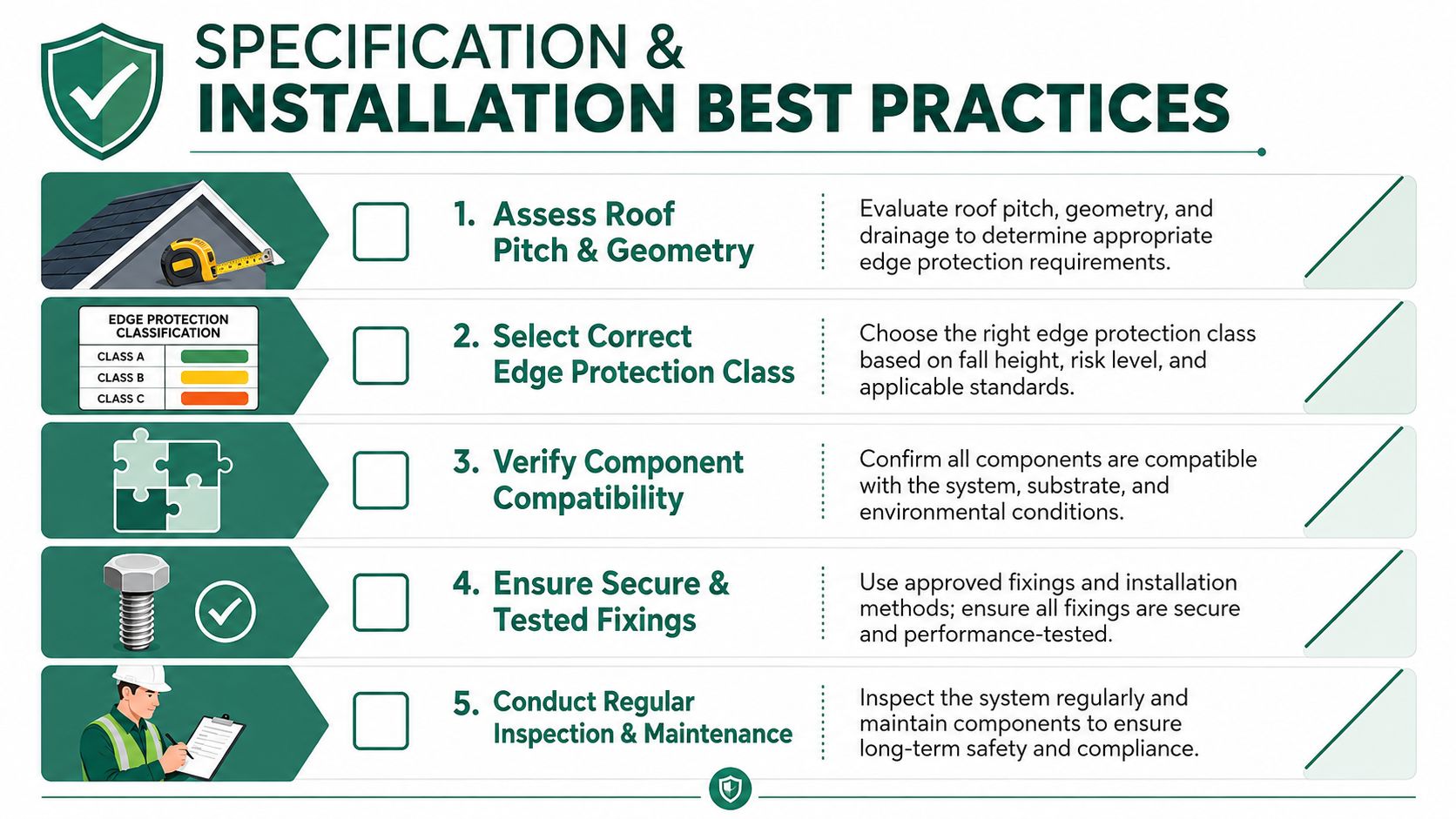
The weak point on many sites is the assumption that a barrier line can be installed once and forgotten. In practice, the structure moves, the access route changes, and the workface often shifts closer to the edge than the original plan allowed. That is why a commissioning check should confirm fixings, post plumb, rail continuity, and the condition of any temporary openings or return points before the area is released for use.
The installation failures that cause trouble
The failures are usually simple. An anchor is chosen for convenience rather than substrate, a post is set with the wrong centre distance, or a fixing is left without a recorded torque check. Each of those shortcuts can leave the line looking complete while the load path is still wrong.
Damage after installation causes just as many problems. A barrier can take a knock from materials handling, a weather event can loosen hardware, or a later site change can leave an opening unprotected because the line was not reconfigured. That is where inspection discipline matters more than the original sales description.
Packaging and site control also affect how safe the workface stays around the edge. Teams using Pallet Wrap to stabilise loads still need edge protection where a fall hazard exists, because load restraint and fall prevention solve different problems. The control has to suit the hazard in front of the team, not just the movement of materials through the site.
When Passive Barriers Outperform Personal Fall Arrest
Passive barriers win when the hazard is shared, continuous, and close to the edge. Personal fall arrest still matters for some complex or short-duration tasks, but it depends on training, fitting, anchor management, and correct behaviour from each worker. Edge protection removes that dependency.
Where the business case is strongest
The strongest case for edge protection appears when several workers are exposed to the same edge over the same period. One installed system protects everybody who enters the area, which is very different from issuing multiple harnesses and hoping every user follows the same routine every time.
It also works well when access is ongoing. Roof maintenance, mezzanine work, loading area activity, and platform use all tend to repeat the same exposure, so the one-time installation of a barrier can make more operational sense than repeatedly setting up and supervising active protection. That is particularly relevant where the site team is trying to keep work moving without creating a training bottleneck.
Practical rule: if people keep returning to the same hazard, the control should stay in place too.
There are trade-offs. Edge protection can obstruct access, it takes upfront investment, and some geometries are awkward enough that a barrier line becomes inefficient or impossible. In those cases, a restraint or arrest arrangement may still be the right answer, but that decision should be made because of site conditions, not because the barrier option was ignored.
Where passive systems save pain later
A passive system also reduces the burden of supervision. Nobody needs to be reminded to clip on before crossing the line, because the line is already there. That matters on sites with subcontractors, short programmes, or changing crews, where consistency is usually the first thing to slip.
The commercial packaging world uses similar thinking in a different setting. Protective products are chosen because they stay in place and don't depend on a person remembering a second step. In that sense, edge protection belongs to the same risk logic, a fixed control that does its job without daily improvisation.
For teams comparing guarding options around access routes, a resource such as temporary stair railing safety guide can help frame the difference between a fixed edge barrier and a more temporary access control. The key question remains the same: which control removes the hazard most reliably for the way the site operates?
Edge Protection Across UK Industries
Edge protection shows up well beyond new-build house roofs. Civil engineering teams use temporary barriers on leading edges during bridge refurbishment, because the exposure is often awkward, raised, and tied to changing work stages. That is exactly where a collective barrier pays off, since the same hazard affects everyone on the deck or platform.
Where it turns up in day-to-day operations
Warehousing and logistics teams use permanent guardrails on mezzanines and loading docks, where staff move repeatedly through the same raised routes. Facilities managers specify it for roof access during HVAC maintenance, because the maintenance work is occasional but the fall hazard is still real. Event contractors use temporary systems on staging and platforms, where the structure is built for use, then removed again after the show.
Those examples matter because they show the same principle in different dress. Whether the system stays in place for months or years, the legal and practical logic is the same, isolate the hazard before someone steps into it. That keeps the discussion focused on risk, not on whether the site looks like a traditional construction project.
A related storage example comes from warehouse design. Products such as industrial racking UK often create raised working conditions where guardrails, loading control, and edge management have to be planned together. The system may change, but the duty to prevent a fall doesn't.
The common thread across industries
The industries differ, but the failure mode is familiar. A worker reaches, leans, turns, or carries something heavy near an edge, and the hazard is suddenly no longer theoretical. That is why edge protection is so often the first line of defence in UK settings where work happens above a lower level.
The best systems are not the flashiest. They are the ones that fit the geometry, survive the loading, and stay effective long after the installation crew has moved on.
If your team is reviewing roof access, mezzanine guarding, or temporary barrier specifications, Packaging Panda can help with protective packaging that supports safe dispatch and site logistics. Visit Packaging Panda to review packaging options that fit warehouse and transport workflows alongside your safety procurement.