
Industrial Racking UK: Your 2026 Warehouse Guide
A warehouse manager often reaches the same point the same way. Orders keep rising, aisles get tighter, overflow stock starts living in picking areas, and every shift loses time moving pallets twice because there isn't a proper home for them. At that stage, industrial racking in the UK stops being a buying exercise and becomes an operating decision that affects space, labour, safety, and compliance every day.
That matters even more in a market where warehousing demand has kept climbing. The UK warehousing sector has expanded by over 15% in the last decade, and as of 2024 the UK held approximately 22% of the total European industrial racking market, according to Fortune Business Insights on the industrial racking systems market. For an SME, that doesn't just signal demand. It means more pressure to use cubic space properly, choose the right layout the first time, and keep systems compliant once they're installed.
The practical challenge is this. Most businesses know they need a competent annual inspection. Far fewer have a workable internal routine that catches damage between those formal visits. That gap is where costs rise and risk builds.
Table of Contents
- Why Your Racking Strategy Is a Critical Investment
- The Main Types of Industrial Racking Explained
- How to Choose the Right Racking System for Your Business
- Essential Structural and Warehouse Floor Considerations
- UK Safety Standards Inspections and Maintenance
- Budgeting Lead Times and Smart Procurement
- Your UK Industrial Racking Project Checklist
Why Your Racking Strategy Is a Critical Investment
A growing online retailer can outgrow a warehouse long before it outgrows the lease. That usually shows up as low picking efficiency, poor stock visibility, and pallets sitting where people need to work. The building hasn't changed, but the storage strategy has failed.
That's why industrial racking in the UK should be treated as infrastructure, not furniture. The right system determines whether stock is accessible, whether replenishment is smooth, and whether forklift traffic stays controlled. The wrong one creates hidden costs that don't show on the initial quote, such as extra travel time, blocked aisles, damaged uprights, and awkward workarounds for fast-moving stock.
Space pressure becomes an operating problem
Many SMEs delay a racking redesign because the warehouse still “works”. Usually, it works only because staff are compensating for a weak layout. They're memorising overflow locations, reshuffling pallets manually, and tolerating aisles that were never meant to carry that level of traffic.
A better racking plan changes that. It uses vertical space deliberately, separates reserve stock from picking activity, and fits the actual stock profile rather than a generic warehouse template.
Practical rule: If staff regularly move stock just to reach other stock, the storage system is already costing money.
A strategic layout protects margin
Racking decisions affect more than storage density. They influence how many SKUs can be held cleanly, how quickly a forklift can work a bay, and how easily damaged areas can be isolated before they become safety issues.
That strategic view matters in the UK because the market is large, competitive, and operationally demanding. Businesses that install the right racking system early usually gain room to scale inside the same footprint. Businesses that guess often end up paying twice. Once for the original installation, then again for alterations, repairs, or replacement.
The Main Types of Industrial Racking Explained
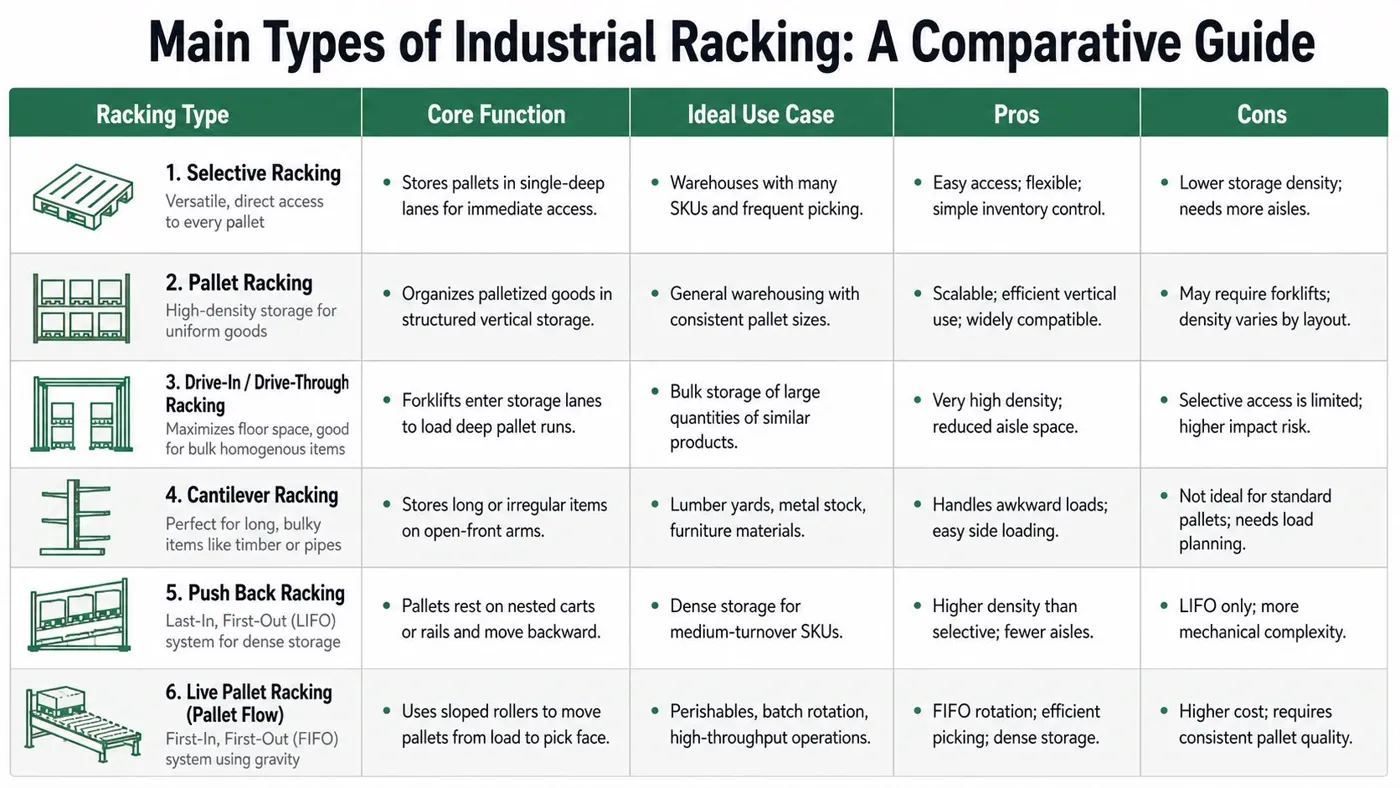
Most racking systems are built to solve one core problem. Access, density, product shape, or stock rotation. The mistake is assuming one system can optimise all four.
The quickest way to narrow options is to ask what the rack's main job is. If every pallet needs direct access, one answer makes sense. If the warehouse stores large runs of the same item, another usually wins.
Selective pallet racking
Selective racking is the warehouse equivalent of a library. Every pallet has its own address, and staff can reach each one without moving another first.
This is the standard choice for operations with broad SKU ranges, mixed pallet sizes, and regular picking or replenishment. It suits businesses that need visibility and flexibility more than maximum density.
Where it works well
- Mixed stock profiles: Different products, changing pallet counts, and uneven turnover.
- Fast access needs: Every pallet can be reached directly.
- Operational simplicity: Training, slotting, and cycle counts are usually easier.
Where it falls short
- Lower density: More aisle space is needed.
- Space trade-off: It's efficient operationally, but not always the most space-efficient choice.
Drive-in and drive-through racking
Drive-in racking is more like a car park lane. A truck enters the structure and places pallets in sequence within a channel. It's built for density, not fast access to every pallet.
This layout suits large volumes of similar goods. Bulk packaged products, seasonal stock, or stable product lines often fit well. It's less useful for mixed, high-SKU operations where selectivity matters.
Dense storage only pays off when the stock profile is disciplined. If the product mix is messy, dense systems usually create handling delays.
Push-back racking
Push-back racking gives higher density without asking the truck to drive into the structure. Pallets sit on nested trolleys or rails and move backward as new stock is loaded.
That makes it useful where floor space is tight but access still needs to be faster than drive-in. It generally suits LIFO stock handling. For products that don't require strict date rotation, it can be a practical compromise between density and accessibility.
Cantilever racking
Cantilever racking is built for items that don't behave like pallets. Timber, pipe, sheet material, metal bar, and other long or awkward goods sit on projecting arms instead of between uprights.
Standard pallet racking presents challenges with long loads. While it can technically accommodate them, handling becomes clumsy and risky. Cantilever gives cleaner loading paths and better support for irregular lengths.
A business storing rolled products may also need separate despatch storage away from the main rack structure. For example, Cardboard Tubes are strong cardboard postal tubes for posters, prints, artwork and documents, available in standard, heavy and extra heavy duty wall thicknesses, with free delivery over £150. Those aren't a substitute for industrial racking, but they're a practical stock line that may need dedicated shelving or bin locations near packing benches rather than pallet bays.
Heavy-duty shelving
Heavy-duty shelving sits between office-style shelving and full pallet racking. It works for hand-loaded stock, archive materials, small parts, boxed inventory, and picking locations that don't need forklift access.
For many SMEs, this is the overlooked system that improves workflow. Not every product belongs on a pallet beam. If the operation relies on piece-picking, shelf storage can reduce wasted space and shorten travel within the pick face.
Live pallet racking
Live pallet racking, often called pallet flow, uses gravity lanes so pallets move from the loading side to the picking side. It's built around FIFO logic.
That makes it particularly useful for stock where rotation matters. Food, drinks, consumables, and date-sensitive goods often benefit from this format. It's more specialised and usually demands careful design, but it solves a very specific operational problem well.
| Racking type | Best for | Main strength | Main compromise |
|---|---|---|---|
| Selective | Mixed SKUs | Direct pallet access | Lower density |
| Drive-in / drive-through | Bulk uniform stock | High storage density | Reduced selectivity |
| Push-back | Dense LIFO storage | Good density without truck entry | Not ideal for strict FIFO |
| Cantilever | Long goods | Handles awkward shapes well | Limited relevance for standard pallets |
| Heavy-duty shelving | Hand-loaded items | Strong for pick faces and small stock | Not for full pallet storage |
| Live pallet | FIFO operations | Strong stock rotation control | More specialist layout needs |
How to Choose the Right Racking System for Your Business
A common SME mistake is easy to spot. The business orders racking that looks efficient on a quote, then spends the next year working around blocked pick faces, awkward pallet handling, and avoidable damage reports.
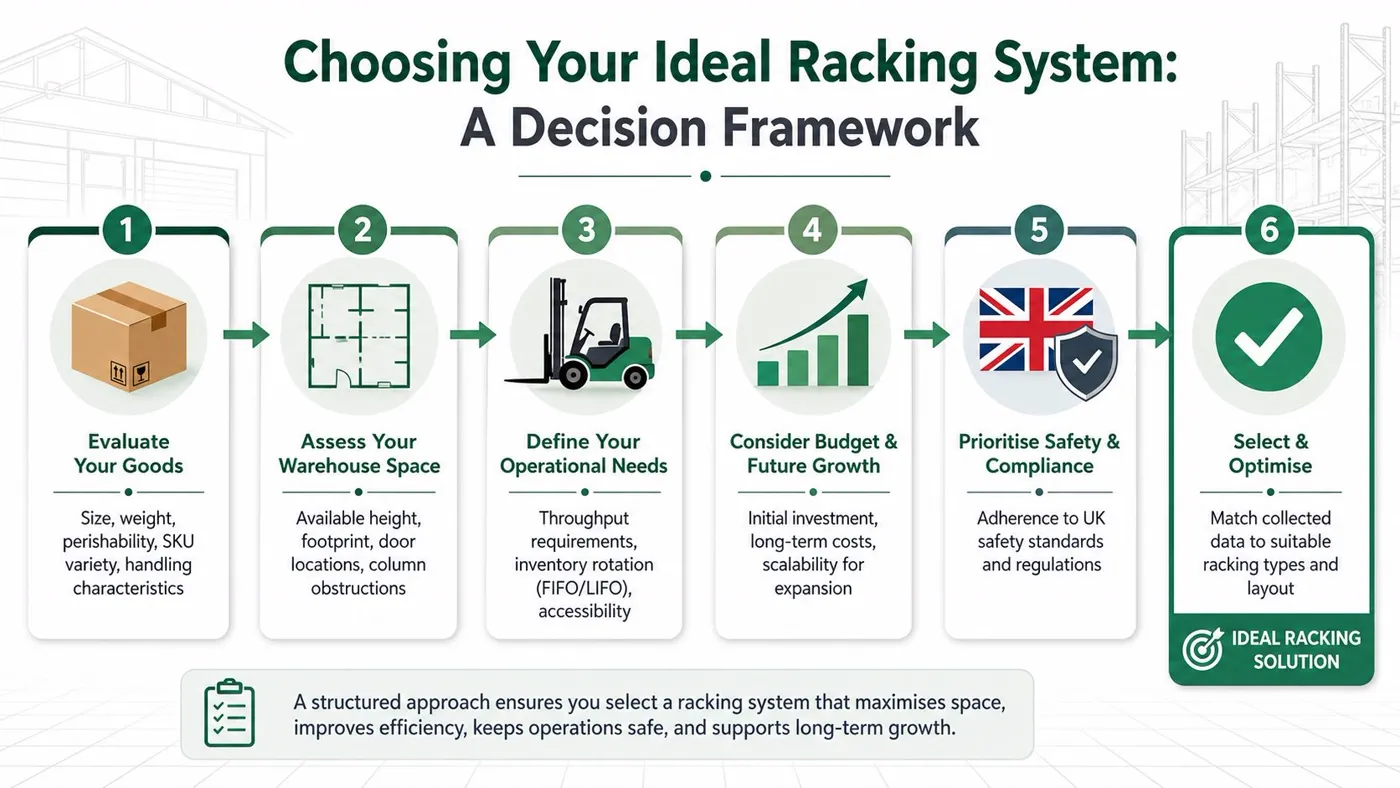
The right starting point is the operating model. Look at what you store, how often it moves, how it is picked, and what level of control you can realistically maintain on site. In practice, the best racking choice is usually the one your team can run safely every day, inspect properly, and adapt as volumes change.
Start with stock profile and access requirements
Begin with the goods themselves. Mixed SKUs, variable pallet heights, and frequent replenishment usually point to selective pallet racking because every pallet is accessible without reshuffling stock. If the warehouse carries repeated pallet lines of the same product, higher-density options can reduce space pressure, but only if stock discipline is strong and product rotation rules allow it.
Many managers save money in the wrong place. Dense storage can look cheaper per pallet position, yet it often increases handling time, raises the risk of pallet damage, and makes problem stock harder to isolate.
A simple test helps. Ask whether the business makes money from storage density, picking speed, or stock accuracy. Most SMEs need a workable balance of all three rather than chasing one metric at the expense of the others.
Match the racking to the way stock actually moves
Throughput matters as much as storage type. Fast-moving lines need clean access and short travel paths. Slower reserve stock can sit in denser systems if operators are not constantly entering the same bays.
Use these checks during selection:
- High SKU count and regular pallet access: Selective racking is usually the safest choice operationally.
- Large volumes of the same palletised line: Drive-in or similar high-density formats can work where selectivity is less important.
- LIFO storage is acceptable: Push-back can improve density without requiring trucks to enter lanes.
- FIFO control is required: Live pallet systems are better suited to stock where rotation has to be maintained.
Outbound handling should be considered at the same time. If pallets are wrapped near despatch, the storage layout should leave enough room for staging, truck movement, and stable finished loads. This guide to pallet wrap for warehouse despatch is useful if load stability and dispatch flow are part of the redesign.
Check handling equipment before approving the layout
I have seen workable racking specifications fail because nobody checked how the current truck fleet would operate in the finished aisles. Beam height, pallet overhang, fork length, turning room, and visibility all affect whether a design is practical.
The key question is simple. Can operators place and recover pallets cleanly without repeated correction?
Check these points before sign-off:
- Lift height: Current trucks must reach the top storage level with a safe working margin.
- Aisle suitability: The aisle width has to suit the actual truck type in daily use, not the truck assumed at design stage.
- Pallet condition: Damaged or inconsistent pallets need more forgiving access and should influence system choice.
- Operator control: If put-away regularly depends on minor adjustments and second attempts, the layout is too tight.
Build inspection into the decision, not after it
A racking system is only a good fit if the business can keep it compliant without excessive cost. For most UK SMEs, that means setting up a two-tiered inspection routine from day one.
The first tier is in-house. Supervisors and trained warehouse staff should carry out regular visual checks, log damage, quarantine unsafe bays, and confirm that load notices, beam clips, and upright protection remain in place. The second tier is a professional inspection at suitable intervals by a competent rack inspector. That external review picks up trends, confirms risk levels, and gives management a clearer basis for repair decisions.
This matters during selection because some systems are less forgiving than others. High-density layouts can save floor space, but they often make impact damage harder to spot and repairs more disruptive. Selective racking usually gives better visibility, simpler isolation of damaged bays, and lower day-to-day management friction.
Choose the system your operation can run safely, inspect consistently, and justify financially. That is usually the right answer.
Essential Structural and Warehouse Floor Considerations
A racking project can look sensible until the installer asks for slab details. That's often when a business realises it has planned around inventory and forgotten the building.
Floor loading comes before layout
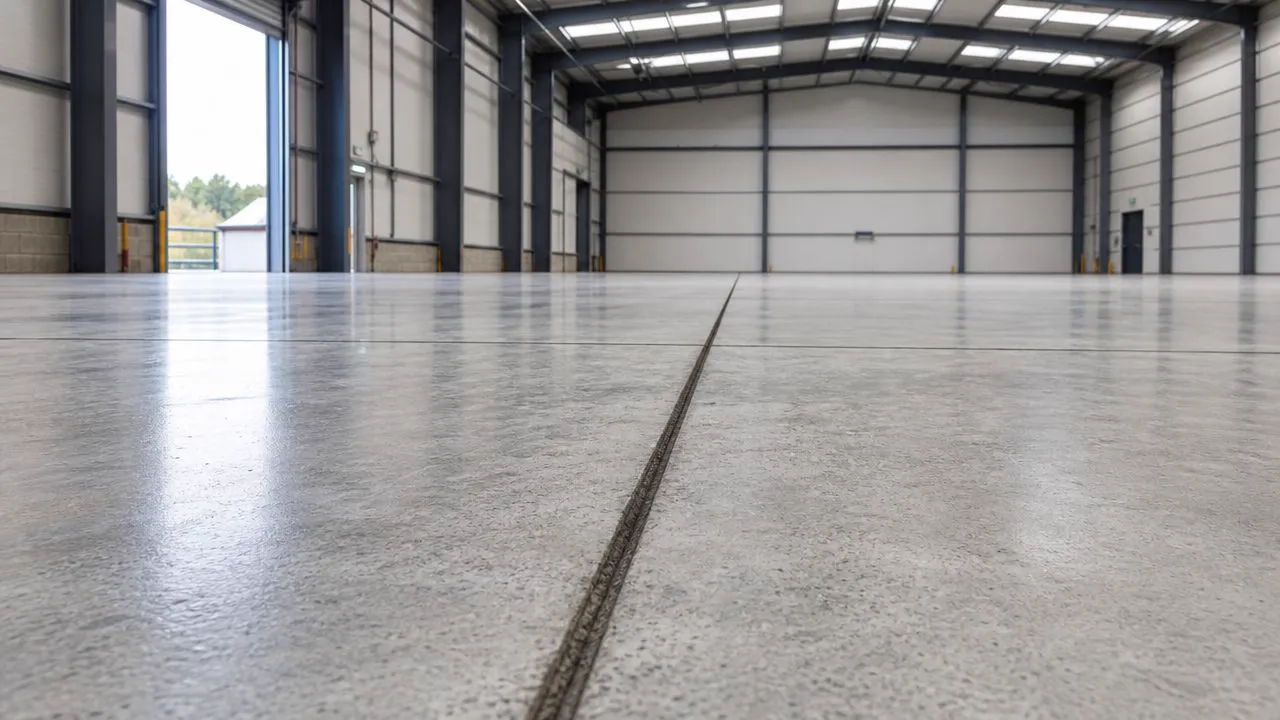
Warehouse floors don't just carry the total weight of stock. They carry it through concentrated points at base plates, truck wheel paths, and repeated traffic zones. That's why a slab that seems perfectly adequate for general use may still need review before high-bay or high-density racking goes in.
A structural engineer or qualified building professional should confirm what the slab was designed to support and whether any local reinforcement, repairs, or restrictions apply. This is especially important in older buildings where records may be incomplete or where previous occupiers used the space differently.
The key checks usually include
- Point loading: What load each base plate transfers into the slab.
- Traffic interaction: Whether forklift routes concentrate stress around certain bays.
- Floor condition: Cracking, settlement, patched areas, and wear around joints.
Levelness and movement matter more than many buyers expect
Tall racking magnifies small floor problems. A slight deviation at slab level can become a significant alignment issue higher up, which affects installation, beam seating, pallet placement, and long-term stability.
That gets more important because, in the UK, industrial pallet racking systems exceeding 3 metres in height are explicitly not designed for seismic activity, so any surface movement at the installation site places additional dynamic loads on the truss and base plate, as explained in Jungheinrich's guide to pallet rack regulations. In plain terms, the floor and fixings aren't a background detail. They are part of the safety system.
A good rule is to freeze the layout until these questions are answered:
- Is the floor level enough for the proposed rack height?
- Are anchors and base plates specified for the actual slab condition?
- Do doorways, columns, drains, or service pits interfere with safe bay placement?
Skipping those checks is expensive because the fix usually happens after delivery, when changes are harder and downtime is already booked.
UK Safety Standards Inspections and Maintenance
Most warehouse managers understand the annual inspection requirement. The weak point is everything between those inspections.
That gap matters because a 2023 industry report found that nearly 40% of UK warehouses had racking systems that had not been inspected within the statutory 12-month period, and expert analysis indicates that SMEs can reduce repair costs by up to 40% by using a continuous, documented internal inspection protocol to catch minor damage early, according to Fact.MR's industrial racking system market report. In practice, that means compliance and cost control depend on a two-tier system, not a single yearly visit.
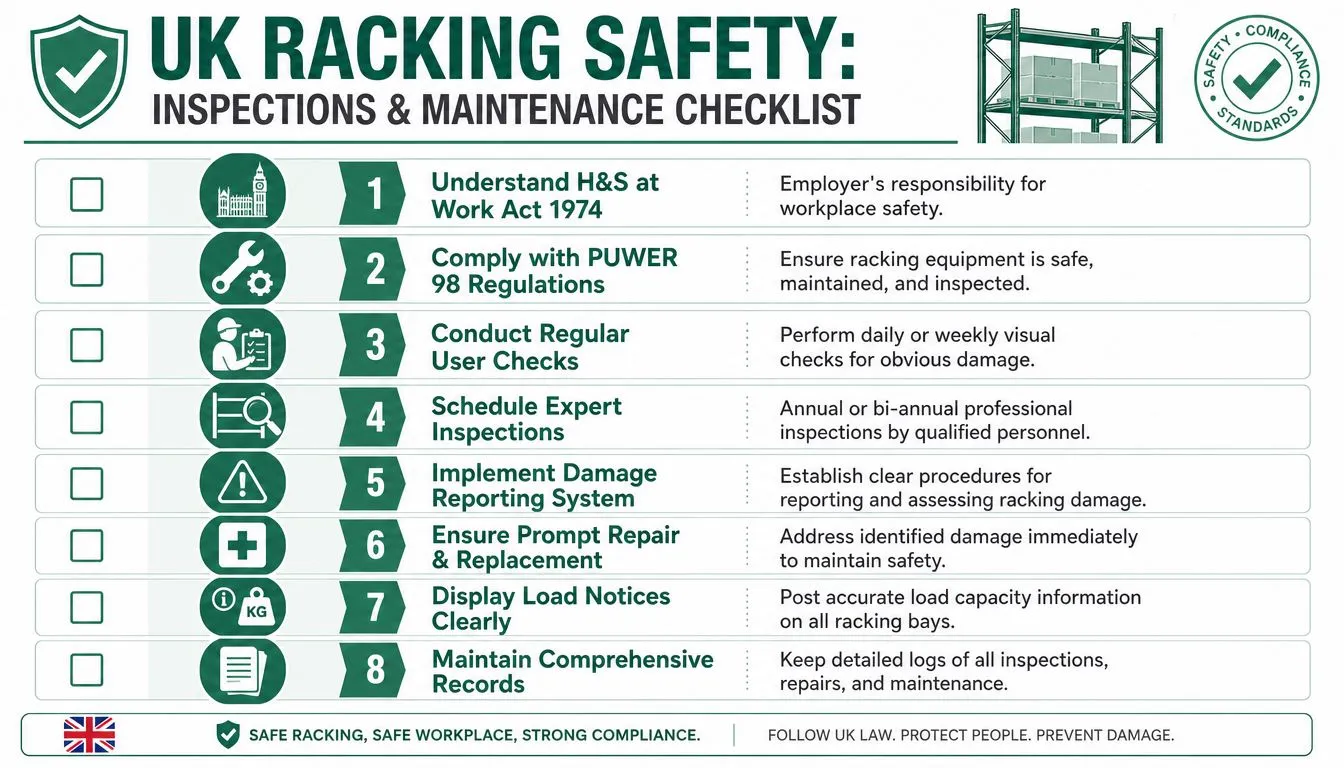
Tier one professional inspection
The formal layer is the annual inspection by a competent person. That inspection should assess structural condition, beam integrity, upright damage, load notices, repairs, and whether the installation still matches how the warehouse is being used.
For an SME, the practical point isn't only booking the inspection. It's making sure the site is ready for it. Missing load notices, undocumented repairs, and unclear damage history can turn a routine visit into a larger corrective job.
A professional inspection should connect to
- A current asset register: Bay locations, rack types, and altered areas.
- A repair history: What was damaged, who repaired it, and when.
- Site controls: Barriers, end-of-aisle protection, and visible load signage.
Tier two in-house visual inspection
The second layer is where many businesses either stay compliant or drift into avoidable risk. This isn't a substitute for the annual professional review. It is the routine that identifies fresh damage before it becomes a structural issue or a paperwork problem.
An internal visual system works best when it is simple enough to survive busy shifts. Warehouse staff don't need to perform engineering analysis. They do need to know what to spot, where to record it, and who has authority to isolate a bay.
A visual check only counts if the business can show what was found, what action followed, and when the issue was closed.
A workable SME routine often looks like this:
- Daily walk-throughs: Shift leads check obvious impact damage, displaced beams, missing clips, and blocked load notices.
- Weekly logged inspections: A named person records aisle-by-aisle observations on a standard form or digital log.
- Immediate escalation: Any suspected structural damage triggers bay isolation and review before reuse.
For businesses standardising warehouse signage and hazard communication, looking at external examples such as Adelaide safety sign regulations can be useful. It's an Australian resource rather than a UK compliance document, but it offers practical ideas for making warnings, traffic controls, and location signage more visible in active warehouse environments.
What the in-house check should include
The strongest internal systems are specific. “Check racks for damage” is too vague to be reliable.
A better checklist includes:
- Uprights and frames: Look for dents, twists, bowing, or fresh impact marks.
- Beams and connectors: Check beam seating, locking clips, and visible deformation.
- Base plates and anchors: Look for movement, missing fixings, or cracking around the base.
- Load notices: Confirm they are present and legible.
- Housekeeping near rack feet: Remove obstructions that hide damage or encourage impacts.
- Pallet condition: Broken pallets often create rack damage, not just stock damage.
There's also a packaging link here. Warehouses that store edge-sensitive products or fragile outbound loads often reduce secondary handling damage by reviewing both rack protection and outbound packing methods together. A practical reference on edge protector foam for shipment stability can support that wider damage-prevention review.
Budgeting Lead Times and Smart Procurement
The quote for the steel is only part of the cost. The full project includes survey work, layout design, delivery sequencing, installation, protection products, signage, downtime, and any changes to truck operation or picking routes.
That's why cheap racking regularly becomes expensive racking. A supplier can be low on purchase price and still create avoidable costs through weak drawings, poor installation planning, or vague repair support.
Look beyond the quote total
One of the clearest budgeting mistakes is treating repair and maintenance as separate from procurement. They are linked from day one. Recent industry analysis indicates that 60% of UK warehousing operators delay racking repairs due to uncertainty about compliance and cost, leading to a 25% higher risk of catastrophic failure within 12 months, according to SEE Racking Inspections on pallet racking damage types.
That finding points to a broader procurement rule. Buy a system only if the business also understands how it will inspect, repair, and document it. A maintenance mindset at purchase stage usually prevents worse spend later. Teams reviewing lifecycle cost may also find it useful to read broader thinking on optimising maintenance spend, especially when deciding whether to defer minor corrective work or fund it early.
Questions that expose weak suppliers early
A decent supplier should answer technical and commercial questions plainly. If answers stay vague, the buyer should slow down.
Useful questions include:
- Standards and specification: Is the racking manufactured and specified to the relevant UK and European standards?
- Survey basis: Has the quote been based on a proper site survey or only a sketch?
- Installation scope: Are anchors, shims, protection items, and load notices included?
- Repair support: Can damaged components be matched and replaced later?
- Documentation: What drawings, load data, and handover records will be provided?
Good procurement removes ambiguity before delivery. Poor procurement leaves the warehouse manager to solve it during installation.
Lead times need operational planning
Lead time isn't just a supplier issue. It affects how long stock must be relocated, whether temporary storage is needed, and how much disruption the business can absorb.
Custom bay sizes, unusual beam lengths, specialist finishes, and phased installation usually add complexity. So do site restrictions such as weekend-only access or shared occupancy buildings. Buyers should also plan for the administrative side of the project, including internal approvals and environmental handling rules for old materials. For firms clearing out obsolete storage or packaging stock during a warehouse reset, guidance on UK packaging waste regulations can help keep disposal decisions organised.
Your UK Industrial Racking Project Checklist
A successful racking project is usually the result of disciplined sequencing. The businesses that get clean installs and fewer post-handover issues are the ones that make decisions in the right order.
Use this checklist to keep the project under control:
- Map the stock profile. Separate pallet storage, hand-pick stock, awkward loads, and fast movers.
- Review throughput thoroughly. Identify where direct access matters and where higher-density storage may work.
- Check truck compatibility. Confirm aisle width, lift height, turning space, and handling limits before approving a layout.
- Verify the building. Get floor and structural constraints confirmed before final design sign-off.
- Interrogate supplier quotes. Compare scope, documentation, installation assumptions, and repair support, not just price.
- Plan protections early. End-of-aisle barriers, upright guards, signage, and traffic controls should be part of the initial project.
- Set up the inspection system before go-live. Assign who performs visual checks, how defects are logged, and who can quarantine a bay.
- Book the formal inspection cycle. The HSE requires racking to undergo a thorough inspection by a competent person at least once every 12 months, which is a legal requirement under the Health and Safety at Work Act 1974, as outlined by PASS on racking inspection requirements.
- Keep records from day one. Store drawings, load notices, repair logs, and inspection records where managers can retrieve them quickly.
- Review after the first operating period. Early traffic patterns often reveal where additional protection or slotting changes are needed.
The core lesson is straightforward. Industrial racking in the UK isn't finished when the installer leaves. It becomes safe, efficient, and cost-controlled only when the physical system and the inspection routine are built together.
If a warehouse team is tightening despatch operations alongside a racking upgrade, Packaging Panda is one UK option for packaging materials such as boxes, tubes, mailers, and protective products. That can be useful when storage design, packing bench setup, and outbound materials need to be reviewed as part of the same warehouse improvement project.