Packaging Waste Regulations 2026: SME Compliance Guide
Orders are going out. Packing benches are busy. Someone on the team is trying to keep courier costs under control, and then a new question lands in the middle of the day: who's responsible for the waste from all this packaging, what needs reporting, and what happens if the business gets it wrong?
Explore our eco-friendly packaging range →
That's where many UK SMEs are right now. A bakery adding branded boxes, an online retailer shipping daily parcels, or a fulfilment operator handling multiple client lines can all end up inside the same regulatory system without realising how quickly packaging choices turn into reporting duties, fees, and procurement headaches.
The practical problem isn't just legal wording. It's operational. Staff need the right data, buyers need to understand recyclability, and owners need to know where cost traps are hiding. For a broader view of how these obligations fit into everyday governance, Receipt Router's business compliance guide is a useful companion read. Businesses also benefit from reviewing a supplier's own approach to materials and waste, such as Packaging Panda's environmental policy, because compliance gets easier when packaging decisions already reflect UK disposal realities.
Table of Contents
- The New Rules for Packaging Are Here Are You Ready
- Understanding Extended Producer Responsibility in the UK
- Your Key Obligations Data Reporting Fees and Timelines
- Navigating Exemptions and Thresholds
- Your Practical Compliance Checklist for 2026
- Avoiding Hidden Costs The Compostable Trap and EU Exports
- Making Smart Packaging Choices for a Compliant Future
- Your Packaging Waste Regulation Questions Answered
The New Rules for Packaging Are Here Are You Ready
A small business owner checks the day's orders, spots another rise in packaging spend, and then sees an email about packaging waste reporting. That moment is familiar across UK retail, bakery, wholesale and e-commerce. The work doesn't stop just because compliance has become more technical.

The shift is simple to describe and much harder to run in practice. Packaging waste regulations now push more responsibility back onto the businesses placing packaging onto the market. That means packaging is no longer just a buying decision or a branding decision. It's a finance, operations and compliance issue as well.
For many SMEs, the first mistake is assuming these rules are only for big manufacturers. They aren't. A company can be pulled into the system because it imports packed goods, specifies the packaging used on its products, fills packaging for sale, or ships orders directly to consumers.
Practical rule: if a business controls packaging decisions or puts packed goods into the market, it should assume the regulations may affect it and confirm the exact obligation level early.
The second mistake is treating the rules as paperwork that can be fixed later. By the time reporting starts, the hard part has already happened. The wrong material may have been bought, components may be impossible to classify cleanly, and no one may know the weight split between box, tape, label and filler.
That's why a practical approach matters more than a legalistic one. Small firms don't need a law degree. They need a method. Start by identifying what packaging the business uses, who supplies it, where goods are sold, and which items are likely to be difficult to recycle in the UK.
A business that does that early usually avoids the worst surprises. A business that leaves it until fees, labels or export checks become urgent usually ends up paying more and rushing decisions.
Understanding Extended Producer Responsibility in the UK
Extended Producer Responsibility, usually shortened to EPR, applies the polluter pays principle to packaging. In plain terms, the business that places packaging onto the market carries the financial responsibility for what happens when that packaging becomes waste.
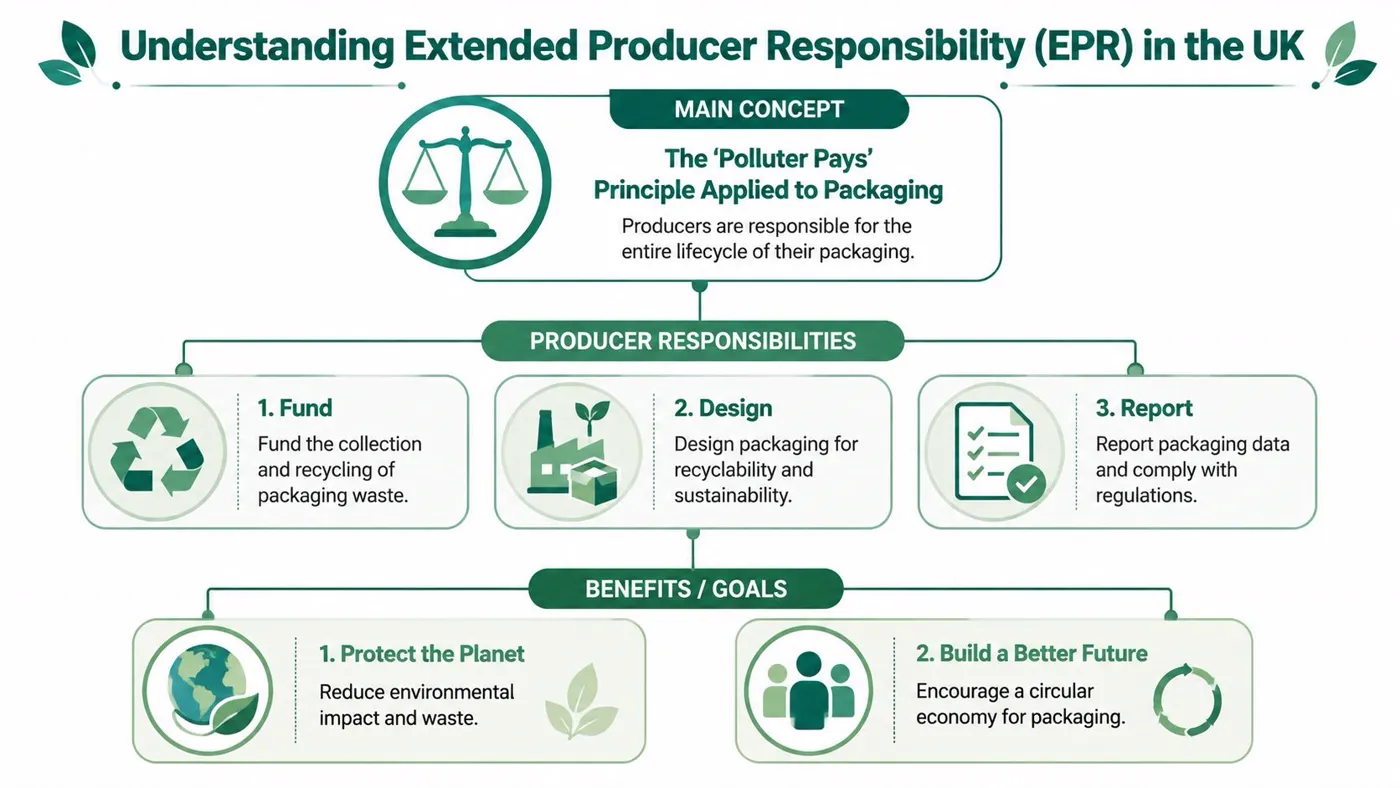
Under the UK's revised Producer Responsibility Regulations for packaging waste, which came into force in 2023, producers and importers of packaging are required to pay for the full cost of managing their packaging waste. The regulations also set recycling targets of 65% of all packaging waste and 50% of plastic packaging waste by 2025, rising to 70% and 55% by 2030, according to Eurostat's packaging waste statistics summary.
Why the cost shift matters
For years, many businesses treated waste costs as something handled somewhere downstream by councils, contractors or the wider system. EPR changes that logic. Once the full end-of-life cost sits with producers, packaging design stops being abstract sustainability talk and becomes a direct cost-control lever.
That's why design-for-recycling matters so much. If a pack works in existing UK recycling infrastructure, it is easier to defend, easier to classify and less likely to attract the harshest fee outcomes. If it relies on mixed materials, awkward adhesives, non-recyclable labels or hard-to-separate components, the business carries the problem.
Packaging that looks sustainable in a product meeting can still perform badly once assessed against actual UK recycling infrastructure.
The Recycling Assessment Methodology is central here. It grades recyclability based on real-world performance in UK industrial systems, not just whether a material sounds recyclable in theory. That means every component counts, including lids, liners and labels.
Who usually gets caught by the rules
Many SMEs think only a factory is a producer. In practice, the net is wider. A business may have producer responsibilities if it imports packaged goods, asks a supplier to use a certain format, packs goods under its own brand, or fulfils orders in its own chosen shipping materials.
That's especially relevant for online sellers using Mailers. The category covers poly mailers, padded bags, paper mailers, book wraps and related ecommerce dispatch formats. Those items may seem routine, but they still create reporting and recyclability questions because they are part of the packaging a business places on the market.
A useful way to think about EPR is this:
- If the business specifies it, the business may carry responsibility for whether it's sensible.
- If the business imports it, the business may inherit obligations that a domestic supplier would otherwise handle.
- If the business ships it, the business should track it as carefully as stock leaving the warehouse.
The smartest SMEs already treat packaging data like product data. That's usually the difference between controlled compliance and expensive catch-up.
Your Key Obligations Data Reporting Fees and Timelines
A small business usually feels packaging regulation in the back office before it feels it in the design studio. The pressure shows up in spreadsheets, supplier emails, missing weights, and awkward questions from finance about why one packaging choice now carries a higher compliance cost than another.
For UK SMEs, the work usually falls into three areas. You need accurate packaging data. You need a clear view of likely fees. You need records that stand up if a scheme, auditor or customer asks questions later.
The three jobs that matter most
First is data reporting. Obligated producers must report packaging placed on the market by material, format and use. In practice, that means knowing what each packaging unit is made from, what it weighs, and whether it is primary, secondary or transit packaging. If those details sit across old supplier quotes, unlabelled spreadsheets and warehouse memory, reporting turns into reconstruction work. Reconstruction work is slow and expensive.
Second is fee exposure. Under UK EPR, obligated businesses are expected to bear the full net cost of managing household packaging waste. That makes packaging design a finance issue, not just a procurement one. The Recycling Assessment Methodology links recyclability to how packaging performs in actual UK systems. A pack that looks sustainable in a sales brochure can still create a poor outcome if UK sorting and recycling infrastructure struggles with it. That is one reason SMEs get caught by the compostable trap. A material can sound environmentally progressive and still create higher costs or weaker compliance outcomes in the UK.
Third is evidence and scheme administration. Many firms use a compliance scheme rather than handling every requirement alone. That can reduce strain, but it does not remove the need for good internal records. PRNs and PERNs still matter because they sit inside the evidence system that supports packaging recovery obligations. A business owner does not need to become a specialist trader in recovery notes, but they do need to understand what evidence is being relied on and whether their submitted data matches the packaging they buy and ship.
Key EPR deadlines and thresholds for UK SMEs in 2026
The useful version of a compliance calendar is the one your team can act on.
| Obligation / Deadline | Applies To | Action Required |
|---|---|---|
| Ongoing packaging data collection in 2026 | Businesses that may be obligated under UK packaging rules | Record packaging by material, format, weight and use as goods are bought, packed, imported or shipped |
| EPR fee exposure linked to recyclability | Obligated businesses using packaging placed on the UK market | Review components for likely performance in UK recycling infrastructure and remove problematic elements where possible |
| PRN or scheme evidence management | Businesses meeting obligations through a compliance route | Keep records organised, match submitted data to packaging specifications, and retain supporting documents for audit |
| The upcoming April 2027 deadline for recycling labels | Consumer packaging placed on the UK market, subject to the final rules taking effect as expected | Prepare artwork and packaging specifications so packs can carry either “Recycle” or “Do not recycle” pictograms in time for the deadline |
Two mistakes show up repeatedly.
The first is waiting until year end to gather weights and material specs. By that point, suppliers may have changed films, boards or adhesives. Substitute packaging may have been used during shortages. Nobody is fully sure which version of a mailer, carton or label was in circulation in which month.
The second is splitting buying decisions from compliance decisions. Procurement picks the lowest unit cost. Compliance reviews it later and finds mixed materials, unclear polymer grades or components that are awkward to classify. For exporters, there is a second layer of cost here. UK compliance does not remove the need to check what an EU customer, marketplace or local regime expects, so a cheap packaging line can become expensive twice.
The lowest purchase price is often not the lowest total cost once reporting time, fee exposure, relabelling work and end-of-life reality are included.
The fix is simple, but it requires discipline. Keep one live file for each packaging SKU with the supplier specification, material breakdown, weight, intended use, artwork version, and any recyclability notes or declarations. Ask for updates every time a supplier changes substrate, coating, adhesive, label stock or pack size. That habit gives finance cleaner cost forecasts, gives operations fewer surprises, and gives the business a much stronger position if compliance questions arrive later.
Navigating Exemptions and Thresholds
Most SME owners don't start with legal interpretation. They start with a practical question: does this apply to the business, or is it still below the line where full packaging compliance kicks in?
The honest answer is that a business shouldn't rely on guesswork. Packaging waste regulations sort firms into different obligation levels, and the exact threshold position depends on the business profile and packaging handled. Where uncertainty exists, the safest move is to calculate carefully and confirm status early rather than assuming exemption.
How smaller firms should think about scope
A local bakery and an online fashion seller can look similar in size on paper but create very different packaging footprints. The bakery may use a steady stream of boxes, trays and bags. The online seller may handle outer mailers, returns packaging, protective filler and labels across every order.
That distinction matters because format matters. The UK's National Packaging Waste Database shows that paper and cardboard made up 5 million tonnes of packaging waste in 2022, and Business Waste's packaging waste facts and statistics also notes that e-commerce accounts for 8 times more packaging waste than offline purchasing. The same source states that global e-commerce has generated approximately 942 million kilograms of plastic packaging waste.
Why packaging format still matters
Two businesses can spend similar amounts on packaging and still face very different compliance pressure. One may use mostly straightforward corrugated board. Another may rely on mixed plastic films, laminated labels and protective formats that are harder to classify and justify.
A sensible internal check looks like this:
- Map the packaging types. Separate primary, secondary and transit packaging instead of lumping everything into one purchasing code.
- Check where it enters the business. Imported goods often create responsibility points that SMEs overlook.
- Review dispatch growth. Businesses selling more online should assume packaging complexity rises faster than they expect.
- Treat substitutions seriously. A temporary switch to a different mailer or label stock can create reporting errors later.
Many smaller firms stumble on this point. They think exemption is about company size alone. In reality, packaging profile, route to market and control over packaging choices often matter just as much.
Your Practical Compliance Checklist for 2026
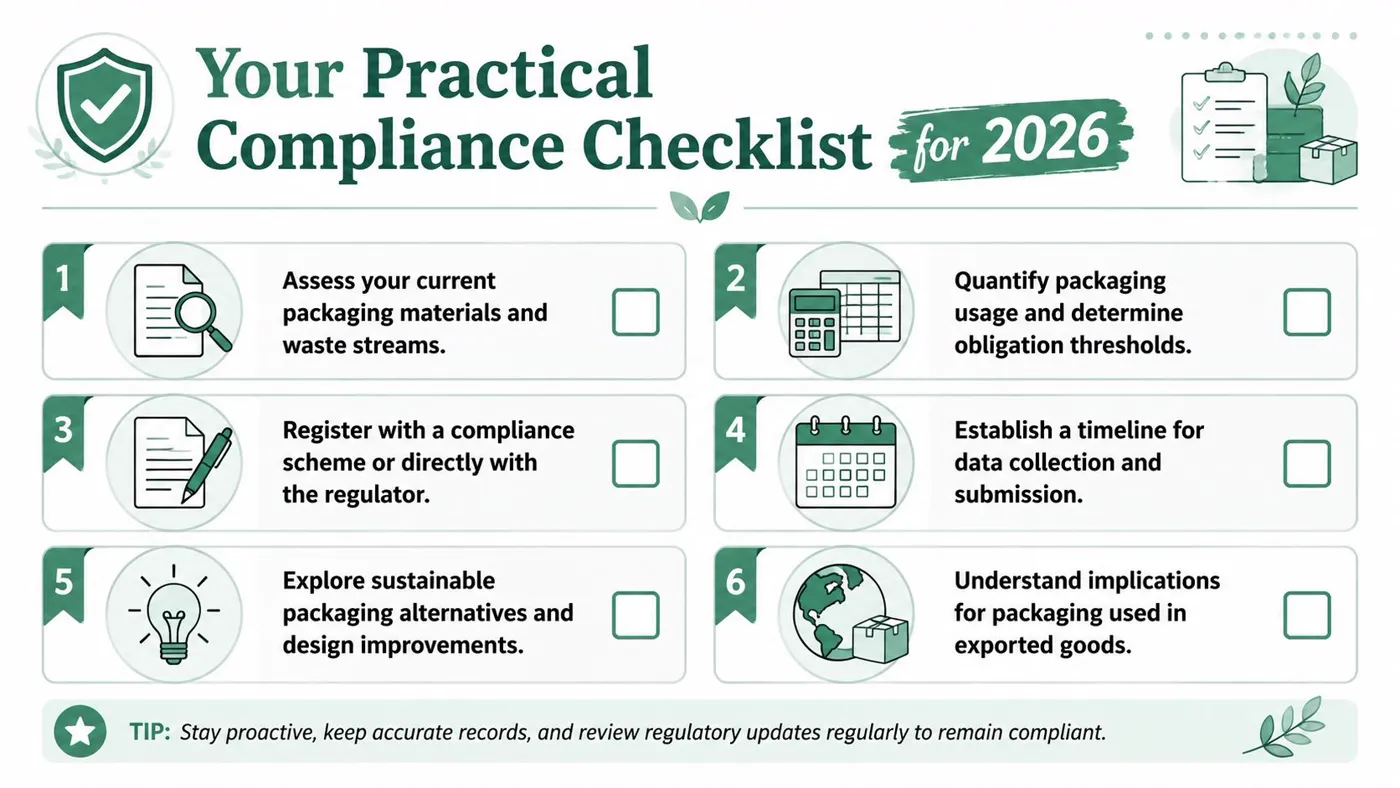
A small business usually feels the pain of packaging compliance in the same place. Friday afternoon, someone needs figures for reporting or a supplier has swapped a material, and nobody can confirm what went out the door. The fix is not a bigger admin burden. It is a simple system that ties packaging choices to purchasing, stock control and artwork before mistakes turn into missed data, rework or extra cost.
A working checklist for busy teams
-
Build a packaging register
List every packaging item the business buys, stores or sends. Include boxes, bags, inserts, tape, labels, sleeves and void fill. If it leaves with an order or protects stock on the way to a customer, it belongs on the register. -
Get exact specifications from suppliers
Ask for material type, unit weight and any relevant technical data for each item. Catalogue descriptions are not enough. Terms such as “eco”, “sustainable” and “recyclable” do not give you what you need for reporting or internal sign-off. -
Match each item to its function
Record whether it is primary, secondary, transit or protective packaging. This saves time later and avoids a common SME problem where purchasing, warehouse and product teams all describe the same item differently. -
Set one reporting owner
One named person should collect updates and challenge gaps. Shared ownership often means nobody checks whether the supplier changed a film grade, swapped a label stock or reduced box weight mid-contract. -
Choose the right compliance route
Some businesses will register through a compliance scheme. Others may deal more directly with regulators, depending on size and obligation. If your packaging data is unclear, sort that out first. Registering with weak data usually creates more work later, not less. -
Keep audit-ready records
Store spec sheets, invoices, artwork approvals and supplier declarations in one place. If you cannot show how a figure was calculated, you may struggle to defend it during a check or when a customer asks for evidence.
A useful buying rule helps here. No new packaging SKU should be approved until someone can answer three questions clearly: what is it made from, what does it weigh, and what is the realistic disposal route in the UK?
For companies that want an external sense check before formal reporting, Lighthouse Consultants environmental auditing can help frame where packaging obligations sit within wider UK environmental duties.
What to set up now for future labelling rules
An upcoming technical requirement is on the horizon. By April 2027, consumer packaging in the UK is expected to carry clearer recycling labelling, such as “Recycle” or “Do not recycle” indicators. For SMEs, the practical point is simple. Artwork approval can no longer sit in a separate lane from compliance.
Set this up early:
- Review existing artwork so there is space for disposal labels without forcing a rushed redesign later.
- Check every packaging component because a recyclable outer pack can still cause problems if the liner, label or closure changes the disposal outcome.
- Put marketing and compliance in the same approval chain so design updates do not create packaging claims you cannot support.
- Ask suppliers about print readiness for revised artwork, smaller runs and updated specifications.
- Challenge “green” substitutions before purchase. A material that sounds better in a sales pitch can create higher cost and no compliance benefit under real UK collection conditions.
If you are reviewing mailing formats, it helps to compare options against actual disposal routes rather than supplier buzzwords. This breakdown of compostable mailing bag myths under UK waste realities is a useful check before you sign off a switch that looks good on paper but creates cost or reporting problems in practice.
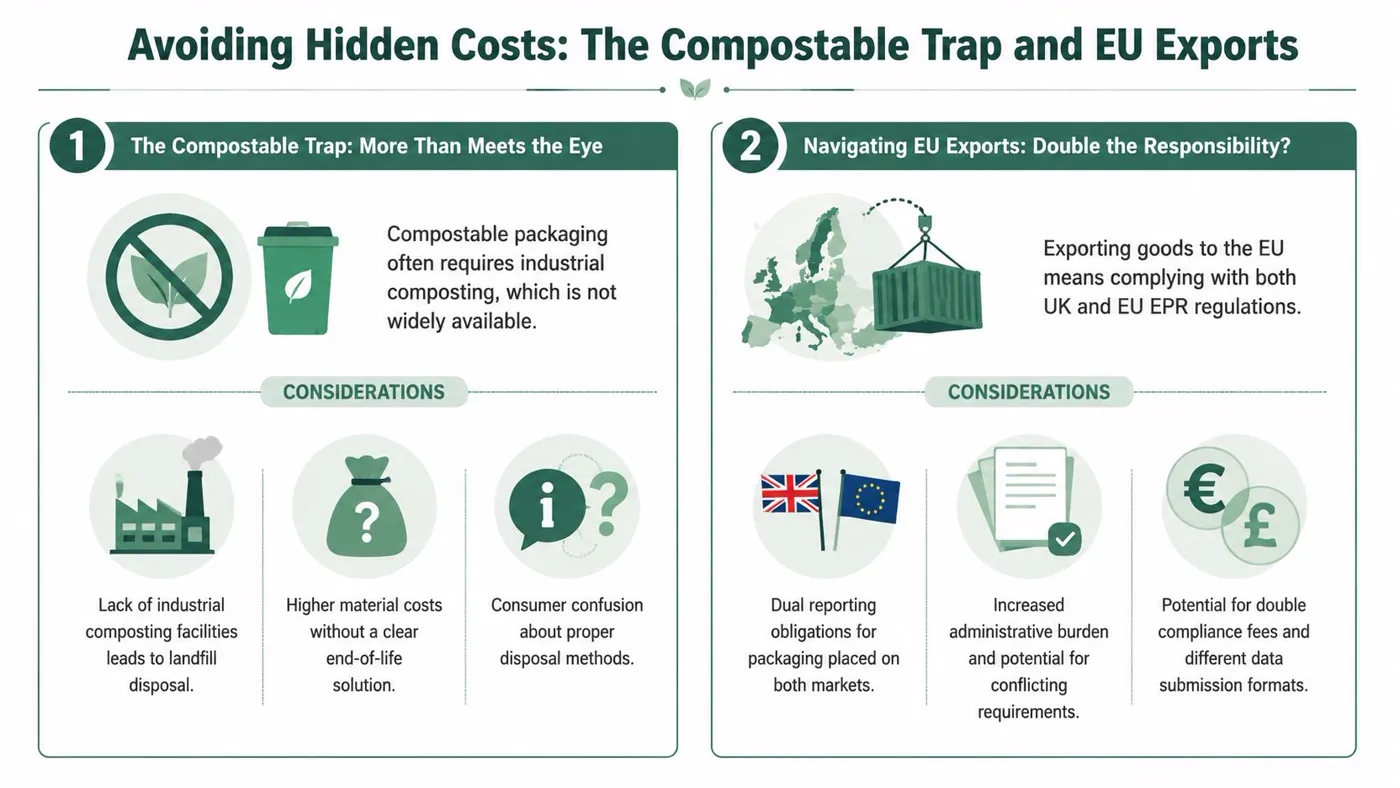
Avoiding Hidden Costs The Compostable Trap and EU Exports
Many SME owners assume that if a package is labelled compostable, it must be the safer environmental and compliance choice. That assumption causes expensive mistakes.
Why compostable often backfires in the UK
UK infrastructure is the issue. Data from WRAP shows that 90% of UK household compostable packaging is incinerated or sent to facilities that cannot process it. Under UK EPR, fees are based on recyclability in UK facilities, and that definition excludes most compostable materials. The result is a greenwashing trap. Businesses can pay more for a material that sounds responsible while getting no fee advantage and no dependable end-of-life outcome.
That's why compostable shouldn't be treated as a shortcut to compliance. In many cases, it creates a mismatch between packaging claims, council collection realities and EPR fee logic.
A better question is not “Is this packaging marketed as eco-friendly?” It's “Can this packaging move through real UK waste infrastructure in the way the label implies?”
For businesses comparing mailing formats, this deeper explanation of the issue in Packaging Panda's guide to compostable mailing bag myths is worth reviewing before switching materials.
If a customer cannot easily dispose of the packaging through ordinary UK routes, the business should assume the sustainability claim needs closer scrutiny.
The quiet pressure on exporters to the EU
There is a second trap for SMEs, and it gets less attention than it should. A UK business may not be directly governed by the EU's PPWR inside the UK market, but it can still face a de facto compliance burden if it sells into the EU.
The practical issue is market access. Exporters may need packaging that meets EU design and recyclability expectations even while they are separately dealing with UK reporting and UK infrastructure rules. That creates dual pressure on packaging selection, technical documentation and supplier conversations.
For a small exporter, this can get messy quickly:
- One format may suit the UK but not an EU customer requirement
- Supplier declarations may be incomplete for cross-border checks
- Artwork, labelling and material specs may need different treatment across markets
- A cheap packaging change can create friction with both customs paperwork and customer acceptance
SMEs often get squeezed. Larger firms can spread compliance work across teams. Small exporters usually can't. The practical response is to identify export SKUs early and keep their packaging specifications separate from domestic-only lines.
The wrong move is assuming a single “green” packaging choice will satisfy every market. It often won't.
Making Smart Packaging Choices for a Compliant Future
The businesses that handle packaging waste regulations well usually do something unglamorous but effective. They simplify.
They reduce unnecessary formats. They remove components that don't earn their place. They stop buying packaging with vague environmental claims and start buying packaging they can classify, report and defend. That is often where compliance savings come from.
What holds up under real trading conditions
Good packaging decisions now tend to share the same features:
- Fewer materials in one pack so disposal routes are clearer
- Less empty space so there is less material to report and pay for
- Cleaner specifications that purchasing and compliance can both understand
- UK-relevant recyclability rather than claims based on ideal conditions
That approach also improves routine cost control. Less complexity means fewer stockkeeping headaches, fewer reporting disputes and less chance that the warehouse reaches for an unapproved substitute. For finance teams looking at waste as part of the wider cost base, Stewart Accounting waste insights offer a useful commercial lens on how disposal decisions affect the business beyond the bin collection invoice.
For e-commerce operators, a sensible next step is reviewing packaging systems rather than single products. This practical stack for sustainable e-commerce packaging is a good model because it focuses on how outer packaging, protection and fulfilment choices work together.
Compliance will keep evolving. The businesses in the strongest position will be the ones that treat packaging as a managed system, not an afterthought.
Your Packaging Waste Regulation Questions Answered
Common questions from SMEs
What's the difference between a PRN and a PERN?
Both are evidence notes used within the packaging recovery system. The main operational point for SMEs is that they form part of how recovery and recycling evidence is handled. A business doesn't need to become a specialist trader to stay compliant, but it does need to understand how its compliance route deals with evidence.
If a business imports goods that are already packed, does that still count?
Often, yes. Importing packed goods can create producer responsibility. That's one reason imported product lines need proper packaging specifications from the start, not months later when reporting is due.
What happens if a reporting deadline is missed?
The risk isn't just a late form. Missed deadlines can lead to regulatory scrutiny, financial penalties and rushed corrections that take staff away from trading activity. Late reporting also exposes weak internal records.
Does compostable packaging reduce EPR costs?
Not automatically. In the UK, compostable often performs badly against real disposal infrastructure, so it may not deliver the fee advantage a business expects.
Should a small exporter use the same packaging for UK and EU orders?
Only if the specification works for both markets. Many exporters are better off checking EU-facing SKUs separately rather than assuming one format will satisfy every rule and customer expectation.
What should be fixed first if the current data is messy?
Start with the packaging register. Get a list of every item in use, gather supplier specifications, and connect each packaging line to a product or dispatch use. Most compliance problems become easier once that file is accurate.
If packaging waste regulations are creating uncertainty around mailers, boxes, protective formats or material choices, Packaging Panda is a practical place to start comparing UK packaging options and learning how different formats fit real compliance needs.