Pallet Wrap Guide 2026: Film Types & Cost Savings
A lot of UK businesses are in the same position right now. Pallets are leaving the warehouse looking secure, then arriving with crushed corners, shifted cartons, split wrap or signs of tampering. At the same time, film spend keeps climbing, sustainability targets are getting stricter, and buyers are still being told to solve it all by ordering a thicker roll.
Browse our pallet wrap & stretch film range →
That's usually where money gets lost.
Pallet wrap isn't just a consumable. It affects product damage, labour time, plastic use, audit readiness and how confidently a load moves through courier and freight networks. When the wrap choice is wrong, the cost doesn't show up in one place. It shows up in returns, rewinds, wasted film, rework at goods-out, and awkward conversations between operations and finance.
The bigger problem is that a lot of old buying habits no longer match current film technology. Thickness still matters in some applications, but it isn't the whole story, and in many warehouses it isn't even the right starting point. Better load containment often comes from matching the film, the load and the wrapping method properly, not from automatically moving up a micron grade.
Table of Contents
- Why Your Pallet Wrap Strategy Needs a Rethink
- Understanding Pallet Wrap Fundamentals
- How to Choose the Right Film and Cut Costs
- Mastering Pallet Wrapping Technique
- Embracing Sustainable Wrapping in 2026
- Common Mistakes and How to Order Your Wrap
Why Your Pallet Wrap Strategy Needs a Rethink
A pallet leaves your site looking fine, then reaches the customer with the load leaning, corners crushed, and film hanging loose. On paper, nothing obvious changed. You still bought the same micron, the same roll width, and the same quantity. In practice, the wrapping strategy was doing more guesswork than load control.
We see this often. One shift wraps tight because they do not trust the film. Another uses fewer revolutions to save time. Purchasing stays focused on roll price, while operations deals with rewraps, damaged stock, and awkward conversations with carriers.
The bigger problem is that many businesses still buy pallet wrap as if thicker film automatically means better protection. It does not. Thickness is only one part of performance, and in plenty of UK operations it is the wrong place to start. Film quality, load type, stretch level, cling, operator method, and transport conditions usually have more impact on results than adding a few more microns.
The hidden cost sits in the operation
A cheap roll is expensive if staff need extra passes to make it hold. A heavy-gauge film is poor value if it slows wrapping, increases fatigue, or adds plastic without improving containment. This is usually where the cost shows up first, long before finance spots a trend in the monthly figures.
Typical signs are easy to recognise:
- Rewrap at dispatch: pallets need another pass before loading
- Overuse of film: operators add layers for reassurance rather than performance
- Damage in transit: loads stay upright in the warehouse but shift on the vehicle
- Slower manual wrapping: staff take longer and tire faster on busy days
- Procurement pressure: plastic reduction targets clash with damage prevention
If the buying conversation starts and ends with, “What micron do we use now?”, you are probably paying for habit.
Old buying rules are costing money
One of the most common mistakes we see is treating pallet wrap like a simple thickness decision. That worked better when film options were narrower and sustainability targets were lower on the priority list. It works poorly now, especially with 2026 compliance and waste reduction targets pushing businesses to justify material use more carefully.
Some firms buy thicker film than the load needs and still get failures because the wrap pattern is poor. Others switch to a lower-plastic or recycled-content option, get the grade wrong, and decide sustainable film is the problem. Usually, the issue is selection, application, or both.
That is why a proper review should start with the load and the process, not the roll spec alone. For many businesses, the best result comes from matching film to pallet profile, transport risk, and application method, then checking whether the warehouse setup itself is helping or hindering consistency. Even small changes in traffic flow, pallet staging, or machine position can affect wrapping quality, which is why optimising warehouse layouts often supports better load stability as much as changing the film does.
A better strategy usually comes down to three practical questions:
- What load are you wrapping?
- How is the film being applied, by hand or machine?
- What does that pallet need to survive after it leaves your site?
Get those answers right and you can often reduce plastic use, improve load security, and avoid paying extra for thickness that adds little value. If you are reviewing options, comparing different types of pallet wrap for warehouse loads is a better starting point than defaulting to a heavier film.
Understanding Pallet Wrap Fundamentals
A pallet can leave the wrapping area looking secure and still fail at the first sharp turn, the first double stack, or the first wet trailer floor. That usually happens because the film was chosen on feel or thickness, not on how it holds tension on the actual load.
Pallet wrap is a stretch film designed to unitise goods on a pallet, add a barrier against dust and light moisture, and reduce movement during handling and transport. In practice, the key job is containment. The film needs to pull the load together and keep that force through storage, forklift handling, and delivery. That is why thicker film is not automatically the safer option. A thinner, better-engineered film can hold a pallet more effectively than a heavier grade that stretches poorly or loses force too quickly.
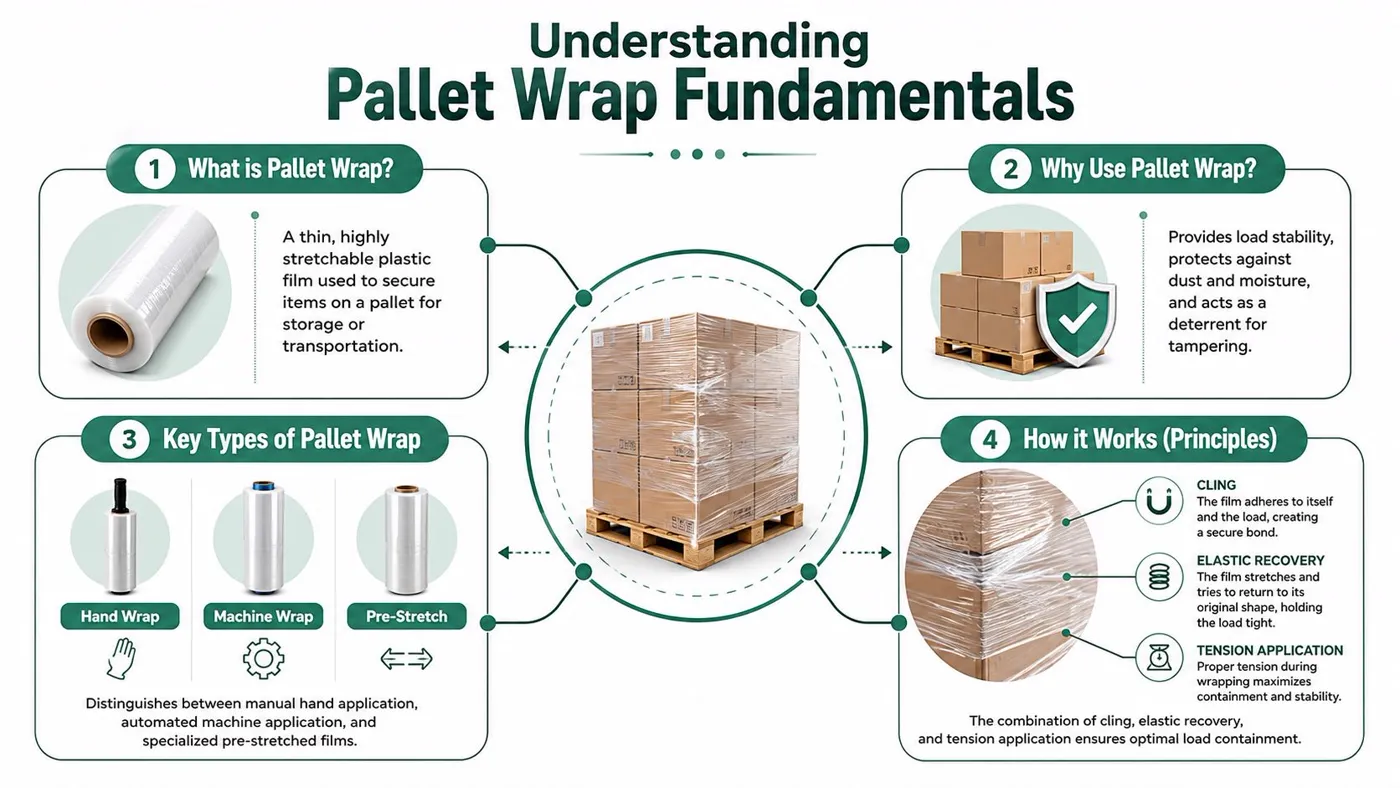
What pallet wrap actually does
Good wrap creates holding force. That force is what stops cartons sliding apart, top cases leaning, or mixed loads opening up as the pallet moves through the warehouse.
It also gives you some surface protection from dirt, splash, and casual interference, but containment is the first job. If staff keep adding extra passes to "be safe", the film, the settings, or the wrap pattern usually need attention. More layers can hide a poor setup for a while, but they also raise cost and plastic use without fixing the underlying cause.
We see the same pattern in many warehouses. A business blames the film, but the pallet base is poor, the cases are overhanging, or the load sits too long in a drafty loading bay and loses shape before dispatch. Wider operational work such as optimising warehouse layouts can reduce handling damage and wrapping inconsistency before a single roll is changed.
Cast film and blown film
Most UK buyers start by comparing cast film and blown film, and the difference is practical rather than technical.
Cast film is clearer, quieter on unwind, and usually easier to apply consistently on regular boxed loads. Staff often prefer it in busy indoor operations where visibility of labels matters and noise is a day-to-day issue.
Blown film has a tougher feel and generally offers better puncture resistance. It often suits awkward pallets, sharper edges, or rougher distribution work where the film is more likely to be knocked, scraped, or stressed.
The trade-off is straightforward. Cast film is often easier to work with. Blown film often tolerates abuse better. Neither is the default "stronger" choice in every setting, which is why buying by micron alone leads so many teams in the wrong direction.
A quick rule of thumb helps:
- Uniform carton loads: Cast film is often the simpler option.
- Loads with corners, sharp edges, or uneven surfaces: Blown film can be the safer choice.
- Operations that need label visibility: Cast film usually gives better clarity.
- Harder distribution chains: Puncture resistance may matter more than appearance or noise.
Hand wrap and machine wrap
The application method changes what good film looks like.
Hand wrap works for lower volumes, overflow space, and irregular consignments. The downside is variation. Two operators can wrap the same pallet with very different tension, overlap, and film use, and fatigue shows up quickly by the end of a shift.
Machine wrap gives tighter control over film usage and load consistency, especially once settings are dialled in for a specific pallet type. This control helps when procurement wants lower cost per pallet and operations wants fewer damaged loads. It also matters for 2026 planning, because reducing unnecessary plastic use is much easier when the application is repeatable.
If you are comparing options, our range of pallet wrap for hand and machine application covers the core formats most warehouses need, including extended and flush core rolls.
One final point matters here. Film type, pallet condition, and wrapping method work as a system. If one part is wrong, adding a thicker roll rarely fixes the problem for long.
How to Choose the Right Film and Cut Costs
The most expensive pallet wrap habit in the UK is buying by thickness alone.
That usually sounds sensible. Thicker film feels stronger in the hand, so it must be the safer option. But that shortcut often leads businesses to overbuy heavy gauges for routine loads, then use extra film anyway because the wrap pattern or film quality still isn't right. The result is more plastic on the pallet and more spend than necessary.
Why micron alone is a poor buying rule
Micron tells you thickness. It does not tell you the whole performance story.
That distinction matters because many UK businesses still overpay for thicker, weaker films, while advanced nano films can be thinner yet stronger, and 30% PCW stretch film can offer comparable strength while using recycled material, as noted in Just Pallet Wrap's UK buying guide. In other words, a higher gauge can still be poor value if the film stretches badly, tears too easily, or needs too many passes to hold the load.
Buyers often get caught out in this scenario. They compare roll against roll instead of comparing outcome against outcome.
A stronger buying approach looks at:
- Load profile: Uniform cartons behave differently from mixed or unstable pallets.
- Application method: Hand wrapping and machine wrapping place different demands on film.
- Material efficiency: Less film per pallet can still mean better containment.
- Waste handling: Thicker wrap increases plastic volume if it isn't needed.
Buying thicker film as a default is often a confidence purchase, not a performance purchase.
Where nano and pre-stretch film make sense
Modern films have changed the discussion. Nano and pre-stretch options are designed to deliver containment with less material, which is why they deserve a place in most 2026 reviews.
Nano film suits businesses that want high performance without automatically increasing thickness. It's a good fit where plastic reduction matters but load security still cannot be compromised.
Pre-stretch film makes sense when consistency and reduced operator effort matter. It can help manual teams avoid over-wrapping because the film is already engineered to work differently from conventional hand film.
30% PCW film is worth serious consideration when sustainability targets are now affecting buying decisions, customer requirements or internal reporting. The key point is that recycled content no longer has to mean accepting poor containment.
Pallet wrap film comparison
The table below is a practical decision aid, not a rigid rulebook.
| Film Type | Typical Micron | Load Type | Cost per Roll (Index) | Sustainability |
|---|---|---|---|---|
| Standard cast hand film | Mid-range | Regular boxed loads, lighter to medium pallets | Medium | Standard plastic use |
| Blown film | Higher | Rough, sharp-edged, awkward or heavier loads | Medium to higher | Higher material use if over-specified |
| Pre-stretch film | Lower | Stable loads, manual wrapping, operations focused on consistency | Medium | Strong option where reducing film use matters |
| Nano film | Thinner high-performance grade | Mixed applications where strength-to-material ratio matters | Medium to higher | Good fit for reducing plastic consumption |
| 30% PCW film | Varies by grade | Businesses balancing containment with recycled content goals | Comparable to conventional options in many use cases | Supports circular economy goals |
The right choice depends less on what sounds heavy-duty and more on what your pallets face. If most loads are clean, boxed and consistent, moving straight to a thick blown film can be wasteful. If loads are irregular, top-heavy or prone to puncture, the wrong lightweight film can create false economy.
A useful warehouse exercise is to review one week of dispatch by load type rather than by stock code. That usually exposes where one “default” film is being forced onto several very different jobs.
Mastering Pallet Wrapping Technique
A good film can still fail on the floor if the wrapping technique is poor. Most load problems come from inconsistent application, not from the roll itself. Too little overlap, poor anchoring at the base, or the wrong containment force will undo even a strong film.
For UK pallet containment, the technical benchmark is clear. A 40 to 60% axial overlap and a pre-stretch containment force of 15 to 25 lbs are required, and that protocol can reduce plastic use by 30% per pallet while maintaining structural integrity, according to 3M's pallet unitisation guidance.
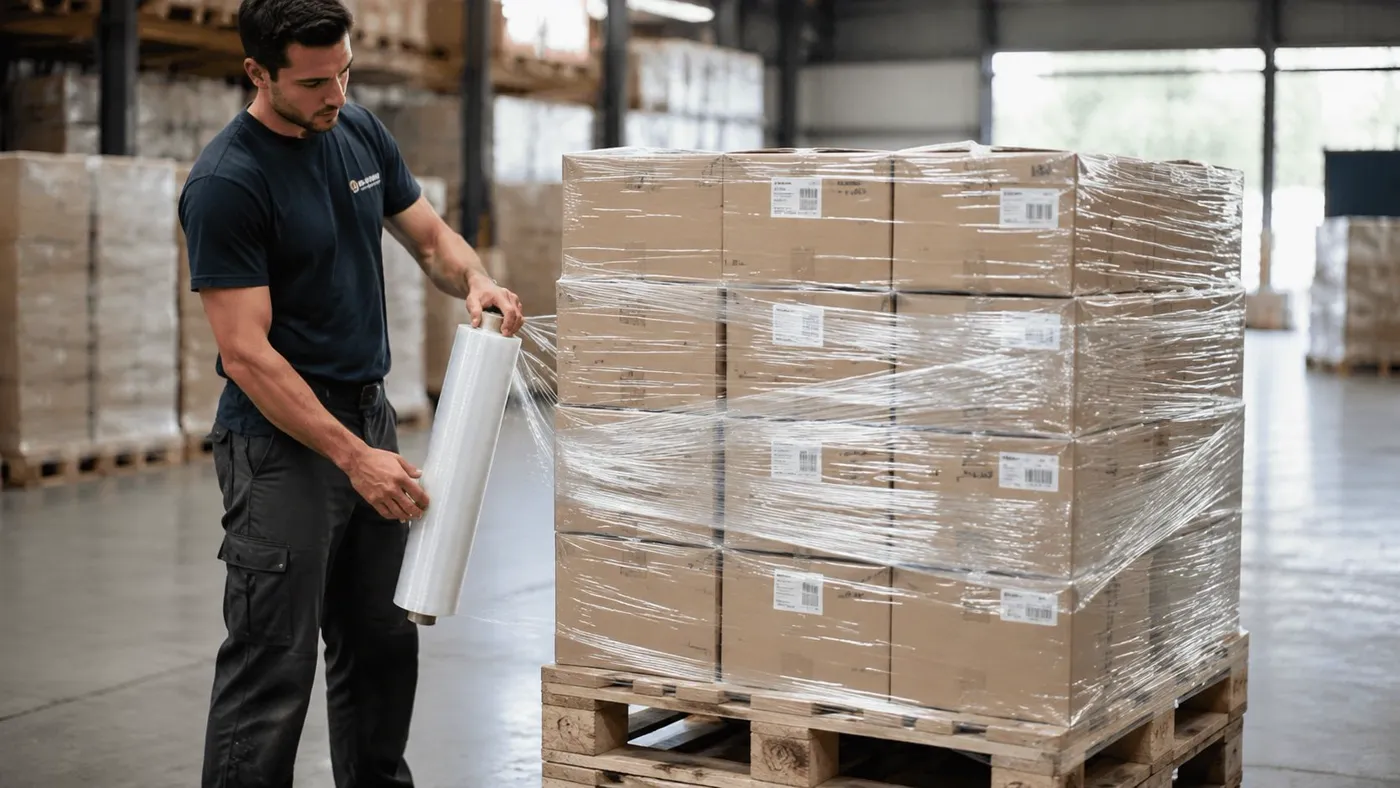
What good containment looks like
Containment isn't the same as coverage. A pallet can look fully wrapped and still be unstable.
The wrap needs to bind the load to the pallet, maintain tension through the body of the stack, and avoid weak zones near the top and bottom. If the film rides too high at the base, the load can shift independently of the pallet. If the top is barely secured, upper cartons can move during braking or cornering.
The overlap matters because it determines whether each pass works with the last one. The containment force matters because it's the actual squeezing pressure that keeps the load together.
A practical wrapping method for stable loads
For hand or machine wrapping, the process should be disciplined rather than rushed.
- Start at the base: Lock the film to the pallet itself, not just the cartons. That creates a foundation for the rest of the wrap.
- Build upward with consistent overlap: Keep within the 40 to 60% overlap range so there are no weak bands.
- Maintain controlled tension: Enough force is needed to stabilise the load, but not so much that cartons crush or edges cut through the film.
- Secure the upper section: The top third often gets neglected, especially in fast dispatch areas.
- Finish cleanly: A loose tail catches easily and leads to unravelled film in transit.
For machine settings, consistency is the biggest advantage. For manual wrapping, operator training matters more than many businesses admit. A strong film won't compensate for random overlap or poor anchoring.
Warehouse note: If loads keep failing near the base, check where the first wraps are landing. The problem is often the wrap pattern, not the film specification.
Common technique failures on the warehouse floor
Some errors appear again and again:
- Wrapping only the load, not the pallet: The stack can slide off the base during handling.
- Too many revolutions with low tension: This adds film without improving containment.
- Inconsistent overlap: Gaps create weak points across the load face.
- Stopping too far from the top: Upper cartons lose restraint.
- Ignoring sharp edges: Film damage starts early and spreads under movement.
Another common issue is using the same wrapping style for every pallet. A neat, uniform carton stack doesn't need the same treatment as a mixed e-commerce pallet with overhang, soft packs and split cases. Teams that wrap everything identically usually waste film on stable loads and under-protect unstable ones.
Embracing Sustainable Wrapping in 2026
Sustainability in pallet wrapping is no longer a side project for the compliance team. It now affects procurement decisions, supplier conversations and how businesses justify packaging choices internally. The practical question isn't whether to reduce plastic use. It's how to do it without creating more transit failures.
One important starting point is material reality. Polyethylene is projected to hold 86.98% of the pallet wrap market in 2026, and 30% PCW wrap has emerged as a key option because it uses recycled material while offering the same load containment as higher micron films, according to Fortune Business Insights on stretch wrap.
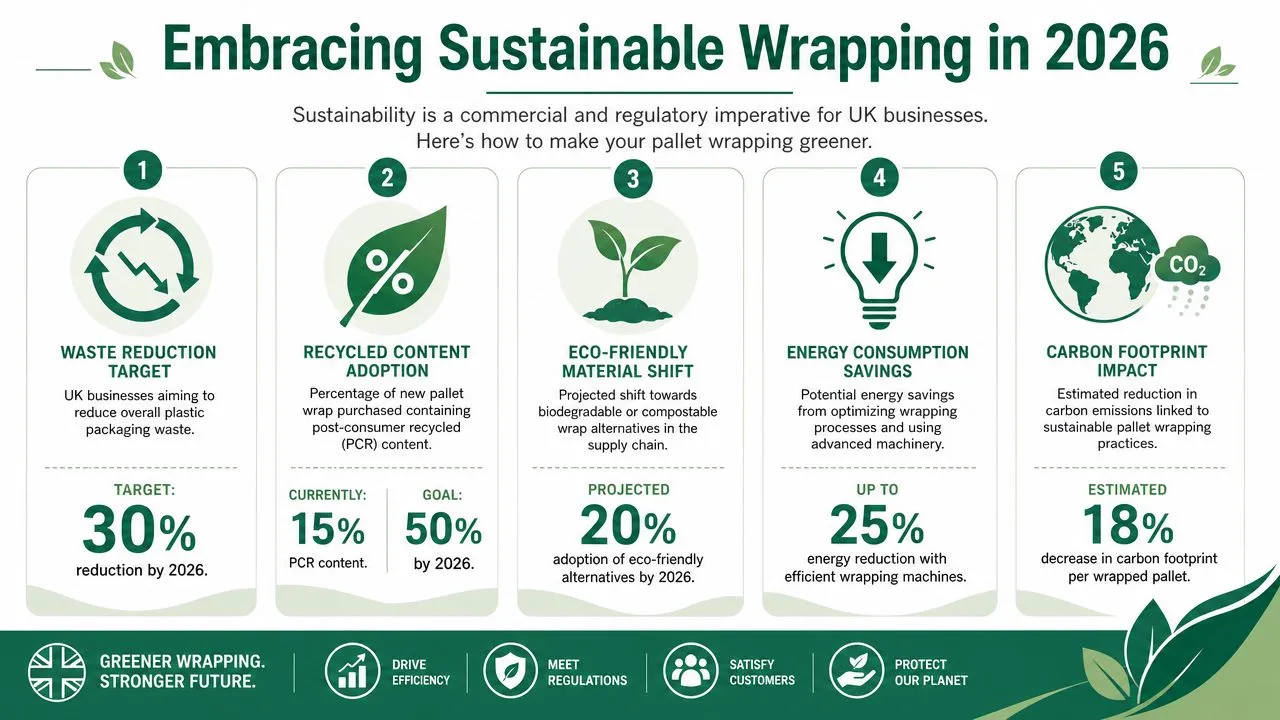
Why recycled content matters now
For many UK businesses, the easiest sustainability gain isn't switching to a radically different wrapping system overnight. It's choosing a film that reduces reliance on virgin plastic without forcing a drop in containment performance.
That's where 30% PCW film stands out. It supports circular economy goals because part of the material comes from post-consumer waste. For operations teams, it provides a valuable route to improve environmental performance without automatically accepting weaker wrap.
This also changes internal conversations. Sustainability teams often push for lower-impact packaging, while warehouse teams worry about damaged loads and more complaints. Recycled-content film can help bridge that tension if the grade matches the job.
For businesses reviewing compliance responsibilities, Packaging Panda's guide to packaging waste regulations is a useful reference point alongside a film audit.
Sustainability that also improves operations
The most effective sustainable change is often using less material, not just changing the material. Thinner high-performance films, pre-stretch formats and better application control all help reduce total plastic consumption per pallet when they're matched properly to the load.
That matters because the wrong sustainability decision usually fails in one of two ways. Either the business picks an eco option with no operational testing and loses confidence after a few failed shipments, or it keeps using excess film because nobody wants to challenge the old spec.
A stronger approach is to review sustainability through operational questions:
- Can the business reduce total film use by improving film selection?
- Can recycled-content film replace part of the current virgin-plastic spend?
- Can machine settings or operator habits be tightened to avoid over-wrapping?
- Are there load types where compostable or other emerging options deserve a controlled trial rather than a full switch?
Businesses don't need a perfect answer on day one. They need a defensible, testable wrapping policy that reduces waste without handing product damage back to the warehouse.
Common Mistakes and How to Order Your Wrap
By the time businesses review pallet wrap seriously, the same mistakes usually show up together. Purchasing has standardised on one familiar grade. The warehouse has adapted with workarounds. Sustainability sits in a separate conversation. No one is wrong individually, but the overall system ends up expensive and inconsistent.
That gap is significant in a market that's still evolving. The UK stretch wrap market is projected to be USD 0.14 billion by 2026, driven by demand for sustainable packaging, but many businesses still lack UK-specific guidance on options such as compostable wraps and compliance-linked decisions, according to Future Market Insights.
The mistakes that keep costing businesses money
Most avoidable pallet wrap costs come from a short list of habits:
- Buying on micron alone: Thicker film gets treated as safer, even when it isn't the best-value option.
- Using one film for every load: Stable boxed pallets and irregular mixed pallets rarely need identical specs.
- Ignoring application quality: Poor overlap and weak anchoring waste film and increase failures.
- Over-wrapping to compensate for uncertainty: Staff add more revolutions because they don't trust the setup.
- Treating sustainability as separate from operations: In practice, material reduction and cost control often support each other.
The best pallet wrap order is usually the one that reduces variation on the floor, not the one that merely changes the roll in stores.
How to place a better pallet wrap order
A better order starts with a short internal review. Buyers should ask what loads are being wrapped most often, whether application is by hand or machine, and where current failures happen. If pallets arrive with split film, the problem may be puncture resistance. If teams use too many wraps on standard carton loads, the issue may be over-specification or weak application control.
From there, order by use case rather than by habit:
- Routine boxed dispatch: Review whether a lighter or higher-performance film would do the same job with less waste.
- Heavier or awkward loads: Keep toughness in focus, but test before jumping to the thickest option.
- Sustainability-led buying: Trial recycled-content film where load patterns are predictable.
- Special requirements: If branding, size variation or specific film characteristics matter, a bespoke route may be more efficient than forcing a stock option to fit.
Where a custom specification is needed, Packaging Panda offers bespoke pallet wrap options that can be considered alongside standard stock grades.
If pallet wrap is causing damage, excess plastic use or unnecessary spend, Packaging Panda can help businesses review the practical fit between load type, wrapping method and film choice. As a UK supplier of packaging materials with a focus on sustainable options and made-to-order solutions, Packaging Panda supports warehouses, fulfilment teams and retailers that need a more reliable approach than buying thicker film.