Cellophane Bags Self Seal: A UK Buying Guide
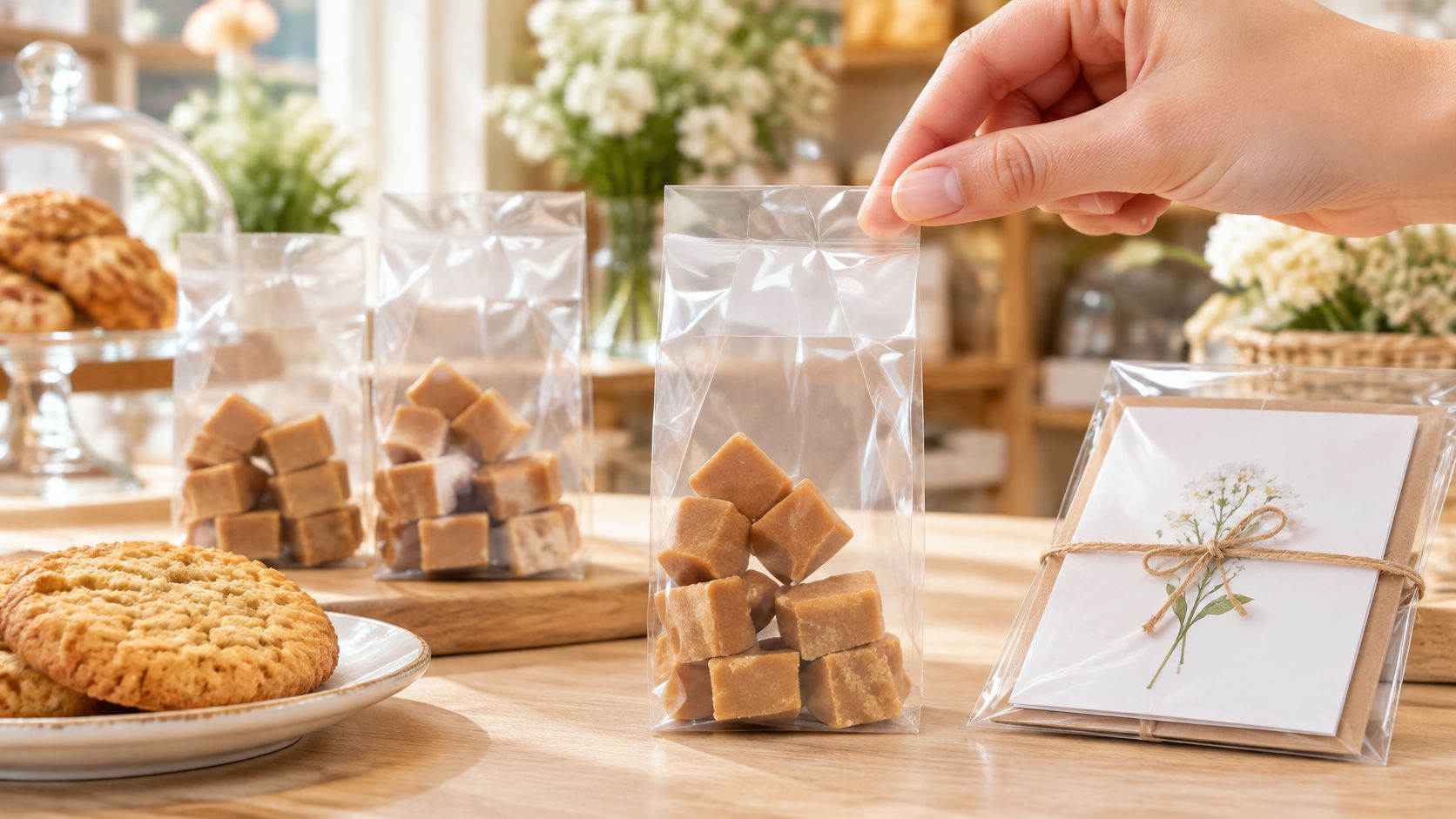
A stack of biscuits is ready for the counter, or a batch of greetings cards is waiting beside the parcel tape. The clear bags look right, but the flap barely reaches, the corners catch and the supplier's description says little beyond cellophane.
That's where a cheap-looking purchasing decision becomes a packing problem. For buyers searching for cellophane bags self seal, the useful comparison isn't just price or transparency. It's whether the bag fits, what it's made from and what happens after the customer opens it.
Table of Contents
- What a Self-Seal Cellophane Bag Is
- Common Sizes and Closures to Match the Product
- Film Coatings and the Adhesive Strip
- Where the Bag Works and When It Does Not
- When a Clear Bag Helps and When It Does Not
- What to Check Before You Order
What a Self-Seal Cellophane Bag Is
A self-seal cellophane bag is a clear flat or gusseted bag with a pressure-sensitive adhesive strip on its lip. The packer fills it, removes the release liner and folds and presses the flap closed, without a heat sealer or separate tape. At a bakery counter, that means the product stays visible while the assistant closes the pack without reaching for another tool.
Genuine cellophane is regenerated cellulose, a plant-derived film distinct from conventional petroleum-based plastic film, a material distinction recognised in HM Revenue & Customs' packaging-material guidance. It isn't another name for every transparent bag.
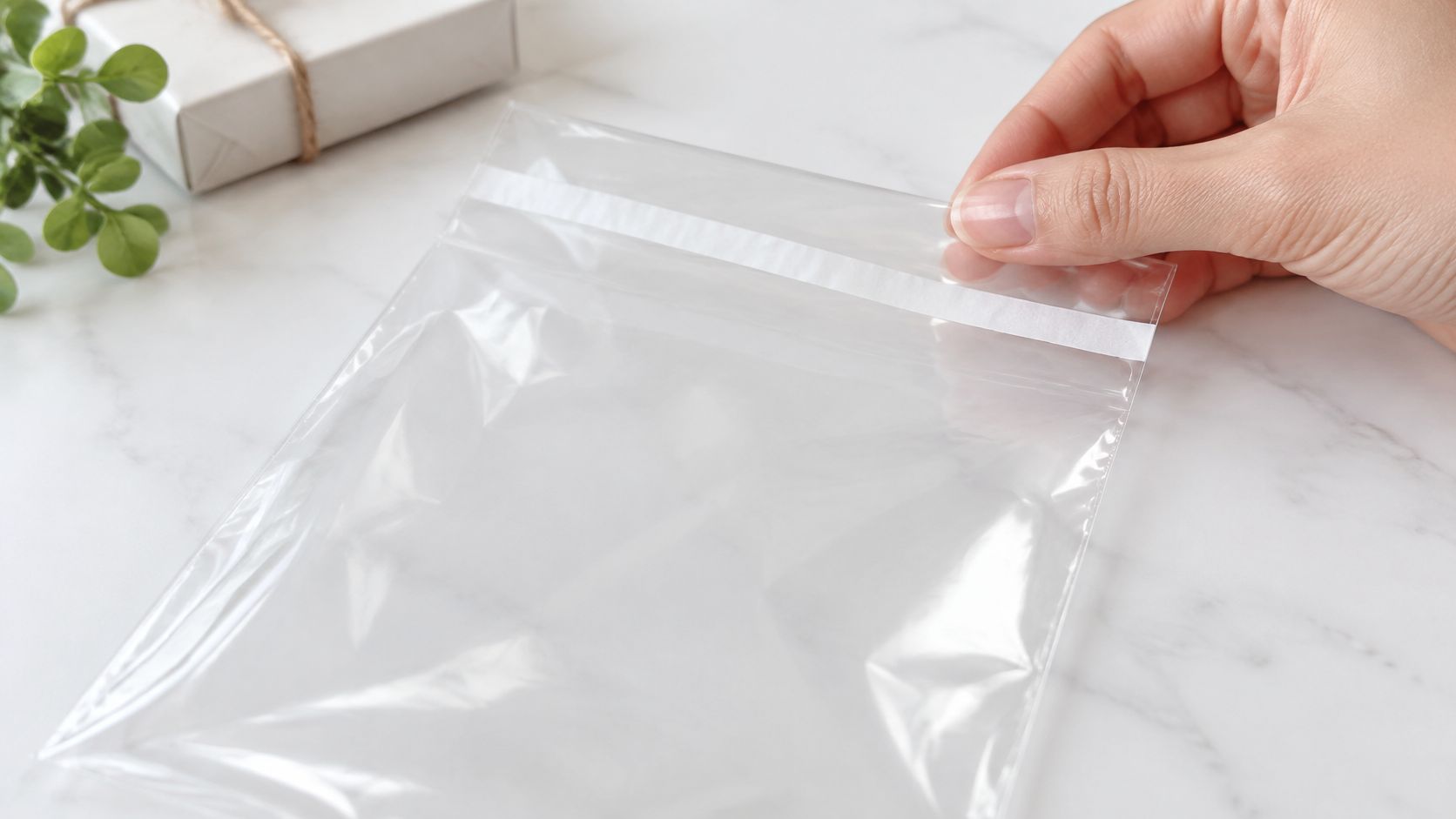
The name isn't the specification
Shops value visibility, an integrated closure and, where the adhesive permits it, a pack that customers can reopen and close again. Repeated resealing shouldn't be assumed: some strips lose their grip after opening or picking up crumbs.
A bag sold as cellophane might be uncoated cellulose, coated cellulose or polypropylene with a cello-style description. Aroma Warehouse's guide to choosing materials for incense boxes offers a useful comparison for scented goods, where the surrounding packaging deserves attention alongside appearance.
Buying principle: A clear photograph proves visibility, not composition or suitability.
The practical checks are straightforward:
- Size: Enough usable space for the product and a clean fold.
- Film and coating: A named substrate and documented surface treatments.
- Use and disposal: A construction suited to the contents and an identifiable end-of-life route.
Common Sizes and Closures to Match the Product
Self-seal cellophane sizes and typical uses
These are illustrative buying sizes, not a guarantee of any supplier's stock range or usable internal dimensions.
| Size (mm) | Typical contents | Best closure | Watch-out |
|---|---|---|---|
| 70 x 100 | A few sweets or a pair of earrings | Narrow self-seal flap | Jewellery fittings can puncture thin film |
| 100 x 150 | Biscuit or bar of soap | Single adhesive strip | Product thickness takes up usable width |
| 140 x 200 | Greetings card or small gift | Flat self-seal flap | Include the envelope when checking fit |
| 180 x 280 | A5 print, cake slice, stationery | Wider lip or gusset if bulky | Leave spare length for the fold |
| 230 x 305 | A4 sheets, larger bakery pack | Self-seal, or heat seal if a machine is used | Heat seal is not a self-seal bag |
| 300 x 400 or larger | Folded clothing or hamper component | Broad self-seal flap | Check the filled pack, not just the flat item |
Measure the packed product
A ruler, a sample bag and the actual product are more useful than a photograph beside a coin. The measurement needs to include backing cards, envelopes, cake boards, folded seams and anything else that will go inside.
Consider a hypothetical biscuit pack. The biscuit fits through the opening, but its depth pulls the sides inwards, leaving less room than the flat bag suggested. The packer needs spare length above the biscuit so the adhesive lands on clean film rather than folding tightly across the food.
A trial allowance of roughly 15 to 25 mm can be a starting point in that example, but the filled sample decides the fit. A tall product or deep fold may need more.
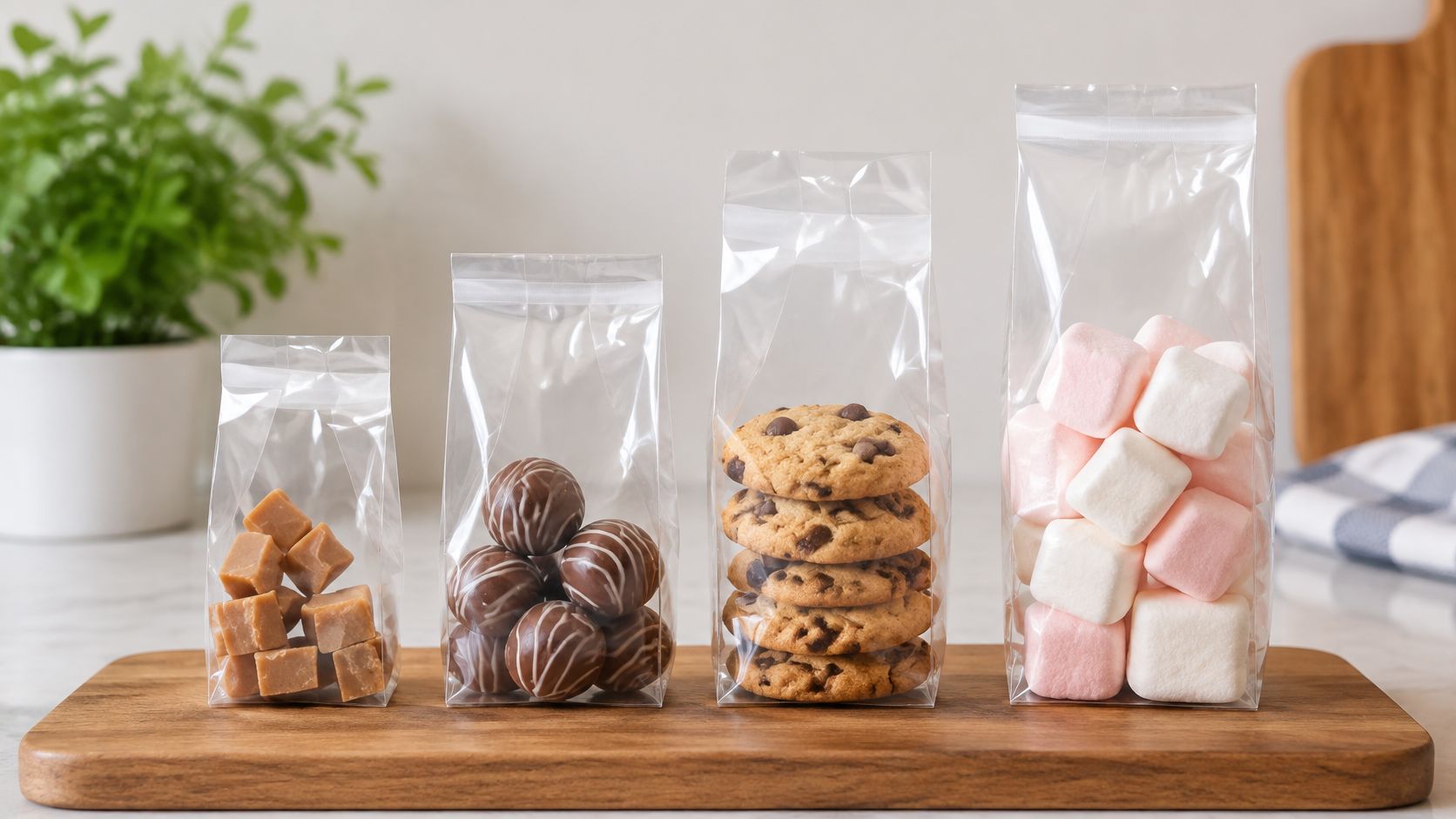
Choose the shape before the closure
Flat bags suit cards, prints and thin confectionery. For a stack of biscuits or a bulky gift, gusseted cellophane bags offer a shape worth checking against a filled sample rather than forcing depth into a flat sleeve.
The Cellophane Bags category covers clear bags for retail display, gift packaging and food presentation, with compostable options available. That description helps locate a range, but the individual specification still needs checking.
- Single adhesive strip: Suits straightforward counter packing, provided the landing area stays clean.
- Wider lip: Gives more room to position the fold, but doesn't make greasy contents compatible with the adhesive.
- Heat-seal opening: Requires suitable film and equipment; it isn't a self-seal closure.
- Zip closure: Often belongs to a different plastic construction and shouldn't be treated as proof of cellulose film.
For dry biscuits, Rip Van's guide to keep cookies crisp with resealable bags provides useful context for considering storage alongside closure convenience. A flap alone doesn't establish shelf life.
Before a tight-fitting order, the buyer should confirm whether dimensions are internal or external and whether they include the lip. The smallest suitable bag is the one that accepts the product easily and still leaves a clean, unstressed fold.
Film Coatings and the Adhesive Strip
A self-seal bag needs to be assessed as a complete construction. The base film, surface coating and adhesive strip can perform different jobs, and a statement about one doesn't automatically cover the others.
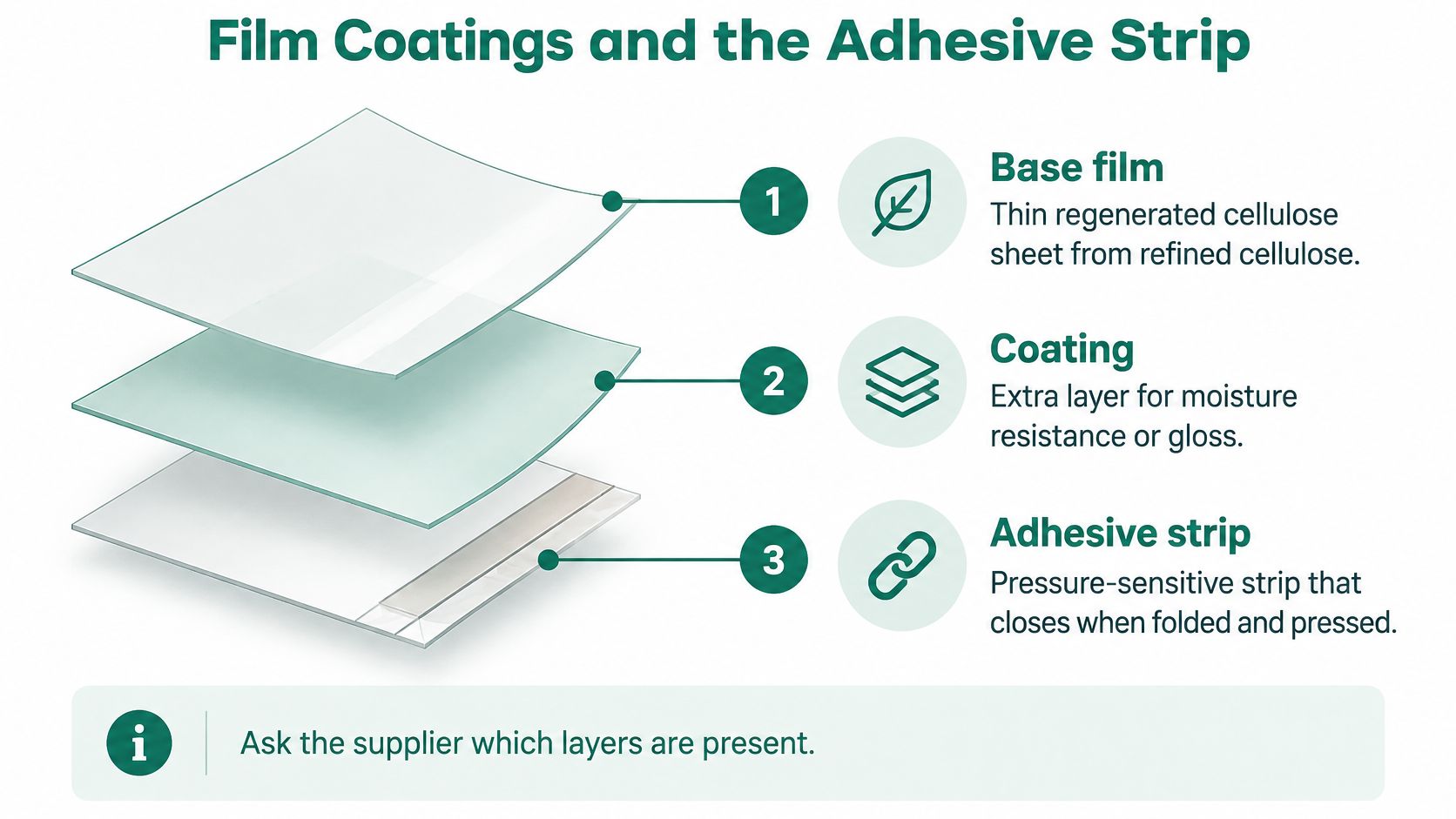
Base film and surface coating
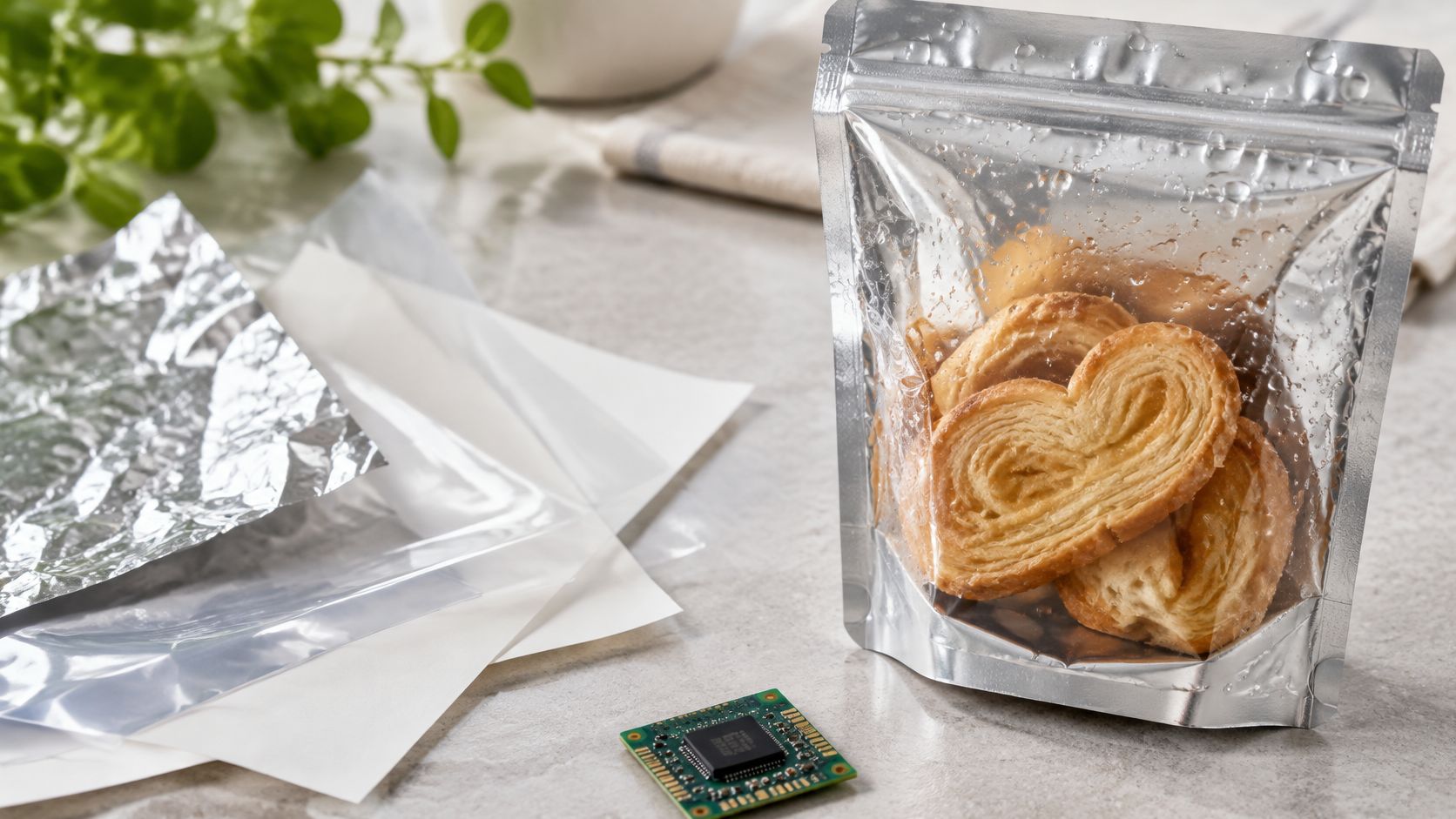
The base film provides the bag's structure. For genuine cellophane, that's a thin regenerated-cellulose sheet made from refined cellulose derived from wood or cotton; the supplier should identify whether it's uncoated or treated on its surfaces.
A coating may improve moisture resistance, gloss or handling. It also changes what the buyer needs to assess for direct food contact, so a generic plant-based description isn't enough.
For regenerated cellulose film coated with plastics, the food-contact migration regulation specifies an overall migration limit of 10 milligrams per square decimetre of food-contact surface, or 60 milligrams per kilogram of food for certain containers or sealing components where estimating surface area is impracticable. Those are alternative test bases for defined circumstances, not interchangeable claims a supplier can choose for convenience.
The rules for regenerated cellulose also limit the total quantity of substances in a coating on the food-contact side to 50 mg/dm², under the applicable food-contact regulations. That coating-content limit measures something different from migration into food.
Adhesive, print and intended use
The adhesive deserves its own answer on the specification sheet. Under the regenerated-cellulose food-contact rules, colourants and adhesives are permitted only when they don't transfer to food in any detectable quantity using a validated method.
In practice, the flap should remain outside the food-contact surface, and printed surfaces mustn't touch the food. A bakery pack compressed inside a delivery carton needs the same attention as one standing neatly on a counter.
A food-contact claim should describe the finished bag and its intended use, not merely the film before printing and conversion.
The technical paperwork should identify:
- Film construction: Uncoated regenerated cellulose, coated regenerated cellulose or another substrate.
- Test basis: Food simulants, contact conditions and results relevant to the proposed contents.
- Closure coverage: Adhesive and sealing components included in the assessment.
- Use restrictions: Any limits involving temperature, fatty foods or storage conditions.
For stationery and gifts, food migration isn't the central issue. Odour transfer, adhesive residue, film scratching and closure strength still matter, particularly for scented soap, printed artwork or products stored in warm stockrooms.
Where the Bag Works and When It Does Not
A transparent self-seal format earns its place when it solves a specific handling or presentation problem. It's less useful when staff have to add trays, extra wrapping and more tape just to make the bag behave.
Bakery counters and confectionery
For a cooled bakery slice or a few biscuits, a clear bag shows the bake without customers handling it. The strip can remove the need for a closing sticker, while a suitable board supports a fragile slice during filling.
The failure case is usually the product condition rather than its appearance. Warm food can create condensation and affect adhesive performance; greasy pastry can contaminate the strip before the flap reaches it.
Food suitability needs documentary support. Government food-contact guidance makes clear that the relevant material framework applies, so a declaration of compliance should cover the film, coating, adhesive and intended use rather than rely on the presence of a resealable flap.
For confectionery, visibility helps show colour and assortment. Small gifts also suit a flat bag when the contents don't need cushioning, but a decorative ribbon shouldn't be expected to correct an unsuitable closure.
A wrapped chocolate selection and loose confectionery aren't the same purchasing job. Direct contact, grease and storage conditions need checking before the same bag is used across both lines.
Cards, prints and ecommerce orders
Stationery is a simpler application because food-contact rules aren't involved. A transparent sleeve can keep fingerprints off a greetings card and hold the card and envelope together for display.
Sharp corners are the weakness. A tightly stretched bag may split as the packer pushes a backing board into place, so slightly more clearance often produces a tidier result than forcing the smallest apparent fit.
For ecommerce, the bag is an inner presentation layer, not a postal pack. A print still needs rigid protection, and a delicate gift still needs cushioning inside a suitable mailer or carton.
Where transparency is useful but cellulose isn't essential, clear polythene bags are another material category to compare. The comparison should cover the required handling performance and disposal instructions, rather than assume all clear films behave alike.
A neat inner bag can organise an order. It can't replace the carton, board or cushioning that prevents transit damage.
A packing trial should follow the route in practice: filling, closing, placing inside the outer pack and unpacking. Corners that survive a careful desk test may still catch when the parcel is compressed.
Jobs that need a different bag
Cash handling and evidence storage require a different kind of closure. A flap that can be opened and pressed back down isn't evidence that the contents have remained untouched.
For those jobs, Tamper Evident Bags include security formats for cash, coins and evidence, with tear-proof seals and tracking codes. Choosing that category is about traceability and integrity, not retail presentation.
The ordinary self-seal format is also a poor choice where the contents are persistently wet, oily or too hot for the documented use conditions. A suitable lidded container, lined paper pack or purpose-designed barrier pouch may be more practical.
For businesses reviewing the whole pack, Smokey Rebel's guide to plan a switch to sustainable packaging is a useful prompt to assess what each component does. Removing an unnecessary inner layer can be more worthwhile than replacing it with another single-use material.
The decision rule is simple: a self-seal bag suits products that benefit from visibility and quick closure. Where neither matters, paper, a reusable box or no additional inner bag deserves a proper trial.
When a Clear Bag Helps and When It Does Not
A self-seal bag can replace separate tape, a sticker or an outer wrap. It may also let a customer inspect the contents without tearing the pack apart, provided the closure is designed for reopening.
That benefit needs weighing against the waste left behind. A lightweight bag still becomes waste, and food residue or an incompatible adhesive can make the disposal route less straightforward than the appearance suggests.
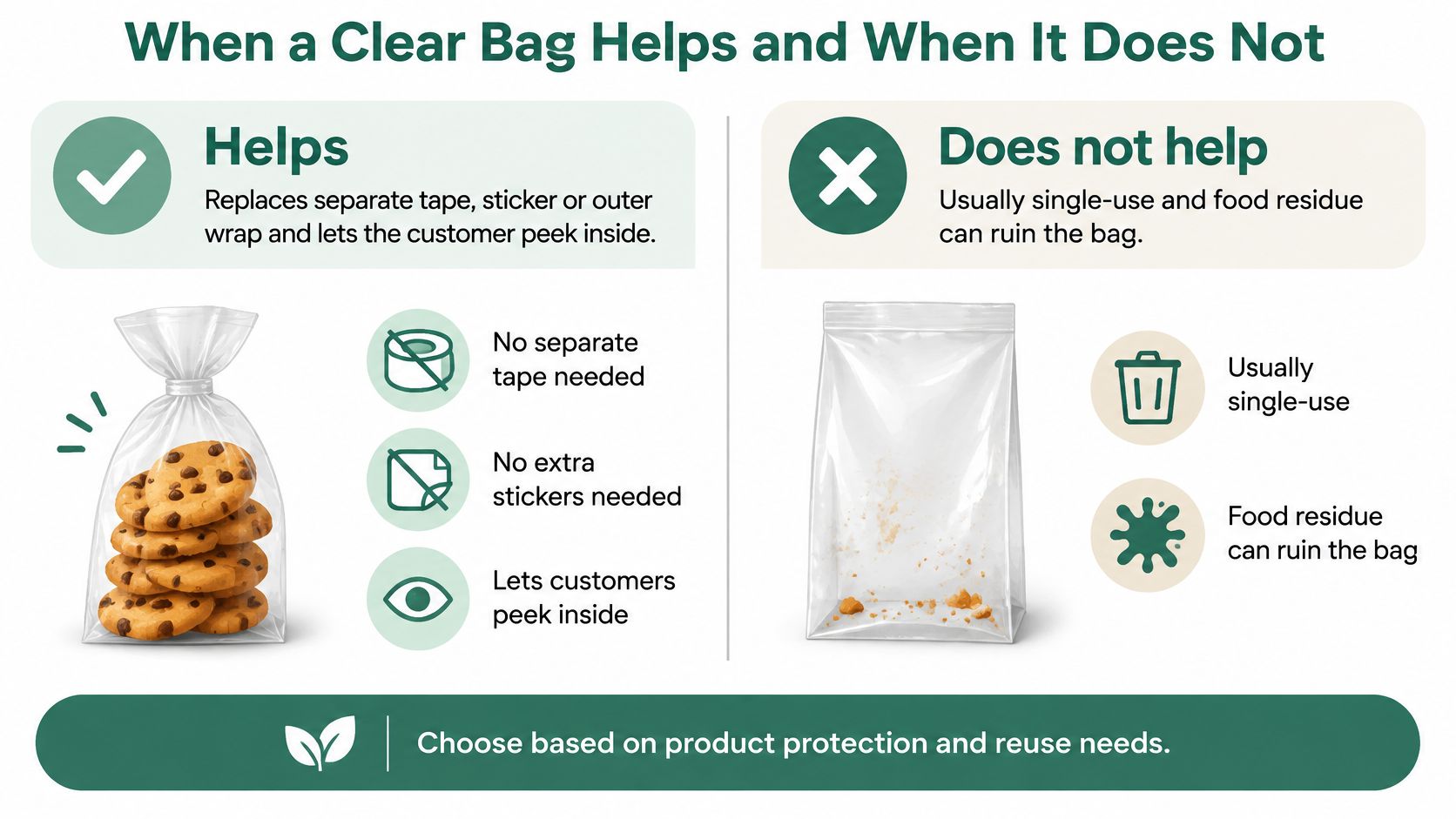
Read the material, not the green description
How to read a self-seal bag's material
| What you were sold | Usual film | Plastic Packaging Tax | Disposal note |
|---|---|---|---|
| Genuine cellophane, uncoated | Regenerated cellulose | Not plastic if chemically unmodified | Don't assume kerbside plastic-film acceptance |
| Coated or laminated cellophane | Cellulose plus coating | Coating can change the classification | Follow the supplier sheet, not the word cello |
| Cello-style plastic bag | OPP or similar plastic film | Counts as plastic; qualifying recycled content can exempt the charge | Check local plastic-film acceptance and planned collection changes |
| Compostable clear bag | May use a polymer other than cellulose | Classification follows the polymer, not the compostable claim | Home and industrial composting differ; plastic-stream acceptance isn't automatic |
For plastic packaging, at least 30% recycled plastic exempts the packaging from the tax charge, although it still counts towards the 10-tonne annual threshold for manufacturers and importers, according to the UK government waste and packaging information; the same information reports that 73.2% of UK packaging waste was recycled in 2024. That overall rate doesn't establish a collection route for a particular bag.
England's planned plastic-stream collection of plastic film and bags from 31 March 2027 doesn't automatically include cellulose film, and compostable or biodegradable packaging doesn't have to be collected in that stream, as described in the UK FSC consumer and disposal context. Until the relevant service accepts the actual material, a general recyclable label isn't a useful instruction.
Compare the whole pack
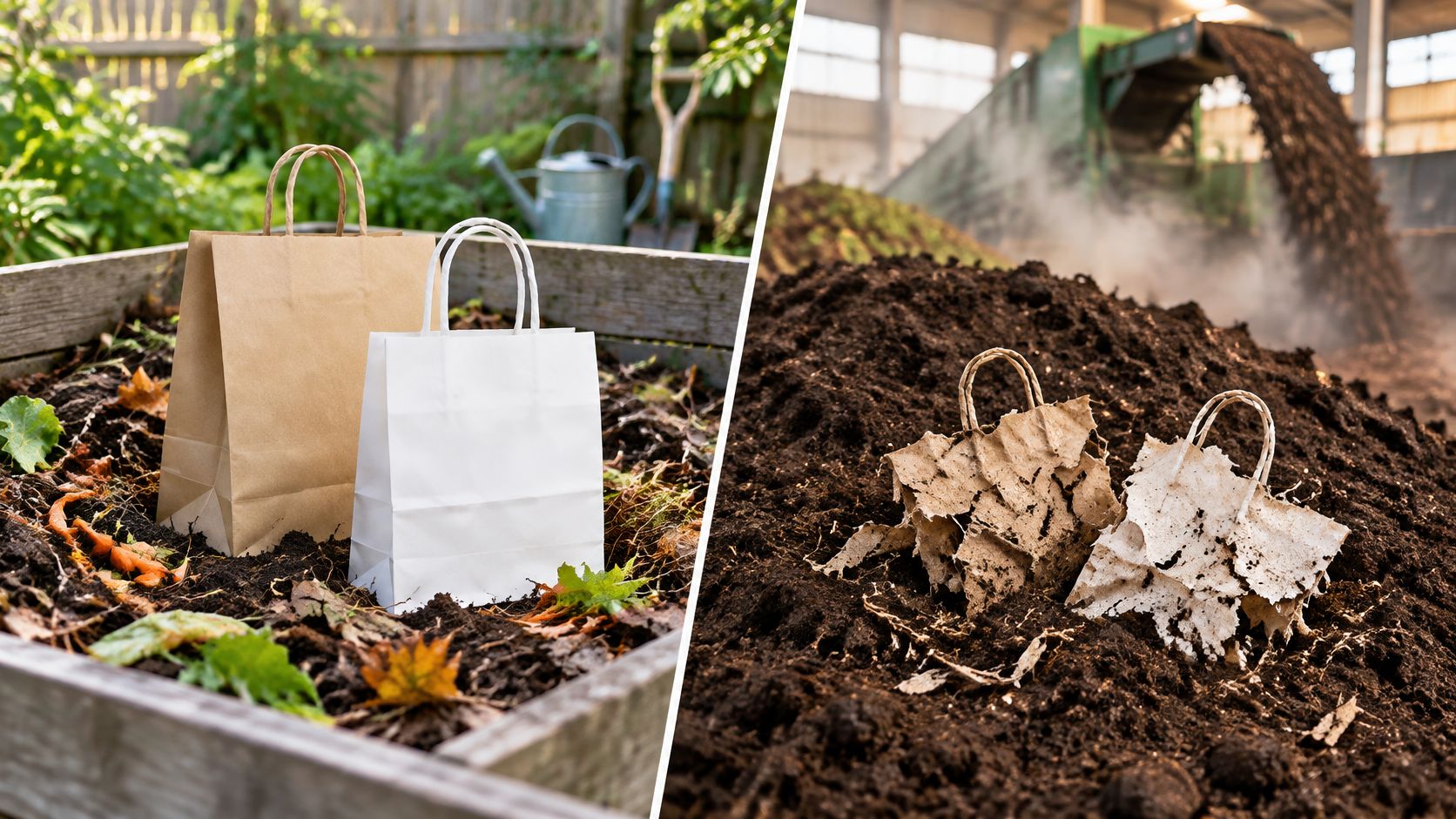
A buyer considering compostable cellophane bags should establish whether the finished bag is suitable for home composting or requires industrial treatment. The evidence needs to cover the closure too, not just a sample of the base film.
The practical comparison is between complete packaging arrangements:
- Clear self-seal bag: Useful when it removes other components and protects a product customers need to see.
- Paper bag: Worth considering when a window adds little and the contents suit paper.
- Reusable box: More attractive where a return or repeat-use system is realistic.
- No inner bag: Often the cleanest choice when the outer pack already keeps the product protected and organised.
A claimed environmental improvement should survive that comparison. Replacing several unnecessary pieces with a documented, suitable bag can make sense; adding a transparent layer purely for unboxing appearance is harder to justify.
What to Check Before You Order
A useful purchase specification fits alongside the delivery paperwork and gives another buyer enough detail to reorder the same construction. A catalogue title and photograph won't prevent a visually similar substitute arriving later.
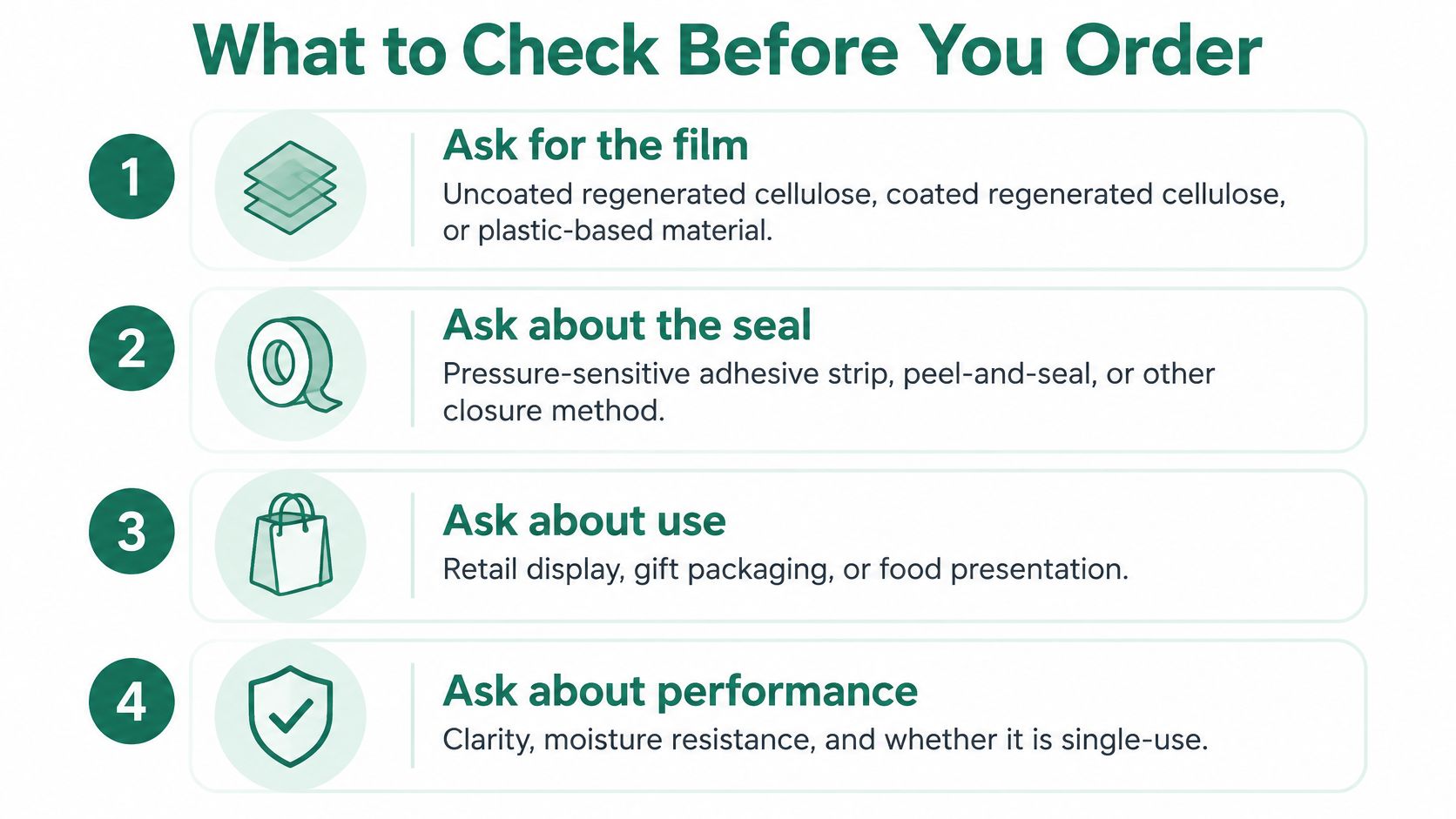
The supplier checks in buying order
Identify the film. The supplier should state uncoated regenerated cellulose, coated regenerated cellulose or the actual alternative polymer. A description such as clear eco film leaves too much unanswered.
Record every additional material. The coating, laminate, adhesive and release liner need identifying, including which contain plastic. That information supports material classification and prevents accounts or warehouse staff guessing from appearance.
Match the food paperwork to the job. Where food touches the bag, the buyer needs a declaration covering the finished construction and intended use, supported by relevant migration evidence. The paperwork should identify food simulants, test conditions and results, while the approved artwork should keep print away from the food-contact face.
Approve a filled sample. The order should state usable dimensions, whether measurements are internal or external, and how the lip is counted. Staff should be able to insert the product without stretching seams or contaminating the adhesive.
Separate plain stock from printed work. Artwork approval, print position and production scheduling need agreeing before a branded order is placed. A plain-stock replenishment assumption shouldn't be carried into a custom print job.
Records that make the reorder reliable
Keep packaging-weight records. Under the Producer Responsibility Obligations packaging regulations, the principal large-producer threshold combines more than £2 million turnover in the relevant previous financial year with more than 50 tonnes of packaging supplied two years earlier, while a lower route combines turnover above £1 million with more than 25 tonnes of packaging supplied. The detailed rules determine the obligation, but lightweight bags still need recording rather than dismissing as negligible.
Approve a written disposal sentence. The supplier's evidence should support wording suitable for the product page and packing information. Compostability doesn't replace food-contact approval, and a broad biodegradable claim doesn't tell a customer which collection service accepts the bag.
Reorder safeguard: The approved sample and specification should stay together, so a lookalike film can't be accepted simply because it fits.
The final order record should name the film type, finished construction, size, food-contact status and disposal sentence. Closure requirements, print position and any restrictions belong beside them, with the delivery note retained against that specification.
A supplier proposing a substitution should provide the same evidence before approval. That turns cellophane from a loose catalogue description into a repeatable purchasing decision.
Packaging Panda offers clear bags for retail presentation alongside bakery packaging, mailers and protective materials for the complete pack. Visit Packaging Panda to compare suitable formats, then match the chosen bag's specification to the product, closure and disposal requirements before ordering.
Shop This Packaging Range
Wholesale prices, volume discounts and fast UK dispatch.