How to Pack Fragile Items for Safe UK Shipping

The parcel is on the packing bench, the customer's address is printed, and the courier collection is approaching. Inside sits a ceramic mug, a bottle, a framed print or a refurbished device that looked perfectly safe when it left the warehouse. The problem is that a fragile item doesn't need a dramatic accident to fail. A little movement, a hard corner impact, compression from another parcel or an oversized box can be enough.
Learning how to pack fragile items properly means controlling three things: movement, impact and pressure. The right box, enough cushioning and a sealing method suited to the parcel matter far more than a bright sticker alone. The method below is designed for UK sellers, studios, galleries, fulfilment teams and anyone sending breakable goods through mixed courier networks.
Table of Contents
- Why Fragile-Item Packing Matters in UK Parcel Networks
- The UK Postal Rule Set for Fragile Goods
- Right-Sizing Boxes and Cushioning for Each Item Type
- Traditional versus Sustainable Protective Materials
- Labelling, Sealing and Handling Instructions
- Testing and Carrier-Specific Risk for UK Shippers
- Ordering, Fulfilment and Dispatch Timing
Why Fragile-Item Packing Matters in UK Parcel Networks
At a Hampshire pottery studio, a returned parcel arrives from a customer. The outer carton looks intact, but the contents tell a different story. Two mugs have been reduced to fragments because a single sheet of bubble wrap was placed around them inside an overfilled box. The packing looked presentable at the dispatch desk, yet it gave the mugs no reliable separation, edge protection or resistance to movement.
That failure is commercial, not merely cosmetic. A damaged parcel creates replacement work, customer-service time, a refund decision and another shipment. The same risks affect independent Etsy sellers, e-commerce brands sending wine, art galleries posting framed prints and electronics refurbishers dispatching delicate equipment.
UK damage evidence shows why the issue deserves attention. A 2024 survey reported 85 million damaged parcels in the previous 12 months, while 29% of respondents said they'd received smashed contents inside packaging and 27% reported torn boxes. Food and drink, crockery and glassware, and books or games were among the commonly damaged categories, as reported in UK parcel-damage coverage citing the survey.

The baseline method
Royal Mail's practical guidance gives a sound starting point. Fragile items such as glass, china and resin should be wrapped in bubble wrap at least 5 cm thick, placed in a strong rigid container and surrounded by enough fill to prevent contact with the box walls or other items. If the box is too large, additional bubble wrap or packing foam is needed, and empty space must be filled rather than left for the contents to travel.
Practical rule: cushioning only works when it stays between the item and the impact. A label can identify a risk, but it can't absorb a drop.
The useful outcome is a repeatable packing decision, not a universal material choice. A seller should be able to match item weight and shape to cushioning depth, box strength and the likely handling environment, then test that combination before using it across a product range. Guidance on shock-absorbing materials can help teams compare the role of different protective layers.
The sustainability question also belongs at the packing bench. Plastic-heavy protection can perform well, particularly where cushioning is reused, but paper, moulded pulp and corrugated structures may reduce material complexity and improve recyclability. The lightest or most eco-labelled option isn't automatically the lowest-impact option if it causes breakage, returns and replacement shipments.
The UK Postal Rule Set for Fragile Goods
A seller packing a bottle for UK delivery has to think beyond wrapping. Postal operators apply restrictions to contents, volume, containment, labelling and the sender's responsibility for the parcel's condition on arrival. The working framework starts with the product, then moves outwards to the inner wrap, absorbent layer, cushioning and rigid outer package.
Post Office guidance for restricted bottle shipments sets a clear example. Each item must not exceed 1 litre, no more than two items may be sent in one parcel, and each bottle should be wrapped in polythene, sealed with tape, surrounded by absorbent material and cushioned to prevent breakage. The sender's name and return address must be visible on the outside, and glass bottles should be marked “FRAGILE”, according to the Post Office restricted-items guidance.
That framework is useful even where a particular product falls outside the bottle rules. It separates the contents, contains leakage, absorbs shock and makes the sender identifiable if the parcel needs to come back. A tamper-evident outer pouch may also be relevant where chain of custody matters. Tamper Evident Bags are described as security bags for cash, coins and evidence, with tear-proof seals and tracking codes, rather than as cushioning for fragile goods.
Rules are not a substitute for pack design
Royal Mail's fragile-parcel guidance recommends a sturdy outer box, secure edge sealing, void fill and separation from both the box wall and other items. Sharp or irregular shapes need their edges flattened or covered, while padded envelopes may suit some shapes that don't have rigid, projecting components. Larger books need particular care, with a corrugated fibreboard book pack and 2.5 cm clearance at each end recommended to protect corners and bindings, as set out in Royal Mail's fragile-item packaging guidance.
The practical lesson is simple. Postal restrictions define what can travel and how it must be contained, but the package still has to survive handling. A FRAGILE mark is a handling request, not a guarantee that the parcel will avoid conveyor belts, stacking or a drop. The inner construction carries the responsibility.
Sellers should also check the carrier's current restricted and prohibited-items terms before dispatching aerosols, perfumes, spirits, liquids or other regulated contents. Product classification can change the service available, the packaging standard and the compensation position, so a familiar carton isn't enough on its own.
Right-Sizing Boxes and Cushioning for Each Item Type
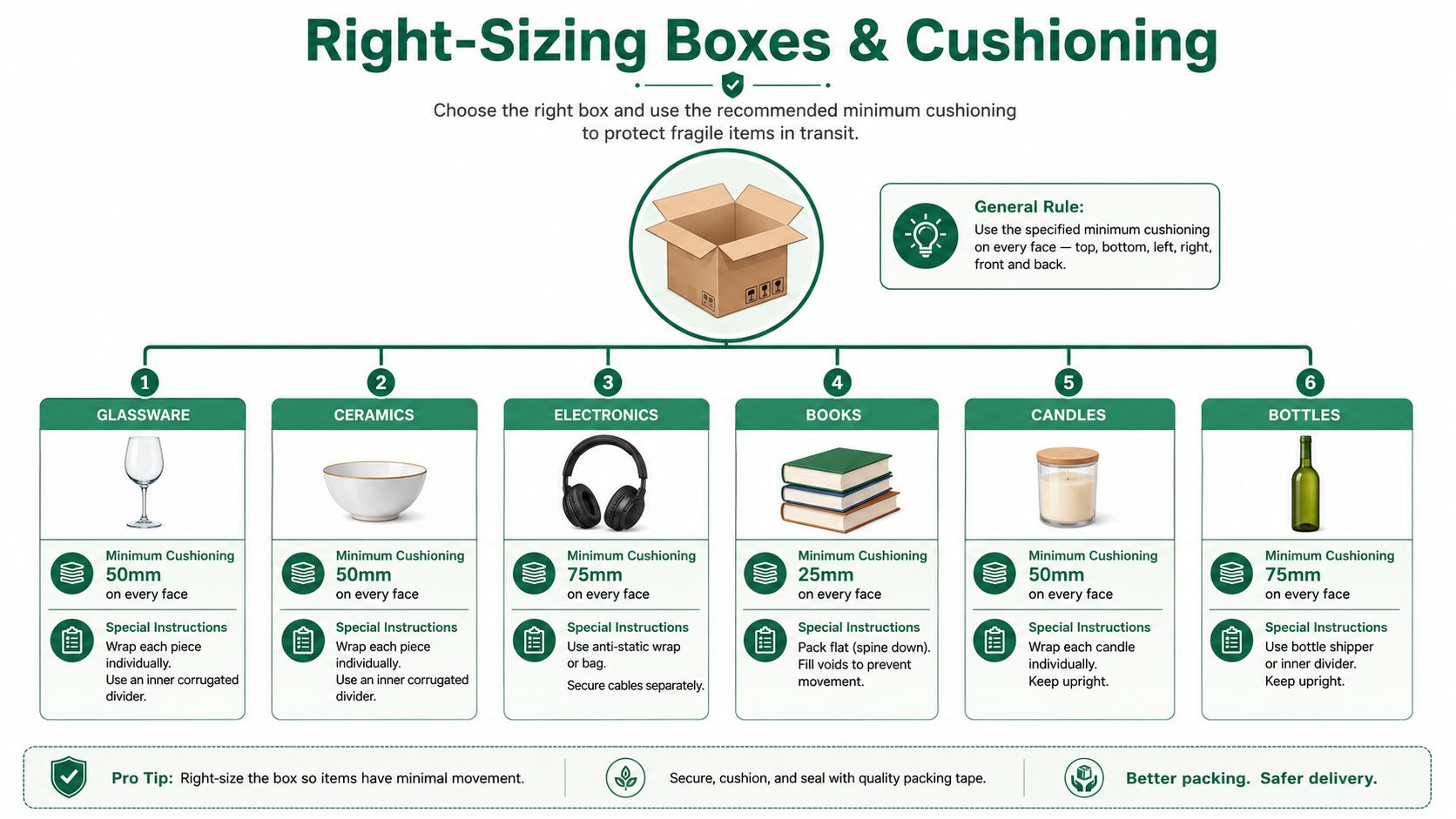
A reliable pack begins with the item category, not with whichever carton happens to be nearest. Glass, ceramics, electronics, framed art, bottles and rolled goods fail in different ways, so each needs its own protection pattern.
Match the interior to the weakness
| Item type | Packing approach | Box decision |
|---|---|---|
| Glassware | Wrap every piece separately and use at least 50 mm of cushioning on every face. Stemware needs an inner corrugated divider so glasses can't knock together. | A double-wall carton is sensible where the contents are dense or the route involves repeated handling. |
| Ceramics | Protect handles, rims and projecting edges individually. Keep pieces apart, then fill every void so they can't gain momentum. | Use a close-fitting rigid carton. Dense ceramics generally benefit from stronger board and a smaller footprint. |
| Electronics | Use anti-static foam around the device and keep the fit snug, with 30 mm walls around the protected unit. Screens and delicate components need stable support rather than loose fill. | Retain the manufacturer's box where it remains structurally sound. Otherwise, choose a strong single-wall or double-wall carton based on weight and stacking exposure. |
| Framed art | Use a custom-cut box sized 25 mm larger than the frame, with corner protectors and a stable face barrier. | Double-wall board is preferable where the frame is valuable, rigid or vulnerable to compression. Guidance on packing materials for art and mirrors offers useful context for protective layers and edge control. |
| Bottles | Keep bottles vertical in a divider grid, use absorbent material and prevent bottle-to-bottle contact. | Choose a rigid carton that supports the divider system without bowing. |
| Rolled goods | Use a triangular postal tube with secure end caps rather than a loose box. A range of Cardboard Tubes includes strong postal tubes for posters, prints, artwork and documents, with standard, heavy and extra heavy-duty wall thicknesses. | Select the wall thickness according to crush and edge risk, not just the weight of the paper. |
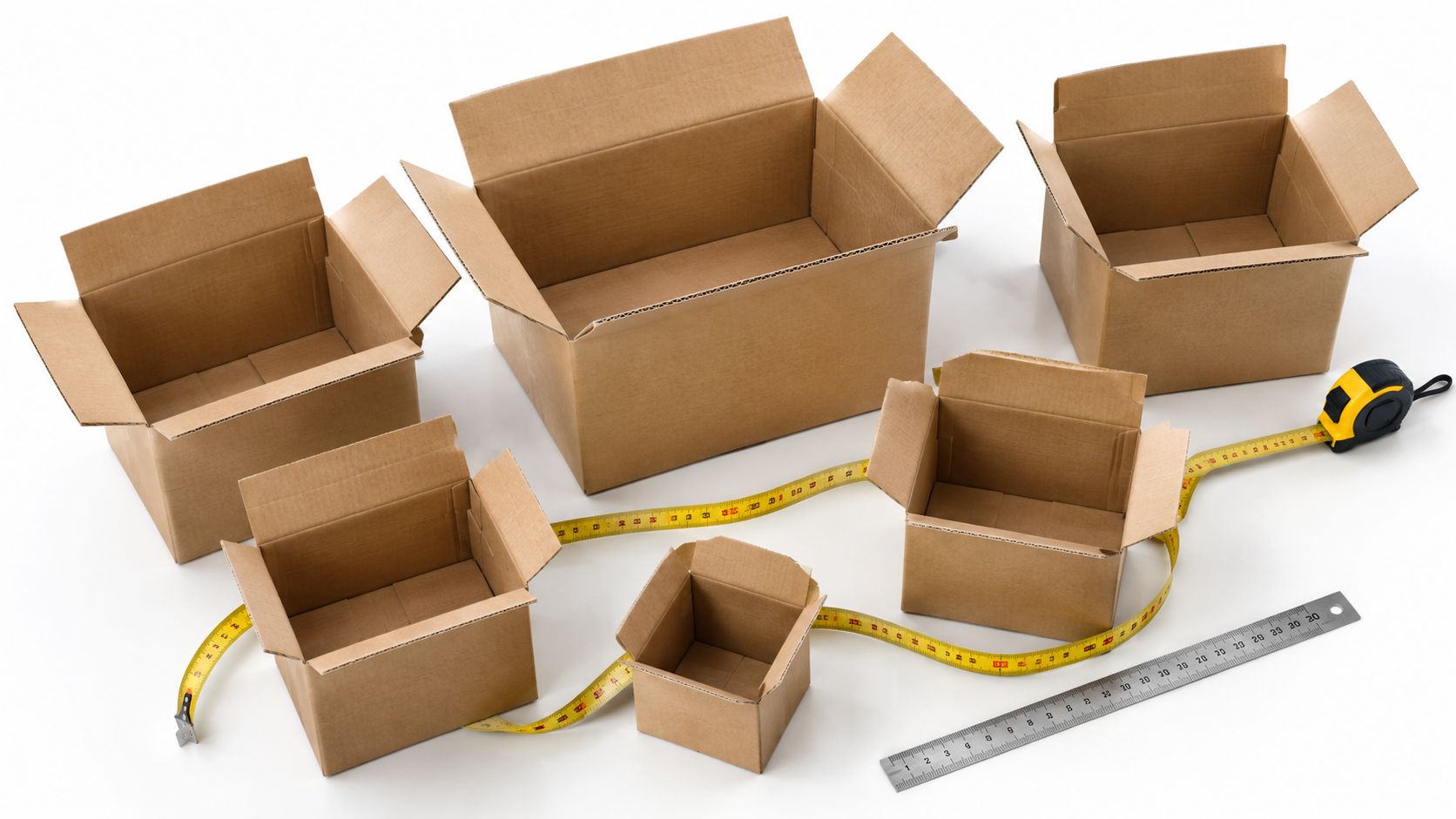
Box dimensions should be measured around the packed item, not the unwrapped product. A guide to measuring boxes helps prevent the common mistake of ordering a carton that appears suitable externally but leaves excessive internal space.
The right-sizing check
Avoid air gaps larger than 25 mm where the item can move. Fill the bottom, sides and top, then close the carton without forcing the contents against the flaps. Cushioning should compress by no more than 60% under the item's weight during a drop-test assessment. If it bottoms out, the item is effectively taking the impact directly.
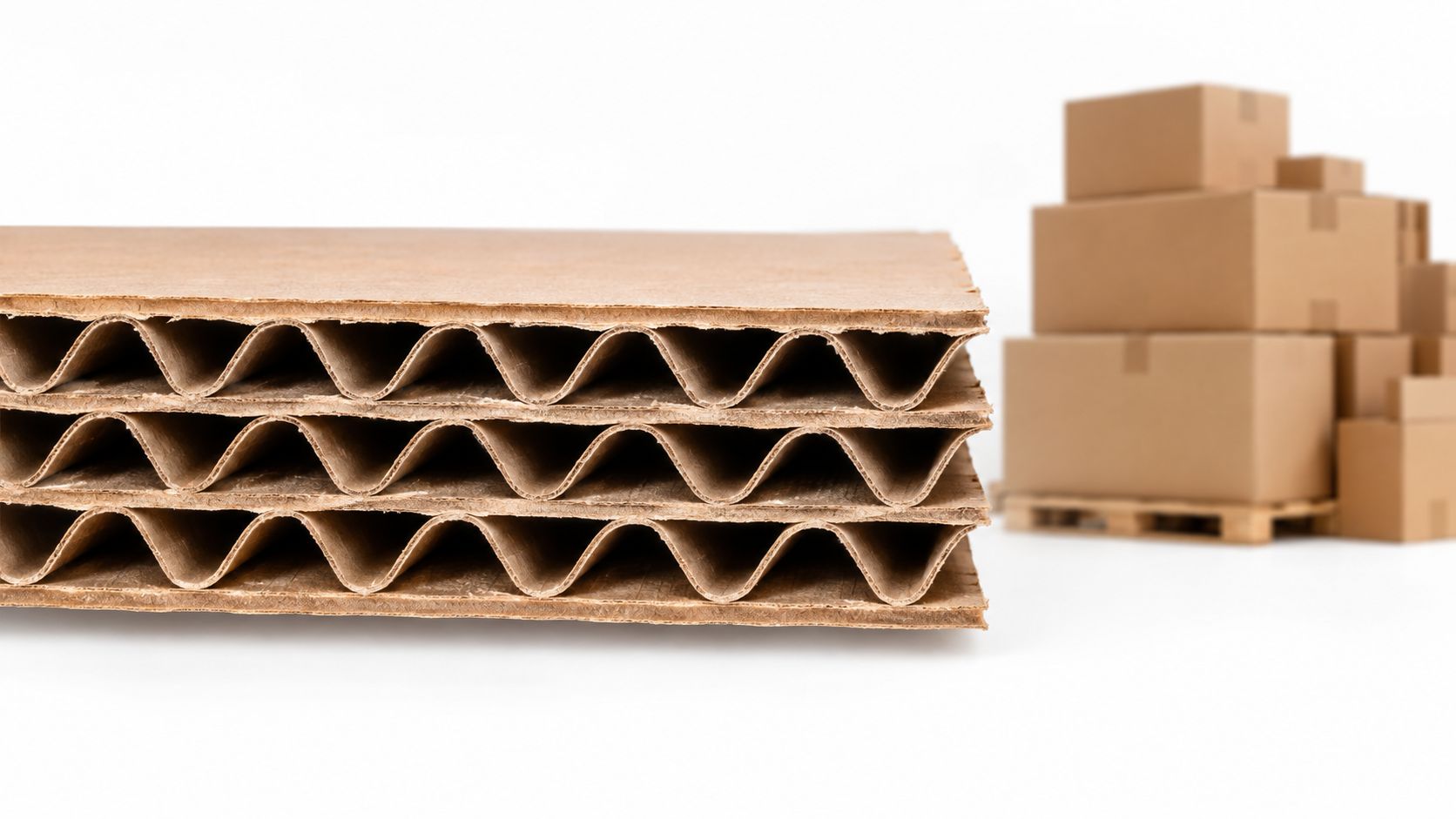
Single-wall corrugated board can suit lighter products with controlled dimensions and modest stacking exposure. Double-wall board gives the pack more resistance when contents are heavy, the box is larger or compression is a concern. Triple-wall construction belongs around unusually heavy, high-value or demanding consignments, where the extra material is justified by the failure cost.
A final shake test catches poor right-sizing quickly. After sealing, move the parcel gently. Any rattle, sliding or shifting means the box needs opening and repacking. A carton that feels tight but not crushed is the target.
Traditional versus Sustainable Protective Materials
Bubble wrap remains useful because it offers consistent impact absorption, separates surfaces and can survive repeated handling. It's particularly effective around glass edges and irregular ceramic shapes, where paper can crease away from the vulnerable point. Where a dispatch team can recover and reuse clean bubble wrap through several packing cycles, its practical value becomes stronger.
Loose polystyrene fill has a different advantage, it reaches awkward voids, but it can migrate through gaps and creates a poor unpacking experience. Kraft paper is easier to handle and recycle in many systems, yet it needs careful crumpling and enough volume to stop dense ceramics moving. Corrugated inserts provide structure and separation without relying on loose particles.
Sustainable alternatives work well when their limits are understood rather than assumed.
- Moulded pulp: Gives products a shaped cradle and can provide useful stacking support. It's a strong option for repeatable product dimensions, though it's less adaptable for mixed shapes.
- Corrugated honeycomb: Creates a lightweight structural barrier and can be cut or folded around products. It suits separation and edge protection, especially where a paper-based pack is preferred.
- Corrugated bubble: Adds a paper-based cushioning layer with a familiar wrap format, but it may not match plastic bubble wrap for every impact pattern.
- Paper void fill: Works for lighter goods and controlled gaps. It can fall short around heavy ceramics if the parcel allows the paper to compress or the item to travel.
- Mushroom mycelium wraps: Can suit shaped products where a compostable moulded solution is available, but it needs validation for the item and route.
- Compostable mailers: May be acceptable around light ceramics with a rigid internal pack. They're unsuitable as the main containment for liquids, which require a sealed inner barrier, absorbent material and rigid outer protection.
A practical comparison of these options is available in bubble wrap alternatives, but material selection still has to follow the item's failure mode.
Sustainable packaging is only lower impact when the product arrives intact. A recyclable pack that causes breakage can create more material use through replacements and returns.
For many UK dispatch benches, the workable mix is a corrugated box with recycled cushioning for ordinary stock, moulded or corrugated structures for repeatable products, and bubble wrap where reuse cycles or impact exposure justify it. Packaging data and waste reporting requirements are also tightening, with new EPR packaging data requirements in force for 2025/2026 and monthly waste reporting tracked through the Environment Agency packaging database. That makes material records important, but protection testing remains the first control.
Labelling, Sealing and Handling Instructions
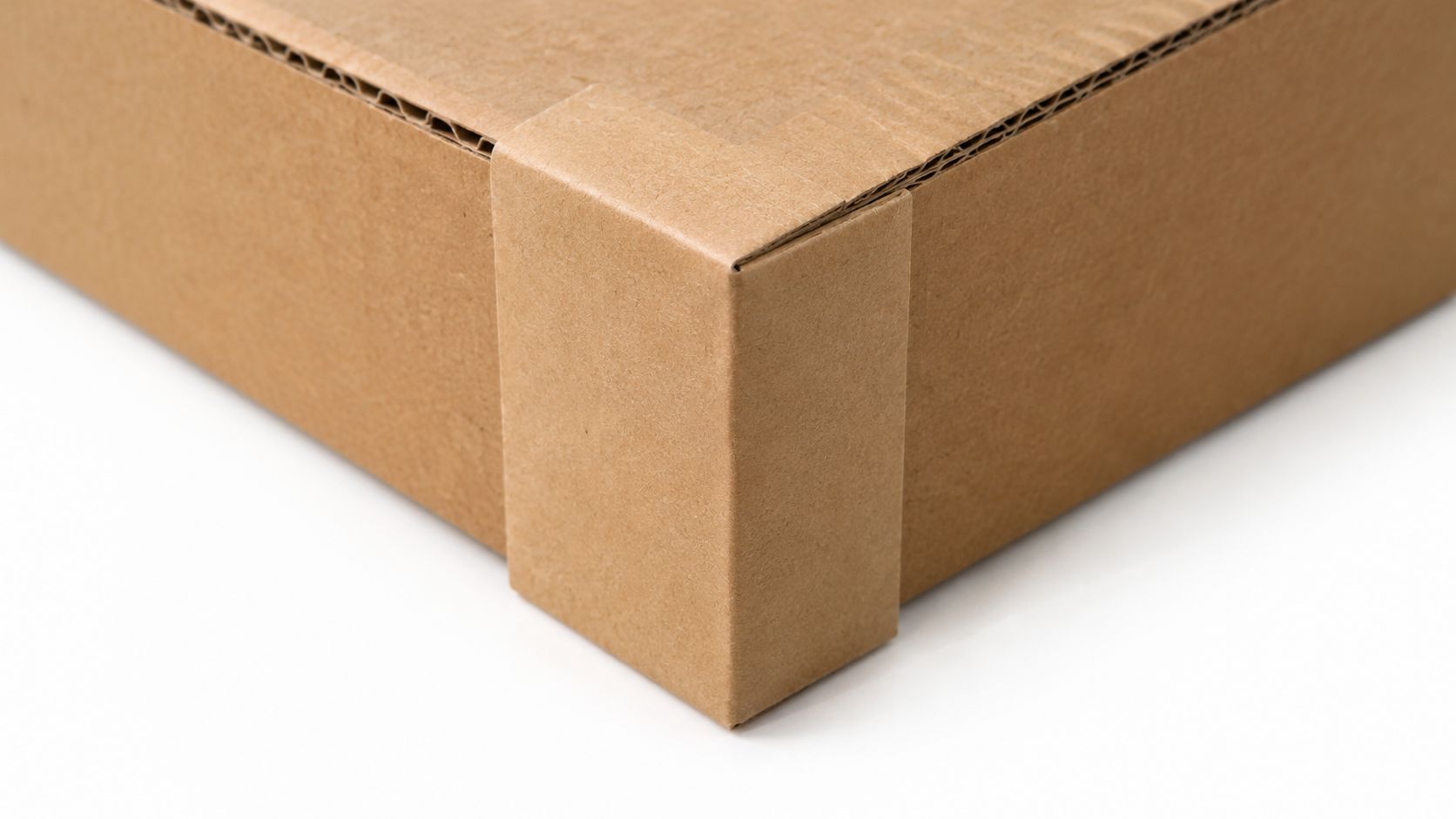
A fragile parcel needs a reliable physical closure before it needs a prominent label. The H-tape method seals the centre seam and extends tape across both end flaps, on the top and bottom of the box. A minimum 60 mm wide kraft tape gives the closure a broad contact area, while filament strapping is better reserved for heavy multi-box consignments rather than ordinary single parcels.
The carton should be clean, dry and free from old labels or barcodes. Place the delivery label on the largest flat face, away from a seam or corner, and keep the barcode smooth. Put the sender's name and return address in a sealed address pouch on the outer packaging, rather than relying on printing directly on cardboard that may scuff or become unreadable.
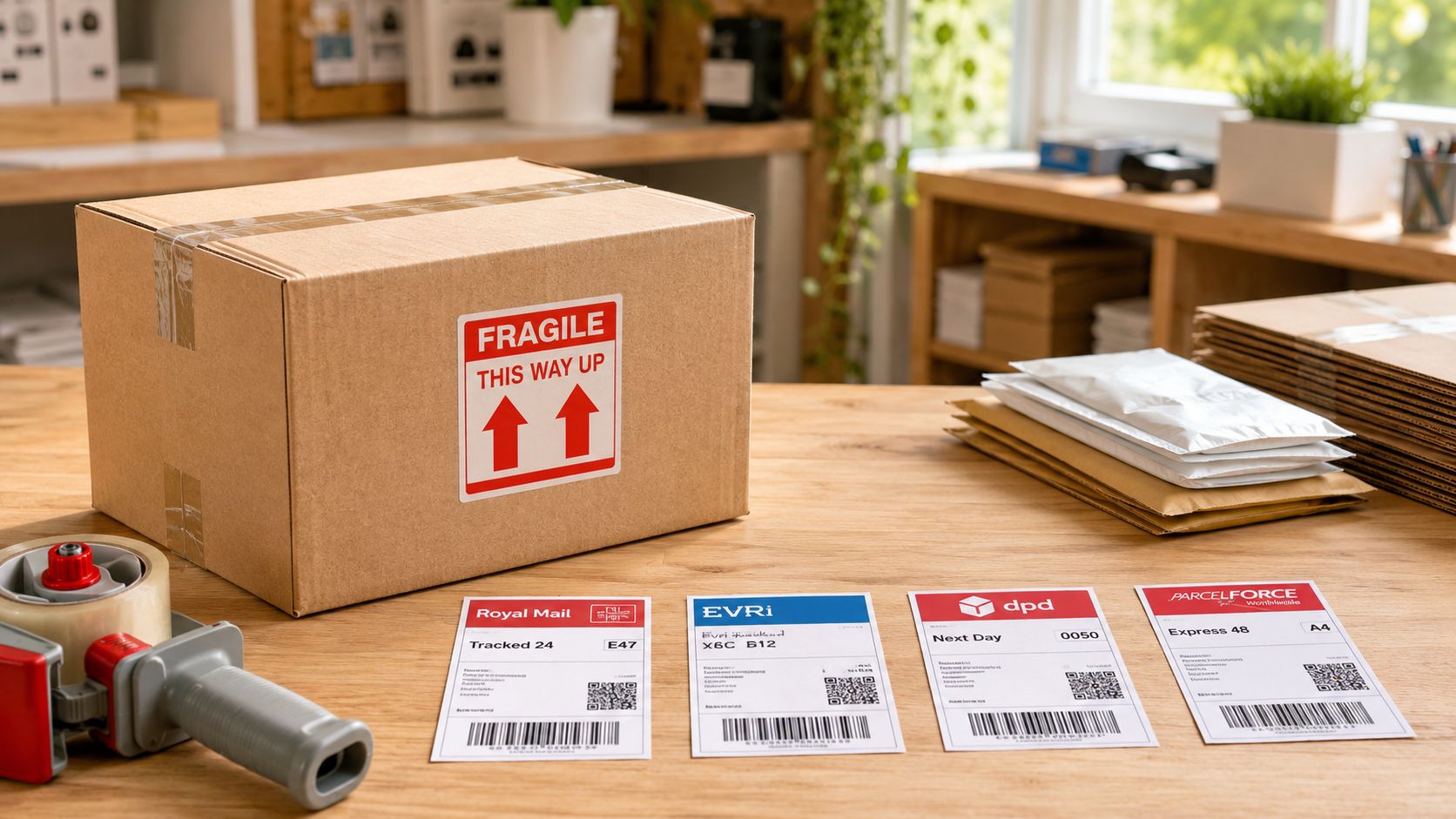
Use labels as information, not protection
Royal Mail and Parcelforce accept FRAGILE marking where appropriate, but the marking doesn't guarantee separate handling. In some automated sortation environments, a large warning label can draw attention without changing the mechanical route. The parcel still needs to be designed for normal courier handling.
Use orientation arrows only when the contents have a required position, such as bottles, framed art or equipment with a vulnerable screen. Place arrows on more than one visible side so they remain readable after stacking, and avoid putting them across the address label or barcode.
A despatch note belongs inside the parcel, protected from the contents. A returns label can sit inside a separate pouch or folded insert, but it shouldn't obscure the primary delivery label. The bench checklist can stay short:
- Closure: H-tape applied to top and bottom.
- Surface: No old labels or loose tape ends remain.
- Identification: Delivery and return addresses are visible.
- Orientation: Arrows are used only where position matters.
- Movement: The sealed parcel passes the shake test.
- Record: Contents, declared value and packaging choice are logged.
That process works across Royal Mail, Evri, DPD and Parcelforce because it controls the parcel before carrier handoff, rather than depending on a particular driver or depot.
Testing and Carrier-Specific Risk for UK Shippers
A packaging design should be treated as a physical system that needs validation. Shock, vibration and compression expose different weaknesses, so a parcel that survives a bench drop may still fail after repeated movement or stacking. UK testing providers use shock machines for product damage boundary analysis and vibration equipment for resonant-frequency response testing, while facilities such as Tri-Wall and other UKAS-accredited or authorised test stations can assess packaging against performance standards, as outlined by Tri-Wall's packaging-testing service.
ISTA protocols provide a useful vocabulary. ISTA 1A is commonly associated with basic packaged-product screening, ISTA 2A adds broader performance considerations, and ISTA 3A is used for more general parcel-delivery simulation. A small Etsy seller doesn't necessarily need a full laboratory programme for every product, but a high-value or frequently damaged SKU deserves more than an informal assumption that extra wrap will solve the problem.
Practical tests before scale-up
A one-person dispatch bench can expose obvious weaknesses:
- The 1 m drop: Test a sealed sample from different faces, including a corner, onto a hard surface. Open the parcel and inspect both the product and the cushioning for bottoming out.
- The corner-impact trial: Pay particular attention to framed art, boxes with projecting contents and cartons where a corner carries most of the load.
- The shake test: Move the closed parcel gently in several directions. Any audible or physical movement signals insufficient void fill or separation.
- The compression check: Place a representative load above the carton briefly and inspect for board collapse, crushed corners or contact with the contents.
Carrier risk varies by service, route and parcel profile, so businesses shouldn't treat a courier name as a complete risk model. Letterbox routes and parcel-post formats expose small packs to different pressures from larger consignments, while automated sortation can create repeated orientation changes. Heavier ceramics may need stronger board and reinforced bases, whereas light glass can be vulnerable to sudden movement inside an oversized carton.
The scale of the network matters. More than 4.2 billion parcels were delivered in the UK in 2024, with about 1% reported as missing or arriving damaged, according to Ofcom-linked parcel-delivery coverage. A UK consumer survey cited by DS Smith put the average value of a damaged product at £115 per item, with shoppers opening about three damaged items on average, as reported in the same trade coverage.
Before increasing dispatch volume, verify the packaging specification, service level, declared value, compensation terms and claims evidence required by the carrier. Insurance won't repair a weak pack, and a damage label won't replace a test.
Ordering, Fulfilment and Dispatch Timing
Fragile packing becomes easier to control when the warehouse makes the right choice obvious. A mixed stock of single-wall, double-wall and triple-wall boxes lets packers match board strength to product weight and handling exposure. Keeping both 30 mm and 50 mm cushioning media available prevents improvised layering, while placing void fill, tape and FRAGILE labels on one pick-face reduces searching and inconsistent substitutions.
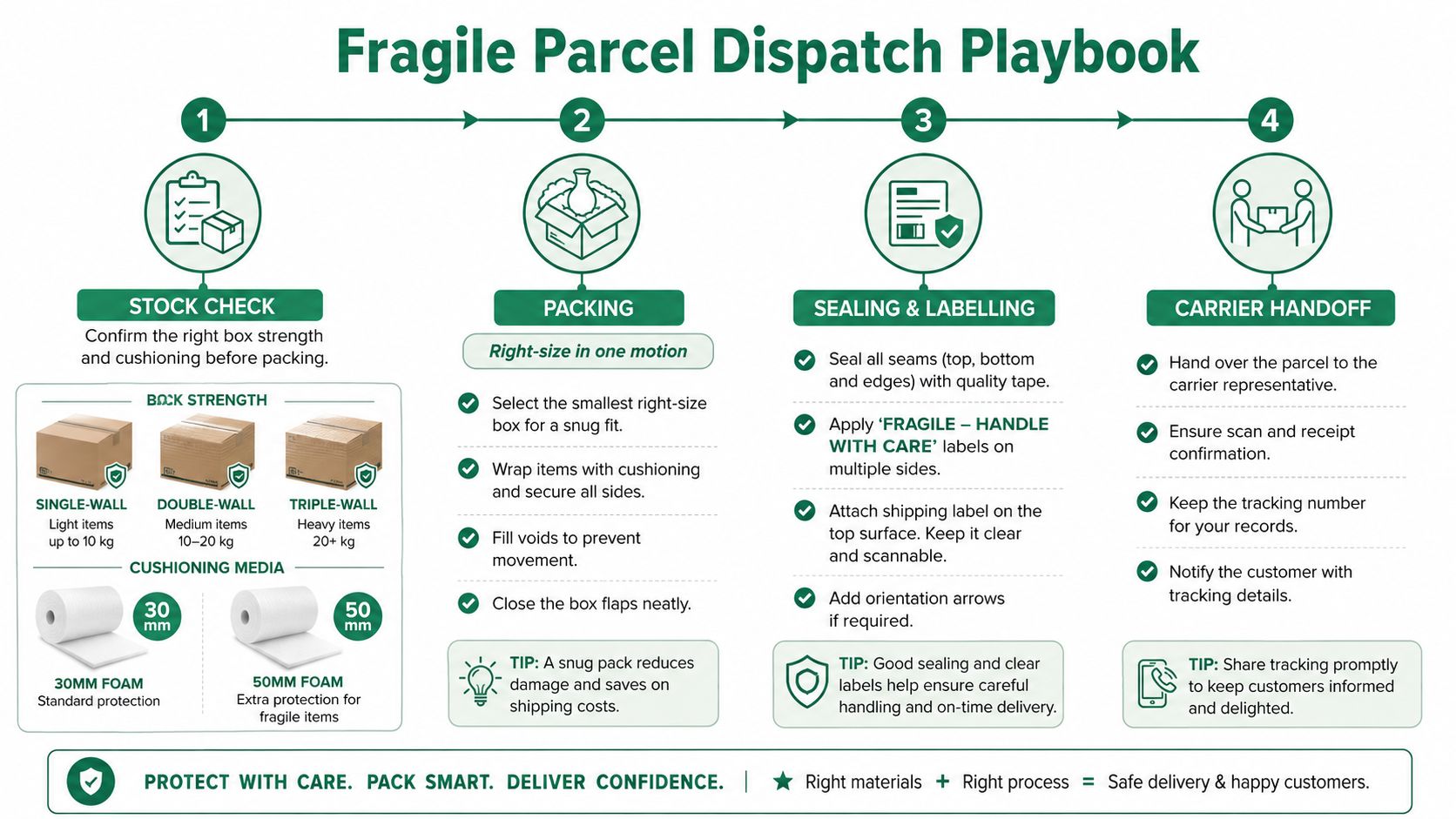
Build the workflow around the product
A weekly stock check should compare available packaging with the previous four weeks of orders. That review flags shortages before they stop the line, particularly for popular carton sizes, dividers, corner protectors and absorbent materials. The check should include damaged or warped stock, because a box that has lost its shape can fail before the carrier receives it.
Packers should confirm the courier service code against parcel weight, dimensions and declared value. Royal Mail's 2 kg and 20 kg pricing tiers affect service selection, while Parcelforce compensation limits matter when sending higher-value glass, ceramics or framed art. These limits should be checked against the current service terms rather than assumed from an old account setting.
The carton also needs measuring before booking. An under-filled oversized box can attract volumetric charging and gives the contents room to move, so right-sizing supports both protection and cost control. For carrier comparisons and service details, teams can find shipping info before changing a dispatch profile.
Control timing as well as materials
Fragile consignments should leave earlier in the day where the operation allows it. Friday dispatch can create longer depot dwell time for long-haul zones, so businesses should avoid it where a safer collection day is available. The purpose isn't to promise gentler handling. It's to reduce unnecessary waiting, rehandling and uncertainty in the route.
The final operational record should map packaging spend against damage returns. If a thicker carton costs more but prevents repeated replacements, the decision becomes measurable rather than anecdotal. If a paper alternative performs well for one product but fails around another, the warehouse can segment materials by SKU instead of forcing a single sustainability policy across every item.
Packaging Panda supplies UK businesses with recyclable cardboard boxes, compostable mailers, protective packaging, tapes, cardboard tubes and made-to-order packaging options for fragile dispatch workflows. Review the available materials and right-sized solutions at Packaging Panda, then choose the combination that gives each product enough protection without unnecessary material.