How Shock Absorbing Materials Protect UK Parcels in Transit

You've packed a parcel well, taped the seams, and handed it over thinking the job is done. Then the customer messages with a cracked item, a dented tin, or a shattered mug, and the whole unboxing experience turns into a refund or a replacement.
That failure usually isn't about the product alone. It's about the shock absorbing materials inside the box, and whether they were matched to the actual journey through a UK courier network, not just to how the parcel looked on the packing bench.
Table of Contents
- When the Wrong Cushioning Costs You Sales
- How Shock Absorbing Materials Work
- Common Types of Shock Absorbing Materials
- Understanding Performance Trade-offs
- Testing Standards and Practical Verification
- Sustainability and Cost Considerations
- Making the Right Choice for Your Parcels
When the Wrong Cushioning Costs You Sales
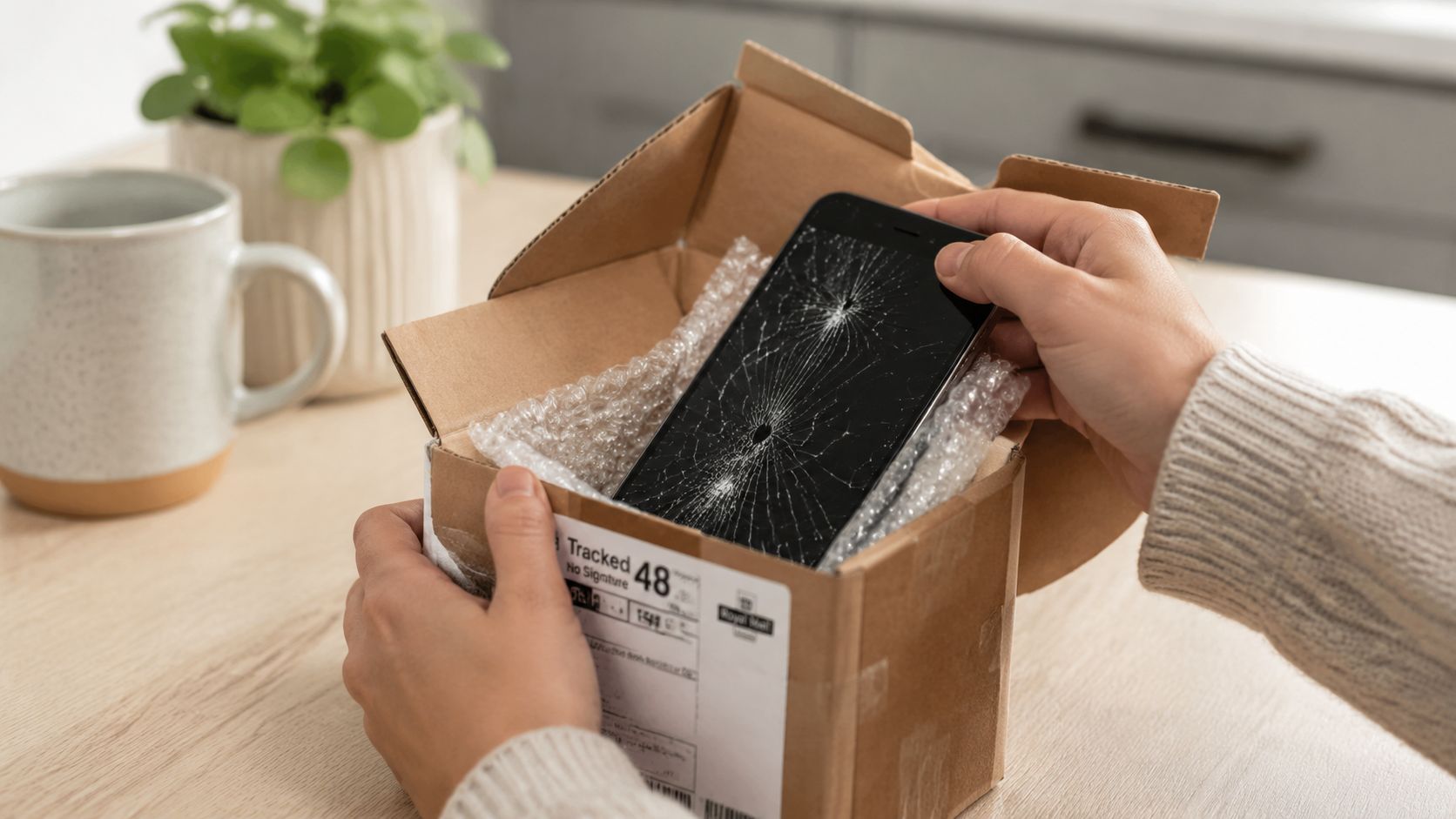
A seller can get everything else right, product photos, branded tape, a neat insert card, then lose the sale on the last mile. A cracked phone screen or a split glass bottle tells the customer that the parcel was not protected for the journey it took.
That's why cushioning is a commercial decision, not a filler decision. A parcel that arrives damaged creates rework for the warehouse, awkward customer service calls, and a return that eats into margin. In the UK, where parcels are handled repeatedly through depots, vans, sorting belts, and stackable loads, the wrong insert can undo the rest of the fulfilment process.
What damage really tells you
A broken item often means the pack-out was designed for presentation, not impact. A soft-looking void fill can still allow a product to travel, and movement inside the box is usually where the trouble starts.
Practical rule: if the item can rattle, shift, or touch the carton wall, the parcel is still under-protected.
That is why protective packaging has to fit the product, not the other way round. Packaging Panda's Protective Packaging range is described as padded bags, bubble mailers, foam inserts, honeycomb sleeves and void fill, which is the sort of mix fulfilment teams usually need when they're trying to stop damage without overpacking.
A one-size-fits-all approach rarely survives real courier handling. A ceramic mug, a boxed perfume bottle, and a rolled print each fail in different ways, so the cushion has to answer a different risk profile each time.
How Shock Absorbing Materials Work
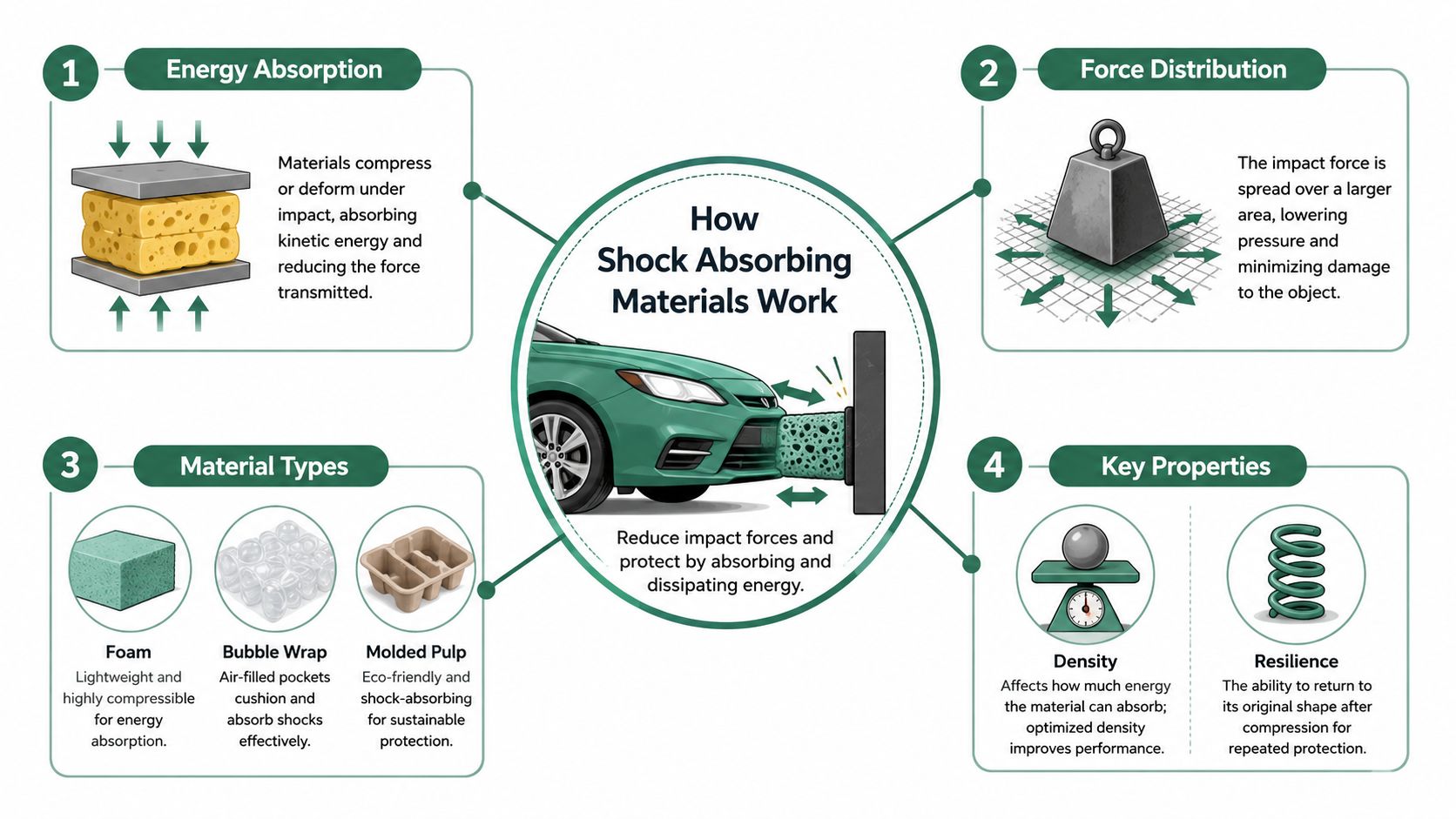
A shipping carton that looks fine on the packing bench can still fail once it enters a courier network. The item has to survive pick and pack, conveyor vibration, stack pressure, temperature changes, and the final handoff, so the cushioning needs to manage more than one kind of stress.
The easiest way to understand shock absorbing materials is to think about a vehicle suspension system. The spring does not remove the bump, it manages the energy so the body of the vehicle does not take the full hit.
The same idea applies in a parcel. When a box is dropped, the impact energy has to go somewhere, and the cushioning material should take as much of it as possible through deformation, heat, and elastic storage instead of passing it straight to the product. A material that feels soft in the hand is not automatically a good absorber.
Why softness is not the same as protection
A cushion can compress easily and still be poor at dissipating impact. Good shock protection comes from the material's internal structure and how it turns a sudden event into controlled movement rather than a hard stop.
NASA's history of memory foam is a useful reminder of that point. Memory foam was developed in 1966 by NASA-contracted engineer Charles Yost and commercialised in 1969 as “temper foam”, using an open-cell polymeric foam with unusually high energy absorption (NASA history). That origin matters because the material was designed for crash and vibration protection, not just comfort.
For parcel work, the key idea is rate dependence. A material can behave one way under a slow warehouse stack load and another way under a sudden drop, which is why a cushion that looks fine in storage can still fail in transit.
Where the cushioning does the work
In practice, the material has to absorb impact and hold its shape long enough to keep the item centred. If it compresses too far, the product bottoms out against the carton. If it rebounds too quickly, it can let the item move again before the parcel has finished shaking.
That is why packaging teams need to match the insert to the journey, not just the product. Packaging Panda's Protective Packaging range is described as padded bags, bubble mailers, foam inserts, honeycomb sleeves and void fill, which is the sort of mix fulfilment teams usually need when they are trying to stop damage without overpacking.
For many dispatch lines, open-cell foams and viscoelastic inserts earn their keep. They are chosen not because they feel premium, but because they control motion, reduce transmitted force, and keep the item from becoming part of the box's movement.
A practical example is Fillaree's black silicone sleeve. It shows the same principle in a smaller format, a protective layer that manages contact and movement without adding unnecessary bulk.
Common Types of Shock Absorbing Materials
A parcel can leave the bench looking secure and still behave very differently once it moves through pick, pack, depot handling, conveyor vibration, stacking, and the final drop at the door. The main packaging choices fall into a few groups, and each one does a different job depending on whether the risk is void space, edge impact, vibration, or repeated movement inside the carton.
Foam, paper, air, and rubber-based damping
Polyurethane foams are widely used because they combine cushioning with resilience. Materials research on polymer foams shows that shock-absorber grades can respond quite differently under slow compression and impact-rate loading, which is why a foam can feel acceptable in hand and still react much harder in transit. That is the practical point for UK parcel work, the box has to survive courier handling, not just a bench squeeze.
Paper-based padding suits lighter goods and brands that want an easier recycling route, provided the item is not especially fragile. It works well where the main task is to keep the product centred and stop it rattling inside the shipper. Air cushions are useful for void fill and for tightening up loose pack-outs, but they still depend on correct fill volume and a carton that closes without stressing the product. Rubber-based damping compounds are better suited to vibration-heavy or higher-energy applications, where the aim is to reduce peak force instead of just padding a corner.
For a simple reference point, a buyer comparing protective options can review Packaging Panda's protective packaging range, which shows the sort of mixed assortment fulfilment teams often draw from when they need to control movement without overpacking.
A practical example is Fillaree's black silicone sleeve. It shows how silicone-based protection is presented for delicate items, with a focus on contact protection and movement control rather than bulk.
| Shock Absorbing Materials at a Glance | Best For | Sustainability | Cost Level |
|---|---|---|---|
| Expanded foam inserts | Fragile boxed goods, cut-to-shape protection | Varies by polymer and reuse potential | Moderate |
| Paper padding | Lighter parcels, branded mailers, recyclable packs | Strong | Low to moderate |
| Air cushions | Void fill, light cushioning, bulk reduction | Depends on material and reuse | Low to moderate |
| Rubber-based damping | Vibration-heavy or high-shock items | Usually weaker on end-of-life story | Higher |
Where warehouse wrapping fits in
For palletised movement, Pallet Wrap is a different tool again. It does not absorb shock in the same way as foam or pads, but it holds the unit load together so the stack does not shift before it even reaches the courier network.
Useful distinction: cushioning protects the product, while pallet wrap protects the load geometry around the product.
That is why the right pack often combines more than one material. A rolled print may need a rigid tube, edge protection, and a sleeve. A bottle may need a formed insert inside a carton. A cake box may need a stabilising layer that prevents side-to-side movement without crushing the outer presentation.
Understanding Performance Trade-offs
A parcel can pass through a warehouse pick face, a packing bench, a courier cage, a van floor, and a final doorstep handoff without ever being treated gently. The cushioning that works cleanly in one of those stages can be awkward, wasteful, or weak in another, so there is no single material that wins every route.
Stiffness and energy absorption pull in opposite directions
A stiffer material resists compression, which helps when cartons are stacked in a depot or squeezed into a tight trailer bay. Push the stiffness too far, and more shock is sent straight into the product during a drop or a sharp knock. A softer material can absorb more movement, but if it compresses too far it stops protecting and starts bottoming out.
That trade-off is why foam data has to be read in context. In one comparison of polymer foams, the same family of material behaved differently under impact-rate loading than it did under slower compression, which is exactly the sort of mismatch that shows up in courier work (polymer foam comparison study). A box that copes with a slow squeeze on a packing bench can still fail if a handler drops it from working height or if vibration keeps working the contents loose across a short UK route.
More material is not always better
Overpacking creates its own headaches. Extra thickness uses more carton space, slows pack-out, and can make closure harder to control. It also leaves the product sitting too tightly in the box, so a hard corner or edge ends up carrying the load instead of the cushioning.
Engineered materials often perform better than adding bulk. High-damping polyurethane systems are a clear example, because their technical data shows they can absorb up to 94.7% of impact shock and work across roughly -29°C to 72°C and a broad frequency band from 10 to 30,000 Hz (Sorbothane technical data). That kind of range is useful where parcels face courier vibration, repeated handling, and sudden drops, but only if durometer, thickness, and contact area are matched to the item and the carton.
The practical lesson is straightforward. The pack needs enough give to avoid bottoming out, but it cannot be so stiff that the product itself becomes the shock absorber.
Testing Standards and Practical Verification
Testing should follow the journey, not just the brochure. A parcel does not experience a neat lab event, it gets lifted, stacked, vibrated, knocked, and sometimes left in a vehicle that is colder or warmer than the warehouse.
What to verify before buying at scale
Suppliers often provide lab reports, and those are useful, but they should be read as starting points. The important question is whether the test setup matches the route your parcels take, including depot handling, courier vibration, and any temperature swings in transit.
The older UK and European transport lesson is still relevant here. The move from simple springing toward dedicated dampers in the late 19th century shows that shock management evolved because real movement patterns needed more than one solution (historical transport context). That same principle applies to parcel testing, where one drop test cannot replace the full handling profile.
The checks that matter in practice
- Drop performance: confirms whether the product stays centred and protected when the parcel hits a hard surface.
- Vibration resistance: shows whether the item shifts or wears during repeated vehicle and conveyor movement.
- Compression resistance: checks whether stacked parcels crush the cushioning before delivery.
- Route trials: reveal whether the chosen insert survives actual courier handling, not just a controlled sample.
A supplier report is useful when it reflects the same carton size, product weight, and cushion thickness being used in production.
For businesses shipping regulated or sensitive goods, labelling and pack presentation can matter as much as the insert itself. Guidance on sterility and labelling standards is a useful reminder that protective packaging choices should sit alongside compliance needs, not apart from them.
A short pilot run beats a large blind order. Real parcels, sent on real routes, tell the truth much faster than a spec sheet does.
Sustainability and Cost Considerations
Eco-friendly packaging has real value, but it is not automatically the lower-risk option. A sustainable cushion that underperforms can create damage, and damage creates replacement shipments, extra materials, customer complaints, and more transport miles.
Where greener materials work, and where they don't
Recent research points to a real design gap in packaging advice, because much of the public discussion treats recyclable or compostable cushioning as better without asking whether it protects the product well enough through the full parcel journey (shock-absorbing materials gap analysis). That matters in the UK, where the wrong choice can increase both waste and operational friction if parcels come back damaged.
Paper-based and fibre-based cushioning can be the right answer for many products, especially where the item is light, the carton is well sized, and the route risk is modest. But if the goods are fragile, premium, or heavy, a material that looks greener on paper can still lose on total impact once breakages are counted.
Cost is more than the unit price
The cheapest insert on the invoice is not always the cheapest option in the business. A low-cost material that lets more parcels fail can cost more through refunds, replacement stock, labour, and customer retention damage.
For sellers comparing void fill styles and mailer options, Packaging Panda's guidance on bubble wrap alternatives is a helpful practical reference point for thinking about replacement materials in a UK fulfilment setting. It fits the same real-world problem, deciding when a greener material is good enough and when it is too soft, too thin, or too inconsistent for the route.
The best sustainability decision is the one that reduces waste without creating damage elsewhere. That means the material has to be judged on performance, recovery, and the likelihood of a clean delivery, not just on its end-of-life story.
Making the Right Choice for Your Parcels
Start with the product, not the material. Weight, fragility, value, shape, and how much movement it can tolerate should drive the choice, then the route conditions and the sustainability target should narrow it further.
A simple decision path
- Heavy or rigid goods: choose cushioning that resists bottoming out and protects corners.
- Light but fragile goods: use inserts or wraps that stop movement without adding unnecessary mass.
- Courier-vibration sensitive goods: prioritise damping and controlled recovery over simple softness.
- Brand-led parcels with compliance needs: check pack presentation, labelling, and any handling rules before choosing the insert.
For sellers comparing mailer formats, choosing the right padded mailer is a useful operational question, because the outer pack and the cushion have to work as one system.
Decision rule: the right material is the one that survives your actual route, your actual item weight, and your actual packing method.
For a practical starting point, Packaging Panda supplies protective packaging for transit, including padded bags, bubble mailers, foam inserts, honeycomb sleeves, and void fill, which gives UK sellers a straightforward place to source the kind of cushioning used in real fulfilment workflows. The job is not to pick the softest option, it's to pick the one that keeps the parcel intact from pick line to doorstep.
If your parcels are costing you refunds, re-shipments, or awkward customer complaints, it's time to tighten up the pack-out. Visit Packaging Panda to review protective packaging, padded mailers, and transit-ready materials that fit real UK fulfilment conditions.