Bubble Wrap Alternatives for UK Business: A 2026 Guide
Orders are going out. The packing bench is covered in boxes. A roll of plastic bubble wrap is still the default because it's familiar, quick, and usually good enough. But for many UK SMEs, “good enough” has stopped being the true test.
See our eco-friendly bubble wrap alternatives →
The test is whether the packaging protects the product, fits the brand, and keeps total fulfilment costs under control. A cheaper wrap that causes more breakages isn't cheaper. A greener material that slows packing or fails on cold-weather deliveries isn't better. That's why choosing bubble wrap alternatives has become a practical operations decision, not just a sustainability one.
A lot of advice in this area still falls short. It lists compostable or recyclable materials, but it doesn't answer the harder questions. Can paper protect fragile electronics on a rough courier route? Can a plastic-free option help with bakery or cosmetic shipments in a UK winter? The British Business Bank's guidance on eco-friendly packaging alternatives notes that existing content rarely addresses this performance gap for temperature-sensitive or heavy-duty UK shipments.
For teams reviewing the wider packing process, not just parcel fill, resources like Best London Removals Ltd's guide to packaging materials for a smooth house move can also be useful because they show how material choice changes depending on handling risk, surface sensitivity, and item weight. Businesses that want a broader view of sustainable shipping materials can also review Packaging Panda's eco packaging range alongside the product-specific advice below.
Table of Contents
- Beyond the Bubble Rethinking Your Protective Packaging
- An Overview of Top Bubble Wrap Alternatives
- A Deep Dive into Paper-Based Alternatives
- Exploring Innovative Biodegradable Materials
- How to Match the Alternative to Your Product
- Calculating the True Cost of Protective Packaging
- When to Choose Bespoke Packaging Solutions
Beyond the Bubble Rethinking Your Protective Packaging
Plastic bubble wrap still survives in many dispatch operations for one simple reason. It's predictable. Staff know how much to use, buyers know what it costs upfront, and many operations have built their packing process around it.
That doesn't mean it's the right answer for every product line now. UK e-commerce businesses are dealing with tighter margin control, more scrutiny on packaging waste, and customer expectations that extend beyond whether the item arrived intact.
Where most advice goes wrong
Many guides treat sustainability as if it's the only variable. They compare recyclability and compostability, then stop there. That leaves a major gap for businesses shipping heavy, sharp-edged, high-value, or temperature-sensitive goods.
The operational question is tougher. A retailer sending candles, ceramics, skincare, supplements, or bakery items needs to know whether a bubble wrap alternative still performs after conveyor drops, van stacking, depot handling, and doorstep storage. For those shipments, material choice has to be judged on protection, speed of use, disposal route, storage footprint, and customer presentation together.
Practical rule: Don't replace bubble wrap with “eco packaging” in the abstract. Replace it with a material that suits the failure point in your current packing process.
What a smarter review looks like
A useful packaging review starts with three direct questions:
- What usually goes wrong: Product breakage, scuffed surfaces, moisture exposure, temperature drift, or wasted box space all need different fixes.
- Where the cost sits: Some businesses overspend on material. Others lose more through damaged returns, bulky storage, or awkward manual packing.
- What the customer sees: A paper-based wrap can also improve unboxing and recyclability at home, which matters for gift, lifestyle, and premium retail categories.
For many SMEs, the right shift isn't a total replacement programme. It's a product-by-product switch. Honeycomb paper may suit ceramics. Wool may suit insulated or heavier goods. Loose-fill compostables may suit irregular shapes. The decision has to follow the parcel risk, not the trend.
An Overview of Top Bubble Wrap Alternatives
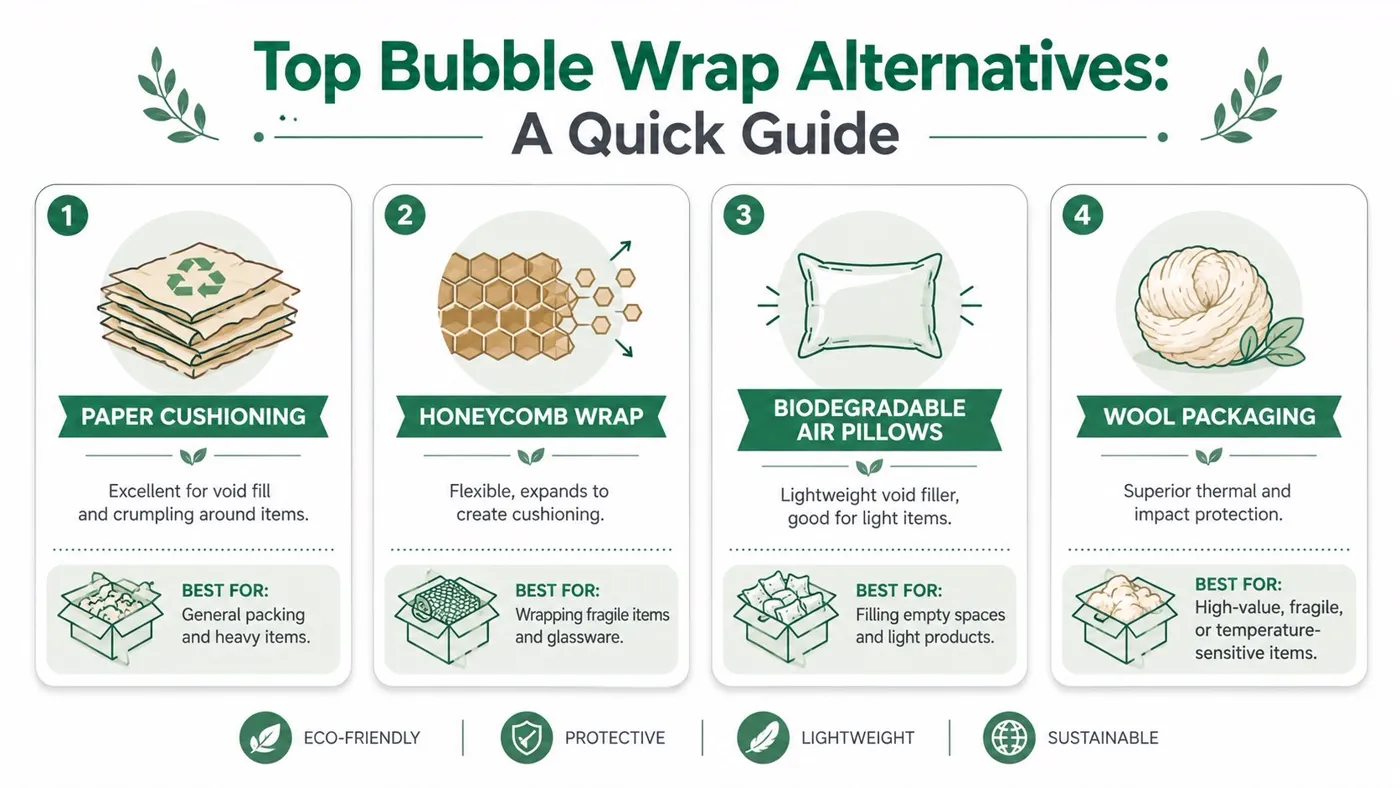
Busy fulfilment teams usually need a short list before they need a deep analysis. The table below gives that shortlist.
| Alternative | Protection profile | End-of-life route | Relative cost view | Best for |
|---|---|---|---|---|
| Honeycomb paper wrap | Medium to high for surface wrap and corner protection | Recyclable and biodegradable | Often viable where presentation and storage matter | Ceramics, glassware, gift items, boxed retail products |
| Corrugated paper wrap or sheets | Medium to high with more rigidity | Recyclable | Useful when structure matters more than softness | Heavy retail packs, layered protection, boxed goods |
| Biodegradable air pillows | Light to medium, mainly void fill | Depends on material and disposal route | Efficient for low-weight void fill if used correctly | Light items, larger cartons with empty space |
| Wool packaging | High cushioning with insulation benefits | Compostable and reusable in some formats | Usually chosen where performance justifies it | Cosmetics, food, pharmaceuticals, premium fragile goods |
| Starch loose fill | Light to medium for void fill around awkward shapes | Compostable, some dissolve in water | Good for irregular items, less tidy for premium presentation | Mixed-product cartons, awkward shapes, basket-style packing |
The shortlist most UK sellers end up with
For most retail businesses, the realistic shortlist narrows quickly.
Honeycomb paper wrap works well when the goal is to wrap individual units cleanly and avoid a plastic look. Corrugated paper becomes more attractive when the parcel needs firmer structure. Biodegradable air pillows are usually a void-fill tool, not a direct wrap replacement. Wool packaging sits in a more specialist category where insulation or added cushioning matters.
A broader perspective can help here. Fulfilment-focused resources such as AUSFF's recommendations for packing alternatives are useful because they frame packaging by use case instead of by material trend alone.
Where a ready-made mailer fits
For small boxed products or flatter retail items, a padded paper mailer can remove the need for separate wrap entirely. One example is Colour Kraft Honeycomb Eco Bags, which are wholesale colour kraft honeycomb padded mailers in dark green, orange, red and black, with 100% recyclable, plastic-free protection and free delivery over £150.
The simplest packing line is often the cheapest one. If a mailer can replace a wrap-plus-box process without increasing risk, that's worth testing.
The key point is that no single alternative replaces bubble wrap in every scenario. Some replace the cushioning function. Some replace the void-fill function. Some change the pack format altogether.
A Deep Dive into Paper-Based Alternatives
A common UK SME packing problem looks like this. Orders are growing, bench space is tight, and the team wants to move away from plastic without increasing breakages or pack time. Paper can solve that, but only if the format matches the job.
Honeycomb wrap and why it works
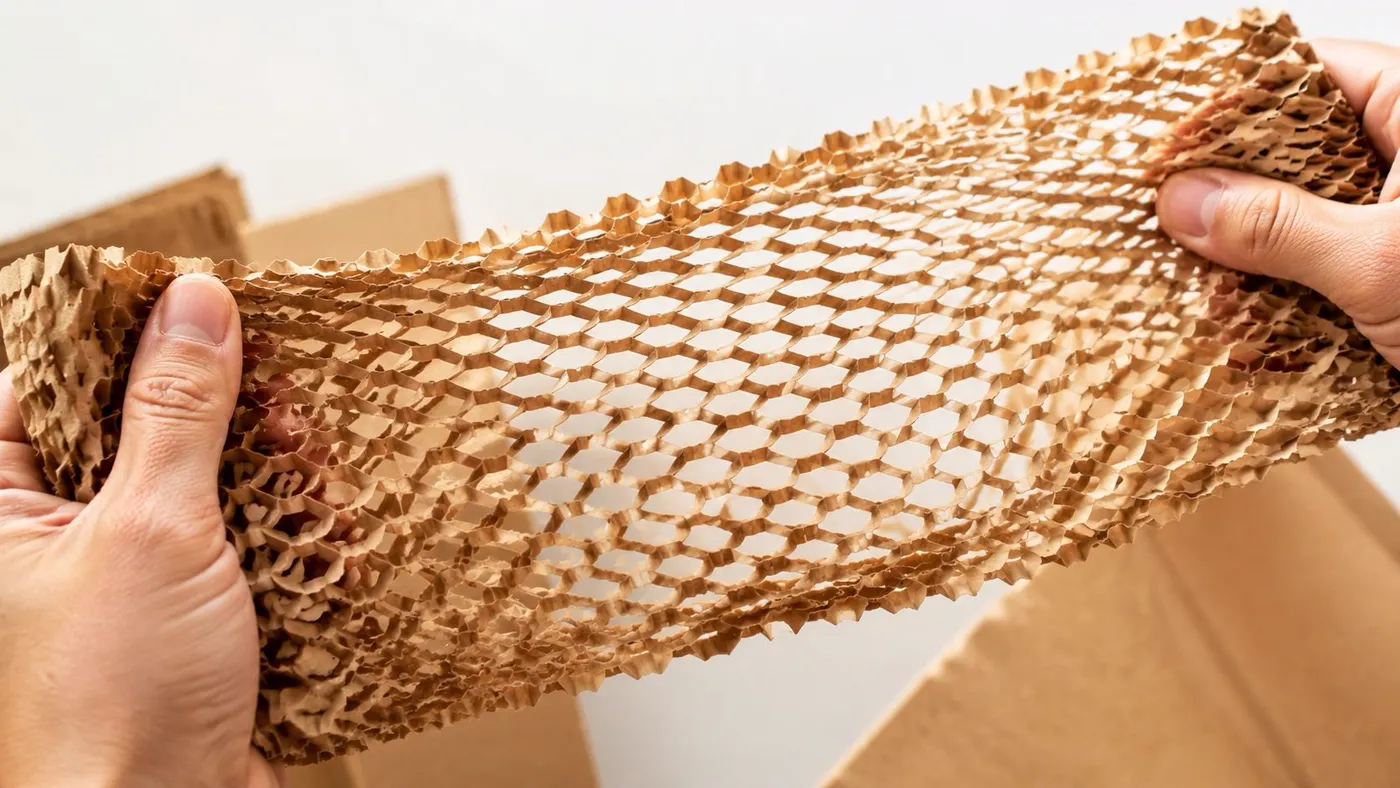
Honeycomb paper wrap expands into a cut-paper mesh that grips the product as it wraps. That grip matters on a busy packing line because the material stays put with less tape, and the cushioning sits where it is needed instead of sliding loose inside the carton.
Controlled benchmarking cited by Globe Packaging found that honeycomb paper wrap can absorb impact at a level comparable to plastic bubble wrap in drop tests, with good corner and edge protection for items such as glassware and ceramics. It is also static-free, which makes it a sensible choice for products where surface finish matters.
The trade-off is straightforward. Honeycomb paper usually gives better presentation and easier kerbside recyclability than plastic bubble wrap, but it is not always the cheapest option per packed unit if you are wrapping low-value, non-fragile stock. It tends to earn its keep where damage risk, unboxing, and brand perception matter enough to justify the material cost.
For flatter items or products with repeatable dimensions, paper honeycomb bags can speed up fulfilment because the packer is loading into a ready-made format rather than wrapping each unit by hand.
Corrugated paper and paper void fill
Corrugated paper does a different job. Its fluted structure adds stiffness, so it works well as a buffer between items, a wrap for heavier units, or an extra outer layer where standard kraft would crush too easily.
Kraft paper and shredded paper are mainly movement-control materials. They fill space and stop migration in transit. They do not automatically replace a cushioning wrap around a fragile surface, which is where some switches from bubble wrap go wrong. If the item can still knock against a box wall or another product, the parcel may look sustainable on paper and still arrive damaged.
That is the performance gap UK SMEs need to watch. In real courier networks, parcels are dropped, rotated, stacked, and squeezed into cages and vans. A paper switch works best when it is measured by cost per protective unit, not just cost per metre or per sheet.
A practical way to choose between formats:
- Honeycomb wrap: Best for individual fragile items that need surface and edge protection.
- Corrugated paper: Better for heavier products, item separation, or added outer-layer strength.
- Scrunched kraft or shredded paper: Best for void fill, blocking, and bracing inside a correctly sized box.
Paper usually works best as a system. Wrap the item, stop movement in the box, and keep the outer carton close to the product size.
The storage and cost case for paper
For smaller warehouse teams, the operational case is often stronger than the environmental one. Paper is usually easier to store, easier to replenish at the bench, and easier to explain to customers disposing of the pack at home.
That does not mean paper is always cheaper. A switch only makes commercial sense if the material, labour, damage rate, and parcel size still work in your favour. In practice, paper often performs well for SMEs shipping cosmetics, candles, homeware, books, boxed gifts, and other products with fairly predictable dimensions. It is less convincing for very sharp-edged items, unusually dense products, or packs that rely on a lot of compressive cushioning from a small amount of material.
The right test is simple. Compare a current bubble wrap pack-out against a paper version over a meaningful sample of orders, then track three things: packing time, damage or return rate, and total packaging used per order. That gives a much clearer answer than choosing by material trend alone.
Exploring Innovative Biodegradable Materials
A UK SME usually looks at these materials after paper has hit its limits. The typical trigger is not trend-led sustainability. It is a packing problem. A chilled product needs insulation, a premium item needs softer contact protection, or an awkward shape still moves in the box after a paper-based pack-out.
Wool packaging for sensitive or premium goods
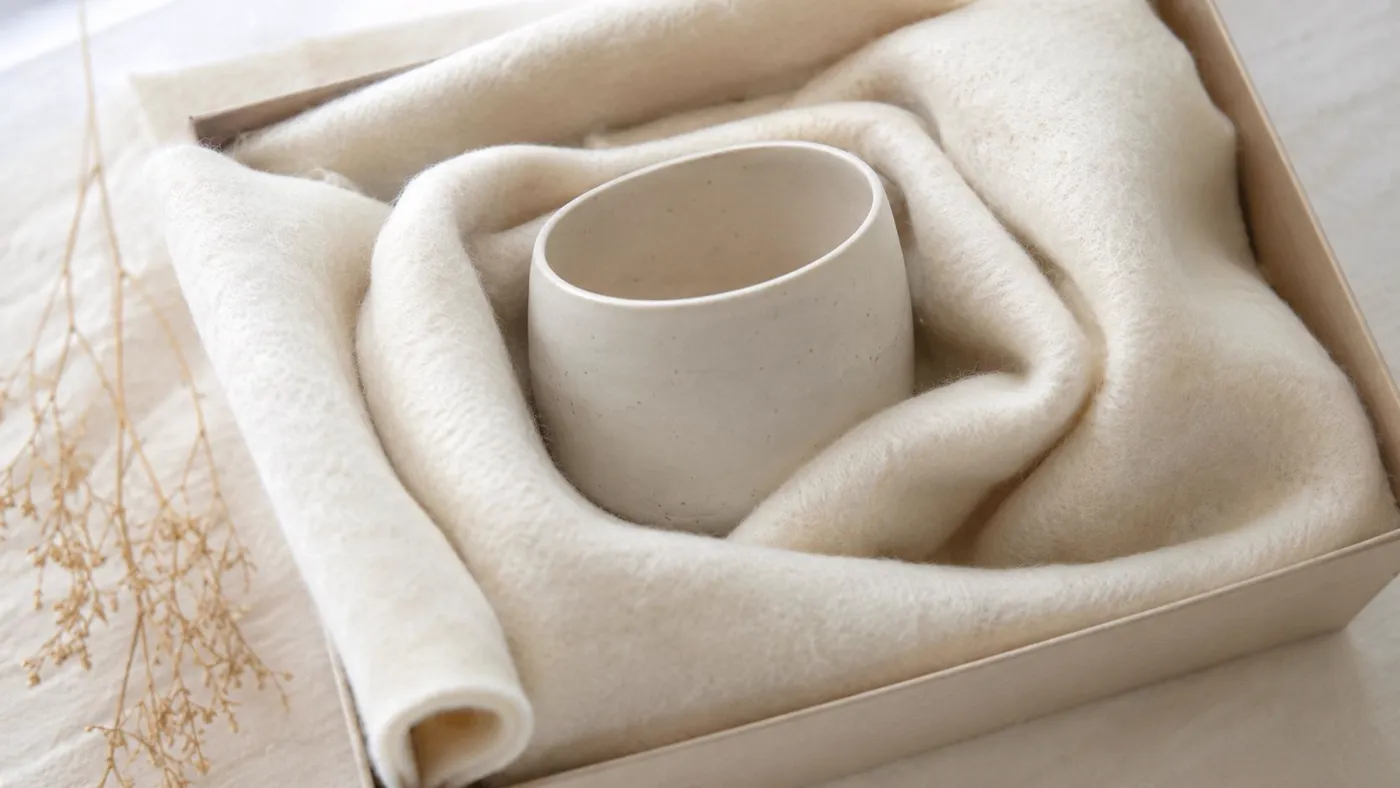
Wool sits in a useful middle ground between presentation packaging and protective packaging. It gives a softer contact surface than paper, adds some insulation, and suits brands that want the pack to feel natural rather than engineered.
The trade-off is cost and consistency. Wool formats are usually harder to buy as a low-cost, high-volume bench material, so the cost per protective unit tends to be higher than standard paper wraps or loose void fill. That can still make sense for skincare, speciality food, gift sets, and other products where temperature stability, premium presentation, or surface protection matter enough to offset the spend.
Disposal is part of the appeal. Wool is compostable, and many customers immediately understand what to do with it without checking local recycling rules.
It also has practical limits. Wool is not the best answer for fast-moving, low-margin orders, and it will not replace a properly sized carton or good movement control inside the parcel.
Mushroom materials and biodegradable void fill
Mushroom packaging, made from mycelium grown around agricultural waste, is better treated as a specialist insert than a direct swap for bubble wrap. It works best where the product shape is stable, the presentation matters, and the pack design can be fixed in advance. For branded kits, fragile gift packs, or repeat SKUs with known dimensions, it can perform well.
For general e-commerce pick-and-pack, the performance gap is operational rather than environmental. Mushroom inserts take planning, storage space, and product-specific design work. If the SKU mix changes often, or if the business packs many one-off order combinations, they become less practical.
Biodegradable loose fill and compostable air pillows solve a different problem. They fill voids around irregular products and can help reduce movement in oversized cartons, but they are not interchangeable.
A few realities are worth keeping in view:
- Loose fill helps with blocking and bracing: It can look messy on arrival and is less convincing for premium unboxing.
- Compostable air pillows keep parcel weight down: They fill space well, but they do less for edge and corner protection.
- Compostability claims vary: Some materials are suitable for home composting, while others need industrial composting or specific waste streams.
For many UK SMEs, the decision comes down to courier risk and pack format. If parcels face frequent drops, belt transfers, and vehicle stacking in standard courier networks, these materials need to be tested as part of a full pack system, not judged in isolation. A greener material that increases damages is rarely cheaper once replacements, returns, and customer service time are added back in.
At Packaging Panda, we usually advise clients to test these newer materials only where they solve a specific protection problem that paper does not solve well. Temperature-sensitive products, premium presentation packs, and unusual shapes are the strongest cases. Everyday stock with predictable dimensions often has a better cost-to-protection result with simpler materials.
How to Match the Alternative to Your Product
The right material depends less on the catalogue category and more on the failure risk of the item being shipped. Product shape, surface finish, weight distribution, and temperature sensitivity all change the answer.
Fragile ceramics and glassware
Honeycomb paper wrap is one of the stronger options here. Verified benchmarking shows it offers impact absorption comparable to traditional plastic bubble wrap and superior shock dispersion for corner-edge protection on fragile items like glassware and ceramics in controlled drop tests, according to Globe Packaging's comparison of sustainable bubble wrap alternatives.
That doesn't mean one layer around a mug is enough. Ceramics usually fail at the handle, rim, or base edge. The wrap should be paired with a correctly sized box and enough void control to stop movement.
Recommended approach:
- Use honeycomb wrap close to the item: It conforms well and helps with edge protection.
- Add paper void fill or corrugated separation: This stops collision inside the box.
- Avoid oversized cartons: Extra air space invites impact.
Electronics and static-sensitive items
Static matters. So does surface scratching. Honeycomb paper's static-free performance is useful, but electronics still need more caution than general fragile goods. Light accessories can often ship safely in padded paper mailers or compact cartons with controlled void fill. Heavier or high-value devices may need a more engineered pack format.
For broader shipping material choices around lower-impact mailing formats, businesses can also review this compostable mailing bags buyer's guide where soft-goods and accessory shipments are concerned. Electronics, however, usually need a stricter protection review than apparel or non-fragile retail.
Rolled prints and long-format goods
Rolled items create a different challenge. The surface may be delicate, but the bigger risk is edge crush, moisture ingress, or flex during transit. Wool-based cushioning can be useful where rolled goods need softer shock absorption and moisture resistance. For many art, poster, and document shipments, though, the better answer is often a rigid tube or another structural format rather than a direct bubble wrap substitute.
That's an important distinction. Some bubble wrap alternatives improve the wrap layer. Others make the wrap layer less important because the outer pack carries most of the protection.
Gourmet foods, cosmetics, and temperature-sensitive parcels
Wool earns its place here because insulation is part of the protection job. A candle, handmade chocolate, chilled cosmetic product, or speciality skincare item may survive impact but still arrive in poor condition if temperature swings are ignored.
For these parcels:
- Choose wool when thermal buffering matters: It handles cushioning and insulation together.
- Use compostable loose fill for odd-shaped gift sets: It fills awkward spaces well.
- Don't rely on paper alone for cold-chain style risk: Paper can wrap nicely without providing much thermal protection.
What doesn't work is forcing one material across every SKU. A sensible packing matrix by product type almost always beats a one-material policy.
Calculating the True Cost of Protective Packaging
Too many buying decisions still start and end with the roll price. That's understandable, but it's incomplete.
Why unit price is the wrong first filter
Many businesses lack concrete cost-comparison data against traditional polyethylene bubble wrap. Without a fuller analysis that includes waste disposal and transit damage rates, UK SMEs can't justify the potentially higher unit cost of sustainable options, leaving the cost-of-protection question unanswered, according to Market Research Future's bubble wrap packaging market guide.
That gap explains why some businesses stick with plastic even when they suspect the overall economics are weaker. The roll looks cheaper. The total process may not be.
A more useful costing framework
The better metric is cost per protective unit. In plain terms, that means the total cost of getting one product to the customer safely, consistently, and in a pack the customer can deal with easily.
A practical review should include:
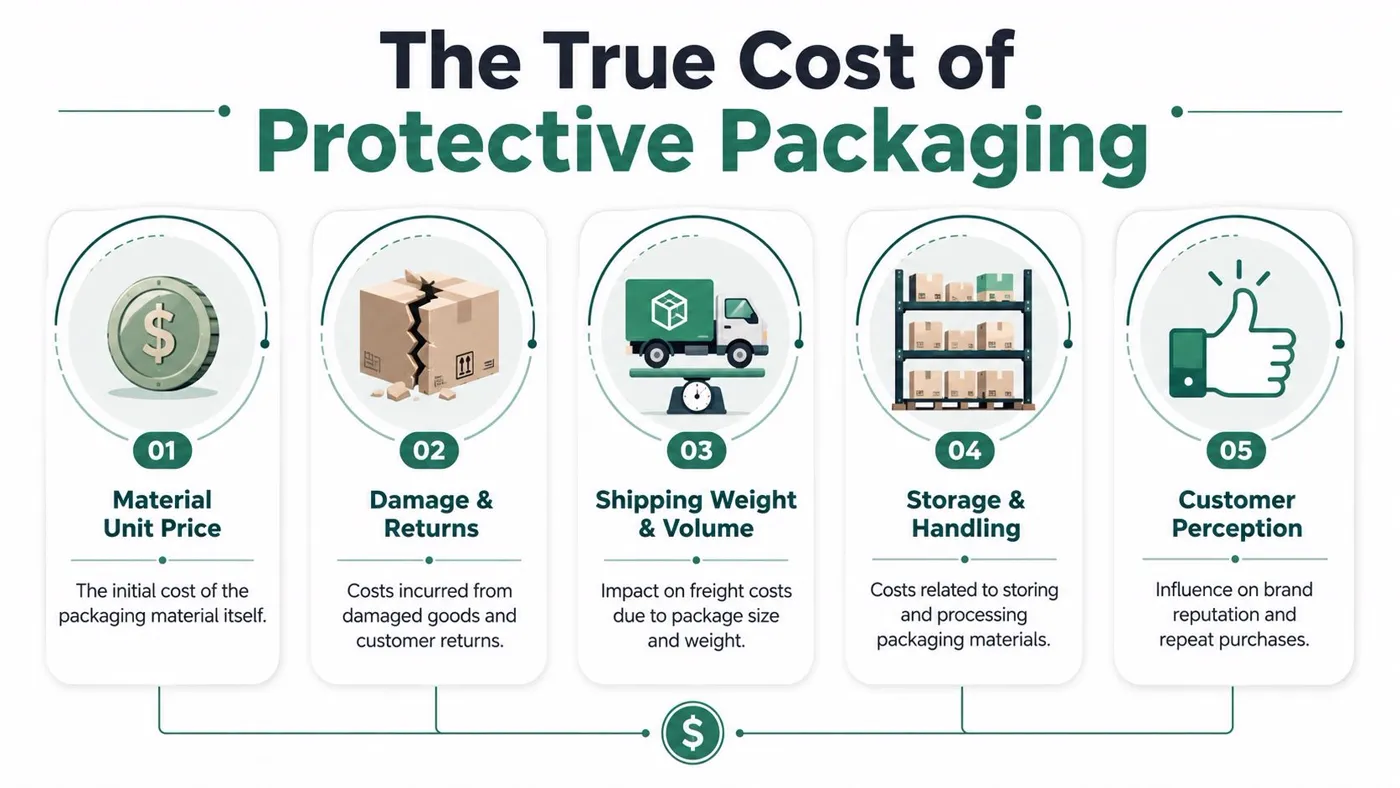
- Material cost: The direct cost of the wrap, fill, or mailer.
- Packing labour: How long staff take to apply it properly.
- Storage footprint: Bulky materials consume shelf and floor space.
- Shipping impact: Extra volume can push carton size up.
- Damage and returns: The most expensive packaging is the one that fails.
- Waste handling: Disposal complexity affects customer experience and business operations.
A material that costs more per unit can still cost less per successful delivery.
What this changes in practice
This is why some businesses move to paper wrap or padded paper mailers even before making a formal sustainability commitment. If the new format speeds packing, stores more compactly, and reduces awkward over-boxing, the operational gain can offset a higher nominal line cost.
It also explains why specialist materials should be reserved for specialist jobs. Wool can be the right commercial choice for insulated or premium goods, but it may be excessive for low-risk accessories. Compostable loose fill can be useful for mixed-product boxes, but inefficient for a single sturdy item.
The right comparison isn't “Which material is cheapest?” It's “Which packaging method produces the lowest all-in cost without exposing the order to avoidable damage?”
When to Choose Bespoke Packaging Solutions
Off-the-shelf materials are enough for many dispatch operations. They're quick to buy, easy to trial, and flexible across changing stock mixes. But there comes a point where standard packaging starts creating repeat problems.
That point usually shows up in one of three ways. The business sees too many damage complaints on one product line. Staff are spending too long building protection around the same awkward item. Or the parcel works, but the finished pack looks oversized, messy, or off-brand.
Signs standard packaging is no longer efficient
A bespoke solution becomes worth considering when the current process relies on too many workarounds.
Common triggers include:
- High-volume repeat SKUs: One product shape ships every day and still needs manual padding decisions.
- Unstable dimensions: The item moves inside a standard carton unless staff add excess fill.
- Premium presentation needs: The brand wants a cleaner unboxing result than generic wrap allows.
- Carrier cost pressure: Oversized parcels increase shipping cost or handling issues.
In those cases, the material choice matters less than the overall pack design. A custom insert, right-sized box, or branded mailer can reduce movement, packing time, and wasted space in one change.
What bespoke does better
Bespoke packaging works because it transfers protection from the operator to the design. Instead of relying on staff to judge how much wrap is enough, the pack itself locates, cushions, or isolates the item more consistently.
That can help with:
- fewer packing errors
- better dimensional control
- less filler use
- stronger shelf and delivery presentation
Packaging Panda offers bespoke packaging such as custom sizes and shapes, plus branded print across boxes, mailers, bags, and tubes, with minimum runs from 500 units. For businesses scaling beyond basic stock packaging, that kind of service is often the next logical step after testing bubble wrap alternatives and identifying which products still need a more engineered solution.
A business doesn't need bespoke packaging for everything. It usually needs it for the products that create the highest cost, the most damage risk, or the most visible brand impression. That's where custom design tends to earn its keep.
For UK businesses reviewing bubble wrap alternatives, Packaging Panda is one option for sourcing recyclable and compostable packaging, paper-based protective products, and bespoke formats for higher-volume or product-specific requirements.