How to Measure Boxes a UK Shipper's Guide for 2026
A seller packs an order, prints the label, and thinks the job's done. Then the courier invoice lands with a surcharge that makes no sense. The parcel was light, the item fit, and yet the shipping line is higher than expected. In UK e-commerce, that usually comes down to one thing. The box was measured in the wrong way, at the wrong point, or for the wrong purpose.
Browse our wholesale cardboard boxes →
That's why learning how to measure boxes properly isn't a warehouse nicety. It's a margin-control habit. A few millimetres can change which parcel tier a shipment falls into, whether a product arrives snug and presentable, and whether the packaging feels responsible rather than wasteful. For any business sending orders through Royal Mail, DPD, or similar networks, measurement affects cost, damage risk, and customer perception in one move.
Accurate dimensions also make planning easier before a parcel ever leaves the bench. When a team needs to compare freight options or get a reliable shipping quote, clean dimensions and weights remove the guesswork that causes re-rates later.
Table of Contents
- Why Accurate Box Measurement Matters More Than You Think
- The Core Principles of Box Measurement
- How to Measure a Standard Cardboard Box Accurately
- Calculating Dimensional Weight for UK Couriers
- Measuring Non-Standard Items and Bespoke Orders
- Common Measurement Mistakes and How to Avoid Them
- Frequently Asked Questions
Why Accurate Box Measurement Matters More Than You Think
Courier charges often look irrational until the measurement method is checked. A parcel can be light in the hand and still expensive in the network because the van, cage, and sortation system price space as well as mass. That's why a seller who “roughly knows” a box size usually pays more than a seller who records it properly.
There's also a brand issue. If the box is too loose, the order arrives padded with unnecessary void fill and feels careless. If it's too tight, corners crush, flaps strain, and products scuff. Neither outcome reflects well on the business, especially when buyers are used to neat, right-sized delivery.
UK shipping rules make this more unforgiving. Couriers don't care what the box was meant to be. They care what it measures when it enters the system, including anything that sticks out.
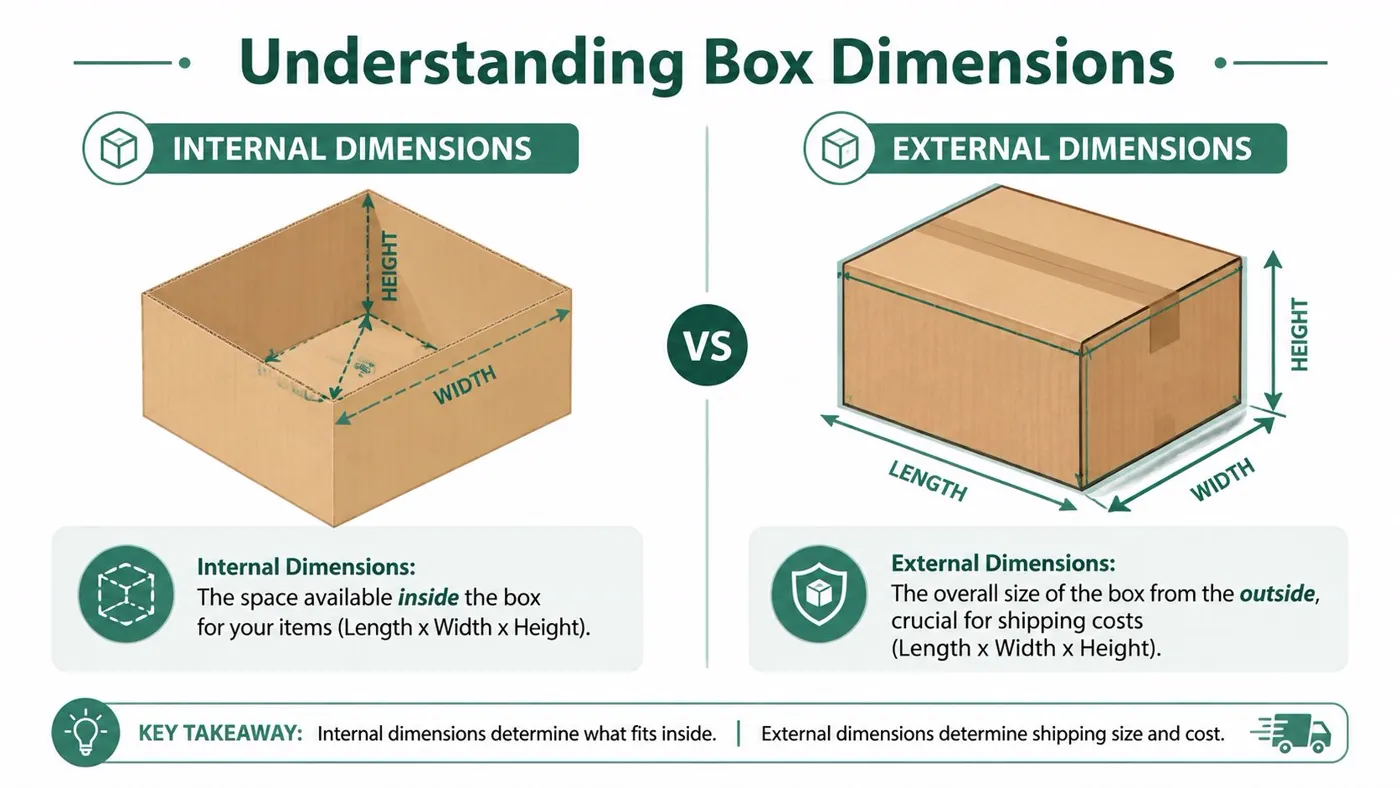
Practical rule: Measure for two separate decisions. Internal dimensions are for product fit. External dimensions are for courier pricing.
That split sounds simple, but it's where many avoidable costs begin. The sellers that treat measuring as part of order quality, not admin, usually get cleaner packing lines, fewer billing surprises, and more consistent parcel presentation.
The Core Principles of Box Measurement
The first thing to get right is the difference between internal dimensions and external dimensions. They sound similar. In practice, they solve different problems.
Internal size and external size are not the same job
Internal dimensions describe the usable space inside the carton. That's what matters when a product needs to fit neatly, sit securely, and arrive without rattling around. External dimensions describe the outside footprint of the parcel. That's what the courier uses when the shipment is rated for dimensional weight and parcel size bands.
In the UK, that distinction is expensive to ignore. The difference between interior and exterior measurements drives a 12 to 15% variance in carrier fees, and a 2023 UK Department for Transport study found that 34% of e-commerce parcels were over-sized due to measuring exterior dimensions when ordering custom boxes, leading to an average £1.80 per parcel overcharge (UK Department for Transport guidance summary)). The practical takeaway is clear. Order boxes by the internal space needed for the product, then cost shipments using the outer size of the finished parcel.
A simple way to think about it is shoes. Foot size decides the fit. Shoe box size decides the shelf space and postage. Mixing the two creates bad decisions.
For teams that want a refresher on accurate measuring habits in general, Room Sketch 3D's measurement guide is a useful reminder that precision starts with consistent reference points.
The standard order of dimensions
Most packaging catalogues and trade specs list box sizes as L × W × H. Length is the longest side of the opening. Width is the shorter side across that opening. Height is the vertical measurement from base to top edge.
That order matters when placing stock or custom orders because suppliers, warehouses, and artwork teams need one shared language.
| Dimension | What it means in practice | Why it matters |
|---|---|---|
| Length | The longest opening side | Usually the first size used for product orientation |
| Width | The shorter opening side | Helps define fit and board layout |
| Height | The depth from bottom to top | Affects fill level, closure, and stack profile |
A stated box size in trade use usually refers to internal usable space, not the outside of the parcel once packed.
Once that mindset is in place, how to measure boxes becomes much simpler. The tape measure isn't the hard part. Choosing the correct reference point is.
How to Measure a Standard Cardboard Box Accurately
A standard corrugated carton is straightforward to measure if it's done the same way every time. Problems start when a team measures one box flat, another assembled, and a third across the wrong edges.
What to use before measuring
Use a calibrated tape measure or measuring jig, and record results in millimetres. According to the UK National Freight Association's 2024 report, the accepted method is to measure the longest internal side between score lines for length, rotate 90 degrees for width, and measure the vertical internal height, with dimensions recorded to the nearest whole millimetre because UK postal standards reject dimensions rounded to inches (UK National Freight Association methodology summary).
For a seller choosing stock cartons, a practical reference like this UK moving box size guide can help compare common formats before deciding what to keep on the shelf. For trade supply, many teams also review standard cardboard box sizes to reduce one-off packing decisions on the bench.
A practical measuring sequence
Use this sequence on an empty, assembled box:
-
Open the carton fully so the inside score lines are visible. Don't measure a collapsed blank unless the supplier specifically asks for flat dimensions.
-
Measure the internal length from one inside wall to the opposite inside wall along the longest side. The score line is the correct edge reference, not the outer face.
-
Turn the box and measure the internal width across the shorter side, again from score line to score line.
-
Measure the internal height vertically from the bottom score to the top edge of the box body. Ignore flap thickness when recording the box size itself.
-
Write dimensions in L × W × H order and keep the unit consistent. For example, record in mm across the whole range, not a mix of mm and cm.
-
Repeat the measurement if the box is hand-assembled, because poorly squared cartons can shift slightly before sealing.
A carton that's being tested for dispatch should then be packed, closed, and measured externally for courier purposes. That second measurement is where flaps, tape build-up, and bulges show their effect.
What sellers usually miss
Three oversights cause most fitting issues. First, they measure the product but forget protective material. Second, they ignore score lines and lose usable space. Third, they assume the nominal box size is what the courier will rate.
Measure the product in its shipped condition, not in its naked condition. If it travels with wrap, sleeve, insert, or void fill, that is the real size to plan around.
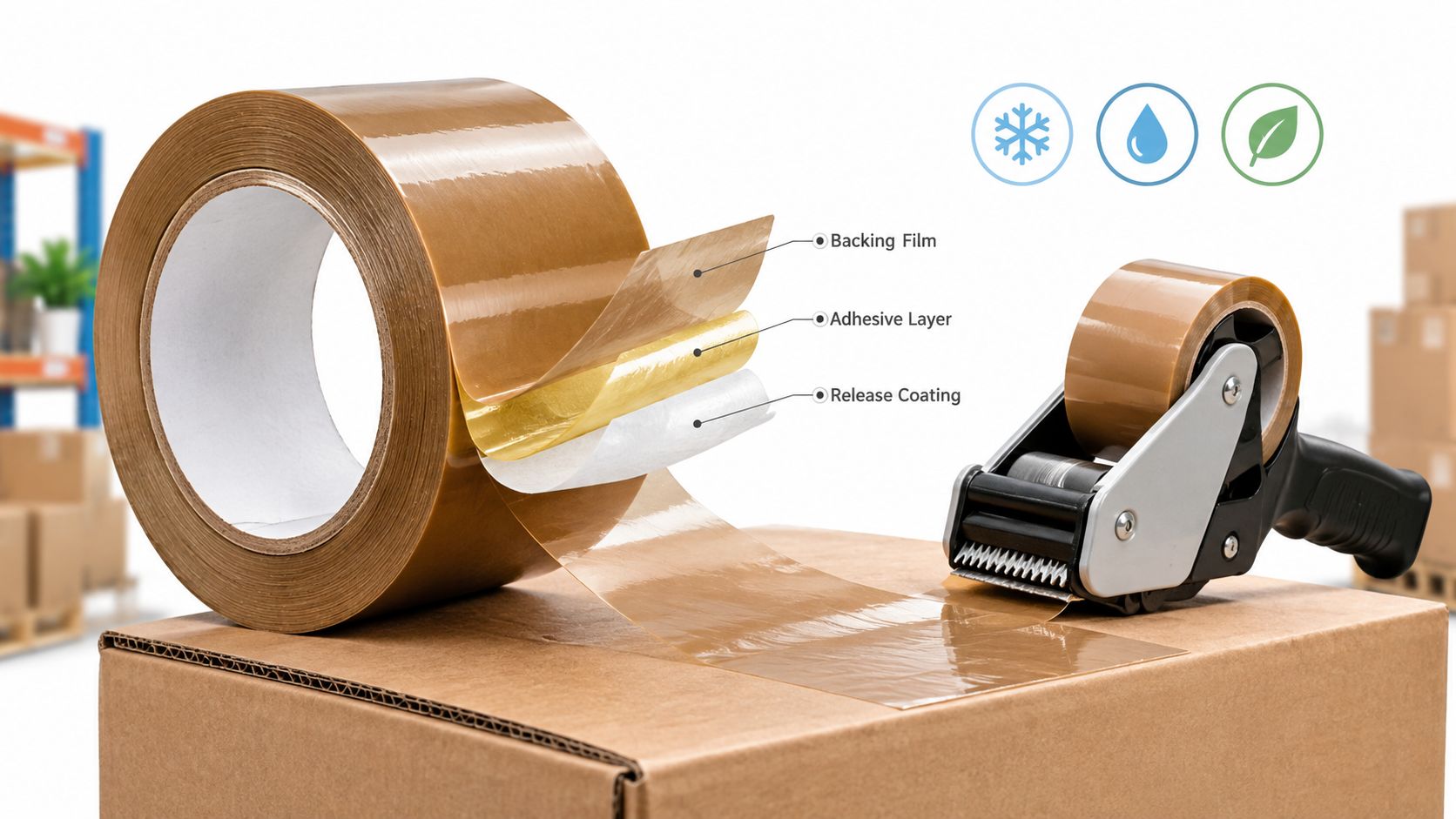
For sealing, products such as Paper Packing Tape are used in many packing lines because they're available in gummed, self-adhesive and printed options, and the product snapshot describes them as strong, recyclable and plastic-free. Whatever tape is used, the parcel should be measured after sealing if the final external size is needed for a courier booking.
Calculating Dimensional Weight for UK Couriers
Many UK sellers still price shipping in their heads by dead weight alone. That's why dimensional charges feel like penalties when they appear. They aren't penalties. They're the courier charging for cubic space in the network.
The formula UK shippers need
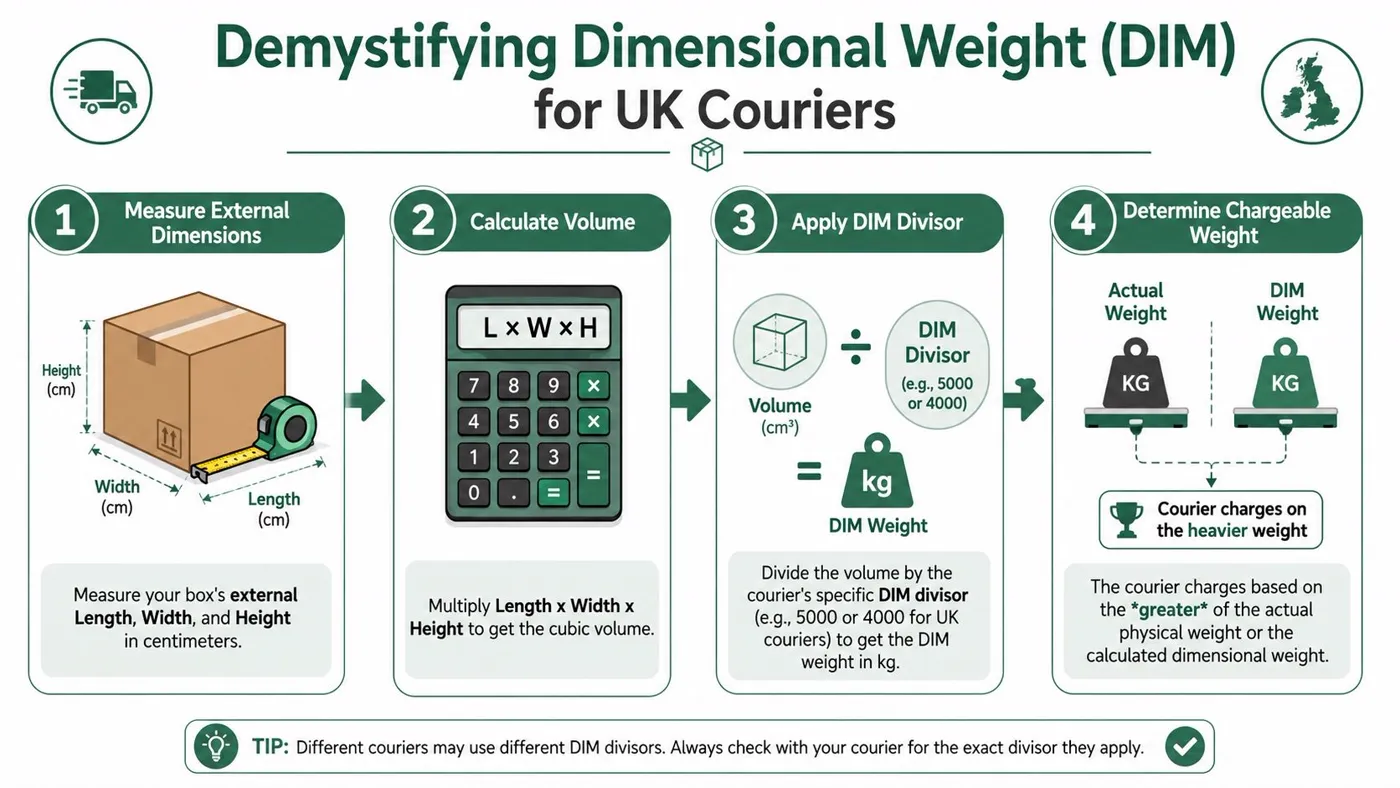
According to an Ofcom 2023 report, 68% of UK parcel carriers now enforce strict dimensional weight pricing, using the formula Length × Width × Height in cm ÷ 5,000 to determine chargeable weight in kilograms. The same report notes that this has pushed UK retailers to optimise box sizes by an average of 15% to reduce shipping costs (Ofcom 2023 dimensional pricing overview).
That means the external dimensions of the sealed parcel matter, not the empty-box spec in the catalogue and not the product dimensions on the SKU sheet.
For sellers who want a separate walkthrough of the maths, this guide on how to calculate volumetric weight is a useful reference point.
A worked example
Take a parcel with external dimensions of 40 cm × 30 cm × 20 cm. Multiply those dimensions:
| External dimensions | Volume | Divide by 5,000 | DIM weight |
|---|---|---|---|
| 40 × 30 × 20 cm | 24,000 cm³ | 24,000 ÷ 5,000 | 4.8 kg |
If the actual weight is lower than 4.8 kg, the courier still charges at 4.8 kg because that is the chargeable weight under the formula cited above.
This is why oversized light goods become costly so quickly. A box that looks harmless on the bench can price like a much heavier parcel once it enters a Royal Mail or DPD style dimensional system.
The cheapest parcel isn't the lightest one. It's the one that uses the least space without compromising protection.
The practical fix isn't to squeeze products dangerously tight. It's to choose a carton that matches the packed item closely, then verify the sealed external size before rates are booked.
Measuring Non-Standard Items and Bespoke Orders
Not every product belongs in a standard shipping carton. Rolled prints, soft textiles, hats, presentation sets, and awkward gift products all need a different measuring approach. Generic box advice breaks down fast when the item has no clean rectangular footprint.

Use the bounding box method
For irregular goods, the safest method is to imagine the smallest possible box that could contain the packed item. Measure the furthest point in each direction. That gives the bounding box.
This works well for:
- Rolled prints and posters. Measure the finished roll length and the full diameter once wrapped and capped.
- Soft goods such as knitwear or garments. Measure them in their folded, bagged state, not spread flat on a table.
- Handle, lid, or trim-heavy products. Include any raised point that affects the final packed profile.
The goal isn't mathematical elegance. It's operational reality. If a corner, rim, or rolled edge sticks out, the packaging has to accommodate it.
How to brief a bespoke packaging supplier
A custom packaging brief is easier when it includes the packed product, not just the bare product. Suppliers need to know what the item looks like once it has inserts, tissue, bubble wrap, sleeves, or transit protection.
A useful brief usually includes:
- Packed product dimensions in L × W × H, or length plus diameter for tubes
- Product type and fragility, so board grade and fit can be judged sensibly
- Any presentation requirement, such as a snug premium fit or extra room for tissue and inserts
- Whether the size is internal or external, written clearly to avoid rework
For made-to-order work, sellers that need cartons, mailers, or tubes outside stock sizes can review bespoke packaging options. The key is to give dimensions in a way that leaves no ambiguity about fit versus shipping footprint.
A tube for an art print, for example, should be specified by the rolled item size plus end-cap and wrap allowance, not by the flat artwork dimensions. A hat box should be sized around the hat in its protected state, not around the crown alone.
Common Measurement Mistakes and How to Avoid Them
Most measurement errors aren't dramatic. They're small, routine misses that seem harmless at packing bench level. Then they show up later as higher courier bills, damaged goods, wasted void fill, or awkward unboxing.
Small errors that create expensive outcomes
One common problem is measuring the product without its protective materials. Bubble wrap, paper padding, sleeves, and inserts all change the required fit. Another is rounding casually instead of recording the actual figure and then choosing the next suitable packaging size with intention.
The environmental cost is no longer easy to ignore either. A 2024 UK Carbon Trust study found that 42% of UK retailers still use non-optimal box sizes, contributing to 1.2 million tonnes of unnecessary packaging waste annually, and that even 1 cm of over-sizing can increase transport emissions by 3 to 5% per parcel (UK Carbon Trust findings on box sizing).
That matters commercially as well as ethically. Customers notice when a small item arrives in a visibly oversized box. It signals waste, poor planning, and avoidable cost.
Boxes should be large enough to protect the product and small enough to justify themselves.
A simple pre-dispatch check
Before approving a box size, check these points:
- Confirm the measurement type. Fit decisions should use internal dimensions. Courier booking should use the final external size.
- Measure after packing for shipping. Seals, flaps, and protective fill can alter the finished parcel profile.
- Keep units consistent. Mixing mm, cm, and inches in one process creates avoidable errors.
- Watch irregular edges. Lid overhangs, rolled ends, and bulges count because the courier measures what exists, not what was intended.
Right-sizing doesn't mean under-protecting. It means removing waste from the process without compromising transit performance.
Frequently Asked Questions
Should custom box dimensions be given as internal or external
For custom box orders, dimensions should be clearly labelled. Internal dimensions are usually what matter for product fit. External dimensions matter when checking courier costs, parcel bands, and shelf or pallet planning.
What is girth and is it the same as dimensional weight
No. Girth is a parcel-size measurement used in some shipping rules. Dimensional weight is a chargeable weight calculation based on external parcel volume. They solve different problems, so they shouldn't be treated as interchangeable.
Can box size affect EPR costs
Yes. According to the UK Environment Agency, over 85% of small e-commerce businesses in the UK are unaware that improper box sizing can increase Extended Producer Responsibility fees by up to 15%, because sizing affects waste tax calculations (UK Environment Agency note on box sizing and EPR). Oversized packaging can therefore create a double cost. It raises shipping inefficiency and can increase packaging-related compliance exposure.
What should be measured first, the product or the box
The product should be measured first in the condition it will ship in. That includes any wrap, insert, sleeve, or presentation material that changes the packed size.
For businesses that need stock cartons, sustainable tapes, or made-to-order packaging in the UK, Packaging Panda supplies wholesale packaging materials across boxes, mailing products, protective lines, and bespoke formats.