Branded Packaging for Small Business: A UK Guide
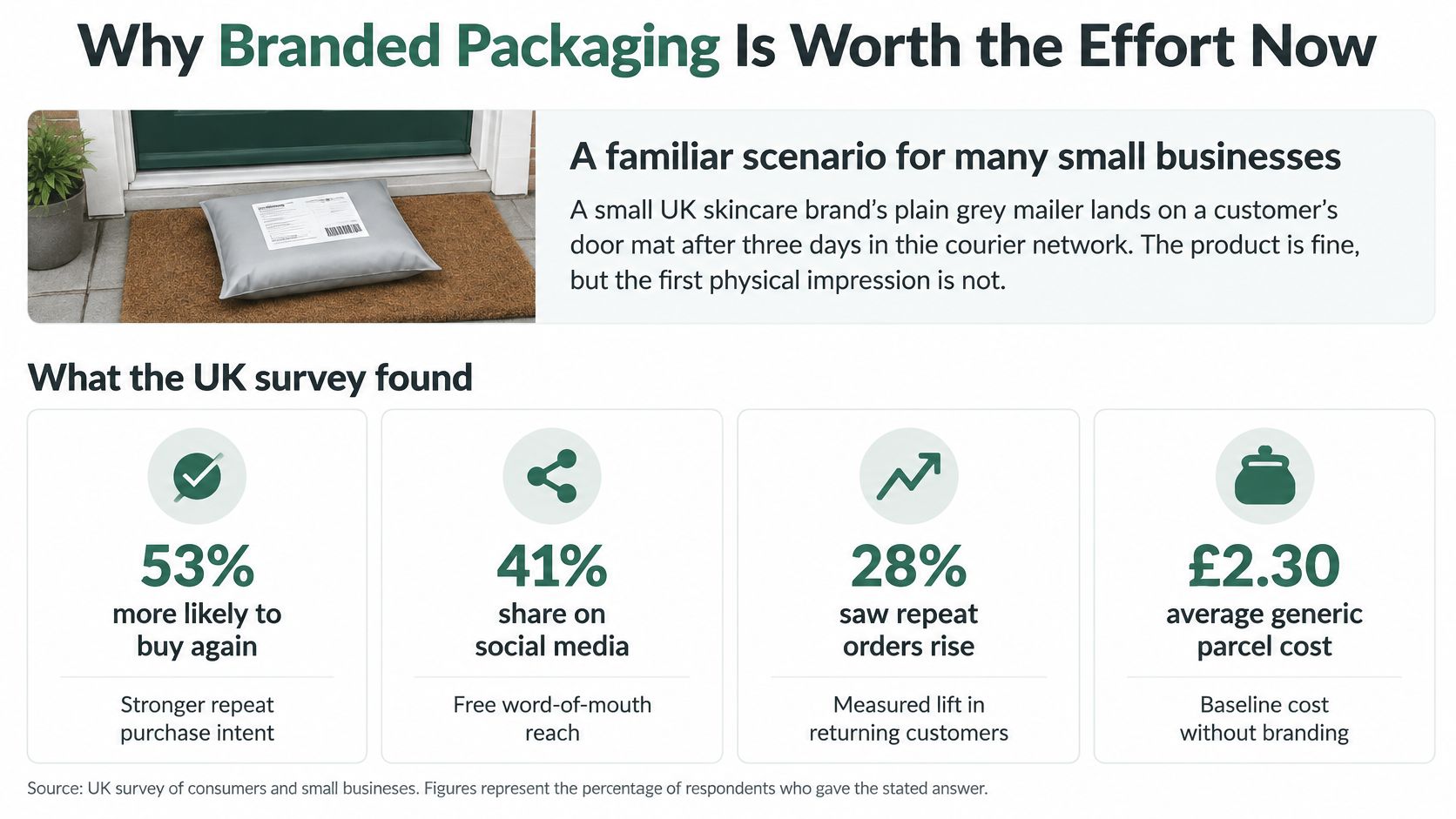
A small UK skincare brand's plain grey mailer lands on a customer's doormat after several days in the courier network. The jar inside is intact, but the bag is creased, the label is crooked and nothing about the parcel resembles the carefully photographed product page. The owner's next move is often to order printed packaging. The better next move is to measure what the current parcel costs and how well it protects the product.
Table of Contents
- Why Branded Packaging Is Worth the Effort Now
- The Seven Steps From Product to Purchase Order
- Choose Materials That Protect the Product and the Planet
- Sustainability and Compliance Checks Before You Print
- Print Methods and Minimum Runs Compared
- Budget Tips That Keep the Unit Cost Down
- Request Quotes With These Five Details
Why Branded Packaging Is Worth the Effort Now
Branded packaging reaches a customer after payment, when the product becomes something tangible rather than an image on a screen. A recognisable colour, neatly positioned logo and useful care card can make that handover feel considered. None of these requires a fully printed box. One well-placed panel, or a printed sticker inside the lid, can carry the identity.
For branded packaging for small business, the sensible starting point is the smallest change that creates a consistent presentation. A stamp on a stock carton, a printed label or a tissue wrap can establish an identity without committing cash to cartons that may become obsolete.
Judge the upgrade on what changes in your numbers. Track complaints and repeat orders for eight weeks before and after the change, and record packing time per parcel alongside them. A stamped carton that adds seconds to each order is a working improvement. A printed box that needs extra void fill to hold the product, or adds a folding step to every parcel, is a cost wearing a logo.
Buying rule: Treat the first branded order as a protection and cash-flow test, not a redesign competition.
Protection, presentation and compliance sit in the same purchasing decision. A box that photographs well but slows the packing bench, demands two handfuls of void fill or carries a recycling claim the material cannot support fails the test that matters. The costliest mistake is approving the print run before testing the packed product.
The Seven Steps From Product to Purchase Order
Establish the starting measurements
Baseline the existing parcel.
Record damage, replacements and returns by stock-keeping unit, alongside packaging cost, packing time and courier complaints. Keep product faults separate from transit damage so the comparison remains useful. The stakes are clear: a Packaging News report of a survey covering 2,000 UK consumers in October 2024 found that 53% had received damaged goods in the previous twelve months and 57% said damage would make them hesitant to shop with that retailer again.Measure the product as dispatched.
Use a tape measure and digital scales on the actual order configuration, including its retail container. Record fragility, mass, dimensions and likely impact points. A glass dropper bottle needs protection around its neck as well as beneath its base; a folded sweatshirt needs a secure closure rather than elaborate cushioning. Choose the smallest practical outer that still accommodates the required protection.Match the structure to the risk.
Start with a stock corrugated carton for boxed goods, stronger board for demanding loads, a suitable paper mailer for soft goods or a tube for rolled prints. Weight alone doesn't establish the correct board grade. Sharp corners, stacking pressure, moisture exposure and unsupported spans can change the answer. The output is a shortlist of structures, not an artwork approval.
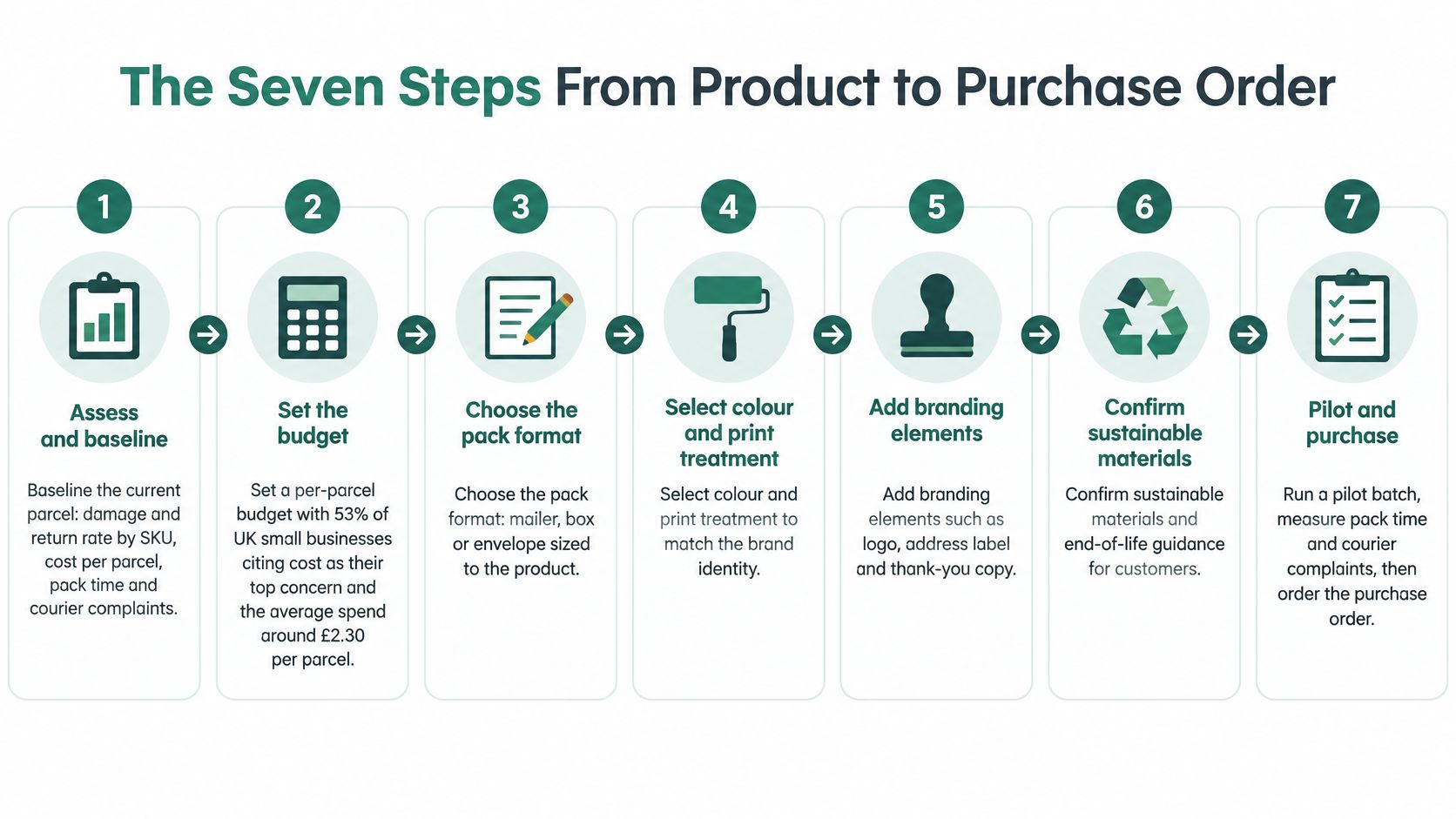
Turn the shortlist into a purchase specification
Choose the print route against actual demand.
Consult the print-method comparison before selecting a run size. Labels and stamps suit uncertain demand; direct printing becomes more attractive when the format and artwork are stable. Record the minimum order, total cash commitment and expected stock coverage for each quotation. A lower unit price isn't a saving if most of the order stays on a shelf.Build production-ready artwork.
Work on the converter's dieline rather than a self-drawn rectangle. Obtain its bleed, safe-area, barcode and minimum-line specifications, then keep important content clear of folds and closures. Supply vector logos, outline fonts and prepare a single-colour version for kraft. The decision is whether the artwork remains legible on the actual substrate, not whether it looks sharp on a monitor.Test the finished pack.
Pack the product with the intended insert, closure and label. Agree appropriate drop, compression and vibration checks with the packaging manufacturer, then send a representative courier pilot. Compare damage, packaging weight, packing time and delivered cost against an unbranded control. Testing an empty carton doesn't establish whether a jar moves inside it.Order with replenishment agreed.
Put the approved construction, artwork revision, acceptable tolerances and delivery terms on the purchase order. Obtain a written reorder price and set a stock trigger using consumption, production lead time and a sensible buffer. The final yes-or-no question is whether the business can replenish without either running out or financing unnecessary inventory.
Choose Materials That Protect the Product and the Planet
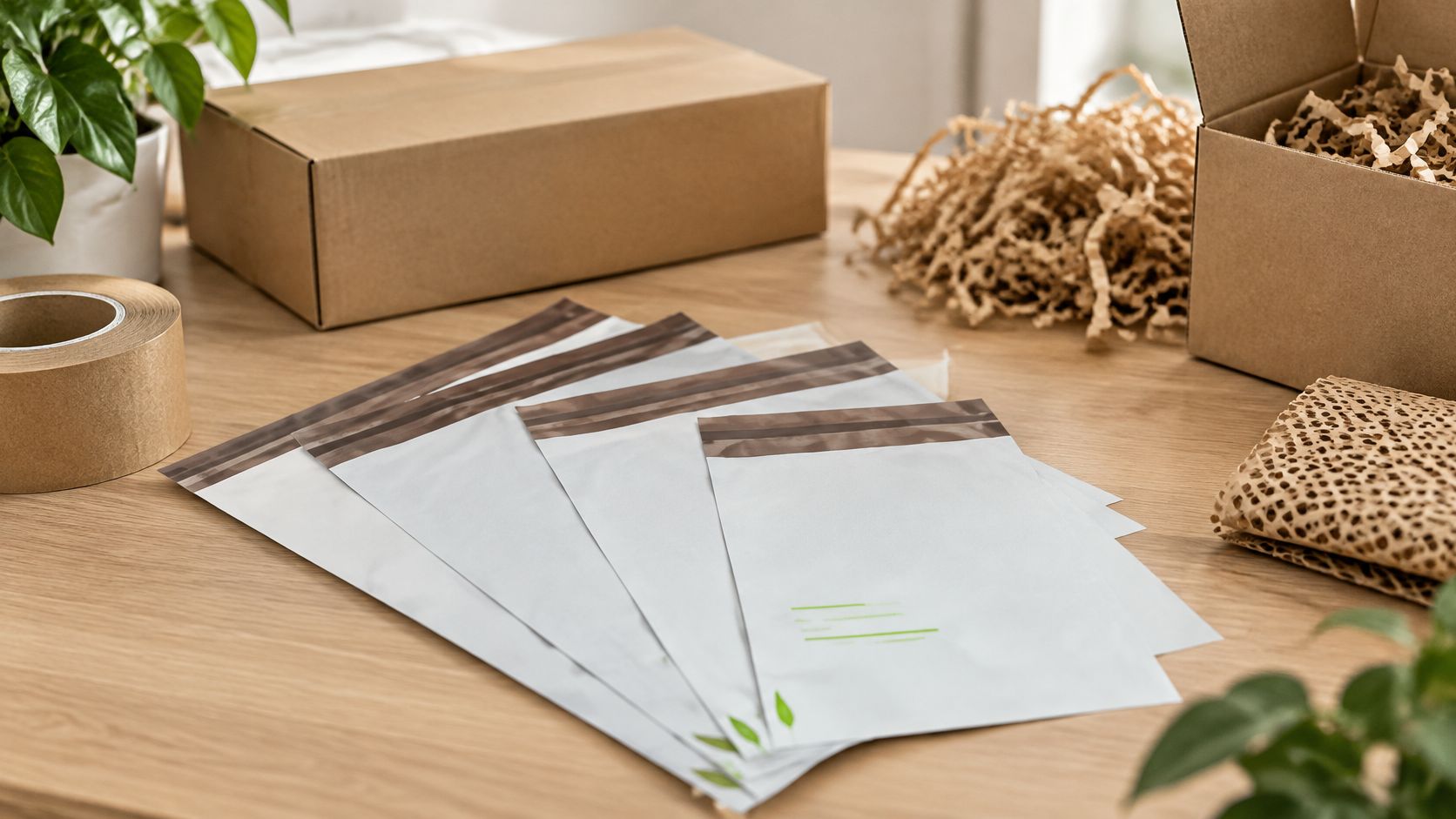
A UK parliamentary written answer on packaging recycling records 5.422 million tonnes of paper-and-cardboard packaging waste in 2023, with 73.4% recycled, alongside 2.259 million tonnes of plastic packaging waste at a 52.5% recycling rate. Paper clearly has the stronger end-of-life story, and a wholesale supplier such as Packaging Panda already stocks recyclable boxes, compostable mailers and cardboard tubes with bulk pricing from 500 units. The recycling figures settle which materials deserve a look. They say nothing about whether a given format keeps the product intact.
Treat the choice like a purchase decision, because it is one. Record the transport weight, the damage rate and the delivered cost for each candidate material. A recyclable box that lets a jar move around costs more than the plastic it replaced once the replacements ship. Protection settles the format, then the disposal route has to be real.
Packaging formats compared on protection, recycling and branding
| Format | Best for | Protection | UK kerbside recycling | Branding route |
|---|---|---|---|---|
| Single-wall corrugated box | Boxed goods with modest loads | Medium, subject to grade | Generally accepted, flattened and dry | Direct print or printed label |
| Double-wall corrugated box | Fragile or heavy goods | High when correctly specified | Generally accepted, flattened and dry | Printed label or direct print |
| Paper padded mailer | Non-fragile fashion, books, accessories | Low to medium | Paper-only construction is the clearest route; check padding | Stamp, label or digital print |
| Compostable mailer | Soft goods with low damage risk | Low | Not in paper recycling; use the certified composting route | Compatible label or supplier-approved print |
| Cardboard tube | Posters, prints, rolled textiles | Strong edge and crush protection | Paper body generally accepted; separate non-paper caps | Direct print or label |
| Kraft pillow box | Small retail items, gifts, cosmetics | Low | Generally accepted if unlined and without incompatible coatings | Stamp, label or small digital run |
| Cellophane bag | Retail display and product visibility | No meaningful impact protection | Identify the film; don't assume household acceptance | Printed header card or label |
| Corrugated envelope | Flat or low-profile items | Low, with useful rigidity | Generally accepted if paper-based | Direct print or label |
The table builds the shortlist rather than certifying the result. Council acceptance and protection both depend on the finished construction, so check the local collection instructions before any disposal wording is printed.
Check the components that complicate recycling
A paper exterior can conceal plastic padding. Film sold as cellophane may be cellulose-based or polypropylene, and each behaves differently at the kerbside. Compostable film may need industrial treatment rather than a home compost heap, so any certification has to name the actual route rather than a vague material family.
For candle sellers, Shivora Candles' discussion of eco-friendly candle packaging trends provides useful presentation context, but glass protection and the finished pack's disposal instructions still need their own assessment.
Fragile goods often justify a plain protective outer with a branded inner, where the print spend goes on the layer the customer handles. Low-risk soft goods can run in a well-sized printed paper mailer alone. A bespoke tube built to the print's dimensions, the kind used to ship original movie posters, protects rolled items without adding bulk or cost. The deciding question for each product is yes or no: does the customer receive it intact, and can they work out where every component goes?
A practical separation test is whether the customer can identify and remove each component without a knife and a search engine.
Keep corrugated board dry and flatten it for collection. Avoid adding a decorative sleeve, bonded window or coating unless it performs a useful job that simpler construction cannot.
Sustainability and Compliance Checks Before You Print
Start with a packaging bill of materials that lists every component: the box, mailer, tape, label, insert, void fill and any packaging arriving around imported goods. Each line should produce a number or a yes-or-no answer. A grammage and a disposal instruction you can document count. A vague intention to be sustainable does not.
The component-audit approach described in SP News' damaged-deliveries guidance is useful operationally: connect material and weight records to the packaging activity, since the printed outer is only part of the parcel. Legal obligations should then be checked against government guidance.
Build a record that survives a packaging change
- Identify the component. Give each item a description, supplier reference and revision so a change of tape or padding doesn't disappear from the records.
- Record material and weight. Weigh a representative sample from each batch and retain the method used, rather than relying indefinitely on an old quotation.
- Map the activity. Record whether packaging is supplied empty, filled, imported or handled through another relevant activity, together with its packaging class.
- Keep supporting documents. Obtain substrate specifications and recycled-content declarations, then retain them with purchasing and production records.
The government's EPR eligibility guidance says UK organisations generally enter scope where annual worldwide turnover is at least £1 million and packaging supplied or imported exceeds 25 tonnes in the previous year. That makes a packaging-weight forecast more useful than counting employees.
Under the small-producer EPR guidance, small producers must register and report packaging data, but don't pay waste-disposal fees or purchase packaging waste recycling notes. Classification needs checking against the applicable turnover and tonnage structure, rather than assuming every small employer qualifies.
Approve the words as carefully as the artwork
| More defensible wording, when documented | Risky wording |
|---|---|
| “Flatten this cardboard box and recycle with household card, following local guidance.” | “Completely green packaging.” |
| “Remove the film liner before recycling the paper outer.” | “Fully recyclable” on an inseparable mixed-material pack. |
| “Industrially compostable through an accepting facility.” | “Compostable” without explaining the required conditions. |
Print only the claims the bill of materials can evidence, and hold the substrate declarations that back each sentence on the pack. The UK packaging waste regulations guide can help organise that purchasing checklist.
Imported goods need attention too: HMRC's Plastic Packaging Tax registration guidance includes relevant plastic packaging imported already filled with goods. Keep those packaging weights and recycled-content records alongside domestic purchases, and maintain the audit even while the business remains below reporting thresholds.
Print Methods and Minimum Runs Compared
| Print route | Typical UK minimum | Setup or plate cost | Lead time | Best for | Watch-out |
|---|---|---|---|---|---|
| Printed label on a stock box | Printer's minimum label order | Artwork and any cutting setup | Confirm after artwork approval | Testing and small runs | Adhesive must suit the board and handling conditions |
| Custom stamp on a stock box or mailer | A stamp plus stock packaging | Stamp manufacture and ink pad | Confirm manufacture and dispatch | Markets and micro-batches | Uneven coverage and manual application time |
| Digital direct print | Converter's minimum for the chosen format | No conventional printing plates; confirm prepress charges | Confirm board supply and press slot | Short runs and artwork changes | Higher unit price can offset low setup costs |
| Flexographic direct print | Converter's economic press minimum | Plates charged by colour and artwork | Confirm plate-making and production slot | Simple logos and repeat orders | Short runs absorb substantial origination cost |
| Lithographic laminated board | Converter's minimum for print and conversion | Plates, make-ready and conversion | Confirm proofing, printing and laminating stages | Photo-quality retail packaging | Complex construction and stock commitment |
| Screen print on mailers or bags | Printer's minimum for the substrate | Screens and setup charged by colour | Confirm printing and curing schedule | Bold logos on flat formats | Ink coverage affects drying and handling |
| Branded tape or printed insert | Tape converter's or insert printer's minimum | Origination and artwork charges | Confirm material availability and production | Branding on plain outers | Tape compatibility or extra insertion time |
Compare the complete job, not the process name
There isn't a universal UK minimum or lead time for any of these routes. Format, substrate availability, ink coverage and the converter's machinery all affect the quotation. A purchasing comparison needs written figures for the same artwork and construction.
Digital printing avoids conventional plates, making it useful when artwork changes or demand is uncertain. That doesn't make it automatically cheapest: restricted print areas, board options or a higher conversion cost can change the result. The digital printing packaging guide is a useful starting point for preparing the technical questions.
Flexography suits straightforward repeat work. A restrained logo on kraft is usually easier to control than photographic detail, fine reversed lettering or large areas demanding perfect coverage. Plate ownership, storage and charges for artwork amendments should be written into the quote.
Proofing check: A screen PDF establishes layout. A physical proof on the intended board establishes whether the colour and surface finish are acceptable.
Resolve colour and application before approval
Brown board affects colour appearance. Bright artwork may require a white underprint or a different substrate, and either can change the job's economics. A physical ink draw-down or representative production proof is more useful than arguing over a monitor image.
Lithographic laminated board earns consideration when photographic reproduction matters. It isn't a necessary upgrade for a simple dispatch carton. Screen printing can produce strong graphics on suitable flat bags, but the printer needs to confirm ink adhesion, curing and rub resistance.
For label-led branding, the Quote My Wall printing guide offers context for preparing a sticker-printing enquiry. The decisive packaging questions remain practical: will the adhesive hold, can the label be applied consistently, and does it complicate disposal?
Choose the least complex method that still looks deliberate. Decorative complexity should solve a presentation requirement, not compensate for an unresolved pack design.
Budget Tips That Keep the Unit Cost Down
Fully loaded unit cost = substrate + print + finishing + setup allocated across the run + delivery + storage and finance costs + applicable VAT. VAT should be shown separately where recoverable, so cash requirements aren't confused with the underlying expense.
A larger reorder may remove origination costs, but no fixed percentage split applies across packaging jobs. Compare quoted cost lines rather than borrowing another business's budget.
Where the money goes on a first branded packaging order
| Cost line | Share of first run | Share on reorder | How to reduce it |
|---|---|---|---|
| Substrate | Calculate from the itemised quote | Recalculate at reorder quantity | Right-size and avoid unnecessary board strength |
| Print setup and plates | Identify separately | Confirm reusable tooling charges | Simplify colours or compare digital |
| Finishing | Separate from basic conversion | Confirm unchanged specification | Use a standard die; remove decorative lamination |
| Delivery | Include in landed cost | Reprice the shipment | Consolidate compatible purchases |
| Artwork and proofing | Record approval costs | Confirm amendment charges | Retain approved vector files and dielines |
| Storage and working capital | Usually outside the supplier's unit price | Still payable internally | Buy stock coverage the business can fund |
- Simplify print. Compare a single-colour identity with the full-colour version.
- Keep standard sizes in contention. A custom die must earn its cost.
- Consolidate sensibly. Delivery savings shouldn't justify unwanted stock.
- Limit exposure. Purchase against realistic consumption and design stability.
- Verify plastic content. HMRC's Plastic Packaging Tax guidance set the rate from 1 April 2025 at £223.69 per tonne for relevant components containing less than 30% recycled plastic; current quotations need the applicable rate checked.
Use the minimum order quantities guide to frame price-break discussions. Include expected replacement and refund costs in the comparison: removing necessary protection can make the apparently cheaper parcel the expensive option.
Request Quotes With These Five Details
A useful enquiry lets each supplier price the same job. Missing dimensions or vague artwork requirements produce estimates that cannot be compared fairly.
A copy-and-send purchasing brief
- Product dimensions and weight: Internal space required, packed weight, fragility and order combinations.
- Demand and quantity: Monthly parcel volume, proposed first order and likely replenishment pattern.
- Format and material: Preferred structure, board or film specification, and protective components.
- Artwork: Vector files, colour references, printed faces and essential barcode or disposal information.
- Delivery and end of life: Required arrival date, delivery location and intended recycling or composting route.
Ask each supplier for landed prices at several realistic quantities, the minimum order and every setup charge. Compare delivery and VAT on the same basis, and ask what happens if the production sample fails approval. The reorder price itself is settled in the final step before the purchase order.
Packaging Panda is a UK wholesale supplier whose bespoke packaging is designed around the customer's brand, product and sustainability goals. Custom sizes and logo printing are available across boxes, mailers and bags, with bulk pricing from 500 units; bespoke enquiries can be submitted through its contact page.
The strongest quote identifies a physical sample, an agreed protection test and a usable reorder price. The first order tests the decision; the reorder establishes whether it works commercially.
Send the brief above to Packaging Panda through its contact page, with dimensions, artwork and expected demand, for a bespoke quote before committing to production.