
UK Packaging Waste Regulations: A Practical Compliance Guide

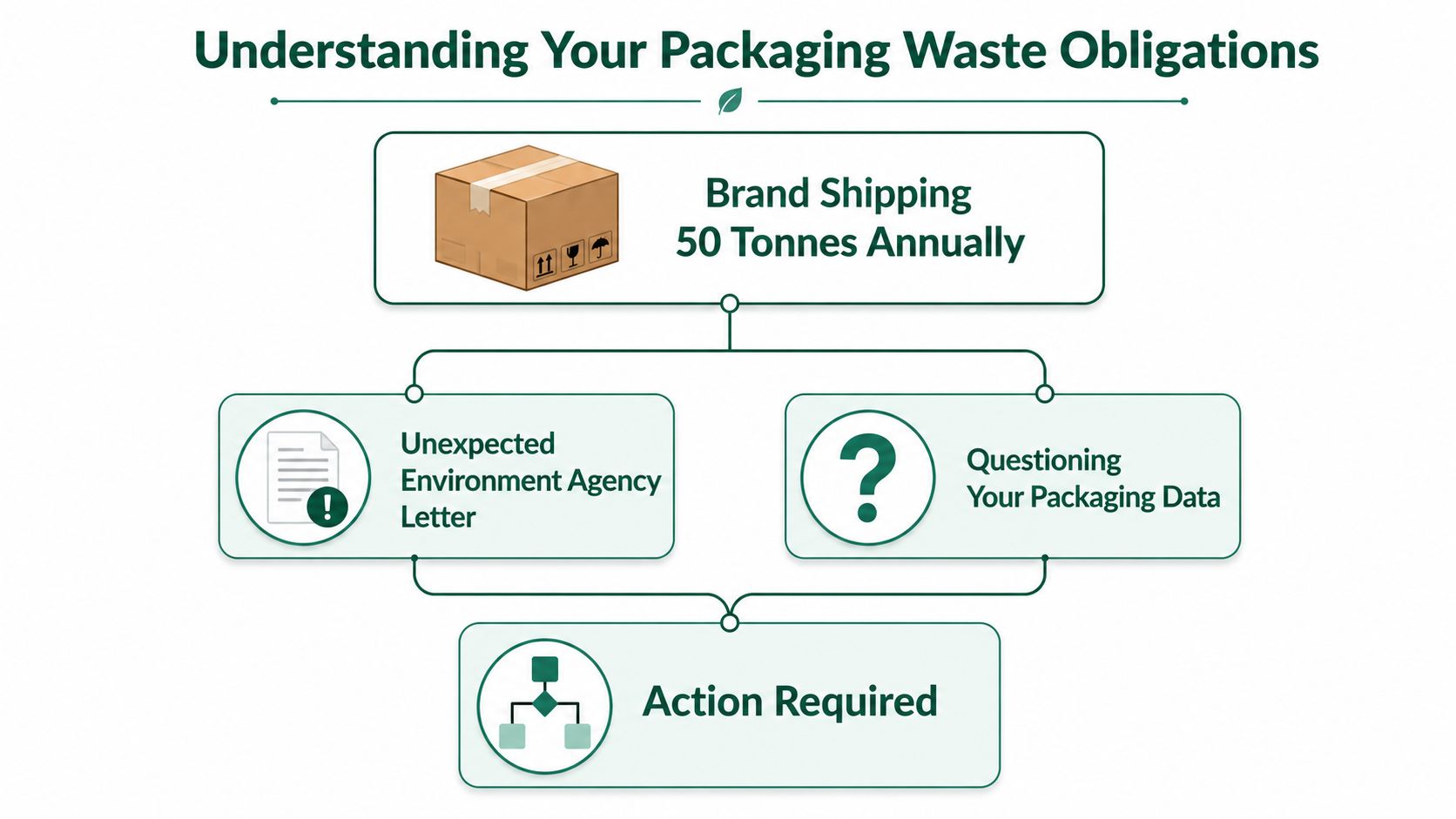
A mid-sized UK online retailer can spend months refining its dispatch operation, then receive an Environment Agency query asking for packaging data that nobody has tracked consistently. The surprise usually isn't that packaging obligations exist. It's that responsibility can sit across imported goods, product packaging, delivery materials, warehouse handling and marketplace sales, with different records needed for each.
The UK packaging waste regulations have moved beyond the old shared-cost model. The Producer Responsibility Obligations (Packaging and Packaging Waste) Regulations 2024 came into force on 1 January 2025 across England, Wales, Scotland and Northern Ireland, introducing a broader Extended Producer Responsibility framework with new reporting, recycling and fee mechanics (official legislation). For SMEs, the practical issue is straightforward: packaging choices now affect both the amount reported and the cost of compliance.
Table of Contents
- Understanding Your Packaging Waste Obligations
- The Key Regulatory Regimes Explained
- Thresholds Registration and Reporting Deadlines
- How Material Choices Affect Your Compliance Costs
- Step by Step Compliance Actions for SMEs
- Sustainable Packaging as a Compliance Strategy
- Your Compliance Roadmap and Next Steps
Understanding Your Packaging Waste Obligations
A retailer can become responsible for packaging without manufacturing a single box. For example, it may import finished goods, add a carton and protective filler in its warehouse, then send the parcel to a household customer. Those activities can create separate responsibilities. The operating records need to show who supplied the packaging, where it entered the chain, and how it was used.
Start by separating handling packaging from placing packaging on the UK market. Moving a carton through a warehouse does not automatically make the business responsible for supplying it. The relevant position usually depends on who first owns or supplies the packaging in that part of the chain. Contracts, invoices, import entries and fulfilment instructions often provide better evidence than a label such as “retailer” or “manufacturer”.
Who may be an obligated producer
The practical categories include:
- Primary producers: Businesses that make or fill packaging, or sell products in packaging under their own brand.
- Importers: Businesses bringing packaged goods or empty packaging into the UK and becoming the relevant owner or supplier.
- Secondary packers: Businesses that add packaging around products before supply, including warehouse and fulfilment operations.
- Online sellers and marketplace businesses: Businesses selling packaged products directly to UK customers, especially where they control the import or supply route.
The overseas manufacturer is therefore not automatically the only responsible party. An importer may have the obligation even when the supplier designed the packaging. An e-commerce operator may also need to record delivery packaging added after arrival. Marketplace arrangements need a close review because the seller, platform operator and importer may have different legal positions.
Why “small” doesn't mean “ignore it”
A business below a familiar threshold can still create a reporting problem if it has not collected the underlying data. GOV.UK guidance states that businesses reporting 2026 packaging data must calculate packaging supplied or imported between 1 January 2025 and 31 December 2025, making data collection a task for the preceding reporting period (EPR packaging checks).
The Environment Agency's National Packaging Waste Database shows UK packaging data by material and packaging type, alongside historical waste datasets (National Packaging Waste Database). For day-to-day operations, the lesson is clear: keep a traceable record of packaging weights, materials, suppliers, imports and household use. Reconstructing those figures from purchase invoices after a query is slower and less reliable.
Practical rule: Map every point where the business imports, owns, fills, adds, sells or ships packaging before deciding whether an exemption applies.
The 2024 regulations have made operational discipline more important. Material classification, household packaging records and evidence supporting reported figures now affect both the quality of the submission and the work required to correct it. A packaging specification agreed with procurement can therefore influence compliance effort before a product reaches the warehouse.
The Key Regulatory Regimes Explained
Packaging decisions can create separate compliance tasks at the same time. Extended Producer Responsibility, the PRN and PERN system, and Plastic Packaging Tax each use different rules, records and cost triggers.
Extended Producer Responsibility makes producers responsible for packaging waste data and, where applicable, disposal fees and recycling obligations. The 2024 regulations introduced the current regime from 1 January 2025 and set recycling targets through 2030. Paper, board or fibre-based composite packaging has a target rising from 75% in 2025 to 85% by 2030. Plastic rises from 55% to 65%, while aluminium rises from 61% to 67% (2024 regulations). Those material categories affect the records your team must maintain and the costs attached to reported tonnage.
The PRN and PERN system supplies evidence that recycling obligations have been met. A Packaging Recovery Note covers recycling in the UK. A Packaging Export Recovery Note covers qualifying recycling overseas. Producers and compliance schemes use these documents to demonstrate recovery and recycling activity. They do not represent disposal charges for an individual box. They support evidence-based compliance linked to material obligations and reported tonnage.
Plastic Packaging Tax is separate from EPR and is administered by HMRC. It focuses on plastic packaging with less than the required recycled content threshold. A business can therefore have PPT exposure even when its EPR position differs. Assess the material, recycled content and supply chain separately. One registration does not cover every packaging duty.
| Regime | Who It Applies To | Cost Basis | Administering Body |
|---|---|---|---|
| Extended Producer Responsibility | Businesses that supply or import relevant packaging | Reported packaging, material obligations and applicable disposal fees | Environmental regulators and the UK EPR administration |
| PRNs and PERNs | Producers and compliance schemes needing recycling evidence | Evidence purchased for relevant material obligations | Accredited reprocessors, exporters and compliance arrangements |
| Plastic Packaging Tax | Businesses supplying or importing qualifying plastic packaging | Tax treatment based on plastic composition and recycled content | HMRC |
The guide to Extended Producer Responsibility explains how these systems interact. Product specifications matter when evidence is assembled. Packaging Panda's paper and poly mailer options include poly mailers, padded bags, paper mailers and book wraps. Record the actual material and weight for each format, rather than using the broad description “mailing bag”.

Thresholds Registration and Reporting Deadlines
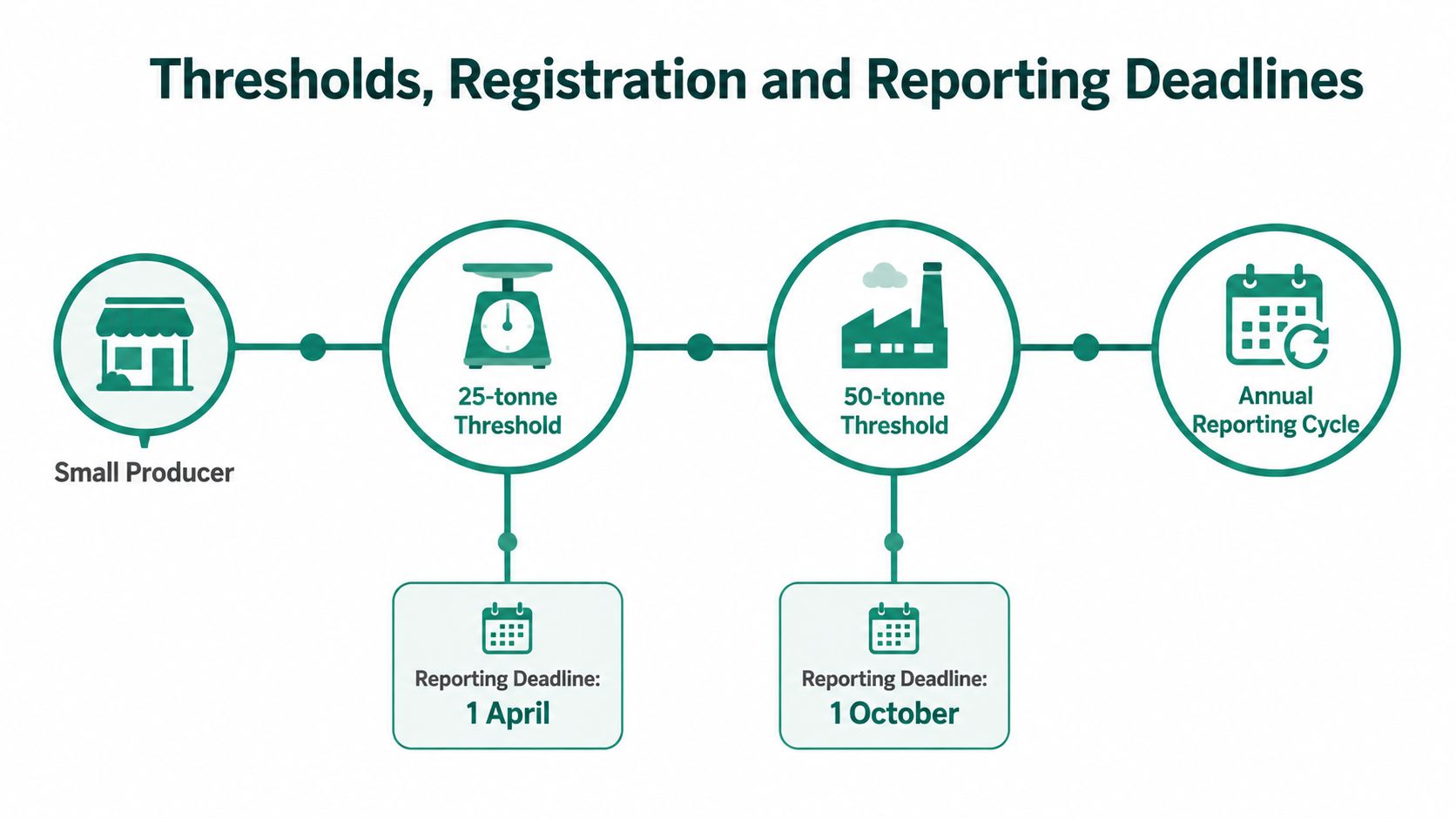
Threshold analysis requires more than one turnover test. Businesses often refer to 25 tonnes, 50 tonnes, £1 million and £2 million, but each figure must be matched to the relevant producer category, packaging activity and reporting route. The historic £2 million and 50-tonne test still appears in older explanations. For current reporting, calculate packaging data for the preceding period, including packaging supplied or imported during 2025, as noted in current regulator guidance.
Start with purchase, import and dispatch records. Calculate packaging tonnage, then compare it with turnover and producer status. Businesses close to a boundary should not round down or rely on an informal supplier statement. Retain the calculation, assumptions and supporting documents so the result can be checked later.
Registration and submission sequence
Use a documented sequence:
- Create an account on the Report Packaging Data service. Have organisation details, Companies House information where relevant and regulator correspondence ready.
- Verify the organisation. The account must connect clearly to the legal entity and its packaging activity.
- Classify the packaging. Separate paper and board, plastic, glass, aluminium, steel, wood and composite formats. Record whether each item is primary, secondary, shipment or transit packaging, and whether it is household or non-household.
- Submit the relevant data. Use supplier specifications, bills of materials, product dimensions, packaging weights and warehouse records. Keep an audit trail showing how estimates were calculated.
- Review the return before submission. An incorrect material category can change recycling obligations and applicable fees.
Small producers generally use a lighter reporting route than large producers. Larger producers may face more frequent reporting, scheme involvement and fee administration. Confirm the route against current regulator instructions instead of relying on an old spreadsheet.
Building a defensible calendar
Defra guidance requires annual recycling-obligation compliance by 31 January for the year ending 31 December (EPR recycling obligations). Other reporting windows and regulator instructions can vary by producer type and service route. Finance and operations should therefore maintain one shared calendar, with named owners for data collection, review and submission.
Flag incomplete supplier data rather than replacing it with a convenient assumption. A temporary estimate may use comparable specifications, but record its source, confidence level and planned correction. The packaging waste regulations guidance helps teams identify the records required before preparing a return.
How Material Choices Affect Your Compliance Costs
A packaging redesign can change more than unit cost. It can alter the material category, recycling assessment, EPR fee exposure and the amount of evidence your team must collect. During the 2024 and 2025 transition, purchasing decisions therefore need to be checked against the reporting consequences, not just the supplier quotation.
The current 2026 targets differ by material, including 77% for paper, board and fibre composite, 76% for glass, 62% for aluminium, 81% for steel, 57% for plastic and 46% for wood. These targets do not make every paper pack cheaper. They underline why classification and end-of-life evidence belong in packaging specifications, alongside weight and price.
A lightweight, recyclable mono-material pack usually gives a clearer reporting profile than a heavier laminate. Dark plastic, bonded multi-layer structures and polystyrene components can be harder to classify or recycle, increasing exposure to modulated disposal fees. Paper and board may suit the application, but contamination or inseparable coatings can change the practical recycling assessment.
| Material Type | EPR Fee Level | PPT Exposure | Kerbside Recyclability |
|---|---|---|---|
| Virgin plastic | Higher exposure where recyclability is poor | Potentially applicable | Depends on format and local acceptance |
| Recycled-content plastic | May improve fee position where the format is recyclable | Depends on qualifying recycled content | Depends on format |
| Paper and cardboard | Often easier to classify and recycle | Generally not plastic packaging | Commonly accepted, subject to condition |
| Glass | Material-specific obligation and disposal-fee treatment | Not a plastic packaging tax issue | Widely collected, but collection route matters |
| Aluminium | Material-specific obligation | Not a plastic packaging tax issue | Often collected, subject to local systems |
| Compostable film | Requires careful classification and disposal evidence | May still require assessment if plastic applies | Not automatically accepted in household recycling |
PPT needs its own assessment. It remains a separate HMRC-administered regime, while EPR fees are expected to reflect recyclability from 2026. A mailer that appears simple may still require evidence about its layers, recycled content and intended disposal route. This Amazon packaging compliance guide can help teams review pack construction and avoidable layers when assessing fulfilment formats.
Record the specification, material weight, recycled-content evidence and recycling rationale for each significant format. That file supports reporting and gives procurement a practical basis for comparing alternatives. It also exposes trade-offs early. A thinner pack may lower material use but fail in transit, while a recyclable format may require more expensive testing or revised supplier documentation.
The cost decision is therefore based on weight, material simplicity, recycled content, actual recyclability and evidence quality. A low unit price can become expensive when the format attracts higher fees or produces unreliable reporting data.
Step by Step Compliance Actions for SMEs
A packaging change can create a reporting problem before it reaches the warehouse. A supplier may replace a laminate, alter a mailer, or change recycled content without changing the product code. SMEs need a repeatable process that connects purchasing, warehouse usage and regulatory returns.
Start with the physical packaging
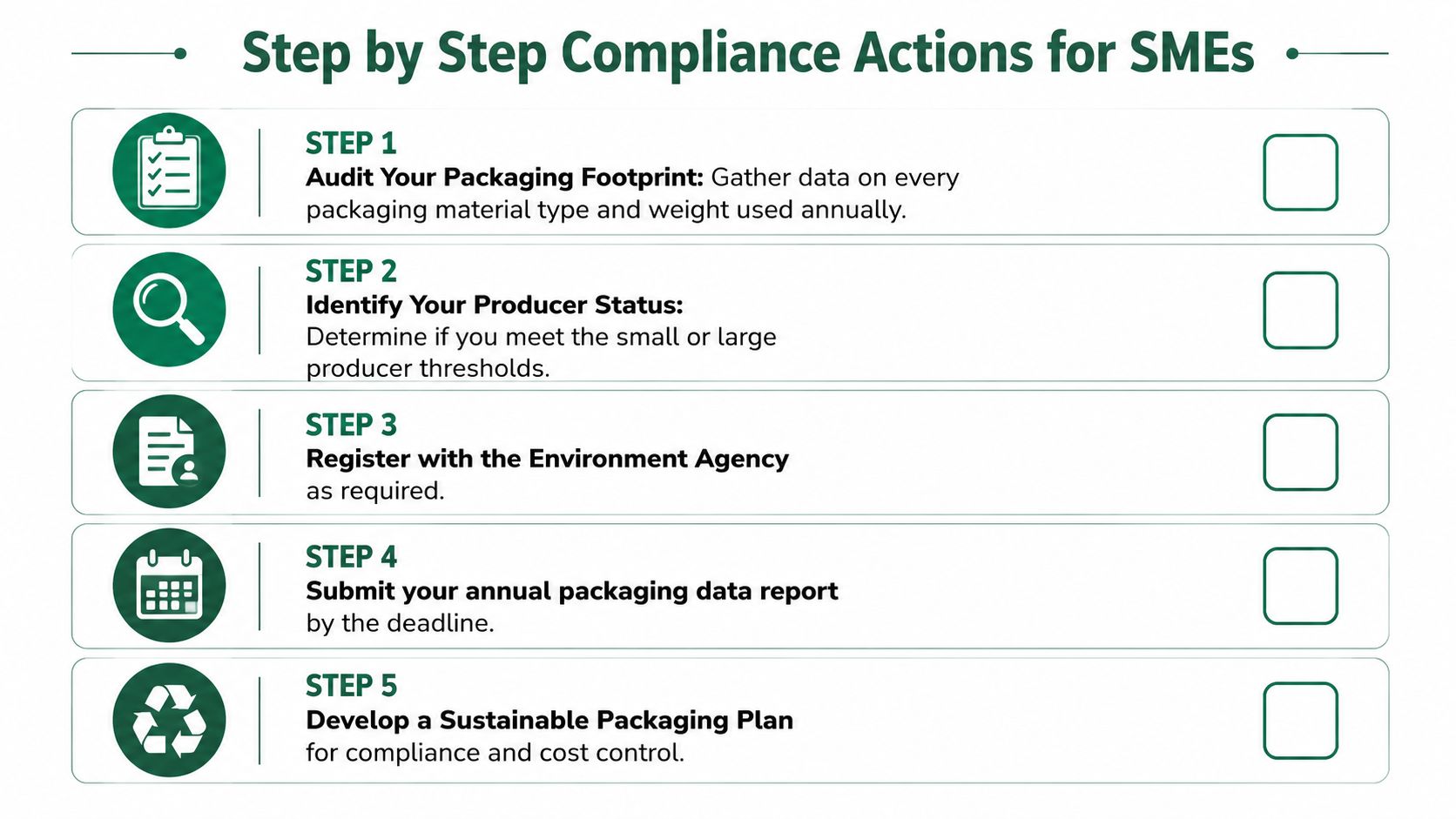
Step one is an audit. List every item placed on the UK market, including product packaging, cartons, void fill, tape, labels, pallet wrap and dispatch mailers. Supplier invoices show purchases, while warehouse records show consumption. Check each site and fulfilment partner separately, because the same SKU may use different formats.
Step two is a producer-status calculation. Add relevant packaging weights, distinguish imported from UK-supplied packaging, and compare the result with the applicable thresholds. Keep turnover and packaging tonnage in the same working file. Revisit the calculation when sales volumes, suppliers or fulfilment arrangements change.
Register with evidence ready
Step three is registration. Use the appropriate environmental regulator route for England, Scotland, Wales or Northern Ireland. Prepare legal-entity details, contact information, packaging categories and the reporting period before starting the application. Registration is easier to correct when the underlying data is organised.
Make reporting part of operations
Step four is classification and submission. Record the material, packaging class, weight and household status for each format. Retain supplier declarations, specifications and calculation notes. If a supplier cannot confirm a laminate's construction, record the uncertainty and request the missing specification rather than assigning a convenient category.
Step five is ongoing control. Procurement, finance and operations should share ownership. Review new packaging before purchase, update the register when materials change, and reconcile reported tonnage with invoices and dispatch volumes. Smaller producers may report annually, while larger producers can have more involved reporting and scheme responsibilities. The compliance calendar must reflect the organisation's status.
Set aside a project period for the initial audit, a review stage for registration and a recurring monthly control for reporting data. The workload depends on SKU count, warehouse complexity and supplier quality. Leaving the work until an annual deadline makes errors harder to trace and correct.
Evidence beats confidence. A signed specification, weight record and documented calculation provide a stronger basis for compliance than an assurance that “the packaging hasn't changed”.
Sustainable Packaging as a Compliance Strategy
A packaging redesign can lower EPR reporting effort and related costs, but only if it works in production. Right-sizing reduces the material placed on the market, mono-material construction can make specifications easier to classify, and recycled content may affect the separate Plastic Packaging Tax assessment. Environmental gains and compliance gains often align, but neither follows automatically.
Start with the complete pack. A paper envelope containing plastic components may still need mixed classification. Compostable film may require a specialist disposal route rather than standard household recycling. A lighter format that causes product damage can generate returns and replacement shipments, removing the expected saving.
The commercial case for redesign
Use the packaging register to find high-volume formats and materials where supplier evidence is weak. Compare each redesign against:
- Material weight: Lower weight generally means less tonnage to report.
- Construction: Mono-material formats are often easier to specify than bonded composites.
- Recycled content: Qualifying content may change PPT exposure under the separate tax rules.
- End-of-life route: The pack needs a realistic recycling or recovery pathway, not a symbol selected for appearance.
- Operational performance: It must protect the product and run on existing packing equipment.
For a practical review of material choices and operational requirements, use this sustainable packaging guidance. Teams assessing new polymers, coatings or refill systems can consult circular economy R&D insights from Polymerize alongside supplier testing and internal specifications.
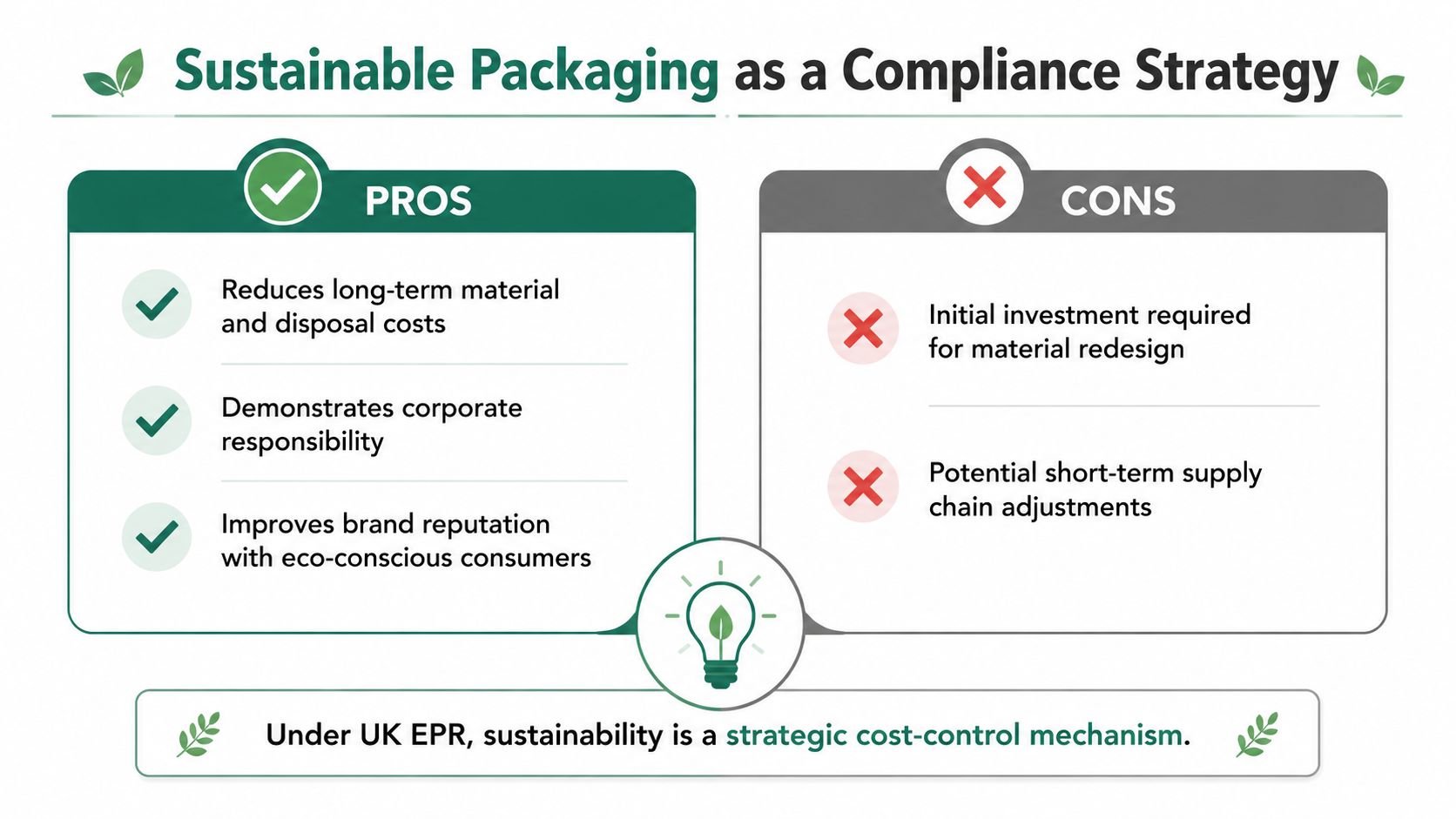
The practical trade-off is upfront work for better control later. Redesign may require performance testing, supplier approval and revised warehouse procedures. It can also change the material evidence needed for EPR records and the assumptions behind tax reviews. A business that delays until a fee or labelling deadline has arrived may face fewer supplier choices and too little time to validate the pack properly.
Your Compliance Roadmap and Next Steps
A practical roadmap begins with four decisions. Confirm whether the business exceeds the relevant packaging and turnover thresholds. Map its supply-chain role, including importing, manufacturing, filling, fulfilment and marketplace sales. Separate EPR, PRN or PERN evidence from Plastic Packaging Tax analysis. Finally, identify household packaging and retain the evidence supporting any non-household treatment.
The regulatory calendar is active. The 2024 regulations came into force on 1 January 2025. Annual recycling-obligation compliance is due by 31 January for the previous calendar year, as set out in GOV.UK guidance (recycling-obligation guidance). Businesses reporting 2026 data need records for the 2025 calendar year. The relevant obligation calculation uses actual data submitted by or after April 2026, while incomplete earlier data may be uplifted to a full-year basis.
Priority actions
- Audit the packaging register: Record primary, secondary, shipment and transit packaging, including material weights and supplier evidence.
- Confirm producer status: Document the tonnage, turnover, import activity and supply-chain role used in the assessment.
- Register through the correct route: Use the relevant regulator or compliance scheme, then retain confirmation.
- Create monthly controls: Reconcile purchases, warehouse usage, imports and dispatch records before reporting periods close.
- Review material choices: Check recyclability, recycled content, weight and likely disposal-fee treatment before approving each new SKU.
- Check labelling readiness: Under the draft rules, recyclable packaging would use the relevant recycle mark and wording, while non-recyclable packaging would carry “Do Not Recycle”. The draft approach has no de-minimis threshold. Primary packaging, except plastic films and flexibles, is scheduled for labelling by 31 March 2026, with plastic films and flexibles scheduled to follow by 31 March 2027, subject to final regulatory confirmation (draft packaging labelling regulations, labelling impact assessment).
Material selection affects the workload as well as the bill. A lighter, simpler pack can reduce purchasing and reporting effort, but only if it still protects the product, runs on existing equipment and has a credible end-of-life route. Approving a new SKU therefore requires procurement, operations and compliance to review the same specification.
Businesses that cope best usually have a reliable packaging register, clear ownership and purchasing controls that capture material data at source. Packaging Panda supplies UK businesses with packaging, mailing and protective products, including recyclable cardboard boxes, paper and poly mailers, and made-to-order packaging options. Visit Packaging Panda to review formats that can support a consistent procurement and compliance process.