Food Safe Packaging: A UK Business Guide for 2026
A food business can get the recipe right, the branding right, and the customer experience right, then still create risk with the wrong pack. That usually happens at the point where packaging starts to look simple. A box is a box. A liner is a liner. A compostable tray must be the safer choice. None of that holds up for long once hot food, grease, moisture, allergens, transport, and UK compliance all enter the picture.
Browse our food-safe catering packaging →
Most owners are dealing with the same pressure at once. The packaging has to protect the food, suit the product, meet legal duties, support shelf or delivery presentation, and fit the budget. It also has to stand up to customer scrutiny, especially when buyers now pay attention to sustainability claims as closely as they watch price.
The practical problem is that food safe packaging is often discussed as if it were a badge. In reality, it's a combination of material behaviour, intended use, supplier evidence, and legal fit. A pack can look premium and still be wrong for hot, fatty, acidic, or long-contact applications. A pack can carry a green claim and still create a chemical risk that standard buying checks miss.
Table of Contents
- Your Essential Guide to Food Safe Packaging
- What Does Food Safe Actually Mean
- Navigating UK and EU Food Packaging Regulations
- A Material by Material Guide to Safe Packaging
- Testing Certification and Supplier Vetting
- Balancing Safety with Your Sustainability Goals
- Your Food Safe Packaging Selection Checklist
Your Essential Guide to Food Safe Packaging
Food safe packaging starts with a basic question. What will this material do when it sits in contact with the exact food being sold, under the exact conditions in which it will be stored, transported, heated, chilled, or handled?
That's the question many buyers skip because the pack itself seems familiar. Cardboard cartons, paper wraps, windows, trays, adhesive labels, and liners all look routine. The risk sits in the details. Dry biscuits and hot chips don't place the same demands on a pack. A chilled dessert with a long dwell time in a carton isn't the same as a sandwich sold within hours. Packaging that performs well for one product can be a poor choice for another.
A sensible buying process needs to judge four things together:
- Food contact suitability means the material is appropriate for the product itself, not just generally described as food related.
- Use conditions include heat, grease, moisture, freezer storage, acidity, and contact time.
- Compliance evidence means the supplier can show proper documentation, not just sales language.
- End-of-life claims must be checked carefully, because sustainable wording doesn't automatically mean safer chemistry.
Practical rule: If a supplier can describe the finish but can't describe the contact conditions it's been assessed for, the buyer doesn't have enough information yet.
Many businesses need a more grounded view of food safe packaging. It isn't only about avoiding obviously unsafe materials. It's also about avoiding mismatches. A paper-based pack might suit one menu line perfectly and fail with another if grease or condensation changes how the surface behaves. A compostable item may sound like progress, yet still raise questions about hidden additives.
The right approach is disciplined rather than complicated. Define the food, define the contact conditions, identify the material stack, and ask for proof. That prevents the most common packaging mistakes before they become customer complaints, enforcement issues, or expensive repacking exercises.
What Does Food Safe Actually Mean
A deli owner switches from a plain greaseproof wrap to a compostable-looking alternative and assumes the safer choice has been made. The pack feels premium, the supplier says it is suitable for food use, and the sustainability message looks strong on shelf. Yet the real question is narrower and more demanding. What exactly is touching the food, under what conditions, and what evidence supports that use?
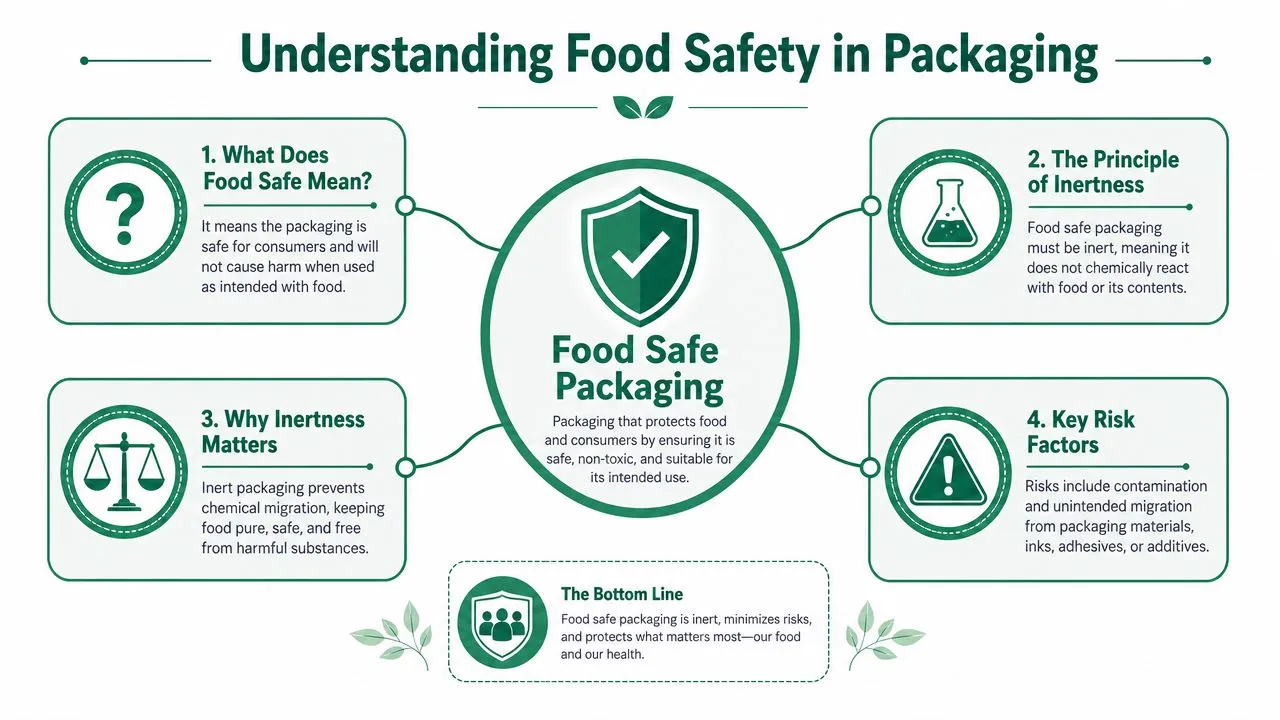
In packaging, food safe means a material is suitable for contact with food without transferring substances at levels that could create a risk during its intended use. It is a performance and compliance question, not a visual one.
A quick visual marker often appears on packs or packaging documentation.
The logo is only the start
In the UK, food contact materials may carry the wine glass and fork symbol where the intended use is not already obvious, as outlined by the Food Standards Agency guidance on food contact materials. Buyers often stop there. We do not.
The practical standard is inertness. The material needs to stay stable against the actual food and the actual service conditions. Heat, grease, acidity, alcohol, moisture, storage time, and reheating all affect whether a pack remains suitable or starts to raise migration concerns.
This is the gap that causes expensive mistakes. A board carton may be fine for a bakery item sold dry. The same format can become a different compliance question once steam, oil, sauces, or freezer-to-oven use enters the picture.
Paper can still be the right answer. Paper Packaging covers formats such as paper mailers, honeycomb bags, paper tape, kraft boxes and tissue, including recyclable and plastic-free options. For some products that is a sensible fit. For others, the coating, adhesive, or barrier treatment matters more than the fact that the outer layer is paper.
Why migration matters in practice
The hardest part for many buyers is that familiar signals can give false confidence. A food-contact symbol does not confirm suitability for every use case. A compostable claim does not prove the chemistry is low risk for direct contact with hot, fatty, or acidic foods. Standard paperwork may also focus on baseline compliance while leaving buyers with limited visibility into added treatments, including fluorinated grease barriers such as PFAS, unless those questions are asked directly.
That is where perceived safety and regulatory reality often part company.
A practical buying standard is to separate three questions:
| Question | What it tells a buyer | What it does not tell a buyer |
|---|---|---|
| Is it marked for food contact? | The supplier presents it as suitable for food contact | Whether it fits a specific hot, greasy, acidic, frozen, or long-contact application |
| Is the material familiar? | Similar formats are widely used in food service | Whether this exact grade, coating, adhesive, ink, or laminate is appropriate |
| Is it marketed as compostable or sustainable? | It may support disposal or brand goals | Whether hidden chemistry has been screened out or the pack is suitable for the intended food |
A food-contact symbol starts due diligence. It does not replace product-specific checks.
In practice, we advise food businesses to treat “compostable”, “plastic-free”, and “eco” as marketing descriptors until the supplier can explain the full material structure and provide evidence for the exact use. That is especially important for hot-fill items, greasy foods, and applications where barrier coatings do the real work.
Packaging also sits inside the wider food safety system. Teams reviewing handling and contamination controls may also find it useful to look at broader steps that prevent foodborne illness, because the risk does not end in the kitchen. It includes every surface and material that contacts the product before sale.
Navigating UK and EU Food Packaging Regulations
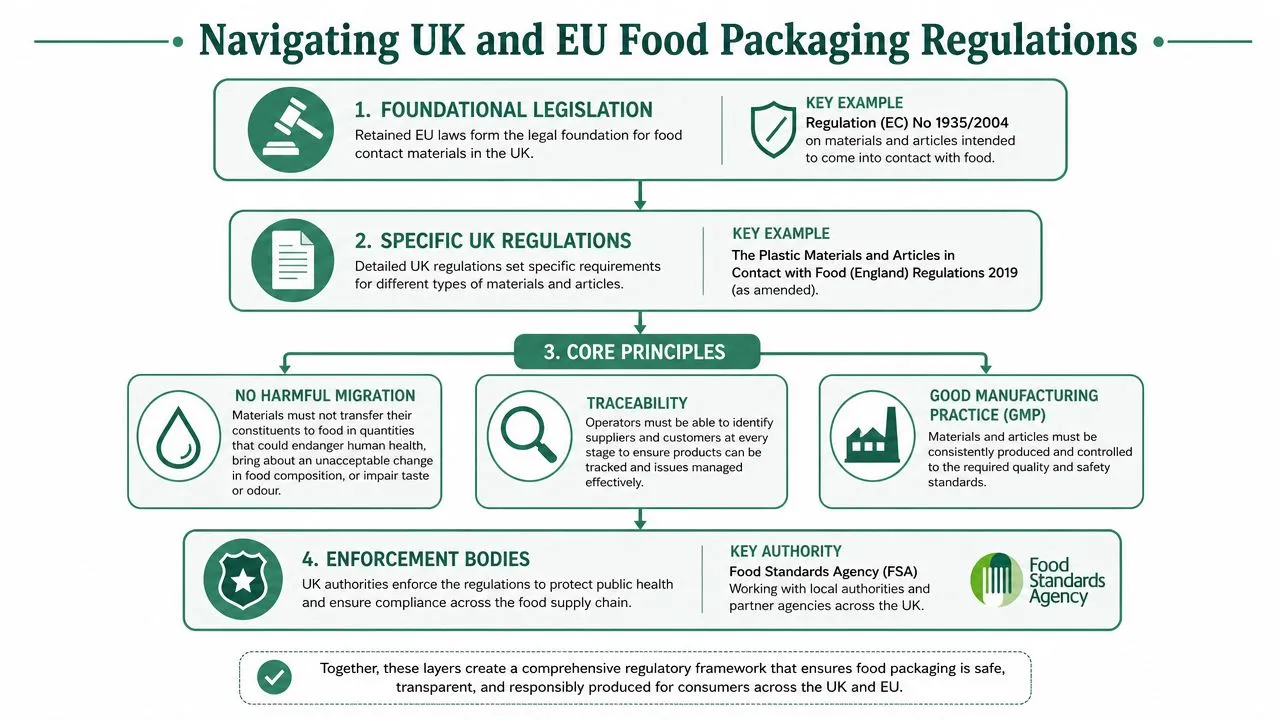
A supplier sample can look clean, carry a compostable claim, and still create a compliance problem once it meets hot, greasy, acidic, or long-held food. That gap between what appears safe and what stands up under UK and EU food-contact rules is where buyers get caught.
The legal baseline every buyer should know
The starting point is retained Regulation (EC) No 1935/2004. Its core test is practical. Food-contact materials must not transfer substances into food at levels that could harm health, change the food unacceptably, or affect taste and smell.
For a buyer, that means compliance is application-specific. A declaration for general food contact does not automatically cover soup, buttery pastries, pickles, freezer storage, or a hot cabinet. We regularly see businesses assume a fibre pack is safe because it feels natural or a compostable tray is safer because it sounds cleaner. The law does not assess marketing language. It assesses the material, the chemistry in the full structure, and the intended use.
That matters with coated paper and moulded fibre in particular. If grease resistance or moisture holdout depends on an added treatment, that treatment is part of the compliance question. Standard paperwork may confirm food-contact suitability in broad terms while saying little about fluorinated chemistries, barrier additives, or whether the test conditions match the actual product.
UK enforcement sits under the named regulations and local authority oversight. Buyers should expect suppliers to support food-contact claims with traceable documents, not just product sheets and sales wording. Where a format has coatings, inks, adhesives, laminations, or windows, each layer can affect compliance. Teams comparing substrates often find it useful to review broader material-performance differences in the Labs USA materials guide, then bring that same discipline back to food-contact decisions.
Where food businesses get caught out
A common failure point is treating packaging compliance and food labelling as separate purchases. For prepacked for direct sale products, the pack has to do both jobs at once. It must be suitable for contact with the food, and it must carry the required product information in a form that remains legible through storage, handling, and sale.
For cafés, bakeries, delis, and farm shops, that usually shows up in everyday formats: sandwich wedges, cake slices, salad pots, and counter-packed snacks. If labels lift in the chiller, ink rubs off on a greasy lid, or condensation makes allergen text hard to read, the problem is no longer a print issue. It becomes a regulatory one.
We advise clients to check each SKU against four points:
- Use condition. Match the pack to the actual food, fill temperature, fat content, acidity, and holding time.
- Full structure. Review coatings, inks, adhesives, windows, and liners, not only the base material.
- Labelling function. Confirm the pack can hold readable ingredient and allergen information for the product's full shelf life.
- Records. Keep declarations, specifications, and test evidence easy to retrieve if enforcement officers ask for them.
This is especially relevant for seasonal and promotional formats. A branded tub or carton bought for appearance or sustainability claims can introduce a new coating system or print finish that was never reviewed properly. We see that risk in custom event and cinema-style foodservice packs, including custom printed popcorn boxes for food service promotions, where heat, grease, and fast turnaround often compress the approval process.
The practical rule is simple. Buy by use case, not by category name. “Paper”, “compostable”, and “recyclable” are not compliance outcomes. They are starting descriptions. The actual decision sits in the evidence behind the finished pack.
A Material by Material Guide to Safe Packaging
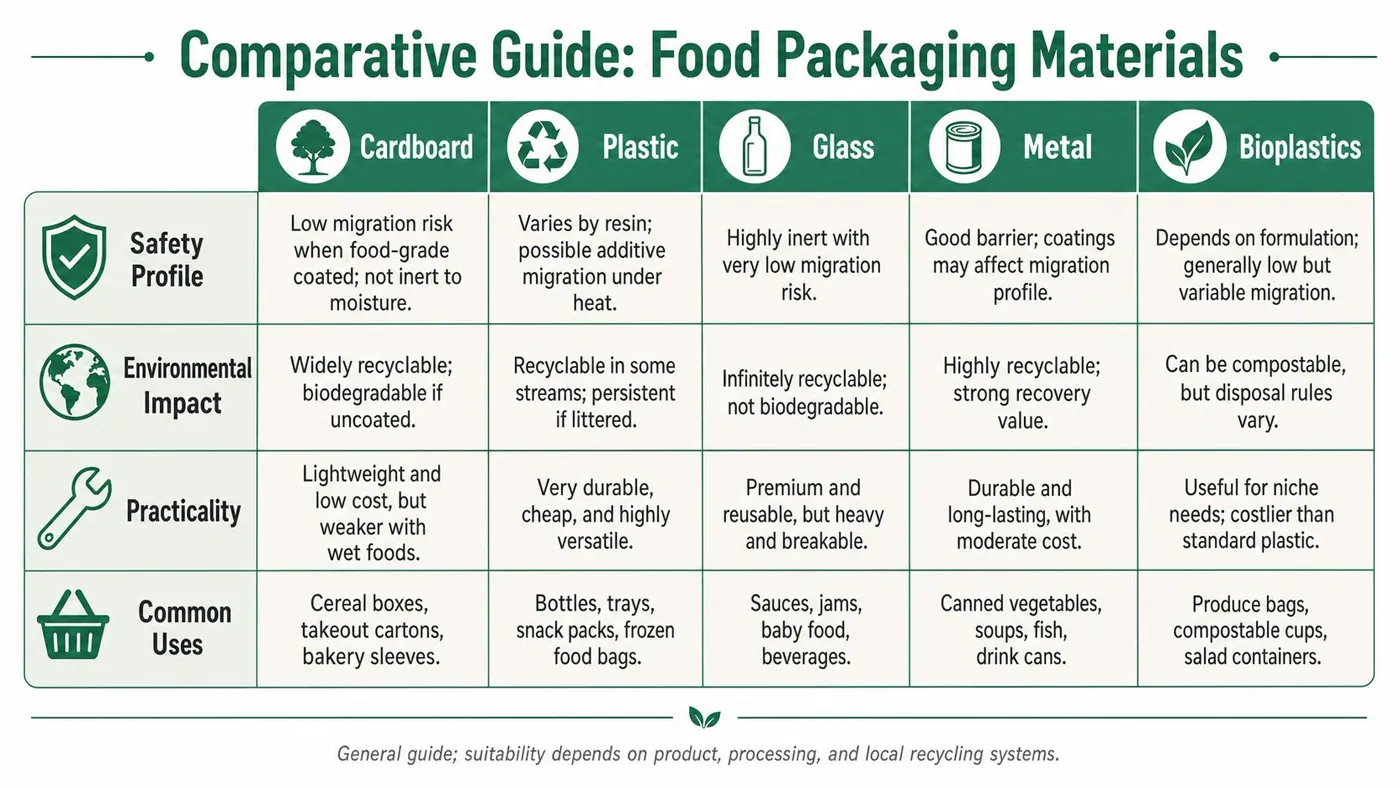
Material choice is where buying teams can either reduce risk early or build it in by mistake. The right question isn't “which material is best?” It's “which material behaves properly with this food, under this use pattern, with this disposal claim?”
How common materials behave
Cardboard works well for many bakery items, dry goods, and secondary packs. It gives structure, prints well, and often aligns with recycling goals. It becomes more complex when the food is greasy, damp, chilled, or in direct long contact. In those cases, the safety question often shifts to the inner surface, liner, window film, or coating rather than the board alone.
Greaseproof and paper wraps can be effective for pastries, sandwiches, and lighter takeaway uses when they're matched correctly to oil content and holding time. They're less forgiving when food is very hot, heavily fatty, or likely to create steam build-up. If a paper format needs a treatment or barrier to perform, buyers should treat that barrier as part of the material specification, not a minor detail.
Plastic films and liners are often selected where moisture resistance, seal integrity, or visibility matter. That doesn't make them automatically problematic or automatically safe. The relevant issue is whether the exact material stack is compliant for the intended food contact. Buyers comparing material performance across sectors sometimes benefit from technical frameworks like this Labs USA materials guide, not because laboratory furniture equals food packaging, but because it shows how disciplined buyers compare materials by chemical resistance, use environment, and performance limits rather than by surface appearance.
Glass and metal remain strong options for certain products because they can provide excellent barrier performance and strong consumer confidence. The trade-offs are operational. Weight, breakage risk, transport cost, closure performance, and filling line compatibility all matter.
Here's a practical comparison:
| Material type | Usually works well for | Watch-outs |
|---|---|---|
| Cardboard | Cakes, dry bakery, outer cartons, sleeves | Needs the right inner contact layer for grease or moisture |
| Paper wraps | Short-life bakery, sandwiches, lighter takeaway | Can lose performance with heat, oil, or condensation |
| Plastic films | Liners, windows, sealed packs, moisture control | Must be assessed by exact grade and intended use |
| Glass | Sauces, preserved products, premium retail formats | Heavy, breakable, harder in delivery channels |
| Metal | Tins, lids, certain long-life products | Internal coating and product compatibility matter |
Where compostable claims need closer scrutiny
This is the area where perception often drifts furthest from reality. Many buyers see “compostable” and assume safer chemistry, cleaner disposal, and lower environmental risk. That assumption can fail badly.
According to Fidra's work on PFAS in food packaging, many compostable food packaging options contain toxic PFAS chemicals, which can contaminate compost and subsequently crops. That undermines the simple idea that a compostable label is enough on its own. In practice, a buyer can select a pack that sounds circular while introducing a different contamination problem into the waste stream.
Buyer warning: Compostable is an end-of-life claim. It isn't proof that the chemistry is clean.
Detailed specification work matters. Ask whether the pack contains added grease-resistant chemistry. Ask whether coatings, barriers, and adhesives are included in the claim. Ask what evidence sits behind the compostable language. If the supplier can only point to the headline claim, the assessment isn't finished.
For food businesses selling cinema snacks, street food, or event catering, format-specific design still matters alongside chemistry. A practical example is custom printed popcorn boxes, where structure, grease behaviour, print finish, and serving conditions all need to line up rather than being treated as separate decisions.
Testing Certification and Supplier Vetting
A failed packaging check rarely starts with a dramatic warning. It usually starts with a supplier saying a tray, cup, or wrap is "food grade", while the paperwork is generic, out of date, or limited to the base material only. That gap matters. It is where businesses end up using a pack that sounds compliant on paper but has never been properly cleared for the food, temperature, and contact conditions in its intended application.
The document we ask for first is the Declaration of Compliance. It should match the exact item being bought and state the intended use clearly enough to test. If a supplier sends a broad statement covering a whole range, or one that ignores coatings, inks, laminates, or adhesives, the review is incomplete.
This is also where "compostable" and "natural" claims can mislead buyers. A pack can carry a sustainability message and still leave major chemistry questions unanswered. Standard compliance documents may cover food contact migration for the main substrate but say little about added grease barriers, print systems, or treatment chemicals that create separate risk. We treat those as separate checks, not as details to assume away.
Ask direct questions before you place the order:
- Request the Declaration of Compliance for the exact SKU, not a similar item or product family.
- Describe the exact use case including food type, fill temperature, contact time, and whether fats, acids, or moisture are involved.
- Check the full specification including coatings, barriers, inks, windows, labels, and adhesives.
- Ask what has been tested and under which conditions, rather than accepting a general "suitable for food contact" statement.
- Confirm traceability so batch records and supporting documents can be produced during an audit or complaint investigation.
- Review storage and handling before filling, because damaged or contaminated stock can create a hygiene issue even if the material itself is compliant.
A short answer is often the warning sign. If a supplier cannot explain the difference between the base board and the finished pack, or cannot confirm whether added treatments are included in the assessment, we would not treat the approval as complete.
Physical performance still matters. A compliant container that cracks, buckles, or leaks in service creates its own food safety problem through spills, contamination, and poor handling control. This article on preventing container failure in food service is useful context for that side of the decision.
Security features belong in the same review. For products exposed to delivery handoffs, retail shelving, or shared storage, tamper-evident packaging for food products in transit and retail settings adds a practical control, but it does not replace material compliance, migration evidence, or supplier traceability.
Good documentation does one job well. It turns supplier claims into something your business can verify, file, and defend.
Balancing Safety with Your Sustainability Goals
A food business can switch to a pack that looks greener on the shelf and still create a bigger compliance problem in the back office. We see this most often with fibre packs sold as recyclable or compostable, where the environmental claim is clear but the food contact picture is not. Coatings, grease barriers, inks, adhesives, and mould-release treatments can change both the legal position and the actual risk.
The commercial pressure is real. UK food brands are making more environmental packaging claims, and shoppers are paying attention, as noted in Mintel's UK attitudes towards food packaging market report. Regulation is pushing in the same direction through measures such as the Plastic Packaging Tax and restrictions on some single-use plastic items. That affects small operators as much as national brands, because customers now ask direct questions about recyclability, recycled content, and whether a pack is better than the option it replaced.
The difficult part is that “sustainable” and “food safe” are not interchangeable. A compostable tray may still rely on added chemistry to resist oil, moisture, or heat. A paper-based wrap may look lower impact than plastic, but if it needs fluorinated treatment to perform, the sustainability claim starts to look thin. PFAS is the clearest example. Standard paperwork may confirm general food contact suitability while missing whether persistent chemicals were used to deliver grease resistance in the finished pack.
That is where buyers get caught. They approve the headline claim and never press on what sits behind it.
A better decision starts with the product, the contact conditions, and the waste route your customer can use.
- Dry bakery and low-moisture foods often suit simpler fibre formats, provided the direct contact surface and any window film or adhesive have been assessed properly.
- Greasy, hot, or chilled foods need closer scrutiny, because the packs marketed as recyclable or compostable can depend on barrier treatments that deserve a separate check.
- Branded formats need a second look at print coverage, laminations, labels, and coatings, since those details can affect both disposal outcomes and material compliance.
We advise clients to be careful with broad compostable claims unless they can answer three plain questions. What standard is the claim based on. Does that claim apply to the full finished pack, not just one layer. Does the material chemistry create a different risk, even if the pack passes a basic compliance review.
Packaging Panda supplies UK wholesale packaging with recyclable and compostable options, bespoke formats, and made-to-order solutions for businesses that need a closer fit between the food, the pack structure, and day-to-day handling. That matters because reducing material use is often a better sustainability gain than switching to a more marketable substrate that brings extra coatings, higher cost, or weaker evidence.
For bakery businesses, right-sizing is usually one of the cleaner wins. If a carton protects the product properly and avoids unnecessary board weight, the result is easier to defend than a vague green claim. In some cases, using better-fit cake boxes for bakery products improves material efficiency without creating new uncertainty around contact layers or disposal instructions.
The best sustainability choice is the one you can explain under scrutiny. It should be suitable for the food, specific in its environmental claim, and supported by enough detail to stand up to regulator questions and customer scepticism.
Your Food Safe Packaging Selection Checklist
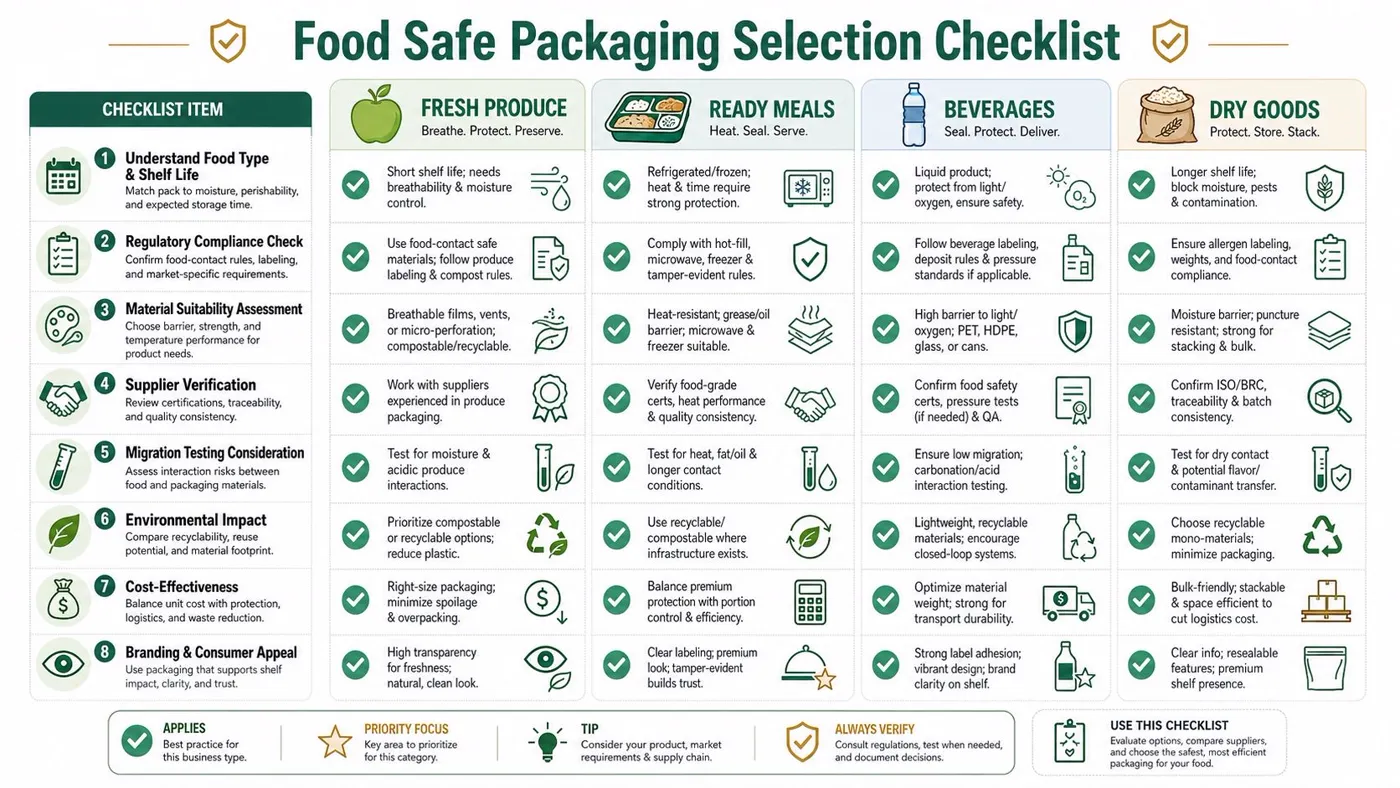
The fastest way to make better decisions is to run every packaging option through the same shortlist of checks. Different food categories need different answers, but the buying discipline stays the same.
Bakery chilled takeaway and dry goods checks
Bakery products need close attention to grease transfer, structural support, and display quality. Whole cakes, slices, pastries, and iced items don't all behave the same way. Check whether the board is the actual contact surface or whether there's a liner, window, or pad changing the specification. If the item is packed for direct sale, make sure the packaging supports legally required ingredient and allergen information clearly and consistently.
Chilled and refrigerated foods demand more discipline around condensation, seal performance, label adhesion, and storage time. Buyers should confirm that the material remains suitable under chilled conditions and that handling in and out of refrigeration won't degrade performance. If the food sits in contact with the pack for longer periods, the proof threshold should rise, not fall.
Hot or greasy takeaway foods are where superficial choices fail quickly. Steam, oil, and short but intense contact conditions can expose weaknesses in wraps, trays, and coated paper formats. Ask whether resistance comes from the base material, an added coating, or a treatment that needs separate scrutiny.
Dry goods retailers often have the simplest route, but only if they avoid overcomplicating it. Dry snacks, confectionery, and shelf-stable products may suit lighter paper or board solutions, though windows, closures, and shelf-life needs still matter.
The shortlist before approval
Use this final check before signing off a pack:
- Food match. Is the pack suitable for this exact food, not just food generally?
- Contact conditions. Will it face heat, cold, grease, moisture, or acidity?
- Material stack. What are the board, film, coating, adhesive, and print elements?
- Supplier evidence. Is there a valid Declaration of Compliance for the exact item?
- Operational handling. Can staff store, fill, label, and seal it without creating avoidable risk?
- Sustainability accuracy. Does the environmental claim stand up to scrutiny beyond the headline wording?
- Business fit. Does the format support transport, display, and customer use without unnecessary material or failure points?
The right pack isn't the one with the strongest claim on the outside. It's the one a business can justify from specification to sale.
A reliable buying process also keeps one final principle in view. If a supplier can't explain why a material is suitable for a particular use, the buyer shouldn't approve it yet. Food safe packaging decisions improve when teams slow down at specification stage instead of solving problems later in complaints, relabelling, or stock write-offs.
If a business needs help narrowing the shortlist, Packaging Panda supplies UK packaging materials across bakery, mailing, protective, tamper-evident, and bespoke formats, including sustainable options and made-to-order solutions that can be reviewed against the product's actual food-contact and handling requirements.