Carbon Footprint Labels for Cake Boxes: A UK Guide
A bakery owner orders a run of cake boxes that look right on a product page. The board feels sturdy enough, the window shows off the finish, and the pack copy says recyclable. Then the awkward questions start. Does the plastic window create a tax issue? Will a grease-marked box be recycled by a UK council? If a carbon label goes on the pack, where does it fit once allergens and ingredients are already taking up the legal space?
Shop our wholesale cake boxes →
That's where cake box buying stops being a simple packaging job and becomes an operational one. For UK bakeries and e-commerce sellers, the box now has to do four things at once. It has to protect the cake, satisfy food law, support the brand, and stand up to scrutiny on sustainability claims. Generic “eco-friendly” advice doesn't solve that.
Carbon footprint labels sit right in the middle of this shift. They're not just a design feature. They affect sourcing, data collection, artwork hierarchy, and how openly a bakery addresses disposal. They also force a more disciplined look at common pack formats that have been accepted for years without much challenge.
Table of Contents
- Why Carbon Labels Now Matter for Your Cake Boxes
- Understanding Carbon Footprint Labels
- Comparing Common Carbon Labelling Schemes
- How a Product's Carbon Footprint Is Calculated
- A Step-by-Step Guide to Getting Carbon Labels
- Practical Realities for UK Cake Box Buyers
- Frequently Asked Questions
Why Carbon Labels Now Matter for Your Cake Boxes
A customer comparing two bakeries online often sees the packaging before they see the detail behind it. One brand shows a neat kraft box, a clear disposal instruction, and a carbon figure explained in plain language. Another has a vague recyclable logo and no context. The first bakery looks organised. The second looks like it's relying on old shorthand.
That matters because packaging now carries part of the trust burden. Cake boxes are no longer just transit protection. They're product presentation, compliance surface, and sustainability evidence all in one.
The commercial backdrop supports that shift. The global cake boxes market is projected to expand from USD 458.9 million in 2025 to USD 712.6 million by 2035 at a CAGR of 4.5%, with growth tied to premium bakery demand and a stronger preference for sustainable packaging in markets including the UK, according to market reporting on the cake boxes sector. That doesn't mean every bakery needs a complex certification tomorrow. It does mean buyers are moving past basic symbols and asking better questions.
Beyond the recyclable logo
A carbon label gives a bakery something more precise to say. Instead of claiming the pack is “green”, the business can show that it has measured impact and made choices around material, print, transport, and disposal assumptions.
A vague sustainability claim can decorate a box. A carbon label has to survive scrutiny.
That's why this topic sits alongside broader compliance pressures. UK sellers already have to keep up with evolving packaging waste regulations for businesses, and cake packaging is one of the clearest examples of where environmental messaging collides with legal and operational reality.
Why this matters outside food packaging too
The broader packaging market has already gone through this change in other sectors. Brands choosing eco-materials for custom apparel face the same problem. A material can sound sustainable in marketing copy, yet still create complications in production, labelling, or end-of-life handling. Bakery packaging is now under that same lens.
For cake boxes, carbon labels are becoming useful because they push a bakery to answer the harder questions before the pack goes into print. What exactly is being measured. What assumptions sit behind disposal. And whether the format that looks best on Instagram still makes sense once tax, contamination, and compliance enter the picture.
Understanding Carbon Footprint Labels
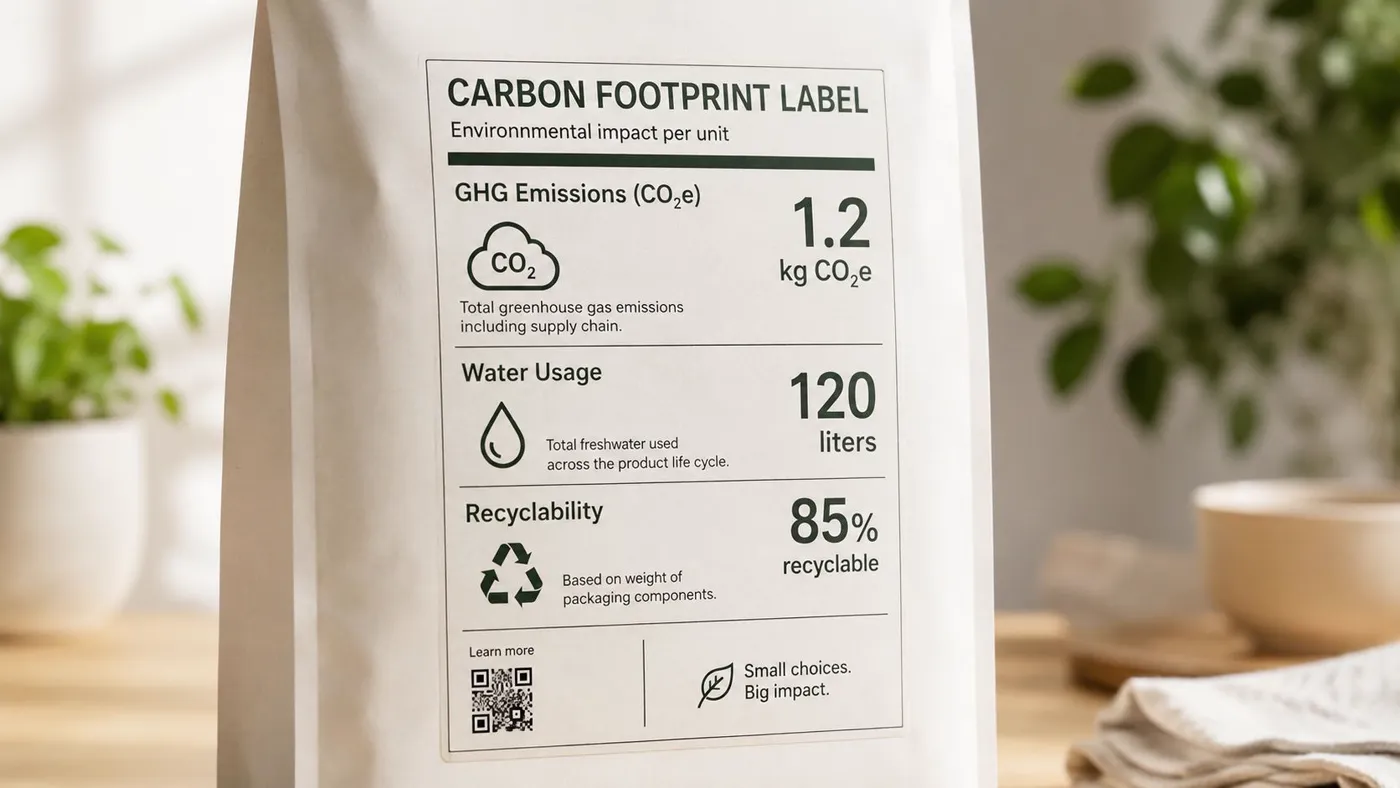
A carbon footprint label works a bit like a nutrition label for the planet. It gives a customer a compact summary of the greenhouse gas impact associated with a product or package, usually expressed as CO2e, which means carbon dioxide equivalent.
That last word matters. A label isn't saying the pack only created carbon dioxide. It's combining different greenhouse gases into one common unit so the total climate impact can be expressed in a way people can compare.
What the label is actually describing
For cake boxes, the label may refer to the packaging on its own or to the packaged product system. That distinction needs to be clear in the artwork and supporting documentation. If the number covers only the box, say so. If it includes the cake, insert, label stock, and transport assumptions, say that too.
Most of the confusion comes from system boundaries. Common terms include:
- Cradle-to-gate means the assessment usually stops when the product leaves the factory.
- Cradle-to-grave extends further and includes use and disposal assumptions.
- Product-level label focuses on one item or pack format, not the whole business.
A bakery owner doesn't need academic language to work with these terms, but the bakery does need consistency. If one cake box range is assessed cradle-to-gate and another is promoted as if the figures are directly comparable, the label becomes more confusing than useful.
Why traceability supports label credibility
Carbon labels depend on data discipline. A supplier saying “recycled board” or “sustainably sourced fibre” is helpful, but a proper chain of evidence is stronger. That's why understanding chain of custody in packaging supply matters when a bakery wants to move from marketing language to measurable claims.
Practical rule: If the bakery can't explain what the carbon figure includes, it isn't ready to print the label.
A good carbon label does three jobs well. It gives a number. It defines the scope behind the number. It avoids implying a level of certainty the business can't back up. For cake boxes, that usually means resisting cluttered badges and using a simple line of explanatory text near the figure so customers and trade buyers don't misread it.
Comparing Common Carbon Labelling Schemes
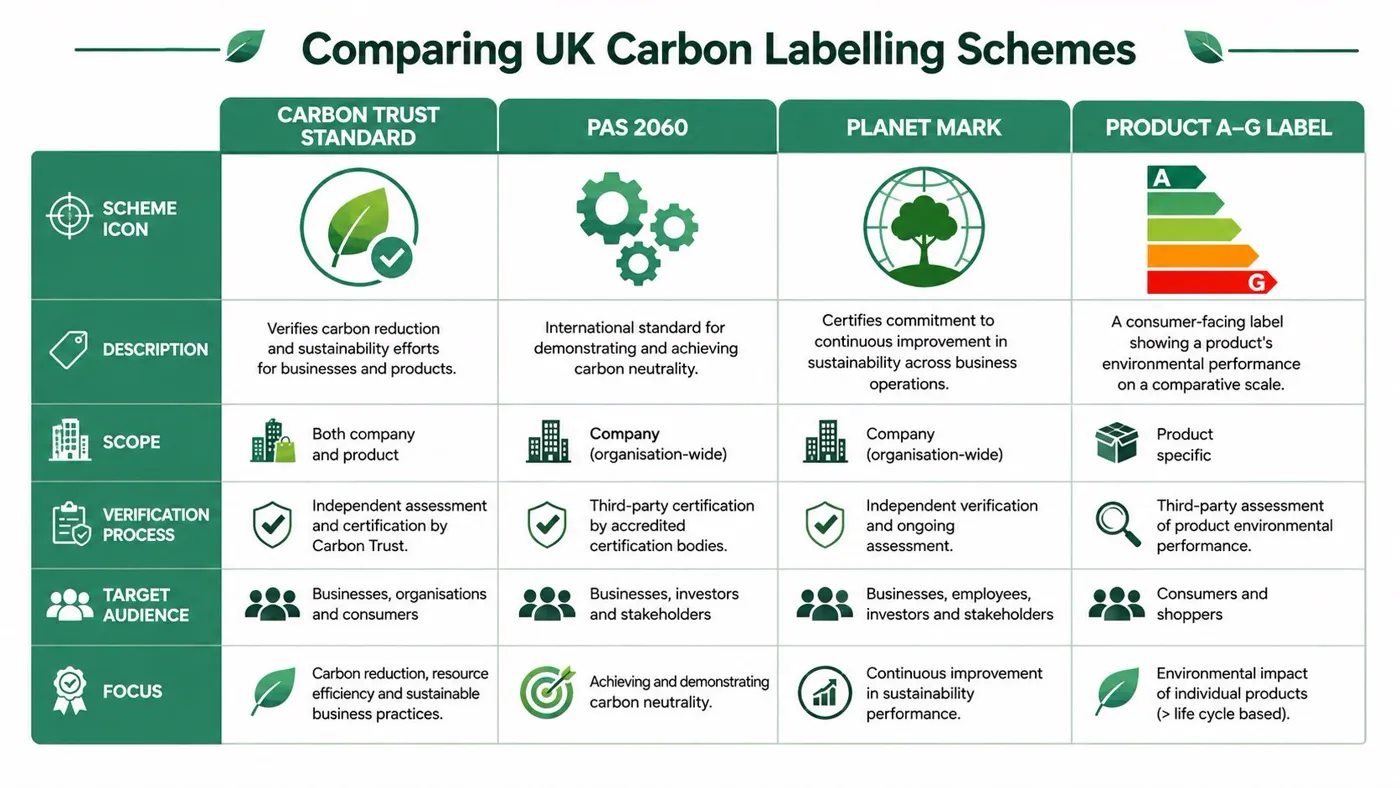
Not every carbon label does the same job. Some focus on reduction. Some focus on neutrality claims. Others provide a framework for measuring footprint without giving the bakery a consumer-facing badge that shoppers will recognise. For a UK bakery, that difference matters more than the logo design.
The practical choice usually comes down to four questions. Is the scheme aimed at product packaging or the whole business. How much third-party verification is involved. Will customers understand it. And can the bakery maintain the evidence each time materials or suppliers change.
How the schemes differ in practice
Some names come up repeatedly in UK sustainability discussions.
- Carbon Trust Standard tends to appeal to firms that want a recognised framework connected to carbon reduction and broader sustainability work.
- PAS 2060 is commonly associated with demonstrating carbon neutrality, which means the claim goes beyond measurement and into how remaining emissions are addressed.
- Planet Mark is often used by organisations that want to show ongoing improvement across operations rather than only one packaging SKU.
- Product A-G style labels are more consumer-facing in feel. They suit brands that want a comparative rating shoppers can read quickly.
None of those options is automatically right for cake boxes. A small independent bakery selling celebration cakes online may need a simple, defensible product-level approach. A larger bakery group with multiple sites may prefer a broader framework tied to annual reporting and supplier management.
UK Carbon Labelling Scheme Comparison
| Scheme / Standard | Governing Body | Primary Focus | Typical For |
|---|---|---|---|
| Carbon Trust Standard | Carbon Trust | Carbon reduction and sustainability verification | Businesses or products with formal reduction programmes |
| PAS 2060 | PAS framework | Demonstrating carbon neutrality | Organisations or products making neutrality claims |
| Planet Mark | Planet Mark | Continuous sustainability improvement | Businesses tracking operational progress |
| Product A-G Label | Varies by programme | Consumer-facing environmental comparison | Retail settings where fast comparison matters |
A useful way to choose
Recognition can help, but recognisability shouldn't drive the whole decision. If a bakery can't maintain the documentation, update figures when board grade changes, or explain disposal assumptions, a well-known badge becomes a liability.
A practical shortlist often looks like this:
- For a single hero product or flagship range. Choose a product-focused route with clear boundaries and manageable evidence requirements.
- For a bakery making neutrality claims. Use a framework that governs the claim properly, not just the calculation.
- For a business trying to improve year by year. Pick a scheme that supports operational tracking, not only front-of-pack communication.
The wrong scheme usually isn't too weak. It's too ambitious for the data the business can actually maintain.
There's another wrinkle in the cake box category. Packaging aesthetics can tempt businesses into consumer-facing labels before they've solved the underlying data quality problem. That's backwards. The scheme should fit the bakery's evidence, internal capacity, and pack update cycle. The artwork comes later.
How a Product's Carbon Footprint Is Calculated
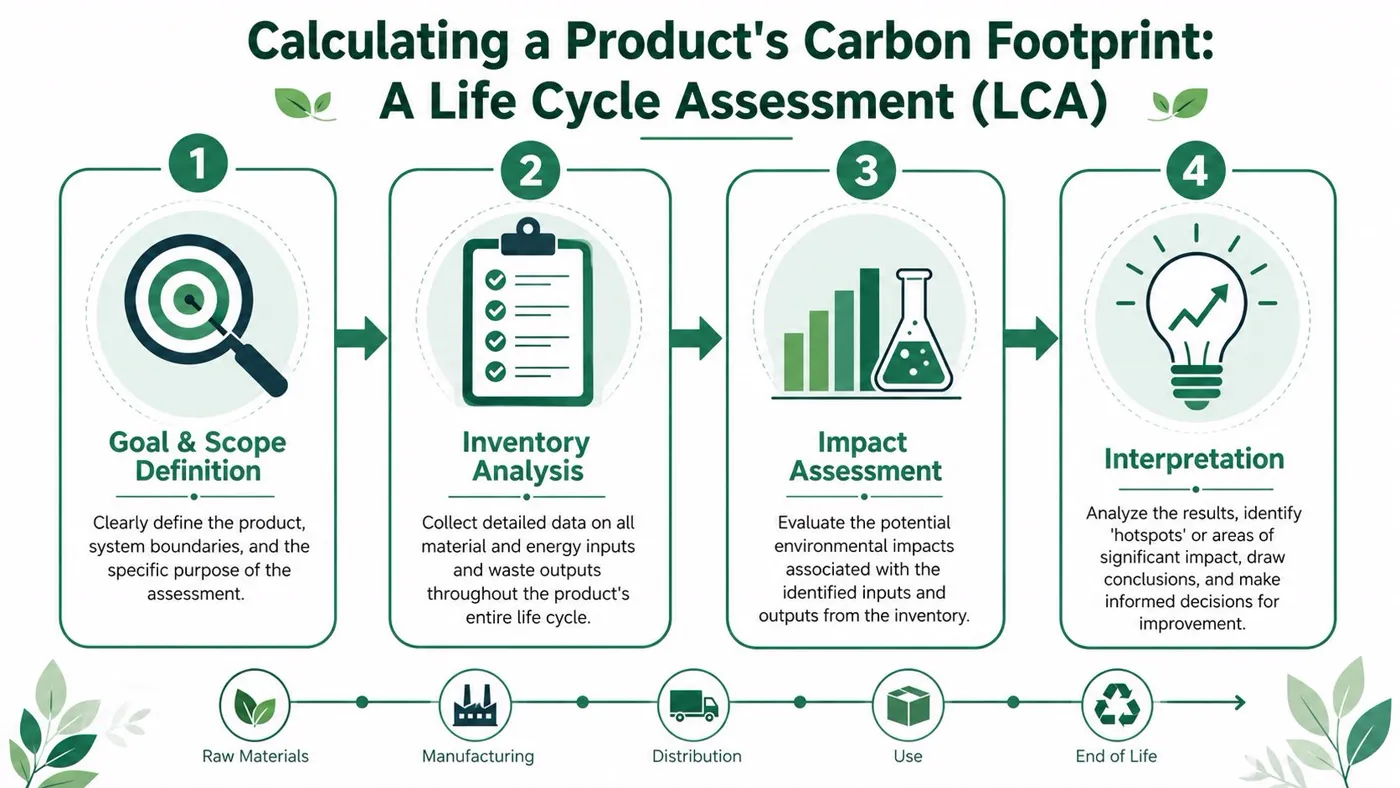
A carbon figure on a cake box comes from a Life Cycle Assessment, often shortened to LCA. The method can get technical quickly, but the logic is straightforward. Track the inputs and outputs across the life of the product, then convert those impacts into a carbon footprint figure using a defined methodology.
For cake boxes, the calculation usually starts with the board, then expands into conversion, printing, transport, and end-of-life assumptions. If there's a window, coating, insert, or label, those parts matter too.
What goes into the calculation
A standard kraft cake box assessment often looks at these stages:
- Raw material stage. Fibre sourcing, board manufacture, and any coatings or films.
- Conversion stage. Die-cutting, folding, gluing, window application, and print.
- Distribution stage. Transport from converter to bakery or fulfilment site.
- End-of-life stage. Whether the box is likely to be recycled, composted, or disposed of as general waste.
Assumptions can distort the result. A bakery may buy a paperboard box that is technically recyclable, but if the actual use case leaves it grease-saturated, the realistic disposal route may be less favourable.
Why specification accuracy matters
The physical spec isn't a side note. It changes the footprint. The technical specifications of a cake box, including the 9 x 9 x 5 inch size commonly used for an 8-inch cake and board grades such as 250µm, directly affect material use and transport emissions within an LCA, according to guidance on cake box dimensions and board grades.
That's one reason rough estimates cause trouble. If the bakery switches from one board grade to another, adds a larger lid depth for tall decoration, or inserts extra cushioning, the footprint can change enough to justify recalculation.
A carbon label is only as accurate as the specification sheet behind it.
Even in adjacent formats, the same principle applies. Products such as Kraft Pillow Boxes use recyclable 350gsm card and come with or without windows for retail and gifting use. They aren't standard cake transport boxes, but they show how small format changes, especially window versus no-window construction, can alter the material mix that an assessment needs to capture.
A Step-by-Step Guide to Getting Carbon Labels
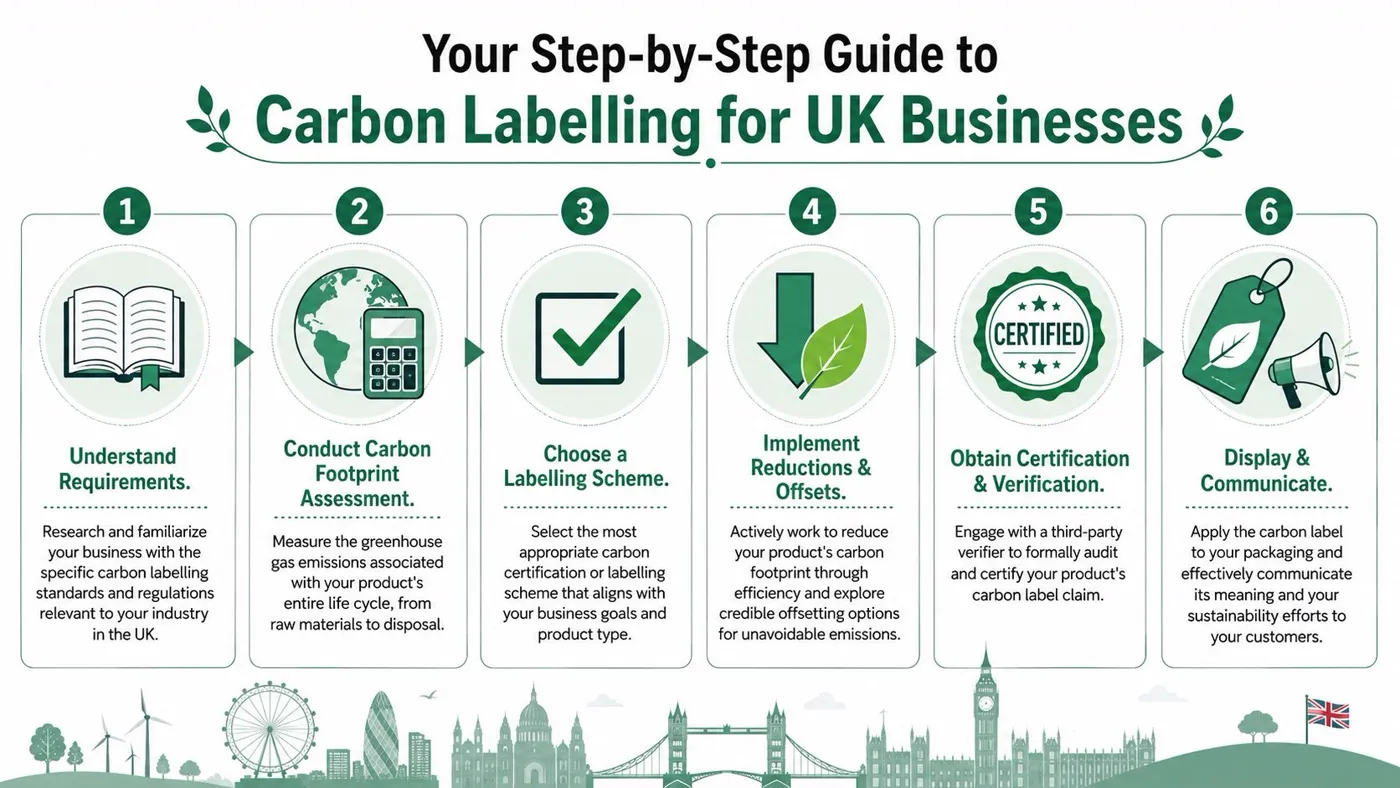
Most bakeries make the same mistake at the start. They think the project begins with artwork. It doesn't. It begins with scope. Unless the business decides exactly which box, which cake line, and which system boundary is being measured, the design team has nothing reliable to put on pack.
Start with scope before artwork
A bakery should first decide whether it wants to label:
- One flagship cake box format
- A core range with similar material construction
- A broader packaged product line with standardised inputs
Starting small is usually more manageable. A single format reveals the data gaps quickly. It also prevents a bakery from printing broad claims across mixed packaging formats that don't share the same footprint profile.
Once scope is fixed, write down what's included. Outer box only. Box plus window. Box plus cake board and label. Full packaged product. This wording will guide every later decision.
Build the data trail
The hardest part is rarely the calculation software. It's supplier data. Bakers often know their own cake weights and dispatch patterns quite well, but they don't always have clean upstream information on board composition, coatings, adhesives, films, and conversion steps.
Useful records include material specifications, purchase descriptions, transport assumptions, and any evidence for recycled or certified content. If a supplier can't provide clear documentation, the bakery may still be able to proceed, but the claim will be weaker and the verification process slower.
A bakery considering broader digital sustainability reporting may also look at systems used in adjacent carbon markets, such as a carbon credit tokenisation platform, to understand how structured carbon data and audit trails are being handled elsewhere. That doesn't replace product footprint work, but it shows how seriously traceability is now treated.
Choose a calculation and verification route
At this stage the bakery can engage a specialist consultant, certification body, or LCA partner. Some businesses handle the data assembly internally and bring in third-party verification later. Others outsource the full process.
The sensible route depends on complexity. If the bakery has multiple materials, changing suppliers, and frequent artwork revisions, external support often prevents expensive rework. If the range is stable and narrow, internal preparation may be enough before formal review.
One option among UK suppliers in the wider packaging space is Packaging Panda, which provides bakery packaging supplies and made-to-order packaging solutions. For carbon labelling, that kind of supplier relationship can matter because custom sizing, material choices, and artwork changes all affect the evidence the bakery has to maintain.
Fit the label into legal packaging space
Many projects hit a wall because UK food law doesn't move over just because marketing wants a sustainability panel. If a cake box fully encloses the product, it counts as Prepacked for Direct Sale, and it must carry the food name plus a full ingredients list with allergens emphasised under Natasha's Law, as explained in guidance on UK cake box requirements and PPDS labelling.
That requirement changes the practical design of carbon labels. Space is limited. Font hierarchy matters. A QR code may help if supporting methodology needs explaining, but the front or side panel still has to prioritise legal food information where required.
Leave room for the mandatory label first. Then build the carbon communication around the space that remains.
A workable sequence often looks like this:
- Lock the legal food panel
- Place the carbon figure where it won't compete with allergens
- Add a short scope explanation
- Review disposal wording for realism
- Approve only after compliance and print checks
That order prevents one of the most common failures in bakery packaging. A sustainability claim gets added late, then forces a rushed redesign that squeezes mandatory information or creates a cluttered, unconvincing pack.
Practical Realities for UK Cake Box Buyers
The hardest truth in this category is that a technically recyclable cake box often isn't recyclable after use. That gap sits behind a lot of weak sustainability messaging in bakery packaging.
Paperboard performs well on paper. In real bakery operations, buttercream smears, oil migration, and food residue change the disposal outcome. Once contamination is heavy enough, the box may be rejected from standard kerb-side recycling and end up in general waste. That practical problem is highlighted in analysis of UK packaging trends and contamination barriers.
The recyclability claim that falls apart after use
This is why disposal wording needs precision. “Recyclable” may describe the base material. It doesn't always describe the likely state of the box after it has carried a fresh cream gateau or a heavily frosted celebration cake.
For UK bakery buyers, the more useful questions are:
- Will this style stay clean enough to be recycled in normal use
- Does the pack rely on a grease-proof layer that complicates disposal
- Can the bakery separate food contact areas from cleaner outer materials
- Is there a better mono-material alternative for the same presentation need
A bakery shipping accessories or dry goods alongside celebration products can learn something from more general transport packaging such as cardboard moving boxes, where the material stream is simpler because the box usually doesn't pick up food contamination. Cake boxes rarely get that luxury.
Why window boxes can become a tax and design problem
Window boxes are popular for good reasons. Product visibility helps presentation, and in many bakery settings the style sells. But UK buyers need to look harder at mixed-material construction. Clear windows, laminated elements, and plastic-coated surfaces can create trouble under the Plastic Packaging Tax if the plastic component doesn't meet the recycled content threshold set by the rules described in guidance on eco packaging options and related UK market commentary.
The issue isn't only tax exposure. It's complexity. Once a box combines fibre with film or coating, disposal instructions get less intuitive, data collection gets harder, and carbon accounting becomes less tidy.
The prettiest cake box in the range is often the one with the weakest sustainability story.
What tends to work better for many SMEs is a disciplined format review. Keep the premium print finish if the brand needs it. Question the laminate. Question the plastic sleeve. Question whether the window is adding enough commercial value to justify the compliance and disposal complications. In many cases, a well-designed uncoated kraft or other simpler fibre-based format will be easier to label, easier to explain, and easier to keep aligned with tax and waste obligations.
Frequently Asked Questions
Do small bakeries need carbon labels
Not always. A small bakery doesn't need a carbon label just because larger brands are using one. It makes sense when the business wants stronger sustainability proof, supplies trade customers who ask for environmental data, or is reviewing packaging formats anyway.
Is a carbon footprint label the same as a carbon neutral claim
No. A footprint label is about measurement. A carbon neutral claim goes further and depends on how the business treats remaining emissions after calculation. Those two ideas shouldn't be blended on pack unless the bakery has the evidence to support both.
What usually causes the biggest delay
Supplier data. Box specifications, coatings, films, transport assumptions, and print changes all need to be documented clearly. The artwork stage is usually easier than the evidence stage.
Can a bakery keep using window cake boxes
Yes, but the bakery should review tax exposure, material complexity, and disposal wording carefully. Windowed formats can still have a place, but they need more scrutiny than plain fibre formats.
What makes a carbon label weak
Two things. Unclear scope and unrealistic disposal claims. If the bakery can't state what the number covers or if the recycling message ignores grease contamination, customers and trade buyers will spot the gap.
Packaging decisions get easier when the supplier understands both compliance and day-to-day operations. Packaging Panda supplies UK businesses with bakery packaging, eco-friendly packaging options, and bespoke made-to-order formats, which makes it a practical starting point for teams reviewing cake boxes alongside labelling, material choice, and wider sustainability requirements.