
What Is Chain of Custody: UK Business Guide 2026
Chain of custody is an unbroken chronological record of who handled an item, file, or material, when they handled it, and why. In business, it also means tracking a product or material through each stage of its journey so a company can prove authenticity, integrity, or sustainability claims.
View our tamper-evident security bags →
A UK business owner usually meets the term when something has already gone wrong. A customer says a returned item isn't the one that was shipped. A courier dispute turns on whether a parcel was tampered with before delivery. A legal team asks for preserved CCTV or internal records. A buyer wants proof that a packaging claim is real, not marketing copy.
That's why chain of custody matters. It isn't only for police evidence bags and courtrooms. The same discipline sits behind secure returns, regulated samples, sensitive documents, electronics disposal, sustainability claims, and tamper-evident dispatch processes. If a business can't show who had control of an item or file at each point, the conversation quickly shifts from “what happened?” to “can this record be trusted at all?”
For companies that handle sealed consignments, test samples, IT assets, or disputed deliveries, the mechanics are often very similar. The item needs a clear identifier. The packaging needs to show interference. Each transfer needs a record. The final outcome, whether that is delivery, inspection, destruction, or disposal, needs closing documentation. A useful example from the IT asset side is Reworx Recycling ITAD chain of custody, which shows how custody controls extend beyond classic evidence handling into business risk and disposal workflows.
For packaging teams, practical choices begin to matter. A plain outer bag can move goods. A tamper-evident system can help prove what happened. For businesses comparing options, this guide to tamper-evident bags in the UK is a useful starting point because it connects packaging selection to documentation strength, not just to transit protection.
Table of Contents
- Introduction What Is Chain of Custody
- The Two Worlds of Chain of Custody
- Core Components of a Defensible Chain of Custody
- How to Implement Chain of Custody in Your Business
- Chain of Custody for Digital Evidence and Intangibles
- UK Compliance and Real-World Examples
- Conclusion From Liability to Asset
Introduction What Is Chain of Custody
A customer reports that a high-value return looks different from the item originally sent out. The warehouse has the parcel back, but three people handled it, the outer label was replaced, and nobody can say exactly when the seal was broken. At that point, the dispute isn't just about stock loss. It becomes a credibility problem.
That's the simplest way to understand what is Chain of Custody. In its strict legal sense, it's a documented history that shows continuous control of evidence from the moment it's collected until final use or disposal. In its broader commercial sense, it's the record that proves an item, material, or file is the same one the business claims it is, and that it hasn't been altered, substituted, or mishandled along the way.
For UK firms, those two worlds overlap more than is commonly assumed. A tamper-evident sample bag used in a testing workflow follows the same logic as a sealed return bag used in retail. A sustainability claim on packaging relies on a traceable record in much the same way a digital file relied on in a dispute needs an access trail.
Chain of custody works like a relay race baton. The baton matters, but the handovers decide whether the result can be trusted.
The practical point is straightforward. A label on its own isn't enough. A receipt on its own isn't enough. A spreadsheet that starts halfway through the journey isn't enough. A defensible chain depends on continuity. Every custody change has to make sense to someone who wasn't there.
For that reason, businesses that handle sensitive or disputed items tend to get better results when they treat chain of custody as an operating discipline, not a legal afterthought. It reduces avoidable arguments, makes internal investigations faster, and gives customers, auditors, and legal teams something much more persuasive than “that's how the team normally does it.”
The Two Worlds of Chain of Custody
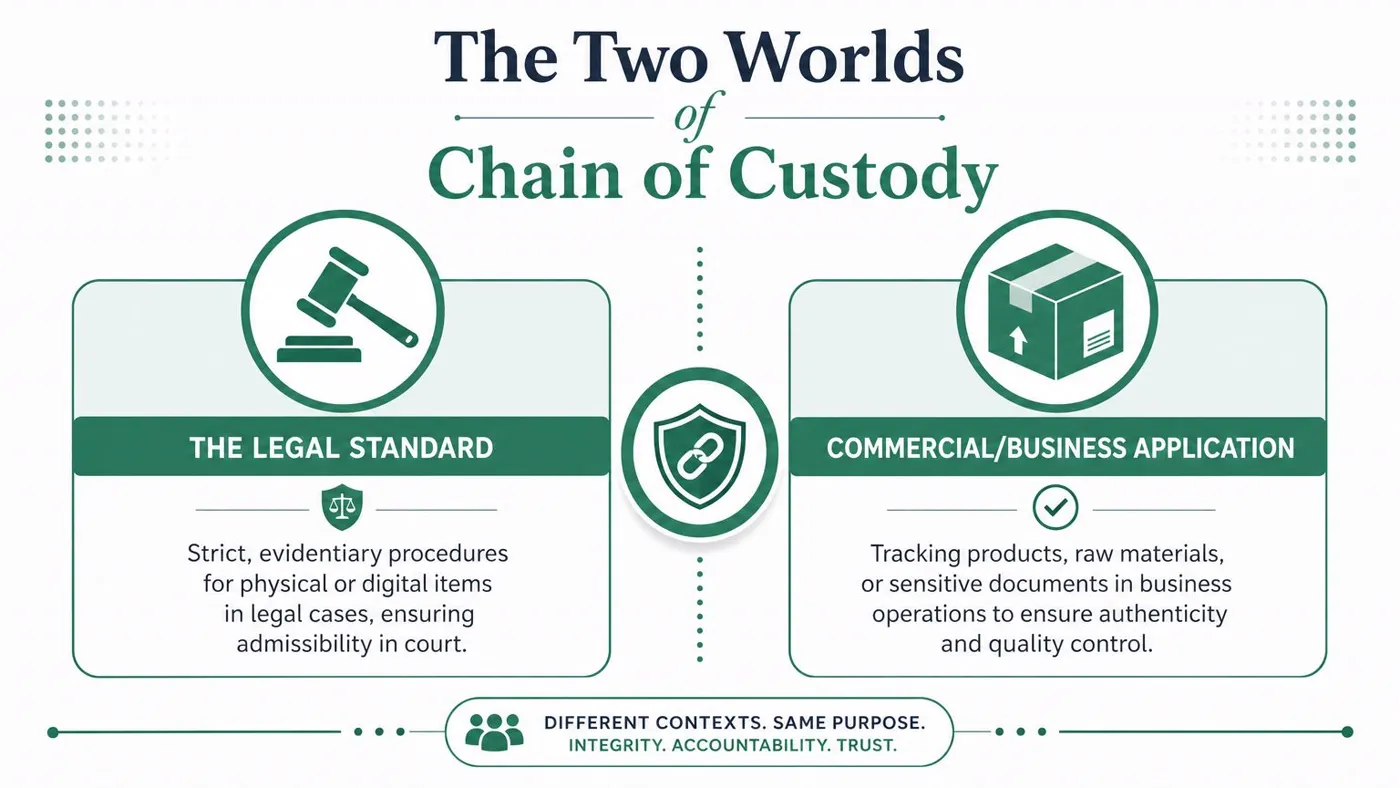
A UK business usually meets chain of custody in one of two moments. A disputed parcel arrives with a broken seal, or a customer asks you to prove a product claim you printed on the pack. The legal version and the commercial version look different on the surface, but they solve the same problem. Can you show, with records that stand up to scrutiny, what the item is, who controlled it, and what happened to it?
The legal standard
In the legal and forensic world, chain of custody is a courtroom test. The record has to show that the evidence presented is the same evidence collected, and that no unrecorded handling, substitution, or contamination undermined it. The Crown Prosecution Service's guidance on real evidence reflects that practical concern. continuity, labelling, sealing, and documented handling all affect the weight a court can place on an item (CPS guidance on real evidence).
That standard sounds distant from day-to-day trade, but the reasoning is familiar to any owner dealing with returns, warranty disputes, sample testing, or damaged goods claims. If nobody can show who opened a package, who moved it, where it sat, or why its condition changed, the record stops being persuasive.
A missing handover entry does not automatically prove misconduct. It does create doubt. In court, that can weaken the evidence. In business, it often means a refused claim, a chargeback you cannot challenge properly, or an awkward conversation with an insurer, regulator, or customer.
The commercial standard
In business, chain of custody is proof behind a claim. That claim might be simple, such as “this return arrived opened,” or more strategic, such as “this packaging contains certified material from a controlled source.”
This matters most where the commercial upside depends on trust. Sustainability claims, secure fulfilment promises, controlled waste handling, product authenticity, and high-value returns all rely on a record that another party can follow. The record does not need to mirror a police evidence process, but it does need to be consistent enough to survive an audit, complaint, or dispute.
For packaging and materials, the commercial side of chain of custody is often built around recognised models set out by ISO 22095, which explains approaches such as Identity Preservation, Segregation, Mass Balance, and Book and Claim (ISO 22095 chain of custody standard overview). Those models matter because they answer different questions. Are you proving that the exact certified material stayed separate throughout, or that certified input and output volumes balance across a production system?
| Model | What it means in practice | Best for |
|---|---|---|
| Identity Preservation | The exact certified material is tracked without mixing | High-assurance provenance claims |
| Segregation | Certified material is kept separate from non-certified material | Clear physical separation |
| Mass Balance | Inputs and outputs are reconciled by quantity rather than kept physically separate | Complex production environments |
| Book and Claim | Credits are traded separately from the physical flow | Market-based sustainability claims |
Legal and commercial chain of custody converge in a useful way for UK firms. The legal world asks, “Would this record stand up if challenged?” The commercial world asks, “Would a buyer, auditor, regulator, or insurer accept this record as proof?” The paperwork changes, but the discipline is the same.
Packaging choices sit right in the middle of that discipline. A business sending ordinary ecommerce orders may use standard Mailers and keep the control light because the risk is low. A business handling test samples, confidential documents, pharmacy returns, or disputed high-value items usually needs tighter packaging control, including tamper-evident evidence bags, unique identifiers, and a clearer handover log.
The same principle applies at the end of the chain as well. If your business transfers custody of sensitive stock, records, or devices for destruction, the record needs to show where responsibility ended and whose hands it passed into. That is the commercial logic behind data destruction liability transfer. You are not just disposing of an asset. You are proving who became accountable for it, and when.
Good businesses do not treat every shipment as forensic evidence. They decide which products, claims, and handovers could create legal or commercial exposure, then match the controls to that risk. That is usually the difference between a chain of custody system that gets used and one that lives in a policy folder.
Core Components of a Defensible Chain of Custody
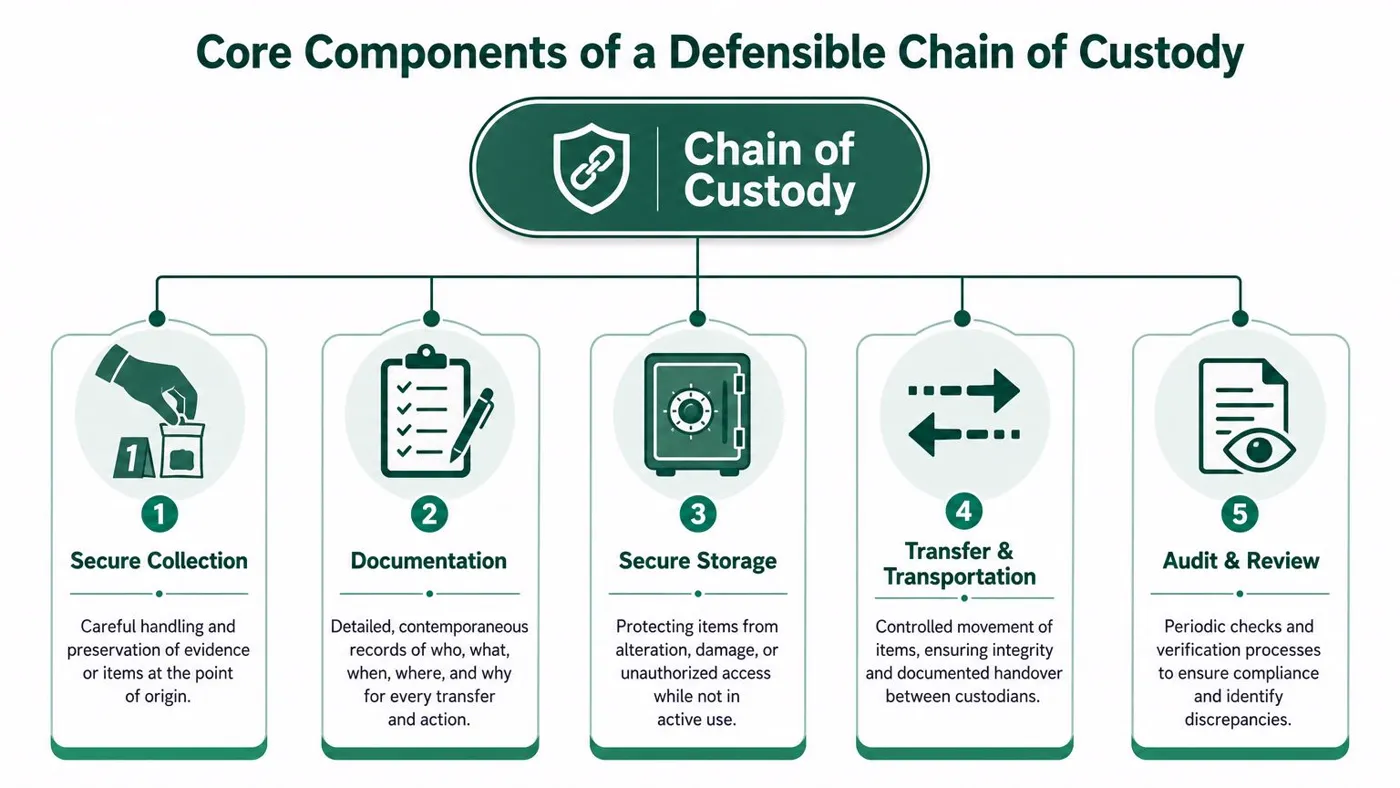
A chain of custody is only as strong as its weakest handover. In UK forensic practice, a defensible chain requires continuous, auditable documentation at every custody change. The record must include the evidence's location, the collector's identity, and confirmation that it was packaged and sealed appropriately. Each handover must record who handled it, when, and why, and any break can weaken or even exclude evidence in court (forensic documentation requirements).
For business use, that standard translates into five practical components.
Secure collection and packaging
The first risk point is the moment an item enters control. If the item is poorly packed, loosely identified, or easy to open and reseal without trace, the rest of the record starts from a weak position.
For physical goods, that usually means choosing packaging that matches the risk. Standard cartons work for ordinary stock movement. Tamper-evident formats are more appropriate for regulated samples, sensitive documents, returns under investigation, and high-value items that may be challenged later. One practical example is the use of evidence bags, which are designed for sealed handling where visible interference matters.
Unique identification and logging
A business can't maintain custody over “the parcel from returns” or “the sample from site”. It needs a unique identifier. That might be a barcode, serial number, case reference, batch code, or sealed bag number.
The identifier should appear on the item, on the paperwork or digital log, and in any related images or system notes. If those references drift apart, disputes multiply because staff start relying on memory instead of records.
A short working rule helps here:
- Use one primary ID for the item or sealed unit.
- Link every secondary reference such as courier number, customer order number, or sample code to that primary ID.
- Avoid handwritten ambiguity where similar numbers can be misread.
Controlled handovers storage and disposition
Most custody failures happen at transitions. Someone leaves a package on a desk. A manager opens a return before logging it. A driver swaps containers without recording the transfer. None of those actions look dramatic at the time, but each creates a hole in the timeline.
A stronger process includes:
- Formal handover points where one named person transfers to another.
- Time-stamped records that explain the purpose of the transfer.
- Restricted storage so items aren't casually accessed between events.
- Clear end-of-life documentation showing release, return, destruction, or lawful disposal.
That last point is often ignored. Yet disposal is part of custody, not a separate admin task. For sensitive records, electronics, or regulated materials, businesses often need a documented close to the chain, including proof that responsibility passed correctly. On the IT asset side, guidance around data destruction liability transfer is useful because it highlights the often-missed link between custody and final destruction records.
Practical rule: If the business would struggle to explain an item's exact status to a solicitor, insurer, auditor, or major customer within five minutes, the chain isn't strong enough yet.
A defensible chain doesn't need to be complicated. It needs to be consistent. The basic formula is simple: seal the item properly, identify it clearly, document every movement, control every handover, and close the record properly when the item's life in the process ends.
How to Implement Chain of Custody in Your Business
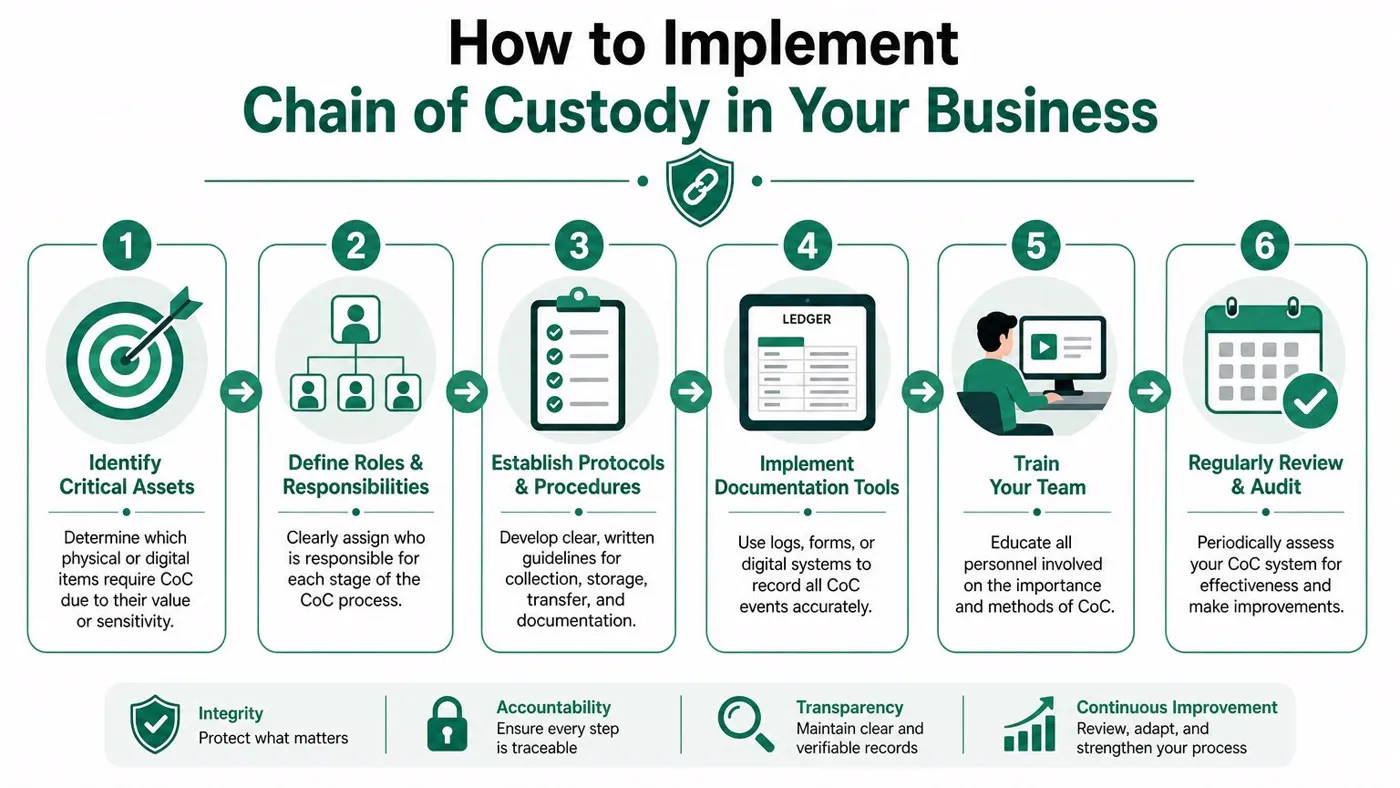
Most firms don't need a large enterprise platform to start. They need a method that fits the risks they face, and a process staff will follow on a busy day.
Start with the items that can hurt the business
Begin by identifying where a custody failure would create real pain. For one company, that's disputed returns. For another, it's pharmacy dispatch. For another, it's signed legal files, test samples, or waste electronics awaiting collection.
A useful first filter is this list:
- High-value items that attract fraud or substitution risk.
- Sensitive goods where tampering affects safety or compliance.
- Digital records likely to be used in an investigation or dispute.
- Sustainability-backed materials where claims need documentary proof.
- Items pending destruction or disposal where the business still carries liability.
Once those categories are clear, the process becomes more targeted. A warehouse doesn't need identical controls for every SKU. It needs stronger controls where challenge, value, or regulation is highest.
Build a process people will actually follow
Simple beats elaborate. A chain of custody process usually fails because it asks staff to do too much, in too many places, under time pressure. The cleaner design is one record, one item ID, one handover rule.
A workable implementation often includes these steps:
- Assign ownership. Someone must own the process, even if several teams touch it.
- Choose a logging method. A controlled spreadsheet, warehouse system, returns platform, or case tool can all work if entries are consistent.
- Match packaging to risk. High-risk items need stronger packaging controls than routine stock. Businesses handling medicines or sensitive dispatches often use procedures similar to those described in this guide to pharmacy dispatch tamper-evident bags.
- Train on handovers, not just packing. Staff usually understand packing. The weak point is often the transfer.
- Audit small samples regularly. Check whether the records match the item, the seal, and the storage status.
One option for physical custody materials is Packaging Panda, a UK wholesale supplier of packaging materials including tamper-evident security bags used to maintain contents integrity during storage, transit, and chain-of-custody processes. The packaging itself won't create a valid chain, but it can make the chain easier to defend.
Simple CoC log template
A small business can start with a plain format like this:
Item ID:
Item description:
Seal or package reference:
Collected by:
Date and time collected:
Location collected:
Condition at collection:
Action taken:
Transferred to:
Date and time transferred:
Reason for transfer:
Storage location:
Final outcome:
Authorising signature or recorded approval:
That template works because it mirrors the core forensic principle: every change in custody must be recorded as it happens, not reconstructed later. If staff complete logs at the end of the shift from memory, the chain weakens immediately.
A short decision table can help determine the right level of control:
| Situation | Minimum sensible control |
|---|---|
| Routine ecommerce dispatch | Order-linked scan and dispatch record |
| High-value return | Tamper-evident packaging, condition photos, named intake |
| Internal investigation file | Restricted access and signed handovers |
| Test sample | Sealed packaging, time-stamped collection, controlled storage |
| Asset destruction batch | Transfer record plus closing destruction documentation |
The best custody process is usually the one that survives Friday afternoon pressure in a busy warehouse, not the one that looks perfect in a policy file.
Chain of Custody for Digital Evidence and Intangibles

Digital files need provenance not just possession
Many businesses still think chain of custody ends with physical items. It doesn't. CCTV exports, call recordings, scans, body-worn video, spreadsheets, and phone extractions all need the same discipline, but the proof looks different.
UK courts and regulators increasingly rely on digital evidence, and guidance highlighted in UK practice stresses preserving integrity by documenting acquisition and recording who accessed the data. An unbroken chain of physical logs isn't enough for digital items. The key question is often provenance and integrity controls such as metadata and audit logs. The ICO also reported 2,817 personal data breaches in 2024, which underlines how important secure handling of digital records remains in the UK context (digital evidence and breach context).
That changes the packaging analogy. A sealed bag shows physical interference. A digital file needs its own signs of continuity, such as access records, export history, preserved metadata, and controlled storage. A file copied to the wrong location without any log may still exist in perfect visual form, but its evidential value can be challenged because nobody can show what happened in between.
Certificates claims and traceable materials
The same thinking applies to intangibles in commercial supply chains. A buyer may never inspect a forest, polymer stream, or recycled fibre source directly. Instead, the business relies on a custody-backed claim supported by certification records, batch documentation, supplier controls, and traceability rules.
So when a box carries a sustainability claim, the claim itself is often the visible end of a longer chain. The customer sees the statement. The business needs the records behind it.
A simple way to explain it is this: metadata for digital evidence plays the same role that certification records play for sustainable materials. In both cases, the visible object alone isn't enough. The surrounding proof is what gives it weight.
UK Compliance and Real-World Examples
A UK business usually notices chain of custody when something is disputed. A customer says the wrong item arrived. A lab result is challenged. A buyer asks for proof behind a recycled-content claim. At that point, the question is always the same. Can you show who had control, when they had it, and what changed along the way?
That is why this topic sits in two worlds at once. In legal settings, chain of custody helps protect the credibility of evidence. In commercial settings, it protects claims, margin, and reputation. The principle is the same in both cases. If the trail is weak, the item or claim becomes harder to defend.
For UK firms, the pressure is practical as much as regulatory. Timber and fibre claims may sit under certification frameworks such as FSC, PEFC, or the UK Woodland Assurance Standard. Packaging claims are also under closer scrutiny because consumers are paying more attention to what they buy and how much packaging comes with it. That makes traceable records more than an audit exercise. They become part of how a business wins trust and avoids expensive arguments.
Tamper-evident packaging fits directly into that picture. A seal on its own does not prove everything. It proves that interference would be visible. The records around that seal, who packed the item, which batch of bags was used, when custody changed hands, are what turn packaging into evidence of control rather than just a container.
Three practical examples
Example 1. A high-value ecommerce return
A retailer receives a return for an expensive item. The intake team photographs the parcel before opening, checks the tracking reference against the order record, logs the staff member handling the return, and opens it under a set process. If the contents are wrong or damaged, the business has a timed record and handling history. That usually carries more weight than two conflicting verbal accounts.
Example 2. A biological sample sent for testing
A clinic or workplace testing provider collects a sample, seals it in a tamper-evident pack, records the collector, time, and location, and logs each transfer into storage and courier handover. Here the packaging and the paperwork do different jobs. The packaging helps show whether the sample was interfered with. The record shows whether control was maintained. If either part is missing, the result is easier to challenge.
Example 3. A recycled-content claim on packaging
A packaging buyer asks a supplier to support a sustainability claim. The supplier needs more than a specification sheet or marketing line. It needs traceability records, supplier declarations, batch references, and a clear explanation of how material was kept separate or accounted for through processing. That is the commercial version of chain of custody. The claim on the box only stands up if the file behind it does.
The trade-off is straightforward. Tighter controls add handling time and admin. Loose controls save a few minutes until a complaint, chargeback, failed audit, or disputed claim wipes out that saving.
In practice, the strongest UK systems are usually simple. Clear identifiers. Tamper-evident packaging where the risk justifies it. Handover records completed at the time, not reconstructed later. Supplier documents that match the claim being made. That is what makes a chain of custody believable in court, in an audit, and in front of a customer.
Conclusion From Liability to Asset
Chain of custody sounds legalistic, but the underlying idea is practical. A business needs to prove that an item, file, or material is what it says it is, that it stayed under control, and that key handovers were recorded properly.
For UK firms, that matters in two directions at once. It reduces legal and operational risk when goods are disputed, records are examined, or sensitive materials are transferred. It also strengthens commercial trust when a business needs to support authenticity, sustainability, or handling claims with something more solid than a label or policy statement.
The strongest systems aren't always the most complex. They're the ones built around clear identifiers, sensible packaging, disciplined handovers, secure storage, and records completed at the moment work happens. That's what turns chain of custody from a bureaucratic burden into a useful business asset.
A company that can show a clean, believable trail usually resolves disputes faster, protects its brand more effectively, and gives customers and partners fewer reasons to doubt its processes.
If chain of custody is part of the challenge, whether for secure dispatch, tamper-evident handling, or everyday packaging operations, Packaging Panda is one UK option to review for mailing, protective, and tamper-evident packaging formats that support a more controlled handling process.


