Tamper Evident Packaging UK: Secure Products & Build Trust
A broken seal rarely starts as a packaging discussion. It starts as a customer complaint, a returns query, a rejected delivery, or a quiet worry in the warehouse that a product may have been accessed somewhere between packing bench and front door. For UK businesses, that's the point where tamper evident packaging stops being a line item and becomes part of risk control.
Browse our tamper-evident bags →
When a buyer sees a damaged closure on supplements, cosmetics, food, medicines, documents, or high-value components, trust drops immediately. The product might still be fine, but the confidence is gone. That creates cost in several directions at once: replacement stock, customer service time, possible compliance questions, and a brand impression that's difficult to repair.
Good tamper evident packaging does one job clearly. It shows whether someone has interfered with the pack before the end user accepts it. That visible proof matters just as much in e-commerce as it does in retail, pharmacy, and chain-of-custody work. Businesses also need to think beyond the seal itself. Stock handling, courier conditions, sustainability targets, and theft prevention all affect whether a tamper system works in practice. For a broader operational view, these expert tips for reducing retail theft are useful because packaging only works properly when it supports wider loss-prevention processes.
Table of Contents
- Introduction Why Product Integrity Matters More Than Ever
- Understanding Tamper Evident Packaging
- A Guide to Materials and Types
- How to Choose the Right Solution for Your Business
- Navigating UK Regulations and Compliance
- Custom Printing and Bulk Supply with Packaging Panda
- Application and Quality Control Best Practices
Introduction Why Product Integrity Matters More Than Ever
Tamper evident packaging matters because most businesses don't get a second chance to explain a compromised pack. If the seal looks wrong, many customers assume the contents aren't safe, authentic, or acceptable to use. That reaction is sensible.
For UK operators, the pressure is sharper now. Regulations are tighter, buyers are more alert, and supply chains involve more hand-offs than many teams realise. A package may move through picking, staging, palletisation, courier sorting, van loading, doorstep delivery, and return channels before anyone notices a problem.
Where the risk usually shows up
A practical risk review usually starts with a few simple questions:
- At dispatch: Can staff tell at a glance whether a product has been opened after packing?
- In transit: Will the seal survive stacking, vibration, cold, and damp conditions without failing accidentally?
- At delivery: Does the customer know what an intact pack should look like?
- In dispute cases: Can the business show that the product left site properly sealed?
Practical rule: If a package can be opened and reclosed without obvious evidence, it isn't giving the buyer enough protection.
The strongest reason to use tamper evident packaging isn't presentation. It's accountability. A good solution draws a clear line between an untouched pack and a pack that's been accessed. That line protects customers, staff, and the business itself.
Understanding Tamper Evident Packaging
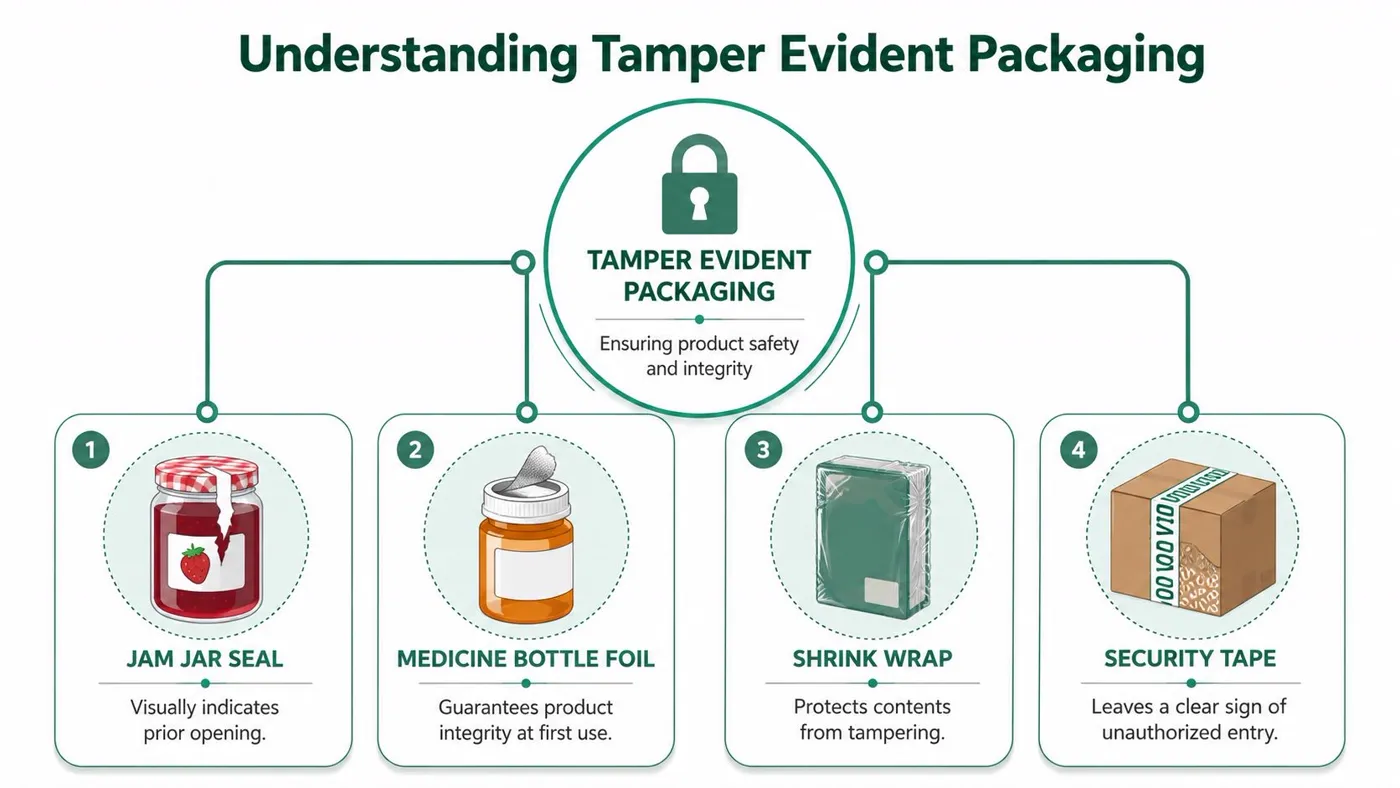
The concept is widely understood through everyday products. A jam jar button, a foil membrane under a medicine cap, or a shrink band around a bottle all send the same message. If the feature is broken, someone has opened it.
That's what tamper evident packaging is for. It does not promise that no one will ever attempt to interfere with the contents. It makes any such interference visible, difficult to hide, and hard to reverse.
Tamper evident and tamper resistant are not the same
These terms are often blurred together, but they solve different problems.
| Term | What it means in practice | What the user sees |
|---|---|---|
| Tamper evident | The pack shows visible proof of opening or interference | A broken band, torn seal, residue, split closure, or disturbed label |
| Tamper resistant | The pack is made harder to open or access quickly | Stronger barriers, tougher materials, more effort needed to gain entry |
A pack can be one without being the other. A rigid carton may resist damage but still allow someone to open and reclose it neatly. A simple seal may be easy to break but excellent at showing that it's been broken.
What works well in the real world
The best tamper features are obvious and irreversible. They don't rely on the customer inspecting tiny details or knowing specialist cues. In UK pharmaceutical packaging, perforated seals, breakable caps, heat shrink bands, and peel-back blister packs are widely used because they provide visible evidence of unauthorised access and act as a first line of defence against interference, theft, and counterfeiting, as outlined by Swiftpak's guidance on tamper evident pharmaceutical packaging.
What tends to work less well is subtle packaging that only trained staff can interpret. If the sign of tampering is too faint, buyers miss it. If the seal fails too easily in normal handling, teams lose confidence and start treating every damaged pack as a false alarm.
The clearest systems don't ask the customer to investigate. They show the answer immediately.
A Guide to Materials and Types
Choosing the right format starts with understanding how different tamper systems fail, not just how they seal. Some are ideal for cartons and parcels. Others suit bottles, blisters, pouches, or chain-of-custody bags. Material choice then decides whether the seal survives handling, storage conditions, and sustainability requirements.
Adhesive systems
Adhesive-based tamper solutions are common because they're flexible and easy to integrate into existing packing lines.
- Void labels and destruct labels work well where a business needs visible evidence on cartons, electronics boxes, document packs, or product sleeves.
- Security tape suits outer cases and shipping boxes. Some constructions show residue or a message pattern when peeled away.
- Seal labels for jars, tubs, and cartons are useful when a single closure point needs a clear break line.
These options depend heavily on surface quality. Dusty board, textured coatings, damp storage, and rushed application all reduce reliability. A strong adhesive on the wrong substrate can also tear packaging in an uncontrolled way, which may not be suitable for premium presentation.
Mechanical closures
Mechanical tamper features are built into the pack or closure itself.
- Breakable caps are common on bottles and containers where first opening must be obvious.
- Heat shrink bands suit necked containers and retail packs that need a visible perimeter seal.
- Perforated tear strips create a defined opening route on cartons and pouches.
- Blister and strip formats are useful where unit-dose integrity matters and where partial opening would be a concern.
These systems often give strong visual evidence, but they need the right equipment and process control. Shrink bands, for example, can look secure while still fitting badly if heat settings are inconsistent.
Integrated bags and chain-of-custody formats
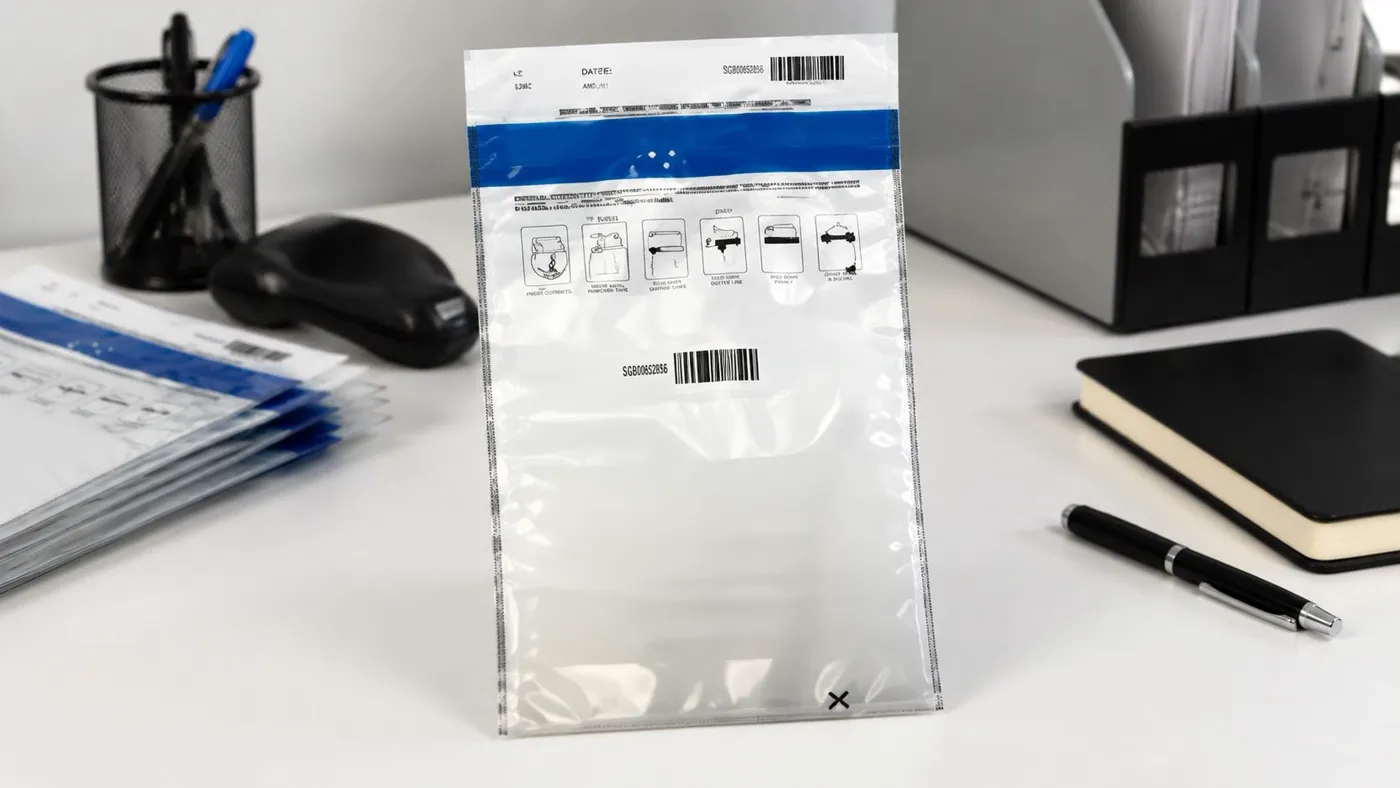
For cash handling, specimen transport, evidence transfer, and secure internal logistics, integrated tamper bags are often the cleaner answer because the seal and the pack are designed together. Businesses comparing formats can review tamper evident bag options alongside other closure methods to see how bag construction, seal style, and tracking features differ by use case.
A relevant example is Tamper Evident Bags, a category that includes tamper evident bags, cash bags, coin bags and evidence bags with tear-proof seals and tracking codes. Those details matter when a business needs accountability across multiple handovers rather than shelf presentation alone.
Sustainable materials in the UK market
Material choice has changed sharply in the UK. Legislation passed on 23 October 2023 banned single-use plastic and polystyrene food packaging, and that has pushed tamper packaging development towards alternatives such as biodegradable cellulose acetate and reinforced kraft paper. The UK Extended Producer Responsibility scheme also requires manufacturers to track packaging data, which has encouraged the use of materials such as PCR PET, according to South Plastic's overview of the UK packaging shift.
That doesn't mean every sustainable option suits every product. Reinforced kraft paper can be a strong fit for dry goods, document mailers, and lower-moisture environments. PCR PET may be more suitable where durability and visibility still matter. The practical question isn't whether a material sounds greener. It's whether it still protects the seal through stacking, humidity changes, and courier handling.
How to Choose the Right Solution for Your Business
The right tamper solution depends less on industry labels and more on consequence. A broken seal on a leaflet pack creates one sort of problem. A broken seal on a cold-chain medicine shipment creates another. Businesses should choose against risk, handling conditions, and proof requirements.
Start with the consequence of failure
A quick decision framework helps.
| Business need | Usually points towards | Main trade-off |
|---|---|---|
| Retail reassurance | Shrink bands, closure labels, breakable caps | Simple to understand, but appearance matters |
| Transit security for parcels | Security tape, destruct labels, tamper mailers | Fast to apply, but dependent on staff consistency |
| Chain of custody | Numbered security bags, tracking-coded bags | Stronger accountability, less suitable for premium display |
| Dose or item integrity | Blisters, strip packs, sealed unit formats | Higher pack complexity, but clearer control |
If the main risk is customer doubt at first opening, obvious visual evidence is the priority. If the main risk is unauthorised access during handling, traceability and controlled handover matter more.
Check the operating environment
Businesses often underestimate how much the environment affects performance.
- Cold chain use: Adhesives can behave differently after chilled storage or temperature swings.
- High humidity: Paper-based seals may curl or lose clean adhesion if applied badly.
- Rough courier handling: Outer tamper features need to survive scuffing and compression without creating false positives.
- Fast packing lines: Complex systems fail when teams can't apply them consistently at speed.
A seal that looks excellent in a sample box but fails on a busy packing bench is the wrong seal.
Know what a validated system looks like
For higher-risk applications, “tamper evident” should mean more than a visual idea. Tamper-evident packaging must use seals that are destroyed upon opening under NSF/ANSI/CAN 60. In the UK, validated systems for higher-risk uses require torque and seal-strength testing plus environmental stress testing such as heat, cold, and vibration, with auditors expecting written design records and test reports, as described in NSF's tamper-evident packaging specification guidance.
That distinction matters when suppliers offer products that look secure but can't be backed up with documented performance.
A practical buying checklist
Before placing an order, buyers should be able to answer these points clearly:
- What must the packaging prove. First opening, transit access, product authenticity, or chain of custody.
- Who needs to read the signal. Warehouse staff, pharmacy teams, couriers, or consumers.
- What will break the system. Moisture, cold, dust, rough handling, or inconsistent application.
- What evidence may be needed later. Batch records, seal tests, trace codes, or audit documentation.
The best solution is rarely the most complicated one. It's the one that reliably shows interference in the setting where the product moves.
Navigating UK Regulations and Compliance
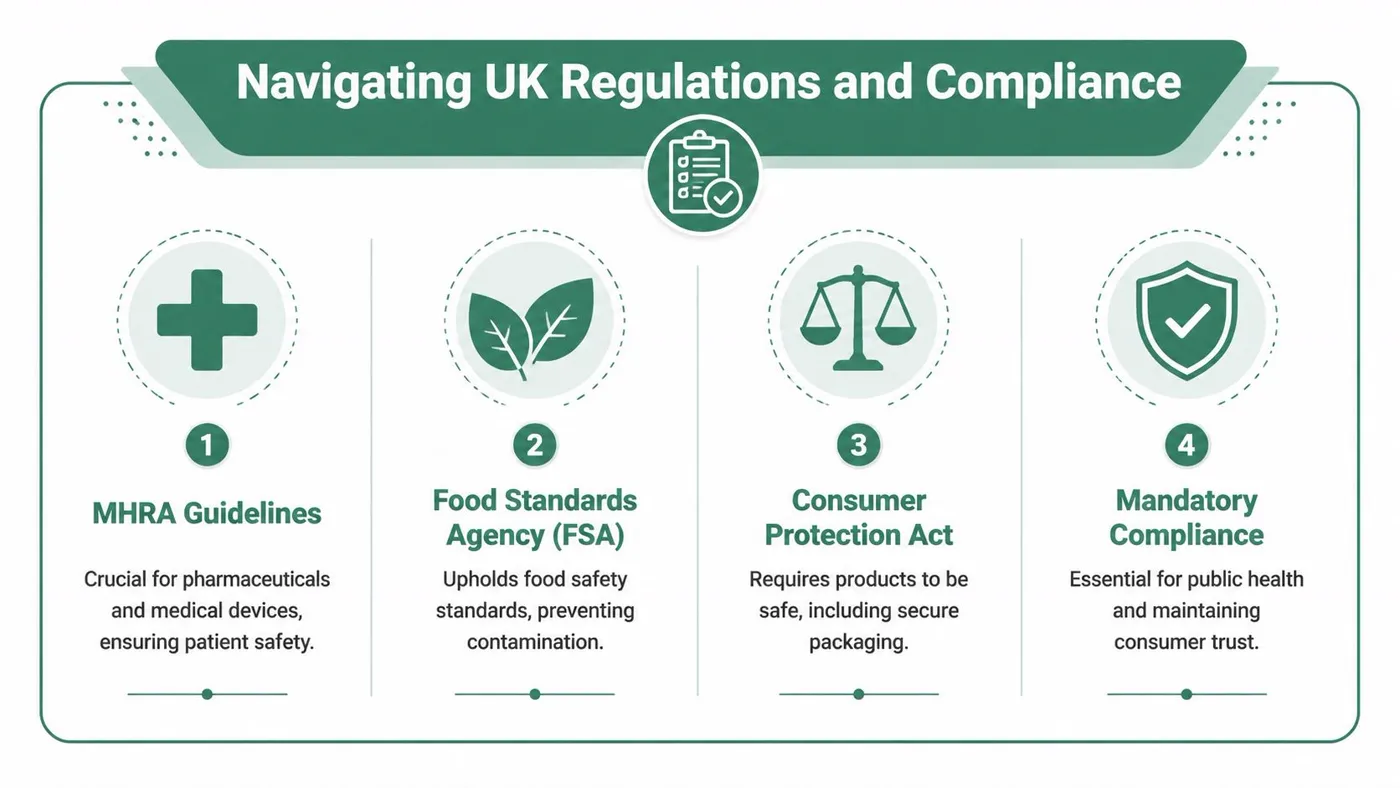
In many UK sectors, tamper evident packaging isn't just sensible practice. It's tied to legal duties around product safety, authenticity, and supply chain control. Businesses that treat it as a decorative add-on usually end up buying twice.
Pharmaceuticals and the supply chain
The clearest example is medicines. The global tamper-evident packaging market was valued at USD 2.56 billion in 2025 and is projected to reach USD 4.26 billion by 2030, with that growth linked to regulatory pressure including the EU's Falsified Medicines Directive. Under that framework, every pack of prescription medicine in the UK must carry a tamper-evident device to protect the supply chain, as outlined in Mordor Intelligence's tamper-evident packaging market report.
For buyers in pharma and adjacent sectors, the practical message is straightforward. The pack must help verify authenticity and reveal interference. Generic closures aren't enough where the product falls under controlled distribution.
Food, disposal, and packaging records
Compliance doesn't stop at the seal. UK businesses also need to think about how packaging materials fit waste handling, reporting duties, and recycling streams. That affects colour choices, substrate selection, and pack combinations.
A tamper label that contaminates a recyclable carton can create downstream issues. A plastic-heavy security format may conflict with internal sustainability policy even if it meets the security brief. Cold-chain operators face an extra layer because insulation, outer cartons, and security features need to work together. For products moving under controlled temperature, Chilled Packaging typically includes insulated boxes, liners and gel packs, so the tamper feature must be selected with the full pack build in mind rather than in isolation.
What compliance looks like on the ground
A compliant approach usually includes:
- Clear warning language so buyers know damaged or missing seals may indicate tampering.
- Legible labelling that remains readable even if the tamper feature is broken.
- Recorded material decisions for reporting and procurement control.
- Documented pack specifications so teams don't substitute a weaker closure without review.
Compliance is rarely a single feature. It's the seal, the wording, the substrate, and the record behind it.
Custom Printing and Bulk Supply with Packaging Panda
For many businesses, an off-the-shelf tamper feature covers the security need but creates new problems in branding, stock control, or warehouse efficiency. That's where custom print and planned bulk supply become practical purchasing tools rather than marketing extras.
What custom print is actually useful for
The most useful print elements are usually operational.
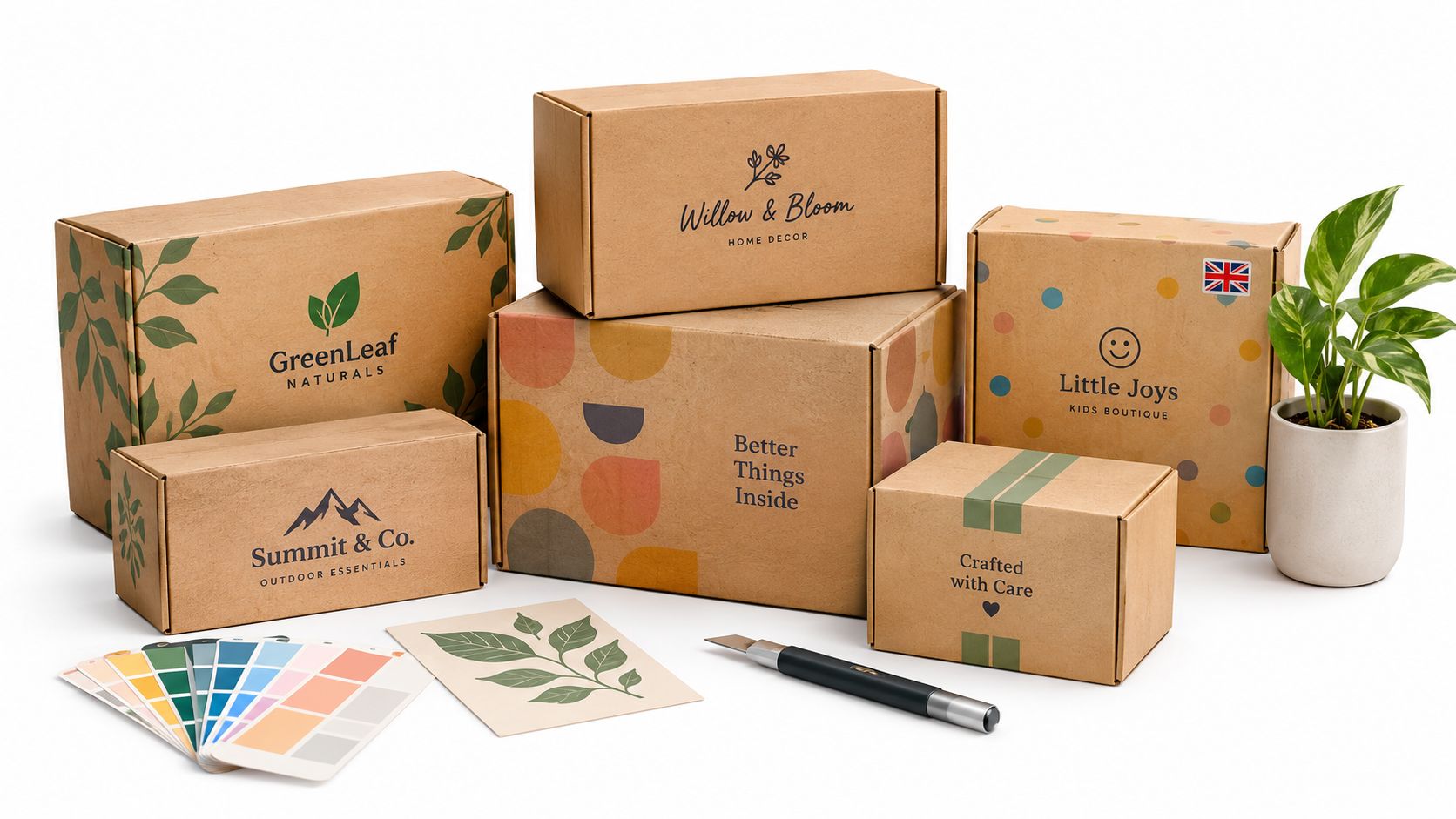
- Serial numbers help with investigation and handover control.
- Barcodes support internal scanning and despatch workflows.
- Logos and brand text make substitution and unofficial repacking easier to spot.
- Handling instructions reduce confusion where staff or end users need to check the seal before acceptance.
A custom printed bag, carton, or label should make the pack easier to verify. If the design only adds decoration, it isn't solving the tamper question.
For businesses planning a wider branded transit range, the design and ordering process is similar to other bespoke packaging formats. Packaging Panda publishes guidance on custom printed cardboard boxes, and the same practical considerations apply here: artwork clarity, print placement, pack size consistency, and sensible minimum runs.
Why bulk buying works for tamper formats
Tamper packaging is one area where fragmented purchasing often causes avoidable problems. Teams buy a small run, change format mid-quarter, then retrain staff and manage mixed stock on the shelf. That weakens consistency.
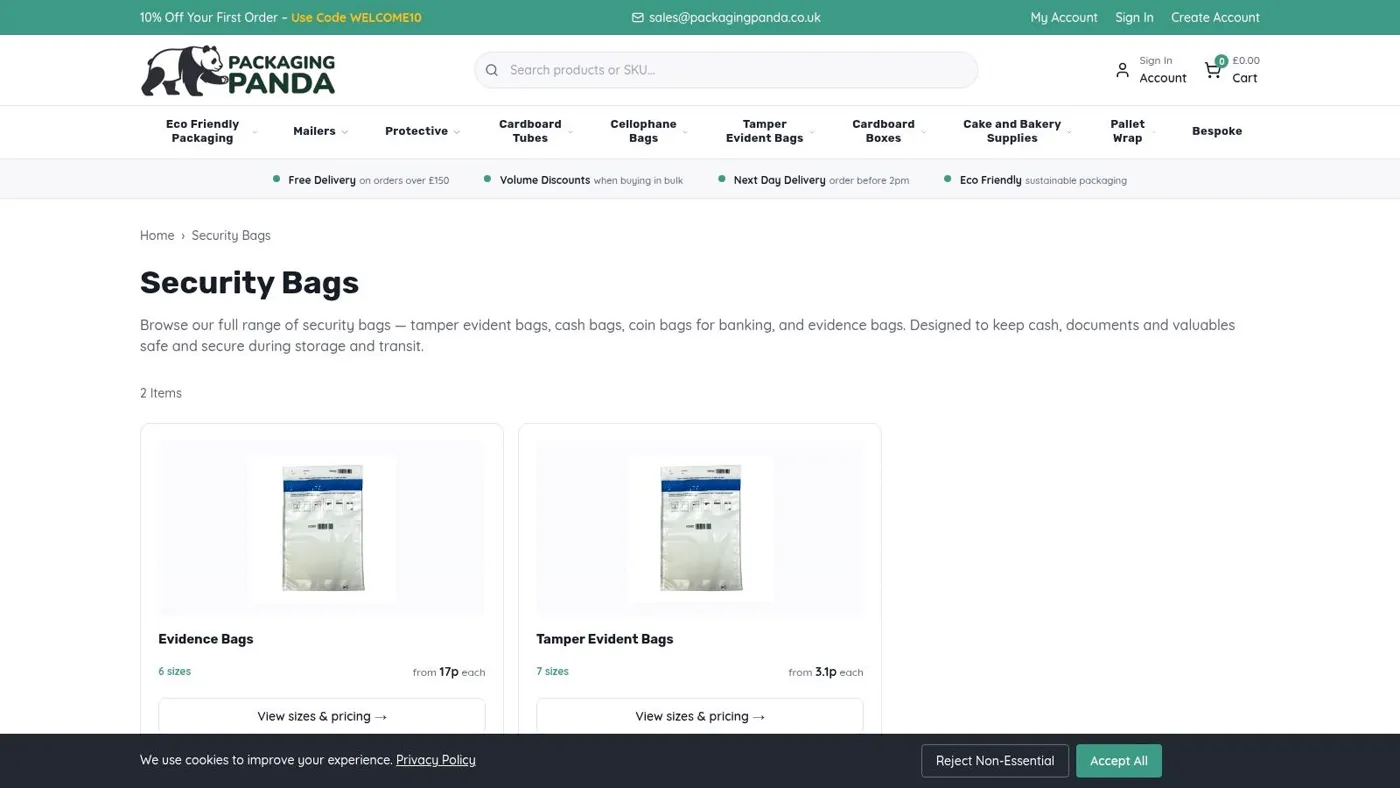
Packaging Panda supplies bespoke packaging with minimum runs from 500 units, alongside free delivery on orders over £150 and transparent volume pricing across the wider range. For buyers, that matters because stable specification and planned replenishment usually deliver better control than ad hoc ordering.
Bulk purchasing makes most sense when the business has already fixed four points:
- Seal design
- Pack size
- Print content
- Application method
Once those are stable, larger runs reduce variation and simplify procurement. If they aren't stable, buying more just scales the wrong choice.
Application and Quality Control Best Practices
A tamper system is only as good as its application. Many failures blamed on the product are process failures: dusty surfaces, poor storage, incorrect heat settings, rushed sealing, or staff who were never shown what a correct seal looks like.
Apply it consistently
Most operations improve reliability by tightening a few basics:
- Prepare the surface: Labels and tapes need clean, dry contact areas.
- Control the environment: Don't apply seals in conditions that are too cold, too damp, or inconsistent for the material.
- Standardise the method: One approved placement, one seal length, one opening direction.
- Train for exceptions: Staff should know when to reject a pack rather than force a poor seal.
Businesses handling medicines and similar items can also review practical examples from pharmacy dispatch tamper evident bags, where correct sealing and visual checks are central to dispatch integrity.
Build quality checks into dispatch
A useful quality routine doesn't need to be complicated. It needs to be repeatable.
- Check the seal after application for full adhesion, correct alignment, and visible integrity.
- Inspect again at pack-out before the item moves to courier cages or pallets.
- Record exceptions so repeated failures can be traced back to material, machine setting, or operator practice.
- Show customers what to expect on the pack or in enclosed instructions.
Customers should know what an intact seal looks like before they open the parcel.
There's also a balance to strike between security and ease of opening. If a pack is secure but frustrating to use, customers may damage it unnecessarily and create confusion about whether tampering has occurred. This overview of frustration free packaging Amazon is useful because it highlights the wider lesson: packaging should protect the product without making normal opening feel hostile.
A good tamper evident system doesn't just deter interference. It survives handling, signals clearly, and works the same way every time.
Packaging businesses that need secure, sustainable, or made-to-order formats can review options with Packaging Panda, a UK wholesale supplier offering packaging materials for dispatch, protection, and bespoke supply across a wide range of business uses.