Your Expert Guide to Custom Printed Cardboard Boxes
The plain brown transit box works well until it doesn't. Orders are leaving the warehouse, customers are receiving them safely, but the packaging says nothing about the brand, uses more space than it should, and starts raising awkward questions about recyclability, labels, and future compliance costs.
Browse our custom printed cardboard boxes →
That's usually the point where first-time buyers start looking at custom printed cardboard boxes. In the UK, that decision sits inside a very large corrugated market estimated at about £3.8 billion in 2024 and closely tied to e-commerce, which is why small gains in presentation, packing efficiency, or damage reduction can matter across high shipment volumes (Fortune Business Insights on the UK corrugated packaging market). A custom box isn't just a nicer outer shell. It affects storage, fulfilment speed, courier dimensions, and increasingly the compliance consequences of the materials and finishes chosen.
Table of Contents
- From Generic to Branded Your First Custom Box Order
- Choosing Your Box Materials and Structure
- Understanding Print Methods and Finishes
- Preparing Artwork and Approving Your Proof
- Navigating Pricing, Lead Times, and Logistics
- Sustainability and UK Compliance Deep Dive
From Generic to Branded Your First Custom Box Order
A first custom box order often starts with a simple frustration. The business has outgrown blank stock cartons, but the buyer doesn't yet know which decisions matter and which ones only add cost. That's where mistakes happen. Too much attention goes to logo placement, and not enough goes to board strength, dimensions, finishing, and how the pack will behave once it enters a courier network.
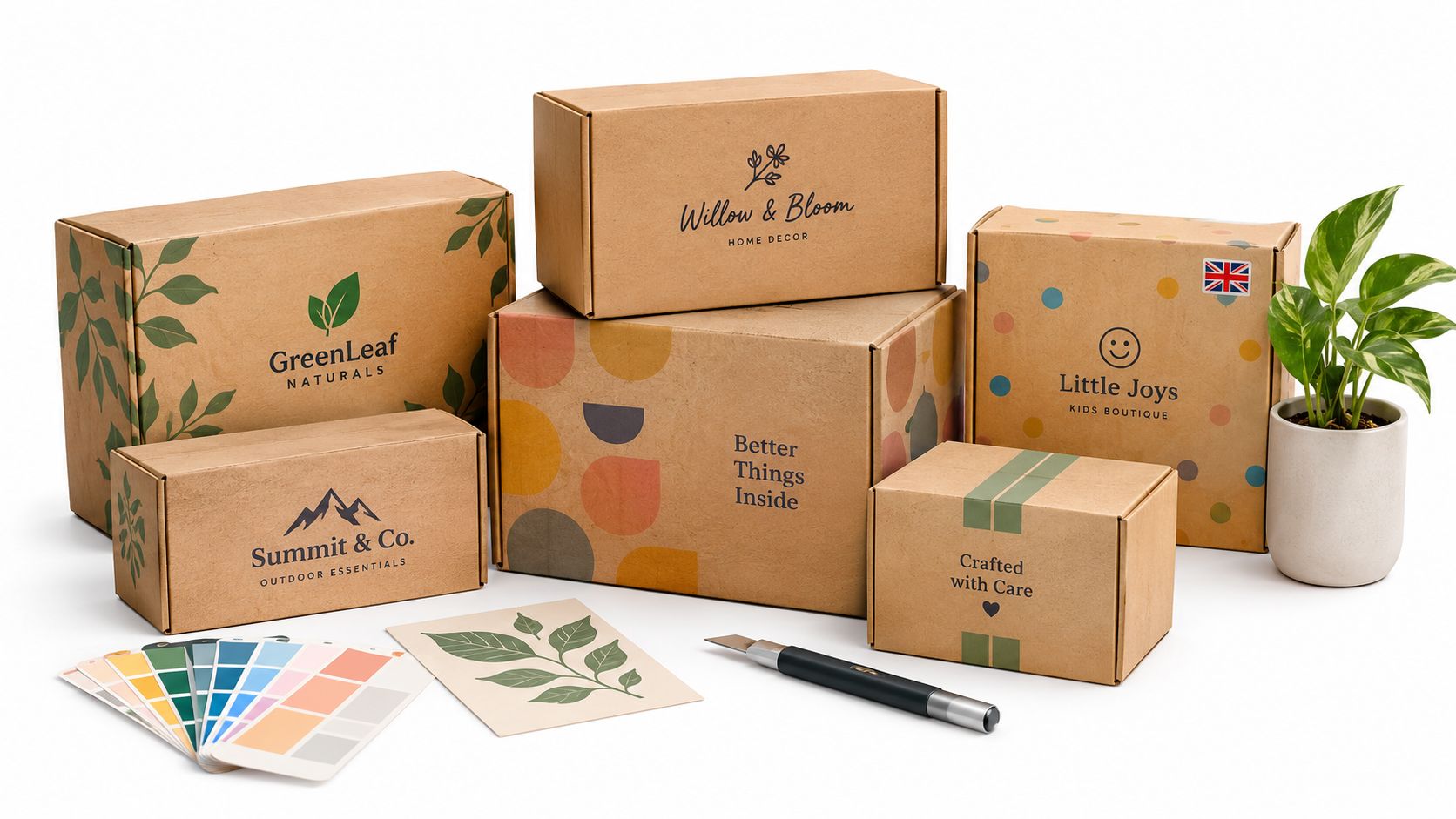
Custom printed cardboard boxes work best when they solve several problems at once. They can sharpen presentation, reduce wasted space, create more consistent packing lines, and make the unboxing experience feel deliberate instead of improvised. They can also create new problems if the specification is driven by appearance alone.
Practical rule: A box should be specified as a shipping tool first and a branding surface second.
For a growing UK seller, that's especially important because cardboard packaging sits inside a highly established commercial and recycling system. The sector is large, volumes are high, and packaging policy is putting more attention on what materials businesses place on the market. That changes the conversation. Buyers aren't just choosing colours and print positions. They're choosing how much stock to hold, what level of protection to build in, and whether a decorative finish could create avoidable cost later.
Some brands need a fully printed outer shipper. Others are better served by a simpler carton with a printed sleeve, label, or insert. Businesses selling gifting lines sometimes move first into presentation formats rather than transit cartons, and a guide on custom printed gift boxes for branded presentation packaging can help clarify when that route makes more sense.
The strongest first orders tend to share the same discipline. The buyer knows the product dimensions, understands the packing method, and treats sustainability and compliance as part of the brief from day one, not as a last-minute add-on after artwork is finished.
Choosing Your Box Materials and Structure
Material choice decides whether a box feels economical, premium, rugged, or wasteful. It also decides whether the print will look crisp, whether the box will survive transit, and whether the pack is pleasant or awkward to assemble at the bench.
For buyers comparing formats, Packaging Panda's range of cardboard boxes for shipping and fulfilment is one example of the kinds of stock and bespoke starting points UK businesses usually review before moving into custom print.
Start with the job the box has to do
The first question isn't what the box should look like. It's what the box needs to withstand. Weight, fragility, stacking pressure, packing speed, and whether the box is shelf-facing or purely for transit all change the specification.
A simple way to think about it is this:
- Light, durable products: Apparel, printed materials, and many soft goods usually don't need an aggressive board specification. The focus is often neat presentation and efficient packing.
- Small but fragile products: Candles, glassware, ceramics, and cosmetics often need more than a nice-looking outer. They need board strength that works with inserts and prevents movement.
- Mixed orders: If a business packs variable product combinations, one very tight custom size for each product can become operationally messy.
Buyers will also hear terms like kraft, test, white-top, flute, and wall construction. In practical terms, those choices affect print surface and durability. Kraft liners usually give a natural brown look and a more utilitarian feel. White-top boards give artwork more visual clarity. Recycled-content test liners can be sensible where visual perfection isn't the priority.
A clean print on the wrong board is still the wrong box.
Choose a style before choosing decoration
Style drives both user experience and production logic. A standard shipping carton is often easier to store, easier to tape, and more forgiving in fulfilment. A mailer style can improve presentation and create a cleaner opening experience for e-commerce deliveries. That matters if the outer box also acts as the branded presentation pack.
A few common decisions typically look like this:
| Style choice | Works well when | Watch out for |
|---|---|---|
| Regular transit carton | The priority is shipping efficiency and straightforward packing | It can feel generic if branding is minimal |
| Mailer format | The box is part of the unboxing experience | Poor sizing shows up quickly because there's less room to hide void |
| Retail presentation format | The product is handed over in person or displayed | It may need a separate outer shipper for courier protection |
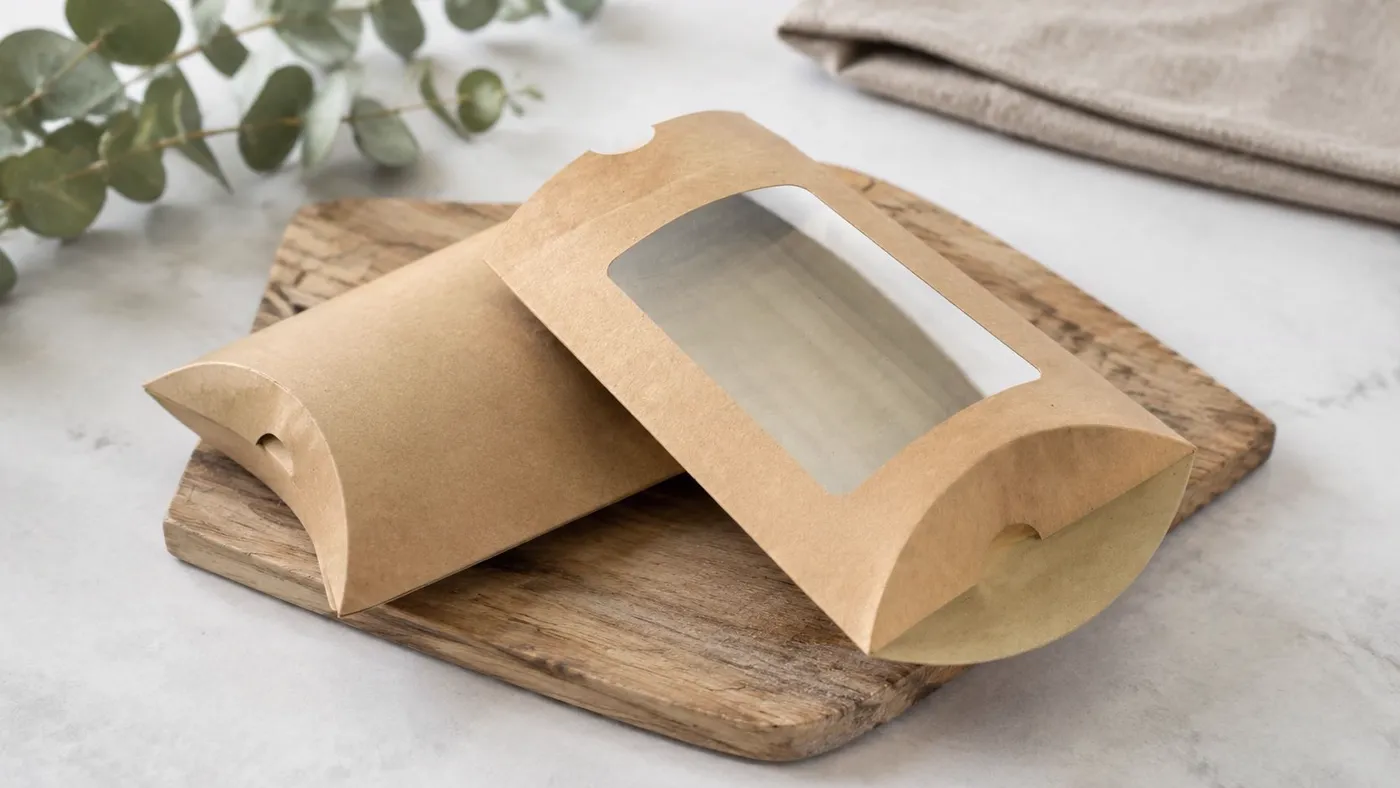
For smaller retail and gifting lines, Kraft Pillow Boxes are a distinct format worth considering. The available snapshot describes manilla kraft pillow boxes with and without windows, made from recyclable 350gsm card and designed for retail, gifting and small products. They suit lighter items where presentation matters more than heavy-duty transit performance.
A buyer's shortlist should usually include these checks before any artwork starts:
- Product fit: Measure the product with any tissue, insert, leaflet, or protective wrap included.
- Packing method: Decide whether staff will hand-pack each unit or whether speed at scale matters more than a refined opening action.
- Storage reality: Flat-packed boxes still take space. More styles and sizes mean more complexity.
- Print surface: White boards tend to favour brighter graphics. Brown kraft boards tend to suit simpler branding and a more natural look.
The best custom printed cardboard boxes feel obvious once they're in use. That's usually a sign that the structural decisions were made well before anyone argued about Pantones or finishes.
Understanding Print Methods and Finishes
Print method is where many first-time buyers either overspend or underspecify. The right option depends less on personal taste and more on run length, artwork complexity, turnaround needs, and whether the box is a premium presentation piece or a hard-working shipper.
The three methods buyers usually compare
Most UK buyers end up choosing between flexographic, lithographic, and digital print. Each has a place. None is automatically the right answer.
| Method | Best For | Unit Cost (at volume) | Colour/Image Quality | Typical UK MOQ |
|---|---|---|---|---|
| Flexographic | Simple branding on transit cartons and larger runs | Usually more cost-efficient at volume | Good for simpler designs and limited-colour work | Often higher than digital |
| Lithographic | Premium presentation and artwork-led cartons | Setup tends to be less forgiving for small runs | Strong image reproduction and refined print finish | Often higher than simpler methods |
| Digital | Shorter runs, multiple versions, quicker design changes | Often useful where setup flexibility matters more than lowest large-run cost | Strong for detailed artwork and smaller bespoke batches | Often lower than traditional setup-heavy methods |
Flexo is the workhorse. It suits shipping boxes where one or two colours and clear branding are enough. It's less suited to artwork that relies on subtle gradients or photographic detail.
Litho is usually chosen when the box itself is part of the brand theatre. It produces a more polished result, but buyers should only pay for that if the pack requires it. For a warehouse outer that gets taped, labelled, and stacked, that uplift often doesn't earn its keep.
Digital sits in the practical middle ground. It's useful when a business wants a branded result without committing to very large volumes, or when artwork changes are likely between runs.
Finishes that help and finishes that complicate things
Finishes should have a job. If they don't, they're decoration in search of a reason.
A sensible hierarchy looks like this:
- Varnish: Useful when the print needs a level of surface protection without making the pack feel heavily coated.
- Matt or gloss lamination: Can improve feel and scuff resistance, but introduces material complexity that needs reviewing carefully.
- Foil and specialty effects: Better reserved for premium presentation cartons than standard shipping packs.
One overlooked issue is how the artwork will behave on board. Fine text, reversed-out details, and large flood areas can all become troublesome if the chosen print method and board surface don't support them. Designers who mainly work on screens sometimes miss these production realities. A practical primer such as Creative Graphic Solutions' guide to visuals for growing businesses can help non-specialists align branding ambitions with print constraints before files go to pre-press.
If the box ships through a courier network, scuffing and compression matter more than studio mock-ups.
A buyer should also separate two questions that often get bundled together. The first is “What looks good?” The second is “What can be repeated reliably over multiple runs?” Reliable print is usually the more valuable answer. Consistency beats a clever finish that causes delays, approval disputes, or recycling concerns later.
Preparing Artwork and Approving Your Proof
Artwork approval is where a well-planned box becomes a usable production file, or where avoidable errors get locked in. The technical side doesn't need to be intimidating, but it does need discipline.
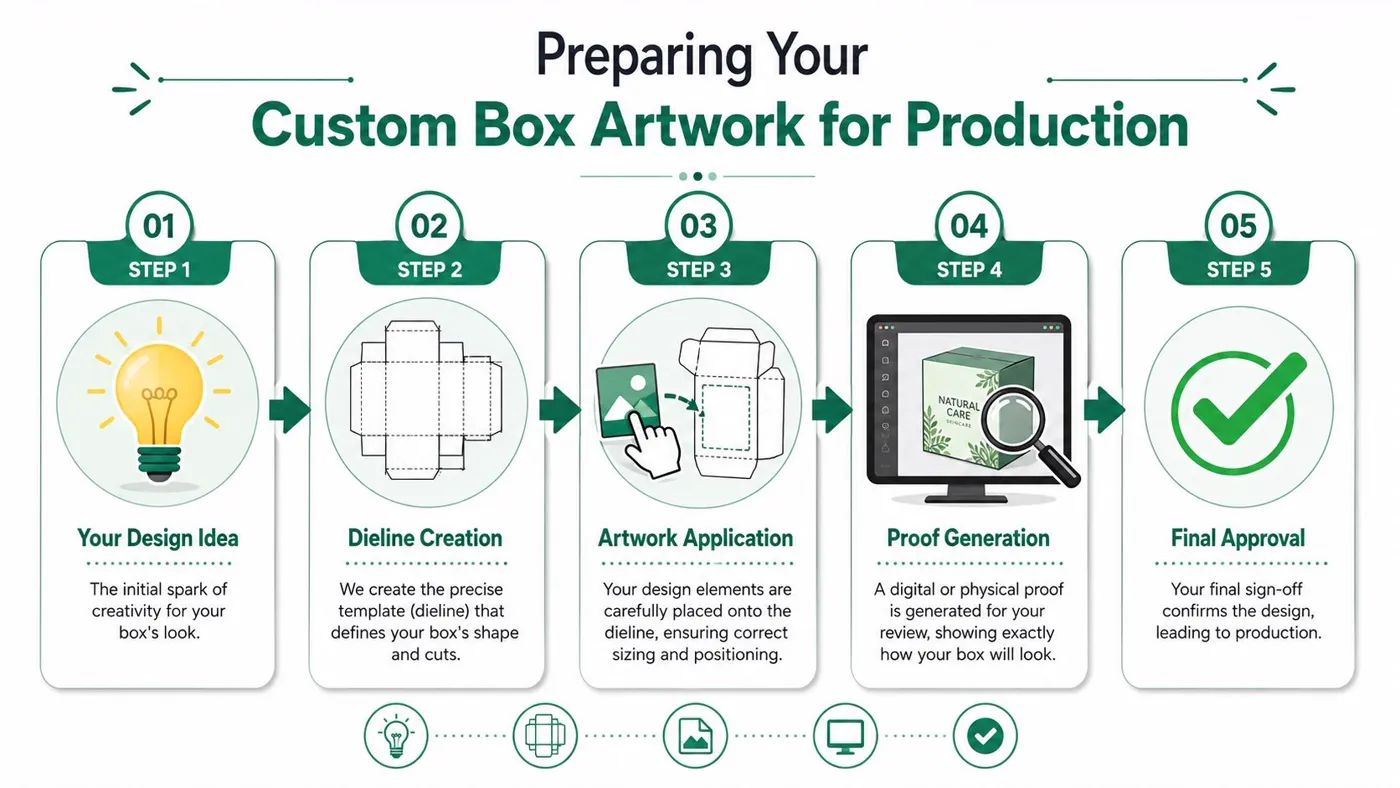
In UK packaging converting, a standard production workflow is structural specification, artwork alignment on the dieline, print method selection, die-cutting, and then quality control. Guidance on that process also notes that many avoidable faults start with the wrong board grade or incorrect artwork specification early on (BoxesGen on custom cardboard box manufacturing steps).
What the dieline actually controls
The dieline is the flat template of the box. It shows cut lines, folds, glue areas, flaps, and printable zones. Buyers don't need to build it themselves, but they do need to understand that it is the master reference for every panel, edge, and closure.
That means artwork shouldn't be dropped loosely onto a visual mock-up and approved by eye. It needs to be placed against the actual layout so that these practical issues are visible:
- Panel alignment: Logos shouldn't fall across creases unless that effect is deliberate.
- Glue areas: Text or critical graphics must stay clear of glued seams.
- Bleed and trim: Artwork needs enough extension beyond the cut line to avoid unintended white edges.
- Orientation: Front, back, lid, and base panels must read correctly when the box is assembled.
Design files also need the right format. Vector artwork is usually preferred for logos, line work, and anything that must scale cleanly. Raster images need enough resolution for print use. For teams still wrestling with what image sharpness means in production, MerchLoom addresses 300 DPI challenges in plain language, which helps non-design buyers spot weak files before proofing starts.
What to check before approval
Proof approval should happen in layers. A PDF proof can confirm content and placement. A physical sample can reveal issues that a screen won't show, such as board feel, fit, fold quality, or how dark ink behaves on a kraft surface.
A useful approval checklist is:
- Text accuracy: Product names, legal copy, contact details, and barcode placement need a line-by-line check.
- Panel hierarchy: The most important message should land on the right visible face.
- Assembly logic: Tabs, flaps, and openings should work cleanly once folded.
- Product fit: The item should fit with any insert or protective material included.
- Print expectation: Buyers should confirm what the proof does and doesn't represent. A screen render is not the same as a press result.
Approving a proof without checking the assembled sample is how businesses end up reordering packaging they already know they don't like.
There's also a human factor. Different people often check different things badly. Marketing looks at colour. Operations looks at pack speed. Procurement looks at unit cost. Someone still has to confirm whether the actual product fits and whether the barcode lands on a scan-friendly face. The cleanest approvals happen when one person owns the final consolidated sign-off instead of collecting scattered comments at the last minute.
Navigating Pricing, Lead Times, and Logistics
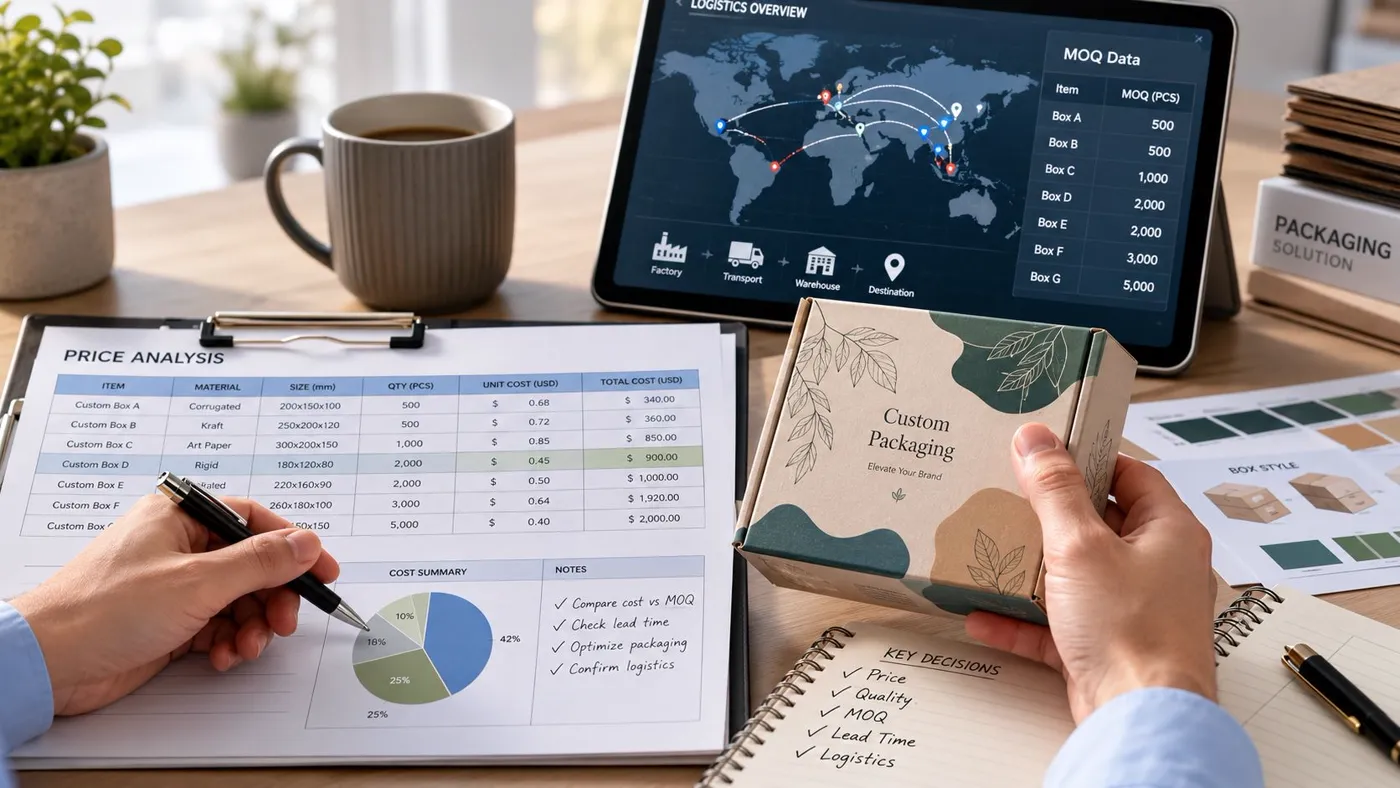
The first custom quote often surprises buyers for the wrong reason. They expect the box cost to be driven mainly by print, when in reality the commercial picture is shaped by setup, run length, board choice, dimensions, storage, and delivery format.
What usually drives the quote
Minimum order quantities exist because production has fixed setup work. Creating print-ready files, preparing tooling, scheduling press time, and handling dispatch all carry costs before the first finished box appears. That's why a bespoke order often becomes more commercially sensible once the buyer has enough consistent volume.
For UK businesses comparing options, one factual benchmark from the publisher is that Packaging Panda offers bespoke packaging with branded print and minimum runs from 500 units. That won't suit every start-up, but it does reflect the fact that fully custom work usually starts where repeat demand is predictable enough to justify setup.
A buyer should expect the quote to move when any of these change:
- Dimensions: Larger boxes use more board and alter pallet yield.
- Board grade: Stronger or more premium material affects production cost.
- Print complexity: Simpler branding is easier to manufacture consistently.
- Run size: Larger runs usually improve the cost picture per box.
- Packing format: Flat-packed, bundled, and palletised delivery all influence handling.
Manufacturers also advise finalising box dimensions early because they lock in the dieline, and converter guidance notes that corrugated boxes are commonly bundled in 25, 50, or 100 units for palletised delivery, which helps with warehouse planning and replenishment logic (Brown Packaging on corrugated box manufacturing and dispatch).
Right-sizing without creating a warehouse headache
Perfect right-sizing sounds efficient, and sometimes it is. But too many bespoke SKUs can create a slow, cluttered packing operation. The smarter answer for many SMEs is a controlled range of core box sizes that cover most orders without forcing the warehouse to manage excessive inventory complexity.
That trade-off matters even more in a market where online fulfilment drives so much packaging volume. The ONS reported that UK internet retail sales accounted for around 26% of all retail sales in late 2024, a point captured in the verified market angle on right-sizing and minimum-order economics (verified reference discussing UK online retail share and packaging trade-offs).
A practical model often looks like this:
| Approach | Strength | Weakness |
|---|---|---|
| One box per product | Tight fit and polished presentation | More SKUs to stock and manage |
| Small family of core sizes | Easier replenishment and simpler storage | Some orders still need void fill |
| Hybrid system with print sleeves or stamps | Brand flexibility with lower stock risk | Less premium than full bespoke print on every SKU |
For operations shipping campaign, pre-order, or backer parcels, broad shipping planning principles still apply. A practical resource on how to optimise crowdfunding shipping costs is useful because it frames packaging as part of fulfilment economics, not a separate design decision.
The cheapest-looking box isn't always the cheapest packaging system. If it slows packing, wastes space, or forces awkward stockholding, the apparent saving disappears quickly.
Sustainability and UK Compliance Deep Dive
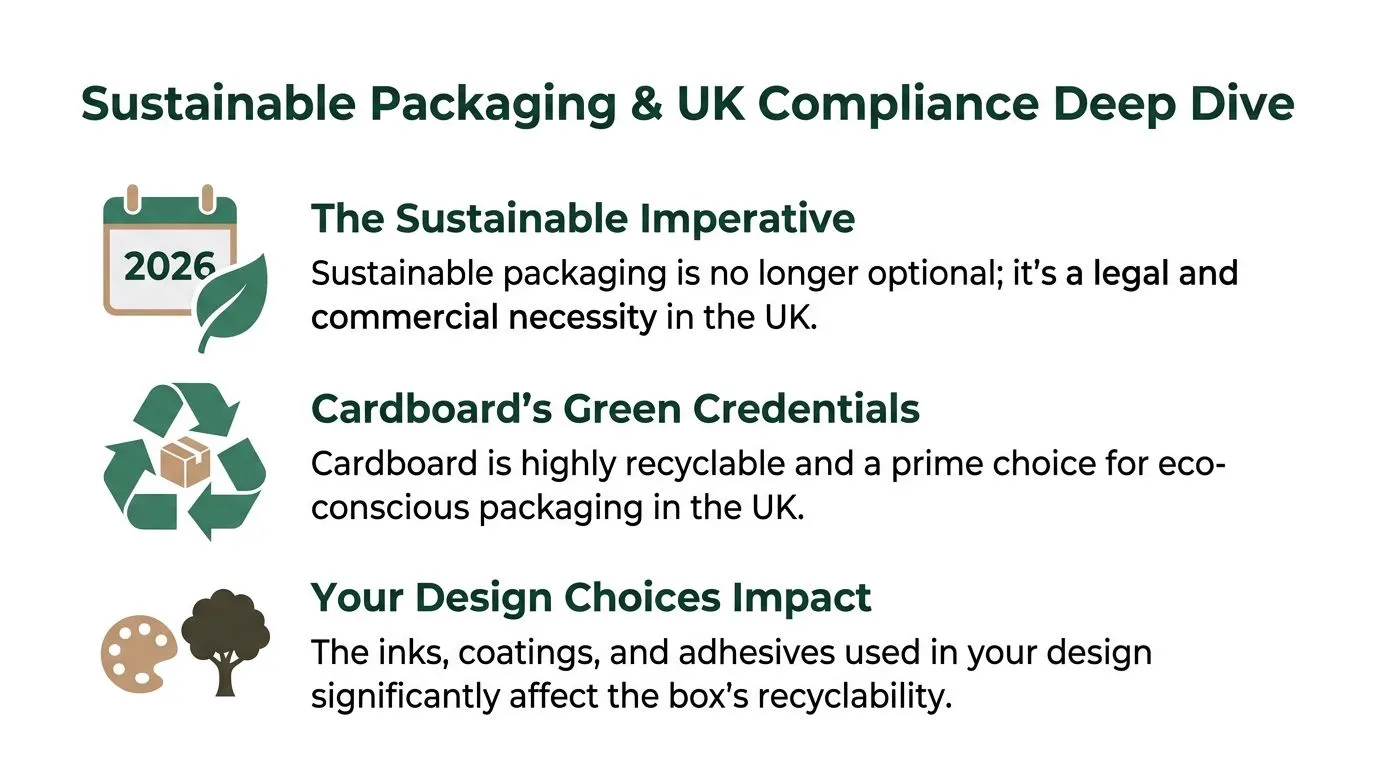
Most buyers understand that cardboard is widely recyclable. Fewer understand that a recyclable base material can still become more complicated once heavy print coverage, laminates, windows, foils, or mixed-material elements are added.
Recyclable is not the same as automatically compliant
This is the part many custom printed cardboard boxes guides skip. They talk about appearance, maybe mention sustainability, then stop short of the commercial consequence. In the UK, packaging decisions now sit closer to legal reporting and producer cost than many first-time buyers realise.
The UK's Extended Producer Responsibility for packaging scheme shifts waste-management costs towards producers, with first payments beginning in 2025/26, and that makes print and material choices that affect recyclability, such as laminates or foils, a direct financial consideration for businesses ordering custom boxes (Urgent Boxes on UK packaging EPR and recyclability implications). That doesn't mean every decorative treatment is forbidden. It means every treatment should be justified.
The safest mindset is simple. Treat sustainability claims as a specification issue, not a marketing slogan. A plain corrugated box and a heavily embellished presentation carton may both start with fibre-based material, but they don't present the same practical recycling profile.
Better print choices usually mean better long-term costs
Businesses that want branded packaging without compliance surprises usually make more restrained choices. They avoid unnecessary mixed materials. They keep the pack structure straightforward. They ask what each finish is doing before signing off on it.
A sensible checklist includes:
- Prefer simpler pack structures: Fewer material layers usually make the pack easier to assess and explain.
- Question plastic-based laminates: If a varnish can do the job, it may be the cleaner option.
- Be careful with windows and foil: These features can complicate the pack beyond what many buyers assume.
- Check recycling language: On-pack claims should reflect the full pack structure, not just the base board.
- Build compliance into procurement: Sustainability should be discussed before artwork approval, not after stock has been ordered.
The wider UK context also matters. Paper and board have long made up the largest share of the nation's packaging waste stream by material type, which helps explain why cardboard remains the default substrate for custom print and distribution packaging in the UK system (Refine Packaging summary of UK packaging waste context). That established position is helpful, but it shouldn't encourage complacency. Familiar material doesn't remove the need for careful design choices.
For businesses reviewing broader fibre-based shipping strategies, Packaging Panda also publishes guidance on sustainable e-commerce packaging approaches that sits naturally alongside custom box planning.
The commercial case is now hard to ignore. A box that looks premium but creates avoidable reporting complexity, muddled recycling claims, or unnecessary material layers is not a well-specified box. It's an expensive one wearing good artwork.
Businesses that need custom printed cardboard boxes usually get better results when the brief starts with structure, shipping method, and recyclability, then moves to print. Packaging Panda supplies UK packaging materials including bespoke branded formats, cardboard boxes, mailing products, and sustainable options, so it can serve as one practical route for buyers who want to align presentation with operational and compliance needs.