
Custom Printed Popcorn Boxes: A UK Buyer's Guide 2026
A food business owner usually reaches custom packaging at the same moment pressure starts to build. Sales are steady, an event calendar is filling up, or a new retail line is nearly ready, and the plain stock popcorn box suddenly looks wrong. It holds the product, but it doesn't carry the brand, doesn't help with presentation, and doesn't answer the awkward supplier questions about food contact, coating, or recyclability.
See our custom printed popcorn boxes →
That's where most UK buyers need a more grounded conversation. Custom printed popcorn boxes aren't just a design exercise. They sit at the junction of brand impact, food-contact compliance, operational speed, storage, and cash flow. A box that looks excellent in a mock-up can fail in service if grease marks the outside panel, if the base slows staff down at a rush, or if the finish complicates recycling and reporting.
The useful way to buy these boxes is to treat them as a working packaging format, not as a marketing accessory. The right specification supports portion control, protects print, survives handling, and still reflects the brand properly in front of customers.
Table of Contents
- Why Custom Popcorn Boxes Are a Smart Investment
- Choosing Your Box Material and Structure
- Getting the Right Size Dielines and Assembly
- Mastering Print Finishes and Branding
- Navigating UK Food Safety and Sustainability Rules
- Calculating Your Order MOQs Pricing and Logistics
- Your Pre-Order Checklist and Artwork Guide
Why Custom Popcorn Boxes Are a Smart Investment
A plain concession carton works when the only job is carrying popcorn from counter to customer. It stops working when the box also has to justify a higher selling price, support a themed event, or make a shelf-ready snack line look deliberate rather than improvised.
That matters in the UK because popcorn isn't a fringe category. Mintel reported in 2018 that the UK popcorn market was worth about £90 million, and that growth had been driven by healthier, portioned snacking becoming more popular, as noted in this UK popcorn packaging market reference. In a mature category like that, packaging carries more weight. It has to communicate flavour, occasion, and positioning quickly.
Where the box starts earning its keep
A local cinema, festival trader, bakery counter, or farm shop all face the same problem in different forms. Customers make quick decisions. They don't study the pack for long. The box needs to tell them whether this is a low-cost snack, a premium treat, a family portion, or a seasonal special.
A custom printed box can help in several practical ways:
- Faster brand recognition: Repeated colours, logos, and format cues help customers identify the product on sight.
- Clearer flavour communication: Printed panels can separate salted, sweet, caramel, or limited-edition lines without relying on staff explanation.
- Better event merchandising: A branded box works harder in cinema-style serving, counters, pop-ups, and takeaway displays.
- Stronger perceived value: Customers often judge the whole offer through the pack, especially when the product itself is familiar.
Practical rule: If the popcorn itself isn't unique enough to sell the experience on its own, the box has to carry part of that work.
There's also a simple commercial point. A branded box creates one more place where the business looks organised. For small operators, that matters. The difference between “stock packaging with a sticker” and “a designed serving format” is often the difference between looking temporary and looking established.
When it isn't a smart investment
Custom print isn't always the right move. If volumes are erratic, artwork changes constantly, or storage is tight, plain boxes with labels may still be the more sensible route for a period. The mistake is assuming custom print is automatically premium and automatically profitable.
It works best when the business has enough consistency in portion, product range, and service model to let the packaging do repeated commercial work.
Choosing Your Box Material and Structure
The fastest way to get a poor result is to choose the board by appearance alone. Popcorn is light, but it isn't packaging-friendly. Oil, salt, handling pressure, heat from fresh service, and stacking all create stress on a paperboard carton.
Start with the barrier, not the print
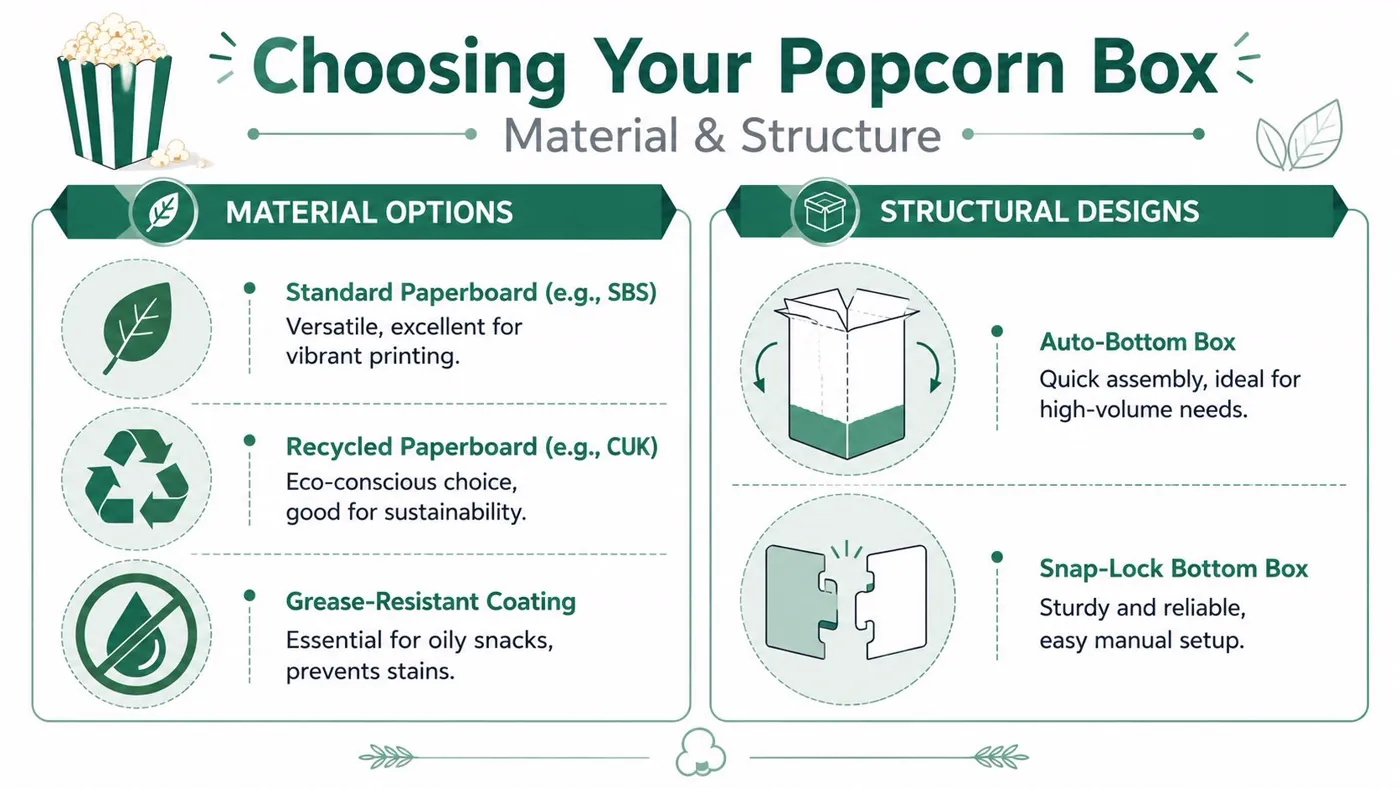
The most important specification isn't the colour count. It's the board-to-food-contact barrier system. For greasy snacks, the internal structure has to manage grease migration, print rub resistance, and fold-crack tolerance. If it doesn't, oil can weaken seams, mark the outside, and distort graphics, as outlined in this guidance on popcorn box barrier performance.
The easiest way to explain this is to compare it with clothing fabric. A jacket can look sharp on the hanger and still fail in bad weather if the material isn't right. Popcorn boxes work the same way. A beautifully printed board without the right internal barrier can underperform in real service.
A buyer usually has three broad board decisions to make:
| Board direction | Best for | Main trade-off |
|---|---|---|
| Clean white food-grade board | Bright branding and sharper colour presentation | Can show grease issues quickly if barrier design is weak |
| Natural or Kraft-style board | Rustic, bakery, artisan, or eco-led presentation | Print colours usually look softer and less crisp |
| Recycled-content leaning board | Sustainability-led positioning | Surface consistency and print finish need checking carefully |
For general box formats and board options, many buyers start by reviewing standard cardboard box formats before moving into a bespoke spec.
The inside face of the box does the technical work. The outside face gets the credit.
A coating or barrier treatment should solve a specific problem. It shouldn't be added because it sounds premium. Heavy laminates and more complex finishes can improve resistance in some cases, but they may also complicate recyclability and add avoidable cost.
Match the structure to the service environment
Structure matters just as much as material. A box used in a quiet deli counter can be simpler than one used in a cinema queue or stadium kiosk where staff need speed and the pack needs to open cleanly every time.
Key structure questions include:
- Does the box need to stand filled for display? Wider bases and firmer locking styles help.
- Will staff assemble it during service? If yes, the base style becomes an operational issue, not a design detail.
- Will customers carry it around for a while? Sidewall stability and grip comfort start to matter more.
- Is the popcorn sold fresh and warm or pre-packed and shelved? Heat and hold time affect board choice.
Even where the final product is unrelated, packaging categories such as Wholesale Hat Boxes show how much structural variation can exist within paperboard packaging, with different colours, sizes and finishes used for retail, gifting and display. The same principle applies to popcorn. Shape and finish should follow use, not habit.
A common buying error is overbuilding the box. Popcorn is relatively light, so a heavy board can become unnecessary cost and waste. Another error is underbuilding the corners and base. That usually shows up late, when packed boxes start leaning, opening, or scuffing at the crease.
Getting the Right Size Dielines and Assembly
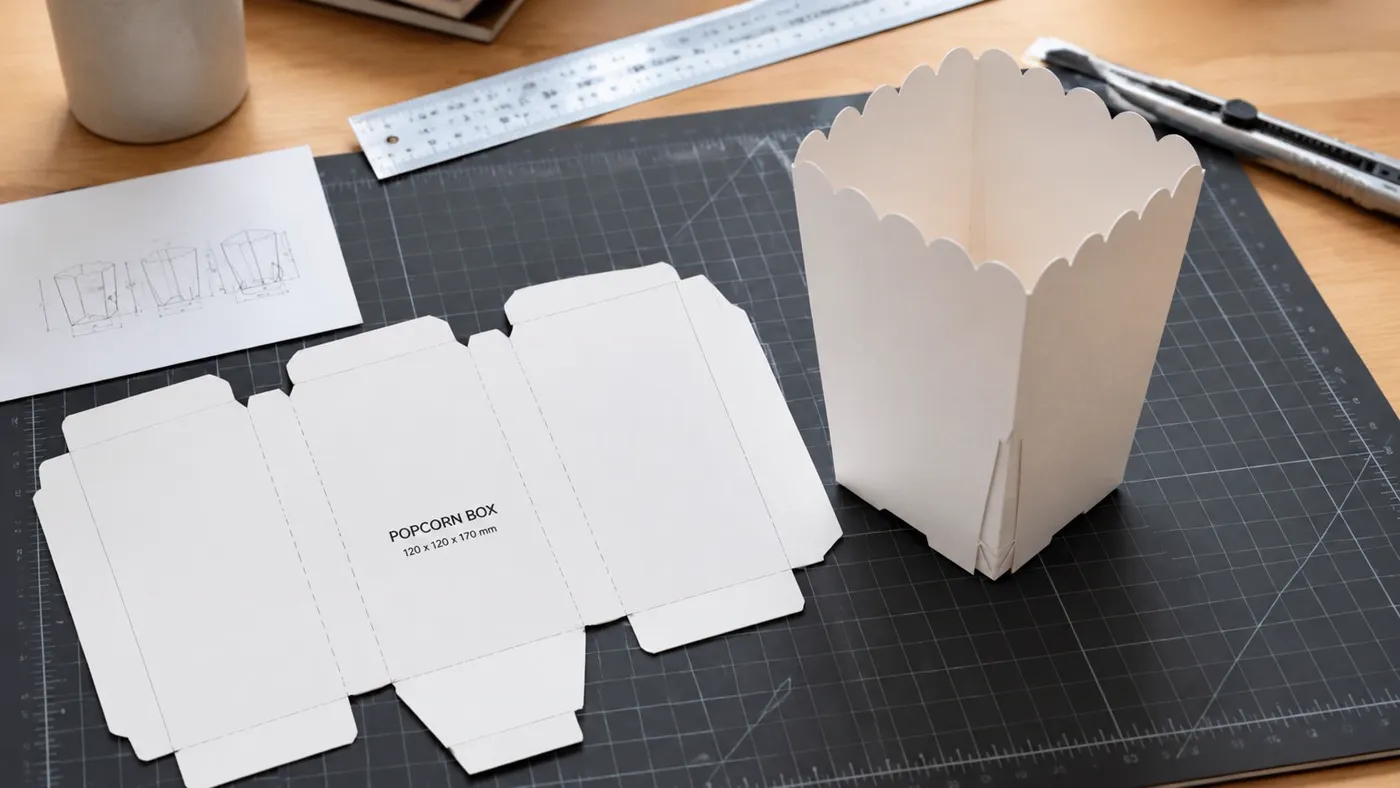
A dieline is the box's production blueprint. It shows where the board will cut, fold, glue, lock, and print. For buyers, that document isn't just for the printer. It affects portion control, artwork fit, warehouse storage, and how quickly staff can form the box on site.
Treat the dieline like a production tool
Many packaging delays start with artwork being created before the final dieline is approved. That creates avoidable problems. Logos drift into glue areas. Text lands too close to fold lines. Important flavour cues get trapped on side panels that customers barely see.
The better sequence is straightforward:
- Fix the serving size first. The box should match the intended portion, not the other way round.
- Approve the structural dieline next. That locks in panel widths, base style, and print-safe areas.
- Build artwork on the live file. This avoids later resizing and panel distortion.
A standard size is often the safer choice for businesses still testing volumes. Fully custom shapes can work, but they need a reason. If the pack doesn't improve stacking, recognition, or service speed, the extra tooling complexity may not pay back.
Assembly style changes labour at busy times
Two boxes can cost roughly the same on paper and perform very differently once staff start using them. That usually comes down to the base style.
A quick comparison helps:
| Assembly style | What it does well | Where it causes friction |
|---|---|---|
| Auto-bottom or crash-lock style | Opens quickly and suits fast service | Usually carries more conversion cost |
| Manual lock or tuck base | Packs flatter and can reduce unit cost | Takes more staff time to assemble |
| Simple folded concession style | Familiar and easy for low-complexity service | Often offers less brandable structure and less rigidity |
A bakery running occasional movie nights may tolerate slower manual assembly. A venue with interval rushes usually won't. Labour gets expensive when service backs up.
A box that saves a small amount per unit can still be the expensive option if staff lose time opening it hundreds of times in a busy session.
There's also a storage angle. Pre-glued or more engineered formats can occupy space differently in transit packs and back rooms. Before approving a bespoke design, a buyer should ask how many flat units fit into existing storage and whether staff can assemble them consistently without training drift.
Mastering Print Finishes and Branding
Branding decisions work best when they follow the commercial role of the box. A family entertainment venue, an artisan caramel popcorn brand, and a corporate event caterer shouldn't all print the same way just because the substrate is similar.
Good, better, best branding routes
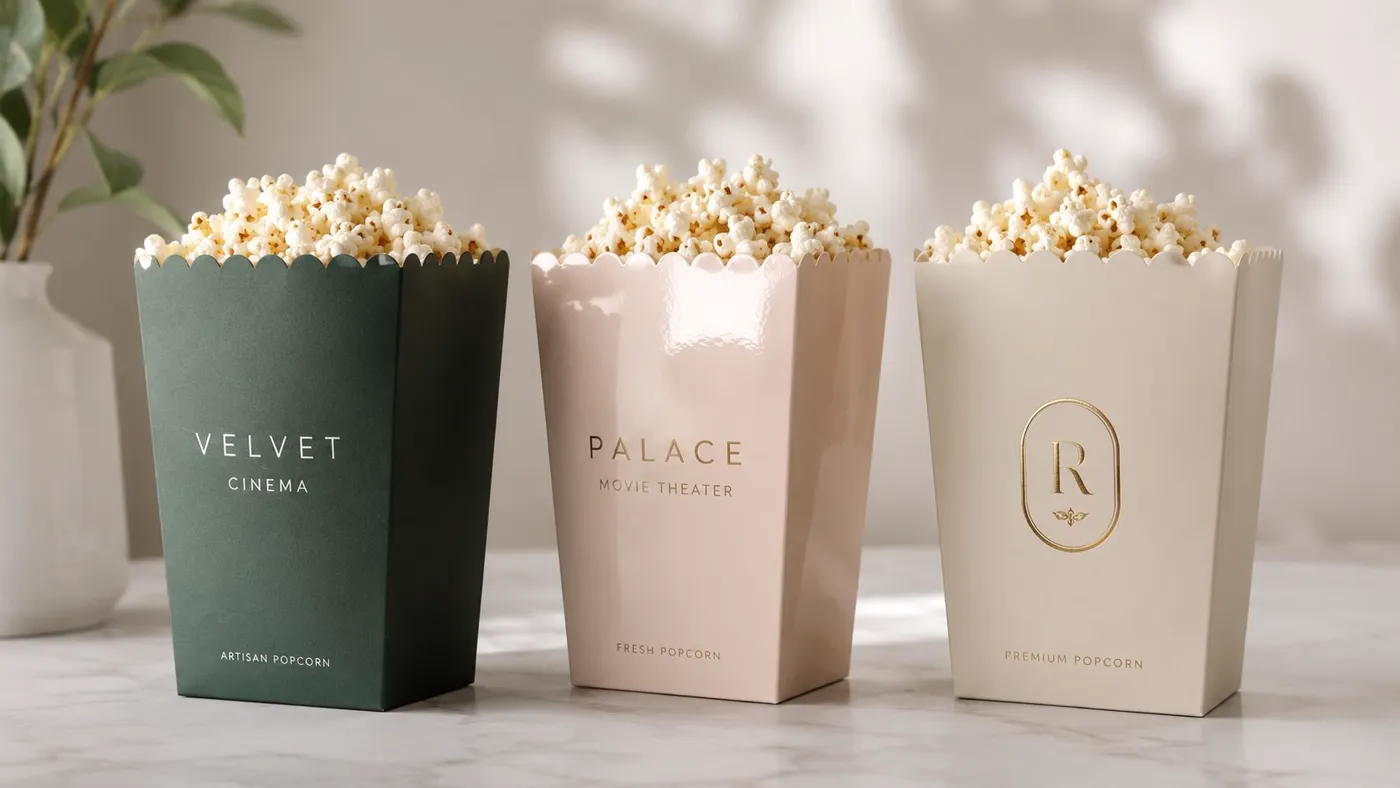
The simplest route is a restrained print job on a stock-style structure. That might mean one-colour branding, a short message, and a practical layout that identifies the business without overengineering the pack. It suits seasonal runs, local events, and buyers who want a cleaner entry point into custom print.
A step up is fuller colour work with more considered panel hierarchy. Front-facing panels carry the logo and flavour, side panels carry supporting brand elements, and the inside remains technically focused. This is often the sweet spot for businesses that want custom printed popcorn boxes to look credible without moving into luxury finishing.
At the top end sits presentation-led branding. That might involve stronger colour management, more precise print quality, and selected decorative finishes. It can work well for gifting, premium food halls, product launches, or branded event activations. It only makes sense when the product and selling context can support the look.
Consider the following:
- Good: Clear logo, readable flavour cue, basic brand consistency
- Better: Full visual system across multiple panels, stronger shelf or event presence
- Best: Premium tactile and visual finish, used selectively where the selling environment justifies it
For creative reference outside the food niche, this roundup of inspiring brand packaging ideas is useful because it shows how colour hierarchy, restraint, and material feel shape perception before a customer even touches the product.
Finishes should support the brand, not fight the pack
A gloss finish can make colours pop and push the pack towards indulgence. A matt or more natural surface can support a bakery, handcrafted, or sustainability-led identity. Uncoated or lightly coated looks can feel honest and tactile, but they need enough technical protection to avoid scuffing and grease marks in use.
The practical decisions usually come down to this table:
| Finish direction | Brand effect | Operational caution |
|---|---|---|
| Gloss or higher-sheen | Bold, bright, more promotional | Can show rub and fingerprinting differently depending on stock |
| Matt | Premium, muted, more contemporary | Can flatten weak artwork if contrast is poor |
| Natural uncoated look | Rustic, craft-led, understated | Needs careful testing for handling and food-use conditions |
A frequent mistake is trying to put every message on the box. Popcorn packaging isn't a brochure. The front panel should do one job well. Usually that means brand, flavour, and perhaps one occasion cue. Everything else is secondary.
Strong branding on a popcorn box usually comes from restraint. One clear message beats six competing claims.
Print method should also reflect order profile. Shorter or more variable runs often favour flexibility. Larger repeat programmes tend to justify more setup-heavy print routes. The right answer depends on whether the business is testing demand, running seasonal events, or replenishing a stable line all year.
Navigating UK Food Safety and Sustainability Rules
Many otherwise strong packaging projects go soft. Buyers spend time on colours, finishes, and portion size, then reduce compliance to a vague “food-safe” statement from a supplier. That isn't enough.
UK food-contact packaging must be produced in compliance with safety expectations, and the UK's Packaging Extended Producer Responsibility framework places greater accountability on producers for the packaging they place on the market, as described in this overview of UK popcorn packaging compliance and EPR context. For custom printed popcorn boxes, that means material choice, inks, coatings, and pack construction all carry consequences.
Food-safe means more than safe-looking
A printed box can look perfectly suitable and still raise the wrong technical questions. Buyers should ask whether the pack is designed for direct food contact or indirect food contact, what barrier system is used, and whether the full construction is suitable for greasy snacks under normal service conditions.
That last point matters because popcorn introduces oil into the structure. If the specification isn't built for that, problems can show up as:
- Grease migration: oil marking through the board or affecting print appearance
- Rub issues: graphics scuffing during transport or handling
- Fold cracking: visible damage on creased edges after conversion
- Seam weakness: packed boxes losing shape during service
These aren't cosmetic details. They affect hygiene perception, product presentation, and waste.
EPR changes the design brief
Sustainability claims have become easier to print than to prove. UK buyers now need to think about reporting burden and material simplicity, not just whether the box sounds eco-friendly.
One of the most important technical trade-offs concerns material classification under UK EPR. Paperboard-based boxes are usually reported by material type and weight, so adding heavier inks, coatings, laminations, or plastic windows can push the pack into a more complex recycling or reporting profile. In practice, mono-material paperboard designs are often easier to recycle than multi-material alternatives, while still allowing strong branding. That design logic is summarised in this discussion of popcorn packaging material classification and recyclability trade-offs.
For buyers reviewing sustainable options, it helps to compare the project against broader eco packaging choices so the popcorn box spec stays aligned with the rest of the business's packaging policy.
Compliance work done early usually reduces cost later. Compliance left vague tends to return as reprint risk, disposal confusion, or reporting friction.
A practical buying approach is to ask suppliers five direct questions before sign-off:
- Is the structure suitable for the intended food-contact use?
- What provides grease resistance inside the pack?
- Are the inks, coatings, and adhesives appropriate for the format?
- Does the finish support recyclability in UK collection systems?
- Does any decorative element create a more complex material profile?
The wrong way to buy is to choose the finish first and ask compliance questions later. The better approach is to approve the technical structure, then build the branding around what remains commercially and operationally sensible.
Calculating Your Order MOQs Pricing and Logistics
This is the part where good packaging ideas often get filtered by reality. The question isn't whether custom print looks better. It usually does. The question is whether the order size, timing, and stockholding profile fit the business.
For UK SMEs, the key consideration is at what volume print pays back through higher perceived value or lower waste, rather than whether branding is possible at all. That means weighing minimum order quantities, setup costs, and lead times against cash-flow and inventory pressure, as discussed in this analysis of custom popcorn packaging economics for smaller UK businesses.
Unit price is only one line on the cost sheet
A low unit cost can hide an awkward total order. A slightly higher unit cost can be easier to manage if it reduces dead stock, takes less space, or suits seasonal demand.
The cost picture usually includes:
- Artwork and setup: Structural and print preparation before production starts
- Minimum order quantity: The threshold that enables custom manufacture
- Storage cost: Flat-packed cartons still need dry, organised space
- Waste risk: Outdated branding, old event dates, or discontinued flavours turn stock into write-off
- Operational time: Slower assembly can increase service pressure
- Replenishment timing: Long lead times force earlier commitment and higher stock buffers
A plain stock carton with a label can win when demand is uncertain. It's flexible, easier to change, and often kinder to cash flow. A fully printed box starts to make more sense when the same design is used repeatedly and the business can absorb stock confidently.
When custom print makes commercial sense
A useful buying test is to separate the reasons into stable and unstable factors.
| Stable factors | Unstable factors |
|---|---|
| Core brand identity won't change soon | Event dates or sponsor logos may change |
| Portion size is fixed | Serving size is still being tested |
| Product range is settled | Flavours rotate often |
| Sales channel is consistent | Demand swings sharply month to month |
Where stable factors dominate, custom printed popcorn boxes usually become easier to justify. Where unstable factors dominate, hybrid solutions often make more sense. That might mean a standard printed shell with variable labels, or a simpler branded carton used across multiple events.
A buyer should also ask practical supplier questions early:
- What is the minimum run for this specification?
- How do print method and finish affect lead time?
- Can the supplier support repeat orders on the same artwork?
- How are cartons packed for delivery and storage?
- What happens if a proof correction delays approval?
The cheapest route on the quote sheet often becomes expensive once stockholding, change risk, and staff time are included.
Logistics also decide whether a project feels manageable. Some businesses don't have the room to hold a large printed run. Others can store it easily but can't risk tying up cash in packaging that won't move for months. Neither problem is solved by a good-looking proof.
Your Pre-Order Checklist and Artwork Guide
Most order problems appear before production begins. They come from vague dimensions, low-quality artwork files, missing sign-off details, or internal uncertainty about what the pack is meant to do.
A clean handover to the supplier saves time, avoids proof loops, and reduces the chance of paying for the wrong specification.
Artwork files that keep projects moving
The strongest starting point is a confirmed dieline and production-ready artwork built to match it. A logo pulled from a website or a social profile usually isn't enough. Suppliers need files that can scale cleanly and sit accurately on fold panels.
Before sending artwork, a buyer should have:
- Vector logo files: Preferred for sharp print and resizing
- Final brand colours: So proofing doesn't become a guessing exercise
- Approved copy: Product names, flavour names, and any legal text checked internally
- Panel priorities: Clear instruction on what must appear on the front-facing panel
- Barcode or retail data if needed: Placed only after the structural layout is fixed
For businesses developing a made-to-order format, a supplier with a bespoke packaging service can be one route to align custom size, print, and structural requirements in one workflow.
Order details to confirm before approval
Artwork alone doesn't make the order safe. The operational details matter just as much.
A final buyer checklist should include:
-
Pack purpose
Counter service, pre-pack retail, event giveaway, or cinema-style use. The structure follows this decision. -
Food-contact requirement
Direct contact or indirect contact. This should already match the agreed barrier specification. -
Size and fill level
The intended portion should fit without underfilling or overfilling the visual line of the box. -
Assembly style
The team using the pack should be able to open and fill it consistently during normal service. -
Finish priority
One or two must-haves are enough. Adding every possible effect usually creates cost without improving sales impact. -
Delivery timing
Production only starts after artwork approval, so launch dates should include proofing time.
Approving artwork without checking fold lines, glue areas, and visible front panels is one of the most expensive small mistakes a buyer can make.
The best custom popcorn box orders are usually the least dramatic. The buyer knows the portion, the service model, the finish, the storage limit, and the compliance questions that matter. That clarity shortens the project and improves the result.
Packaging Panda offers UK packaging materials and bespoke packaging solutions for businesses that need standard transit packaging, eco-focused options, or made-to-order formats. For a buyer planning custom printed popcorn boxes, that kind of supplier is most useful when the brief is already defined: size, material direction, barrier requirement, finish level, quantity, and delivery window.


