
How to Ship: Deliver Large Parcel Uk Made Easy in 2026
A large parcel usually becomes a problem at the exact wrong moment. The item is awkward, the box choices look vague, the courier limits don't line up, and the quoted price changes the second collection, length, or weight enters the conversation. That's when damage claims, surcharge emails, and failed first attempts start to look less like bad luck and more like a process issue.
Ship parcels in our compostable mailing bags →
That pressure makes sense. The UK domestic courier, express and parcel market is estimated at USD 12.05 billion in 2025 and projected to reach USD 14.12 billion by 2030, according to Mordor Intelligence's UK CEP market report. Large parcels move through the same busy networks as everything else, but they're less forgiving. If the box flexes, if the dimensions are wrong, or if the service is booked under the wrong tier, the parcel gets punished fast.
Most guides stop at weight limits. They don't explain why a long carton caves in at the centre, why void fill needs to create structure rather than softness, or why “collection included” often depends on details hidden behind oversized rules. That's where large-parcel shipping usually goes wrong.
Table of Contents
- Sending a Large Parcel The Right Way
- Prepare Your Parcel for a Safe Journey
- Measure and Weigh Like a Pro
- Navigating UK Courier Rules and Costs
- Booking Your Delivery and Avoiding Surcharges
- Your Final Pre-Shipment Checklist
Sending a Large Parcel The Right Way
Large-parcel shipping gets easier once the job is broken into the right order. The order matters more than people think. Most problems start because the sender chooses a courier first and only then tries to make the parcel fit that service.
That approach creates the usual mess. The box is too weak. The packed dimensions jump into a different price band. The courier accepts the booking but adds a surcharge later. A long parcel gets accepted online and rejected in handling because the packaging can't support its own span.
Start with the item, not the courier
A sound process starts with four checks:
- Shape first. Long, flat, rolled, or dense parcels behave differently in transit.
- Structural risk next. A wide carton holding a compact heavy item needs board strength, not just extra tape.
- Packed size after protection. Measure only once the parcel is fully sealed.
- Courier fit last. Match the finished parcel to a service that properly suits it.
Practical rule: If a parcel is awkward to carry in a warehouse, it's awkward to move through a courier network.
The hidden difference between standard and bulky parcels
A standard carton can survive average handling with decent tape and some cushioning. A bulky parcel often needs engineered support. That means stronger board, tighter internal bracing, and less empty space. It also means paying attention to collection rules, because long or heavy parcels can trigger different handling logic than ordinary e-commerce boxes.
For anyone trying to deliver large parcel UK shipments without waste, the biggest gain comes from treating packaging and booking as one decision. If the parcel is packed without regard to courier rules, the sender usually pays twice. Once in materials, then again in surcharges, rework, or damage.
Prepare Your Parcel for a Safe Journey
The first place large parcels fail is the box itself. That sounds obvious, but it's the point most courier guides skip. ParcelHero's guide to large and heavy parcels highlights a real gap in advice for oversized items and notes that standard single-wall boxes often fail under 15kg+ loads.

Why large boxes fail
A bigger box is weaker in the middle. That's the part many sellers underestimate. When the parcel is lifted from the ends, stacked under other freight, or pushed across belts, the centre panel takes stress. If the board grade is too light, the carton bows. Once that happens, corners open, seams strain, and the contents start moving.
Single-wall board can be fine for smaller, lighter parcels. It's often the wrong choice for bulky items, dense products, or anything with length that causes strain from within the carton. The fix isn't “more tape”. Tape can reinforce a good carton, but it can't turn a weak one into a strong one.
How to build strength into the parcel
Start with the outer carton. For large or heavy items, use board strength that matches the load and shape. If the parcel has weight plus span, move up from basic single-wall options and use a stronger carton style.
For stock shipping formats, Cardboard Boxes are available in single wall, double wall, mailing and storage formats, which is the sort of range that matters when the job needs a stronger board rather than a generic carton.
Then build the inside so the item can't travel within the box.
- Create a fixed interior: Use inserts, pads, folded kraft, or other protective packaging options to stop movement and spread load.
- Support the centre: If the item is long or heavy, add internal reinforcement under the middle section rather than only wrapping the ends.
- Separate fragile edges: Corners, glass panels, and exposed fittings need buffer space from the box wall.
- Use a box-within-a-box setup for delicate goods: The inner pack protects the item. The outer pack absorbs handling stress.
A large parcel should feel rigid when lifted. If the box sags, rattles, or bulges before collection, it isn't ready.
What works and what does not
The method that works is simple, but it has to be done properly.
| Packing choice | What happens in transit |
|---|---|
| Strong outer box with tight internal support | Better resistance to crushing and shifting |
| Oversized box with loose fill only | Contents migrate and corners take impact |
| Heavy item packed in single-wall carton | Base and side panels can deform |
| Reinforced seams with proper tape coverage | Flaps stay closed under handling load |
A few practical habits save a lot of grief:
- Tape the box using the H pattern: Seal the centre seam and both edge seams on top and bottom.
- Fill voids with purpose: Void fill should immobilise the item, not just occupy space.
- Don't leave dead air at the top: Vertical compression gets worse when the lid panel has no support below it.
- Avoid mixing soft and heavy contents loosely: Dense parts will migrate through cushioning if they aren't blocked in place.
What doesn't work is packing a large parcel as if it were a standard one. Oversized cartons expose every weakness in the pack. If the goal is to deliver large parcel UK orders without returns and damage, structural integrity is the starting point, not a finishing touch.
Measure and Weigh Like a Pro
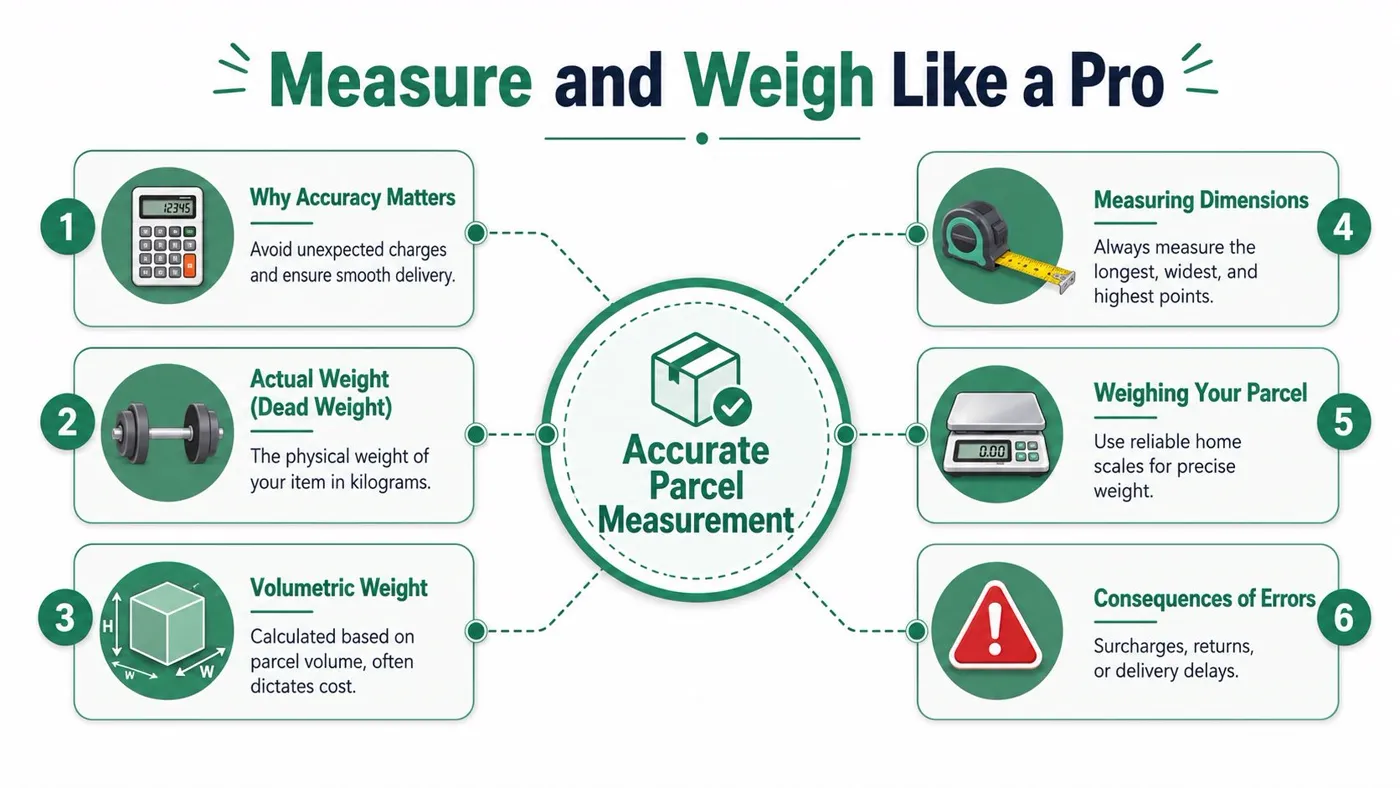
Most surcharge disputes come from one basic mistake. The sender measures the item, not the finished parcel. Couriers charge on the packed shipment that enters the network, not on the product before cardboard, corners, and cushioning are added.
Measure the parcel after packing
Always seal the parcel first. Then measure the longest point, the widest point, and the highest point. If the box bulges even slightly, measure the bulge. If a tube cap or edge protector extends beyond the carton, include it.
For a quick refresher on box dimensions and how trade packers usually record them, Packaging Panda has a useful guide on how to measure boxes.
Understand actual and volumetric weight
Couriers usually compare two figures:
- Actual weight, which is what the parcel weighs on the scales.
- Volumetric weight, which reflects the space the parcel occupies.
The standard formula is:
Length × Width × Height ÷ divisor
The divisor depends on the courier. Many use a divisor such as 4000 or 5000 for volumetric calculations. The important point isn't memorising one universal figure, because there isn't one. It's checking the divisor used by the service before booking.
A bulky but light shipment often gets priced on volumetric weight. That's why long boxes, bedding, furniture parts, and foam-filled products can cost more than their scale weight suggests. If the parcel is especially awkward, it helps to review examples of transparent mattress shipping costs, because mattress-style shipments show exactly how dimensions can dominate the quote even when the load isn't especially dense.
A simple check before booking
Use this three-step check:
- Weigh the sealed parcel on a reliable scale.
- Calculate volumetric weight using the courier's divisor.
- Compare both figures and expect the higher one to drive pricing.
If the quote looks too good for a big box, the volumetric check probably hasn't been done properly.
One more point matters. Re-measure after adding outer wrap, extra corner protection, or a second carton. Those final tweaks often tip a parcel into a different charge band. For anyone trying to keep large shipments predictable, measurement discipline saves more hassle than price-shopping a dozen services.
Navigating UK Courier Rules and Costs
A parcel can be packed perfectly, measured accurately, and still become an expensive headache if the service rules do not fit the carton. I see this most often with large boxes that are technically within the quoted limits but too weak for the handling pattern that service uses. A long double-wall carton sent through a budget drop-off route may clear the booking screen, then bow at the centre, catch on conveyors, or pick up a surcharge after a depot remeasure.
Courier choice starts with two questions. Can the box hold its shape through the service's handling method, and does the price still make sense once collection, weight banding, and oversize rules are included? If you need a quick refresher on the pricing side, how to calculate volumetric weight is still the right place to check the chargeable weight logic before comparing services.
Why carrier choice matters
“Large parcel” is not a shared UK standard. Each carrier sets its own limits for length, weight, combined dimensions, and how awkward parcels are handled in practice. A service may accept the measurements on paper but still be a poor fit for a carton that flexes, has a low crush strength, or needs more careful manual handling.
That trade-off gets missed in a lot of courier guides. They focus on published size caps and ignore structural integrity. For bulky goods, the safer option is often the carrier with slightly tighter limits but better handling consistency, especially if the box contains flat-pack parts, homeware, or anything heavy enough to shift inside the carton.
UK large parcel courier comparison 2026
The table below uses named UK services so you can compare real thresholds instead of vague service labels. Always verify the live service page before dispatch, because account terms and depot rules can differ.
| Courier | Example service | Max Weight | Max Length | Max Girth + Length | Collection Available? |
|---|---|---|---|---|---|
| Royal Mail | Royal Mail Tracked 48 | up to 20kg | up to 61cm | up to 150cm | Collection available on eligible bookings |
| Parcelforce | Parcelforce Express48 | up to 30kg | up to 2.5m | up to 3m | Yes |
| DPD | DPD Next Day | up to 30kg | up to 1.75m | up to 3m | Yes |
| Evri | Evri Standard / ParcelShop | up to 15kg | up to 120cm | up to 245cm | Drop-off standard, collection optional on some bookings |
| DHL parcel services | DHL Parcel UK | up to 25kg | up to 120cm | up to 300cm | Yes |
| Broker platforms | Example: service depends on selected carrier | carrier dependent | carrier dependent | carrier dependent | Collection or drop-off depends on checkout choice |
The useful detail is not only the top-line limit. It is where the pricing and handling model changes. A 12kg parcel at 110cm long can still be awkward enough that drop-off stops being practical. A 28kg carton may fit the service rules, but collection is usually the better choice because moving it through a shop counter or ParcelShop adds risk before the network even touches it.
Collection and drop-off costs are rarely as simple as they look
For lighter bulky parcels, drop-off can be cheaper if the carton is rigid, easy to carry, and well within the shop's acceptance limits. Once the parcel gets longer, denser, or harder to lift safely, collection often becomes the cheaper decision overall, even if the base rate is higher. That is because the hidden cost is not only the booking fee. It is staff time, failed acceptance, repacking after damage, and surcharge exposure when a parcel is forced into the wrong channel.
I use a simple rule. If the parcel is above 20kg, close to the service's maximum length, or packed in a carton that can flex under its own weight, compare collection first. The saving on a drop-off price often disappears after one failed handover or one damaged corner.
Operations teams handling repeat shipments can also cut costs using mobile proof of delivery when they need tighter control over collections, handovers, and claim evidence.
How to shortlist the right service
Use the parcel's physical behaviour, not just the published size band.
- Long and light items: Choose services with generous length limits and avoid weak cartons that can banana in transit.
- Heavy compact parcels: Check weight caps carefully and favour collection if the box is difficult to move safely.
- Bulky fragile goods: Prioritise consistent handling and stronger parcel tracking over the cheapest quote.
- Large boxes near the limit: Check whether the outer carton still holds its shape when lifted from the base and from the ends. If it twists or bows, use a stronger carton or a different service.
Cheap large-parcel delivery usually goes wrong through poor fit between the box, the handling route, and the charging rules. The right service is the one that suits the parcel's real structure, the actual weight tier, and whether collection or drop-off makes operational sense.
Booking Your Delivery and Avoiding Surcharges
A common failure point looks like this. The box is packed well, the item should travel safely, then the booking is done in a rush and the parcel gets priced again at the depot, rejected at collection, or billed for an extra handling fee no one expected.
Collection versus drop-off
Collection and drop-off are not interchangeable once parcel size climbs. Price tables often make them look close, but the operational cost changes fast across weight tiers.
DHL Parcel's large parcel delivery guidance shows how mixed the market can be. Collection is not always included in the headline rate, and length or weight thresholds can push a parcel into a different charging rule without much warning. That matters most with long cartons, borderline weights, and boxes that lose shape when they are carried by one end.
In practice, drop-off suits parcels one person can move safely, load cleanly into a car, and place on a counter without dragging or tipping. Collection usually makes more sense for heavier shipments, awkward dimensions, and cartons that are structurally sound on a pallet trolley or doorstep but vulnerable during an extra manual transfer. I have seen the cheapest drop-off quote become the most expensive option once the box is lifted twice more than necessary.
Booking details that trigger avoidable charges
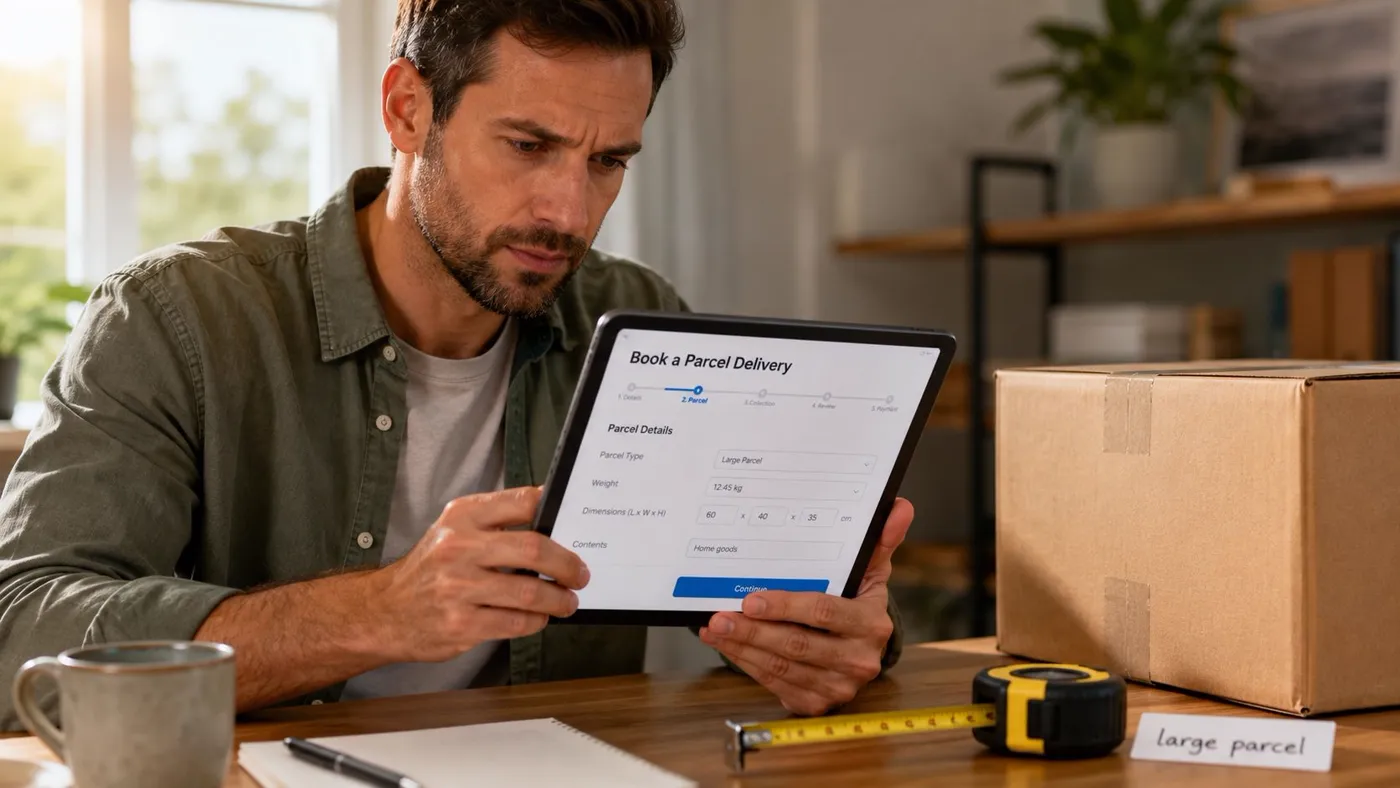
Small booking errors create expensive corrections later. Use the packed parcel details exactly as shipped.
- Enter final dimensions after sealing: Filled corners, extra tape, and top bulge can change the size band.
- Book the actual weight tier: A parcel near 10kg, 20kg, or 30kg needs a proper scale check, not an estimate.
- Match the service to the box shape: Long, flat, or irregular cartons often fall under separate handling rules.
- Check collection terms before paying: Some services price collection separately, others build it in only for certain parcel bands.
- Add clear access notes: Driver delays at flats, business parks, farm addresses, or gated properties often turn into rebooking fees.
Address details still need a clean final check, especially for large parcels. Redelivery is harder to arrange, storage charges arrive faster, and a bulky return to depot is far less forgiving than a small box.
Insurance and proof of delivery
Insurance should cover the full replacement job. That means the item, the packaging, the outbound carriage, and the labour to pick and pack it again.
Proof of delivery matters just as much with bulky shipments because disputes are harder to argue after the parcel has gone through several manual handovers. Teams shipping larger or higher-value orders can cut costs using mobile proof of delivery when they need cleaner collection records, handover evidence, and fewer customer service arguments.
Good booking discipline saves money because it prevents the avoidable problems that carriers charge for most often: misdeclared size, wrong service selection, failed collection, and preventable rework.
Your Final Pre-Shipment Checklist
At 4:20pm, large-parcel jobs often encounter issues. The carton is packed, the label is printed, the driver is due, and someone notices the box has started to bow at the base or the delivery postcode is one digit out. That last two-minute check often decides whether the parcel arrives cleanly or comes back with a surcharge, damage note, or failed delivery scan.
The last review before dispatch
For bulky consignments, structural integrity comes first. A box can be within the courier's size limit and still fail in transit because the board grade is too light, the base is unsupported, or the contents create pressure points at the corners. If the carton flexes when lifted from underneath, do not send it as packed. Rebox it, reinforce it, or reduce the void.
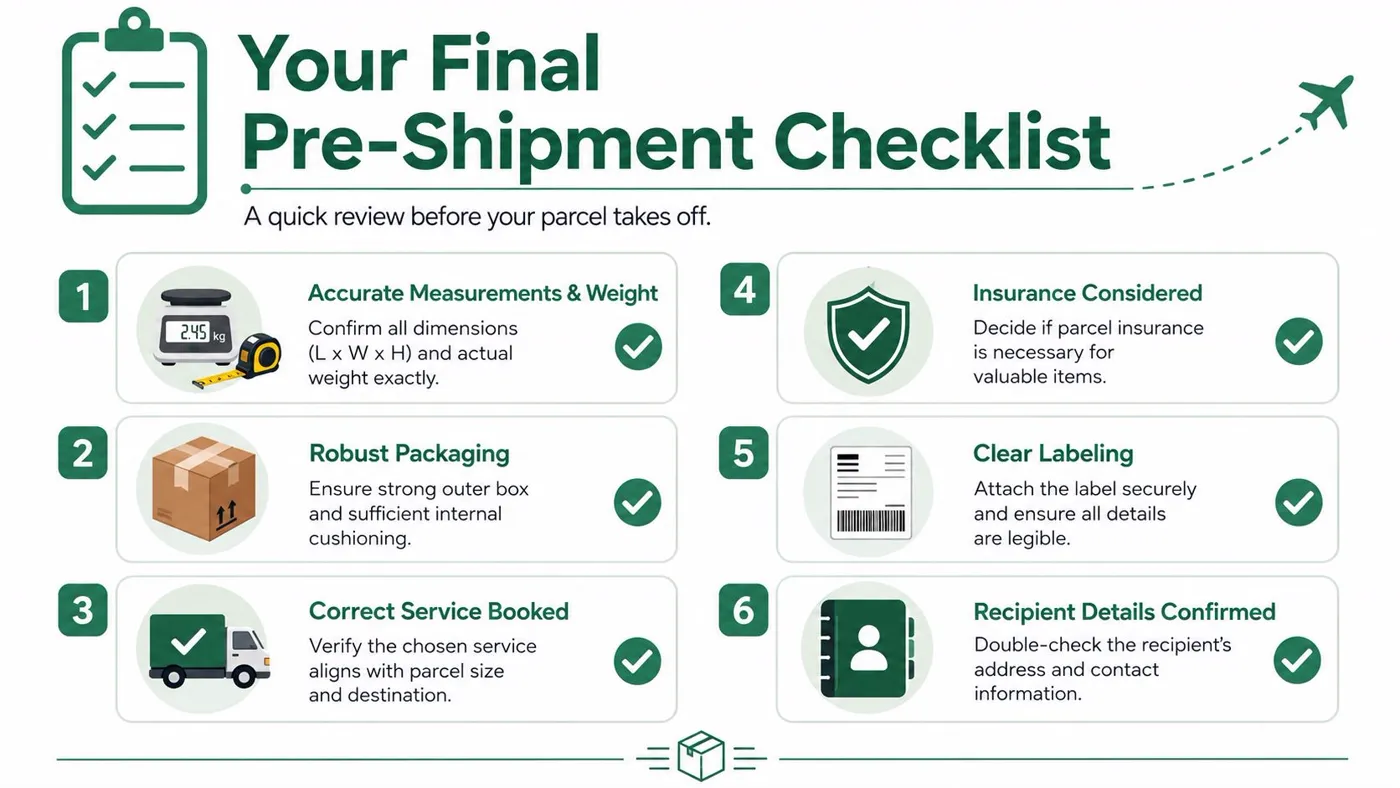
Use this final check before handover:
- Box strength checked: The carton suits the load, the base stays flat when lifted, and the sides do not bulge.
- Internal movement eliminated: Contents cannot slide into a corner, crush an edge, or punch through the outer wall.
- Dimensions confirmed after sealing: Measurements match the finished parcel, including bulges, overhang, and added edge protection.
- Weight verified on scales: The declared weight matches the packed parcel, especially near common pricing thresholds.
- Tape applied properly: Top and bottom seams are sealed fully, with extra reinforcement on heavier boxes.
- Label attached cleanly: The label is flat, scannable, and clear of seams, corners, and tape glare.
- Recipient details reviewed: Name, postcode, unit or building details, and contact number match the order exactly.
Address checks deserve more attention than they usually get. As noted earlier, first-attempt failures are common enough to be expensive, and address errors are one of the easiest causes to prevent. With large parcels, the cost is rarely limited to one missed delivery. It can also mean storage, manual handling, customer service time, and a second collection.
Read the label against the order after the parcel is sealed, not before. That is when the real dimensions, the final weight, and the actual delivery details are all in front of you.
Special cases worth checking
Some consignments need one more pass before release.
| Scenario | What to check |
|---|---|
| Northern Ireland delivery | Whether customs or movement documentation is required for the goods |
| Hazardous or restricted items | Whether the contents fall under dangerous goods or ADR-related restrictions |
| Rolled goods | End protection, crush resistance, and whether a tube suits the item better than a box |
| High-value products | Insurance cover, signature expectations, and proof-of-delivery requirements |
One last point on costs. Collection and drop-off are not interchangeable once parcels get larger or heavier. A service that looks cheaper at booking stage can become poorer value if collection is added separately, or if the parcel sits in a weight band where depot drop-off is accepted but home collection triggers a higher charge. Check that part before dispatch, especially for boxes near the next pricing tier.
If regular dispatch includes bulky cartons, rolled goods, or heavy e-commerce orders, Packaging Panda is one practical option for sourcing shipping materials such as boxes, tapes, protective packaging, and bespoke formats that fit UK fulfilment workflows.