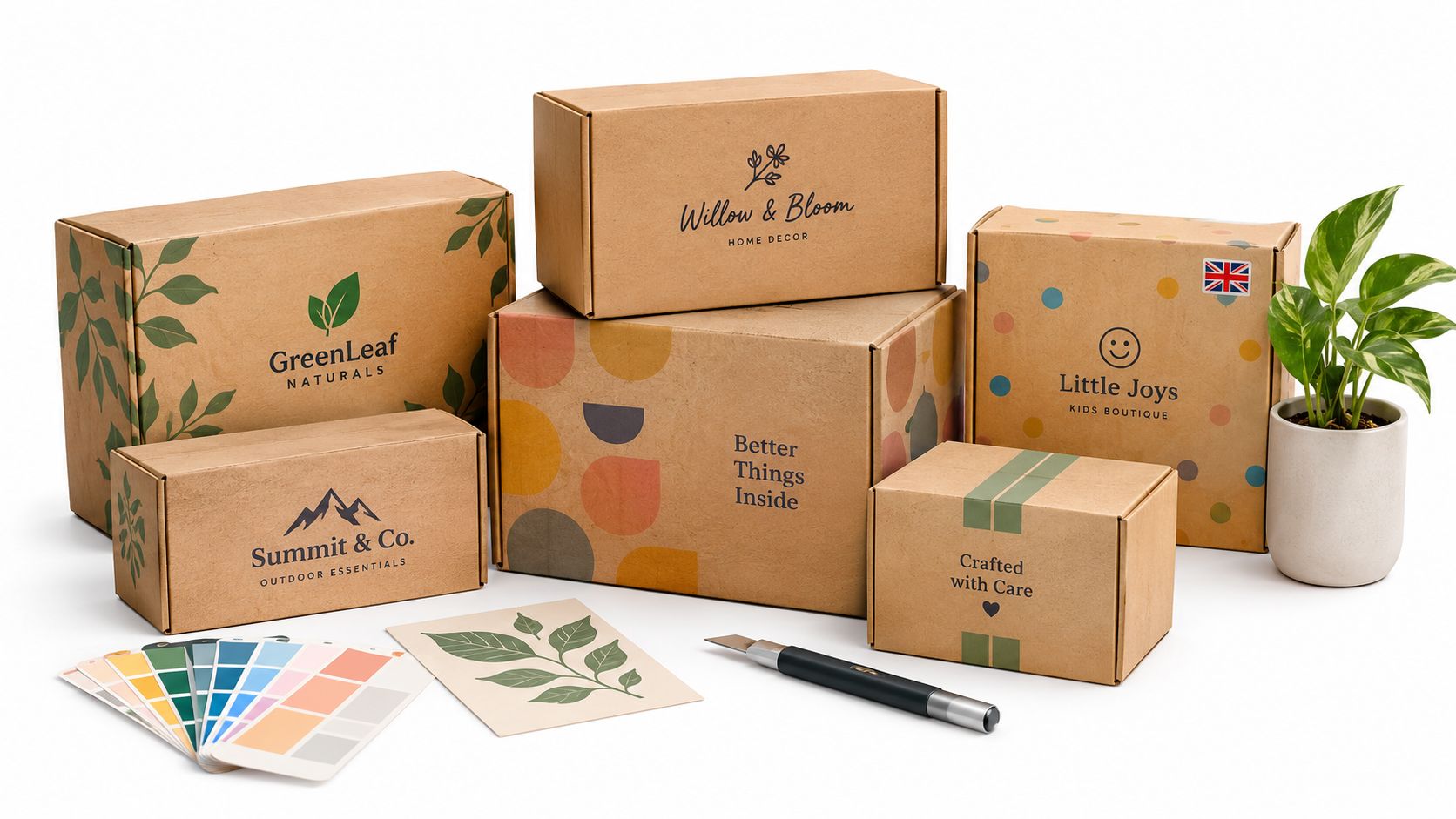
Cardboard Counter Display Boxes UK: Buyer's Guide

The mistake most retailers make with counter displays is treating them like decoration. A neat mock-up can still fail at the till if it blocks the queue, empties out badly, or gets ignored by staff who are trying to keep people moving. The right cardboard counter display boxes UK buyers choose earn their space because they fit the counter, fit the product, and still look purposeful after the first rush of customers has taken a few packs.
Table of Contents
- Why Counter Display Boxes Make or Break Impulse Sales
- Understanding Counter Display Unit Formats and Terminology
- Choosing the Right Board Grade and Flute Profile
- Sizing Your Display for Real Retail Environments
- Proving Profitability Before Committing to Production
- Navigating Custom Print and Branding Options
- Ordering Logistics and Supplier Selection Criteria
- Maximising Merchandising Impact Through Strategic Placement
Why Counter Display Boxes Make or Break Impulse Sales
A pharmacist with a busy front counter does not have room for packaging that behaves badly. If a display leans into the card reader, flaps open at the wrong time, or looks half-empty after the first hour, staff stop trusting it. Once that happens, the unit is usually pushed aside, and the brand loses the very slot it paid to secure.
That is why the physical build matters as much as the artwork. The strongest counter displays do three jobs at once, they present the product cleanly, protect the stock, and make replenishment easy enough that staff will keep topping them up. A unit that is awkward to refill becomes dead weight fast, especially in convenience, pharmacy, and beauty channels where every square centimetre of counter space is argued over.
Practical rule: if a CDU is hard to restock by hand, it will not stay full for long.
A good retail buyer also notices what happens when the stock line drops. Some displays look brilliant when packed, then go thin and shabby once a few units have sold through. That visual decline kills momentum, because customers read emptiness as low demand, old stock, or both.
The better approach is to specify a unit that still looks intentional when part-filled, and that keeps product facing forward without constant intervention. That is where well-built counter display units start to earn their keep, because they support sell-through instead of adding friction at the till.
For a related packaging format that uses the same shelf-ready logic, Packaging Panda's shelf ready packaging guide is a useful reference point for how retail presentation and operational handling overlap.
Understanding Counter Display Unit Formats and Terminology
In UK packaging, CDU and CTU are used interchangeably for a counter display unit or counter top unit, a small stand placed at or near the point of purchase. That matters because the wording can change from supplier to supplier, but the commercial purpose stays the same. The unit is there to sell at the counter, not to store inventory in the back room.
Know the format before you brief the supplier
A CDU can be a simple open-front tray, a tiered organiser, a gravity-fed dispenser, or a branded stand with a header panel. The right option depends on how customers take the product and how much control the retailer wants over facing and refill. Counter displays are often built bespoke from corrugated cardboard, solid board, or folding carton, so the structure should match the job rather than force the product into a one-size-fits-all shell (Smurfit Kappa).
A useful way to think about the difference is this, a CDU is like a compact shop fixture, while a floor stand is a freestanding gondola. One lives in the high-pressure checkout zone, the other works further out in the store. That distinction affects everything from board grade to height limits to how much time staff will tolerate during replenishment.
Counter displays can also act as secondary packaging, which makes folding behaviour and presentation finish just as important as structure.
That dual role is why terminology needs to be precise. If the product sits in the same box that does the display work, the carton has to protect the stock during handling and still present it properly on the counter. Some buyers even compare a compact CDU to a premium presentation box, which is where products such as Wholesale Hat Boxes become relevant as a reference for retail, gifting, and display formats in round or finished presentation styles.

Choosing the Right Board Grade and Flute Profile
The board choice decides whether a display survives the route from warehouse to till and still looks sharp after handling. For cardboard counter display boxes UK retailers usually get the best balance from E-flute, because it keeps the unit slim, prints well, and has enough crush resistance for countertop use. A UK supplier notes that E-flute suits inner containers, presentation boxes, and smaller countertop displays, while BC double-wall is better when stacking strength matters more than a neat print face (W. H. Skinner).
Match the board to the product, not the artwork
Lightweight confectionery, cosmetics, and impulse accessories usually do not need a heavy board build. They need a printable face, a small footprint, and a shape that does not bulge when filled. E-flute or thin card is normally the right starting point for that brief, because it keeps the display tidy and commercially efficient.
Heavier products are different. If the unit sits in storage before deployment, gets moved around frequently, or carries dense stock, a stronger double-wall structure is safer. BC double-wall adds more resistance to burst and compression, which reduces deformation and load creep when a display spends time in transit or back-of-house circulation.
Use the print surface as part of the buying decision
Solid board and folding carton options can make sense where presentation is the priority and the product load is light. They often give a cleaner, more premium feel, but they are not automatically the right answer for every retail job. The key trade-off is simple, better print does not help if the unit sags under product weight.
The UK market has enough manufacturing depth to support that kind of choice. IBISWorld estimates the broader cardboard packaging and paper bag manufacturing industry revenue at £6.4 billion in 2026, with 377 businesses in the UK, which supports short-run custom production and fast replenishment for retailers (IBISWorld). That scale is one reason buyers can specify a structural grade that fits the product rather than settling for whatever happens to be easiest to source.
For a deeper look at custom print choices across board formats, Packaging Panda's custom cardboard display boxes guide sits in the same practical territory as this discussion.

Sizing Your Display for Real Retail Environments
A display that looks tidy in artwork approval can still fail at the till if the dimensions clash with the counter. UK counter displays often sit in a practical size band of 40 to 50 cm high, 30 to 40 cm long, and 20 to 25 cm wide, because that keeps them visible without swallowing the working surface. A published UK product specification shows a smaller example at 21.4 cm × 18.2 cm × 47.6 cm, with shelf footprints of 210 mm × 140 mm on the top shelf and 210 mm × 180 mm on the bottom shelf (LD Display).
Start with the counter, not the carton
That sizing works because it respects checkout realities. Operators still need sightlines to the customer, space for a card machine, and room to slide products across without knocking the display sideways. A unit that is too tall can block visibility, while one that is too deep can sit awkwardly over the till edge and create friction during service.
Working backwards from the product carton size is the safest way to brief a supplier. Once the pack footprint is known, the shelf footprint can be set around it, instead of forcing the SKU into an arbitrary format. That also helps control unit load and makes facings more predictable, which matters when replenishment happens during a busy rush.
Compare display shapes against live store conditions
| Display Type | Overall Dimensions (H×L×W) | Shelf Footprint | Best For |
|---|---|---|---|
| Compact countertop CDU | Small, store-specific | Tight pack footprint | Checkout counters with limited depth |
| Standard retail counter display | 40 to 50 cm high, 30 to 40 cm long, 20 to 25 cm wide | Sized to product carton | Convenience, pharmacy, beauty |
| Tall branded unit | 1605 mm high, 510 mm wide, 250 mm deep | 260 mm shelf space height, 60 mm shelf lip, 420 mm header height | Merchandising with stronger vertical presence |
One UK supplier specification shows a tall counter display at 1605 mm high, 510 mm wide, and 250 mm deep, with 260 mm shelf space height, 60 mm shelf lip, and 420 mm header height (HW Direct). That kind of example proves the point, dimensions are not a guess, they are a merchandising decision that has to fit a defined footprint.
A display should clear the checkout, not compete with it.
Proving Profitability Before Committing to Production
A CDU only makes sense if it pays back the space it occupies. Too many buyers approve artwork because the unit looks strong, then discover later that the issue is whether the display shifts enough incremental stock to cover print, board, and handling. The better question is not whether it looks good, but whether it earns the counter space.
Test the commercial case before the artwork is final
The easiest mistake is to assume every display will perform once it is branded. It won't. The product needs enough margin, enough turnover, and enough visibility to justify a separate unit, especially where the retailer already has a shelf placement in play. That is why profitability has to be tested before production is locked.
A practical in-store trial should check more than sell-through. Full-load stability matters, but so does the half-empty look, because that is the stage where many displays start to lose their visual pull. Grab-and-go ergonomics also matter, since a display that slows customers down can cause queue friction, and staff refill time matters because a box that takes too long to restock is one that will be neglected.
Use a simple trial checklist
- Incremental sales lift forecast. Estimate the extra units needed to justify the display's cost.
- Unit production and fulfilment cost. Include print, board, packing, and delivery.
- Retailer placement cost. Factor in any slotting fee or paid space.
- Display lifespan in store. Judge how long it will stay attractive under real handling.
- Break-even sales volume. Compare expected sell-through against the total display cost.
The planning logic is the same whether the product is confectionery, cosmetics, or accessories, but the display behaviour can differ sharply once stock drops. A unit that still looks strong when half-empty is usually the one worth repeating, because it protects the brand image right through the sell-through curve. That practical testing mindset is the gap many buyer's guides leave open, even though it is the difference between a clever idea and a profitable format.

Navigating Custom Print and Branding Options
Print turns a functional CDU into a retail asset, but only if the artwork and board spec work together. Flexographic print suits simpler branded runs where cost control matters, while digital print helps with shorter runs and faster artwork changes. Litho-lamination makes sense when the finish needs a more premium face, but it should be chosen for the retail job, not just for appearance.
Prepare artwork for corrugated surfaces properly
Artwork on a flat screen rarely translates cleanly to a textured board without planning. Registration, colour drift, and panel alignment all need checking before the first production run. Physical proofs are worth the extra time because they show how the design behaves once it is wrapped around folds, scores, and cut lines.
The ordering process also needs realistic expectations on volume and timing. Bespoke runs from Packaging Panda are built around made-to-order work with minimum runs from 500 units, which is the right scale for a branded retail test or a repeatable rollout rather than a one-off mock-up. Packaging Panda's custom printed cardboard boxes guide sits in the same lane for buyers who want to understand print and file preparation in more detail.
Balance finish against budget and retail use
A glossy finish can lift visibility in cosmetics or gifting, while a matte finish can feel calmer and more premium. The wrong finish, though, can fight the lighting at the checkout or make the branding harder to read from a standing position. The goal is not to create a poster, it is to make the product identifiable in seconds.
For buyers who also need artwork discipline across non-packaging formats, the acrylic sign design and ordering tips from Quote My Wall are a useful reminder that print quality starts long before the press run begins. The same principle applies here, because file setup, proofing, and realistic colour expectations decide whether the display lands well on the shop floor.
Ordering Logistics and Supplier Selection Criteria
Price matters, but so does whether the supplier can deliver the right box on the right day without making the process painful. In the UK, bespoke counter display orders often sit around a 500-unit minimum, and lead times can stretch depending on board choice, print method, and seasonal demand. That makes supplier reliability just as important as unit cost.
Judge suppliers on operational support, not just quotes
A supplier who can help with structure, artwork checks, and sampling saves more money than a cheap quote that arrives late or needs redesigning. Sample turnaround is a strong indicator of how the full job will be handled, because it shows whether the team understands the retail brief or just processes files. Delivery reliability matters too, especially for brands that need repeat runs to keep a campaign alive.
UK-based suppliers have a practical advantage when the display is needed quickly. Next-day delivery windows are valuable for urgent replenishment, but they only help if the supplier already understands local retail constraints, shelf space, and checkout conditions. That is where short-run flexibility and repeat-order consistency become more useful than a broad but generic catalogue.
The right supplier is the one who can repeat the same display cleanly, not just make the first sample look good.
Packaging Panda fits into that supplier conversation as one option for made-to-order packaging with bespoke print and standard UK service features, including quick dispatch windows and volume pricing across its range. Buyers should still compare it with other suppliers on samples, lead times, and communication, because the best fit depends on how often the display will be reordered and how tightly the retail rollout is timed.
Maximising Merchandising Impact Through Strategic Placement
A good CDU placed badly underperforms. High-traffic spots such as checkout queues, entrance zones, and junction points create different buying behaviours, so the display structure has to match the location. A small, easy-grab unit works best where customers are waiting, while a slightly taller branded piece can help when the product needs more visual presence near the entrance.
Place the display where customers already slow down
A UK packaging guide notes that cardboard counter displays can serve a dual role as secondary packaging and counter display, and recommends high-traffic areas such as the entrance or checkout for maximum visibility and interaction (CEF Box). That is useful because it reflects how these units are used, not just how they look in a sample photo. The most effective placements are usually the ones where customer hands are already free and the product can be picked up without hesitation.
The routine matters as much as the position. Stock rotation should keep the front line full, face-forward, and tidy, because a messy display loses authority quickly. Staff also need simple replenishment instructions, especially in busy trading periods when a display can fall out of shape between till interactions.
For a broader sense of how merchandising hardware supports that job, the retail stands guide from Display Guru is a useful companion read, especially where a brand is deciding whether a counter unit or a larger stand will do the better selling job.
Keep the unit fresh through the trading week
- Checkout queue end-cap. Place fast-moving items where waiting customers can grab them easily.
- High-traffic junction points. Use corners and crossings where attention naturally shifts.
- Adjacent to complementary products. Pair the display with items customers already intend to buy.
- Weekly stock and condition check. Replace crushed, bent, or faded units before they drag down the brand.
- Train staff on display purpose. A short brief keeps refills consistent during busy shifts.
Seasonal pressure changes the equation again. Christmas trading, for example, raises the need for displays that can survive heavier footfall, faster depletion, and less careful handling. The brands that win tend to use a clear placement plan, a simple refill routine, and a display structure that still looks intentional when the stock line starts to fall.
Packaging Panda supplies made-to-order packaging with UK fulfilment, including bespoke print and practical board choices for retail use. If you need cardboard counter display boxes UK buyers can run on the shop floor, visit Packaging Panda to discuss a display that fits your product, your counter space, and your replenishment cycle.