Custom Cardboard Display Boxes: A UK Buyer's Guide (2026)
A product can be good, well priced, and properly stocked, then still disappear on shelf. That's the reality many UK brand managers run into when a launch moves from a sales deck to an actual supermarket aisle, pharmacy shelf, or convenience counter. Standard outer packaging protects the product. It rarely does enough to stop a shopper.
View our custom cardboard display boxes →
That's where custom cardboard display boxes earn their place. In practice, they're part packaging, part merchandising fixture, and part logistics problem. If the structure looks sharp but fails in transit, the campaign wastes money. If it survives distribution but ignores retailer handling rules, stores won't want it. If it meets compliance but uses the wrong finish or too much material, it can become expensive and harder to recycle than it needs to be.
In the UK, the right answer usually sits in the middle. The display has to look good, ship flat or efficiently, assemble quickly, hold its load, fit distribution constraints, and support sustainability targets without becoming over-engineered.
Table of Contents
- Why Your Product Needs More Than Just a Shelf
- Choosing Your Display Format Counter Shelf or Floor
- Selecting the Right Cardboard Grade and Material
- Mastering Print Finishes and Visual Appeal
- Structural Design and Dieline Considerations
- Designing for Sustainability in the UK Market
- Navigating Costs MOQs and UK Supplier Logistics
- Frequently Asked Questions
Why Your Product Needs More Than Just a Shelf
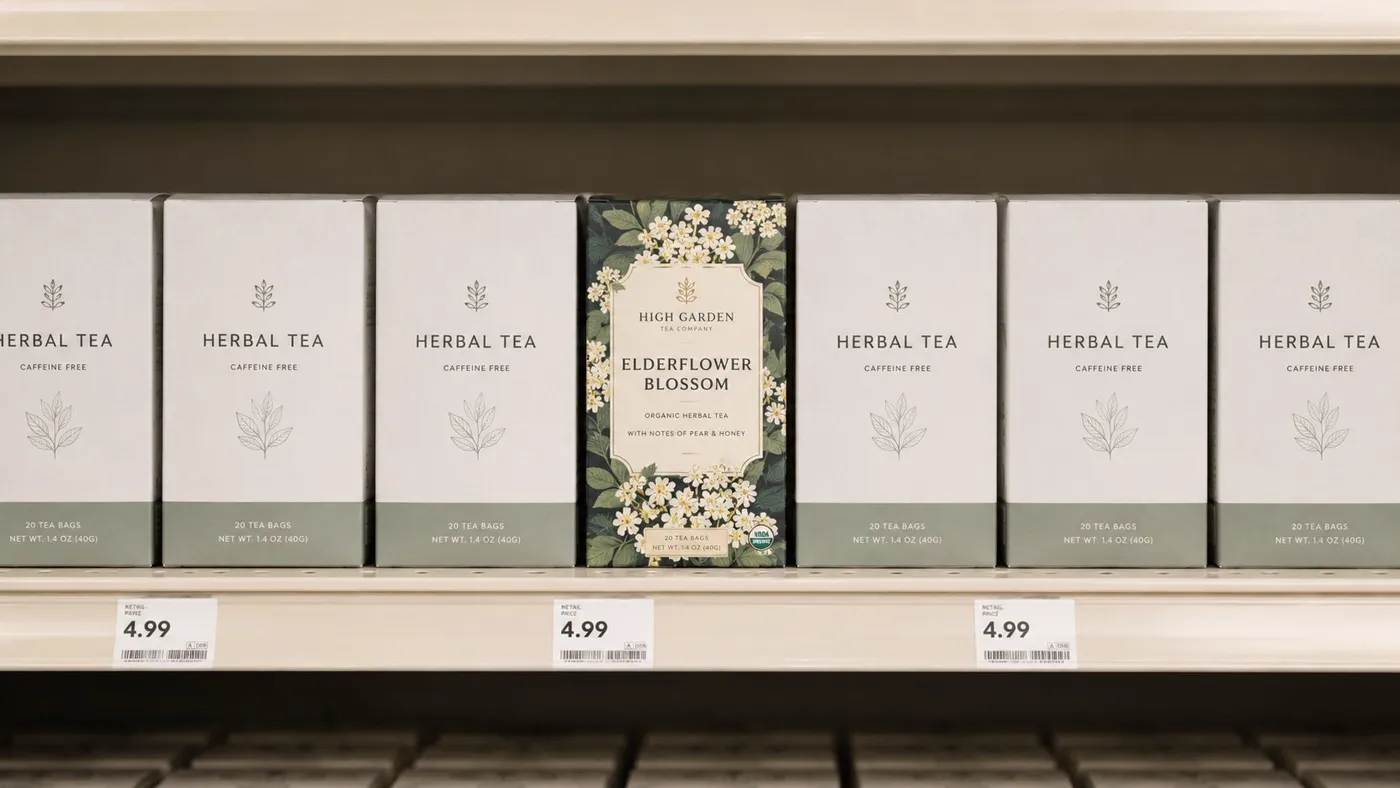
A shelf only gives a product a place to sit. It doesn't give it a reason to be noticed.
That matters because in-store attention is bought and fought for. UK retailers and FMCG brands allocate approximately £1.2 billion annually to in-store displays, with cardboard units representing over 40% of this spend, which shows how central display packaging has become for checkout and end-aisle visibility in the UK market, according to this retail display overview. Brands don't keep spending at that level on cardboard displays unless they solve a real commercial problem.
A good display box does three jobs at once:
- Interrupts the shopper's eye before the product gets lost among similar pack formats
- Makes selection easier by presenting the item at the right angle, quantity, and height
- Carries the brand story at the exact point where a purchase decision happens
For smaller items, that can mean a simple counter unit near the till. For seasonal lines, it can mean a freestanding unit that creates its own selling space. For shelf-based ranges, it can mean a tray or shelf-ready format that improves facings and keeps replenishment tidy.
Practical rule: If the product needs to win attention in under a few seconds, the outer pack alone usually isn't enough.
Display structure also needs to work with store behaviour. Staff need to refill it quickly. Shoppers need to understand it instantly. The format should guide the hand, not just decorate the aisle. Brand teams that want a stronger foundation for those decisions should understand retail visual merchandising, because display success depends as much on placement and shopper flow as on artwork.
Choosing Your Display Format Counter Shelf or Floor
The wrong format creates friction before the campaign even starts. Products don't fit properly, stores can't place the unit where planned, and replenishment becomes awkward. The right format usually becomes obvious when the display is matched to retail location, product weight, and campaign purpose.
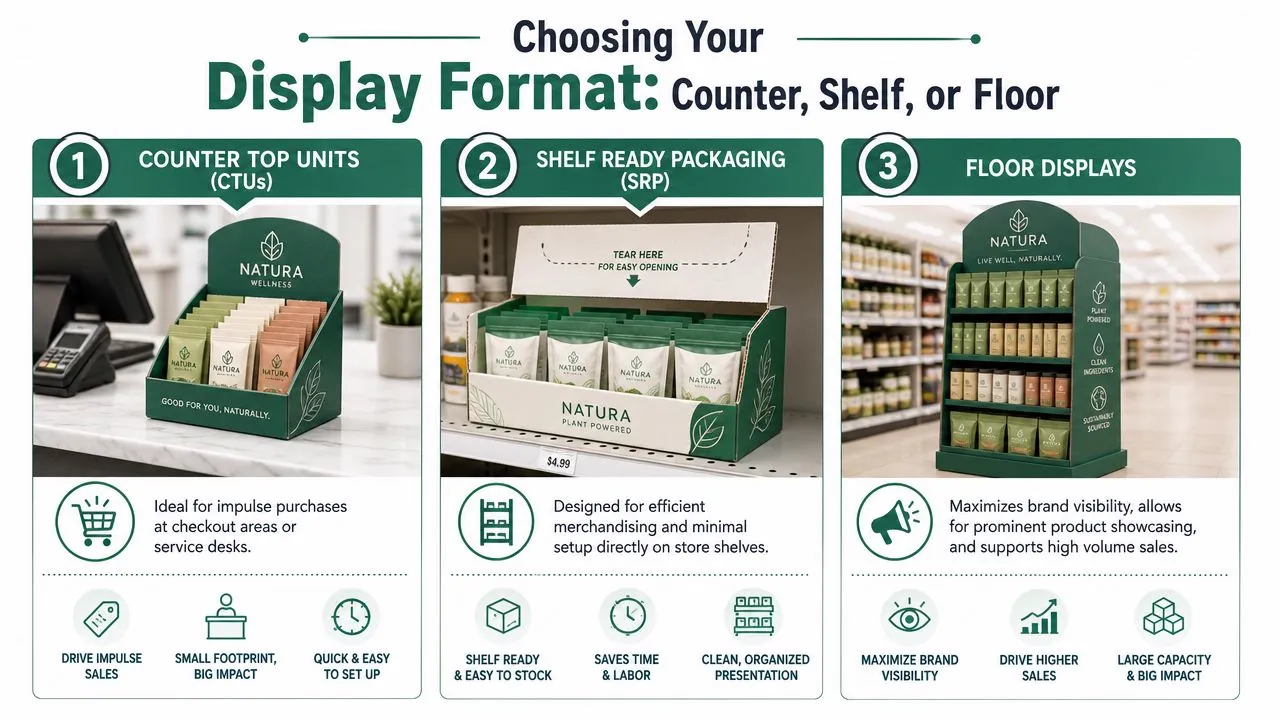
Counter top units
Counter top units, often called CTUs, work best when the product is small, easy to understand, and suitable for impulse purchase. Think confectionery, travel sizes, sachets, lip balms, batteries, or grab-and-go wellness items. Their strength is proximity to payment points and service counters.
They fail when brands try to force too much stock into a small footprint. That usually leads to bowed side walls, poor product presentation, or a unit that blocks staff interaction at the till.
Best for:
- Impulse-led products that don't need long explanation
- Compact packs that can be front-faced neatly
- Short campaigns where quick setup matters more than long-term durability
Shelf-ready packaging
Shelf-ready packaging sits between shipping carton and display fixture. It's designed to move through distribution, open cleanly, and go straight onto shelf with minimal handling. For grocery, pharmacy, and convenience retail, this format often works better than a more elaborate display because it respects how stores replenish stock.
The practical advantage is labour. Staff remove the lid or perforated front, place the tray, and start selling. The practical risk is poor opening performance. If the tear line is messy, the front lip rips, or the graphics are hidden once opened, the pack looks unfinished on shelf.
A lot of retail products fit this route better than a full FSDU. Even categories that also use presentation packaging, such as Wholesale Hat Boxes, still benefit from shelf-ready thinking when ranges need organised retail display and straightforward handling.
Floor standing display units
Floor standing display units, or FSDUs, are for visibility first. They suit promotions, new product launches, seasonal pushes, and multi-SKU ranges that need their own destination in-store. When they work, they create space a shelf alone can't provide.
When they don't work, the problems are expensive. Weak shelves sag, headers lean, and the whole unit can feel unstable once partly depleted. Floor displays demand more structural discipline than most first-time buyers expect.
A floor unit should never be approved from artwork alone. If the loaded sample feels uncertain in the hand, it will feel worse after distribution and store handling.
A simple format choice test
Use this quick filter before briefing a supplier:
- Where will it sit? Till point, shelf, aisle, or promotional area.
- How heavy is the loaded display? Not just one product, but the full stock weight.
- Who replenishes it? Store staff need speed and simplicity.
- Is this a launch, an always-on line, or a short promotion?
- Does the display need to travel as a shipper, a fixture, or both?
If the answer is impulse and compact, choose counter. If the answer is operational shelf efficiency, choose shelf-ready. If the answer is campaign theatre and volume, choose floor.
Selecting the Right Cardboard Grade and Material
Material choice decides whether a display survives real retail use or only looks convincing in a mock-up. The board is the working structure. Print sits on top of it, but strength, fold quality, edge crush, and assembly behaviour all start with the grade.
Start with the job the display has to do
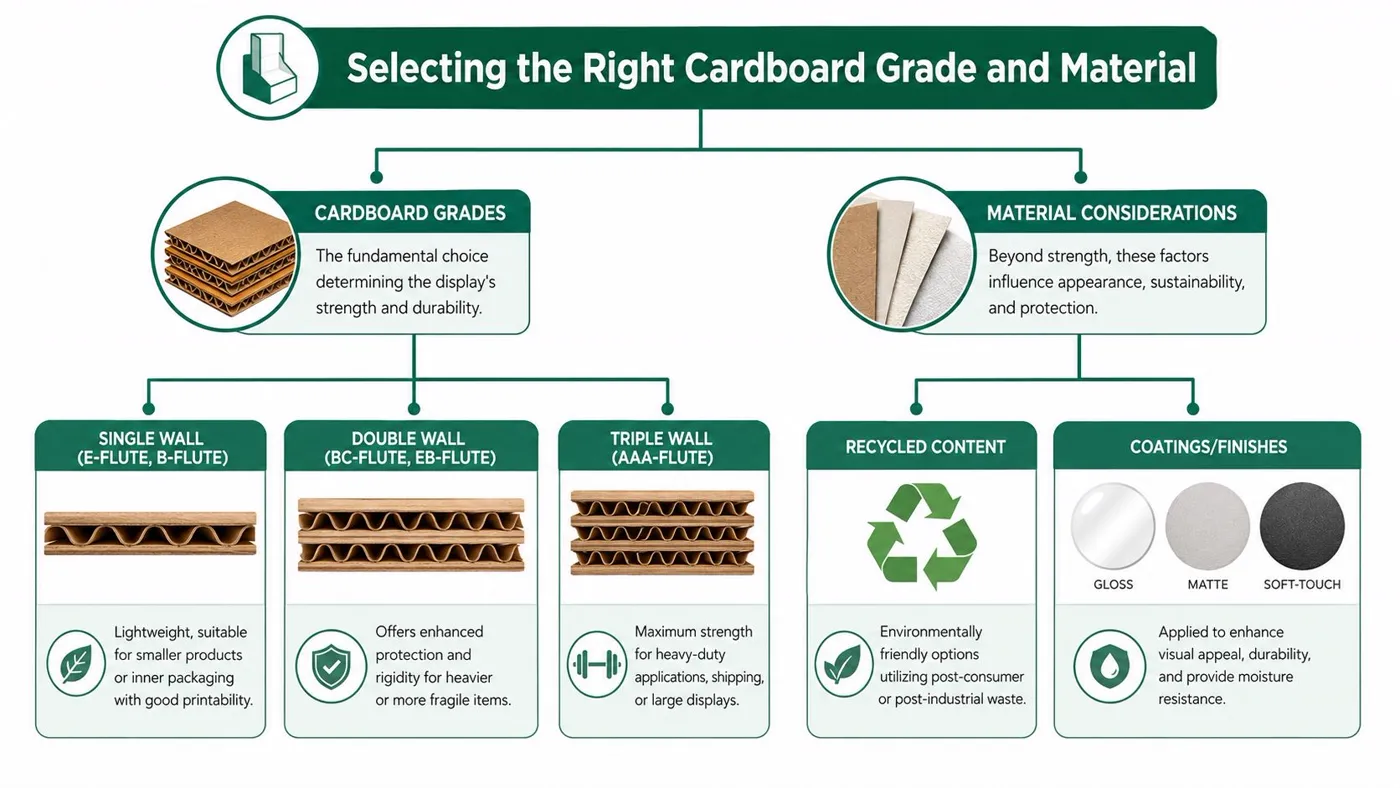
UK suppliers typically recommend E-flute for counter displays because it offers a smoother print surface and handles retail contact well, while B-flute is preferred for heavier shelf-ready displays needing to hold 3 to 5 kg of product and withstand stacking in distribution centres, according to this guide on display box materials.
That distinction matters in practice. E-flute gives cleaner graphics and a neater edge for smaller displays. B-flute gives more structural confidence when weight and distribution handling increase. Choosing the wrong one usually shows up fast. A fine flute under a heavy product load starts to fatigue. A heavier flute on a small premium display can make the unit look clumsy.
Cardboard Flute Profile Comparison
| Flute Type | Approx. Thickness | Key Characteristics | Best For |
|---|---|---|---|
| E-flute | Approx. 1 mm | Smooth print surface, compact structure, good for crisp folds and lighter retail handling | Counter displays, smaller branded units, lighter products |
| B-flute | Approx. 2.5 to 3.0 mm flute height | Better load support, stronger feel, more suitable for stacking and heavier contents | Shelf-ready packs, PDQ formats, heavier displays |
| Double wall options | Thicker than single wall | Added rigidity and protection, but more material and weight | Select heavy-duty applications where single wall won't hold up |
Board choice affects more than strength
Liner quality changes how the display prints, scuffs, and presents on shelf. Recycled board can support sustainability goals well, but it still needs the right surface for the artwork. A premium cosmetic launch with dense colour areas may need a cleaner print face than a transit-focused grocery tray.
The same applies to coatings. A finish that improves rub resistance may also affect recyclability or cost. A heavy coating can solve one problem and create another, particularly when the display only needs to last a short campaign window.
For brands comparing general board options before moving into a custom specification, Packaging Panda's range of cardboard boxes shows the broader category of corrugated and paper-based formats available in UK supply.
A sensible material brief should include:
- Loaded product weight across each shelf or tray
- Store environment such as counter use, shelf use, or aisle traffic
- Print requirement from simple branding to high-fidelity graphics
- Expected display life so the board isn't overbuilt
- Recycling target including preference for lighter single-wall solutions where feasible
Mastering Print Finishes and Visual Appeal
Graphics sell the first glance. Structure sells the second. Both have to work together.
A common mistake is spending heavily on artwork effects before checking what the board and retail setting will support. Under bright store lighting, subtle details can disappear. In convenience retail, shoppers often see the display from an angle and at speed. That means clarity usually beats decorative complexity.
Print method should follow run length and artwork needs
Digital print suits shorter runs, artwork variation, and faster revisions. It's useful for pilot campaigns, retailer-specific versions, and seasonal work where the brief may change late. It also reduces the pain of holding obsolete printed stock if packaging updates are likely.
Litho-laminated print tends to make more sense where the volume is higher and brand finish is tightly controlled. It can deliver a more polished result, but the extra process steps need to justify themselves commercially. For many cardboard displays, that only pays off when the campaign scale is large enough or the product margin supports the finish.
One practical discipline helps more than any finish choice. Before artwork approval, brand teams should review bleed, safe areas, image resolution, and cut-line interaction properly. File errors on a display unit don't just spoil a panel. They can cut through logos, text, or key product messaging. A useful checklist is File Studio's guide to File Studio print preparation, especially for teams handling artwork in-house.
Finishes should support the brand not fight the format
Matt lamination can create a restrained, premium appearance. Gloss can add punch to brighter consumer goods and high-contrast designs. Spot UV works best when used sparingly on a focal element such as a logo or product image.
What doesn't work is piling on effects because each one looks attractive in isolation. Retail display packaging is viewed from a distance first. If the finish muddies the hierarchy of information, the display becomes harder to shop.
Premium doesn't always mean more finishes. Premium often means fewer elements used with more control.
A sound print brief usually answers four questions:
- What must be visible from two or three steps away?
- Which panel faces the shopper first in store?
- Will the finish scuff during packing and replenishment?
- Does the visual treatment still look good when the display is half empty?
The strongest display graphics tend to be disciplined rather than busy. Clear brand blocking, simple calls to action, and a finish that matches the category will outperform decorative clutter in most UK retail environments.
Structural Design and Dieline Considerations
Most display failures start long before production. They begin in the dieline.
The dieline is the working blueprint for cuts, folds, tabs, lock points, shelves, and assembly logic. If it's poorly resolved, no amount of attractive print can rescue the finished unit. A custom cardboard display box has to stand up, hold stock, survive movement, and still look intentional once retail staff assemble it on a busy shop floor.
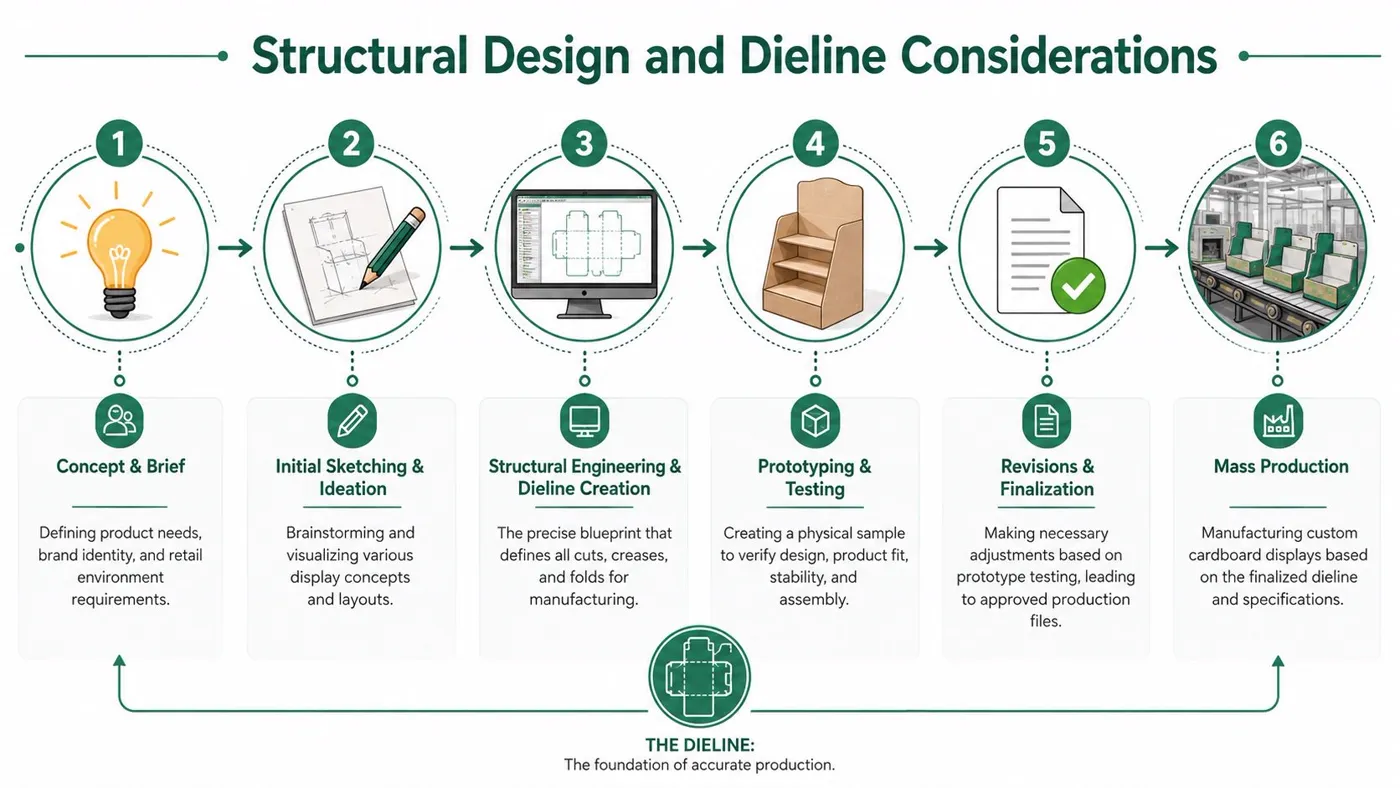
The dieline decides whether the idea works in real life
Good structural design starts with simple questions. How does the unit lock? Where does the weight sit? Can one person assemble it correctly without tools? Is the front lip low enough to show product but high enough to retain it?
A display should also degrade gracefully. That matters more than many buyers realise. A unit often looks strongest when fully loaded, but the true test comes after customers remove stock. Shelves still need to hold shape. Headers should remain upright. The footprint should still feel stable.
Design for stores and warehouses not just renders
For UK retail, displays often need to fit within a 1,200 mm × 1,000 mm pallet footprint. A floor display that uses that pallet space efficiently without overhang is more likely to pass stability expectations and move cleanly through distribution networks.
That single requirement changes many design decisions:
- Base dimensions need to align with pallet and transit handling
- Height ambitions should be tempered by stability and top-heaviness
- Shelf depths must suit product weight and shopper reach
- Assembly sequence should be obvious for retail staff with limited time
A structurally smart unit also avoids unnecessary reinforcement. Too much internal board can make the display harder to recycle, slower to assemble, and more expensive to ship. Too little reinforcement causes sagging or collapse. The balance usually comes from prototyping, not guessing.
If a display needs a complicated instruction sheet, the structure probably needs simplifying.
Retailers also care about safety. Displays in compact UK stores can't create trip hazards, lean into walkways, or become unstable after replenishment. Practical engineering means keeping the centre of gravity sensible, using lock tabs that reliably hold under live conditions, and checking that product removal won't distort the frame.
The strongest briefs include a physical sample review with real product loaded inside. Flat plans and 3D visuals are useful, but they don't show how the board behaves after handling, stacking, and repeated customer contact.
Designing for Sustainability in the UK Market
Sustainability decisions in display packaging aren't just about choosing cardboard over plastic. In the UK, they also involve material reduction, recycled content, recyclability in practice, and compliance expectations from retailers that have become much more specific.
According to WRAP-related analysis cited in this overview of custom cardboard displays, major UK retailers pushed suppliers between 2016 and 2021 to increase post-consumer recycled content in promotional displays from under 50% to over 75% and reduce average box weight by up to 22%. That pressure has changed design briefs in a very practical way. Buyers now have to think about board weight, recycled content, and format efficiency much earlier in development.
What UK buyers should specify early
A sustainable display brief should cover more than “make it recyclable”. That phrase is too loose to guide production properly.
Instead, specify points like these:
- Recycled content target so suppliers know whether the brief favours higher post-consumer content
- Material minimisation so the structure isn't overbuilt
- Ease of separation if the display includes inserts, headers, or non-board components
- Ink and finish restraint where heavy coverage or added layers may complicate recovery
- Campaign duration so the board is matched to actual use rather than imagined worst-case abuse
For brands already sourcing broader sustainable formats, Packaging Panda's eco packaging range is one example of how UK suppliers categorise recyclable and lower-impact packaging options.
Sustainability gets harder when marketing adds extras
Projects often drift off course when marketing teams ask for metallic effects, plastic windows, heavy lamination, or complex glued assemblies. Each addition may be defensible on its own. Together, they can make a display heavier, harder to flatten, and less straightforward to recover after use.
There's a useful lesson from adjacent sectors such as exhibition booth design, where temporary structures also have to balance visual impact, transport practicality, and material efficiency. The principle carries over. The most responsible design is rarely the one with the most features. It's the one that delivers the selling job with the least avoidable waste.
A better sustainability question is this: what can be removed without harming performance?
That often leads to stronger outcomes. Lighter board where structure allows. Fewer mixed materials. Simpler assembly. Cleaner end-of-life handling. In the UK market, those choices increasingly align environmental sense with retailer expectations.
Navigating Costs MOQs and UK Supplier Logistics
Display costs usually rise for predictable reasons. Complexity adds cutting and assembly time. Heavier board adds material and transport weight. Premium print and special finishes add process steps. Low volumes can make setup costs feel expensive because they're spread across fewer units.
What usually pushes the price up
The biggest cost drivers are usually:
- Structural complexity such as multi-part builds, extra shelves, or separate headers
- Board upgrades when the design moves from a light retail tray to a heavier duty unit
- Print specification including litho work, laminates, and specialist effects
- Packing method if displays are part-assembled, pre-filled, or require unusual collation
The cheapest quote isn't always the lowest total cost. A flimsy display that arrives damaged or takes too long for store staff to assemble is expensive in a different way.
Questions worth asking before approval
Ask suppliers for a plain answer on sampling, assembly method, packing configuration, and lead time from approved artwork. Ask whether the display ships flat or erected. Ask how the unit will be packed on pallet and whether the chosen footprint creates wasted space.
For brands buying made-to-order packaging across multiple formats, Packaging Panda's bespoke packaging service is one UK option that covers custom sizes and branded print, with published service details such as free delivery over £150 and next-day delivery on orders placed before 2pm.
A good supplier conversation should also cover contingency. If artwork slips, if retailer requirements change, or if the campaign needs a repeat run, the supplier's operational flexibility matters nearly as much as the unit price.
Frequently Asked Questions
Can a brand get a sample before committing to a full order
Yes, and it should. A sample helps check fit, board feel, print placement, and assembly logic before the full run. For floor units and shelf-ready packs, a loaded sample is especially important because it reveals sagging, awkward folds, and poor visibility quickly.
How long do custom cardboard display boxes usually last in store
That depends on the format, product weight, and campaign handling. In general, temporary display packaging is built for promotional use rather than permanent fixture duty. If the board and structure match the retail environment, it should hold up for the intended campaign window without being overbuilt.
What information should be ready when asking for a quote
Provide the product dimensions, unit weight, number of SKUs, target retail environment, intended display format, print requirements, and any sustainability requirements. It also helps to state whether the display must travel through distribution fully loaded or ship flat for store assembly.
What's the most common buying mistake
Approving a visual concept before checking structural practicality. Displays succeed when artwork, board grade, loading pattern, and retail handling are solved together.
If a brand needs custom cardboard display boxes that are practical for UK retail, not just attractive in concept, Packaging Panda is worth contacting for a bespoke brief. The business supplies made-to-order packaging in the UK, with sustainable options, branded print capability, and service features that suit fast-moving campaigns, including free delivery over £150 and next-day delivery on orders placed before 2pm.