
Shelf Ready Packaging: A UK Retailer's Guide for 2026
A delivery has landed at the back door. Staff are already short-handed, the stockroom is tight, and the shelf gap needs filling before the next rush. Instead of lifting one outer case, removing tape, pulling out individual units, flattening waste, and then trying to make the shelf look neat, someone wants a pack that opens cleanly and goes straight into place.
Browse our wholesale cardboard shelf-ready boxes →
That's usually the point where shelf ready packaging stops being a packaging conversation and becomes an operations conversation.
In UK retail, that distinction matters. A well-designed shelf ready pack can cut handling steps, keep the shelf looking consistent, and make replenishment easier for staff who don't have time to wrestle with awkward transit cartons. A poor design does the opposite. It tears badly, drops product onto the floor, hides the brand behind a high front lip, or takes up too much shelf depth for the format.
Outside supermarkets, the same questions still apply, but the answer changes by channel. An independent convenience shop doesn't replenish in the same way as a chain pharmacy. A garden centre handles stock differently from a high street health and beauty store. An e-commerce-to-store model creates another layer again, because transit, storage, and display all pull the pack in different directions.
Table of Contents
- Introduction From Stockroom Chaos to Shelf Success
- What Is Shelf Ready Packaging and Why It Matters in the UK
- The Dual Benefits of SRP for Brands and Retailers
- Exploring SRP Types and Sustainable Materials
- Designing Effective SRP From Structure to Shelf
- Your Implementation Checklist for UK Businesses
- Conclusion Unpacking Your Competitive Advantage
- Frequently Asked Questions about Shelf Ready Packaging
Introduction From Stockroom Chaos to Shelf Success
A stockroom usually reveals the truth faster than a meeting room does. If staff are slicing open mixed cases, stacking loose units on cages, and carrying products to shelf by hand, the packaging is making the job harder than it needs to be. That cost doesn't only show up in labour. It also shows up in messy presentation, slower replenishment, and shelves that look half-maintained by midday.
Shelf ready packaging solves that when it's designed for the actual store environment.
The best examples don't ask store teams to improvise. They arrive in a format that can be identified quickly, opened without a fight, placed on shelf without repacking, and cleared away without leaving a trail of waste. That sounds simple, but it only works when the structural design, pack count, board grade, opening method, and shelf dimensions have all been thought through together.
Poor shelf ready packaging turns a transit case into a store problem. Good shelf ready packaging removes a store task altogether.
That's why suppliers and brand managers in the UK need to look beyond generic advice. Grocery has shaped most of the language around SRP, but many products now move through channels that behave very differently. Independent retailers often need flexibility over standardisation. Pharmacies value orderliness, visibility, and safe handling. E-commerce-to-store models need packaging that survives transport but still presents cleanly at handover or collection.
The practical question isn't whether shelf ready packaging is useful in theory. It's whether a specific format helps a specific retail channel sell and replenish stock with less friction.
What Is Shelf Ready Packaging and Why It Matters in the UK
Shelf ready packaging, also called retail ready packaging, is designed so products can move from delivery to display without individual unpacking. In the UK, its adoption is closely tied to the operational pressure inside grocery and convenience retail, where speed, labour efficiency, and limited back-of-store space matter every day. The British Retail Consortium's Efficient Consumer Response work helped establish the five easies framework that still defines good SRP: easy to identify, easy to open, easy to stock, easy to shop, and easy to dispose, as outlined in this guide to retail ready packaging.
The working definition that matters
That definition matters because SRP isn't just a printed outer case. It's a transport pack, a replenishment tool, and a display vehicle in one structure. If it fails at any one of those jobs, staff compensate for it on the shop floor.
The UK context makes that more important. Convenience stores often work with tight shelf depths and limited storage. Grocery chains push for rapid replenishment and predictable execution. Smaller formats can't afford bulky outers that waste space or awkward tear lines that need a knife and two hands.
This is also where adjacent packaging categories matter. For chilled and temperature-sensitive products, Chilled Packaging covers insulated boxes, liners and gel packs for food and pharma cold chain, which shows that not every product should move into a standard shelf ready format without first checking handling and temperature requirements.
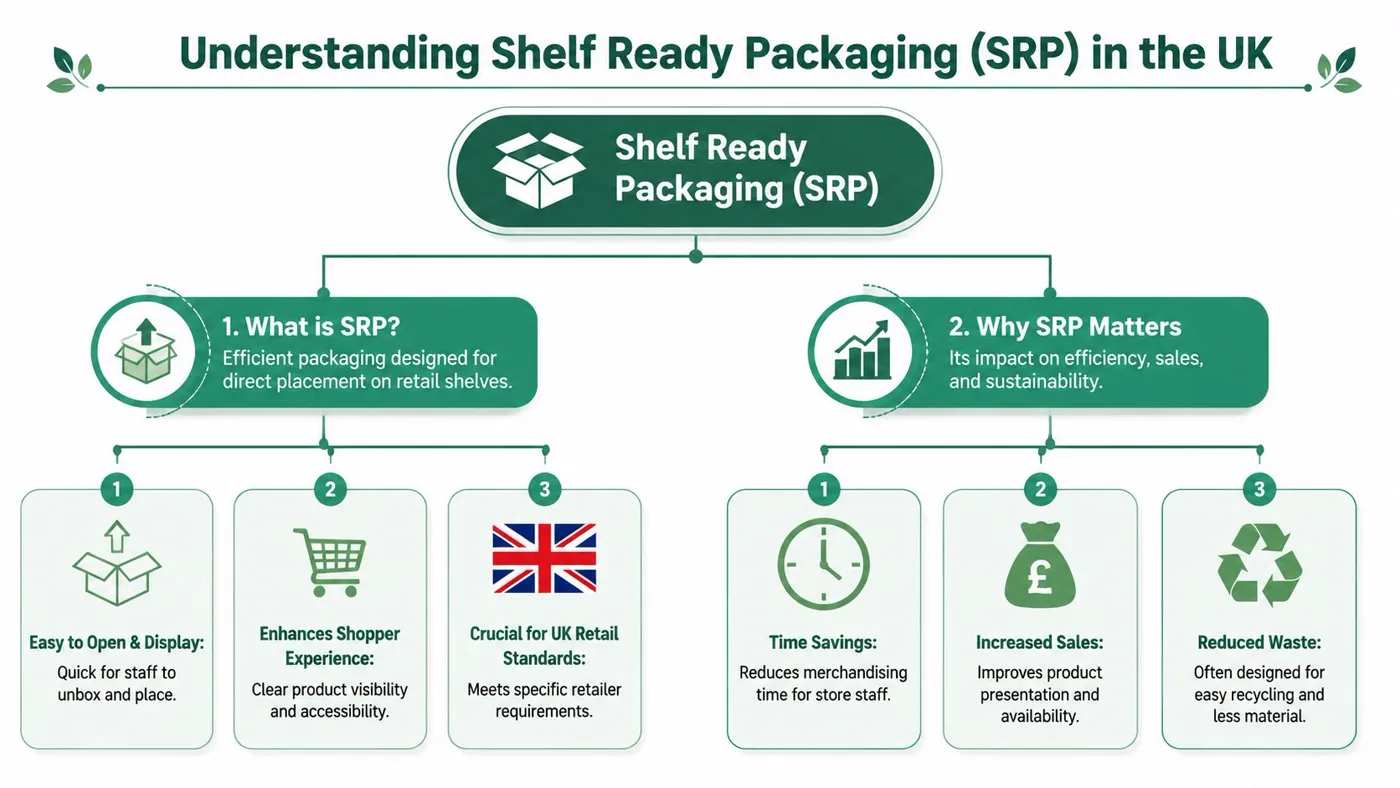
The five easies in practice
The five easies remain useful because they force practical decisions instead of vague design ambition.
- Easy to identify means staff can recognise the product quickly in the stockroom or on a delivery cage.
- Easy to open means the opening method is obvious and controlled, not a rough tear that exposes product or destroys the display edge.
- Easy to stock means the whole pack can be placed where it belongs without extra handling.
- Easy to shop means customers can see and remove units without fighting the tray.
- Easy to dispose means the empty pack flattens and recycles without creating unnecessary mess.
Practical rule: If a store colleague needs to explain how to open it, the design isn't finished.
Many brands still treat shelf ready packaging as a supermarket-only requirement. That's too narrow. The same logic applies anywhere staff need a pack to move efficiently from transit to display, provided the channel benefits from case-based merchandising rather than loose back-stock.
The Dual Benefits of SRP for Brands and Retailers
Shelf ready packaging works best when both sides win. Retailers need handling efficiency. Brands need dependable presentation. A format that only serves one side usually gets redesigned, delisted, or worked around in store.
What retailers gain on the shop floor
For retailers, the strongest argument is operational. FEFCO states that corrugated shelf ready packaging should be easy to identify, open, get on shelf, access by shoppers, and flatten for recycling. It also says replenishment should be “in one movement” and that total weight must remain within safe handling limits, which puts structural design and pack weight at the centre of labour efficiency and in-store safety, as set out in FEFCO's shelf ready packaging guidance.
That principle changes how a case should be specified. If the pack is too heavy, too deep, or too awkward to grip, it no longer behaves like SRP in practice. It becomes a transit case with marketing graphics.
Retail teams usually value SRP for a few very concrete reasons:
- Faster shelf fill because the case goes up as a unit rather than item by item.
- Cleaner routines because less waste and fewer loose units build up during replenishment.
- Safer handling because the structural format can be designed around realistic manual movement.
- Better consistency because each shelf placement looks similar across stores.
What brands gain at shelf level
Brands benefit for different reasons, but the gains are still commercial.
A good SRP format controls how the product appears when staff are busy. It creates a consistent front edge, keeps branding visible at the point of sale, and reduces the risk that products end up loosely arranged or facing in different directions. It can also help protect the product from avoidable in-store knocks, especially where the outer tray continues to support the product during display.
The most useful way to think about brand benefit isn't “more decoration”. It's more control.
A branded tray only helps if the structure still lets shoppers pick up the product easily.
That matters beyond grocery. In pharmacies, clarity and order often matter more than theatrical display. In independent retail, one neat case presentation can save staff from touching every unit. In e-commerce-to-store environments, the same branded outer can support handover, temporary display, or organised click-and-collect staging, if the format is compact enough.
When shelf ready packaging is specified well, the retailer gets a simpler task and the brand gets a better-looking shelf. That's the commercial sweet spot.
Exploring SRP Types and Sustainable Materials
Shelf ready packaging isn't one structure. It's a family of formats, and choosing the wrong one creates problems that no print finish can fix.
Common formats and where they fit
Some SRP formats suit high-volume repeat lines. Others work better for smaller runs, mixed retail estates, or products that need more protection in transit.
A few of the most common are:
- Wrap-around blanks suit products that benefit from a tight-fitting outer with strong billboard space. They're often used when unit alignment matters.
- Tear-perforated trays work well when the top needs to come away quickly and leave a clean display tray behind.
- Two-piece containers can help where a separate lid improves stacking or protection before the pack reaches shelf.
- Stackable display trays are useful when stores need easy fronting and stable presentation across repeated replenishment cycles.
The right choice depends on product weight, fragility, pack count, and how the retailer replenishes. A compact countertop line in an independent pharmacy doesn't need the same format as a deep-shelf grocery SKU.
Materials choice is a commercial choice
The materials conversation usually starts with corrugated and paperboard, and for good reason. The global retail-ready packaging market is projected to grow from USD 82.78 billion in 2026 to USD 136.33 billion by 2035, at a 5.7% CAGR, with paperboard highlighted as the preferred material. One market analysis also says corrugated packaging accounts for 71.6% of the product segment in 2026, which shows how dominant corrugated-led solutions are in this category, according to market analysis from Towards Packaging.
For UK suppliers, that aligns with day-to-day reality. Corrugated remains the default because it balances strength, printability, recyclability, and cost control. Folding carton can work well for lighter products or premium presentation, but it won't replace corrugated where the case still needs to perform as a sturdy transit unit.
A useful outside reference for teams reviewing substrate options is Afida's guide to compare eco-friendly packaging materials, especially when sustainability targets need to be weighed against product protection and end-of-life handling. For businesses sourcing recyclable and lower-impact stock formats, eco packaging options can also be part of that wider material review.
Comparison of Common SRP Materials
| Material | Best For | Sustainability Profile | Cost |
|---|---|---|---|
| Corrugated cardboard | Heavier products, shelf trays, transit-to-display formats | Widely recyclable and well suited to store recycling streams | Usually practical for broad retail use |
| Paperboard | Lighter products and higher graphic presentation | Recyclable and widely accepted in retail packaging systems | Can suit presentation-led packs |
| Folding carton board | Compact retail packs with lower load demands | Recyclable when designed simply | Often workable for lighter-duty applications |
| Solid board | Neater presentation where more rigidity is needed | Can support recycling goals if specified cleanly | Depends on structure and finish |
The most sustainable SRP isn't automatically the lightest or the most minimal. It's the pack that protects the product, works on shelf, and enters the retailer's recycling flow without unnecessary complication.
Designing Effective SRP From Structure to Shelf
The fastest way to get shelf ready packaging wrong is to begin with artwork and hope the structure will adapt around it. The shelf should drive the design. The store task should shape the opening method. Print comes after that.
Start with shelf geometry, not artwork
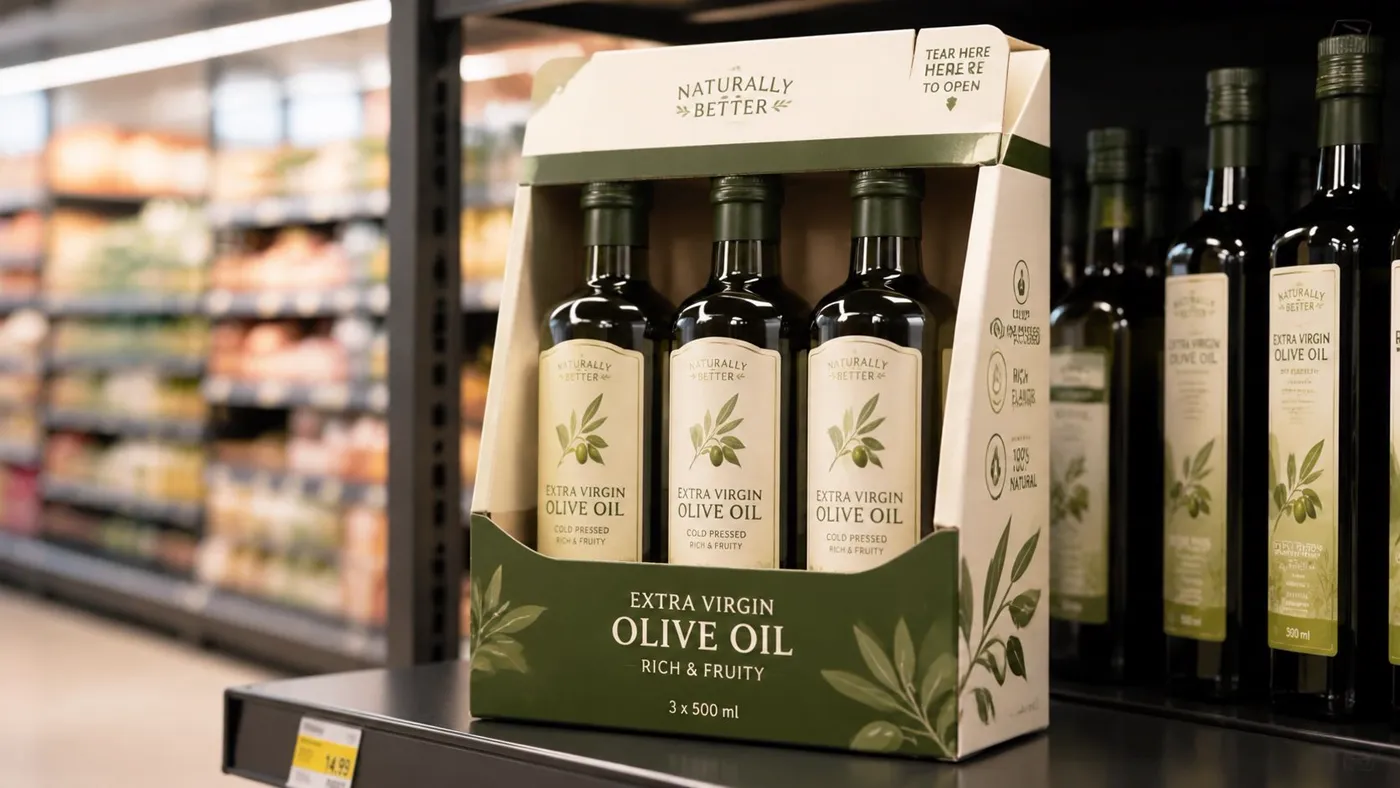
Industry guidance for UK grocery and convenience channels stresses that SRP performs properly when pack geometry and tear-open performance are controlled so replenishment is fast without product fall-out. Guidance also points to visible brand and size panels, clear opening instructions, perforation placement, shelf-fit constraints, and the need to balance front lip height against containment, visibility, and handling protection, as described in this shelf ready packaging design guide.
That has several design implications:
- Shelf depth matters. If the tray overhangs or wastes depth, stores lose space and staff lose patience.
- Case count matters. Too many units can make the pack heavy and unstable. Too few can make replenishment inefficient.
- Product stance matters. Bottles, cartons, pouches, and blister packs all behave differently once the front panel is removed.
- Front lip height matters. Too high and the product disappears. Too low and items tip forward.
For brands that also serve direct-to-consumer or fulfilment-heavy channels, looking at broader ecommerce packaging solutions can help teams separate what's needed for parcel performance from what's needed for in-store display. The two jobs overlap, but they aren't identical.
Opening performance decides whether the design works
Most SRP failures happen at the tear line.
Perforations need to be placed where staff can find them quickly and use them cleanly. If the board tears unpredictably, the tray edge looks ragged, branding is damaged, or product is exposed badly. If the opening feature is too weak, the case can fail in transit. If it's too strong, staff use blades and defeat the whole purpose.
A practical design review should test:
- How clearly the opening point is signposted
- Whether the tear follows the intended line
- Whether any product catches or falls during opening
- Whether the remaining tray edge is neat enough for display
- Whether the opened pack still fits the shelf correctly
If the first store colleague to open the case leaves a jagged edge, the structure needs work, not more instructions.
For standard corrugated outers used in prototyping and fit checks, single wall cardboard boxes are often a relevant baseline format before a fully bespoke SRP structure is finalised.
Graphics still matter, but structure comes first
Once the pack opens well and fits the shelf, graphics do the final job. Brand name, variant, and product type should be visible from normal working distance. Staff need to identify it quickly. Shoppers need to understand it quickly.
That doesn't mean every panel should be printed heavily. In many channels, a cleaner layout works better than trying to turn every tray into a mini display stand. Pharmacies, health products, and specialist retail often benefit from clarity over visual noise.
The strongest shelf ready packaging feels obvious in use. That usually comes from disciplined structure, not graphic excess.
Your Implementation Checklist for UK Businesses
Many SRP projects go wrong because businesses jump straight to artwork, unit cost, or a retailer conversation before they've mapped how the pack will be handled. A useful rollout starts with process, not print.
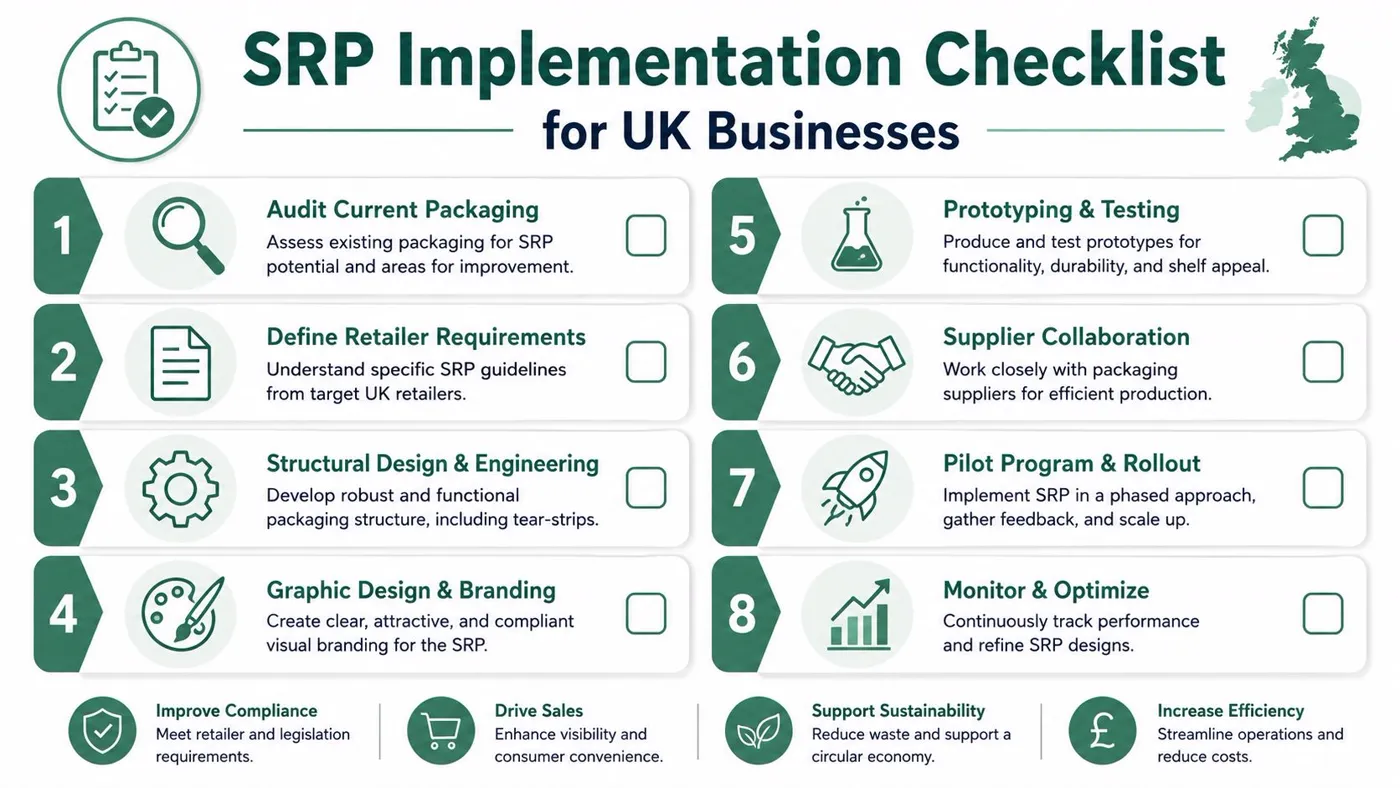
A practical rollout sequence
A sensible implementation sequence usually looks like this:
-
Audit the current pack
Check how products move from inbound delivery to shelf today. Note where staff lose time, where waste builds up, and where presentation becomes inconsistent. -
Define the retail task
Decide what the new pack must achieve. Faster replenishment, cleaner presentation, easier disposal, better shelf fit, or safer handling are all valid aims. The key is to rank them. -
Get retailer requirements early
Different customers will have different shelf depths, opening preferences, and display expectations. Don't assume one format will satisfy every account. -
Prototype with real product
Empty mock-ups rarely reveal enough. The pack needs to be tested with actual weight, actual units, and realistic opening conditions. -
Trial with store staff
The people opening the case will usually spot flaws before anyone in a boardroom does. -
Plan replenishment and reorder
If the format changes packing efficiency, pallet build, or storage footprint, logistics needs to be involved before launch.
A relevant read for online and multi-channel operators is this Packaging Panda article on sustainable ecommerce packaging stack, because many UK businesses now need one packaging strategy that covers both store-facing and fulfilment-facing requirements.
Channel fit comes before scale
One of the most overlooked points in UK guidance is that SRP isn't a universal answer across all channels. Commentary around the sector often focuses on supermarket use, but non-grocery environments such as independent retail, pharmacies, garden centres, and e-commerce-to-store replenishment can behave very differently. A more useful view is to treat SRP as a channel-specific operational tool where the return depends on retail format rather than assuming it suits every stock profile, as noted in this discussion of the five easies and channel context.
That means the checklist should include one hard question: does this channel benefit more from single-case display, or from keeping stock in the back room and replenishing by hand?
The best SRP rollout often starts with one product line in one channel, not a full catalogue conversion.
If the answer is unclear, the business should test before scaling.
Conclusion Unpacking Your Competitive Advantage
Shelf ready packaging earns its place when it removes work from the shop floor and improves what the customer sees on shelf. This is the ultimate standard. Not whether the outer case looks impressive in a design review.
For UK suppliers and brand managers, the strongest results usually come from treating SRP as an operational format first and a branding surface second. The structure has to fit the shelf, open cleanly, protect the product, and leave a tray that still works once staff have taken the top away. After that, the graphics can do their job properly.
The wider lesson is just as important. Shelf ready packaging doesn't have the same value in every retail channel. Grocery may have shaped the rules, but independent shops, pharmacies, garden centres, and e-commerce-to-store models all need different answers. Some lines justify a purpose-built transit-to-display format. Others are better served by a simpler case and manual replenishment.
Businesses that review packaging through that lens usually make better decisions. They reduce friction, support store teams, and present the product more consistently. In a crowded retail environment, that's a competitive advantage people can use.
Frequently Asked Questions about Shelf Ready Packaging
Is shelf ready packaging always more expensive
Not always in practical terms. The pack itself can be more complex than a plain transit carton, but the right comparison isn't only box cost. The useful question is whether the format reduces handling, improves shelf consistency, and avoids wasteful repacking in store. If it doesn't, the extra complexity probably isn't justified.
Does shelf ready packaging work outside supermarkets
Yes, but not automatically. Independent shops, pharmacies, and specialist retail can benefit when staff want a compact case that opens quickly and displays neatly. It's a weaker fit where stock is mostly kept in the back room, shelf space is irregular, or the product sells too slowly to justify case-based display.
Can shelf ready packaging support e-commerce-to-store models
It can, especially where stock arrives at a branch or collection point and needs to stay organised without repeated handling. The structure has to be chosen carefully, though. A pack built only for parcel resilience may open badly for display, while a display-led tray may not protect the product well enough in a more complex distribution route.
What's the biggest design mistake
Starting with graphics before checking shelf dimensions, case count, and opening behaviour. Most SRP failures come from structure, not branding. If the tray doesn't fit, tears badly, or lets products topple forward, the shelf team won't care how good the print looks.
How should a business test a new SRP format
Use real product, real weights, and a realistic retail setting. Check how the case arrives, how easily staff identify it, how cleanly it opens, whether the tray edge stays presentable, and whether shoppers can remove units without disrupting the rest of the pack. Testing should include the exact channel the pack is being designed for.
Is corrugated always the right material
No, but it's often the most practical choice for shelf ready packaging because it combines structural performance with recyclability and straightforward store disposal. Lighter products or more presentation-led lines may suit paperboard or folding carton, but the final choice should reflect handling conditions, shelf use, and disposal needs.
Packaging teams reviewing shelf ready packaging across grocery, pharmacy, independent retail, or fulfilment-led models can explore practical stock and bespoke options through Packaging Panda, a UK wholesale supplier of packaging materials including recyclable and made-to-order formats for business use.


