
Heavy Duty Strapping: A Practical UK Buyer's Guide

A curtain-sider is reversing onto a Midlands distribution centre at half five. Inside the trailer, a stack of shrink-wrapped beverage multipacks has bellied out during the journey. Nothing dramatic happened, just uneven tension, repeated braking and the constant movement of a heavy load. Yet the result can be damaged stock, a rejected pallet and a haulier left carrying the cost.
That scene is familiar across UK warehouses, 3PL operations and e-commerce dispatch floors. Pallets fail when shrink-wrap tension varies, pallet heights are mixed, corner boards are too short, or one strap runs across a load that really needs cross-binding. A small sway becomes a much larger problem behind a 44-tonne artic travelling along the M62.
The choice of heavy duty strapping is therefore a load-security decision, not merely a packaging purchase. It connects with pallet wrap, vehicle restraint calculations, the driver's CPC hours and the customer's returns policy.
Table of Contents
- When a Pallet on a UK Bay Won't Stay Put
- What Heavy Duty Strapping Does
- Comparing Steel, Polyester and Polypropylene Strapping
- The British Standards That Shape Strap Selection
- Matching Strap to the Job in UK Warehouses
- Tooling Choices When Driver Shortages Bite
- Recycled Versus Virgin Strap in Real Conditions
- Handling, Storage and End-of-Life Best Practice
When a Pallet on a UK Bay Won't Stay Put
The first warning is often found at the receiving bay. A pallet that left the despatch floor square and stable arrives with cartons leaning, film stretched into a loose belly and the bottom layers beginning to spread. A forklift driver may still move it, but the receiving team sees the risk immediately. If the load can't be unloaded safely or counted accurately, it may be refused.
Shrink film protects against dust, moisture and minor movement, but it doesn't replace a strap where the load needs firm compression or attachment to the pallet. A tall pallet of drinks, building products or boxed goods can shift even when the outer film looks intact. Mixed heights make that worse because the strap tension is shared unevenly across the top surface.
Short corner boards create another weak point. The strap cuts into the exposed carton edge instead of distributing pressure, so the operator either damages the packaging by tensioning correctly or leaves the load under-tensioned. One strap run can hold the centre while allowing the ends to fan out. Cross-binding, additional horizontal restraint or a better load pattern may be needed, depending on the calculation.
Practical rule: A strap should support a prepared load, not compensate for a badly built one.
UK freight volumes make small failures operationally significant. GB-registered HGVs lifted 1.53 billion tonnes of goods in 2025, with 162 billion tonne-kilometres moved, according to Domestic road freight statistics for the United Kingdom in 2025. Every weak pallet creates extra handling, claims, rework and delay somewhere in that network.
The correct strap must work with the pallet pattern, edge protection, application tool and intended transport restraint. BS EN 12195 requirements, rather than a strap's marketing label, determine whether the finished load is suitable for road movement.
What Heavy Duty Strapping Does
On a UK dispatch floor, a strap earns its place when a pallet must leave the bay, survive forklift handling and arrive with its load pattern intact. A cable tie closes a courier parcel. A ratchet strap holds a patio set in a Transit. Engineered polyester or steel banding binds dense goods to a EUR pallet and restrains them through vibration and braking.
The strap performs three linked functions:
- It contains lateral movement. Tension draws cartons, boards, packs or components towards the load centre and limits outward spread.
- It transfers restraint into friction. Downward pressure increases contact between the goods, pallet and bearing surfaces.
- It provides controlled containment. If movement starts, the strap absorbs force before the pallet structure or outer packaging gives way.
Heavy duty describes a performance bracket, not a universal specification. Widths commonly range from 13 mm to 32 mm, while break strains can run from roughly 1.5 kN for lighter polypropylene to beyond 35 kN for heavy-duty steel. These figures depend on the product, joint and restraint method, so the roll specification must be checked against the finished load.
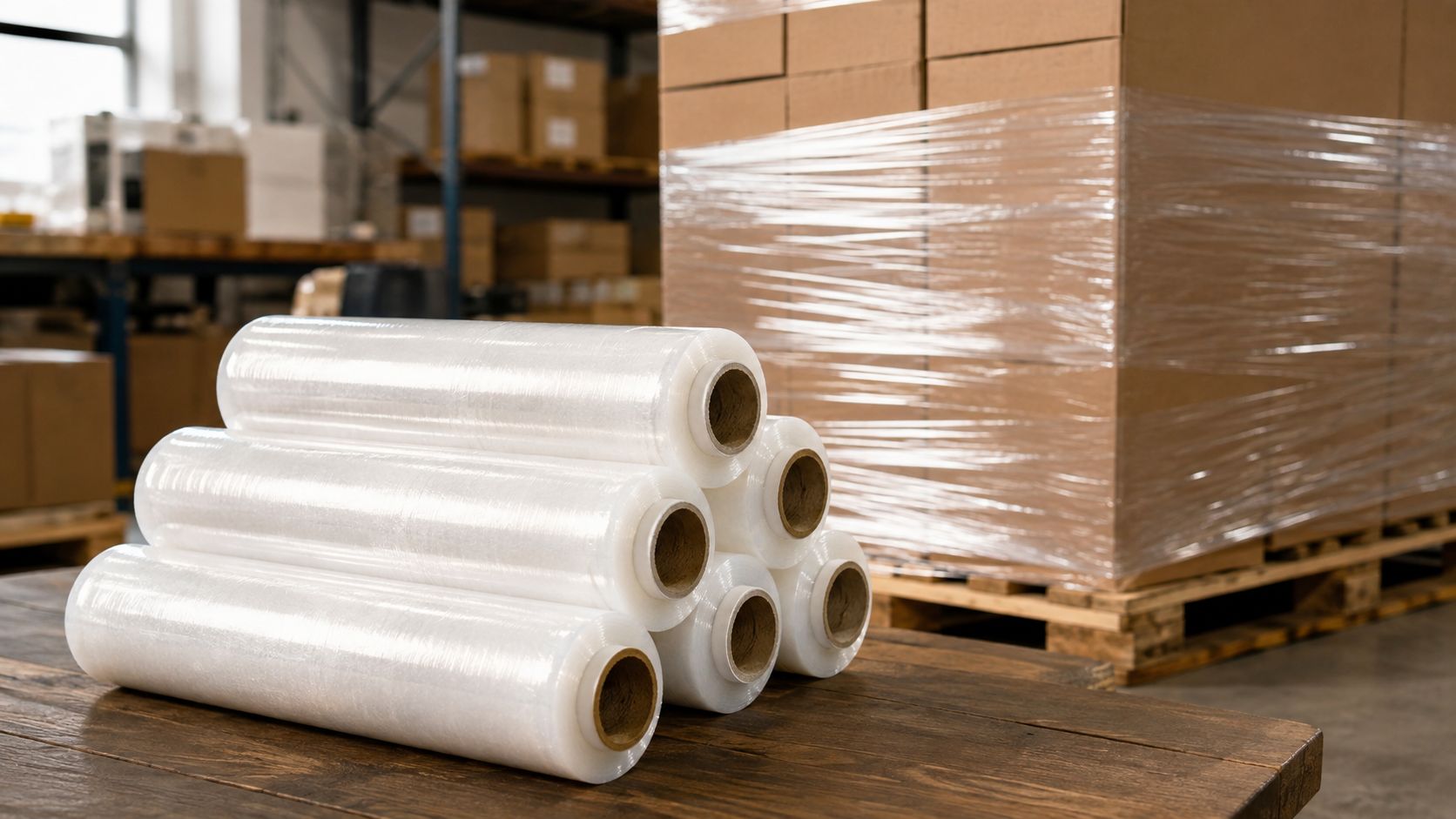
Raw break strength alone does not predict performance. Tension shows how firmly the load is held. Elongation indicates how much the strap relaxes or absorbs movement. Joint efficiency shows how much parent-strap capacity remains at the seal, buckle or weld. A strong strap can underperform when the joint is weak or the tool cannot apply repeatable tension.
Stretch film and strapping address different risks. Pallet wrap encloses the unit load and helps protect it during storage and handling. Strapping applies concentrated restraint, particularly where cartons or components need controlled compression. In a busy fulfilment operation, Pallet Wrap can sit alongside strap as part of the packaging system, rather than replacing it.
Comparing Steel, Polyester and Polypropylene Strapping
Steel remains the choice when the load presents sharp edges, exceptional restraint demands or severe impact risk. It has high tensile strength and low elongation, which suits coil, brick, timber and other dense products that can push hard against the strap. The drawbacks are practical and serious: steel is heavy, can spring during cutting or sudden release, and requires suitable seals and crimping equipment.
Polyester, or PET, is the workhorse for many palletised UK loads. It offers high tensile performance without steel's weight and handles vibration well when the correct grade and joint are selected. The UK plastic strapping market is estimated to consume 80,000 to 110,000 tonnes annually, with PET high-tensile strapping accounting for 25% to 30% of volume, because buyers need strength, low elongation and resistance to impact and temperature variation. These figures are reported in United Kingdom plastic strapping market analysis.
Polypropylene, or PP, is lighter and generally suited to lighter palletising, bundling and unitising. It has useful flexibility and can absorb some handling shock, but it isn't the default choice for dense, tall or high-value loads that must retain tension over extended transport. UV exposure, creep and lower restraint capacity can become limiting factors.
| Property | Steel strapping | Polyester (PET) strapping | Polypropylene strapping |
|---|---|---|---|
| Typical widths | Narrow to broad industrial bands | Commonly medium to broad pallet grades | Narrow to medium pallet and bundling grades |
| Break strain | Highest of the three materials | High, with grades for demanding pallet loads | Lower, suited to lighter duties |
| Elongation at break | Low | Low to moderate, depending on grade | Higher and more forgiving |
| Recommended joint type | Metal seals with heavy crimpers | Friction weld, serrated seal or buckle | Heat weld, plastic buckle or metal seal |
| Best-fit load | Coil, brick, timber and dense sharp-edged products | Palletised consumer goods, bricks and awkward loads | Light pallets, cartons and general bundling |
| Weight per metre | Highest | Lower than steel | Lowest |
| Key caveat | Snap-back and sharp edges during release | Grade and weld quality vary by product | Creep and UV exposure can reduce retained tension |
A UK product specification illustrates steel's upper end. For 19 mm × 0.5 mm blue waxed steel strapping, the published minimum tensile strength is 800 N/mm² and the minimum break load is 7,600 N, with verification to EN10002-1, as shown in this heavy-duty steel strapping specification.
Joint selection matters across all three materials. Guidance associated with tensional strapping recommends joint strength of at least 65% for metallic straps, rising to as much as 90% of minimum break strength for lifting and lashing use, as detailed by BSI's tensional strapping specification.
The British Standards That Shape Strap Selection
A strap specification should start with the restraint task, not the roll colour or width. BS EN 12195-1:2010 sets the calculation framework for securing loads on road vehicles. The UK load restraint guidance sets out the forces the vehicle securing system must withstand, while BS EN 13247:2001 covers tensional strapping used for lifting, lashing and securing loads.
BS EN 12195-1 considers top-over lashing, direct lashing, diagonal restraint and full-cradle arrangements. Each changes the force path. Strap angle, friction between the load and deck, load mass, acceleration, and the condition of anchor points all affect the required setup. A strap that looks strong on its roll can still be unsuitable once those factors are applied.
The UK guidance requires restraint against forces equivalent to the entire load weight forwards, half the load weight sideways and half the load weight rearwards. Strap geometry affects the calculation. Under the EN 12195 guidance, a lashing angle between 75° and 90° uses the normal table values. At an angle between 30° and 75°, the number of lashings must be doubled or the table values halved, according to the lashing-angle guidance.
| Lashing method | Strap angle from horizontal | Typical number of lashings | Approximate force per strap |
|---|---|---|---|
| Top-over | Calculated for the load and friction | Calculation required | Calculation required |
| Direct | Matched to anchor and load geometry | Calculation required | Calculation required |
| Diagonal | Commonly set to suit opposing restraint paths | Calculation required | Calculation required |
| Full-cradle | Designed around the complete load | Calculation required | Calculation required |
The usable restraint depends on more than minimum break strength. Joint performance, strap routing and anchor capacity can reduce what the system provides. BS EN 12195-2:2001 covers web lashings made from man-made fibres for road vehicles, trailers, vessels and rail wagons, including testing methods, as explained in the IRU load-securing guide.
BSI's tensional strapping requirements also make joint strength a selection point, not a tooling afterthought. For metallic straps, guidance associated with the specification recommends a joint strength of at least 65%, rising to as much as 90% of minimum break strength for lifting and lashing use.
BS EN 415-8:2025 is a separate machinery reference for strapping machines. BSI lists it as a safety standard for this equipment, published on 31 March 2025. On an automated or semi-automated line, guarding and tensioning cycles need review alongside the strap grade, as outlined in HSE packaging safety guidance.
Matching Strap to the Job in UK Warehouses
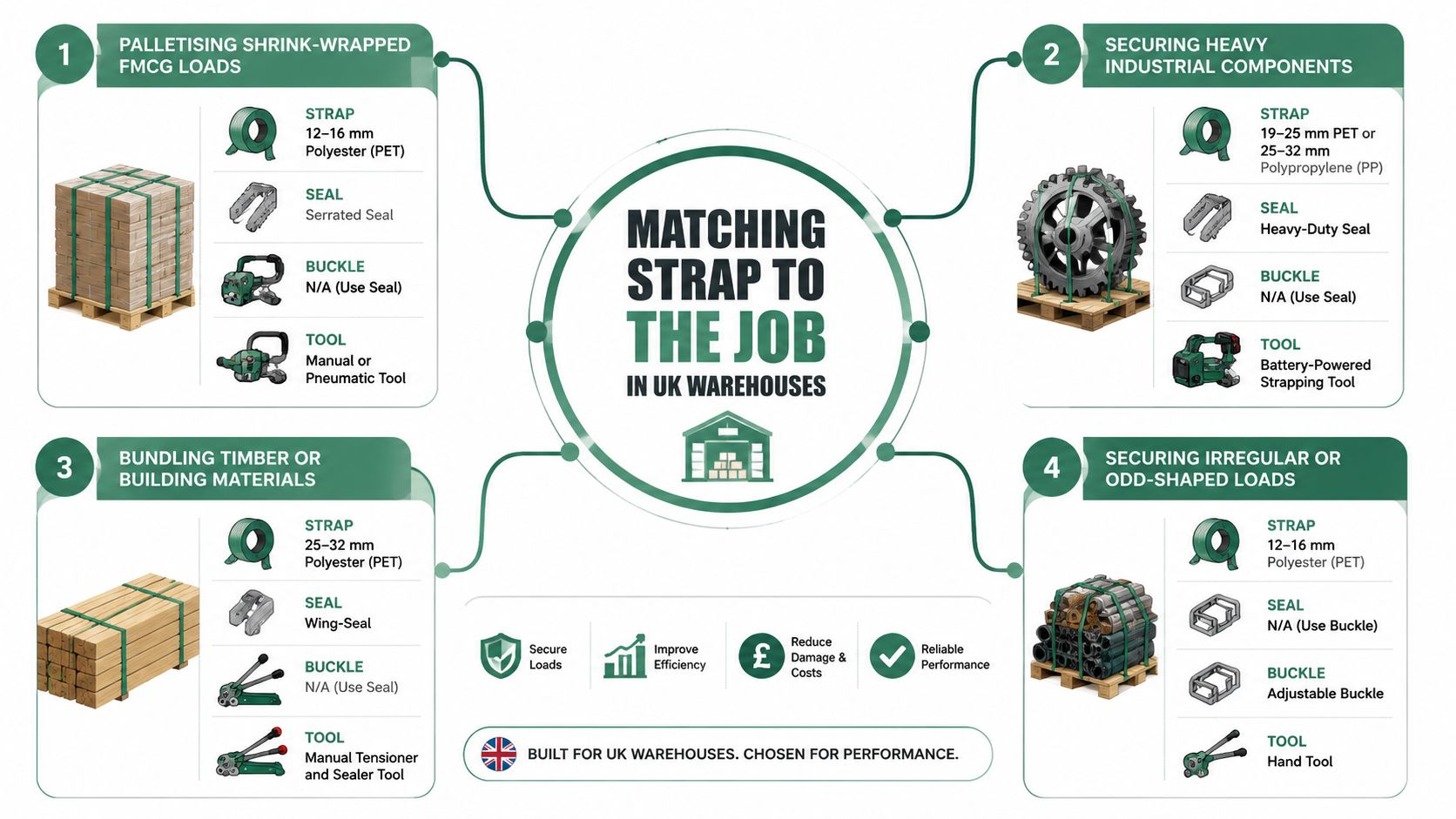
A pallet waiting on a UK despatch bay may face forklift handling, trailer movement and hard braking before it reaches its destination. Select the strap from the load first, then confirm the joint, routing, anchor points and tool. These combinations are practical starting points, not substitutes for a calculated road-restraint system.
- Shrink-wrapped FMCG pallets: PET with a serrated metal seal and a battery friction-weld tool provides repeatable tension across stacked consumer goods. Tall, uneven or movement-prone loads also need suitable edge protection, with the strap kept clear of carton corners.
- Timber, bricks and extrusions: Heavier PET or ribbed steel handles dense, abrasive surfaces better than a light PP strap. Welded seals and a pneumatic combination tool suit repetitive bundling, provided operators can keep their hands clear while tensioning.
- Containerised export loads: Corded polyester or galvanised steel with buckles accommodates irregular routing and repeated handling. Match the rated system to the calculated lash force and record the safety margin selected by the responsible load designer.
- Yard movements and one-trip courier pallets: PP with hand-tensioned buckles can suit a stable, light unit load on a short journey. Prolonged storage or higher restraint forces require evidence that the strap will retain the required tension.
Strap routing matters as much as the material grade. Corners can cut into cartons, timber and wrapped goods, reducing contact and changing the restraint path. The practical role of edge protection for pallet strapping is to spread pressure across those contact points.
The combination fails when the warehouse chooses a strap from a specification sheet alone. PP can creep during prolonged storage, while a worn crimper can form a weak steel joint. Recycled PET may meet the required grade, but performance still needs checking on the actual pallet line, especially where tension, dust and handling vary. For lifting or road restraint, verify the complete system against the relevant standard rather than relying on a previous pallet that stayed intact.
Tooling Choices When Driver Shortages Bite
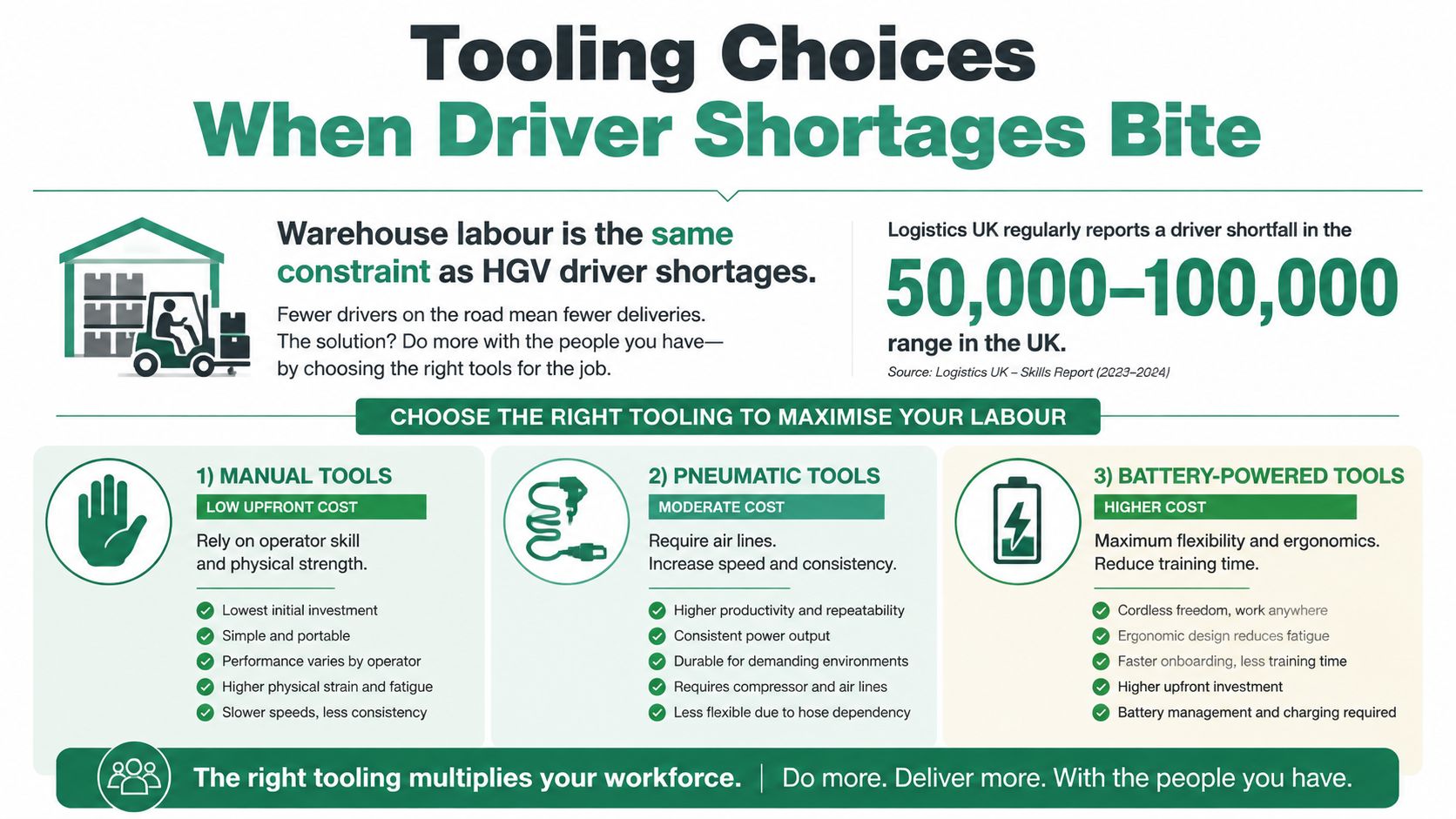
Driver shortages expose delays that packaging managers can underestimate. With transport capacity tight, an avoidable hold-up at the despatch station can delay loading and increase labour pressure. Tool selection therefore needs to reflect both the pallet pattern and the people available to run the line.
Manual tools remain sensible where loads vary, volumes are modest and operators need flexibility. A hand tensioner and seal crimper are inexpensive to deploy, but results depend on training, seal formation and the operator repeating the same method throughout a shift. A basic tool used correctly beats an automated machine running the wrong strap or poorly maintained parts.
Battery friction-weld tools, including systems such as the Signode BXT and Fromm P327, remove the need for a fixed air line. They can produce a cleaner, more repeatable joint than hand sealing. The operator still has to manage battery charge, keep the weld area clean and service the tool so tension and welding remain consistent.
Semi-automatic machines suit a predictable pallet pattern and a line that can feed them continuously. They standardise the tensioning cycle and guarding, but require floor space, maintenance and a strap grade compatible with the machine. A PP-only setup will not repay its cost if the load requires PET or steel.
Automation pays back when a repeated pallet profile creates a genuine bottleneck. Compare labour, rework, rejected loads and downtime with the tool's purchase and maintenance costs before committing. Driver pressure strengthens that case, but does not justify automation by itself.
The same discipline applies to associated packaging equipment. Teams handling other despatch tools can use this tape-gun guide to reduce setup errors, but tape application and pallet restraint should remain separate process steps. A correctly loaded tape gun cannot compensate for inadequate strap selection, tension or restraint.
Recycled Versus Virgin Strap in Real Conditions
Recycled content is valuable, but the right question is not whether a strap contains recycled polymer. The question is whether it retains enough tension, joint strength and dimensional consistency for the actual load path.
rPET can enter production through post-consumer bottle flake or regranulated manufacturing scrap. Feedstock quality, processing and blend control influence the finished strap. Buyers should ask for the declared recycled content, minimum break load, elongation, joint performance and batch consistency rather than accepting a general sustainability statement.
Virgin PET normally offers the wider performance envelope for demanding work. It gives the converter more predictable raw material, which can matter on automatic lines where a variation in thickness or weld behaviour causes stoppages. Recycled PET can work well in suitable applications, especially where the load is stable and the restraint demand is moderate, but the decision should be validated on the line.
| Property | Virgin PET, 12 mm | 30% rPET, 12 mm |
|---|---|---|
| Break-load consistency | Usually more predictable between batches | Must be confirmed by specification and batch testing |
| Weld behaviour | Typically easier to standardise | May require closer machine and process control |
| Creep and retained tension | Suitable for demanding applications when correctly graded | Application-dependent and should be validated over storage time |
| Sustainability profile | Less recycled content | Supports recycled-content objectives |
| Best buying test | Minimum load and joint requirements | Same tests, plus documented recycled-content and consistency data |
The UK packaging strapping materials market is projected at US$269.1 million in 2025, while recycled strapping is identified as the fastest-growing source segment through 2033, according to the UK packaging strapping materials outlook. That direction makes recycled content increasingly relevant, but it doesn't remove the need for application testing.
The sustainable strap is often the one that stays intact. A failed strap can create damaged goods, rework, replacement packaging and reverse logistics.
For high-tension, moisture-exposed or long-duration loads, virgin PET may be the responsible choice if it materially reduces failures. For stable internal movements, lighter consignments or validated pallet-line applications, recycled content may meet both security and environmental objectives.
Handling, Storage and End-of-Life Best Practice
A good strap can be ruined before it reaches the tool. Coils should remain in their original protective wrap and be stored on edge, away from standing moisture, impact and uncontrolled unspooling. Yard doors deserve particular attention because repeated UV exposure can degrade coils left in direct light, while careless dragging can kink the strap and damage its edges.
The pre-shift check should be quick enough to happen every time:
- Inspect the strap: Remove coils showing cuts, nicks, crushed edges or white stress marks.
- Check the joint: Look for weak welds, distorted seals and buckles that don't seat correctly.
- Examine the tool: Clean cutting blades and inspect tension mechanisms before production starts.
- Protect the load: Confirm corner boards cover every strap path and aren't too short for the stack.
- Separate scrap: Keep used strap in a designated bin at the de-pallet station rather than mixing it with general waste.
Steel can move into scrap-metal streams. PET and PP should be segregated where a suitable recycling route exists, with contamination controlled so the material remains useful to the reprocessor. Packaging labels also matter. Current UK labelling rules state that, once fully in force, packaging other than plastic films and flexibles must carry either “recycle” or “do not recycle” by 31 March 2026, while plastic films and flexibles must carry the relevant label by 31 March 2027, according to the UK packaging labelling summary.
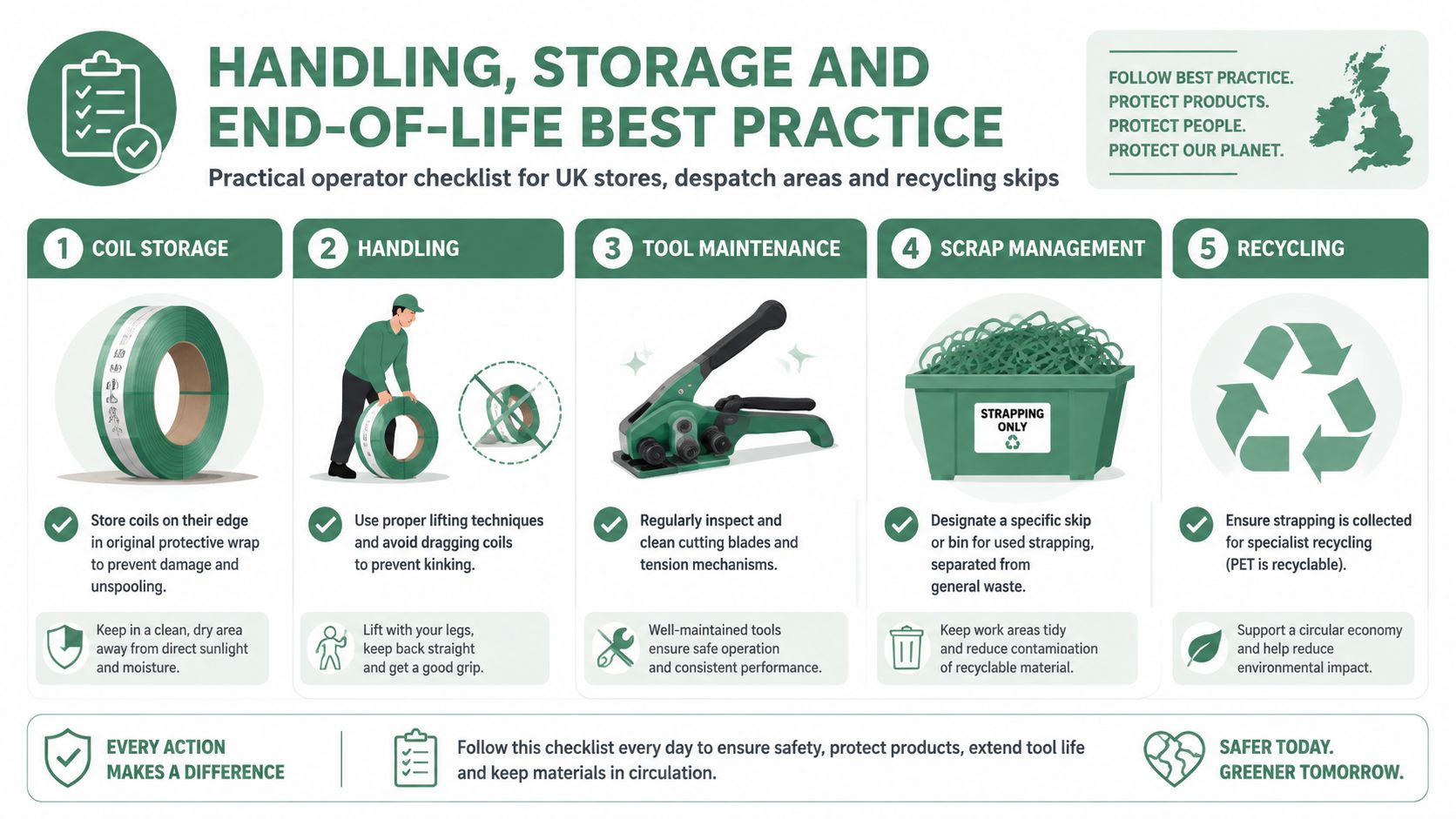
Where volumes justify it, a mobile baler can consolidate clean strap for collection. A licensed waste carrier should handle movement to the appropriate reprocessor, with the warehouse retaining a clear segregation and collection routine.
Packaging Panda supplies packaging materials for UK warehouses, fulfilment teams and dispatch operations, including pallet wrap and protective packaging that can sit alongside a properly specified heavy duty strapping system. Visit Packaging Panda to review suitable packaging options and discuss repeat or made-to-order requirements for the operation.