Greaseproof Paper Bag Guide for UK Bakeries

Busy bakery counters don't fail on the sales floor first, they fail at handover. A croissant gets tucked into a bag, a burger box steams for a minute too long, or a courier stacks warm items against the wrong side of the parcel, and suddenly the packaging looks tired, greasy, or split at the seam.
That's why a greaseproof paper bag isn't just a paper bag with a nicer label. In UK bakery and takeaway work, it's a short-window food-contact barrier, one that has to hold back oil, stay presentable, and still make sense for disposal in a market where councils can treat food-soiled paper as contamination, as shown in Barnsley Council's bin guidance for greaseproof paper and other food-soiled paper items (Barnsley Council).
Table of Contents
- What a Greaseproof Paper Bag Does Behind the Counter
- How the Greaseproof Barrier Works in Plain Language
- Greaseproof vs Grease-Resistant vs Glassine vs Waxed
- Sizes and Formats for Bakeries, Takeaways and E-Commerce
- Food Safety, Compostability and the PFAS-Free Question
- Practical Packing Tips to Reduce Leaks and Transit Damage
- Printing, Branding and Bespoke Orders for UK Businesses
- Buying Checklist and Common Questions Before You Order
What a Greaseproof Paper Bag Does Behind the Counter
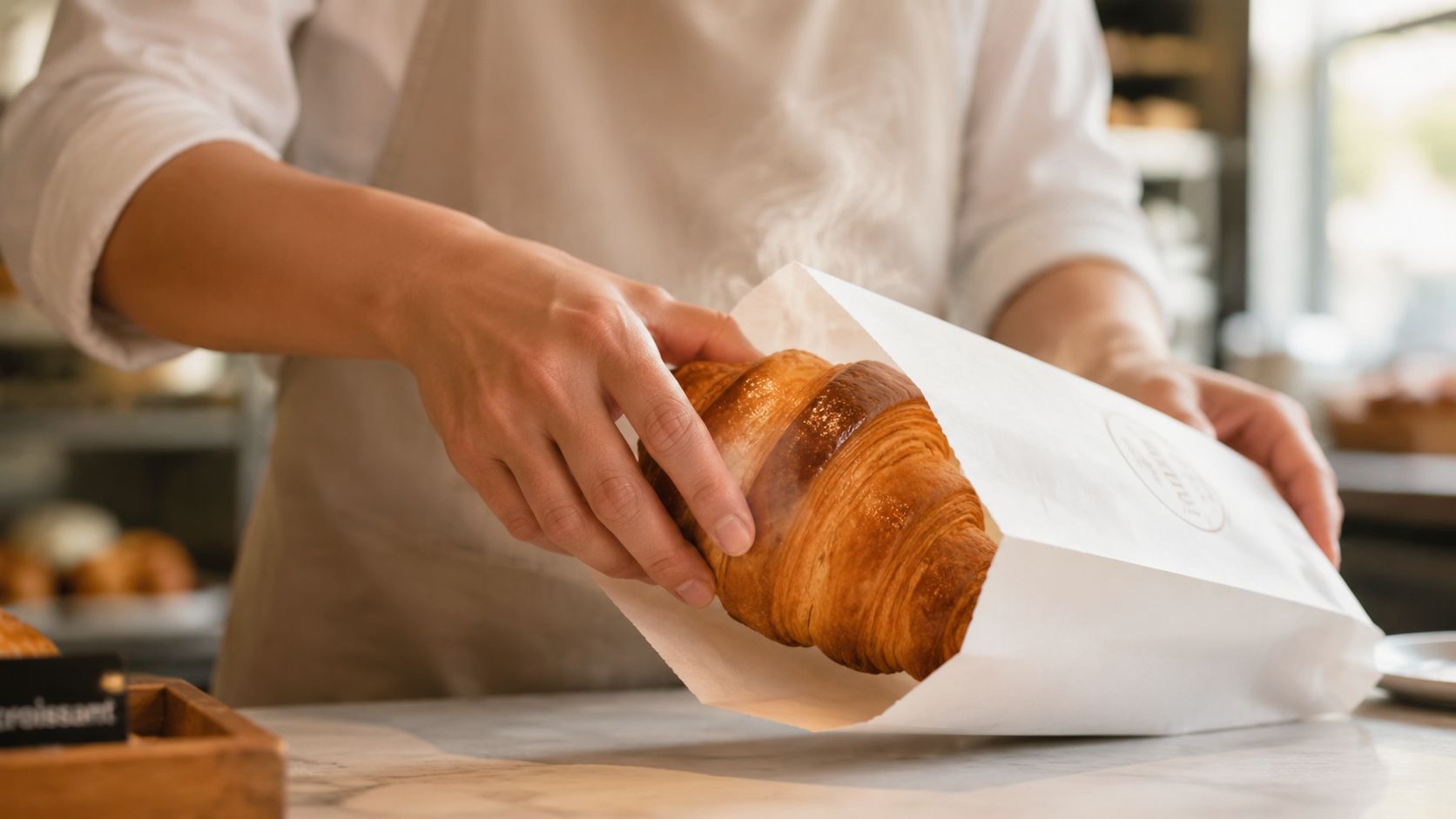
A tray of pastries comes out of the oven, the counter staff lets them breathe for a moment, then one goes into a bag and heads straight to the customer. That is the practical test, whether the bag can hold a greasy item through the short window between packing, handover, and the first part of the journey home.
The phrase greaseproof gets used loosely in the UK market, which is where buyers get caught out. A bag can look like greaseproof packaging and still fail if the seam opens, the base softens, or the oil barrier is too light for the food sitting inside it.
What buyers pay for
What matters is not a romantic idea of paper, it is a controlled barrier for a short period. UK food packaging rules require materials in contact with food to be made so they do not transfer harmful constituents or change the food in an unacceptable way.
That is why a greaseproof paper bag works best as a service item, not a storage vessel. It should manage oil migration and presentation during serving and short transit, while the rest of the pack, outer box, sleeve, or carrier handles structural protection.
A buyer who treats the bag like a sealed container usually ends up disappointed. A buyer who treats it like a controlled barrier for a defined hold time usually gets a much cleaner result.
Practical rule: if the food is still steaming hard when it goes in the bag, the bag is being asked to do two jobs at once, grease control and moisture control, and that is where weak packs start to fail.
You will also see sustainable ranges grouped under broader paper packaging catalogues, including Paper Packaging, but the buyer still has to check whether the chosen bag is right for the food, not just the category label.
How the Greaseproof Barrier Works in Plain Language
A greaseproof paper bag works because the paper itself is made denser, not because of a surface trick that only dresses up the sheet. In technical terms, prolonged fibre refining collapses the gaps between cellulose fibres, which is why the paper becomes more translucent and better at resisting grease penetration (peer-reviewed review).
Think dense fibres, not magical coating
A tighter tea towel slows movement through the fabric. A dense paper web slows oil passage through the sheet.
That difference matters because buyers often assume every oil-resistant paper behaves the same way. It doesn't. Some papers gain resistance through how they are manufactured, while other grades rely on coatings or treatments, and suppliers should be able to say which route they have used (review on greaseproof paper products).
The common benchmark in UK food packaging is the KIT method, rated on a 1 to 9 scale, where higher numbers show stronger resistance to oily migration (Hydon Paper grease-resistant paper guidance). That does not mean every product needs the highest score. The right rating depends on the oil load and how long the food sits in the bag.
Why grammage still matters
UK grease-resistant papers used for food wrapping can sit around 39 gsm and still work well when the barrier is right, while tear resistance around 190/220 mN (MD/CD) helps control failure during filling and transport (Hydon Paper grease-resistant paper guidance). The point is straightforward. A lighter sheet can still perform if the structure and barrier are tuned properly.
That is only half the job, though. Grease resistance keeps oil from striking through the paper, while leak resistance depends on seam integrity, fold quality, and how much steam or liquid the bag has to hold. A bag can look fine on the counter and still fail in transit if the seams open up or the contents are too wet for the grade.
A buyer needs to separate the problem before placing the order. If the issue is oil migration, the paper grade and barrier rating matter most. If the problem is bag breakage under handling, the seam, format, and fill method need attention first.
For UK buyers choosing PFAS-free paper, that trade-off matters again. The cleaner end-of-life story can come with a barrier limit, and suppliers sometimes gloss over the point where grease resistance is strong enough for bakery use but less forgiving once hot, wet food and long carry times enter the picture. A practical check is to compare the bag against the actual food, the hold time, and the route from counter to customer. A simple glassine option such as flush-top glassine bags can suit some dry and lightly oily fills, but it still has to match the product, not the brochure language.
Greaseproof vs Grease-Resistant vs Glassine vs Waxed
A lot of UK packaging orders go wrong because everyone on the call uses greaseproof to describe four different papers. That causes mismatch, and mismatch causes complaints.
Greaseproof comes from fibre refinement. Grease-resistant grades often use surface treatments or coatings. Glassine is highly refined and translucent, but it behaves differently at the seal and fold. Waxed paper prioritises moisture hold, but the trade-off is much weaker recycling compatibility in many practical routes.
UK paper formats for greasy and moist food
| Paper format | How the barrier works | Typical UK use | Key trade-off |
|---|---|---|---|
| Greaseproof paper | Dense, refined fibre web resists oil penetration | Pastry wrap, bakery bags, light takeaway items | Can still fail if seam or fold is weak |
| Grease-resistant paper | Often depends on coatings or treatments | Burger packs, hot food wraps, food-service bags | Performance varies with coating type |
| Glassine | Highly refined, smooth, translucent sheet | Sandwich pillows, premium wraps, display packs | Sealing and stiffness differ from true greaseproof |
| Waxed paper | Wax layer slows moisture and grease transfer | Cold wraps, short-life moisture control | Recycling route is often harder to justify |
| Kraft paper | Base paper, may need treatment or lining for oil | Outer carriers, sleeves, secondary packs | Alone, it isn't enough for greasy fillings |
If a supplier pitches everything as one universal solution, that's a warning sign. The right bag depends on what the food does inside the pack, not what the marketing copy says on the outside.
For buyers comparing specific shapes, a flush-top glassine bag can make sense for certain display-led bakery items, but it shouldn't be confused with a greaseproof bag that has to hold hot, oily food through handover.
Match the format to the food
Pastries and dry baked goods usually need presentation and light barrier. Burger packs need seam control and stronger resistance to oil transfer. Hot chips are often better served by formats that breathe a little, because trapped steam makes a poor pack look worse even when the paper itself is fine.
The cleanest procurement decision is to stop asking for “greaseproof” as a catch-all and start asking what the item has to survive, oil, steam, handling, or all three.
Sizes and Formats for Bakeries, Takeaways and E-Commerce
Stocking the wrong format usually wastes more money than choosing a slightly better paper grade. A flat satchel that works beautifully for pastries will feel useless for a loaf, and a side-gusset bag that suits bakery bread can be clumsy for counter service.
Common formats buyers actually use
Small flat satchels suit croissants, cookies, and individual slices. Side-gusset bags work better for loaves, rolls, and taller bakery items because the bag opens without crushing the product. Pinch-bottom and SOS styles are easier for counter filling where speed matters.
Square-bottom formats are useful when a bakery wants a more stable pack for box-like items or mixed selections. Pillow packs fit pre-packed items, sliced products, and some e-commerce dispatch sets where stackability is more useful than display.
Size and use should follow handling
A windowed version helps when the product has to be seen at the counter, especially for premium bakery ranges. It's less useful when the priority is oil control or when the item is going straight into a courier box anyway.
E-commerce buyers tend to make a different mistake, they pick the biggest practical bag instead of the smallest stable one. Flat, stackable bags usually save storage space and reduce crush risk in the dispatch flow, which matters when the food is being protected again inside a shipper and not carried loose.
For restaurants moving online orders through a digital menu and collection flow, Baslon Digital on restaurant ordering is a useful reference point for how packaging and ordering systems intersect.
- Small: single pastries, cookies, mini bakery items.
- Medium: sandwich portions, rolls, small takeaway sides.
- Large: loaves, multiple bakery items, mixed lunch packs.
- Extra-large: bulky bakery bundles, grouped takeaway portions, outer protection.
The working rule is simple, choose the format that supports the food's shape first, then the barrier second. If the bag fights the product, the product usually loses.
Food Safety, Compostability and the PFAS-Free Question
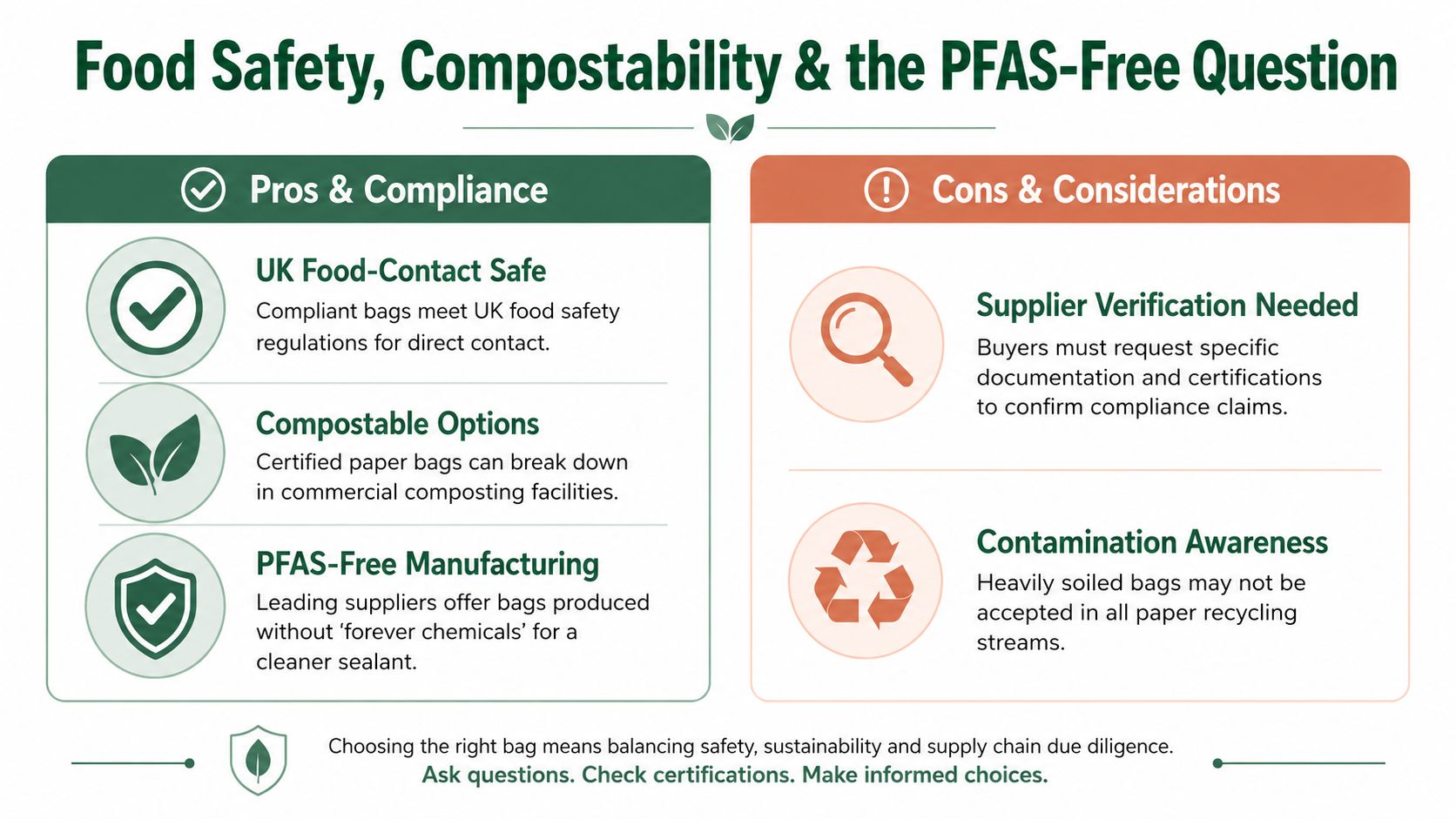
A greaseproof paper bag can look fine on the counter and still fail the buyer's brief if the food-contact paperwork is thin. In practice, I ask two separate questions. First, is the bag suitable for direct food contact. Second, does the supplier back that claim with proper compliance information, rather than a loose marketing line. The UK government food contact materials regulations set the framework buyers should be working within.
Why PFAS-free matters, but isn't a free upgrade
PFAS scrutiny is real in UK food packaging. CHEM Trust reported PFAS in packaging from 8 out of 9 major UK supermarkets, in 100% of takeaways tested, and said around 30% of screened packaging was likely to contain PFAS (CHEM Trust). The same reporting notes that greaseproof cake liners and similar paper food-contact products are among the formats where these chemicals can appear.
That makes a PFAS-free claim worth taking seriously, but it does not solve every packaging problem. A bag can be PFAS-free and still underperform if the food is very oily, full of steam, or held too long before handoff. I have seen plenty of samples that sound cleaner on paper but give up barrier strength earlier than a coated pack that was chosen with the product in mind.
Claims need paperwork, not just slogans
Recyclable, biodegradable, and commercially compostable are not interchangeable terms. A paper bag may still miss a household recycling route if it is food-soiled, and local UK guidance treats dirty greaseproof paper as contamination in paper recycling streams, as Barnsley Council shows in its bin guidance.
Buyer's question: what exactly supports the end-of-life claim, the fibre type, the coating, the soiling level, or the certification?
That question matters because suppliers often sell the end-of-life story more confidently than the pack itself. A bag may look better on a sustainability page, yet still be a poor fit for a bakery item that sweats in transit or a takeaway portion that stays warm for too long. For UK buyers, the trade-off is barrier performance versus disposal claim, not a simple green upgrade.
For food businesses, the practical test is straightforward. Ask which structure gives the grease control you need, which documents support the food-contact claim, and which disposal route still makes sense once the bag has touched food. For a more general reference point before ordering, Packaging Panda's food-safe packaging guidance is useful.
Practical Packing Tips to Reduce Leaks and Transit Damage
Leak complaints often get blamed on the paper, but the seam, bottom fold, and packing method deserve just as much attention. A bag can pass a grease test and still fail in the hand if the fold opens under the weight of warm food or the filling method crushes the base.
What improves real-world holding
Let steam vent for a moment before you seal or fold the pack. That reduces condensation softening, especially with hot bakery products. Overfilling pinch-bottom bags does the opposite, because it stresses the fold and gives oil a clear route to the weakest point.
Double-bagging can help, but only when the first bag is the wrong barrier for the product. It is a poor fix when the packer is trying to make up for handling that should have been controlled earlier. Matching hold time to bag barrier is usually more effective than adding extra paper and hoping for the best.
A bag that survives the oil test but splits at the seam has still failed the customer.
Courier and dispatch habits that cut damage
For e-commerce, keep greasy items inside a secondary paper sleeve or a stable outer box when the parcel has to travel further than the counter handover. Keep sauces separate from the main item. Stack flat packs so they do not bow in transit, and do not let a warm pack sit directly against a cold wall of the shipping carton.
If a packaging room is also handling sealing and bundling, browse packing tape options alongside the bag specification, because the outer closure matters when a food order is moving as part of a larger parcel. The same brief should cover the artwork and pack format too, so the bag choice, closure method, and printed finish all work together. For a practical guide to preparing print files, see Packaging Panda's bespoke packaging artwork advice.
- Vent steam first: reduces condensation and softening.
- Avoid overfill: protects seams and folds.
- Separate wet extras: sauces and dressings belong apart from the main item.
- Use outer support: a box or sleeve reduces courier movement.
- Test the hold window: do not assume the label tells the whole story.
A heavier GSM does not automatically fix leakage. Very often, the failure is barrier-related or moisture-related rather than a simple tear problem, so weight alone is the wrong lever. If the seal is weak or the fold is stressed, the bag can still let the customer down even when the paper itself looks strong.
Printing, Branding and Bespoke Orders for UK Businesses
A plain bag does the job. A branded bag does the job and carries the bakery's identity through the handover. For independents and growing online food brands, that usually makes print worth discussing, as long as the artwork and run size are realistic.
Print method should match the order size
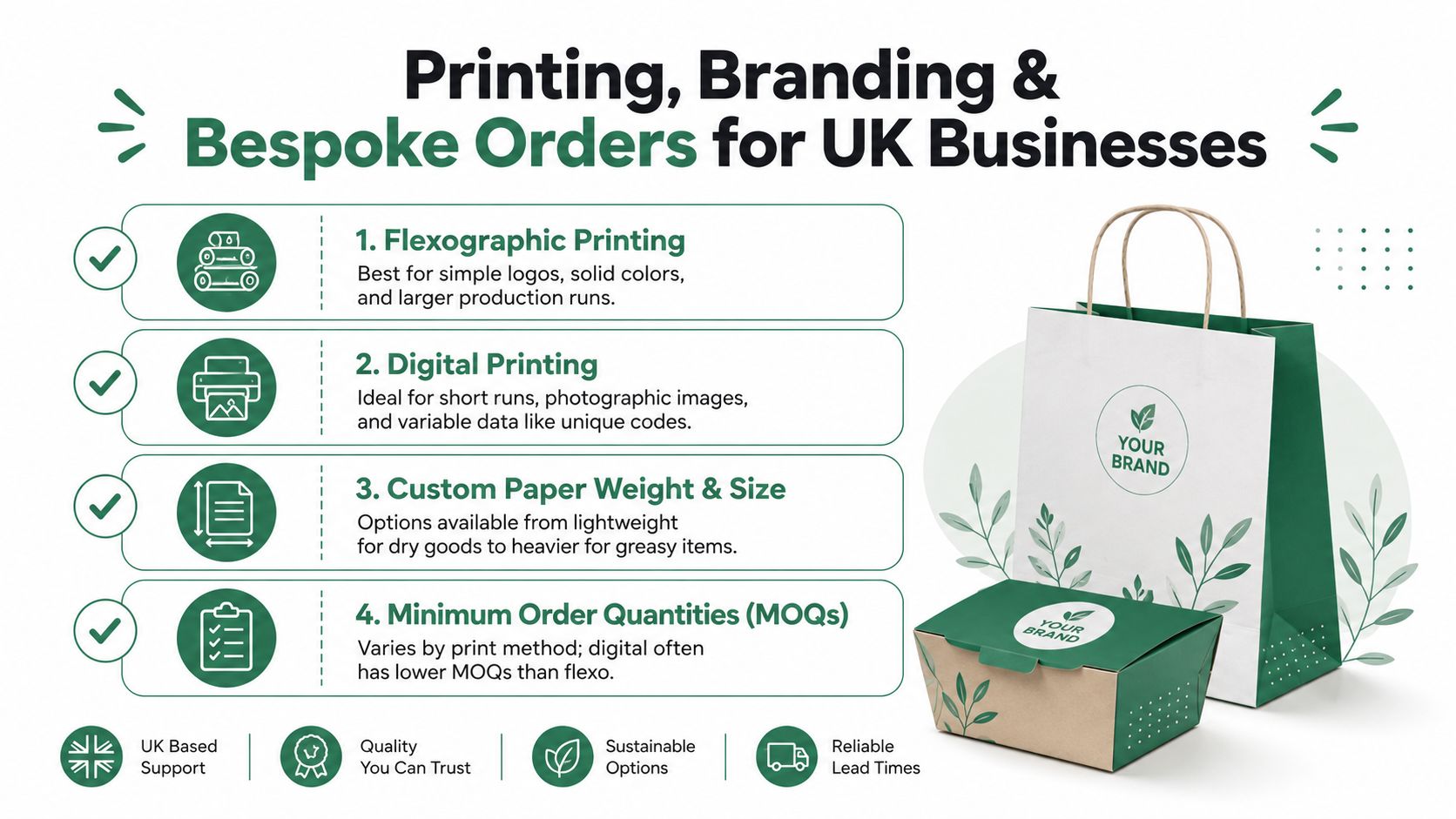
Flexo suits simple logos, solid colours, and larger runs. Digital is better for shorter runs, more complex artwork, and variable details. Offset can make sense for premium presentation when the budget and run size justify the setup.
Artwork has to be clean before it ever reaches the printer. Suppliers usually want vector files for logos and crisp line work, because muddy artwork gets worse on uncoated paper.
Pantone matching can help control colour, but on uncoated kraft it won't look identical to the same ink on coated stock. That's normal, not a defect. Window placement, gusset print areas, and inside print all affect the cost and the visual result, so a clear brief saves more money than a rushed correction later.
Minimums and lead times need planning
Many UK suppliers work with minimum runs in the low hundreds, which is fine for a busy bakery and less comfortable for a tiny start-up that wants to test a design. Bespoke print also brings lead-time implications that stock packaging doesn't have, so the order has to be tied to a sales plan rather than a last-minute shortage.
For brands that need a broader printed pack system, Packaging Panda also offers bespoke packaging options with custom sizes, shapes, and printed boxes, mailers, bags, and tubes, which can help align a greaseproof bag with the rest of the unboxing flow. The practical value is consistency, not novelty.
Buying Checklist and Common Questions Before You Order
A good order starts with a short checklist, not a catalogue dive. For a greaseproof paper bag, the buying decision usually comes down to format, KIT rating, GSM, window or no window, print method, food-contact documentation, PFAS-free status, end-of-life claim, minimum run, and lead time.
- Format: match the bag shape to pastries, burgers, bread, or pre-packed goods.
- Barrier level: ask for the KIT rating and relate it to the food's oil load.
- Paper weight: check GSM, but don't let it override barrier performance.
- Structure: inspect seam, bottom fold, and gusset behaviour.
- Print: confirm method, artwork file type, and colour expectations.
- Compliance: request food-contact confirmation and any PFAS-free evidence.
- Disposal claim: check whether recyclable, compostable, or biodegradable is supported.
- Commercial terms: confirm run size, lead time, and repeat-order consistency.
Are greaseproof bags leakproof
No, not by default. Grease resistance and leak resistance aren't the same thing, and seam strength, base construction, and moisture softening can still cause failure even when the paper resists oil well. A bag should be tested with the actual food and the actual hold time, not just on its label.
Is PFAS-free always the better choice
Not necessarily. PFAS-free can be the right choice where the food and hold time suit the barrier, but the pack still has to perform in real bakery or takeaway conditions. If the food is oily or steam-heavy, the better option may be a different structure, coating, or pack format rather than a purity claim alone.
Is greaseproof paper recyclable in UK household collections
Not when it's food-soiled in many local systems. UK council guidance still treats food-contaminated greaseproof paper as a contaminant in the paper stream, so the disposal claim depends on cleanliness, local rules, and the exact construction of the bag. That's why the barrier spec and the end-of-life claim have to be checked together.
For buyers ready to compare wholesale formats, Packaging Panda's paper packaging range and related carrier bag options are a sensible place to start because the choice can be matched to bakery, takeaway, or dispatch use rather than treated as a one-size-fits-all purchase.
If you're pricing your next paper pack order, line up the bag format, barrier level, and disposal claim before you sign off the artwork. Visit Packaging Panda to review paper packaging, bakery packaging, and bespoke options, then use the spec sheet to choose a bag that fits the food, the route home, and the waste route after that.