UK Export Packaging Guide 2026: Customs & Solutions
A first international order usually feels like a win right up to the moment the dispatch team has to pack it. The carton that works for UK courier deliveries suddenly looks under-specified. Questions pile up fast. Does the pallet need a special mark? Is the outer pack too heavy? Will customs stop it because the paperwork and packaging don't line up?
Shop export-grade pallet wrap →
That's where many UK SMEs misread the job. They treat export packaging as a stronger box problem. It isn't. It's a margin protection problem. The right pack has to survive handling, support compliance, reduce avoidable border friction, and avoid building unnecessary future cost into the format itself.
The UK context makes that even sharper. Packaging choices now sit closer to regulation, recycling obligations, and customs scrutiny than many first-time exporters expect. A shipment can arrive physically intact and still become expensive because the wood packaging isn't compliant, the specification is overbuilt, or the marking and security features create questions at the border.
Table of Contents
- Your First International Order and the Packaging Challenge
- Understanding Export Packaging as a Complete System
- Navigating UK Legal and Customs Requirements
- Choosing the Right Materials for Goods and Transit Mode
- Best Practices for Palletisation and Protective Packing
- The Financial Case for Sustainable Export Packaging
- Your UK Export Packing and Documentation Checklist
Your First International Order and the Packaging Challenge
The first export order often starts with a simple warehouse assumption. Use the same carton, add more tape, book a courier, and get it out the door. That approach works just often enough in domestic fulfilment to feel sensible. In international shipping, it's where expensive mistakes begin.
A small UK seller sending goods to Manchester is packing for a relatively short, familiar network. A seller sending the same goods overseas is packing for repeated handling points, customs inspection risk, longer storage periods, and hand-offs between different operators. The packaging now has to do more than protect the product. It has to communicate, comply, and stay efficient.
The most common first-shipment error isn't underestimating breakage alone. It's separating packaging from the rest of the export process. The box gets chosen by one person, the documents by another, and the freight booking by someone else. Then the shipment reaches a border and the weaknesses line up.
Practical rule: Export packaging should be specified at the same time as the shipping method, paperwork, and destination requirements.
That matters because some of the biggest avoidable costs don't come from visible damage. They come from repacking, customs questions, rejected wood packaging, over-specified materials, and formats that are harder to justify under UK packaging rules. For an SME, those costs hit cash flow quickly.
A good export pack does four jobs at once:
- Protects the goods against movement, stacking pressure, and handling.
- Supports compliance with UK packaging and wood packaging requirements.
- Reduces avoidable checks by using clear marks, sound structure, and secure closure.
- Controls cost by keeping material use proportionate to the product and route.
That's why export packaging should be treated as part of the shipment design, not a last-minute warehouse task.
Understanding Export Packaging as a Complete System
Export packaging works best when it's treated as a system, not a single box. A domestic parcel might cope with a straightforward courier route in a standard carton. An export consignment may face consolidation, unloading, reloading, storage, vibration, compression, and shifts in temperature or humidity. That changes the design brief completely.
Why domestic packing often fails abroad
A useful comparison is clothing. Packing for a local parcel run is like dressing for a short walk. Export packing is dressing for an exposed expedition. The outer layer matters, but so do the base layers and the way they work together.
That's why a heavier outer carton on its own often doesn't solve the problem. If the item moves inside, the stronger box just contains the damage more effectively. If the outer packaging is sound but the pallet is unstable, the whole load can still lean, crush, or open under strain.
For electronics, the system approach becomes even clearer. John Pipe's export standards guidance notes that each item should be individually wrapped in anti-static bags and secured within cushioned boxes placed into larger treated wood crates meeting ISPM 15 standards. That's a multi-layer protective system, not a single packaging decision.
The three layers that work together
Most export packaging decisions sit across three layers:
-
Primary packaging
This is the layer in direct contact with the product. It may prevent scuffing, electrostatic discharge, contamination, or surface damage. -
Secondary packaging
This groups or cushions the product. It controls movement and absorbs routine shocks. Products that rattle inside a box are already under-packed. -
Tertiary packaging
This is the freight layer. Pallets, stretch wrap, straps, edge protection, and export crates all sit here. This layer keeps the load stable through handling and transit.
A practical export specification asks what each layer is doing. If no layer is assigned to control moisture, vibration, static, or crush risk, those threats are being left to chance.
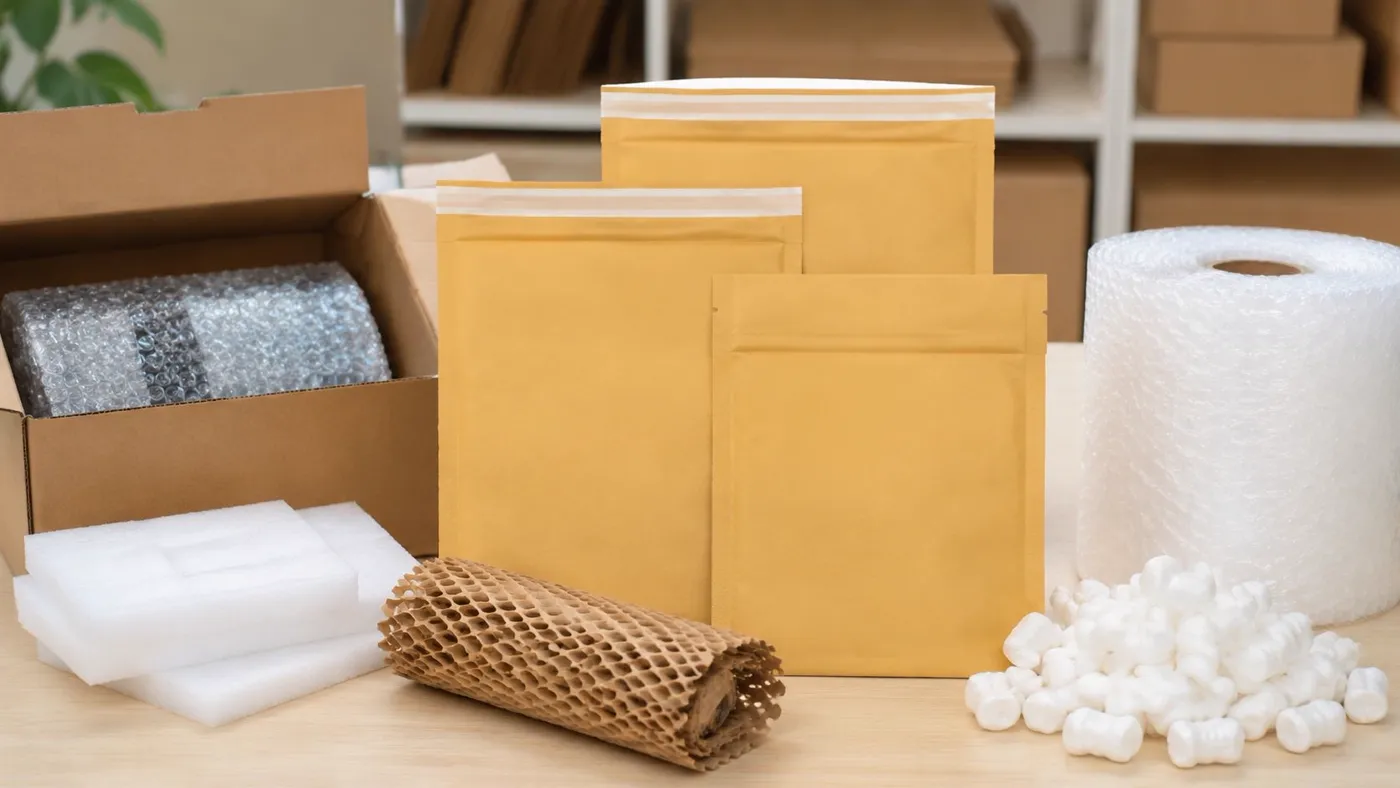
For day-to-day packing operations, Protective Packaging covers common transit materials such as padded bags, bubble mailers, foam inserts, honeycomb sleeves and void fill. Those materials are useful when they're chosen for a specific role inside the wider export system, not added randomly at the bench.
The safest export pack is rarely the one with the most material. It's the one where each layer has a clear job.
Navigating UK Legal and Customs Requirements
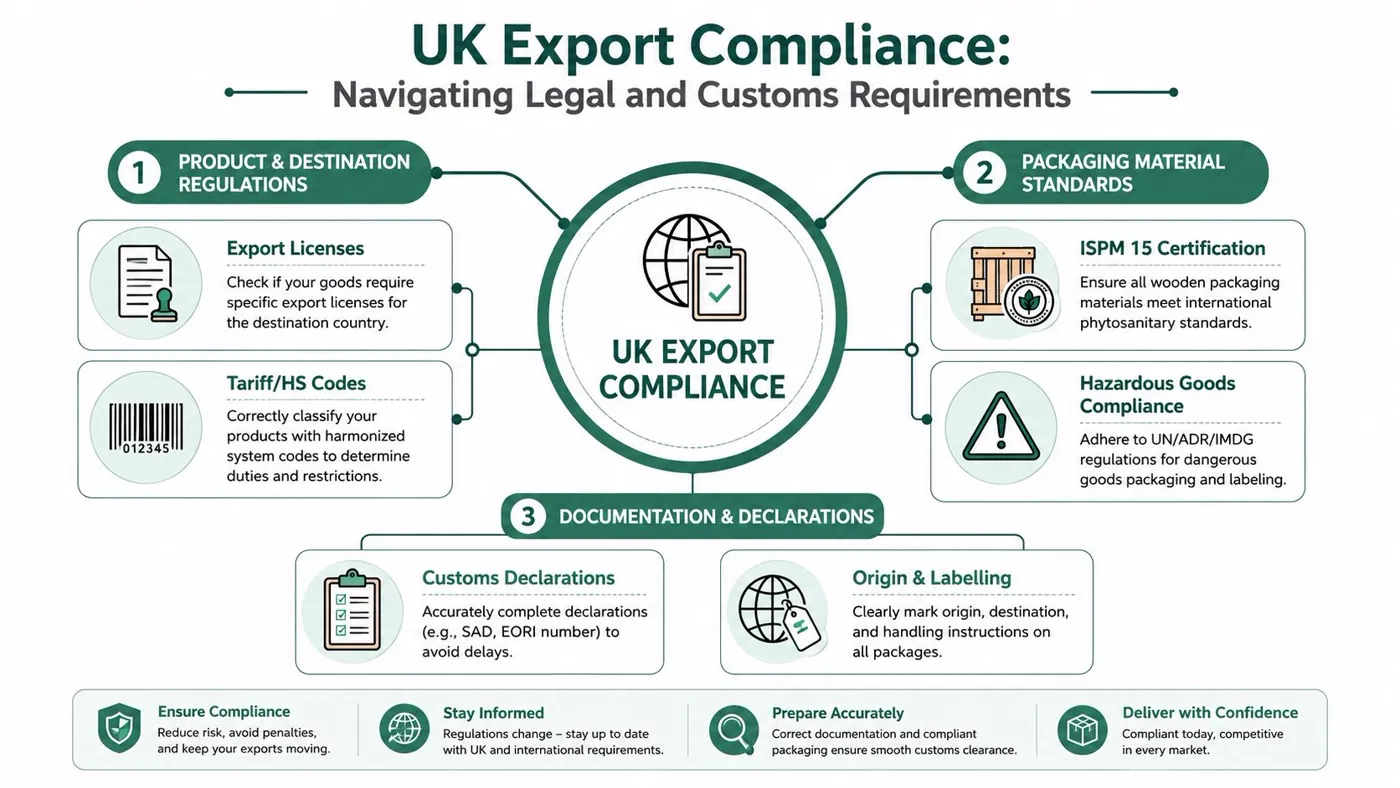
A first export shipment can leave the warehouse looking tidy and still become expensive at the border. I see this with UK SMEs that focus on preventing breakage but give less attention to whether the pallet, labels, and paperwork stand up to inspection. Export packaging has to do both jobs. Protect the goods and remove reasons for customs, carriers, or inspectors to stop the load.
Wood packaging rules that can't be ignored
If you use wood packaging material such as pallets, crates, cases, or dunnage, it has to comply with ISPM 15. The UK government guidance on wood packaging material sets out the treatment and marking rules, including heat treatment and accepted marks.
The costly mistake is usually not the main pallet. It is the last-minute timber brace, repair block, or swapped pallet added on the day of dispatch. One untreated piece can put the whole shipment at risk of inspection, repacking, or refusal.
Check these points before collection:
- ISPM 15 marks are present and readable on each relevant wood item
- Stamps are not obscured or damaged by paint, stretch wrap, or repairs
- All added timber parts are compliant, including braces, chocks, and replacement boards
- Pallet supply is controlled so warehouse teams do not pull in unverified stock under time pressure
That check takes minutes. Reworking a held shipment does not.
The UK packaging rules behind the box choice
Box choice also has a legal and cost angle. UK packaging rules require businesses to keep packaging limited to the amount needed for the packed product, its safety, hygiene, and acceptance. For an exporter, that means you should be able to explain why the pack size, board grade, void fill, and closures were chosen for that product and route.
That matters for your bottom line as much as compliance. Over-packing increases freight cost, storage space, and packaging waste exposure. Under-packing creates claims and returns. The right answer is a specification you can justify.
Documentation matters here too. If Trading Standards asks how a pack was specified, “that's what we usually use” is weak evidence. Keep a simple compliance file with the pack format, material details, supplier information, and the reason the design is suitable for the shipment. If your team is still getting to grips with producer obligations, Packaging Panda's guide to UK packaging waste regulations and EPR responsibilities is a useful operational reference.
A practical file usually includes:
- Approved pack specifications with dimensions and materials
- Route-based justification for why that format is suitable
- Supplier declarations or records for specialist components
- Test notes or internal reviews where relevant
- Version control so the warehouse packs to the current standard
Customs classification and border friction
Customs delays are not caused by packaging alone, but packaging often creates the questions that slow clearance. Outer markings, consignee details, carton counts, country of origin marking where required, and tamper evidence all need to match the documents. If the paperwork says industrial components and the outer pack gives only vague or conflicting information, your shipment is harder to assess quickly.
Export packaging protects margin, not just product. A load that gets examined, relabelled, or held for clarification costs money even if nothing is damaged.
Classification discipline matters as well. If your team ships to the US and is still aligning product descriptions with customs paperwork, this primer on US HTS codes is a helpful starting point. The key point is consistency. The invoice, packing list, labels, and goods presentation should all describe the same product in the same way.
A shipment clears faster when the packaging and the paperwork support the same story.
Choosing the Right Materials for Goods and Transit Mode
A carton that performs well on a next-day UK pallet can fail badly on its first export run. The route changes the risks. So does the charging model. Air freight punishes wasted size and weight, while sea freight exposes weak materials to longer storage, stacking pressure, and damp conditions that turn a minor packaging shortcut into a landed-cost problem.
Start with the transit mode, then work back to the product.
Match the material to the route
For air freight, the target is controlled protection. Use the lightest specification that still holds its shape, protects the product, and survives handling. Oversized boxes and heavy fillers do more than waste material. They can push up chargeable weight and make a low-margin order expensive before it even clears the airport.
Sea freight needs more tolerance built in. Cartons may sit longer, carry more top load, and move through humid conditions even when the container itself is sound. Double wall corrugate, better sealing, moisture-aware inner protection, and stronger unitisation are often justified here because the cost of a failure is not limited to breakage. Delays, repacking, and rejected deliveries all eat margin.
Road freight inside Europe usually sits between those extremes. The load still needs compression strength and internal restraint, but you may not need the same moisture protection or board grade you would specify for a long sea journey. Good export packaging is not about choosing the heaviest format available. It is about choosing enough pack for the route, without paying to ship unnecessary material.
Regulated goods need another layer of planning. If the product falls into a controlled category, the pack format, absorbents, labels, and closures may all be affected. A practical overview of shipping hazardous materials safely is useful before you finalise the specification or book the carrier.
Match the pack to the product
Different products fail in different ways. Glassware needs cushioning and crush resistance. Electronics may need anti-static protection as well as shock control. Rolled prints and technical drawings usually need end protection and shape retention, which is why a heavy-duty tube often outperforms a folded carton. Dense metal components may not need much cushioning, but they can burst through an under-specified box if the board grade is too light.
SMEs often waste money in this area.
A single house-standard box feels efficient because it simplifies buying and picking. In practice, it creates void space around small items and adds unnecessary board weight to light products. One raises freight and filler costs. The other reduces packing efficiency without adding useful protection. Measuring each SKU or product family properly before you set carton sizes avoids both problems. Packaging Panda's guide on how to measure boxes correctly for export cartons is a good reference if your team is standardising pack specs for the first time.
The best material choice usually comes from asking three practical questions:
- Will the product move inside the pack?
- Will the outer pack hold its strength for the full journey?
- Will the pack protect margin, or add avoidable freight and handling cost?
Export Packaging Material Selector
| Material | Best for Air Freight | Best for Sea Freight | Best for Road Freight | Key Benefit |
|---|---|---|---|---|
| Single wall corrugated box | Suitable for lighter, low-risk items where size and weight need control | Usually limited on tougher or longer export routes | Suitable for many routine shipments | Keeps material use lean |
| Double wall corrugated box | Suitable where extra strength is needed without moving to wood | Well suited for many export consignments | Well suited | Better stacking strength |
| Anti-static bag with cushioned inner box | Suitable where electronics need protection without excessive mass | Suitable when paired with a stronger outer pack | Suitable | Helps manage electrostatic risk |
| Heavy-duty cardboard tube | Suitable for posters, plans, and rolled prints | Suitable if sealed well and protected from crushing | Suitable | Protects edges and shape |
| Foam inserts or structured void fill | Useful where movement control matters | Useful where vibration and internal movement are concerns | Useful | Holds product in position |
| ISPM 15 treated wood crate or pallet | Used where product weight or sensitivity justifies it | Often used for heavier or high-risk loads | Used for palletised freight | Strong freight platform and compliance when marked |
The right answer is rarely the cheapest unit price or the thickest material. It is the pack that gets the goods through the route, through handling, and through arrival checks without adding avoidable weight, wasted space, or rework.
Best Practices for Palletisation and Protective Packing
Well-packed cartons can still arrive damaged if the pallet is unstable. Freight networks handle units, not intentions. If the load leans, overhangs, shifts, or crushes under itself, the individual carton quality matters much less.
Building a stable pallet
Start with the footprint. Every carton should sit within the pallet edge. Overhang is a common shortcut in busy warehouses, but it exposes corners to impact and weakens the stack. A load that fits the pallet properly is easier to wrap, easier to strap, and less likely to deform.
Weight distribution matters next. Heavier cartons belong low down and lighter cartons higher up. The top of the load should be level where possible. Mixed heights create weak points that invite movement and strap pressure in the wrong places.
A practical pallet build usually follows this order:
-
Check the pallet condition
Don't build export freight on damaged boards or weak deck surfaces. -
Stack for strength
Use a pattern that supports the load rather than chasing speed alone. Stability matters more than shaving a few seconds off the build. -
Protect vertical edges
Edge protection helps prevent straps or wrap from cutting into outer cartons. Packaging Panda's guide to edge protector foam is a useful reference when a load includes vulnerable corners or printed cartons. -
Wrap with purpose
Stretch wrap should secure the load to the pallet base and hold the stack as one unit. Random passes around the middle won't do that.
Poor palletisation doesn't just cause damage. It creates handling problems that spread across loading, unloading, and storage.
Protecting the contents inside the carton
Internal protection should stop movement, not solely fill empty space. If an item can shift from one side of the carton to the other, the pack hasn't been finished yet. Export routes expose that weakness quickly because the parcel or carton experiences repeated vibration and directional change.
Three checks help at the bench:
- Shake test by hand. If the contents move noticeably, add structured support, not just loose filler.
- Corner check. Fragile products often fail first at corners and edges, not broad flat surfaces.
- Closure check. The seal has to match the carton load. Light tape on a strained box flap is a known failure point.
Moisture risk should also be considered before dispatch. Sea-bound freight and long transit cycles can expose even strong board to softening if the pack design ignores the environment. That doesn't always mean adding complexity. Often it means using the correct board grade, secure sealing, and avoiding badly stored packaging materials before use.
The Financial Case for Sustainable Export Packaging
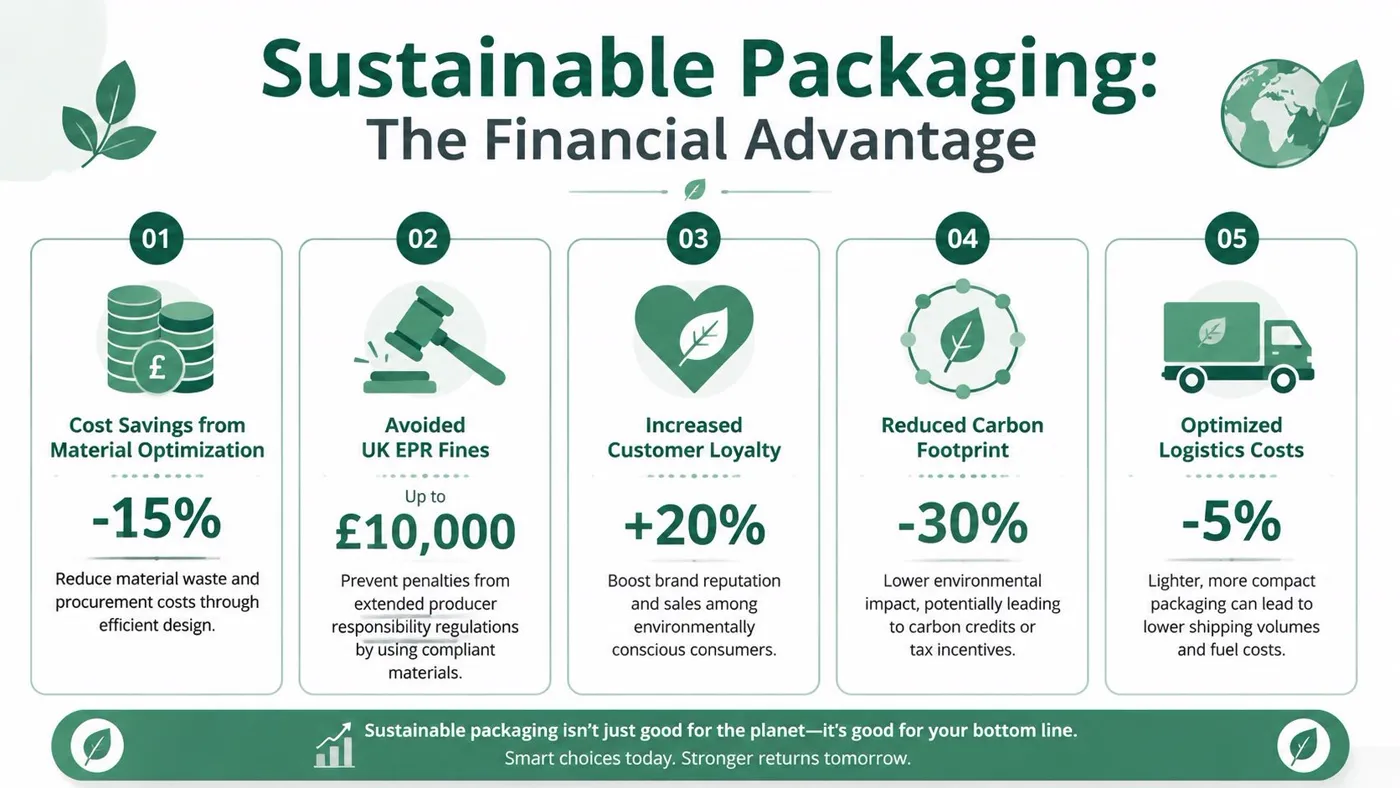
Sustainable export packaging used to be framed mainly as a brand preference. That's no longer enough. For UK exporters, it's becoming a cost-control issue tied to how packaging is designed, what it's made from, and how recoverable it is at end of life.
Why sustainability now affects cost control
The UK generates over 11 million tonnes of packaging waste annually, with plastic accounting for nearly 2.5 million tonnes, according to the UK packaging waste and recycling figures discussed here. The same source notes that provisional 2024 figures indicate between 64.1% and 75.2% of UK packaging waste was recycled, and paper and cardboard reached 74.3% under methodology 1 and 86.4% under methodology 2. That context matters because it shows why fibre-based export formats remain central to practical sustainability planning.
There's also a direct regulatory cost signal. Eunomia's analysis of the UK EPR scheme says the upcoming system is designed to financially penalise non-recyclable formats and to “stimulate and reward advanced structural packaging design” that includes “higher levels of recycled content”. In plain terms, format choice is moving closer to fee exposure.
Plastic strategy is part of the same picture. In 2023, the UK exported more than 685,000 tonnes of plastic packaging declared as recycled, representing 51% of the total 1,186,000 tonnes recycled domestically that year, according to RECOUP's report on exporting plastic packaging resources. That report also notes that around 150,000 tonnes, or 22%, went to non-OECD countries, up from 13% in 2022 and 6% in 2021. It further notes the UK Plastic Packaging Tax is set at £217.85 per tonne for materials containing less than 30% recycled plastic, effective 1 April 2025.
What better structural design actually means
For an SME, the practical question isn't whether sustainable packaging sounds good. It's whether the pack can be redesigned to stay protective while using materials that are easier to recover and easier to justify under future fee pressure.
That usually means work in three areas:
-
Right-sizing
Remove unnecessary volume before adding greener claims. Empty space is still waste, even in recyclable board. -
Material simplification
Mixed-material formats can become awkward to recover. Cleaner structures are often easier for both operations and compliance. -
Recycled content and recoverability
The structure should be chosen with end-of-life reality in mind, not just shelf appearance.
A cross-border perspective can also help when UK exporters compare market expectations and packaging formats used for Europe-facing trade. This guide for Indian exporters to Europe is useful as a reference point for how packaging decisions affect overseas presentation and compliance thinking.
Sustainable export packaging isn't just lighter, greener wrapping. It's structural design that protects goods without building avoidable compliance cost into the format.
Your UK Export Packing and Documentation Checklist
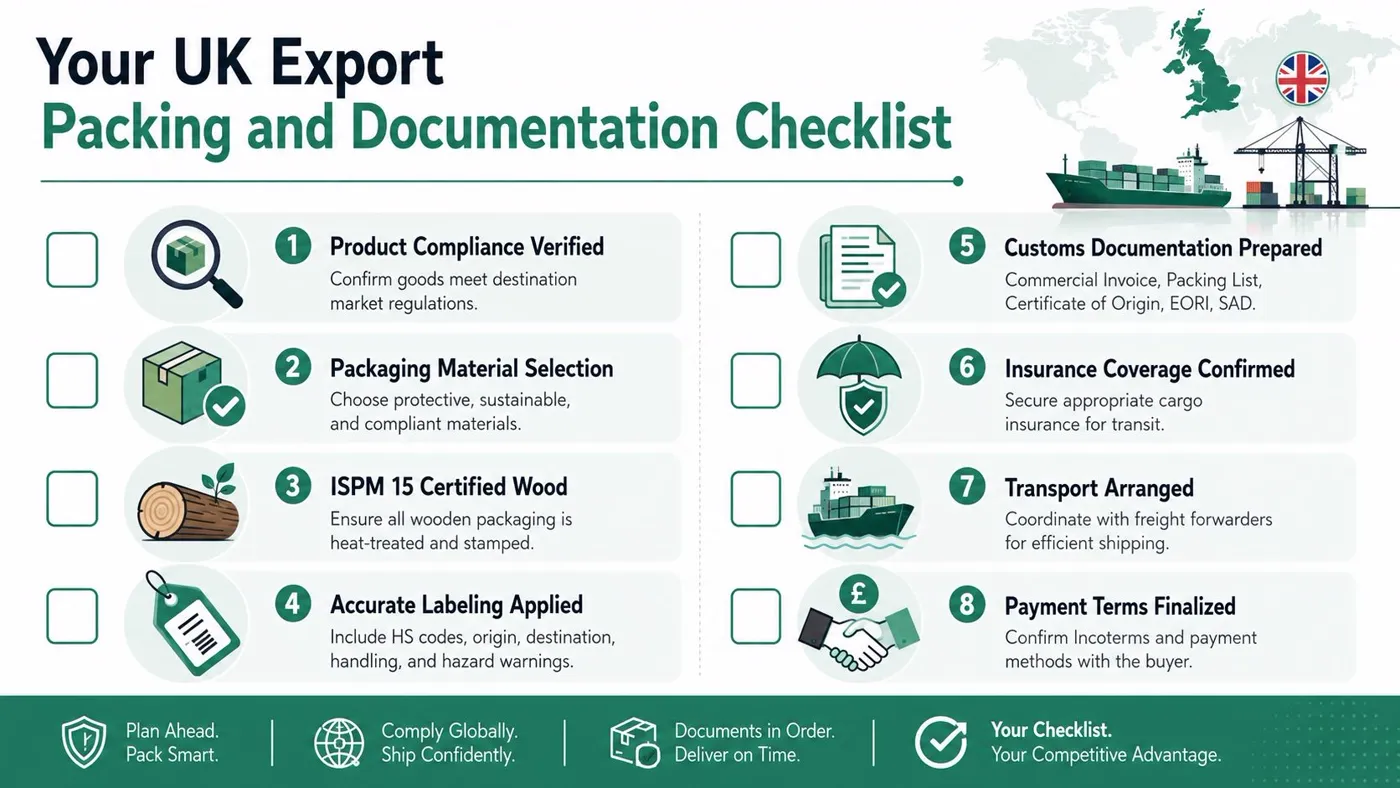
A first export order often goes wrong in familiar ways. The goods are packed well enough to survive the trip, but the pallet carries the wrong timber mark, the carton description does not match the invoice, or the labels are hard to read once the stretch wrap is on. Those are not minor admin slips. They lead to holds, repacking costs, and awkward calls with a customer who expected delivery this week.
The practical fix is a pre-dispatch check encompassing the pack, the markings, and the paperwork as one release process. If any one of those three fails, the shipment is not ready.
Physical packing checks
Check the product first, then the shipping unit.
-
Product fit checked
The product should sit securely in its primary and secondary packaging with no avoidable internal movement. -
Outer packaging appropriate to the route
Choose board grade, cushioning, and closure around the real journey. Air freight, parcel networks, and groupage pallets place different stresses on the pack. -
Wood packaging verified
If pallets, crates, or timber supports are used, the ISPM 15 mark must be legible and the unit must be suitable for export use. -
Load stability confirmed
Palletised freight should have even weight distribution, no carton overhang, and secure wrap or strapping.
For high-value or sensitive goods, add tamper-evident closure where it serves a clear purpose. I usually recommend it when a shipment will pass through several depots or where customs inspection risk is higher, because it helps show whether the pack has been opened in transit.
Labelling and customs checks
Outer markings should help a warehouse team and a customs officer identify the shipment quickly.
-
Consignee and shipper details clear
Labels should be readable, durable, and placed consistently. -
Handling marks used sensibly
Use only the markings that apply. Too many symbols create confusion and make the important instructions easier to miss. -
Product description aligned with paperwork
The carton marks, packing list, and commercial invoice should describe the same goods in the same practical terms.
As noted earlier, UK exporters continue to face border friction from paperwork and control checks. Clear, consistent marking will not remove every inspection, but it does reduce the chance of avoidable questions caused by vague descriptions, mismatched carton counts, or poorly identified pallets.
Documentation checks before dispatch
A shipment can be packed properly and still miss its delivery window because the document set is weak. Before release, confirm:
-
Commercial invoice completed accurately
The description, value, and trading details should be internally consistent. -
Packing list matches the physical shipment
Carton counts, pallet counts, weights, and contents should line up with what is loaded. -
Classification and origin records reviewed
Tariff treatment and country-of-origin details should be checked before booking, not after a query from the broker or customer. -
Internal compliance records filed
Keep the packaging specification and supporting documentation in the shipment file. That matters if questions come back later on packaging materials, timber compliance, or EPR-related data capture. -
Buyer-facing presentation considered
Export packaging still represents the brand. A right-sized, neat, clearly finished pack gives a better first impression at destination, especially for e-commerce orders, samples, and wholesale launches.
The most reliable export shipment is the one a warehouse team, carrier, customs officer, and buyer can all understand at a glance.
Put a print-and-use checklist at the packing bench and dispatch desk. If the team cannot verify the pack, the labels, and the documents in one pass, hold the shipment and fix it before collection.
Packaging Panda supports UK businesses with wholesale packaging materials, including sustainable options and made-to-order formats for shipping, mailing, protective packing, and security applications. For teams preparing export consignments, the practical starting point is choosing a pack format that fits the route, complies with the relevant rules, and does not add avoidable cost. More information is available from Packaging Panda.