Eco Friendly Mailing Bags: A UK Business Guide to MOQs
A lot of UK e-commerce businesses hit the same wall at the same moment. They've finally decided to stop sending orders in plain, forgettable packaging. They want branded eco friendly mailing bags that look better, support the brand story, and don't create an environmental contradiction every time a parcel leaves the warehouse.
Then the supplier comes back with a minimum order quantity that feels built for someone else's business, not theirs.
That's where packaging decisions stop being a design exercise and become an operations problem. Stock has to fit somewhere. Cash has to stay available for ads, inventory, and fulfilment. And the wrong “eco” choice can leave a business holding thousands of bags that are expensive, awkward to dispose of, or not practical in UK waste streams.
Table of Contents
- The Small Business Packaging Dilemma
- Decoding MOQs in the Packaging World
- The Hidden Costs of a High MOQ
- Smart Strategies to Navigate High MOQs
- Choosing the Right Eco Mailer in the UK
- Finding a Flexible UK Packaging Partner
The Small Business Packaging Dilemma
A growing seller usually starts with a sensible goal. Replace generic packaging with something cleaner, more branded, and more responsible. For apparel, accessories, prints, and other non-fragile products, eco friendly mailing bags often look like the obvious answer.
The trouble starts after the sample stage. The bag looks right. The material sounds right. The print proof looks strong. Then the order requirement lands, and the quantity is far beyond what the business can comfortably store or pay for.
That problem gets worse when the business is still learning its dispatch pattern. One month might be driven by marketplace orders, the next by website sales, and the quarter after that by a seasonal push. Packaging bought too early, in too much volume, can lock a company into decisions it hasn't earned the data to make yet.
Small businesses rarely have a packaging problem on its own. They have a stock problem, a cash-flow problem, and a fulfilment problem wrapped into one.
There's also the delivery side to think about. A branded mailer doesn't work in isolation. It has to suit picking, packing, carrier handling, returns, and local drop patterns. Teams reviewing their wider dispatch process often benefit from thinking beyond the bag itself and looking at optimising local delivery operations as part of the same workflow.
Where the frustration usually comes from
Most buyers aren't objecting to buying in volume. They're objecting to buying blind.
A business may still be testing:
- Order mix: whether most shipments fit one core size or several.
- Brand direction: whether current artwork will survive the next refresh.
- Material preference: whether paper, recycled poly, or compostable film works best in day-to-day fulfilment.
- Customer messaging: whether buyers respond better to a premium printed bag or a simpler pack with clear disposal guidance.
That's why MOQ pressure feels so sharp at this stage. The business isn't just buying bags. It's committing to one operational model before it has enough evidence.
Decoding MOQs in the Packaging World
A growing retailer might only need a few hundred eco friendly mailing bags to test a new size or seasonal insert. The supplier may still quote a minimum that feels far above what the business can use sensibly in the next few months.
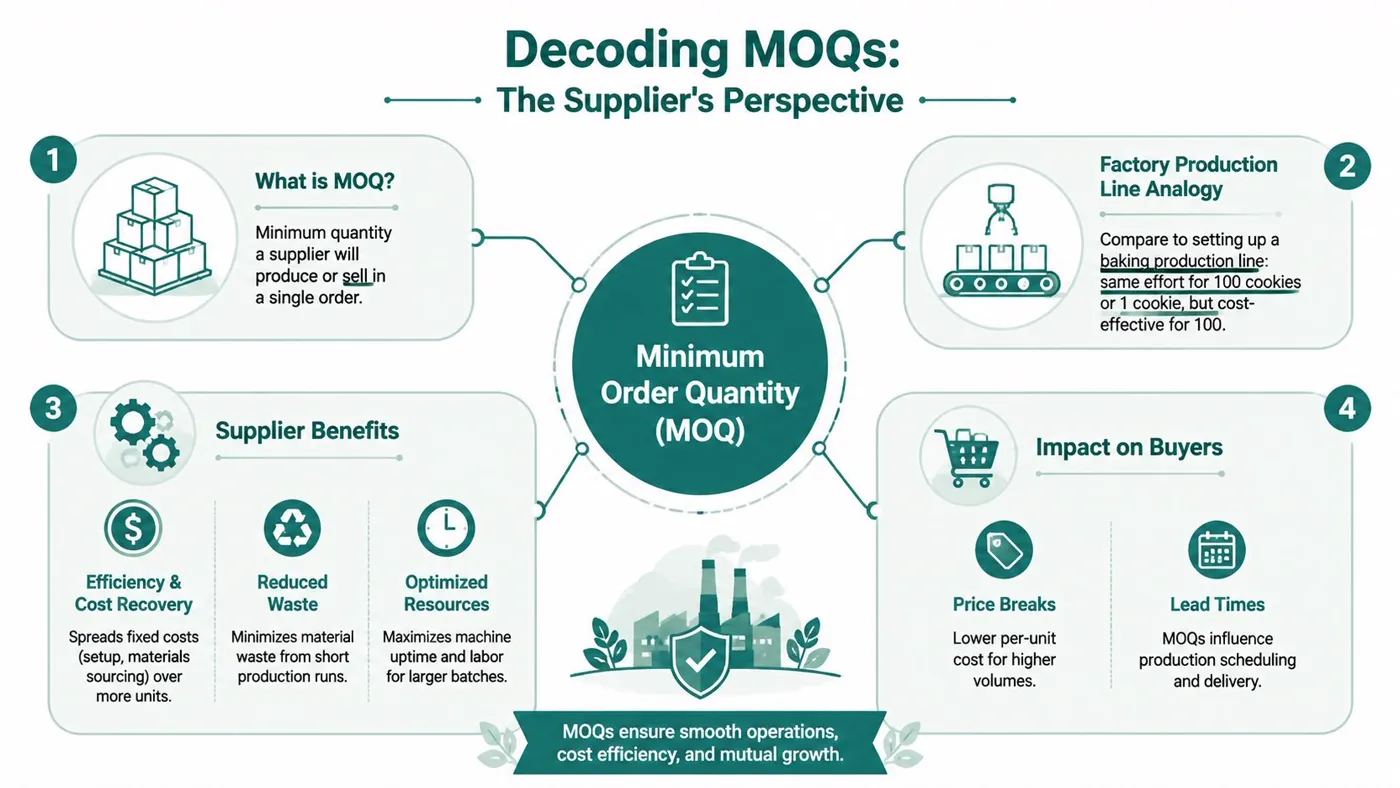
That usually comes down to how packaging is made, not arbitrary pricing. A minimum order quantity exists because the first bag carries setup, sourcing, and production costs that do not disappear just because the run is small.
The costs that sit behind the minimum
Before a custom mailer is packed into a carton, a supplier may already have paid for material allocation, print preparation, machine time, and quality checks. Those costs are spread across the run. If the run is too short, the unit cost rises fast.
In practice, MOQ is usually driven by a few factors:
- Machine setup: print registration, sealing temperatures, cutter settings, and test output all take operator time.
- Material purchasing: recycled film, paper grades, or compostable substrates may come with their own supplier minimums.
- Artwork preparation: custom printing can involve origination, plate charges, or digital press setup.
- Waste allowance: short runs often create a higher proportion of startup waste against usable finished stock.
This matters for buyers because the right question is not “Why is the MOQ so high?” It is “Which part of the job is forcing it up?”
A material-led MOQ can sometimes be solved by changing substrate or gauge. A print-led MOQ may be reduced by using fewer colours, simpler artwork, or a stock size with one-colour branding. A run-length MOQ usually points to factory efficiency, which is harder to shift unless the supplier offers shared production slots.
Why eco options often come with stricter minimums
Eco products can be less flexible than they first appear. That is one of the least understood parts of buying sustainable packaging.
If a business wants compostable film, high recycled content, or a specific paper construction, the converter may need to buy that material in larger batches than standard poly. Certified materials also narrow the supply chain. Fewer mills and film producers means fewer options for small-volume custom work.
We also see buyers get caught by the label rather than the end use. “Biodegradable” is a common example. If a bag only breaks down in specific conditions, or performs poorly in damp storage, it may create more waste rather than less. Disposal claims and material choice should be checked against how the pack will be used and disposed of in the UK, especially with tighter packaging waste regulations for UK businesses.
Practical rule: Ask the supplier whether the MOQ is driven by material, print, or production scheduling. Each one has a different fix.
For many small brands, the sensible starting point is a stock size from our mailing bags and mailers range, then adding branding with labels, tape, or inserts while order data builds up. We recommend that route often because it keeps cash free, avoids overcommitting to one format, and helps teams test what is sustainable in day-to-day fulfilment rather than what sounds best on a product page.
The Hidden Costs of a High MOQ
The unit price on a large order can look attractive. The total business cost often doesn't.
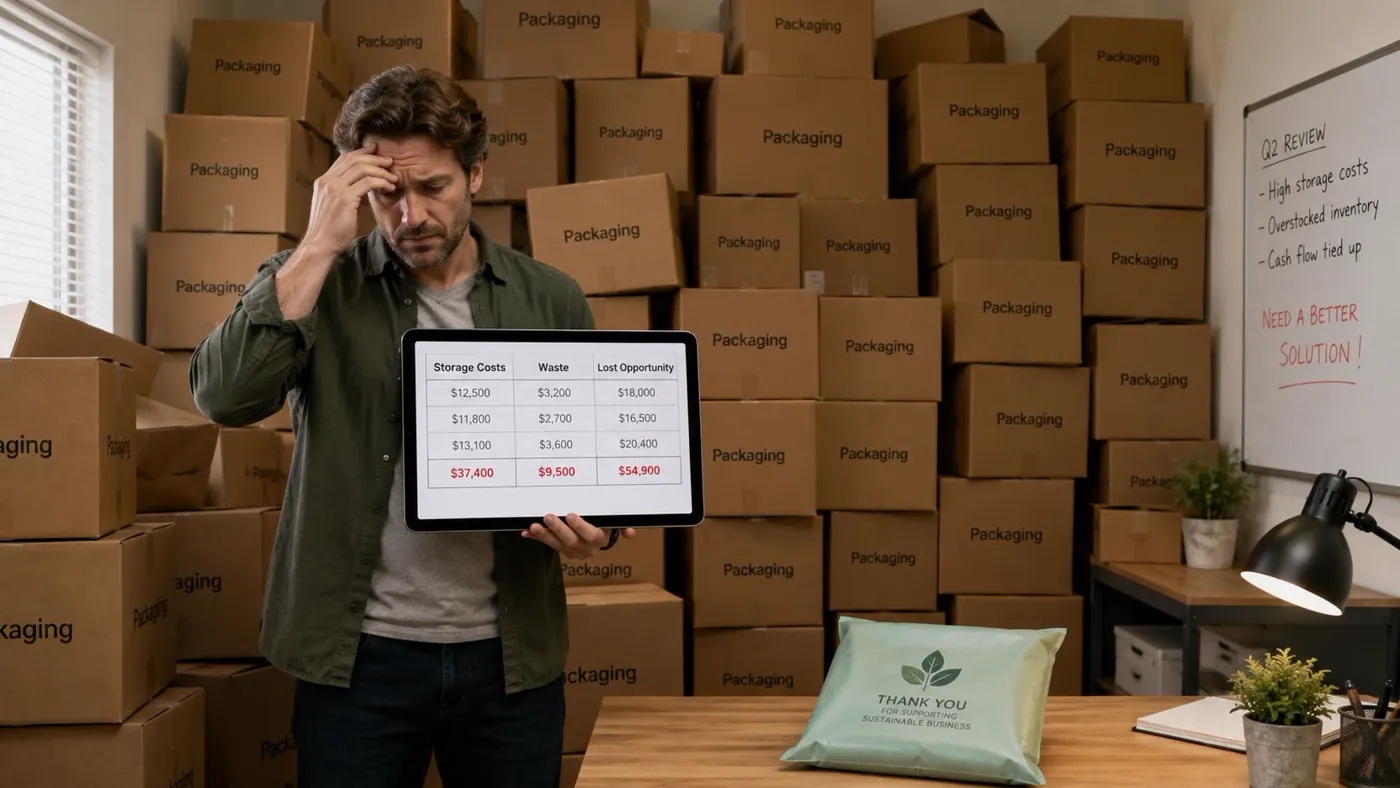
A high MOQ changes more than the packaging line on a purchase order. It affects storage, working capital, packaging flexibility, and disposal risk if the specification turns out to be wrong.
Cash tied up in the wrong place
For a small but growing retailer, packaging stock competes with stock that sells. Money tied up in months of mailers can't be used for product development, seasonal buys, or acquisition spend.
Storage adds another layer. Even compact bags take space once packed in trade cartons. If the business is already running a tight fulfilment area, excess packaging stock creates friction in daily picking and replenishment.
The weight mistake gets repeated thousands of times
Material choice matters more when the order is too big to correct quickly. In the UK, kraft paper mailers can add 20 to 30% extra weight compared with 1.5-mil recycled poly, which can increase shipping costs and carbon emissions where courier pricing tiers by weight, as noted in EcoEnclose's guide to sustainable inner packaging.
If a buyer commits to the wrong structure because the MOQ forced a single large decision, that penalty carries through the whole batch.
A similar issue shows up when businesses buy protective formats they don't consistently need. Poly Gloss Bubble Bags provide bubble-lined, water-resistant protection and come in colours including yellow, orange, blue, pink, white, red and robin egg blue. They make sense for selected products, but not as a universal default for items that would travel safely in a lighter mailer.
Obsolescence is a real packaging cost
Custom printed stock becomes obsolete faster than many founders expect.
A batch can become awkward or unusable after:
- A rebrand: logo, colours, or tone shifts.
- A compliance change: disposal wording or pack information needs updating.
- An address update: old details remain printed on thousands of units.
- A product pivot: the business starts shipping a different average order profile.
Businesses also need to keep one eye on compliance duties around packaging and waste. Anyone reviewing stock strategy alongside legal obligations should understand the broader UK context around packaging waste regulations.
Buy enough packaging to support growth. Don't buy so much that the packaging starts controlling the business.
Smart Strategies to Navigate High MOQs
The best response to a high MOQ isn't to abandon custom packaging. It's to remove risk from the decision.
Small UK businesses usually get better results when they treat mailers as a phased procurement decision rather than a one-off branding purchase. That changes the questions asked at quote stage and usually leads to a more workable outcome.
Start with the product, not the print
A lot of over-ordering starts with design enthusiasm instead of packing data.
Before ordering, the team should check:
- What ships most often. One hero size often handles a large share of orders.
- Which items need protection. Soft goods and boxed items don't need the same mailer.
- Where dead space appears. Oversized bags make parcels look less premium and can add avoidable thickness.
- Whether returns need a second life. Reusability matters more for some categories than others.
That review often strips a packaging range down to fewer core SKUs, which makes any MOQ easier to handle.
Use lighter branding first
Full custom print isn't the only way to look established.
A practical sequence is:
- Begin with stock eco mailers
- Add a branded label or sticker
- Include a printed insert with disposal guidance
- Move to one-colour print before considering more complex artwork
This approach lowers commitment while still improving presentation. It also gives the business time to see whether customers care more about the bag itself or the message inside it.
Ask different supplier questions
MOQ discussions improve when the buyer stops asking only for a lower minimum and starts asking for alternative routes.
Useful questions include:
- Are there overruns or short-run opportunities? Some suppliers have excess stock from previous jobs.
- Can the specification be simplified? A standard size or simpler print can reduce setup burden.
- Is there an unprinted version? Branding can be added later if the bag works operationally.
- Will the supplier quote a smaller run at a higher unit cost? Sometimes that's still the cheaper total decision.
The cheapest unit price often comes with the most expensive commitment.
Buy in stages when possible
Some businesses can handle a full production run but not a full delivery.
Where the supplier allows it, staged delivery can help with:
- Storage pressure
- Cash-flow timing
- Stock rotation
- Specification review between drops
That model won't solve every MOQ issue, but it can stop packaging from taking over warehouse space.
Typical MOQs for Eco Friendly Mailing Bags in the UK
Exact MOQ figures vary by supplier, print method, and material availability. The table below is a practical planning tool rather than a fixed market schedule.
| Packaging Type | Typical Stock MOQ | Typical Custom MOQ (Unprinted) | Typical Custom MOQ (Printed) |
|---|---|---|---|
| Recycled poly mailers | Low, often available in trade pack quantities | Moderate | Higher than stock, often driven by print setup |
| Paper mailers | Low to moderate | Moderate | Higher, especially for bespoke sizing |
| Compostable mailers | Moderate | Moderate to high | High, often linked to certified material runs |
| Sugar cane mailers | Moderate | Moderate to high | High, depending on converter setup |
| Padded mailers | Low to moderate | Moderate | Higher where colour or print is bespoke |
Collaborative buying can also work in the right circumstances. Two compatible businesses may be able to share a generic eco mailer order if neither needs printed branding. That only works when the spec, size, and timing line up closely, but it's a sensible route for local sellers with similar dispatch profiles.
Choosing the Right Eco Mailer in the UK
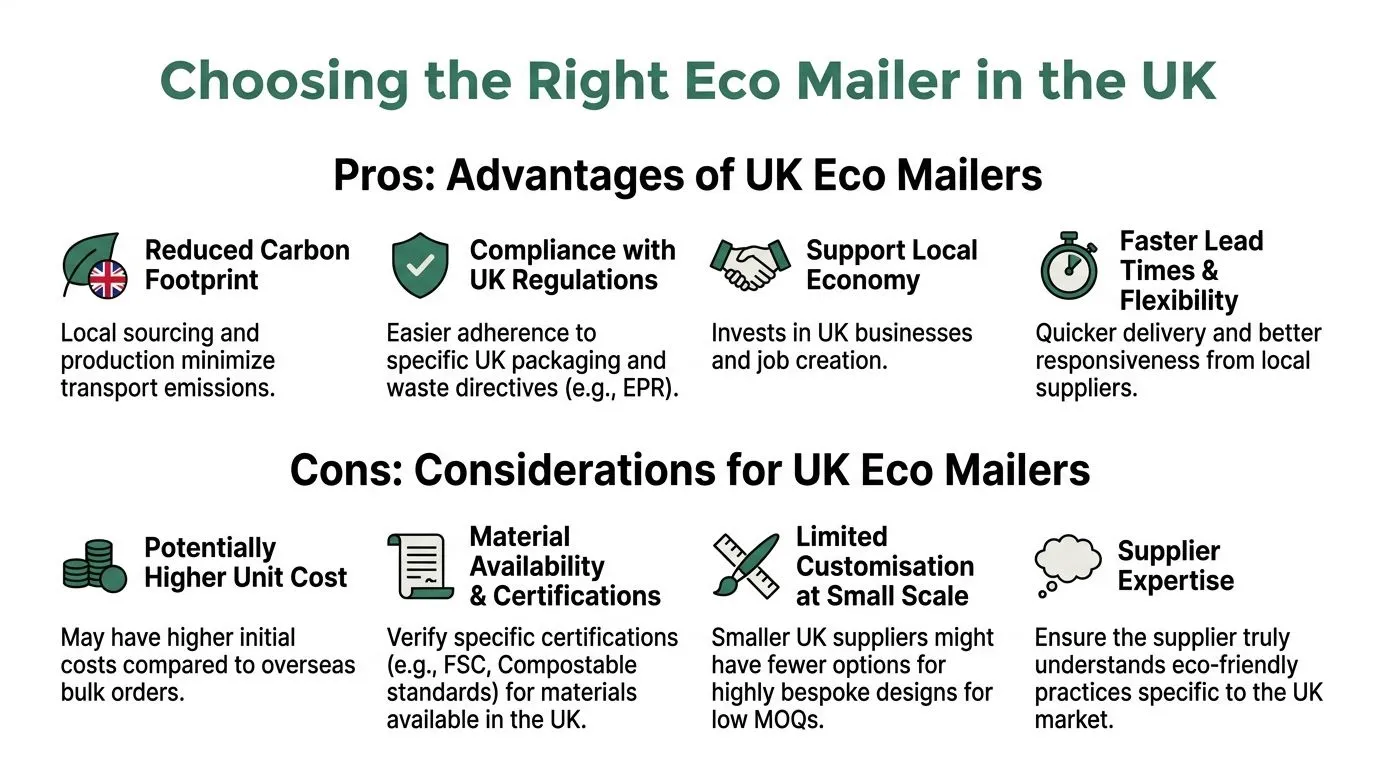
A UK retailer ships knitwear in winter, switches to lighter accessories in spring, and keeps seeing the same problem. The mailer that looked convincingly green on a product page turns out to be a poor fit once moisture, returns, postage bands, and customer disposal habits are factored in.
That is usually where eco claims start to unravel. The right choice depends less on the label and more on how the pack performs in a real delivery chain.
The biodegradable trap
One of the most common buying errors is treating biodegradable as a guaranteed waste solution. In practice, that only holds up if the bag is likely to enter the right disposal stream. If it ends up in general waste, the environmental outcome is often far less convincing than the marketing suggests.
We regularly advise clients to test the disposal reality before they test the branding. A mailer that depends on specialist composting access is a weak choice if the customer is unlikely to have that access or understand what to do with it.
That is why recycled LDPE continues to make sense for many UK e-commerce businesses. It is familiar, durable, light in transit, and aligned with established film recycling routes where those collections are available. Compostable formats still have a place, but only where the end-of-life route is credible and clearly communicated. For a closer technical comparison, see our buyer's guide to compostable mailing bags.
Paper, recycled poly, and what actually works
Paper mailers are often the easiest option to explain to customers. They also come with practical trade-offs that matter once volumes grow.
For apparel, paper can work well, especially where presentation and kerbside recyclability matter more than water resistance. For products exposed to damp delivery conditions, warehouse dust, or higher return rates, paper can create more failures unless the specification is chosen carefully. Gusset strength, burst resistance, and seal performance matter just as much as the sustainability claim.
Recycled poly is often the better operational fit for fast-moving e-commerce. It keeps pack weight down, resists tearing, and handles courier networks well. The trade-off is customer perception. Some buyers still see any plastic as the wrong answer, even when the recycled content and disposal route are stronger than a poorly specified paper alternative.
Sugar cane mailers sit somewhere in the middle for some retailers. Kite Packaging's eco mailing bag specifications describe them as recyclable in the same streams as conventional polythene and suitable for Royal Mail size guidance, which can help where postage profile matters as much as material choice.
The UK tax angle buyers shouldn't ignore
Material choice also affects cost control. UK Plastic Packaging Tax applies to plastic packaging with less than the required recycled content threshold, so recycled film mailers can make financial sense as well as environmental sense.
That point gets missed surprisingly often. A business can pay more for a mailer marketed as greener, then lose again on storage, damage rates, or tax exposure because the specification was chosen on headline claims rather than actual use.
Transpack's details on green bio mailing bags highlight how recycled polythene content changes the tax position. For growing brands, that can be the difference between a sensible packaging upgrade and an expensive one.
The best mailer is the one that fits the product, survives the delivery network, suits the customer's disposal options, and does not force unnecessary cost into the operation. That answer is rarely the one with the loudest eco badge.
Finding a Flexible UK Packaging Partner
A growing business usually doesn't need a supplier with the widest theory. It needs one that understands low-risk progression.
That means access to stock mailers for immediate use, sensible advice on material trade-offs, and bespoke options that don't demand enterprise-scale commitment from day one.

A knowledgeable supplier should also understand the technical detail behind the eco claim. UK-compliant compostable mailing bags typically use a 70% PBAT, 5% PLA, and 25% cornstarch blend at 60 to 65 microns. That formulation is needed to achieve EN13432 certification for 90-day decomposition while maintaining courier-safe puncture resistance, as shown in this UK compostable mailing bag specification.
That's why flexibility matters just as much as catalogue depth. A supplier should be able to say when a compostable bag is appropriate, when recycled film is the better choice, and when the business should hold off on custom print altogether.
For businesses that expect to scale into more customised packaging later, low-minimum bespoke routes can reduce the jump from stock packaging to printed formats. Packaging Panda offers bespoke packaging with minimum runs from 500 units, alongside stock packaging and service options such as free delivery over £150 and next-day delivery on orders placed before 2pm. For businesses comparing custom routes more broadly, this article on custom printed boxes with no minimum in the UK is also useful context.
The right partner doesn't just sell eco friendly mailing bags. They help the business avoid buying the wrong ones in the wrong quantity.
Businesses that need eco friendly mailing bags without overcommitting should start with a supplier that can handle both stock requirements and lower-run bespoke packaging as volumes become clearer. Packaging Panda supplies mailing and sustainable packaging materials for UK businesses, including made-to-order options designed to suit growing brands that want better packaging decisions, not just bigger orders.