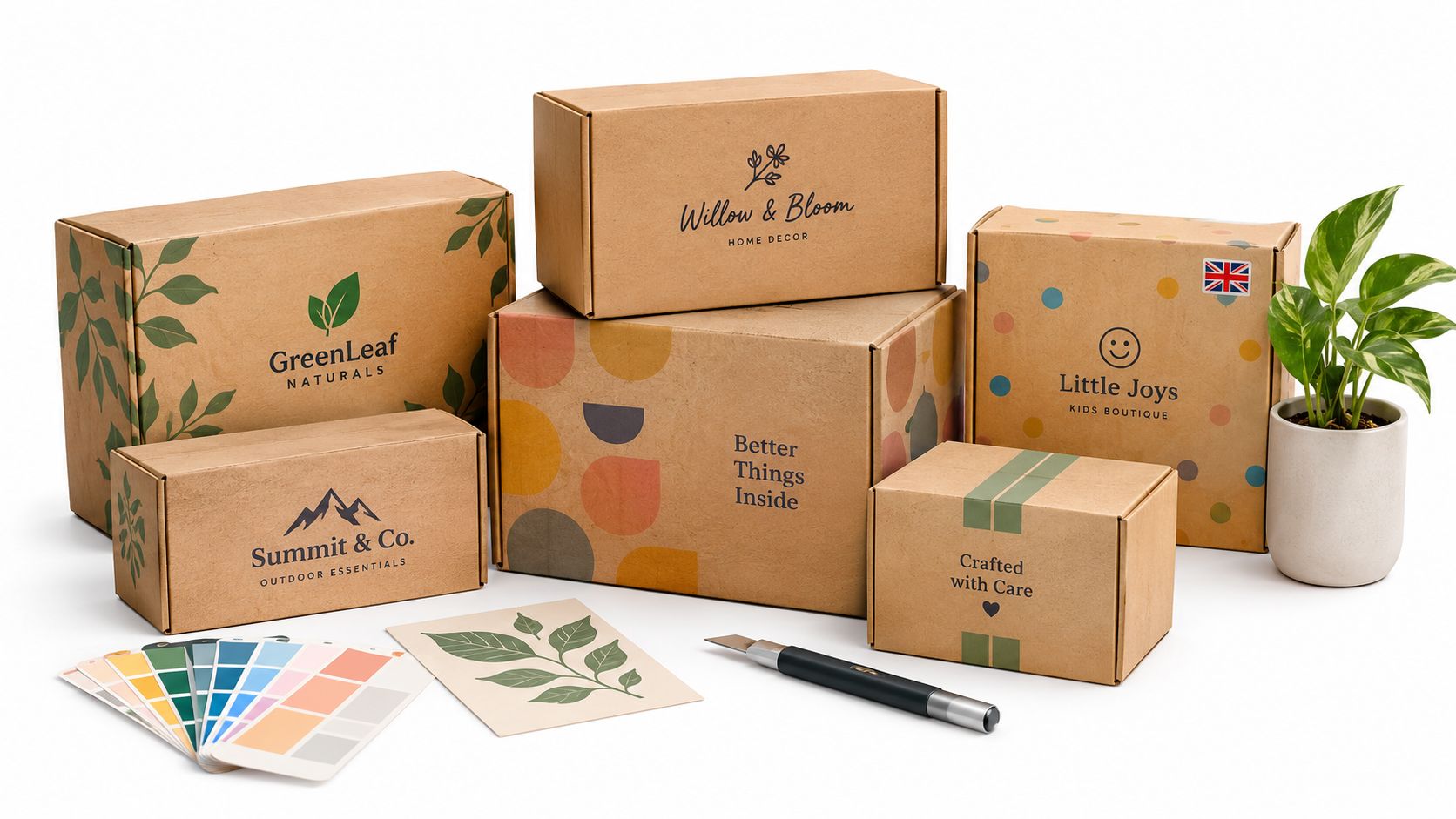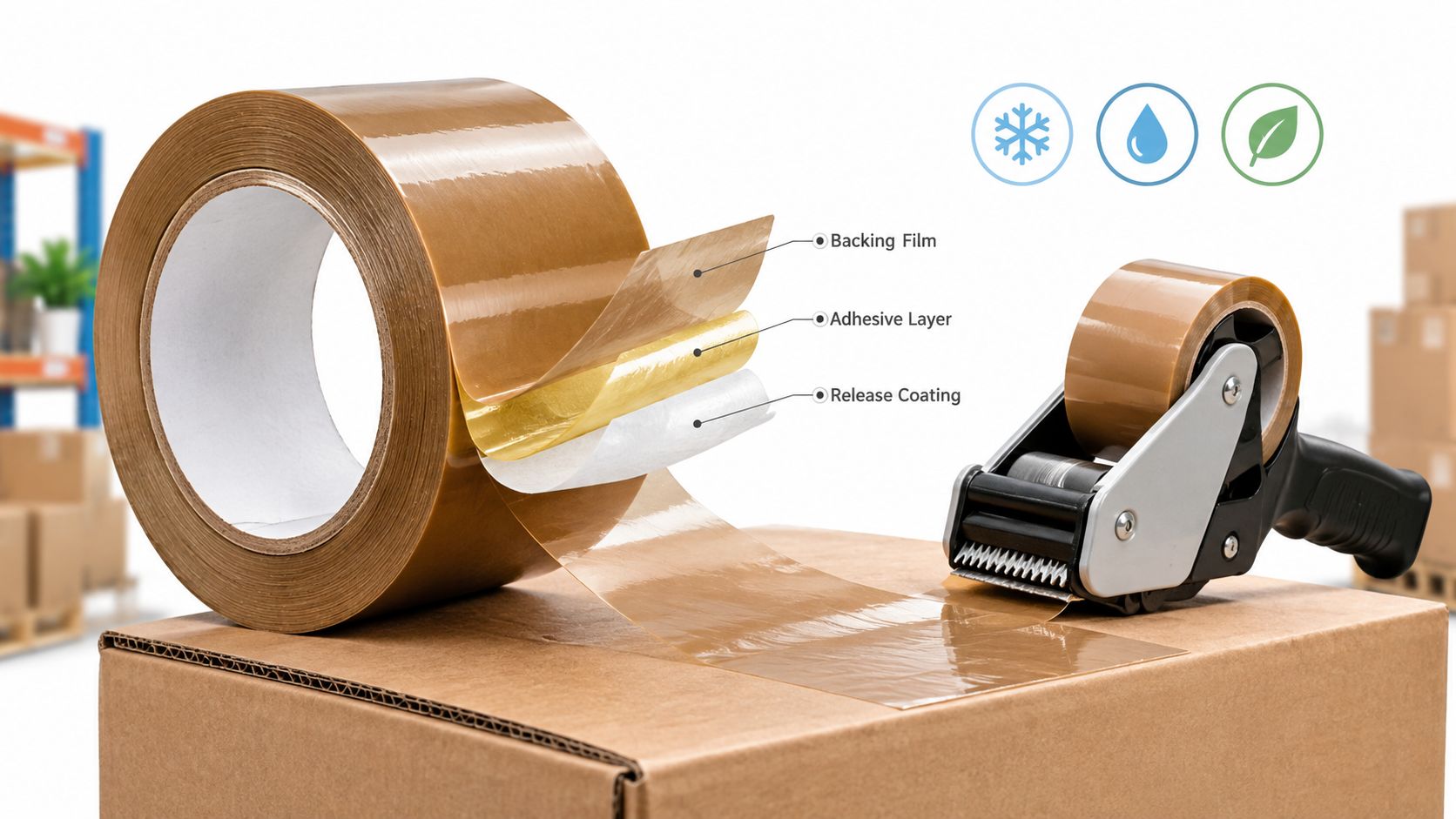
Custom Printed Boxes No Minimum UK: Your Ultimate 2026 Guide
Launching a product in the UK often starts with a small, awkward packaging problem. A business needs 50 boxes, not 1,000. It wants proper branding, not a plain stock carton with a rushed sticker. Then the quotes arrive, and the numbers rarely match the early optimism.
See our custom printed boxes with no minimum order →
That's why demand for custom printed boxes no minimum UK keeps growing. Sellers on Etsy, Amazon, Shopify, TikTok Shop, and their own sites don't order in perfectly predictable volumes. They test product lines, swap seasonal artwork, and change pack sizes as they learn what sells. That pressure is even more obvious in a market where online sales accounted for 26.7% of total retail sales in Great Britain in 2024 according to Packlane's summary of ONS context.
Branding still matters, of course. Good packaging helps a business look organised before a customer even sees the product. But branded boxes aren't just a design choice. They're part of the wider work of positioning, consistency, and trust. For founders still shaping that side of the business, this guide on how to create a successful brand identity is worth reading before signing off artwork.
The catch is simple. “No minimum” sounds like a pricing promise. It isn't. It's a manufacturing option. That difference matters because many small firms buy the wrong way round. They chase the smallest possible run first, then discover that setup choices, lead times, courier cut-offs, artwork changes, and compliance questions combine to increase the total cost.
Table of Contents
- Introduction The Dream of Custom Branding for Every UK Business
- What Does No Minimum Really Mean
- Digital vs Litho The Technology Behind Your Box
- Unpacking the True Cost Drivers and Trade-Offs
- Smart Alternatives to Full Custom Printing
- How to Choose and Evaluate a UK Packaging Supplier
- Your Next Steps to Professional Branded Packaging
Introduction The Dream of Custom Branding for Every UK Business
A small business usually reaches the same point. Orders start coming in, the products look right, and the outer packaging suddenly feels underpowered. Plain transit boxes may be functional, but they don't always support the level of presentation a growing brand wants.
That's where no-minimum custom printing becomes attractive. It offers a route to branded packaging without tying up cash in a large run that might become outdated after one artwork tweak, one size change, or one product launch that doesn't go to plan. For UK sellers working in short cycles, that flexibility is the main appeal.
The dream is sensible. The buying process often isn't.
Practical rule: Buy packaging for the next proven phase of demand, not for the most optimistic version of the business.
Many SMEs need packaging in uneven quantities. One month they need a few dozen units. The next month they need a replenishment run with revised branding or a seasonal message. No-minimum ordering helps because it matches that stop-start reality far better than old bulk-only models.
Still, a branded box isn't automatically the right first move. Some businesses need visibility more than luxury. Others need better protection, faster packing, or easier reordering. A box has to do all of those jobs before it becomes a marketing asset.
What Does No Minimum Really Mean
“No minimum” usually means a supplier is willing to produce a very small custom run. It doesn't mean every order size is equally economical. It means the factory process no longer depends on the old requirement to spread setup cost across a large batch.
Accessibility is not the same as low cost
The simplest analogy is custom clothing. One digitally printed t-shirt is easy to order, but the price per shirt will be higher than a big screen-printed run for an event. Boxes work in much the same way.
Digital print removed a major barrier because it avoids the physical plate setup that made tiny orders impractical. That's why small firms can now test concepts, launch limited editions, or buy low volumes without committing to warehouse stock they may not use. Buyers trying to understand those purchasing thresholds may also find this outside perspective on advice on packaging minimums useful alongside supplier quotes.
A lot of confusion starts when businesses compare “can be ordered” with “should be ordered”. A supplier may accept a very small run, but the landed cost can still make that run poor value once print, finishing, delivery, and revision risk are factored in.
Where buyers get misled
The phrase often hides three separate questions:
- Can the supplier print a low quantity? Usually yes, if digital production is available.
- Will the unit cost be attractive? Not always.
- Will the result fit the brand need? That depends on board, finish, artwork, and timing.
This matters most when the box is expected to do more than one job. A gifting box, for example, has to look presentable. A shipping box has to survive courier handling. A bakery box may need speed, freshness, and short lead times around events. The production method that suits one use case may be wrong for another.
Some businesses also overbuy design complexity too early. Full-colour external print, internal print, foil, or specialist finishing can make sense later. They can be expensive ways to test a market at the beginning.
A smarter buying pattern is to define the actual objective first. If the objective is proof of demand, use the smallest practical commitment. If the objective is retail presentation, spend more attention on visual consistency and material feel. If the objective is dispatch efficiency, choose dimensions and board strength first.
For readers comparing formats for branded presentation, Packaging Panda's guide to custom printed gift boxes is a useful example of how different packaging goals change the specification.
Digital vs Litho The Technology Behind Your Box
Most of the confusion around custom printed boxes no minimum uk disappears once the buyer understands the printing method. The technology usually determines the practical lead time, the viable order size, and the price behaviour.
Digital works for uncertainty
Digital printing is what made true short runs practical. It removes the need for physical plate setup, and that changes the economics for small orders. The UK Department for Business and Trade notes that digital printing adoption in the packaging sector has surged by 42% since 2022, and the shift has helped enable lead times of 3 to 5 days compared with the traditional 14-day minimum-run cycle in older workflows, as referenced by the Department for Business and Trade.
For a small business, digital usually suits these situations:
| Need | Why digital fits |
|---|---|
| New product launch | Low commitment while testing demand |
| Seasonal artwork | Easier to change graphics between runs |
| Limited stockholding | Less risk of obsolete packaging |
| Fast reorders | Shorter production windows in many cases |
Digital is also practical when a business is still refining dimensions. If the product insert changes, or the item size shifts slightly, there's less pain in adjusting a smaller run than writing off a large one.
Some stock-led presentation formats can bridge that gap. For instance, Gift Boxes are available in white, brown, black and printed designs for retail, hampers and ecommerce, with trade pricing and free delivery over £150. That's relevant when a buyer wants a polished presentation box but doesn't yet need a fully bespoke production route.
Litho works when volume is stable
Lithographic printing suits a different stage of business. It makes more sense when artwork is settled, volume is consistent, and the buyer wants lower unit cost at scale. The upfront preparation is the trade-off. It takes more commitment and usually less flexibility.
A business that reprints the same box again and again should compare small-run convenience against repeat-run efficiency before defaulting to digital every time.
Litho tends to be the stronger fit when:
- Forecasts are reliable: the business can commit without fearing dead stock.
- Brand rules are fixed: there won't be constant artwork edits.
- The order is recurrent: the box isn't for a one-off campaign.
- Unit cost matters more than initial cash flow: common once demand is steady.
The practical distinction is simple. Digital helps when uncertainty is high. Litho helps when the business has already reduced that uncertainty.
Unpacking the True Cost Drivers and Trade-Offs
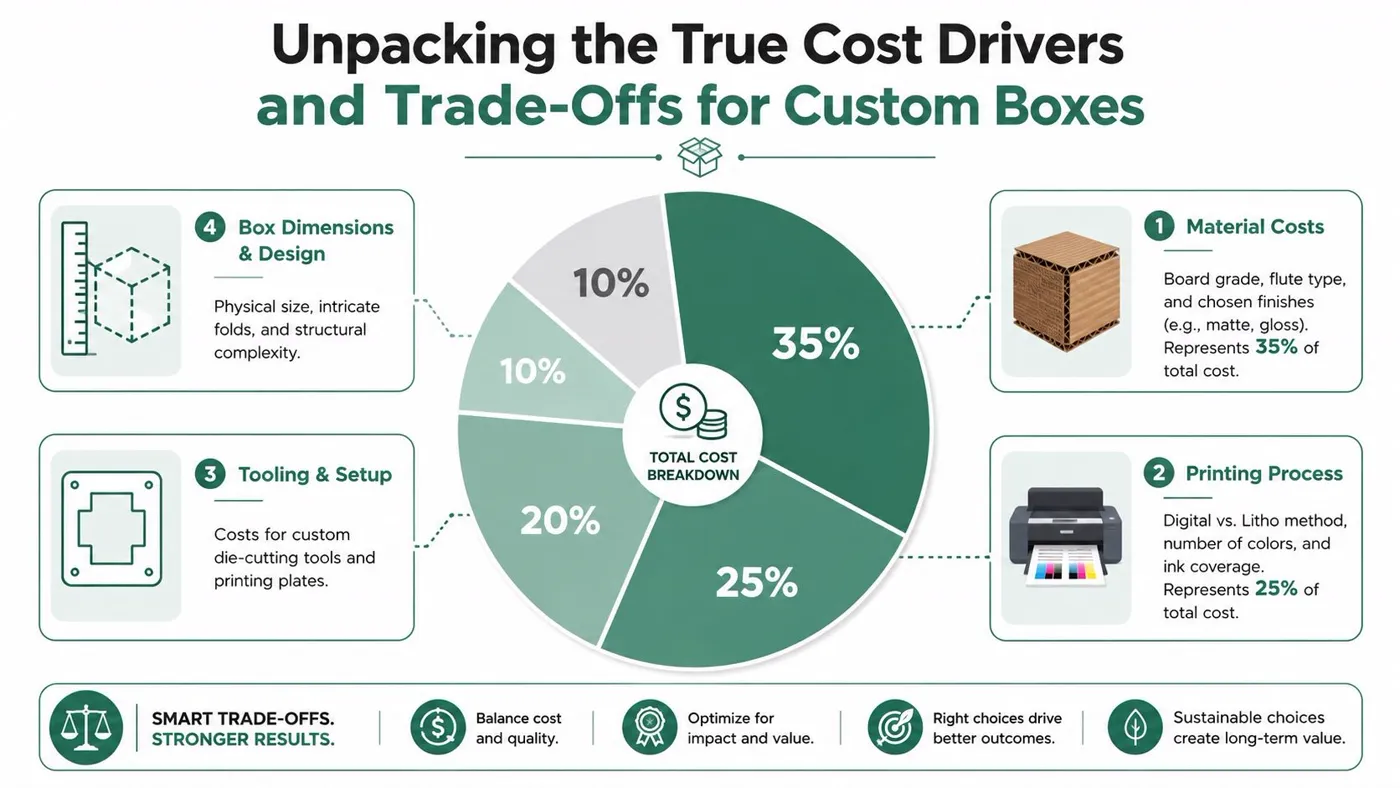
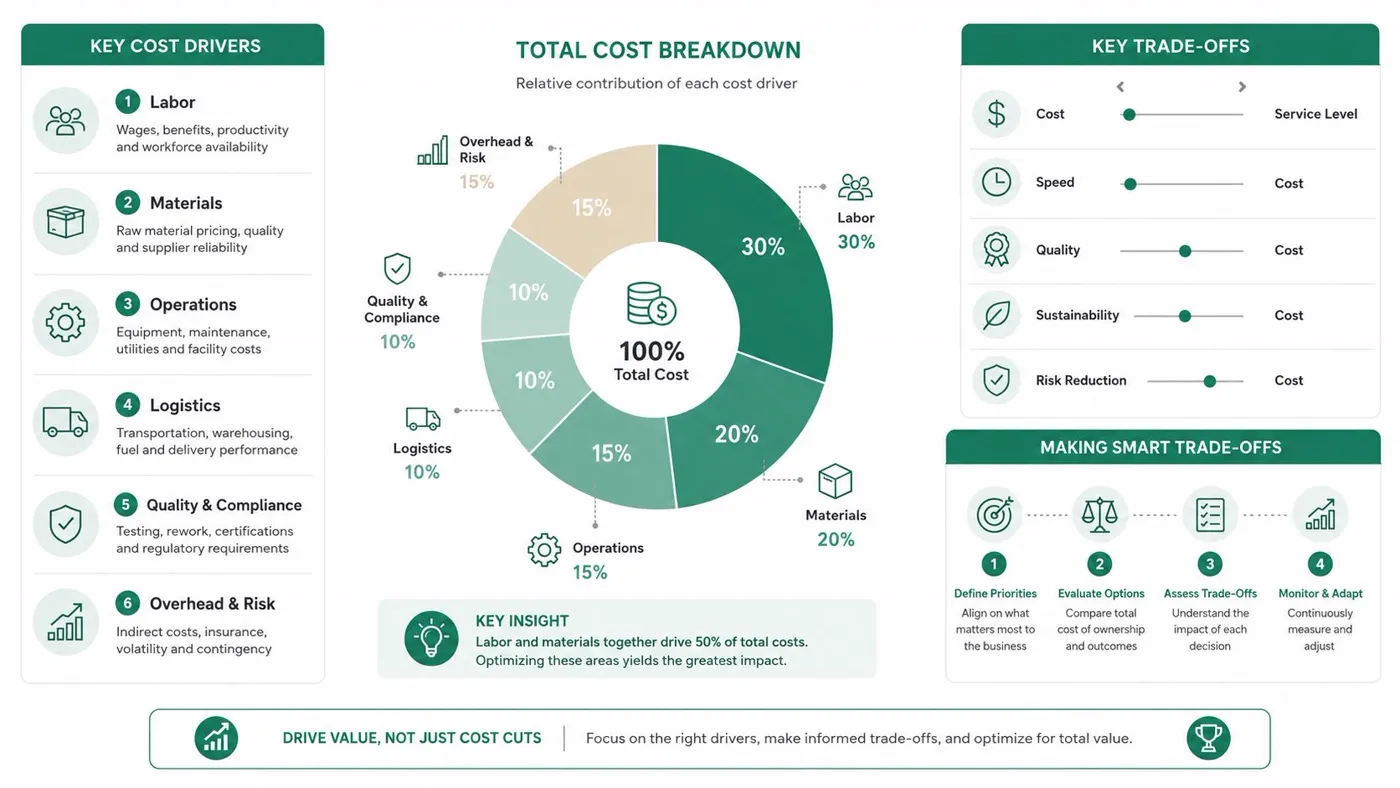
The phrase “no minimum” hides the part buyers most need to understand. The quote is never just about printing. It's about material, dimensions, finishing, production method, and quantity all interacting at once.
What actually changes the quote
The biggest mistake small firms make is treating all boxes as if they differ only by print. They don't. A plain carton and a retail-ready rigid or premium folding box are different cost structures.
The core cost drivers are usually these:
- Board and material choice: stronger grades, premium finishes, and presentation-led materials cost more than straightforward transit board.
- Box size: larger formats use more material and can affect packing and delivery costs.
- Print coverage: simple branding often behaves very differently from full artwork coverage.
- Finishing: lamination, foil, embossing, and similar extras add cost and time.
- Quantity: this is the biggest commercial lever in most quotes.
That final point matters because the UK market is dominated by smaller buyers. The British Business Bank reports that 99.9% of UK businesses are SMEs, and that's why low-commitment packaging attracts so much attention. But the same market reality also creates a trap. For small runs, digital pricing can leave the cost per unit 1.2x higher than bulk orders, as noted in Pure Custom Boxes' summary of the SME trade-off.
When no minimum stops being strategic
There's a point where no-minimum ordering stops being a clever flexibility play and starts becoming expensive indecision. That usually happens when a business has repeat sales, settled dimensions, and stable branding, but still keeps ordering tiny quantities.
A better way to decide is to ask three commercial questions:
- Will this artwork still be valid for the next reorder?
- Will the product size stay the same?
- Can the business afford to hold a modest amount of stock?
If the answer is yes to all three, the buyer should at least compare a slightly larger run. That doesn't mean jumping straight to very large quantities. It means checking whether the next step up changes the unit economics enough to justify the cash tied up.
The cheapest box isn't always the one with the lowest unit price. It's the one that the business can use fully, reorder easily, and ship without waste.
For businesses balancing cost with environmental goals, Packaging Panda's article on sustainable ecommerce packaging is useful context because right-sizing and material choice often affect both spend and waste.
Smart Alternatives to Full Custom Printing
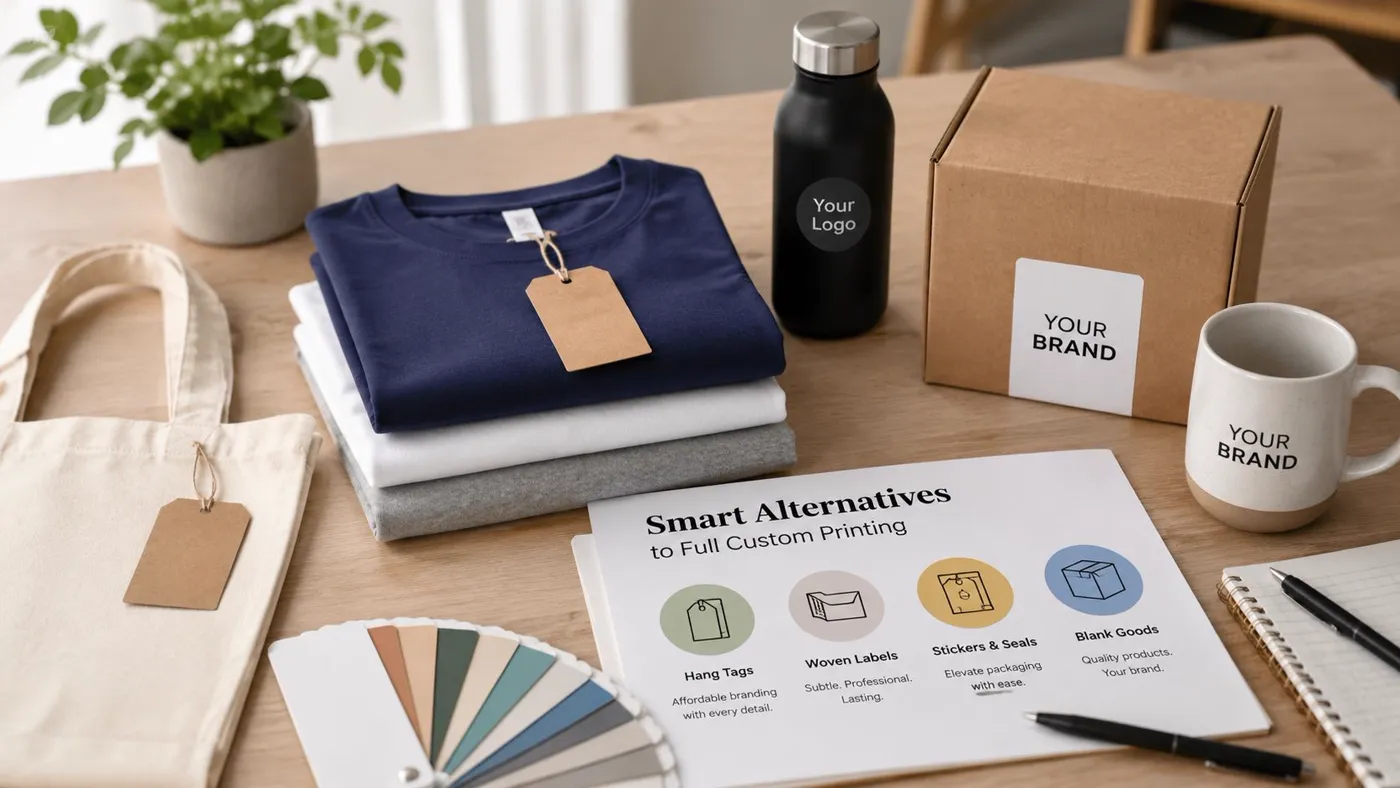
Not every business needs a fully printed bespoke box straight away. Often the smarter move is to build a branded presentation system in layers. That approach keeps cash free for stock, ads, or product development while still giving customers a more polished unboxing experience.
Use plain stock boxes with branded labels
This is the most practical starting point for many startups. A business buys standard boxes in the right size, then applies a professionally printed label or sticker.
The advantages are clear. Stock boxes are easier to replenish, artwork can change without wasting old cartons, and the business can test brand messaging quickly. The downside is that labels rarely create the same premium finish as direct print, especially for gift-led products.
This route works well for:
- New launches: when sales volume is still uncertain
- Multiple SKUs: where each product may need slightly different messaging
- Seasonal offers: where temporary branding would make a full print run inefficient
Add a printed sleeve instead of printing the whole box
A sleeve can do a surprising amount of visual work. It turns a plain box into a branded pack without requiring print across every panel. For many products, that's enough.
Sleeves are especially useful when the box structure itself is standard. A bakery gift pack, subscription item, or hamper-style product can look considered with a well-designed outer wrap and a plain inner carton. The result often feels more deliberate than a sticker and avoids paying for full-box print where it isn't adding much value.
Brand the inside experience
Some businesses get a better return by branding what the customer notices after opening. Tissue, inserts, thank-you cards, printed tape, or a simple information card can create a stronger impression than an expensive outer box.
This matters when the outer carton's main job is transit protection. In that case, spending heavily on external print may not be the best first use of budget. A restrained outside and a branded inside can be the better commercial choice.
A phased packaging system is often more professional than overspending on one premium element and cutting corners everywhere else.
These alternatives aren't cheap compromises. They're often the right bridge between plain stock packaging and a later move into fully custom printed boxes once demand is predictable.
How to Choose and Evaluate a UK Packaging Supplier
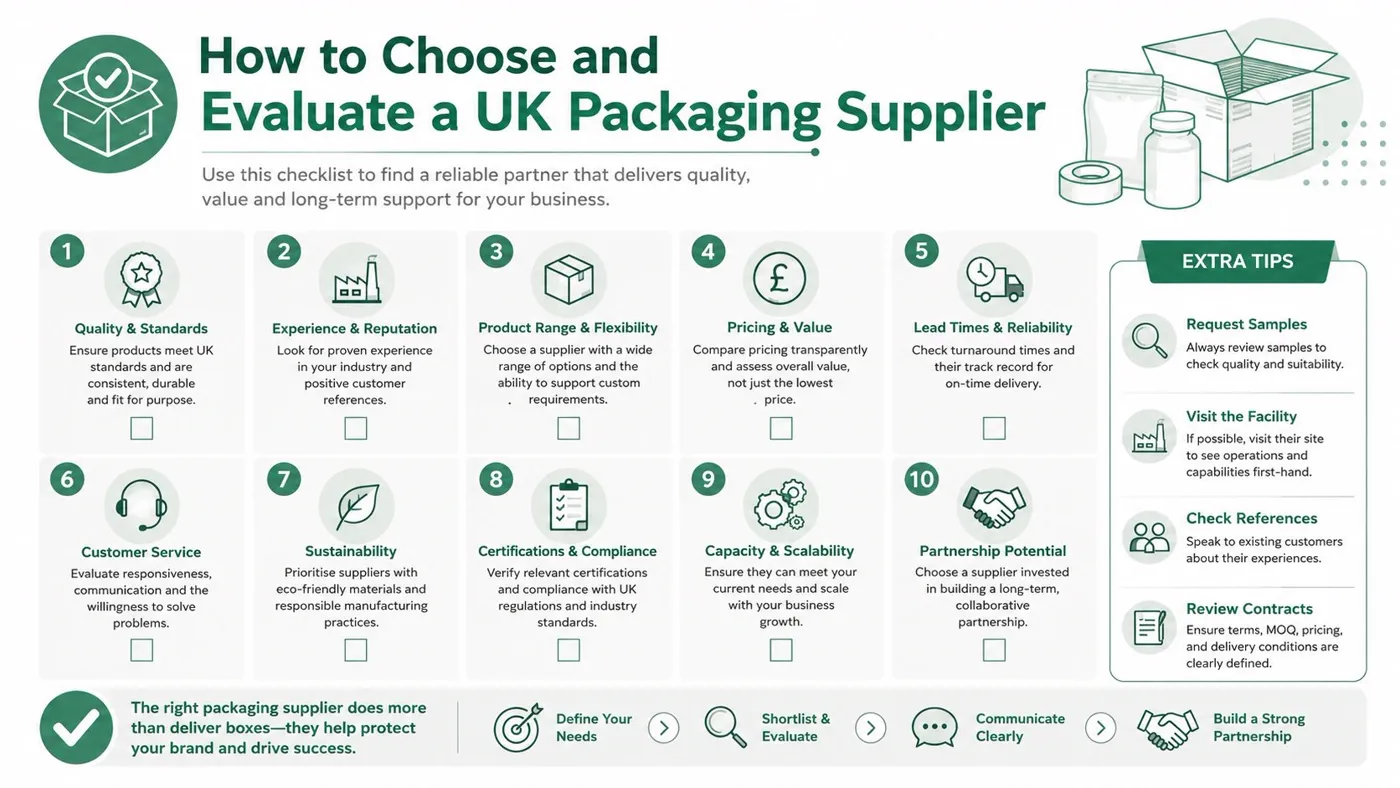
Supplier choice affects more than price. It affects missed launch dates, artwork errors, stock gaps, and packaging that looks compliant on the website but raises awkward questions later.
Questions that expose risk early
A buyer should push past headline claims and ask for operational detail. “Fast turnaround” isn't enough. It matters whether the supplier means production time only, or production plus proof approval plus dispatch.
These are the questions that usually surface the truth:
- Can samples be supplied first? A photo rarely shows board feel, print sharpness, or closure quality properly.
- What exactly starts the lead time clock? Some suppliers count from payment. Others count from final artwork approval.
- Which artwork files are acceptable? If this isn't clear, revision rounds can eat into the promised delivery window.
- What happens if artwork is wrong? Good suppliers explain proofing responsibility clearly.
- Can recycled-board options still meet the same schedule? That matters when sustainability isn't optional for the brand.
Turnaround risk and compliance are especially important in the UK because packaging choices now sit inside a tighter policy environment. The rollout of Extended Producer Responsibility for packaging has reporting and fee implications, and buyers should verify whether a supplier can meet a production window while still supporting recycled-board choices and compliance expectations, as outlined by Packaging Mart's discussion of custom cardboard box buying considerations.
What a good supplier should clarify without being chased
Reliable suppliers usually answer practical questions before they become problems. That includes board options, minimums, print method, dispatch expectations, and what changes if artwork is revised after proof approval.
A buyer comparing UK options may also want to review a supplier's bespoke service page directly. Packaging Panda's bespoke packaging options are one example of the sort of page that should make scope and production approach clearer before an enquiry turns into a quote.
A solid supplier relationship usually shows up in these signals:
| Checkpoint | What to look for |
|---|---|
| Quote clarity | Separate line items or at least a clear explanation of what is included |
| Production honesty | Realistic dates, not vague promises |
| Material transparency | Straight answers on recycled or recyclable options |
| Proof process | A defined approval step before print |
| Delivery terms | Clear cut-off points and dispatch expectations |
If a supplier can't explain the production path in plain English, a small business shouldn't assume the order will run smoothly.
Your Next Steps to Professional Branded Packaging
The right packaging move depends on business stage, not on what sounds most impressive.
A brand-new seller should usually start lean. Use a stock box, a good label, a sleeve, or a branded insert. That keeps risk down while the business learns which products justify repeat packaging spend.
A growing business with steadier orders should look closely at short-run digital print. That stage is where custom printed boxes no minimum uk can make commercial sense. The brand gets stronger presentation without overcommitting to large inventory.
A scaling business should stop treating tiny runs as automatically safer. If the dimensions are stable and reorder patterns are clear, a larger run may be the more disciplined choice. The earlier sections covered why the unit economics often improve once uncertainty drops.
Protection should stay part of the decision, not just branding. For UK e-commerce retailers, the UK Chartered Institute of Logistics and Transport reports that 28% of product returns stem from packaging-related damage, and that custom-sized boxes lower breakage rates by 35% compared with standard sizes by removing internal void space, according to CILT UK. That's the operational case for getting packaging right. It affects returns, customer experience, and margin at the same time.
Good packaging doesn't need to start expensive. It needs to start with the right brief.
If the next step is comparing stock packaging with bespoke options, Packaging Panda supplies UK businesses with mailing, protective, eco-friendly, and made-to-order packaging, including bespoke solutions for brands that need custom sizes and printed formats once order volumes justify the move.