Custom Poly Mailer Bags: A Practical UK Ordering Guide
A dispatch manager sees the problem before the marketing team does. The new mailer looks attractive on screen and costs less per unit, but the first busy packing shift produces split seams, loose closures and inconsistent presentation at the customer's door. Meanwhile, the sustainability lead needs material data, finance wants a reliable landed cost, and the warehouse wants a bag that works without slowing the line.
Custom poly mailer bags should therefore be treated as a specification decision, not merely a printed branding accessory. Film gauge, dimensions, closure, print coverage and end-of-life instructions affect product protection, packing efficiency, reporting and the total cost of ownership. That matters even more as UK packaging rules place greater emphasis on material efficiency, recyclability and producer responsibility.
Table of Contents
- Why Custom Poly Mailer Specification Matters More Than Ever
- Choosing the Right Substrate and Film Gauge
- Print and Branding Options Compared
- Artwork Preparation and Dieline Approval
- Navigating UK Compliance and EPR Fees
- Placing Your Order and Validating Performance
- Your Specification Decision Framework
Why Custom Poly Mailer Specification Matters More Than Ever
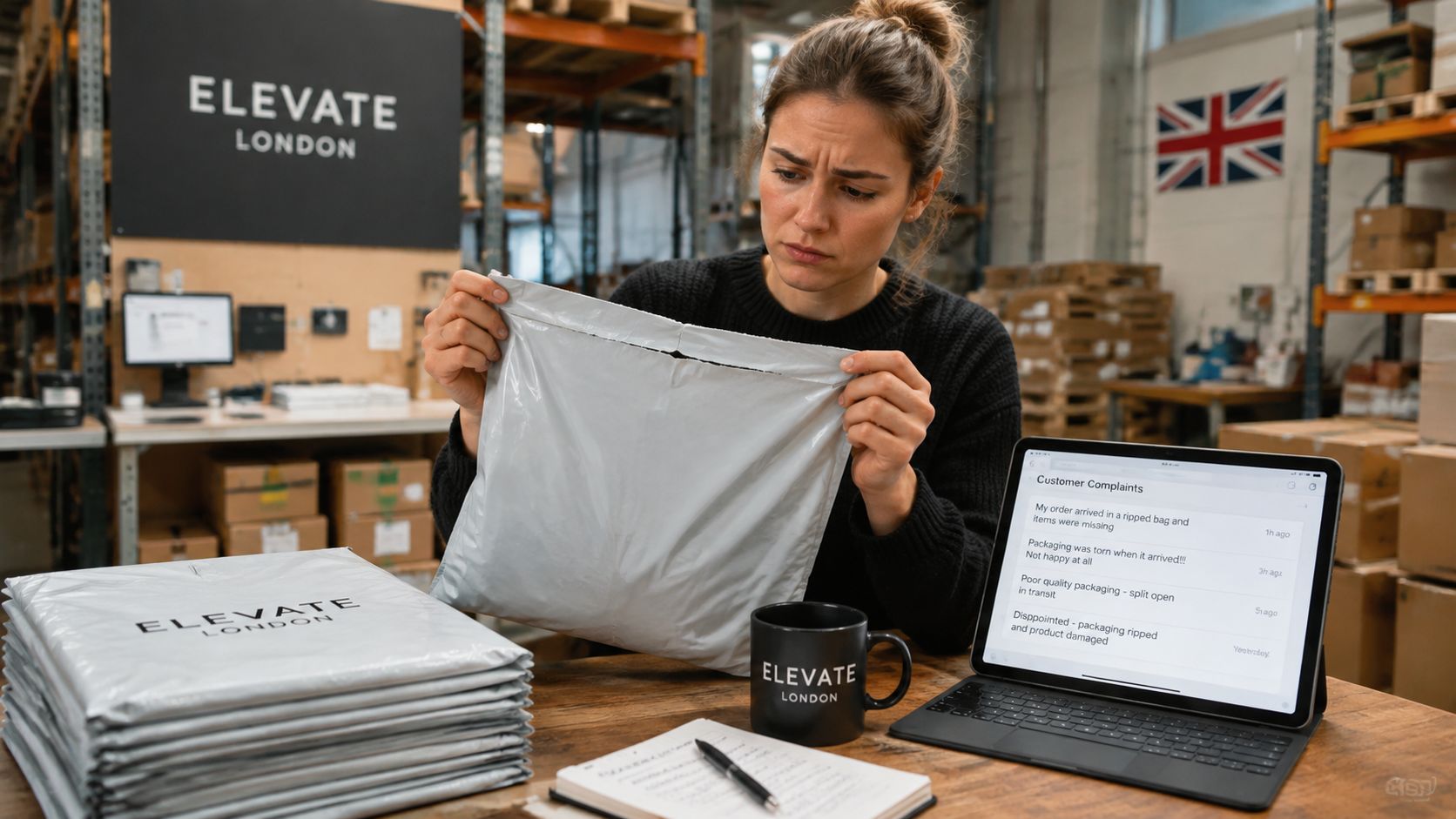
A growing UK fashion brand can easily make a false saving. It changes from a correctly sized grey polythene mailer to a cheaper, thinner alternative, expecting the difference to appear only in the packaging budget. On the packing line, staff start reinforcing corners with tape. Customer service receives complaints about torn outer bags. Marketing then sees several shades of the same brand colour because the replacement run was produced on a different substrate.
The invoice may be lower, but the operating cost has moved elsewhere. Extra handling, repacking, damaged goods, replacement shipments and lost confidence all sit outside the unit-price comparison. A mailer that survives the courier network while presenting consistently at delivery is usually worth more than one that wins a narrow purchasing comparison.
The UK market has changed
England's carrier-bag charge provides a useful signal for packaging buyers. The charge began on 5 October 2015 at 5 pence and rose to 10 pence from 21 May 2021, with the charge extended to all businesses, although mandatory reporting remains focused on large retailers. Government reporting recorded 437 million single-use plastic bags sold by 102 reporting retailers in 2024/25, still 79% below the 2.12 billion sold in 2016/17. The following release recorded 399 million bags sold by 94 reporting retailers in 2025/26, another 9% decline and an 81% drop versus 2016/17. These figures come from the UK government's carrier-bag charge data.
Carrier bags and mailing bags aren't identical products, but the direction is relevant. UK buyers increasingly need formats that use material carefully, fit the product closely and support reuse or realistic recycling routes rather than relying on high-volume single-use plastic.
Practical rule: A custom mailer needs approval from operations, brand and sustainability stakeholders before production. A design that satisfies only one team is unfinished specification work.
The Environment Agency's National Packaging Waste Database shows how packaging is now reported nationally by material and packaging type in tonnes under the Packaging Waste (Data Reporting) Regulations 2023 and the Producer Responsibility Obligations (Packaging and Packaging Waste) Regulations 2024. For a business, that turns a mailer into more than a warehouse consumable. The chosen material, format and print treatment can affect records, future fees and customer disposal guidance.
Choosing the Right Substrate and Film Gauge
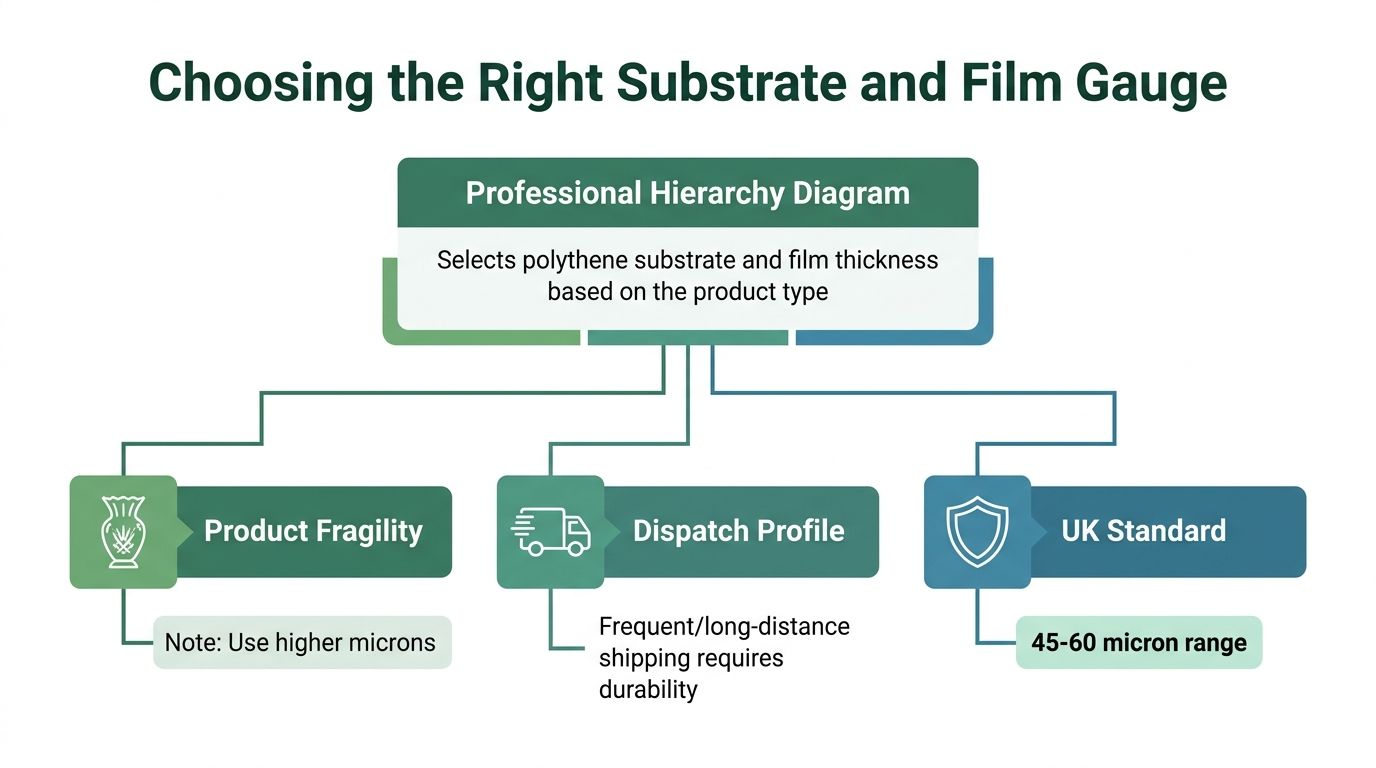
The correct gauge starts with the product and the distribution route, not with a supplier's default size. UK specification guidance commonly places 45 to 60 micron grey polythene at the industry standard for garments and soft goods. Larger mailers used for courier and Royal Mail despatch are commonly supplied in the 38 to 60 micron range, so a buyer should assess each SKU class rather than assign one thickness to every order. The UK mailing-bag specification example illustrates the type of sizing and closure detail that needs checking.
Match gauge to the parcel class
A practical selection sequence looks like this:
-
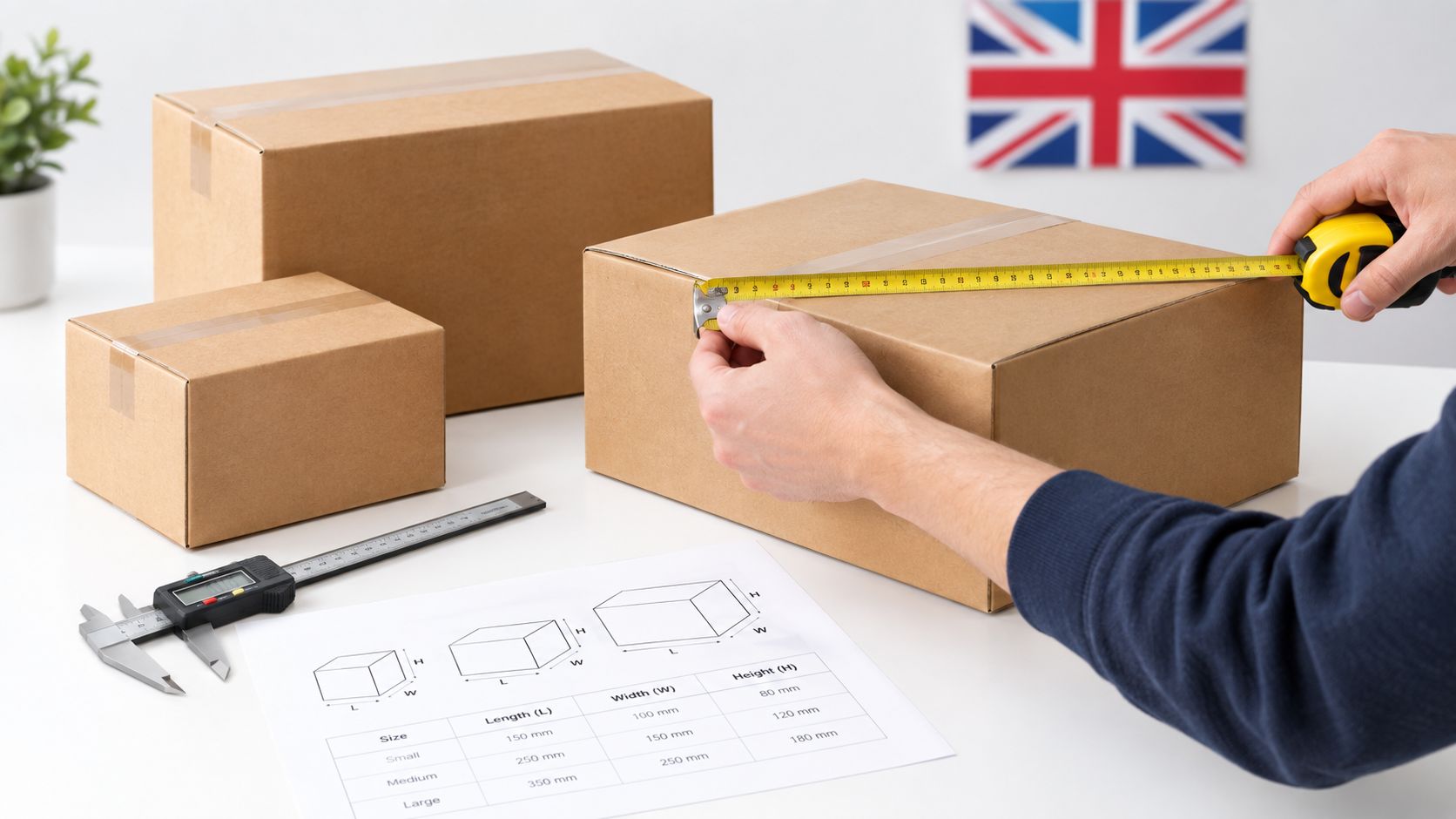
Define the packed dimensions. Measure the product after folding, including any inserts, tissue or secondary packaging. Specify the largest normal configuration, not the smallest item in the range.
-
Classify the load. Lightweight apparel can often use 45 to 55 micron film. Heavier garments, multi-item orders and courier lanes with greater handling abuse generally justify 60 micron or more, provided the bag is correctly sized.
-
Map the route. A short, controlled fulfilment route has different demands from a parcel travelling through several handling points or a long-distance courier network. Puncture risk, sharp product edges and compression should influence the gauge.
-
Choose the minimum functional thickness. The aim isn't maximum film thickness. UK packaging law requires packaging volume and weight to be the minimum necessary for safety, hygiene and consumer acceptance, while heavy-metal concentration limits must also be met. The UK packaging compliance guidance is useful when reviewing lightweighting and essential-requirements considerations.
-
Test the finished bag. Check seam strength, closure adhesion, puncture resistance and fit using the actual packing process.
Over-specifying thickness without right-sizing the bag is a common mistake. Excess empty space lets the contents move inside the parcel, creating folds and stress points that a thicker film won't automatically solve. A snug fit can improve stability while reducing unnecessary material.
Closures need line testing
Easy-seal and tamper-evident strips are standard features on premium mailing lines. The packing team should test the seal after normal filling, not just inspect an unused sample. Closure overlap also matters. Any bag where the overlap falls below the manufacturer's stated lip depth should be rejected, because a visually acceptable adhesive strip can still fail when the parcel is overfilled.
For a broad comparison of formats, Mailers include poly mailers, padded bags, paper mailers and book wraps for e-commerce and retail dispatch. A more focused view of mailing-bag formats is available through mailing bag options, but the final gauge should still be validated against the buyer's own products and route.
Print and Branding Options Compared
Branding method changes more than appearance. It affects setup, order economics, colour control, production timing and the amount of ink or adhesive placed on the finished mailer. The right choice depends on the run, the artwork and the compliance record the business needs to maintain.
Flexographic printing
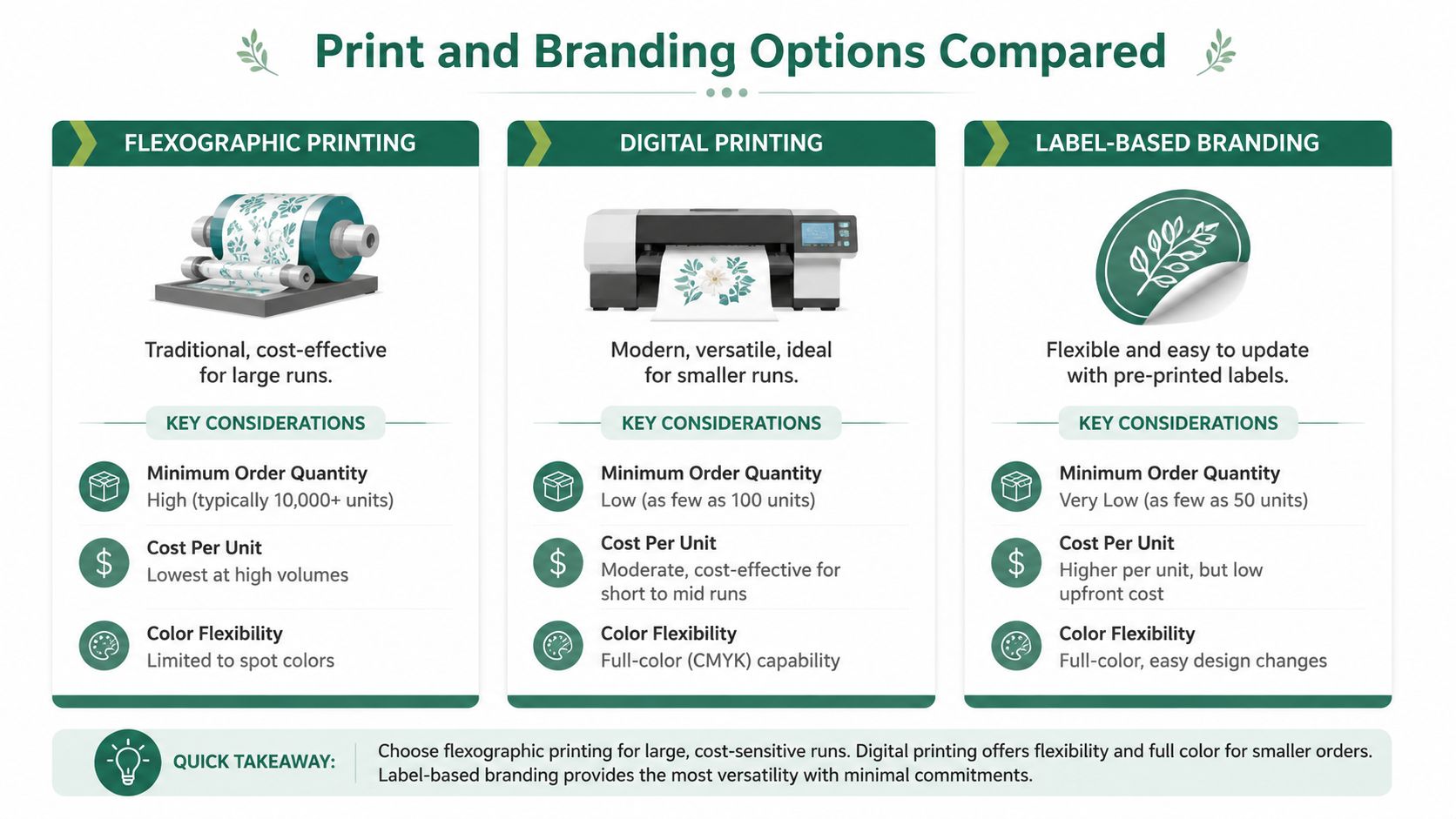
Flexography uses plates to transfer ink onto film. It usually makes more commercial sense for a 10,000-unit run, where the plate investment can be spread across a larger quantity. The method can deliver consistent repeat branding once the press is set, but it needs careful approval before production.
Flexo is suited to a stable design that won't change between replenishments. A business that expects frequent campaigns, seasonal artwork or changing legal copy may find the setup less flexible. Registration also needs attention, especially where artwork runs near the lip, side seams or gussets.
Large areas of ink can affect how the film folds and how the closure area performs. The supplier should confirm whether the print coverage is compatible with the adhesive strip and sealing process rather than treating the artwork as a purely visual layer.
Digital printing
Digital printing is more adaptable for short or variable runs. A 500-unit run may favour digital production because it avoids the same plate commitment associated with flexography and can support a pilot design. It also suits brands that need to test a new colour system or message before committing to a longer production cycle.
The trade-off is that colour appearance still depends on the film. A colour selected on a bright white monitor may look different on grey polythene, and screen proofs can't reproduce every physical characteristic of the finished substrate. Digital print can also carry a different unit cost structure from a long flexographic run.
Labels and applied branding
Labels provide the most changeable route. A buyer can keep the outer mailer plain and apply a branded label, campaign message or operational identifier at packing. This can be useful for multiple product lines sharing the same bag, although label application adds a manual step and creates another adhesive component to assess.
A label also gives less coverage and a different unboxing effect from a fully printed bag. It may, however, simplify artwork changes and reduce the risk of scrapping a complete mailer stock when a campaign ends.
| Option | Best fit | Main trade-off |
|---|---|---|
| Flexographic print | Stable, larger-volume artwork | Plate setup and less flexibility |
| Digital print | Shorter runs and design testing | Different unit economics and substrate-dependent colour |
| Label branding | Variable messaging and shared stock | Extra application work and adhesive assessment |
Print, ink and adhesive choices should be recorded alongside the base film. The independent UK guidance on parcel-bag recycling notes that grey and black poly mailers are LDPE film and commonly need soft-plastics drop-off or council film collections. A printed design isn't automatically disqualifying, but the business should confirm the supplier's material information and give customers accurate disposal instructions.
Artwork Preparation and Dieline Approval
Artwork errors are expensive because they appear late. A logo that looks centred on a screen can sit too close to the seal once the film is folded. A barcode that scans perfectly on a flat proof can cross a crease or seam in production. The cure is a controlled dieline and approval process.
Start with the supplier template
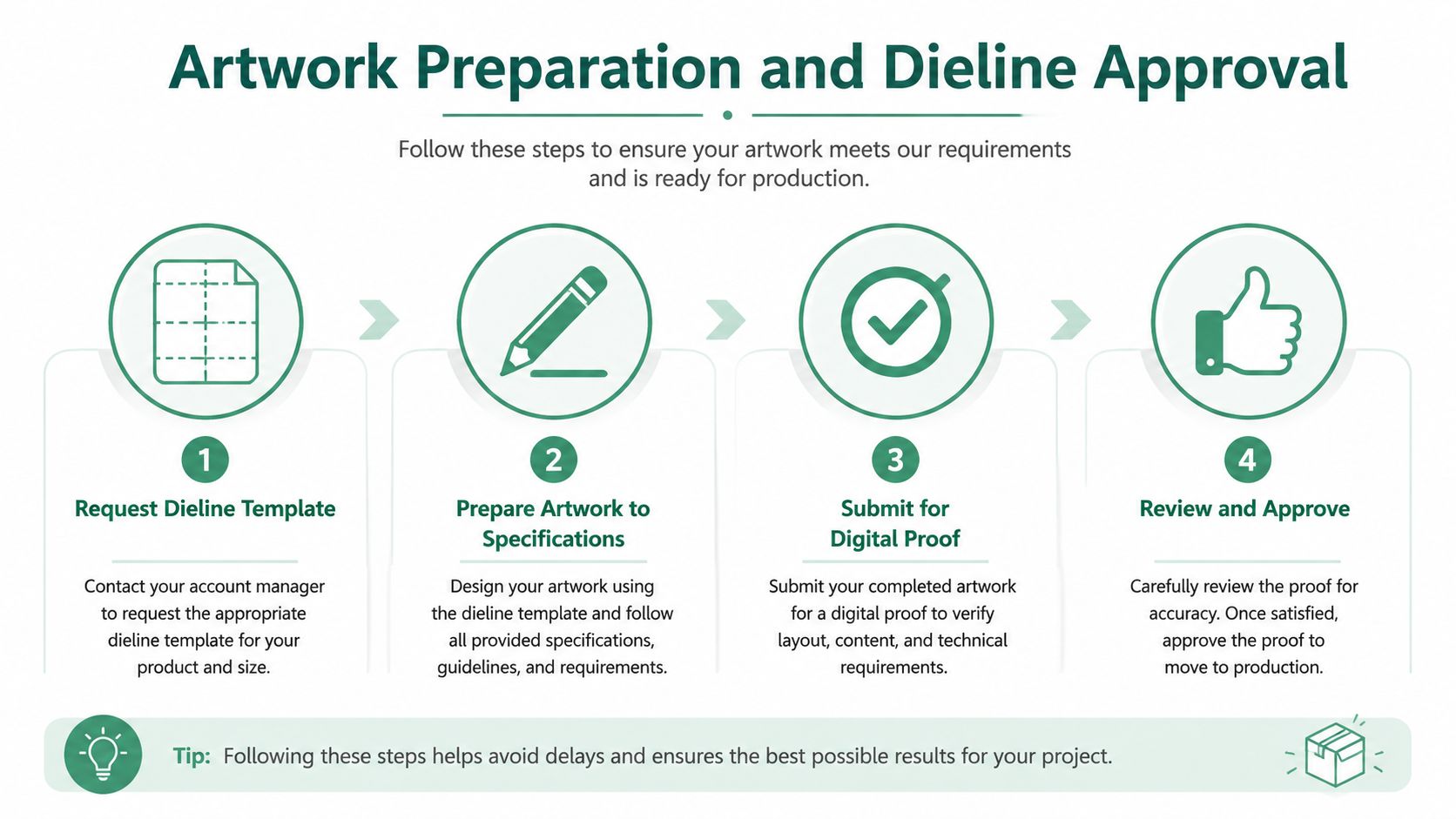
The supplier should issue the exact dieline for the selected size, gusset, lip and closure. A generic template is risky because manufacturing tolerances and seal zones vary between bag constructions. The designer should lock the safe artwork area before placing logos, copy, QR codes or courier-facing identifiers.
Artwork should follow the supplier's requested colour space, resolution and file format. Brand teams should also request the printer's guidance for colour matching on grey versus white film. White film generally gives colours a cleaner base, while grey film can alter lighter tones and reduce contrast.
Protect functional zones
No important copy should sit close to the adhesive lip, side seal or gusset. The design team should leave clear space around those areas and check the folded result rather than approving only the flat artwork. Large ink coverage near a seal can interfere with closure performance, while heavy graphics can make defects harder to spot during inspection.
A barcode needs a flat, high-contrast area that remains visible after the mailer is packed. The warehouse should test the actual scanner used in despatch, because courier acceptance depends on the finished parcel, not the designer's monitor.
Approval should happen on the production geometry, not just the artwork file.
Choose the right proof
A digital proof is appropriate for checking layout, text, logo position and general colour direction. A physical press proof becomes more valuable when the order value, colour sensitivity or reputational risk is high. It gives the buyer a better view of film opacity, ink coverage, folds and the relationship between print and closure.
The approval record should capture the final dieline, artwork version, colour references, dimensions, closure position and authorised sign-off. Practical pre-press guidance is also available in bespoke packaging artwork advice, but the supplier's own dieline remains the controlling document.
Navigating UK Compliance and EPR Fees
A branded mailer can pass artwork approval and still create extra work after launch. UK producers now operate under the Producer Responsibility Obligations (Packaging and Packaging Waste) Regulations 2024, SI 2024/1332, which replaced the 2007 framework. The new regulations came into force on 21 December 2024, and amended provisions took effect from 1 January 2026 across England, Wales, Scotland and Northern Ireland. The legislation text provides the formal reference.
Large producers must register, report packaging data and pay fees based on the amount and type of packaging placed on the market. From 2026, those fees are modulated by recyclability. More recyclable packaging attracts lower charges, while harder-to-recycle packaging pays more, as outlined in the UK packaging EPR compliance guide.
Customisation affects that calculation. A plain mailer may be easier to catalogue, while a printed version can remain suitable if the business has verified the film, ink, adhesive and disposal route. Heavy print coverage or a multi-material construction can create extra questions for data capture and future recyclability labelling. A low purchase price can become a higher total cost once reporting effort, modulated fees and operational risk are included.
Build a usable packaging record
The procurement file should identify:
- Material and format: Record the polymer and whether the mailer is a single-material film or a composite construction.
- Weight and dimensions: Keep the finished specifications used for packaging data reporting.
- Print and closure details: Record inks, labels, adhesives and tamper-evident features supplied with the bag.
- Market destination: Separate UK and EU sales where different obligations or labelling expectations apply.
- Disposal wording: Match customer instructions to the collection route available.
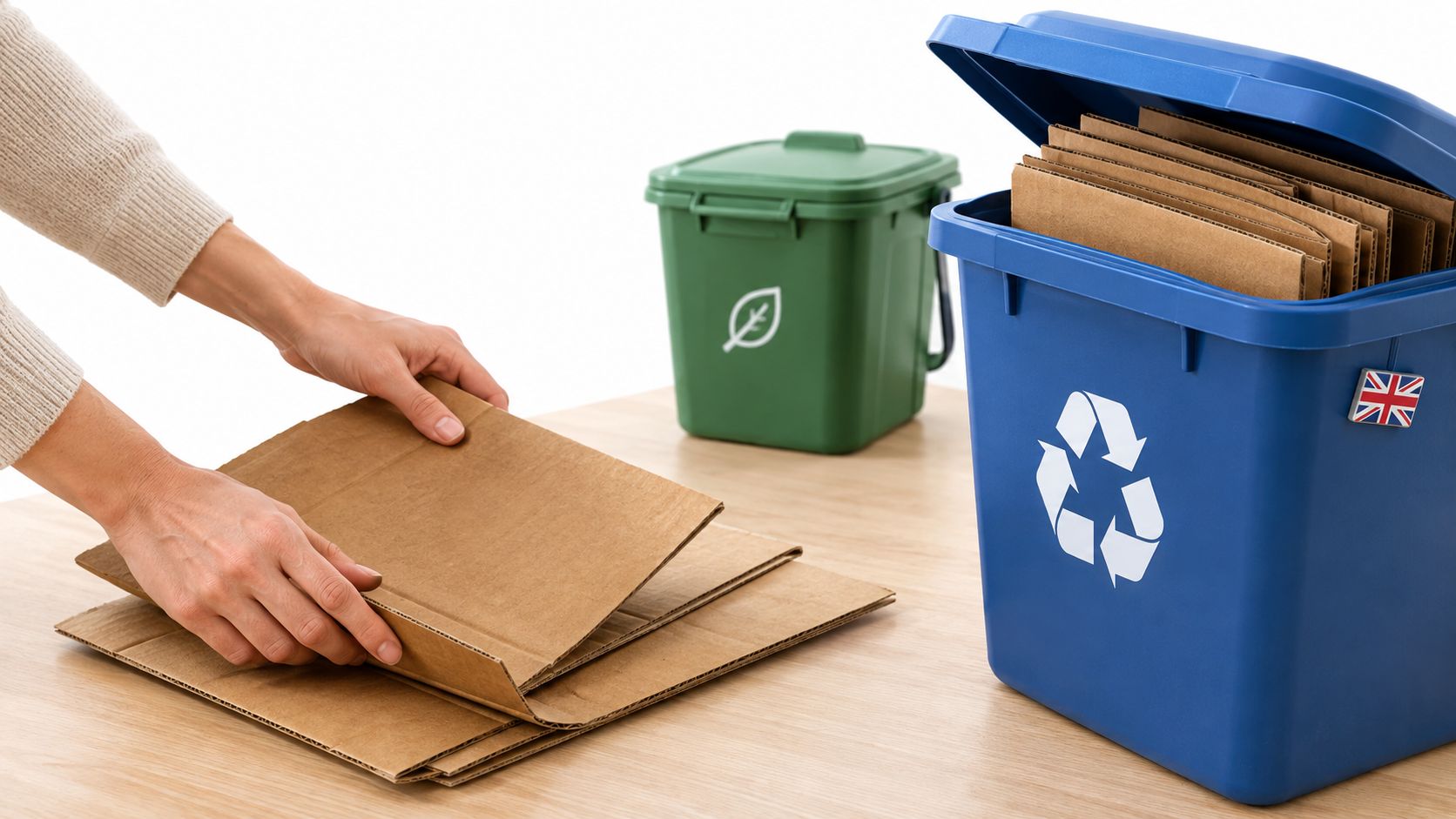
Grey and black poly mailers are generally LDPE film. Independent UK guidance says they commonly require soft-plastics drop-off or council film collections, while padded bubble mailers are mixed material and generally belong in general waste unless they are paper-padded. Disposal instructions should state where, when and in what condition the customer can return the material.
The UK rollout of film collections is still developing, with all English councils expected to have film collection by March 2027, according to the UK parcel-bag recycling guidance. Print, adhesive labels and contamination can affect acceptance, so the supplier should provide clear material information rather than a broad recycling claim. Keep the wider requirements in the UK packaging waste regulations guide alongside the supplier's specification and reporting records.
Prepare for EU sales
For UK businesses selling into the EU, the Packaging and Packaging Waste Regulation entered into force on 11 February 2025, with initial requirements applying from 12 August 2026. It requires packaging to be recyclable, minimally wasteful and clearly labelled, with further phased requirements through 2040, as summarised by the British Retail Consortium's PPWR overview.
The EU timeline sits alongside UK obligations, so shared product records reduce duplication. Approve the complete mailer specification with compliance, operations and finance involved, covering film, print, closure, weight, destination markets and customer disposal wording. That record supports fee reporting and gives the packing team a clear specification to buy against.
Placing Your Order and Validating Performance
A supplier conversation should begin with a written specification, not a request for “a strong branded bag”. The brief should state the packed dimensions, largest product configuration, expected route, closure type, film gauge, print method, artwork status, forecast usage and required delivery window.
For bespoke runs, Packaging Panda lists minimum runs from 500 units as part of its made-to-order capability. That makes a pilot order possible for a growing brand, but a pilot still needs to represent real warehouse conditions. A sample filled with the smallest garment proves very little if the largest multi-item order is the one that causes seam stress.
Use a practical ordering checklist
- Confirm the size: Test the largest intended pack, including inserts and returns documentation.
- Confirm the gauge: Match the film to the product class and handling route, then record the approved specification.
- Confirm closure performance: Open and close samples using the same packing method and check the adhesive overlap.
- Confirm artwork: Approve the dieline, proof, print coverage and barcode position in writing.
- Confirm timing: Align production and delivery with warehouse replenishment needs, dispatch windows and next-day cut-offs.
- Confirm commercial terms: Ask about volume pricing, delivery thresholds, credit-account arrangements and order tracking where relevant.
The performance check should include repeated packing-line trials, seal integrity checks, fit validation and controlled drop testing. A basic visual inspection also matters. Look for uneven seams, pinholes, weak corners, inconsistent opacity and print migration near functional zones.
Evaluate the supplier beyond the quote
A supplier should be able to explain what happens when artwork changes, a repeat run is ordered or a delivery window moves. Live order tracking can help warehouse teams plan replenishment, while transparent volume pricing makes the comparison more useful than a single headline unit cost.
Free delivery thresholds can alter the landed cost for repeat orders, but they shouldn't override a poor specification. The buyer should compare the complete cost of the bag, freight, labour, failure risk, reporting effort and likely replacement activity. A mailer that arrives on time but fails at the seal is not an operational success.
The sample is part of the approval process, not a courtesy item. It should run through the same hands, equipment and product mix as the production order.
Your Specification Decision Framework
A reliable custom poly mailer decision can be reduced to five linked approvals:
- Product fit: Define the largest packed SKU and choose a right-sized format.
- Functional gauge: Start within the 45 to 60 micron UK soft-goods range, then adjust for weight and abuse rather than defaulting to the thickest film.
- Branding method: Use digital print or labels for design flexibility and smaller pilots, and consider flexography when artwork is stable and volume supports setup.
- Compliance record: Capture film, weight, dimensions, print, adhesive and disposal information for UK reporting and EU market preparation.
- Line validation: Approve the mailer only after checking fit, seal integrity, scanning, handling and finished presentation.
| Business situation | Sensible priority |
|---|---|
| New or changing range | Flexible print, samples and conservative pilot quantities |
| Stable high-volume apparel | Repeatable flexographic artwork and tightly controlled gauge |
| Mixed product sizes | Several right-sized formats rather than one oversized bag |
| UK and EU sales | Verified material data, disposal guidance and forward-looking labelling review |
| Sustainability target | Minimum functional material and a realistic collection route |
The specification should be reviewed whenever the product mix, courier route, print design or regulatory exposure changes. That turns mailer procurement into a repeatable control rather than an emergency purchase.
Packaging Panda supplies made-to-order branded mailers alongside paper, poly and padded mailing formats, with bespoke runs from 500 units and UK delivery services including free delivery over £150 and next-day delivery for orders placed before 2pm. Visit Packaging Panda to compare mailing options and start a custom poly mailer specification based on fit, performance and UK compliance requirements.