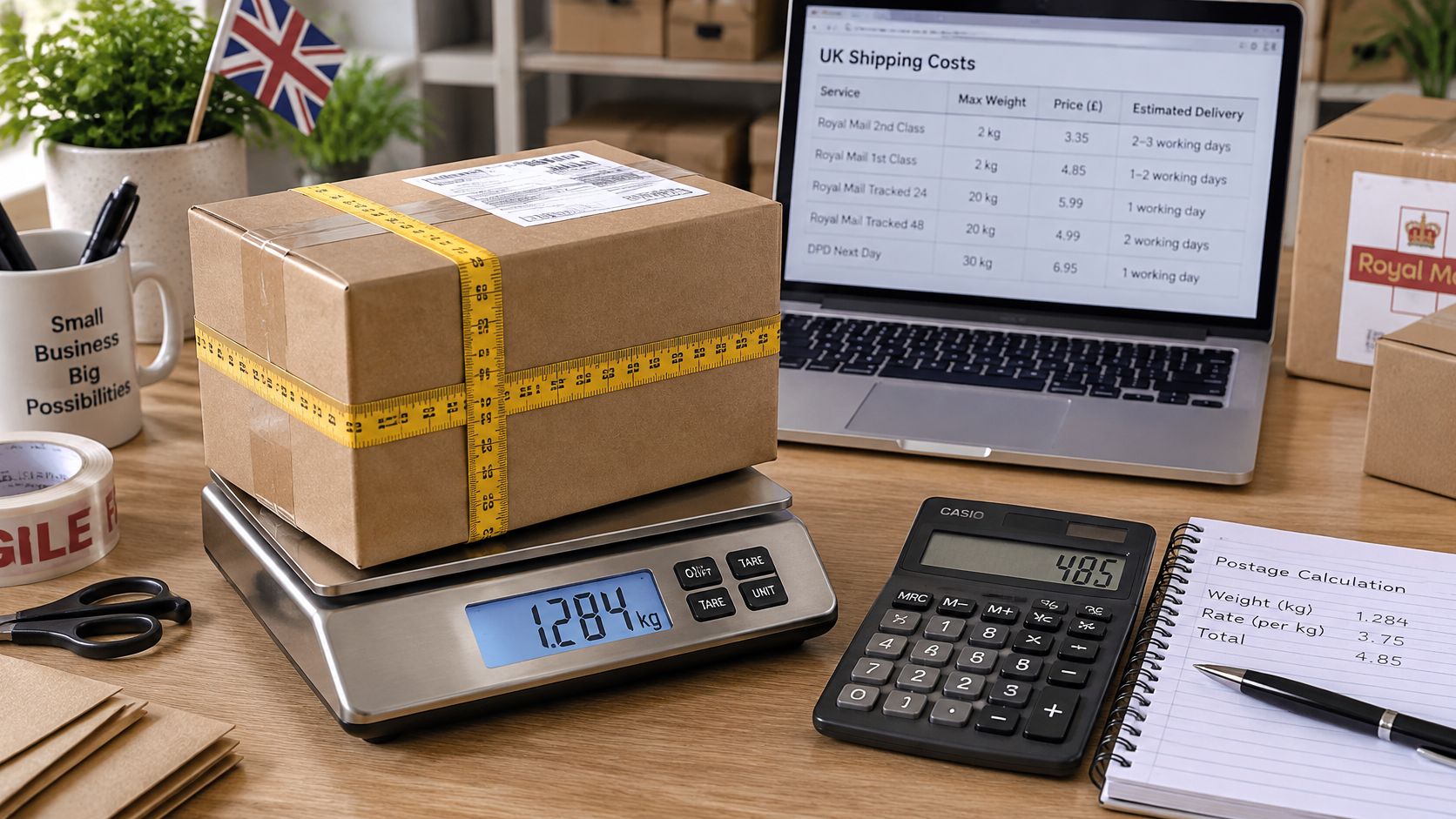
Custom Box Sizes: A UK Guide to Right-Sized Packaging
A typical UK dispatch bench tells the story quickly. A small product goes into a carton that could hold several more, the packer adds a handful of paper or plastic filler, then seals the top with extra tape because the contents move around. The parcel leaves the warehouse looking efficient enough, but the business has paid to transport unused space and the customer receives an oversized box that makes the order feel wasteful.
That pattern is why custom box sizes deserve attention beyond branding. The right dimensions can support courier compliance, reduce void fill, improve packing consistency and create cleaner packaging data for UK waste reporting. The sensible aim isn't a warehouse full of unique cartons. It's a controlled range of optimised sizes that matches the products being dispatched.
Table of Contents
- Why Custom Box Sizes Matter for UK Businesses
- How to Measure and Specify Custom Box Dimensions
- Structural Considerations and Tolerance Choices
- Right-Sizing to Reduce Costs and Waste
- How to Order Custom Boxes and Validate Them
- Key Takeaways for UK Sellers Planning Custom Boxes
Why Custom Box Sizes Matter for UK Businesses
A standard carton can look like the sensible choice at the buying stage. It appears in the catalogue, staff know where to find it and replenishment is simple. Problems begin when one size serves products with different footprints. A candle, clothing item and boxed accessory may share an outer carton even though their space and protection requirements differ.
That mismatch creates avoidable work on a busy fulfilment bench. Packers find filler, adjust unstable loads and deal with labels positioned near folds or seams. Products can move during handling, while parcel dimensions become less consistent for carrier checks and waste records. Customers see the outcome too. A 2023 unboxing-trends survey cited by GWP found that up to 40% of shoppers believed online deliveries often arrived in boxes much larger than the items inside, and 48% named excessive packaging among the most annoying parts of online shopping, according to UK e-commerce packaging coverage.
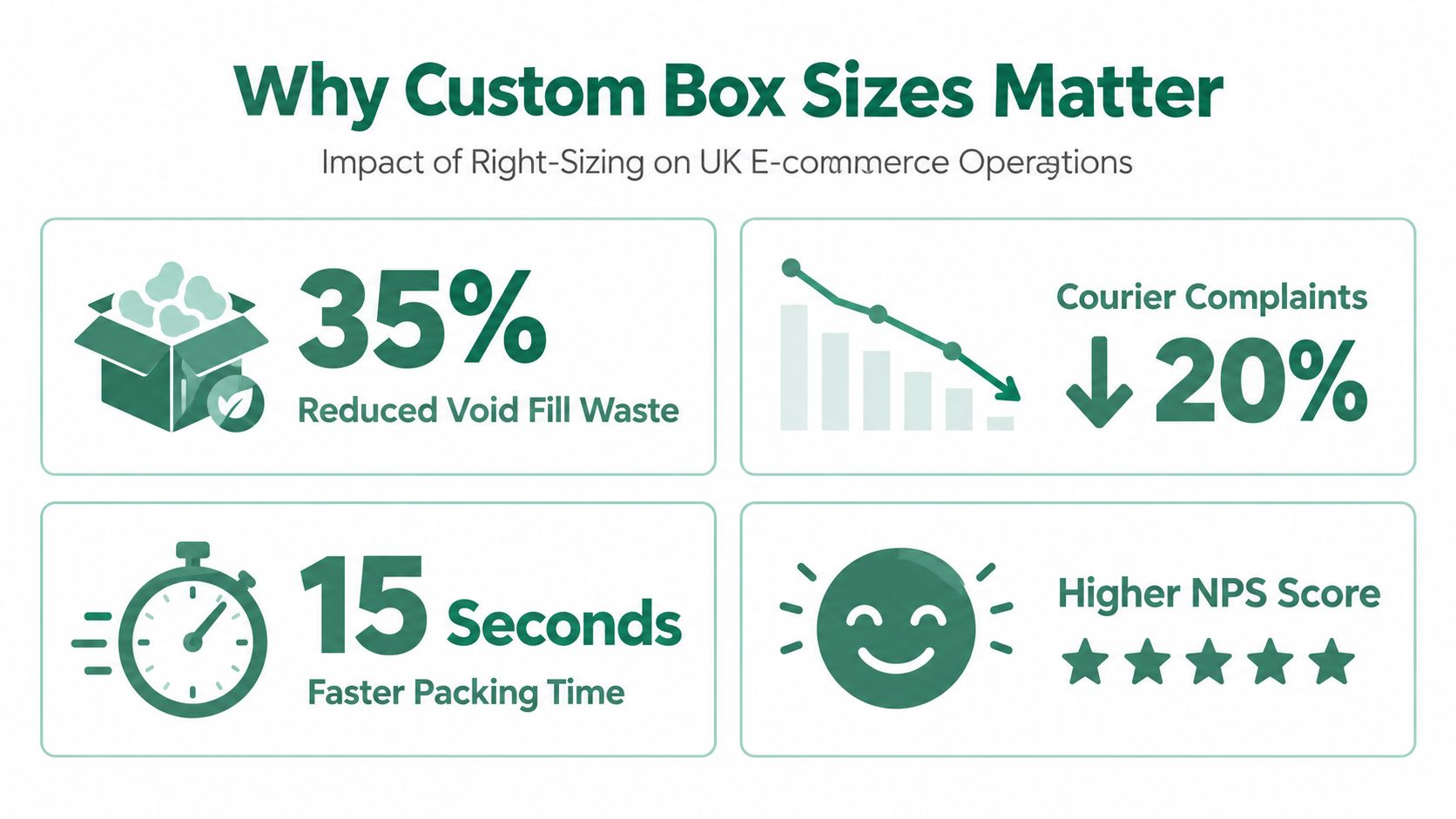
The commercial case extends beyond presentation. Right-sizing reduces empty volume, limits the need for void fill and can help sellers keep parcels within relevant delivery bands. It also makes packaging use easier to measure. For UK businesses preparing packaging information for EPR and NPWD processes, a controlled set of carton formats gives operations teams clearer records of what packaging is being used and where excess material is entering the system.
GWP's 2022 UK packaging industry guide recorded that 14% of online orders still arrived with too much packaging, down from 16% the previous year. The direction was positive, but the remaining gap represented a practical packaging problem for sellers to address.
Practical rule: A small range of well-designed carton sizes usually works better than one universal box or an unmanageable catalogue of alternatives.
UK packaging guidance has therefore encouraged e-commerce businesses with mixed product ranges to plan around limited, standardised custom dimensions. This gives purchasing, packing and reporting teams a repeatable system without requiring a unique carton for every order. The right size protects the product, suits carrier requirements, supports consistent handling and leaves the business with packaging data it can explain.
How to Measure and Specify Custom Box Dimensions
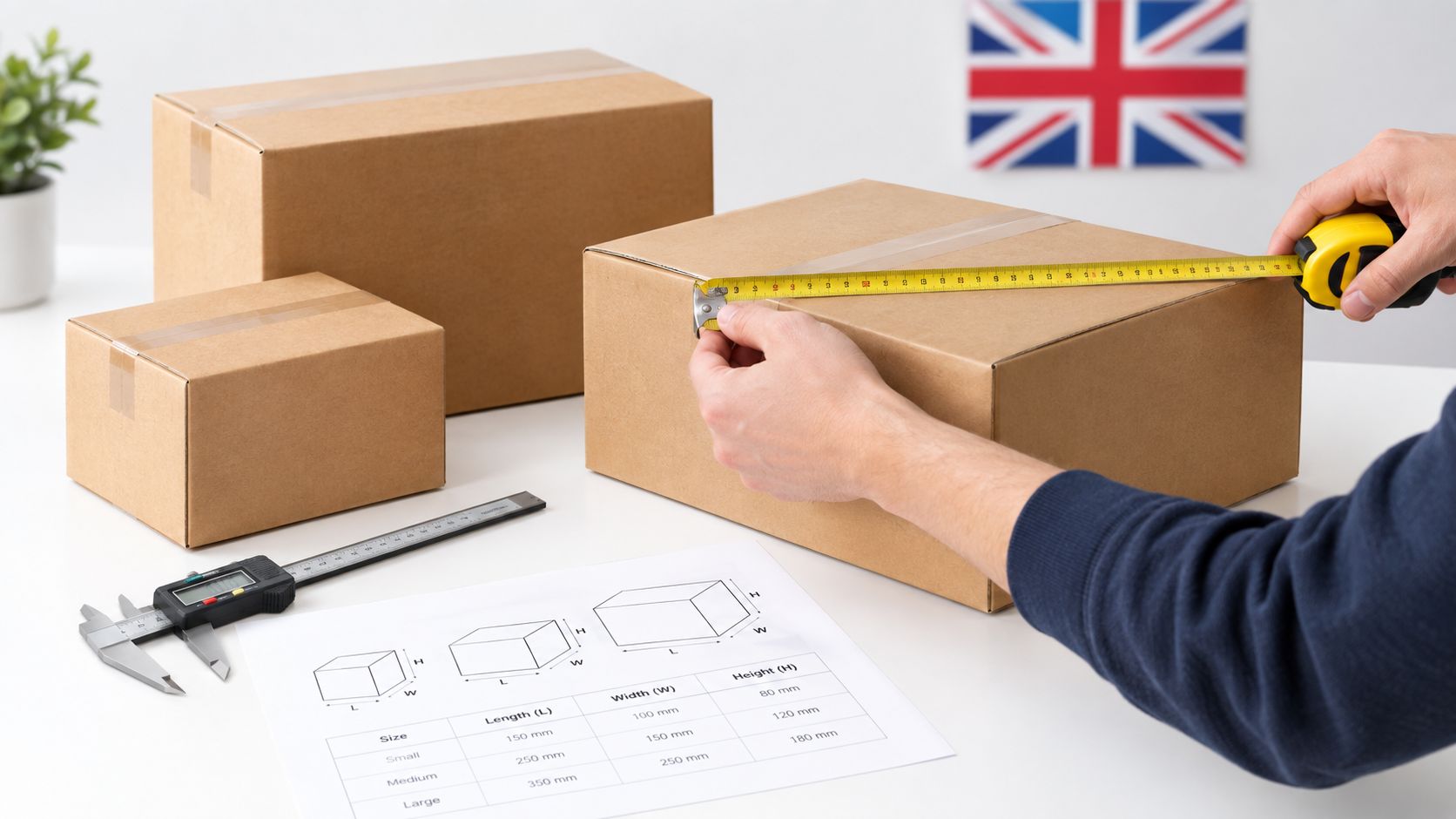
The first specification decision is whether the dimensions describe the inside or outside of the carton. Product fit depends on internal dimensions, while courier charges and warehouse space depend on external dimensions. A supplier needs both, or at least enough board and construction information to calculate the external size accurately.
Measure the product in its dispatch-ready condition, not as a bare object on a desk. Include the lid, cap, protective sleeve, tissue, insert, seal or any other component that will be inside the parcel. Irregular shapes should be measured at their widest, longest and tallest points, because a diagonal corner or raised fitting can make an apparently suitable carton too tight.
A useful specification sheet should record:
- Product dimensions: Length, width and height for the packed product.
- Protection allowance: Space needed for paper padding, card dividers or other inserts.
- Closure clearance: Room for flaps, locking tabs and folds to close without crushing the contents.
- Label area: A reasonably flat external panel for the address label and handling marks.
- Finished dimensions: The required internal size, plus the manufacturer's external dimensions and board construction.
- Tolerance: The acceptable variation that still allows reliable packing and closure.
The conventional order is length × width × height, but teams should state whether each measurement is internal or external. The guide to measuring boxes is useful when several people are recording dimensions and the business needs a consistent method across SKUs.
A product's shape doesn't determine the carton on its own. Closure geometry, board thickness and the way the item is placed can matter just as much. For small retail and gifting products, Kraft Pillow Boxes are available as manilla kraft formats with or without windows, made from recyclable 350gsm card and designed for easy assembly.
Record the top dispatch SKUs first
A full catalogue review can become a slow project. Start with the products that account for the greatest dispatch activity, then group items with similar packed dimensions and protection needs. This often reveals that a business needs a handful of dependable carton formats rather than a separate size for every product.
Add tolerances deliberately
A box that fits perfectly in a drawing can fail on a production line. Board thickness, crease position and conversion accuracy all create small differences, so the specification should identify where clearance is essential and where a close fit is acceptable. Too little allowance causes crushed corners and difficult packing. Too much allowance brings back the void-fill problem the project was meant to remove.
Structural Considerations and Tolerance Choices
Dimensions are only half of a custom carton specification. The same external footprint can behave very differently depending on board grade, flute profile, construction and how the pack is loaded. A lighter board may be perfectly suitable for a stable, lightweight product, while a heavier or fragile item may need stronger compression resistance and better edge protection.
The wrong response is to specify the heaviest board available without testing the product. That increases material use and can make the carton harder to fold or store. The better approach is to match the board and construction to the load, stacking conditions, handling route and protection required during courier transit.
Choose construction for the job
Regular slotted cartons suit many warehouse operations because they are straightforward to seal and stack. A mailer-style construction can make sense where presentation, quick assembly and a secure integrated closure matter. Flute choice affects cushioning, rigidity and the finished internal space, so it should be considered alongside product weight and insert design rather than selected in isolation.
Where a parcel is close to a carrier threshold, reducing external dimensions may be more valuable than changing to a lighter board. Conversely, a fragile product that arrives damaged creates a cost that no saving in corrugate can justify. The specification must therefore balance protection performance, dimensional exposure and packing speed.
A manufacturer should explain the relevant strength measures in plain language, including edge crush performance where it affects stacking and transit. Buyers don't need to demand the highest rating by default. They do need to understand what the proposed board is expected to withstand and how that expectation will be checked.
Treat tolerance as an operating range
Tolerance isn't a licence for vague manufacturing. It defines the range within which the carton remains usable. Internal length and width may need enough clearance for smooth loading, while height may need tighter control if the lid must close over a product without pressure. Crease placement is also important, particularly for shallow cartons and formats with locking tabs.
A prototype should be packed by the person who normally fulfils the order, not only inspected on a supplier's sample table.
Request samples when the new dimensions alter the closure, insert arrangement, board grade or courier route. Test packed cartons for closure, label placement, stacking and handling before approving a production run. A practical sample review can expose problems that a dimension drawing won't show, such as a tab catching on a product edge or a label crossing a fold.
Right-Sizing to Reduce Costs and Waste
Right-sizing is strongest when it starts with the dispatch data already available. A UK packaging optimisation case cited 85 million m³ of air shipped to homes each year, together with 169,291 tonnes of extra cardboard, 480 million m² of plastic tape, 80 million m³ of filler and 86,071 tonnes of avoidable CO₂. These figures are reported in DS Smith's UK air-commerce analysis.
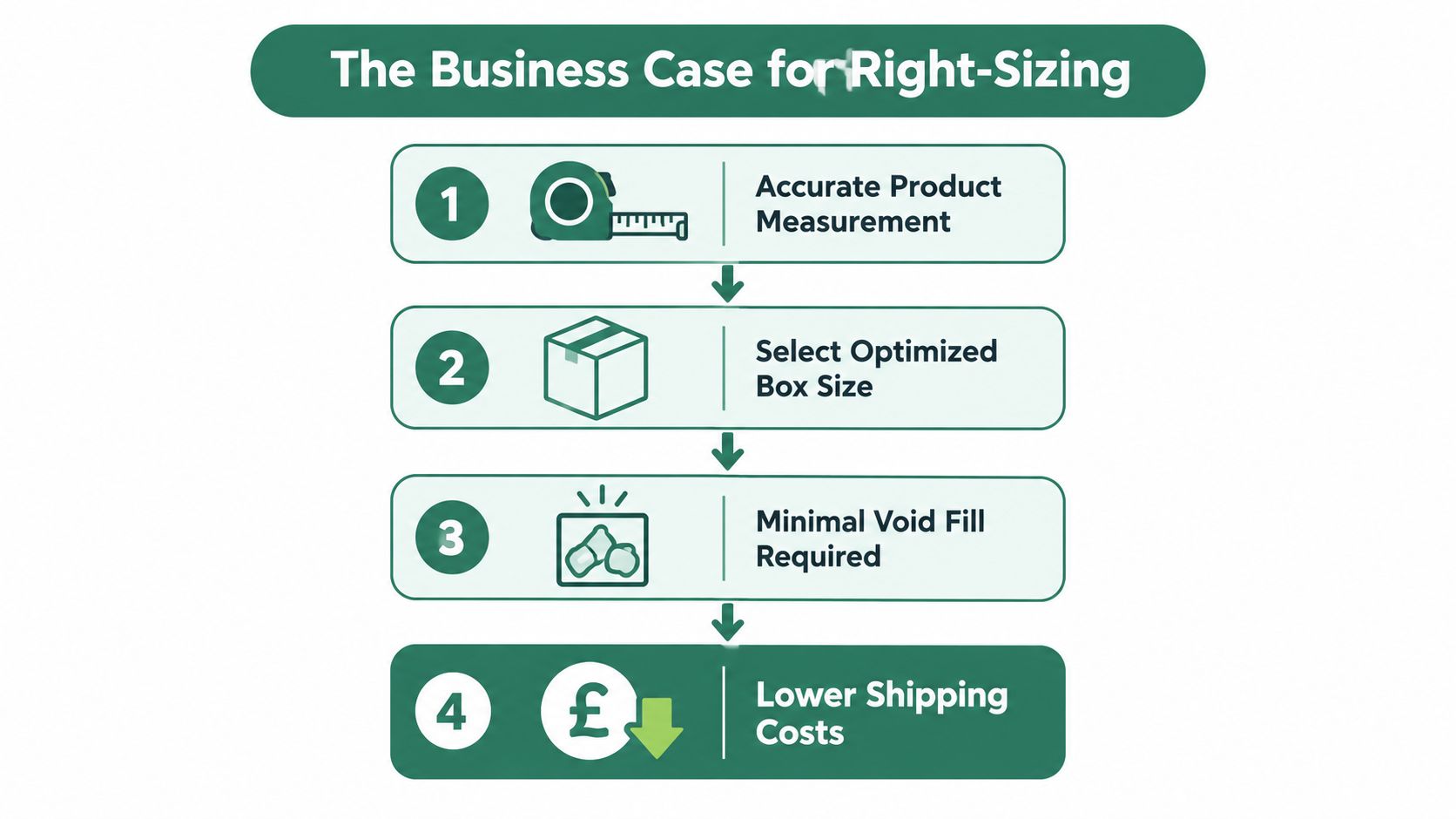
The lesson isn't that every carton should be made as small as possible. A tight box can increase damage, slow picking and leave no room for the protection the product needs. The objective is to remove avoidable empty space while retaining a reliable pack-out and a workable handling process.
Audit the current carton mix
Pull the top dispatch SKUs and record the product's packed dimensions, the carton used, the amount of filler and the finished parcel dimensions. Photograph representative packs if several shifts or fulfilment partners are involved. This makes the variation visible and gives the manufacturer a useful starting point.
Prioritise products where the difference between the item and the carton is obvious, where filler is used routinely or where the outer parcel sits close to a courier size boundary. The design should then be checked against a modular pallet or parcel footprint, because a box that fits the product but wastes space in storage or on a pallet may not improve the total operation.
UK courier rules can make millimetres commercially important. Royal Mail's Large Letter format has a maximum external size of 353 × 250 × 25 mm, and UK market reporting states that many retailers target thickness at 22 mm or less to improve delivery reliability, as outlined in UK e-commerce packaging market reporting. A product that can safely fit within that boundary may need a very different carton design from one intended for a larger parcel service.
The same principle applies to small containers and components. Businesses reviewing packaging formats can use guidance on choosing 1 ounce containers wisely as a useful reminder that a small change in primary-pack dimensions can affect the outer carton and the amount of protective material required.
For broader reference, standard box dimensions can help a team compare existing stock sizes before deciding whether a custom format is genuinely necessary. A standard size is good enough when it protects the product, uses little filler and sits comfortably within the carrier's rules. Custom tooling earns its place when the repeated operational waste is clear.
How to Order Custom Boxes and Validate Them
A supplier can quote accurately only when the buyer provides more than a product name. The enquiry should include internal dimensions, intended external limits, product weight, board or appearance requirements, closure style, printing needs, estimated order volume and the delivery destination. Photos of the existing pack and a sample of the product can remove uncertainty early.
The buying decision should separate design from validation. A low unit price for a carton that fails a drop test, takes too long to assemble or attracts a higher delivery charge isn't a saving. Ask the manufacturer how samples are produced, which dimensions are controlled, what board specification is proposed and how any tolerances will be shown on the approval drawing.
Build a realistic purchasing brief
Minimum runs and lead times vary with board, print, tooling and factory workload. Buyers should ask whether an unprinted trial is possible, whether multiple sizes can be combined in a production plan and when artwork must be approved. UK supply details can also affect the replenishment plan, including next-day cut-offs, delivery thresholds, credit-account arrangements and tracking for repeat orders.
A useful brief includes:
- Pack-out objective: What the carton must hold and how it will be protected.
- Carrier requirement: The service used and the relevant dimensional restrictions.
- Data requirement: Board material, weight and packaging format information needed for internal records.
- Approval route: Who signs off the drawing, sample and final print.
- Reorder trigger: The stock level at which a repeat run must be placed.
For businesses comparing formats, a supplier's guidance on custom shipping boxes can help frame the conversation around construction and use rather than artwork alone.
Test the finished pack
Pack a trial run using normal staff, normal inserts and the actual label process. Check closure, product movement, sealing, stacking and the time required at the bench. Then send representative parcels through the intended courier route or complete a suitable drop and handling test that reflects the product's risks.
Record damage, scuffing, crushed corners and any packing steps that feel awkward. If the carton passes technically but causes repeated errors, the design still needs work. A short trial run is often more useful than approving a large production quantity from a single display sample.
Packaging data should be captured at the same time. Record carton dimensions, board weight, material type and the SKU or format used. That information supports cost analysis and makes later waste reporting less dependent on estimates.
Key Takeaways for UK Sellers Planning Custom Boxes
Custom box sizing should begin with the products that leave the warehouse most often, not with a preferred carton catalogue. Measure the packed item, define internal and external dimensions separately, allow for protection and closure, then test the finished format with real packing staff.
Structural choices matter as much as size. Select board and construction for the product's weight, stacking and transit risks, and don't specify extra material without a clear performance reason. A standard carton remains the right choice when it fits well and avoids unnecessary filler.
Right-sizing also improves the quality of packaging information. The National Packaging Waste Database records packaging by material and type under UK reporting rules, including the Packaging Waste (Data Reporting) Regulations 2023 and the Producer Responsibility Obligations (Packaging and Packaging Waste) Regulations 2024. Large producers report packaging data every six months, so consistent carton specifications make internal classification and material declarations easier to manage.
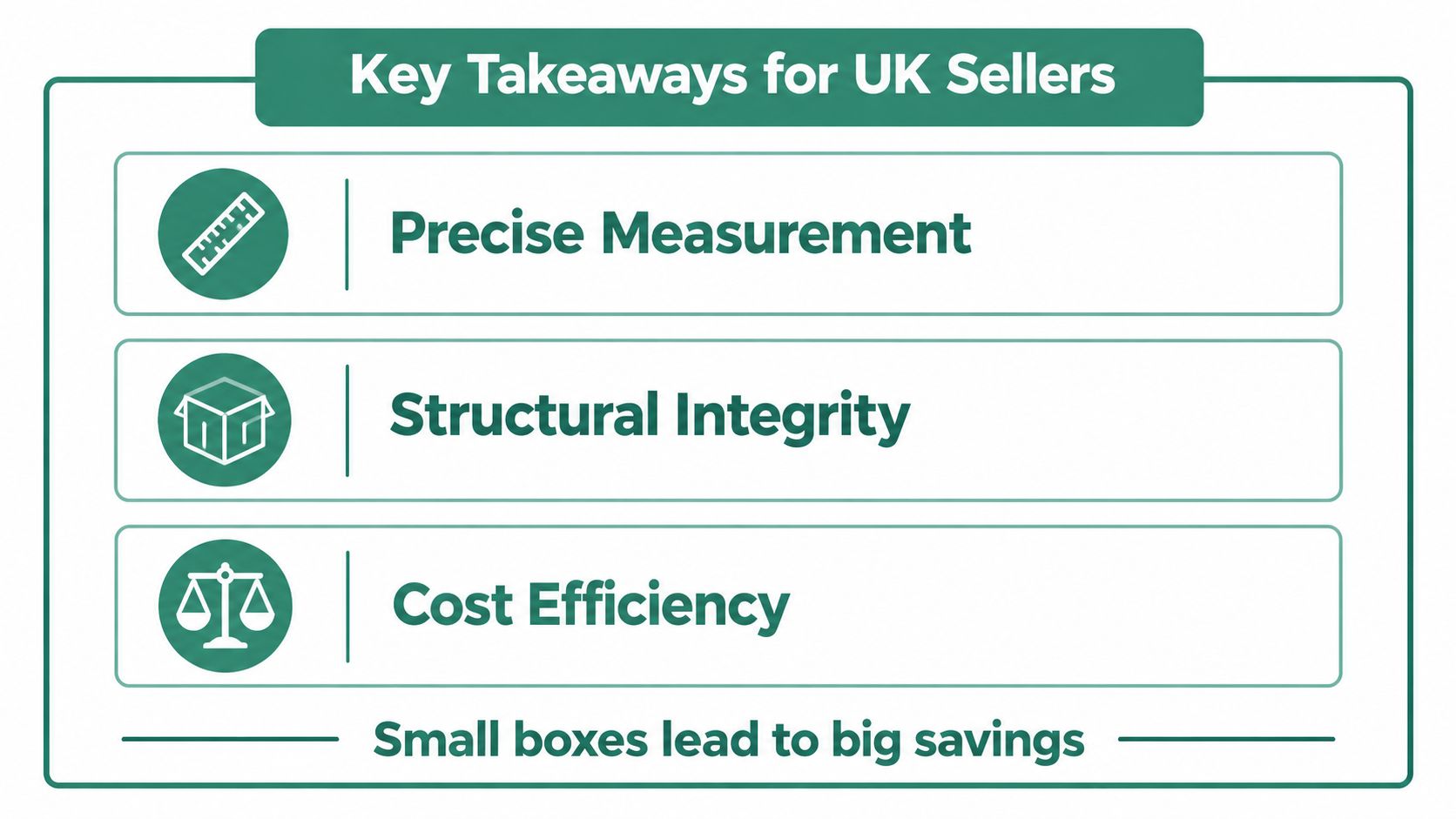
For UK sellers, the decision framework is simple: measure precisely, protect adequately, fit the carrier and record the material accurately. Small boxes lead to big savings only when they also survive the journey.
Packaging Panda supplies recyclable cardboard boxes, shipping cartons, mailing products and made-to-order packaging for UK businesses, including bespoke sizes and printed formats with minimum runs from 500 units. Review the available options and discuss a practical right-sizing project through Packaging Panda.