Box Dimensions Standard: A UK Sizing and Carrier Guide

A parcel is waiting on the packing bench. The product fits comfortably, the label is printed, and the carton looks perfectly reasonable. Then someone measures the finished package and finds that its outer length has crossed a carrier limit. The contents haven't changed, but the postage category has.
That moment captures the meaning of box dimensions standard in the UK. There isn't one universal carton size that every manufacturer, retailer and courier follows. Instead, businesses work within a practical system shaped by parcel bands, external measurements, product protection and packaging obligations. The right box is the one that fits the item safely while remaining inside the most suitable carrier threshold.
Table of Contents
- Why Box Dimensions in the UK Are Driven by Carriers
- How to Measure a Box the Right Way
- Royal Mail Parcel Bands and Their Practical Limits
- Common UK Carton Sizes and What They Are Best Used For
- Rolled and Irregular Parcels Including Tubes and Cylinders
- Why Smaller Is Not Always Cheaper
- A Practical Right-Sizing Checklist for UK Shippers
- Choosing a Standard Box That Fits Your Business
Why Box Dimensions in the UK Are Driven by Carriers
A Bristol business selling flat-packed candles once discovered that a seemingly minor carton change affected dispatch costs. The revised box added 4 cm in one direction, enough to move orders into a higher delivery band. The candle set was identical, the packing team worked in the same way, and the customer received the same product. Only the packed parcel dimensions had changed.
That is why UK packaging decisions start with the carrier, not with an isolated catalogue description. Royal Mail uses practical size bands for Large Letter, Small Parcel and Medium Parcel services, while other networks, including DPD, Evri, Yodel and Amazon shipping services, apply their own acceptance rules and pricing structures. The exact thresholds differ, but the operating principle is shared. External dimensions can decide what a parcel costs and whether a service accepts it.
Practical rule: A standard box is usually a carrier-compatible envelope, not a universal carton measurement.
A business that sends mostly compact clothing orders might design around the Royal Mail Small Parcel ceiling. A company shipping larger mixed orders may need a Medium Parcel profile or a courier-specific carton range. Teams comparing parcel dimensions with actual product weights can also use this guide to calculate volumetric weight, because a spacious carton can affect courier calculations even when the contents are light.
The second pressure on carton design
Carrier economics now sits alongside packaging-waste responsibility. GOV.UK packaging guidance asks businesses to use the minimum weight and volume needed to keep goods safe and hygienic, while the UK's packaging rules are set out under the 2024 regulations as amended, with 2025 amendment regulations extending across the UK (GOV.UK packaging responsibilities, 2025 packaging amendment regulations).
That creates two tests for every carton. It must be small enough to avoid unnecessary material and unsuitable carrier bands, but strong enough to survive handling. A business shouldn't treat a carrier limit and packaging-waste obligations as separate purchasing exercises. Both reward a repeatable range of cartons designed around real orders.
The UK box dimensions standard is therefore best understood as a logistics standard. Manufacturers and wholesalers commonly offer sizes that work with carrier breakpoints, warehouse shelving, packing routines and product protection. The most efficient range isn't necessarily the smallest range. It is the range that keeps frequent orders compliant, protected and economical.
How to Measure a Box the Right Way
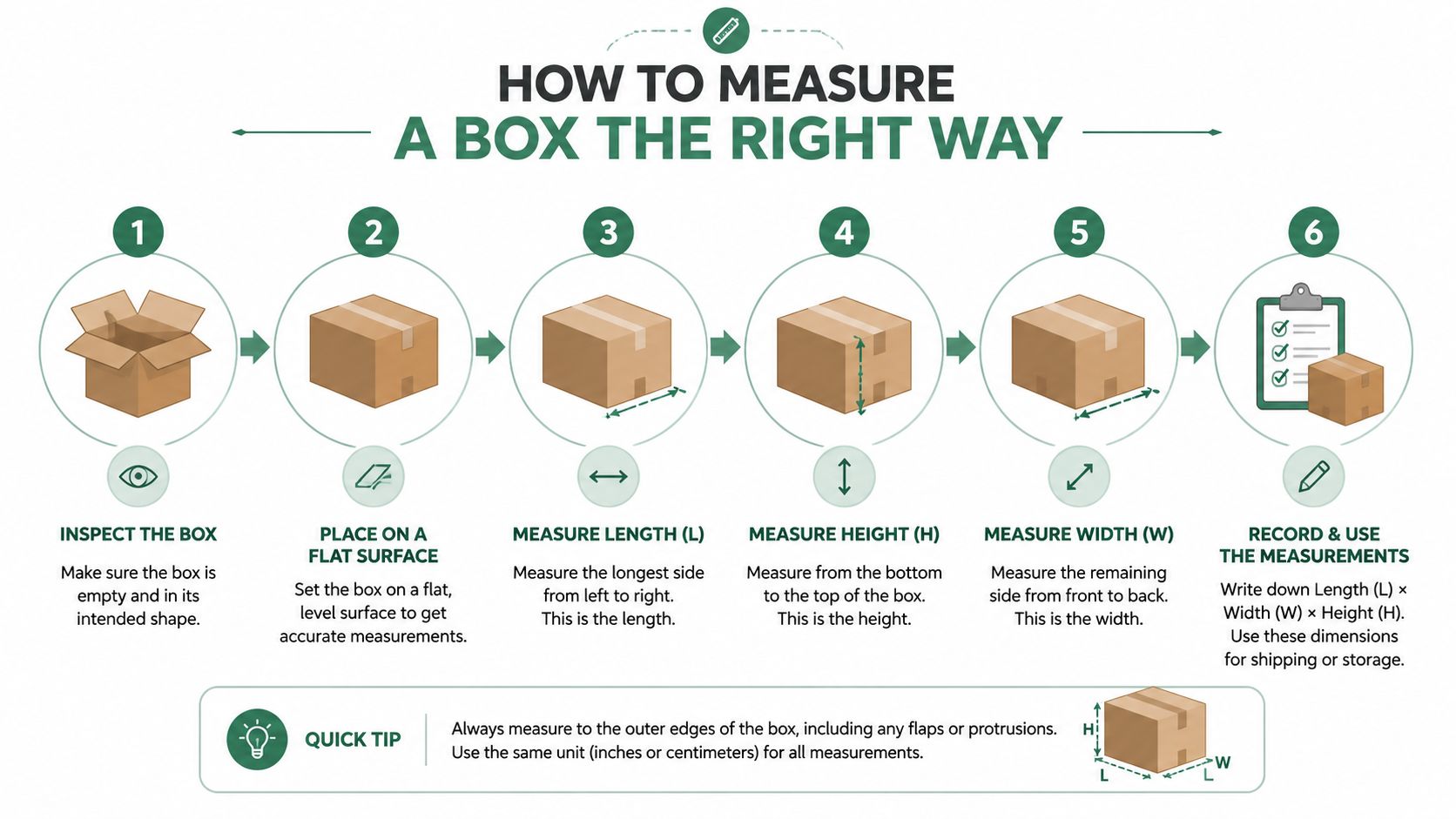
A carrier measures the finished parcel, so the packing team needs a consistent method. UK box dimensions are normally recorded as length × width × height, or L × W × H, and the measurements should describe the outside of the closed carton.
Establish the three dimensions
Length is generally the longest side. Width is the shorter side across the top or face, and height is the remaining dimension once the carton is positioned in its normal upright orientation. The order matters because a carrier's limit applies to each dimension, not just to the total of all three.
Take a Royal Mail Small Parcel as the working example. The parcel must be no more than 450 mm long, 350 mm wide and 160 mm high, with a maximum weight of 2 kg, as shown in the Royal Mail parcel guidance. A carton measuring 440 mm × 340 mm × 150 mm passes the dimensional check, assuming the packed weight also remains within the stated limit. A carton that exceeds any one of those external measurements doesn't become compliant because the other two sides are smaller.
Measure after inserting the product, protective material and closure. Royal Mail's own framework requires sellers to measure the packed parcel, not the product alone (Royal Mail weighing and measuring guidance). Tape, bulging panels, an overfilled mailer and a label that changes the final shape can all affect the finished package.
Outside size is for postage, inside size is for fit
Box manufacturers often quote internal dimensions because those figures tell a buyer whether a product will fit. Couriers check the outer dimensions, including board thickness and anything that pushes against the carton walls. A product may fit the stated internal length while the assembled box fails the carrier test because its outside length is larger.
A packing team should use a rigid tape measure rather than a flexible ruler, particularly on crushed, softened or reused cartons. Measurements should be taken in millimetres where possible, recorded without guessing, and rounded up rather than down when the carton sits close to a threshold. The same discipline helps when selecting Packaging Tapes, which covers carton, parcel and pallet sealing options including clear, brown, printed, paper and PVC tapes.
The safest process is simple:
- Close the carton in its dispatch condition.
- Measure the longest external side.
- Measure the shorter external side.
- Measure the remaining external depth or height.
- Weigh the complete parcel.
- Compare every result with the relevant carrier table.
This prevents a common mistake, measuring an empty box or product and assuming the packed shipment will have the same dimensions.
Royal Mail Parcel Bands and Their Practical Limits
Royal Mail's domestic categories give many UK businesses a useful starting point for carton design. The four main bands are Large Letter, Small Parcel, Medium Parcel and Large Parcel. Each has a size ceiling and weight limit, so a box that crosses one boundary can change the available service and price.
| Band | Max Length | Max W × H | Max Weight | Typical Use |
|---|---|---|---|---|
| Large Letter | 353 mm | 250 mm × 25 mm | Not stated in the supplied guide | Flat documents, thin clothing and slim items |
| Small Parcel | 450 mm | 350 mm × 160 mm | 2 kg | Compact e-commerce orders |
| Medium Parcel | 610 mm | 460 mm × 460 mm | 20 kg | Larger cartons and multi-item orders |
| Large Parcel | 1.5 m | Length plus girth up to 3 m | 30 kg | Oversized or heavy consignments |
The Large Letter ceiling is especially restrictive on thickness. It allows a maximum thickness of 25 mm, with maximum dimensions of 353 × 250 mm, according to the UK parcel-size reference used by packaging suppliers (Royal Mail size guide). A rigid product may therefore need a Small Parcel carton even when its length and width look suitable for a letter-style format.
A Small Parcel reaches 450 × 350 × 160 mm and 2 kg. That envelope suits many ordinary online orders, but the final carton must stay within every dimension. A t-shirt packed in a box measuring 460 mm long crosses into the Medium Parcel category purely because of that additional 1 cm, based on the stated Royal Mail thresholds. The contents don't need to be heavier for the classification to change.
What the higher bands mean operationally
Medium Parcel permits 610 × 460 × 460 mm and 20 kg, giving fulfilment teams more room for kitchenware, bundled orders and protective inserts. Large Parcel extends to a maximum length of 1.5 m, a length-plus-girth limit of 3 m and a maximum weight of 30 kg, using the cited carrier guide.
Services such as Tracked 24, Tracked 48 and Signed For sit within Royal Mail's broader service offering, but the available option still depends on the parcel's category, dimensions, weight and destination. Domestic rules shouldn't be mixed with international assumptions. Royal Mail maintains separate domestic and international parcel guides, and overseas services use their own tiered tables with different, often tighter, ceilings.
A business comparing stock should therefore review Royal Mail postage boxes against the packed measurements, not just the product description. A round presentation format may also need a different approach. For example, Wholesale Hat Boxes are available in varied colours, sizes and finishes for retail, gifting and display, but a business still needs to check the assembled outer dimensions before selecting a postal service.
Common UK Carton Sizes and What They Are Best Used For
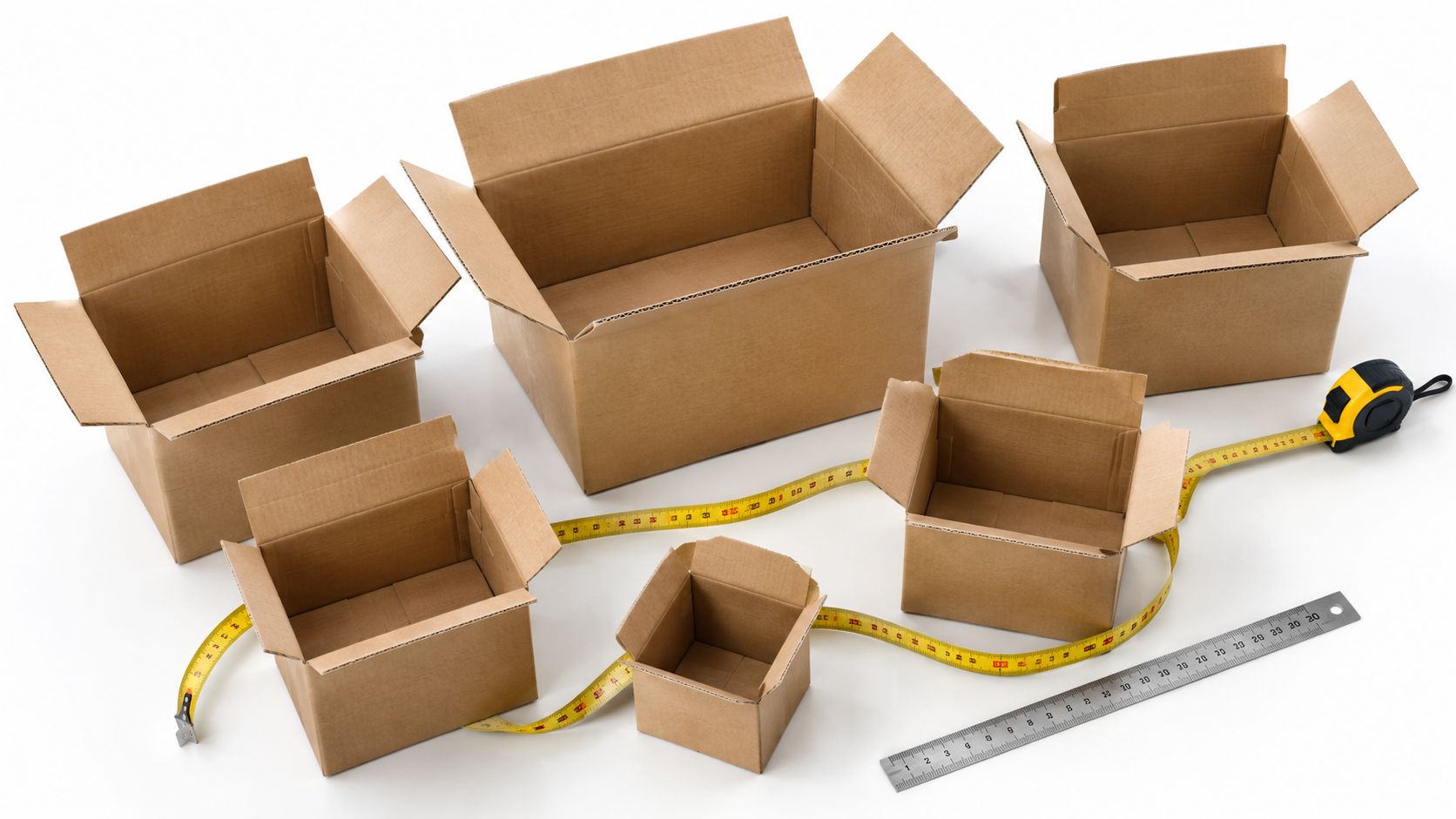
Stocked cartons become easier to manage when each size has a clear job. A small business doesn't need a box for every individual product if a few repeatable footprints cover the main order families without creating excessive empty space.
| Carton Size (L × W × H mm) | Typical Products | Likely Carrier Band |
|---|---|---|
| 150 × 150 × 150 | Cosmetics, supplements, small electronics and compact gifts | Small Parcel or courier small-parcel service |
| 229 × 165 × 65 | A4 documents, books, stationery and flat retail items | Small Parcel, subject to packed measurements |
| 350 × 250 × 100 | Clothing, books, board games and modest kitchenware | Small Parcel, subject to the external envelope |
| 457 × 305 × 305 | Multi-item orders, larger kitchenware and heavier retail packs | Medium Parcel or courier service |
| 610 × 457 × 457 | Bulky mixed orders and substantial protective packing | Medium Parcel at the stated ceiling, or a large courier service if exceeded |
The smallest cube works when the product itself is compact and doesn't need much cushioning. It can suit a cosmetics bundle or a small electronic accessory, but a team shouldn't force a fragile item into it just because the carton looks efficient. The A4-friendly footprint offers a flatter alternative for paperwork, books and stationery, while the shoebox-style carton accommodates clothing and board games without the unused height of a cube.
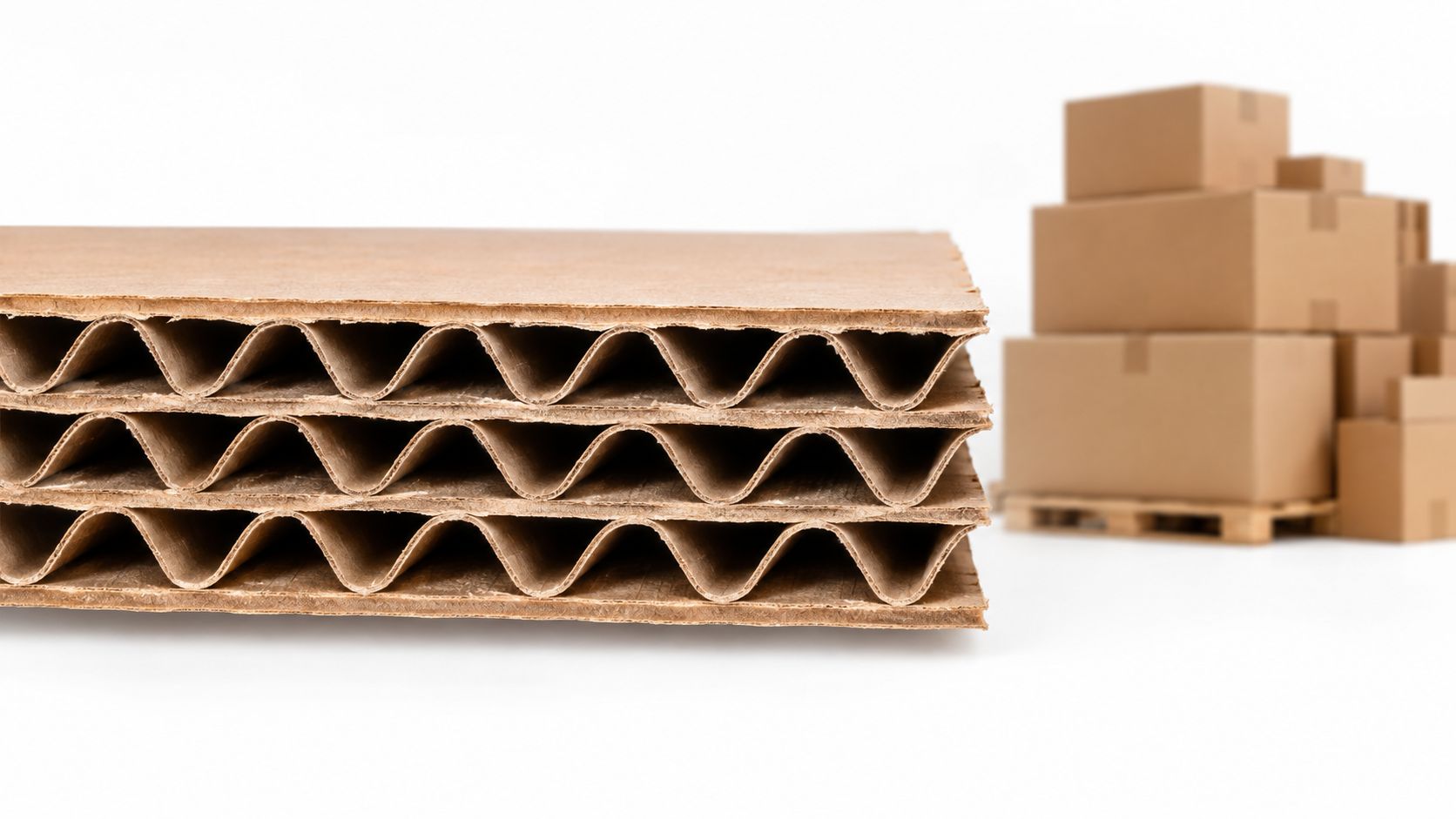
The larger carton sizes require closer attention to board strength. Double-wall board becomes relevant once an edge exceeds about 300 mm or weights climb past 10 kg, particularly where the contents can shift or the parcel will be stacked. Those figures are practical design markers rather than universal carrier rules. Product density, fragility, stacking conditions and closure quality still determine the appropriate board grade.
Dispatch decision: The most useful carton is the one that handles a repeat order family consistently, not the one with the largest internal capacity.
Teams working with heavier shipments should also review guidance on how to understand container weight rules, especially when product weight, packaging weight and handling equipment affect warehouse decisions. Royal Mail bands use the packed parcel, so the carton and protective materials belong in the calculation.
A SKU rationalisation exercise can group products by their outer packing needs. Books and supplements may share one mailer, while fragile kitchenware and multi-item orders need a stronger, deeper carton. That creates a manageable stock range without pretending that one box can serve every product.
Rolled and Irregular Parcels Including Tubes and Cylinders
Cylinders don't fit neatly into a rectangular box table. Their usable parcel space depends on both length and circumference, so a tube that looks short enough may still fail the combined measurement.
For rolled and cylinder-shaped items, the Post Office states that length plus twice the diameter must be no more than 104 cm, and the greatest dimension must be no more than 90 cm (Royal Mail UK parcel services). In practical terms, the calculation is:
length + 2 × diameter
For a rectangular interpretation of girth, the equivalent formula is L + 2W + 2H. A poster tube measuring 700 × 70 mm has a length of 700 mm and a diameter of 70 mm, giving a combined length-plus-twice-diameter measurement of 840 mm, which is below the stated 1,040 mm limit. A wider rolled textile can consume the available dimensional allowance quickly, even where its length remains unchanged.
Triangular tubes may help protect long, rigid products such as golf equipment or long-handled tools, but an awkward shape can be harder to process and label. Musical equipment, rolled artwork and irregular assemblies need a carrier check before a standard tube is selected. The longest dimension should be obvious on the label and in the dispatch record.
A tube may fall into a Medium Parcel rather than a Large Letter because of its length and diameter. Businesses comparing formats can also use cardboard postal tube facts when deciding whether a tube offers genuine protection or whether a flat mailer would use the carrier envelope more efficiently.
Why Smaller Is Not Always Cheaper
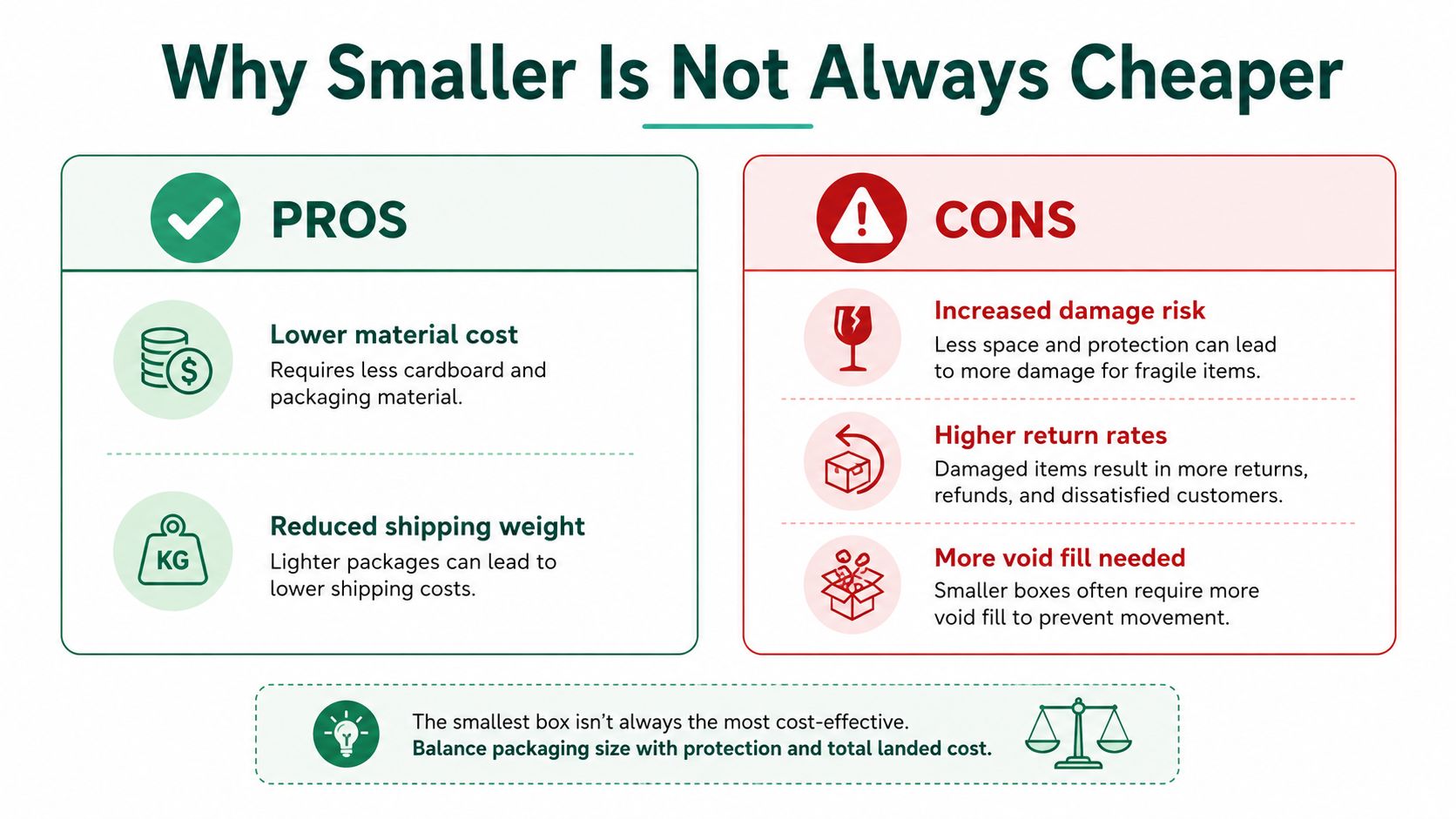
A small business can choose a tighter carton and still pay more to dispatch an order. If the product arrives damaged, needs replacement, generates a return or becomes difficult to pack consistently, the saving in board may disappear.
Right-sizing also has a practical limit. A carton that leaves too little clearance can make a rigid item press against the walls, expose fragile goods to knocks or require extra void fill. Overfilling may bow the panels and increase the parcel's measured dimensions. The carrier sees the finished parcel, not the intention behind the carton.
Total dispatch cost matters
Packaging guidance calls for the minimum weight and volume needed to keep goods safe and hygienic. The UK's packaging rules also include 2025 amendments under the Extended Producer Responsibility framework, as outlined in the GOV.UK packaging guidance and the 2025 regulations. The practical reading is straightforward: remove material that serves no purpose, while keeping the protection the product needs.
A slightly larger carton with a snug insert can perform better than a thin box that lets the contents move. Double-walled board may suit a vulnerable or heavy order, while single-wall board may be enough for a lighter, stable product. Assess each format against five questions:
- Carrier fit: Does the sealed parcel stay within the intended band?
- Protection: Can the carton handle normal handling, stacking and product movement?
- Packing labour: Can staff pack it consistently without improvised filler?
- Customer outcome: Should the goods arrive in saleable condition?
- Waste responsibility: Is the material necessary and recyclable through the business's chosen system?
The Weights and Measures (Packaged Goods) Regulations 2006 cover constant nominal quantities packed by weight or volume from 5 g or 5 ml up to 25 kg or 25 litres. They also extend to outer containers holding at least one package, according to the Weights and Measures Regulations. These rules do not set one universal carton size. Carrier limits, product protection and justified material use still determine the suitable format.
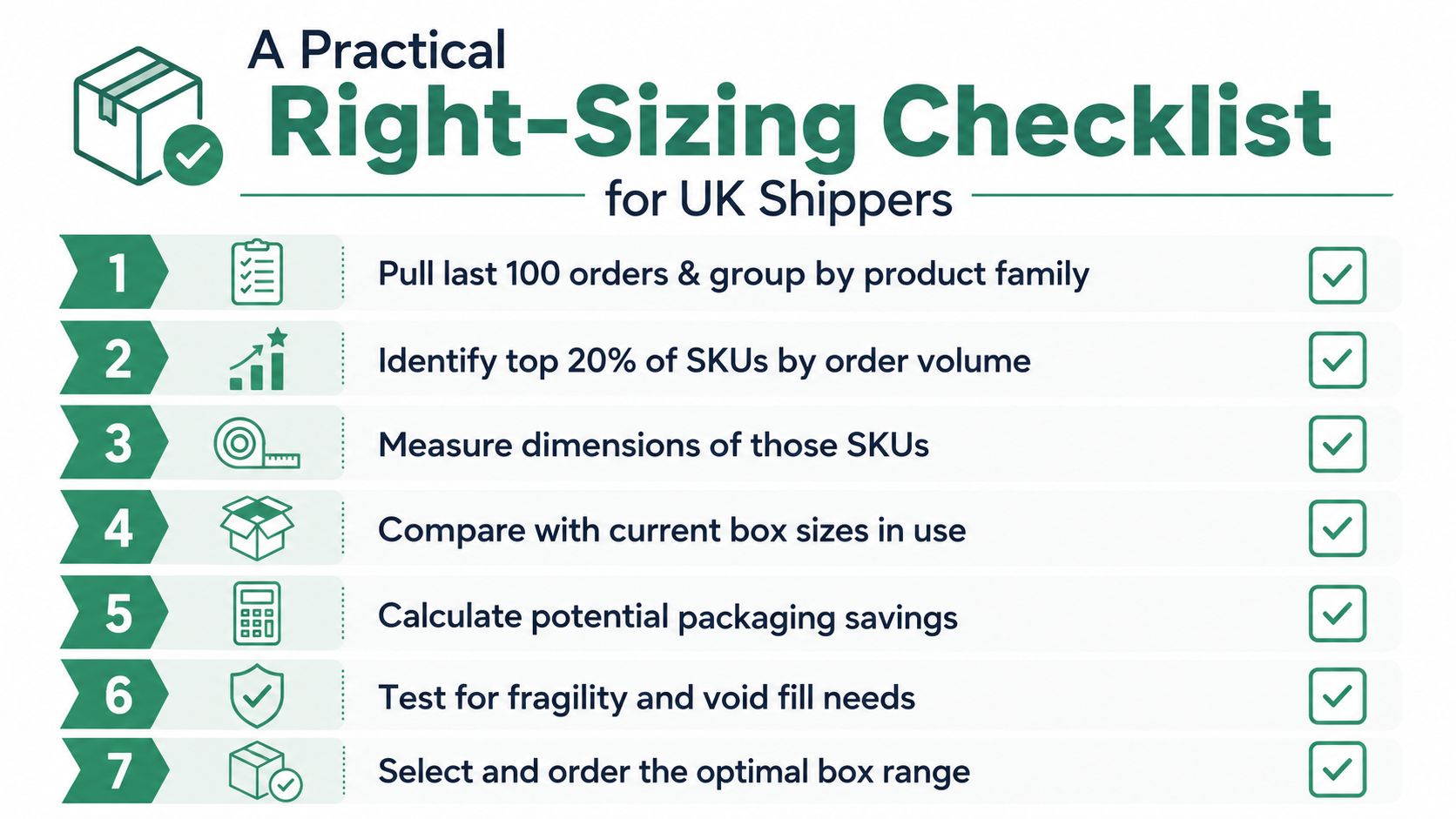
A Practical Right-Sizing Checklist for UK Shippers
A useful packaging review starts with the orders a business sends. A seven-step process can turn scattered carton choices into a controlled range, provided each step ends with a clear pass or fail decision.
-
Group recent orders by product family. Pull the last 100 orders and group them by family rather than by individual SKU. Pass if repeated packing patterns emerge, fail if every order still requires an unrelated carton.
-
Map each family to a carrier band. Test each packed product against the smallest Royal Mail category that can contain it safely. Keep a 2 cm buffer for tape, label overlap and ordinary packing variation. Pass if the closed carton remains compliant, fail if it only fits before sealing.
-
Match board grade to the shipment. Use single-wall board for items under 5 kg, and consider double-wall board for anything heavier or fragile. Pass if the carton remains firm during a practical handling test, fail if the panels bow or the contents shift.
-
Control the void fill. Use paper or corrugated loose fill rather than air pillows that can distort the measured shape. Pass if the product stays in position without forcing the carton closed.
-
Compare weight methods. Measure volumetric weight against actual weight for courier shipments, then follow the carrier's stated charging method. For Royal Mail band checks, use the completed parcel's actual outer dimensions and packed weight.
-
Review packaging responsibility. Under the 2025 regulations, check that the selected board is suitable for the business's recycling arrangements and that unnecessary surface area has been removed. Pass if the material choice has a documented operational reason.
-
Review the range regularly. Recheck the carton list every quarter so new products don't create a silent expansion of box types. Pass if new SKUs are assigned to an existing carton or trigger a recorded packaging decision.
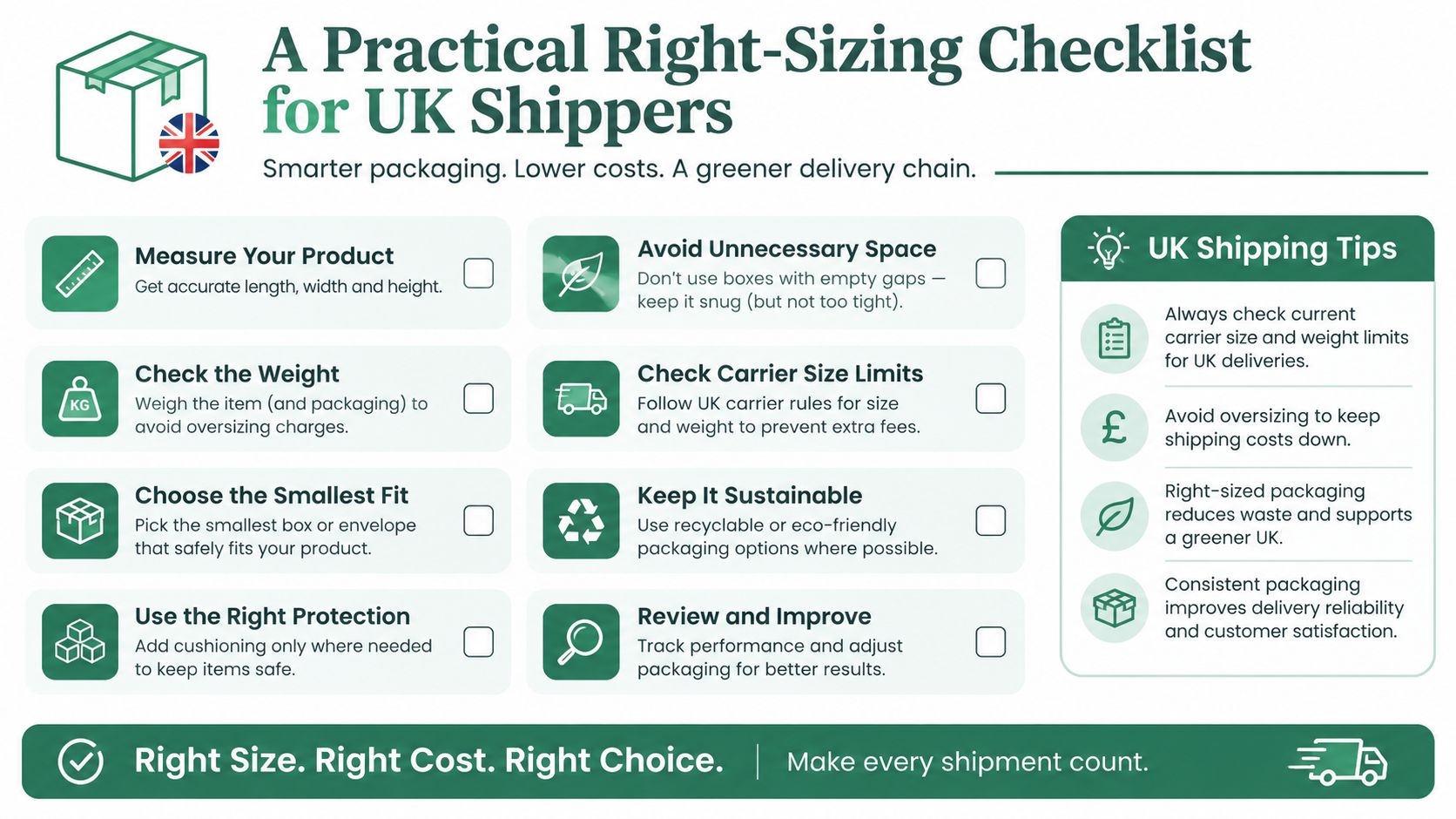
The checklist works best when measurements are written down beside the product family, carton code and carrier category. That record gives the packing team a shared reference instead of relying on memory or a product's unwrapped dimensions.
Choosing a Standard Box That Fits Your Business
The first decision is the carrier handling most orders. Royal Mail rewards a different carton profile from DPD, Evri or Yodel, so a business should review dispatch records before ordering a large range. The second decision is whether a small set of cartons can cover the common product families without forcing fragile or bulky orders into unsuitable shapes.
A starter range might include a flat mailer, a compact box around 200 × 150 × 100 mm, a medium carton around 300 × 200 × 150 mm, and a stronger outer for awkward or heavier goods. These are useful starting profiles, not universal carrier standards. The finished external measurements still need checking against the selected service.
| Box Size (L × W × H) | Typical Use | Royal Mail Band | Recommended Qty to Start |
|---|---|---|---|
| Flat letter-style mailer | Documents and slim products | Large Letter if within the stated ceiling | Small trial quantity |
| 200 × 150 × 100 mm | Compact e-commerce items | Small Parcel if packed dimensions comply | Core working stock |
| 300 × 200 × 150 mm | Clothing, books and grouped small orders | Small Parcel if packed dimensions comply | Core working stock |
| Heavy-duty outer | Fragile, dense or awkward products | Medium or Large Parcel, depending on final size | Limited reserve |
Plain single-wall stock usually gives a straightforward recyclable option for lighter products and keeps storage simple. Printed cartons can support presentation, but they add purchasing and storage considerations. A business shouldn't commit to a year-long pallet before confirming which sizes the packing bench consumes. Holding roughly two weeks of stock provides a practical starting point, followed by reorder decisions based on observed usage.
For large, fragile household items, a dedicated outer may be more suitable than a parcel carton. Businesses preparing to protect a TV during a house move can use specialist packing guidance to think through shape, cushioning and handling before applying the same principles to commercial dispatch.
The right box meets three tests in order. It stays within the lowest suitable carrier band, protects the product through handling and fits the packaging budget without unnecessary material. That is the useful UK definition of a box dimensions standard.
Packaging Panda supplies UK businesses with recyclable cardboard boxes, mailing products, protective packaging, tubes and packaging tapes in multiple formats. Visit Packaging Panda to compare carton options and build a practical box range around carrier limits, product protection and right-sizing requirements.