Custom Shipping Box Buyer’s Guide

A parcel leaves a UK warehouse with too much air inside it. The product shifts, the void fill gets crushed, and a customer receives a box that looks careless rather than considered. In another business, a carefully printed carton appears in an unboxing video, turning an ordinary delivery into a visible brand moment.
Both outcomes begin with the same decision: how well the custom shipping box has been specified. The right carton connects protection, packing speed, presentation, transport efficiency and UK packaging responsibilities. The wrong one creates avoidable damage, wasted material, awkward storage and higher delivered cost.
Table of Contents
- Understanding a Custom Shipping Box
- When Bespoke Boxes Are the Right Choice
- Choosing Materials and Board Strength
- Getting the Size and Structure Right
- Printing and Branding Your Shipping Box
- Ordering Custom Boxes in the UK
- Controlling Cost Without Cutting Corners
- Sustainability, Compliance and Next Steps
Understanding a Custom Shipping Box
A small UK seller might notice the problem through social media first. A customer opens a parcel on camera and finds a product moving inside an oversized carton, surrounded by unnecessary filler. The seller intended to protect the order, but the packaging communicates poor fit and adds work at the packing bench.
A fulfilment manager can spot the same issue from the opposite direction. A carton arrives at the packing station, the product barely fits, the flaps resist closing and the team reaches for extra tape. Neither situation calls for a prettier generic box. Both call for packaging designed around the product and its route to the customer.
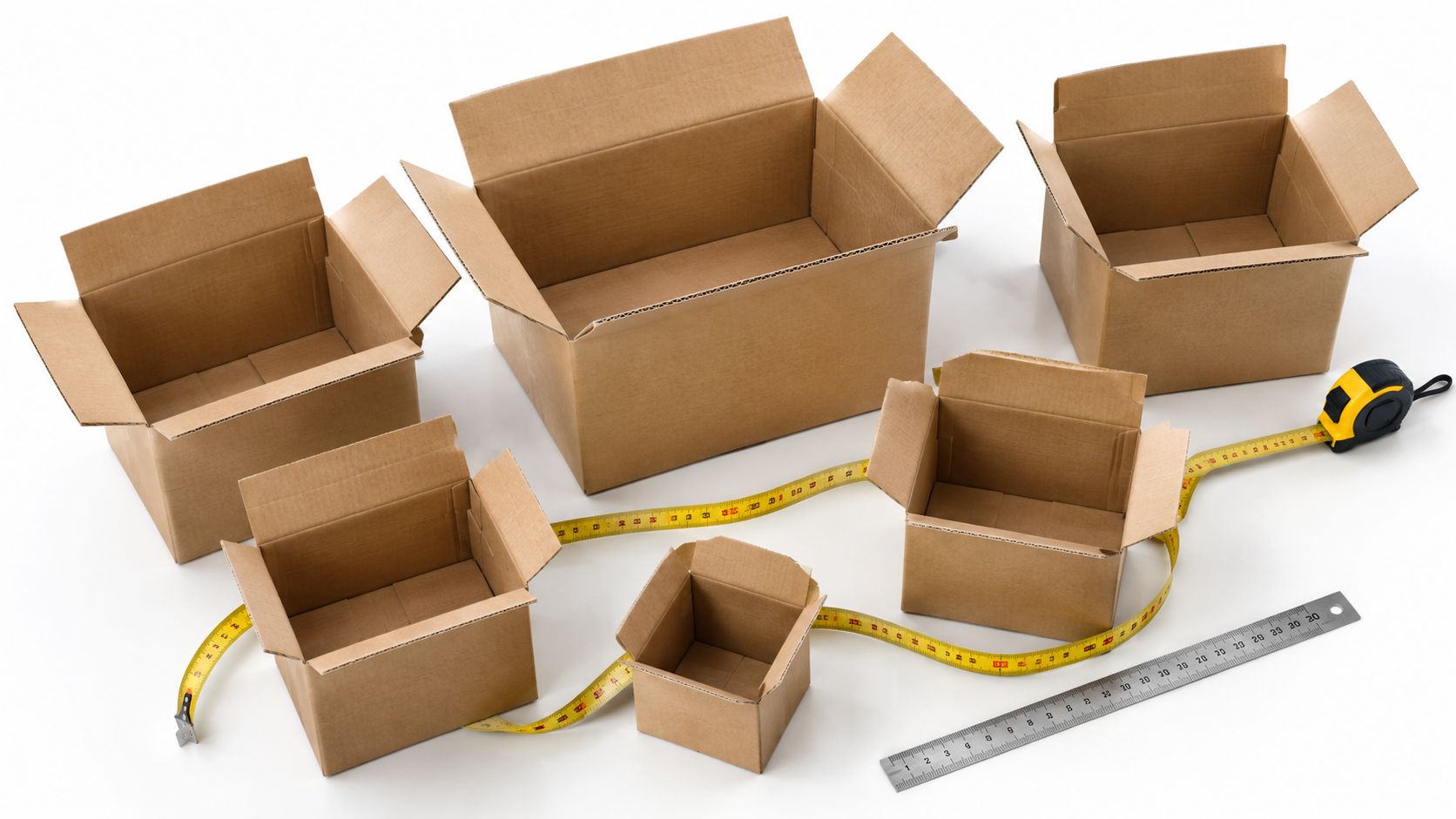
A custom shipping box is a corrugated container whose dimensions, board grade, print, closure style and internal fitments are selected for a particular product or product range. It differs from a standard catalogue carton because the specification starts with the contents and distribution environment, not with whatever size happens to be available.
More than a product container
A product box usually concentrates on shelf presentation or the immediate consumer experience. A postal mailer often prioritises quick assembly and a neat delivery format for lighter goods. A shipping carton must handle warehouse movement, courier labels, sorting equipment, repeated handling and, where relevant, pallet stacking.
That means one box performs three jobs:
- Protection: The board and internal structure limit crushing, movement and impact.
- Brand presentation: Print, colour and opening style shape the customer's first physical interaction with the brand.
- Operational control: Accurate dimensions influence packing time, storage, void fill and carriage exposure.
UK households receive more than 200 cardboard boxes per year on average, according to UK packaging industry reporting. The same source describes a household delivery stack that can reach the height of London's Walkie Talkie skyscraper, showing how box-based parcel delivery is embedded in everyday commerce.
Practical rule: A shipping box should be specified as part of the fulfilment system, not chosen as a decorative outer layer.
The decisions become clearer once the box is treated this way. Product measurements determine the internal size. Handling conditions influence board strength. Packing speed affects the closure. Brand maturity guides the print method. Order volume affects tooling and minimum runs. A well-designed carton behaves like an operating system, coordinating all those parts so the delivery works from warehouse shelf to customer doorstep.
When Bespoke Boxes Are the Right Choice
Bespoke packaging isn't automatically more efficient. A stock box can win when a business needs immediate availability, modest quantities or flexibility across a changing product range. A custom format earns its place when the improvement in fit, handling or presentation outweighs the cost and commitment of making and storing it.
The fairest comparison uses several lenses rather than one unit-price quotation.
| Criterion | Custom Shipping Box | Stock Shipping Box |
|---|---|---|
| Fit | Designed around a specific product or kit | Limited to available catalogue dimensions |
| Cost | May involve tooling and minimum runs | Usually simpler to purchase in small quantities |
| Lead time | Requires design approval and production planning | Often available for immediate dispatch |
| Damage risk | Can use tailored structure and inserts | May require extra filler or accept a loose fit |
| Presentation | Supports planned print and opening experience | Usually relies on labels or unprinted board |
| Sustainability | Can reduce void space and unnecessary formats | May use more filler if the fit is poor |
Five reasons to consider a made-to-order format
An unusual product is the strongest starting point. Long, shallow, delicate or irregular goods often sit badly in standard cartons. Fragile products may also benefit from a box that keeps them away from the walls without relying on loose filler.
High-value goods create a different argument. A tighter fit can reduce movement, while a deliberate opening structure can make the delivery feel consistent with the product inside. Kits and subscription orders can also justify a format that holds several components in a repeatable arrangement.
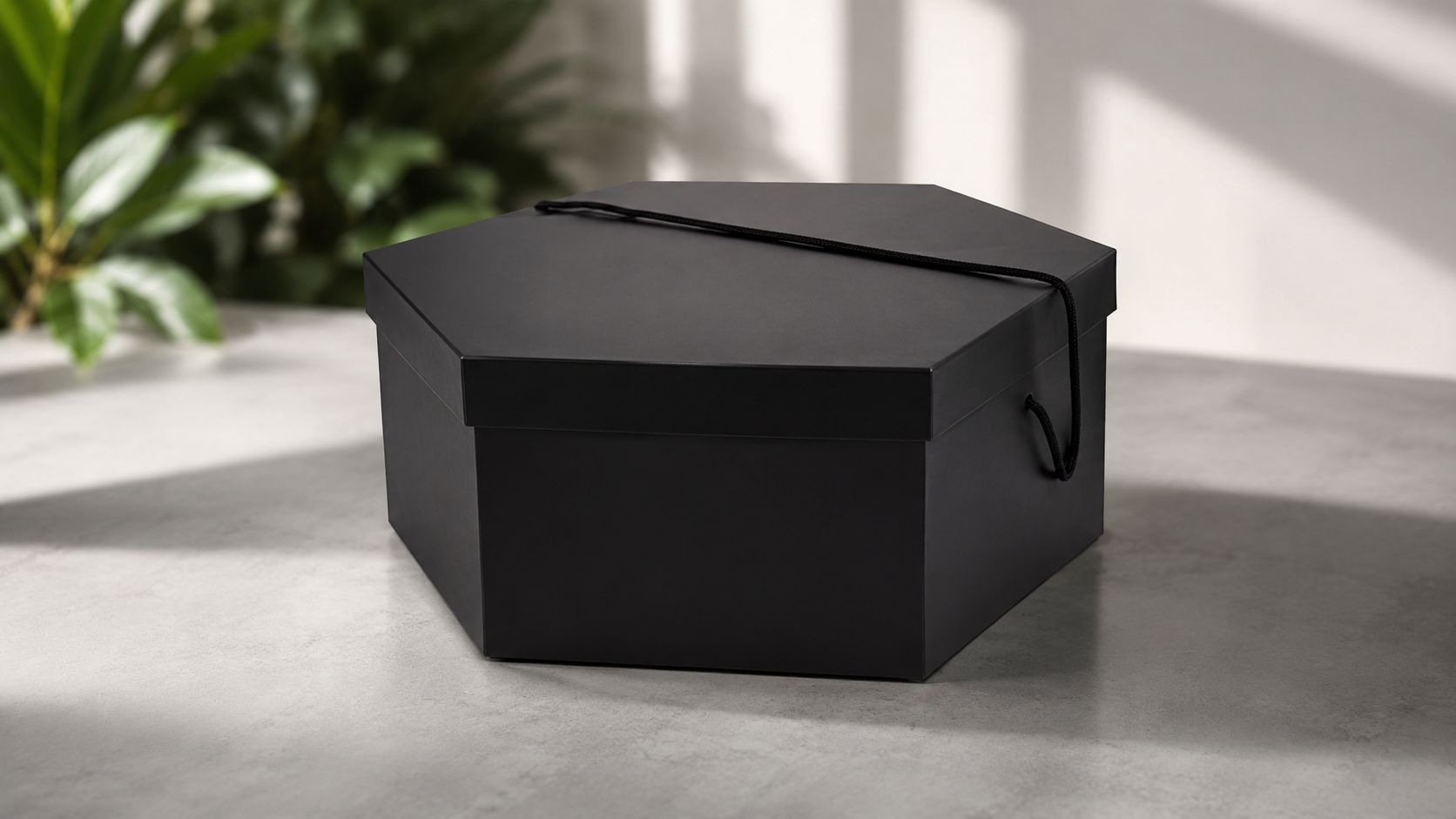
Direct-to-consumer brands may value the printed experience. A plain kraft carton can be the right choice for a practical dispatch operation, while a printed exterior or interior can help a customer recognise the parcel and understand how to open it. Businesses comparing presentation formats can also review Wholesale Hat Boxes, which are described as round storage boxes for retail, gifting and display in a range of colours, sizes and finishes.
Carriage is another test. If a stock carton leaves substantial empty space, a custom size may improve parcel density and reduce filler. That doesn't guarantee a saving, because a new format can introduce tooling, storage and minimum-order commitments.
A growing order volume makes those commitments easier to absorb. A smaller seller should ask whether a custom run would tie up cash or create obsolete stock. A larger operation should compare the cost of holding a custom carton with the cost of repeated filler, slower packing and avoidable claims.
Fairness test: If a proposed box promises fewer damages, compare the expected reduction in claims and returns with tooling, stockholding and production costs. Don't approve bespoke packaging on appearance alone.
A useful rule is simple: request a custom quote when the product is difficult to protect, expensive to transport, costly to return or central to the customer experience. Otherwise, test whether a standard carton with disciplined packing can achieve the same operational result.
Choosing Materials and Board Strength
Corrugated board selection requires layered thinking. An outer shell must withstand rough handling, while the internal structure keeps the contents supported rather than allowing the carton to collapse. For a custom shipping box, the right grade also depends on stacking, moisture, product weight and courier movement. That choice affects protection, packing efficiency and delivered cost, not just the carton's appearance.
Corrugated board has three basic layers:
- Outer liner: The visible surface that faces handling and may carry print.
- Flute: The shaped paper layer between the liners, creating separation and giving the board stiffness.
- Inner liner: The layer facing the product and completing the structural sandwich.
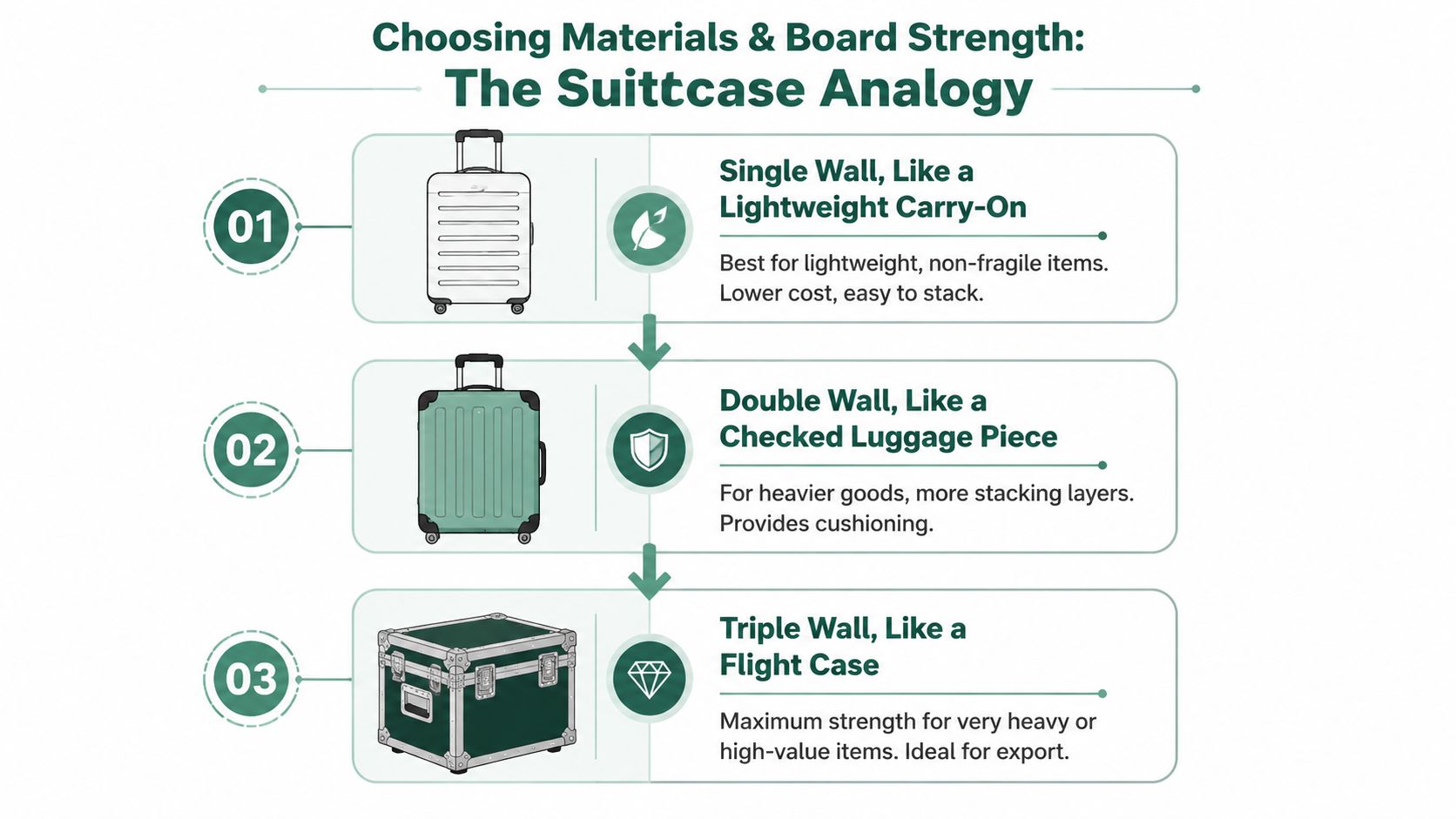
A single-wall board contains one fluted layer. Double-wall board combines two fluted layers for greater rigidity, while triple-wall construction adds another structural layer for demanding loads. Extra layers can improve protection, but they also add material, weight and cost. The specification should therefore reflect the route and handling conditions, rather than defaulting to the thickest option.
Understanding flute profiles
The flute profile balances thickness, cushioning, print surface and storage efficiency.
- B-flute is relatively compact and suits cartons needing a practical balance between strength and a cleaner print surface.
- C-flute is a common all-round choice for general shipping, providing useful cushioning and structural support.
- E-flute is thinner and offers a smoother face for shelf-style graphics or smaller presentation cartons.
- BC-flute double wall combines two flute profiles for heavier goods, multi-item shipments or greater stacking demands.
These labels matter less than the environment the carton will face. A lightweight retail parcel may need a different construction from a carton stored beneath other cartons on a pallet. Ask the supplier to assess the full distribution route, including warehouse stacking, courier handling and storage conditions.
ECT versus burst strength
For palletised shipping and stack-heavy courier networks, prioritise Edge Crush Test, or ECT, rather than relying only on burst strength. ECT measures the compressive force a strip of board can withstand on its edge, which relates to vertical load-bearing capacity. UK packaging guidance on ECT commonly treats around 44 ECT as a baseline for standard single-wall shipping boxes, with 48 ECT and 51 ECT+ used for heavier or more frequently handled applications.
Burst strength measures resistance to tearing and puncture. It remains useful for cartons exposed to sharp knocks, but a box can resist puncture and still collapse under stacked compression. Match the grade to the distribution route. Light parcels can use a lower grade, while pallet-stacked e-commerce cartons should generally be discussed at 44 ECT or above. Double-wall board may suit heavier loads and export-style handling.
For buyers comparing larger supply options, affordable bulk corrugated containers provide background on bulk carton purchasing. Request a sample before approval, then review compression strength testing where stacking performance matters.
Board choice should follow the route, not just the product weight. A light product can still need a strong carton if it faces repeated handling or sits beneath other boxes.
Getting the Size and Structure Right
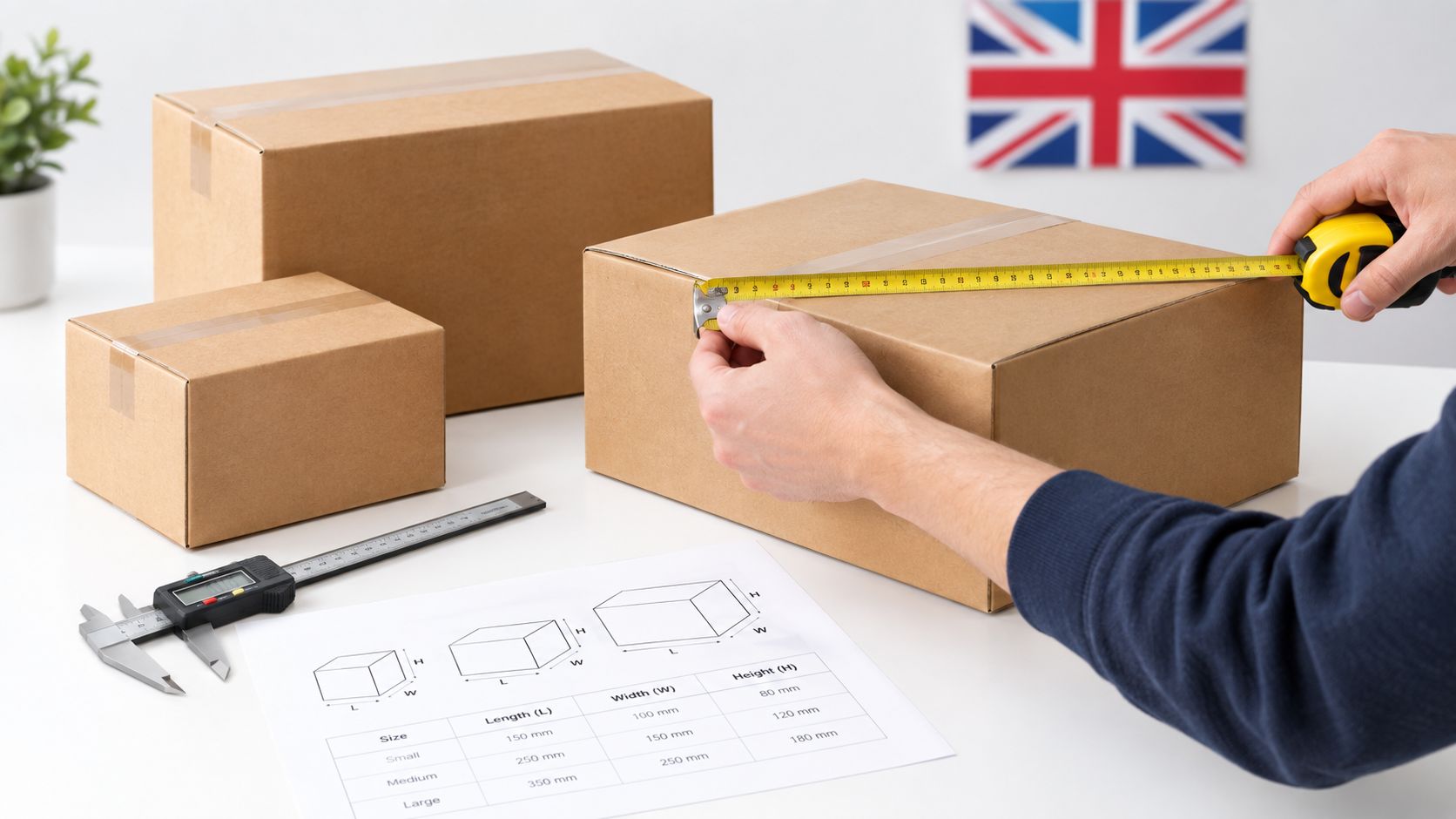
A custom shipping box connects the product, packing bench, pallet and carrier. Internal dimensions must hold the packed item securely, while the outer dimensions affect storage, pallet fit and transport volume. Measuring only the bare product usually produces a carton too tight for protective wrap, separators or a secure closing action.
Measure the product in its actual packing position. Add the thickness of paper padding, a protective sleeve, divider or retention insert. Fragile edges also need clearance from the carton wall. Do not rely on the board to absorb every impact.
Excess space creates a different operating problem. A loose product needs filler, takes longer to pack and can occupy more transport volume than necessary. The comparison therefore needs to include the complete packing system. Amazon's UK automated packaging rollout reported average savings of more than 26 grams of packaging per shipment by fitting cartons more closely, as described in coverage of that rollout and the UK e-commerce packaging market.
Use the guide to measuring boxes to keep internal and external dimensions consistent when discussing a specification with a supplier.
Match the structure to the packing bench
Closure style affects packing speed, tape use and parcel security.
| Box Style | Closure Type | Best For | Limitation |
|---|---|---|---|
| Regular slotted container | Flaps sealed with tape | General warehouse dispatch and palletised cartons | Needs tape and a separate sealing action |
| Tuck-flap mailer | Folding locking tabs | Direct-to-consumer orders and presentation-led dispatch | Less suitable for very heavy or highly compressed loads |
| Hinged-lid carton | Attached lid with tuck or lock | Products needing a deliberate opening experience | Can use more board and require careful die-cutting |
A regular slotted container suits familiar warehouse routines and repetitive packing. A tuck-flap format can reduce tape use and give the recipient a cleaner opening. A hinged lid adds presentation value, although the structure still has to withstand the distribution route.
Internal fitments need their own specification. Corrugated dividers separate several products, shaped fitments hold an item in position, and retention inserts limit movement without filling the entire void. They can reduce contact between products, but add assembly time and another material choice.
Before approving production, check whether the proposed outer size fits the practical parcel band and pallet footprint. Pack a prototype with the actual product, protective materials and intended closure. Inspect movement, compression, assembly time and label placement. This test shows whether the box protects the item while keeping fulfilment and delivered cost under control.
Printing and Branding Your Shipping Box
A printed carton should support the operation rather than obstruct it. The first question isn't whether the box can carry a logo. It is where print adds value, which information must remain visible, and how much artwork the chosen board and process can reproduce consistently.
An unprinted kraft box is the simplest route. It keeps the surface practical and lets a carrier label or separate brand sticker do the communication. This suits early-stage ranges, mixed products and businesses still testing their packaging format.
Single-colour flexographic printing offers a stronger branded presence without covering every face in artwork. A logo, handling message or limited graphic can work effectively on kraft board. Digital print can support more detailed designs and shorter, more variable runs, subject to the supplier's process and board specification.
Full-colour litho-laminated or high-resolution digital print suits a brand where the parcel itself forms part of the customer experience. It can reproduce richer graphics, but it demands accurate artwork, careful colour control and a clear understanding of print coverage.
Artwork details that prevent expensive errors
The printer needs an accurate dieline, not just a flat logo file. The artwork should show cut lines, crease lines, glue areas, safe zones and the positions of carrier labels. Barcodes must remain scannable, while handling marks and regulatory information need enough contrast and clear space.
Outside print creates recognition during delivery. Inside print can turn the opening into a brand touchpoint, but it adds another printed surface and may affect cost. Matt, gloss and uncoated finishes create different tactile and visual results. Uncoated kraft feels natural and practical, while coated surfaces can make colour appear sharper.
Colour consistency should be agreed before production. A Pantone reference or an approved physical proof gives the supplier a clearer target than a screen image, which can vary between devices. Brands still developing their visual system can use a practical guide from Silver Spoon Agency to clarify how packaging should reflect wider identity decisions.
Reserve label space before approving artwork. A beautiful carton that hides a barcode or forces the courier label across key graphics creates an operational problem at every dispatch.
The right print method depends on order quantity, lead time and brand maturity. A young seller may begin with kraft and a single-colour mark, then move to fuller coverage once the carton size and demand pattern are stable. A mature brand should specify colour, print locations and replenishment rules before production begins.
Ordering Custom Boxes in the UK
A smooth buying process begins with a useful brief. The buyer should provide the product dimensions, packing method, expected order quantity, preferred board or protection level, delivery destination and any existing artwork. Clear information helps the supplier quote a real specification rather than a generic carton.
Packaging Panda's stated bespoke service covers custom sizes and shapes, branded print across boxes, mailers, bags and tubes, with minimum runs from 500 units. Printed production commonly needs a larger commitment than unprinted stock because artwork preparation, print setup and production planning are part of the job.
A practical purchasing sequence
- Request the quotation: Include product details, target quantity and artwork files where available. The quotation should identify board construction, dimensions, print coverage, tooling and delivery.
- Approve the dieline: Check that panels, flaps, glue areas, folds and label zones match the physical design. The dieline is the map that turns artwork into a carton.
- Sign off the proof: Review colour, position, wording and print coverage before production scheduling. A proof can reveal an alignment issue that a digital mock-up hides.
- Plan production and delivery: Confirm the expected lead time, delivery destination and tracking arrangements. Packaging Panda lists live order tracking as a service feature.
- Test before scaling: A short sample run can help the fulfilment team assess packing speed, product fit and closure performance before a larger commitment.
Unprinted stock can suit businesses that need lower minimums or immediate replenishment. Printed runs need more planning, but volume pricing can change the unit cost as the order size rises. The buyer should compare the complete quotation, not just the carton figure.
Account holders may also use scheduled deliveries, stock holding and reorder reminders where those arrangements suit the operation. Packaging Panda states that it manufactures in the UK and can ship boxes directly to a single site or multiple fulfilment addresses, which can simplify distribution for businesses using more than one packing location.
Controlling Cost Without Cutting Corners
The line price of a carton hides several separate decisions. Board grade affects material usage and protection. Dimensions influence both board area and transport volume. Print coverage, cutting dies, print plates, quantity breaks, delivery distance and storage all shape the landed cost.
A smaller carton can reduce material and empty space, but only if the product still packs safely. A lighter grade may lower the purchase price, yet a rise in damage claims can erase that saving. Single-colour print can reduce setup complexity compared with full-colour coverage, while shared die sizes across related stock-keeping units can limit tooling duplication.
| Cost Driver | Impact on Price | Smart Saving Lever |
|---|---|---|
| Board grade | Stronger or thicker construction uses more material | Match ECT and wall construction to the route |
| Dimensions | Larger footprints consume more board and transport space | Right-size around the packed product |
| Print coverage | More colours and surfaces increase setup and production work | Use focused branding where it matters |
| Tooling | New dies and print plates add setup cost | Share suitable structures across related products |
| Quantity | Larger planned runs can improve unit pricing | Order against a realistic forecast |
| Delivery | Distance and split destinations affect freight | Coordinate replenishment and delivery points |
| Storage | Large runs occupy warehouse capacity and tie up cash | Balance price breaks against stock rotation |
Genuine savings and false economies
Right-sizing can reduce filler, packing effort and dimensional-weight exposure. It can also help the carrier and warehouse move more product through the same physical space. But the design needs testing, because a carton that is only marginally smaller may offer little practical benefit if it makes assembly slower.
Consolidating box formats can reduce the number of SKUs and simplify procurement. The compromise is that one shared carton may fit several products adequately without fitting any of them perfectly. Palletisation should be checked at the same time, since a carton that looks efficient individually may create awkward gaps across a pallet layer.
Businesses planning packaging around ecommerce growth from Next Point Digital can use the same discipline for carton demand, replenishment and warehouse planning. The useful question is not “Which supplier has the lowest unit price?” It is “Which specification protects margin after freight, storage, packing time, damage and disposal are included?”
A reliable buying sequence is:
- Sample first: Pack the product and inspect the result.
- Benchmark fairly: Request quotes using identical dimensions, board, print and quantity.
- Calculate landed cost: Include delivery, storage, labour, waste and damage exposure.
- Review quality controls: Confirm how the supplier manages board consistency, print approval and repeat orders.
- Choose the margin-protecting option: The cheapest line item isn't always the lowest-cost packaging system.
Sustainability, Compliance and Next Steps
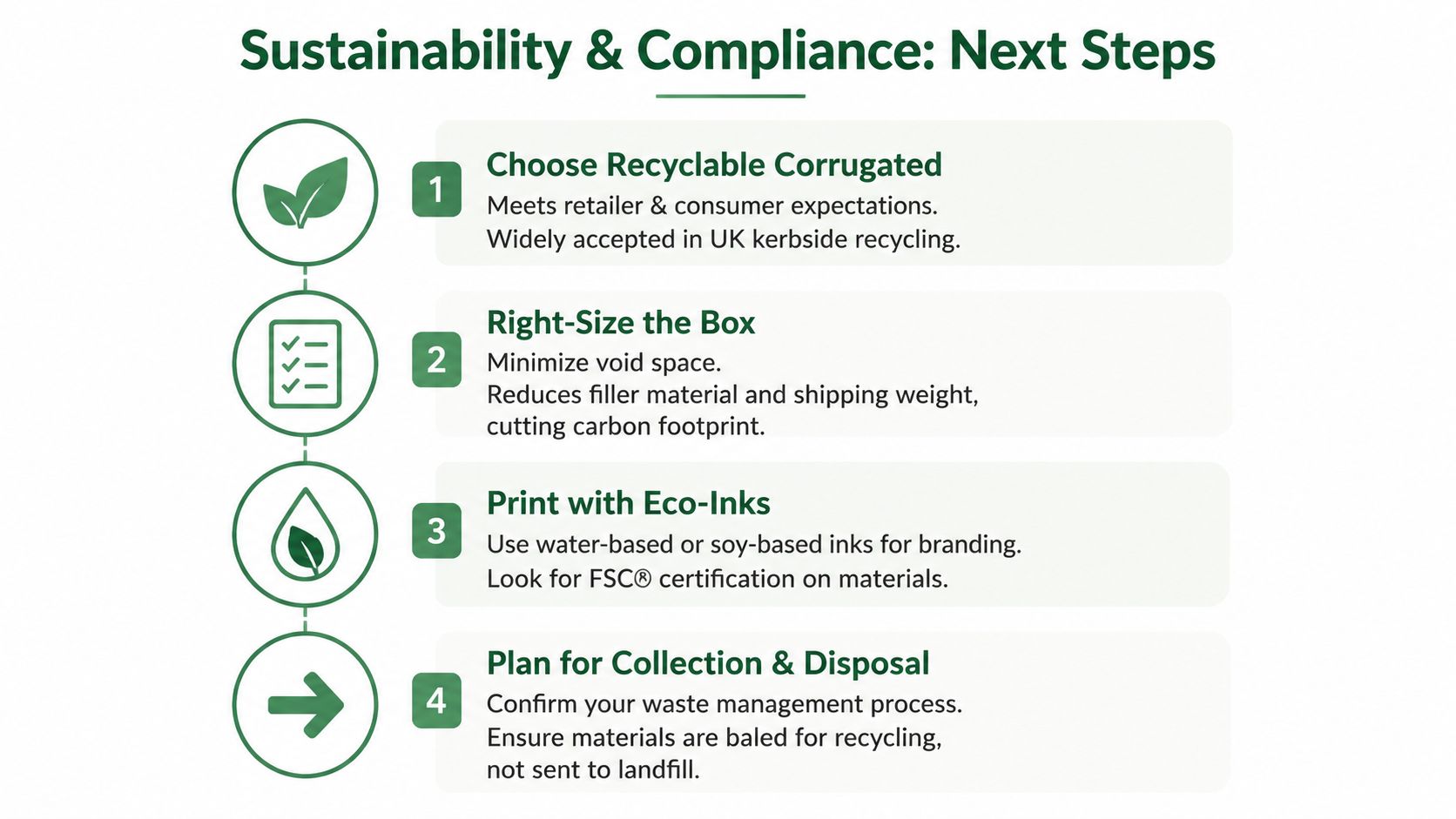
A custom shipping box works like an operating system for the order. Its board protects the product, its dimensions affect transport and packing, its artwork carries instructions, and its material data supports UK packaging reporting. Sustainability therefore starts in the specification, not after production.
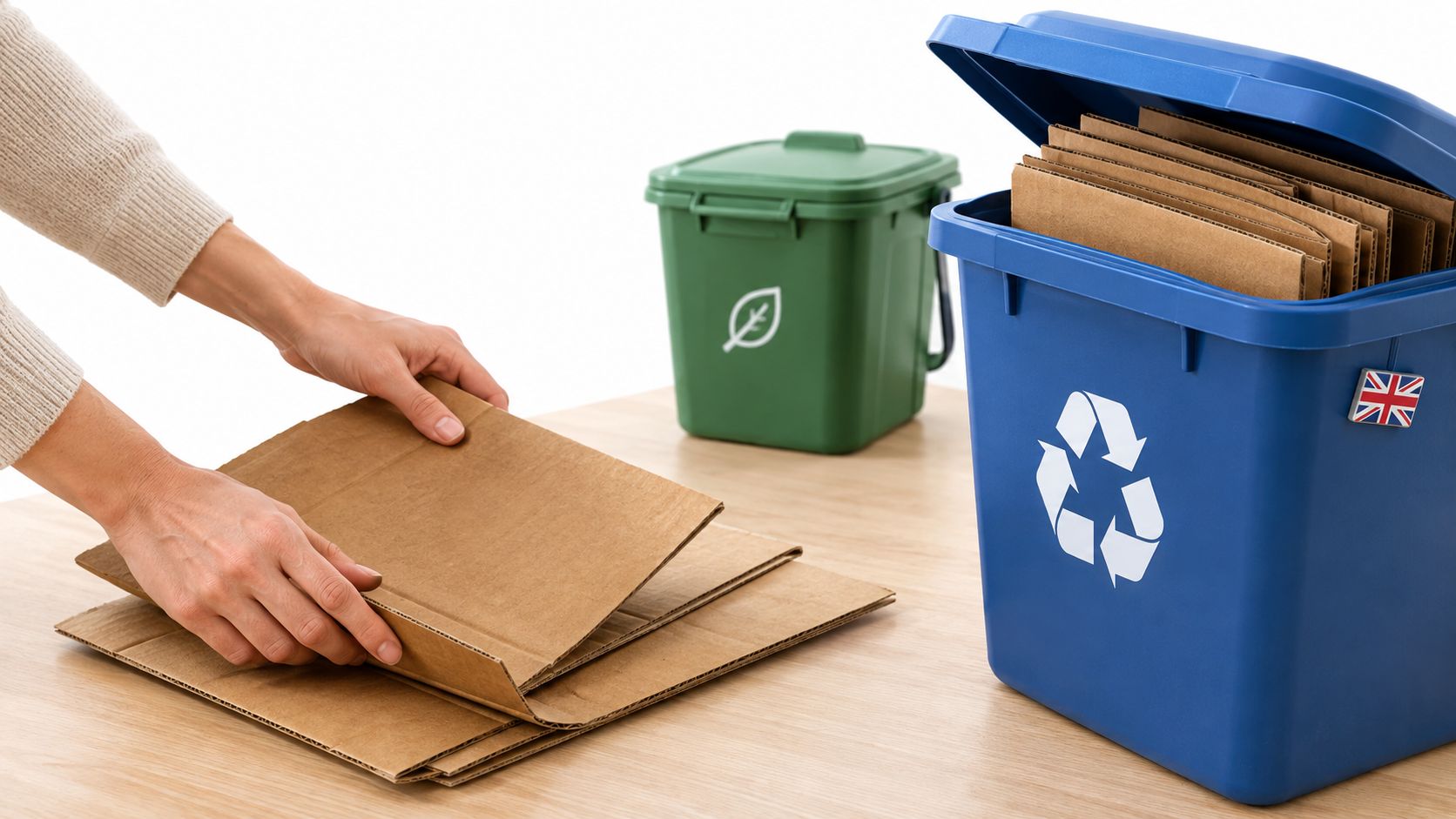
Corrugated fibre fits established UK recycling infrastructure, provided the carton avoids unnecessary space and difficult mixed materials where practical. A recyclable box can still waste material, occupy excess vehicle space or create disposal problems if its design is poorly matched to the product.
UK households are familiar with cardboard recycling. The industry source cited earlier reports that over 8 in 10 UK consumers are green-minded and recycle every cardboard box delivered to their home. Official UK data records 74.3% recycling of paper and cardboard packaging in 2024 under methodology 1, compared with 64.1% overall UK packaging waste recycling under the same methodology, according to UK cardboard packaging industry data. The same source records 5.4 million metric tonnes of paper and cardboard packaging generated in the UK in 2023, with about 3.9 million metric tonnes recovered for recycling, equivalent to roughly 73.4%.
Design for reporting as well as recovery
UK packaging rules cover packaging used for containment, protection, handling, delivery and presentation. Businesses within the relevant requirements must report packaging data every six months, with 2024 data due by 1 April 2025, as set out in the UK packaging regulations. A practical explanation of these obligations is available in this guide to UK packaging regulations and EPR compliance.
The EPR cost model belongs in the box brief too. The UK government's 2025 base fee for paper and card packaging is £196 per tonne, while the official modulation statement lists paper at £196 and glass at £192. Right-sizing a fibre-based carton can reduce material use and transport demand while keeping packaging cost records easier to reconcile.
UK packaging law requires packaging to be designed for reuse or recovery. The combined concentration of cadmium, mercury, lead and hexavalent chromium in packaging or any component must not exceed 100 parts per million. Ask the supplier for suitable material declarations, and avoid plastic coatings or mixed substrates that make kerbside recycling harder when they are not needed.
Artwork must also allow for consumer guidance. A 2026 regulatory guide indicates that all consumer packaging will need to display either “Recycle” or “Do not recycle” instructions by April 2027. Reserve an appropriate area in the dieline now, rather than forcing the label into finished artwork later.
A buyer's final checklist
- Board: Confirm wall construction, flute and ECT against the shipping route.
- Dimensions: Record internal measurements with protection and inserts included.
- Structure: Approve the closure, dividers and retention method.
- Print: Reserve space for barcodes, handling information and recycling labels.
- Quantity: Balance minimum runs, volume pricing, storage and forecast demand.
- Compliance: Organise material, weight and packaging data for reporting.
- Testing: Pack real products, review damage and returns, then refine the specification.
Packaging Panda supplies recyclable cardboard boxes, made-to-order packaging and branded formats for UK businesses, with bespoke minimum runs from 500 units. Share the completed brief with Packaging Panda for sampling, quotation and lead-time confirmation, then schedule delivery around the warehouse's actual packing needs.