
Cardboard Boxes Dimensions: UK Sizing Guide

The most popular advice about cardboard boxes dimensions is also the source of many fulfilment problems: measure the product, find a carton that looks slightly larger, and dispatch it. That approach ignores the space taken by protective packaging, the thickness of the board, the finished external footprint and the carrier class. A carton can fit the product perfectly and still be the wrong carton for the warehouse, the courier network or the recycling stream.
UK packers need to answer three questions together. Will the product fit internally? Will it have enough room for protection? Will the packed carton remain within the intended delivery limits? Treating dimensions as a logistics decision, rather than a label on a flat-packed box, produces more reliable packing and fewer expensive surprises.
Table of Contents
- The Hidden Costs of Ignoring Internal Dimensions
- How the UK Packaging Industry Measures Box Sizes
- Calculating the Right Size for Product Protection
- Aligning Box Dimensions with Royal Mail and Courier Limits
- How Board Grades and Flutes Affect Usable Space
- The Warehouse Cost of Carrying Too Many Box Sizes
- Designing for Sustainability and Recycling Sortation
- Solving Niche Transit Challenges with Bespoke Formats
- Quick Reference Checklist for Specifying Your Next Order
The Hidden Costs of Ignoring Internal Dimensions
External measurements help with transport planning, but they do not show how much working space remains inside a carton. Board thickness, flap construction and the gap between a supplier's stated dimensions and the usable cavity can all change the fit. UK packaging guidance recommends checking the packed product and allowing space for protective material, rather than sizing a carton around the bare item alone (UK box sizing guidance).
That creates three separate decisions:
- Product fit: The internal cavity must hold the product without pressing its corners, lids or seams against the carton.
- Protection allowance: Bubble wrap, paper padding, foam corners and dividers need room to sit around vulnerable surfaces without being crushed.
- Delivery compliance: The sealed, packed carton must stay within the carrier's size and weight rules.
A carton that looks suitable from the outside may be too tight inside. Packers then remove cushioning, compress the contents or force the flaps closed. The reverse mistake creates its own costs. Too much empty space increases void fill, allows products to shift during handling and takes up more racking and vehicle capacity.
Why the outer label gives an incomplete answer
Internal dimensions control product fit and protection. External dimensions control how the parcel occupies a van, sack, cage or pallet. They are related, but they answer different warehouse questions. A thicker board can improve resistance to crushing while reducing the cavity available for contents. A carton that appears efficient on a product shelf may become inefficient once packed, taped and placed into a carrier network.
The finished parcel, not just the product cavity, must meet carrier rules. A small increase in the outer footprint can move a shipment into a different delivery class, changing the available service or its cost. Check the carrier category after packing, including the board, cushioning, tape and any overhang. The current Royal Mail thresholds are covered in Section 4, where the parcel classes and measurements are set out together.
The operational cost of a poor fit
An undersized carton can crush corners, strain seams and leave fragile goods exposed to impact. An oversized carton can consume more void fill, permit movement and use storage volume that the product does not need. Comparing carton prices alone hides these handling and transport costs.
The working specification should link the product dimensions, cushioning requirement, internal cavity, board construction and final packed dimensions. Record the result as a packing standard that the warehouse can follow, rather than leaving each operator to judge the fit at the bench.
That approach also gives procurement a clearer brief. Suppliers can quote against the required internal working size and board specification, while the fulfilment team can test the sealed carton against the intended carrier class before ordering at scale. Small differences in cavity or outer footprint then become visible before they create recurring packing delays, damage or delivery surcharges.
How the UK Packaging Industry Measures Box Sizes
UK corrugated packaging uses a straightforward convention, but accuracy depends on using it consistently. Box dimensions are normally stated as internal Length × Width or Breadth × Height in millimetres, not as the outside footprint. A supplier discussing a carton in this format is describing the usable working space, which is the information needed to match a product to a box (Macfarlane's box measurement guidance).
Reading length, width and height correctly
Length is the longer opening dimension. Width or breadth is the shorter opening dimension. Height runs from the opening down to the base. The opening is the reference point because it represents how the product enters the carton, while the height determines the vertical space available after the item is placed inside.
A packer should record the product in the same orientation used for dispatch. A rectangular product may fit in more than one orientation, but changing the orientation can alter the cushioning requirement, the centre of gravity and the way the carton closes. The intended internal dimensions should therefore be written in order, rather than described informally as “a box about this size”.
The how to measure boxes guide can support that handover when warehouse staff, procurement teams and carton suppliers need to use the same terminology. Standardised descriptions reduce the risk of ordering a carton whose external measurement has been mistaken for its internal capacity.
Why working size comes before footprint
The internal cavity controls product fit, insert clearance and void-fill placement. The external footprint still matters for carriers and pallet planning, but it comes after the working size has been established. Board caliper and flute selection then need to be allowed for when comparing the internal requirement with an outside measurement.
FEFCO-style cases also distinguish special formats from ordinary cartons. A telescope box may require a fourth lid dimension because its components overlap, while sheet dimensions are specified separately along and across the glue lines (FEFCO-style case guidance). That information matters when a supplier is quoting a non-standard format, because a simple three-dimension description may not define how the finished case closes.
For routine warehouse requirements, Cardboard Boxes can be described by their internal working dimensions and board construction, whether the range includes single wall, double wall, mailing or storage cartons. Wholesale pricing and free delivery over £150 are catalogue details, but they don't replace the need to specify the correct measurement convention.
Calculating the Right Size for Product Protection
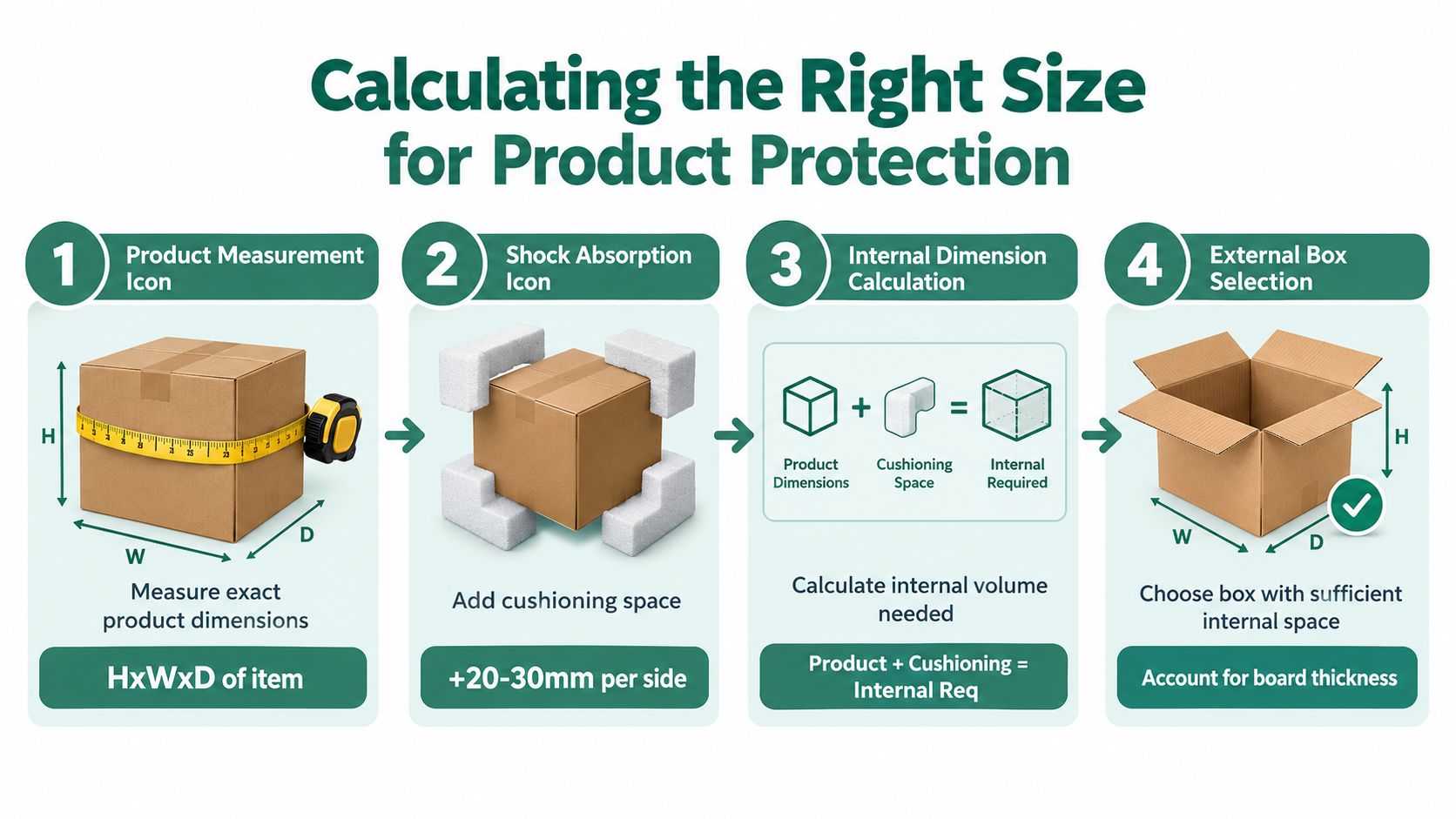
A carton that hugs the product with no clearance may look efficient during packing, but it leaves little room to absorb shock. The internal target should be based on the product dimensions plus a deliberate allowance for the protection method, not on the product dimensions alone.
UK packaging guidance commonly recommends 25–50 mm of space on each side for protective packaging (UK cushioning and box sizing guidance). That range isn't a universal answer for every product. A rigid item with protected corners may need a different treatment from a delicate object requiring separated surfaces, but it provides a practical starting point for specifying a working cavity.
A simple sizing calculation
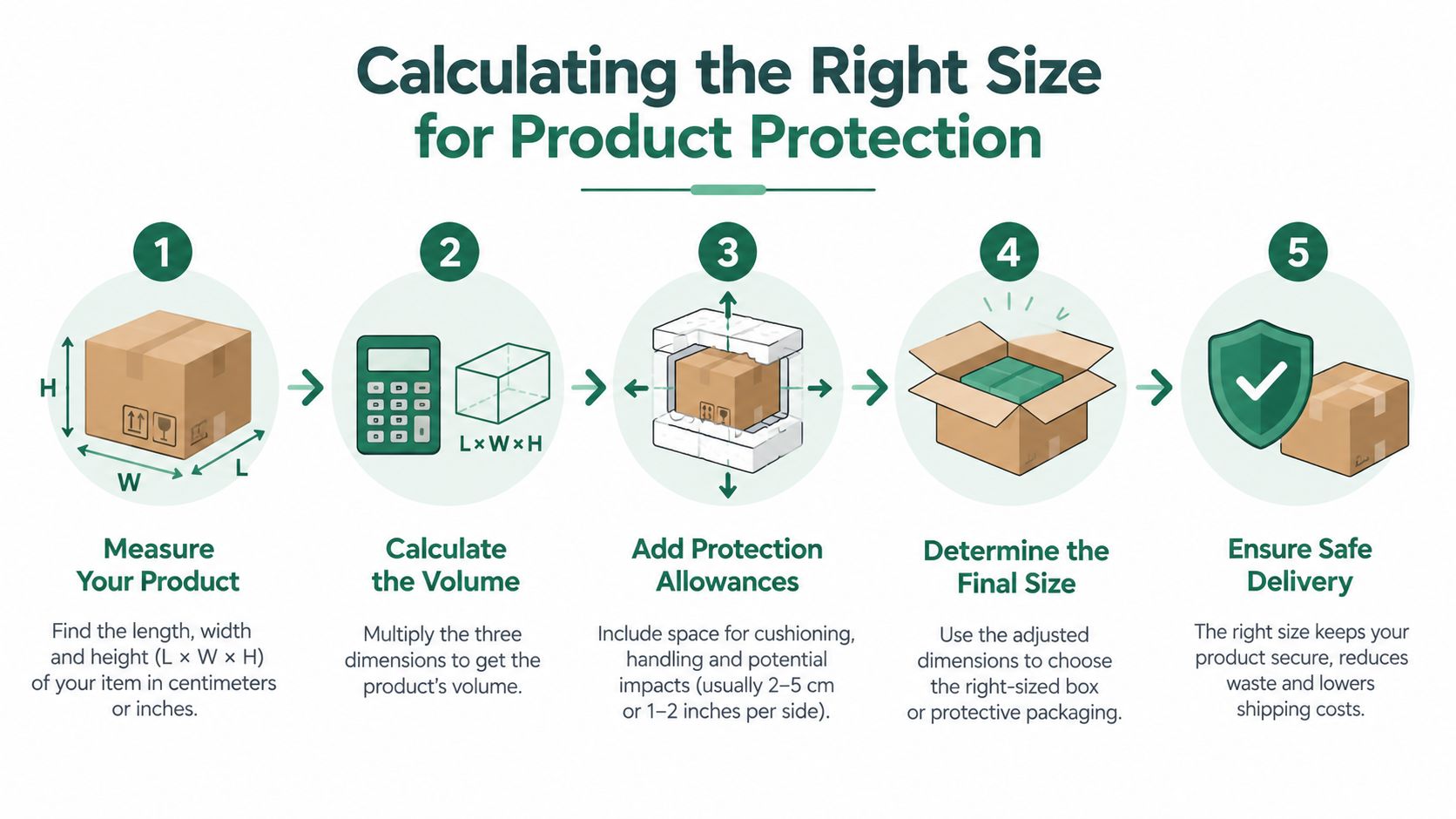
The calculation should be completed for each axis:
- Measure the product's length, width and height in the orientation used for packing.
- Decide how much protection is needed on each side.
- Add the allowance to both opposing sides of each dimension.
- Compare the result with the carton's internal Length × Width × Height.
- Check that the packed carton's external measurements remain suitable for the intended carrier.
For example, if a product needs protective space around every face, the internal length must accommodate the product length plus the allowance at both ends. The same logic applies to width and height. The calculation isn't a request for empty space throughout the carton. It is a way to reserve enough room for the material that stops the product contacting the board or another item.
Protection must match the product
Bubble wrap can cushion surfaces, while paper padding can fill voids and restrict movement. Edge protectors and dividers can be more suitable where corners, glass or multiple units need separation. A carton should be tested with the actual packing method, because a nominal internal measurement may be adequate for one protective system and unsuitable for another.
The packer should also check whether the product shifts after sealing. Movement suggests that the box is too large for the chosen fill method, while resistance during closure suggests that the internal target or packing sequence is wrong. Practical guidance on packing a TV for self-storage illustrates why vulnerable, awkwardly shaped products need more than a simple length and width comparison.
A reliable specification records the product measurement, the protection method and the resulting internal requirement together. That record gives procurement a defensible carton brief and gives the warehouse a repeatable packing standard.
Aligning Box Dimensions with Royal Mail and Courier Limits
A carton can fit the product perfectly and still fail the delivery brief. Carriers assess the finished parcel, including the packed contents, cushioning, board, tape and any bulging panels. Check the outer dimensions with the carton closed and ready for collection, not from the product cavity or catalogue description.
Royal Mail provides a useful UK reference point. Its published guidance gives a maximum Small Parcel size of 450 × 350 × 160 mm and a maximum weight of 2 kg. A Medium Parcel can measure up to 610 × 460 × 460 mm and weigh up to 20 kg (Royal Mail parcel packaging guidance).
Royal Mail parcel size limits
| Parcel class | Max Length (mm) | Max Width (mm) | Max Height (mm) | Max Weight (kg) |
|---|---|---|---|---|
| Small Parcel | 450 | 350 | 160 | 2 |
| Medium Parcel | 610 | 460 | 460 | 20 |
Treat these figures as working limits, not as a target for filling every available millimetre. Closure tape can add to the finished length, while overfilled contents may push out the side panels. Protective corners can also create a high point that changes the measured height. Leave a practical margin where the parcel class allows it, especially when several operators pack the same SKU.
Compare the finished carton, not the catalogue size
The carton specification should record both internal and external dimensions. Internal measurements define the working space for the product and its protection. External measurements determine whether the packed carton fits the intended carrier service, pallet footprint and storage location.
A sound warehouse check uses a representative packed carton. Pack it using the normal materials and sequence, seal it, then measure the longest, widest and highest points. Record those results against the planned parcel class and repeat the check after any change to board grade, closure method or protective fill.
Courier pricing may also use dimensional volume rather than actual mass. Use the volumetric weight calculation guide, then confirm the relevant carrier's divisor, rounding method and service conditions before approving the carton. A box that is light on the scales can still attract a higher charge if its external volume is large.
Designing around a delivery class
Choose the delivery class before signing off a custom box. A shallow carton may suit a flat product, while a deeper format can provide safer vertical cushioning for a fragile item. The trade-off is external height, cubic volume and possible movement inside the pack.
Royal Mail states that its maximum parcel dimensions are 61 cm × 46 cm × 46 cm, with a maximum length of 1.5 metres and a maximum combined length and width of 3 metres for standard services. The same guidance confirms the operational rule: the final outer parcel is what the carrier assesses. A carton design is complete only when it protects the product and remains within the selected service's limits.
How Board Grades and Flutes Affect Usable Space
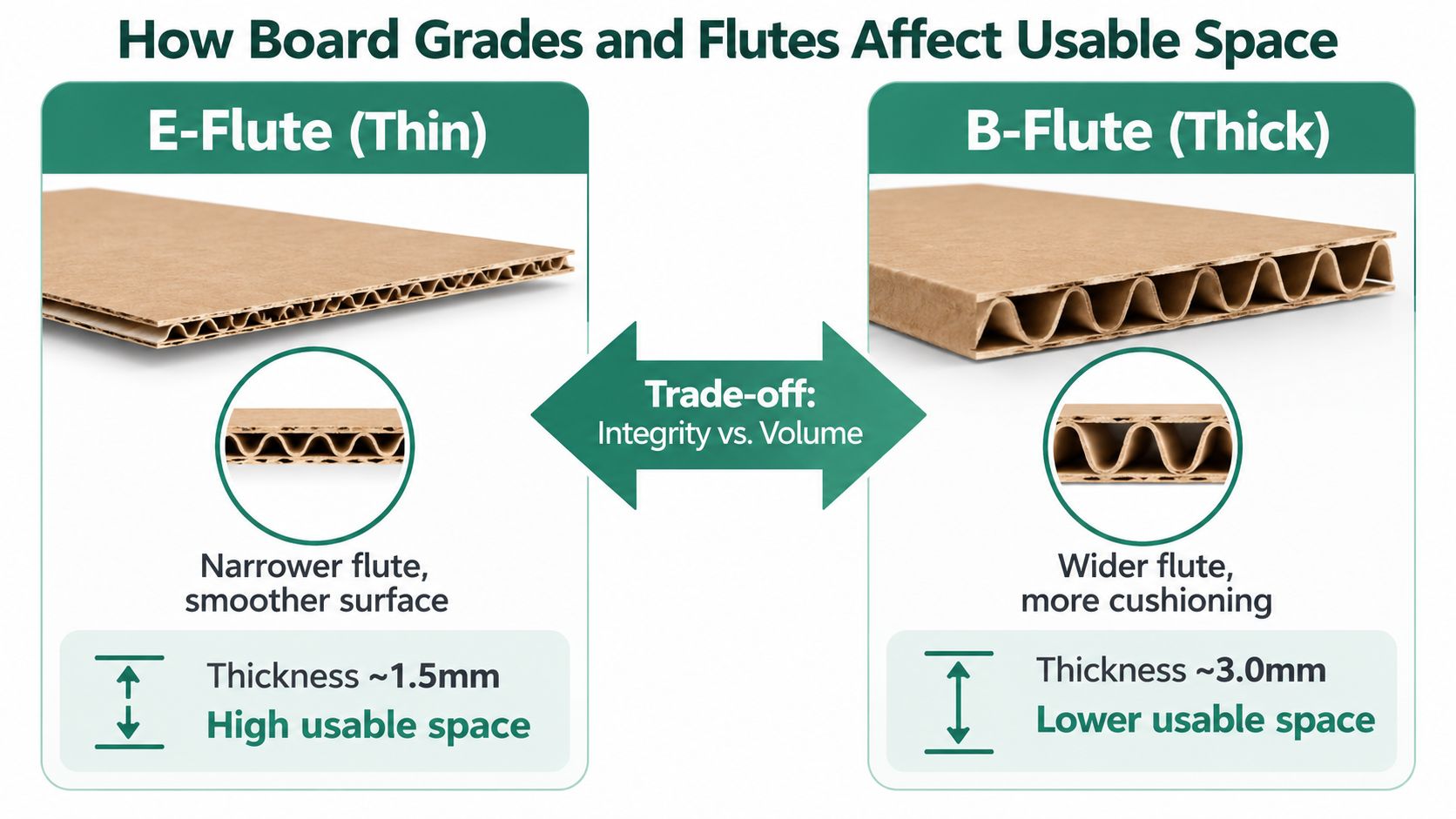
A heavy-duty carton isn't just a stronger version of the same internal box. Thicker walls occupy space on every side, so the external footprint may stay similar while the usable cavity becomes smaller. That change is easy to miss when a buyer compares catalogue descriptions without checking whether the quoted dimensions are internal or external.
Single-wall, double-wall and triple-wall constructions offer different balances between strength, protection and available volume. Flute profiles also change the board's caliper and handling characteristics. The correct choice depends on the product weight, fragility, stacking conditions and delivery environment, not on the label “heavy duty” alone.
Strength can reduce the working cavity
If the outside of a carton is fixed, thicker board reduces the internal length, width and height. If the internal size is fixed instead, the outside dimensions grow. Either way, the change affects carrier compliance, pallet fit or the amount of space available for protective material.
That makes the board grade part of the dimension calculation. A product may fit inside a single-wall carton but need a double-wall construction for better load resistance. The replacement carton should be checked against the same internal product requirement, rather than assumed to be dimensionally equivalent.
Match construction to handling risk
Royal Mail packaging guidance recommends double- or triple-walled boxes for fragile or heavy items of 10 kg and above (Post Office parcel packing guidance). That recommendation changes the specification in two directions. The carton needs suitable structural support, and the resulting internal size must still accommodate the item and its cushioning.
Practical rule: A box's load rating doesn't prove that the product will fit safely inside it.
Warehouse teams should test the chosen grade with the actual closure, stacking pattern and product weight. A carton that performs well when empty may behave differently when loaded, sealed and placed beneath other parcels. Flute orientation, score lines and the condition of the board also affect how consistently the carton holds its shape.
The useful comparison is therefore not “thin versus thick”. It is usable internal space versus protection requirement versus finished external size. A lighter construction may preserve volume for a low-risk item, while a heavier construction may prevent compression or puncture where the contents justify it. The supplier brief should record all three considerations.
The Warehouse Cost of Carrying Too Many Box Sizes
The smallest possible carton isn't automatically the most efficient carton for a warehouse. A range packed with near-duplicate sizes can slow selection, complicate replenishment and consume storage locations. Staff spend time deciding between cartons that offer almost the same capacity, while procurement has more lines to forecast and count.
A lean range works when it covers common product families without forcing fragile or awkward goods into unsuitable formats. Standardised dimensions can also make pallet planning and replenishment more predictable. The objective isn't to eliminate choice. It is to remove choice that doesn't create a meaningful packing benefit.
Audit the existing range
A useful audit starts with dispatch records and the cartons currently used at each packing station. For every carton, the warehouse should record the internal dimensions, board construction, products packed in it and the reason that format exists. Near-duplicates often become visible when the range is viewed as a complete system rather than as separate purchases.
The audit should ask:
- Does the carton solve a distinct product problem? If two cartons accept the same product family and use the same protection method, one may be unnecessary.
- Does the smallest option protect the contents? Removing a carton that prevents movement or crushing can create more damage than it saves in storage.
- Does the carton support the intended carrier class? An apparently efficient format may be inefficient once packed and measured externally.
- Can the packing team identify it quickly? Clear labelling and consistent storage locations matter as much as the nominal dimensions.
Avoid both extremes
Too few sizes force operators to overfill cartons or add excessive void fill. Too many sizes create selection friction and make stock control harder. The practical answer is a controlled core range, with specialist formats held for products that need them.
A dense cluster of standard cartons exists because many UK businesses need repeatable formats for fulfilment, storage and pallet handling (UK packaging product guide). That doesn't mean every catalogue size belongs in one warehouse. It means common formats can provide a dependable baseline while bespoke or specialist cartons handle exceptions.
The range should be reviewed after product changes, not only after a packaging failure. If a new product repeatedly needs a different insert, damages in a standard carton or causes operators to improvise, the carton policy is already carrying a hidden cost. Conversely, if a carton remains unused while similar sizes move every day, consolidation may release space and simplify dispatch.
Designing for Sustainability and Recycling Sortation
A recyclable material can still create a recycling problem if its components are too small for the sorting process. Dimensions affect the outcome of packaging after use, not only the fit of the product during dispatch. Small tear-off sections, closures and inserts deserve the same attention as the main carton.
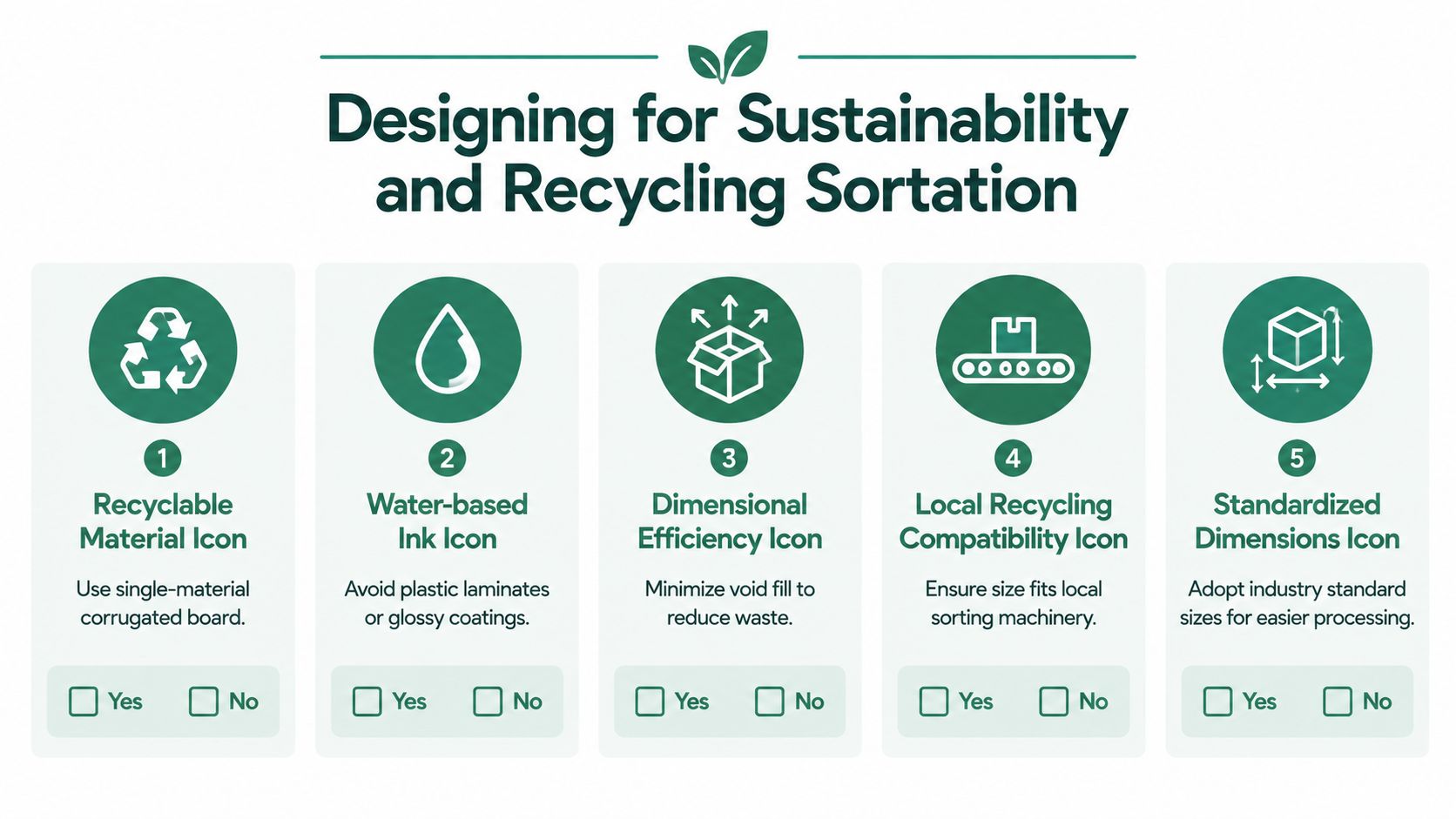
The UK government's recyclability assessment methodology states that a packaging item or component must be at least 40 mm in at least two dimensions to pass the sortation stage of assessment (UK government recycling assessment methodology). That threshold gives packaging designers a concrete check for small cardboard parts that might otherwise be treated as harmless offcuts.
Audit the whole packaging system
The main box may be recyclable while its accessories create a separate issue. A practical review should examine the carton, dividers, pads, tear strips, closures, labels and any presentation components. Each part should be assessed for material compatibility, unnecessary size variation and whether it remains large enough for the intended sorting process.
A sustainable design also limits waste at the packing bench. Right-sized internal space can reduce excess void fill, but the carton must still protect the product. Removing protective material merely to make a parcel look smaller transfers waste into damage, replacement goods and returns.
Design for the local waste route
Packaging teams should check the requirements used by the recycling system serving their customers and sites. The relevant question isn't just whether a box is made from cardboard. It is whether the complete format, including small components and coatings, can pass through the expected collection and sorting route.
The following checks help turn sustainability into a design control:
- Separate unnecessary components: Remove inserts or closures that add no protection or presentation value.
- Review small parts: Measure tear-off sections and detachable pieces against the sortation threshold.
- Reduce avoidable void: Select a carton that accommodates the product and its protection without excessive empty volume.
- Keep specifications consistent: A narrower box range can simplify purchasing and reduce redundant packaging formats.
- Record the reason for each material: Teams can then distinguish essential protective features from decorative additions.
Guidance on recyclable cardboard boxes can help packaging buyers compare material and design considerations. Sustainability claims should be tested against the complete packed format, not made from the board material alone.
Solving Niche Transit Challenges with Bespoke Formats
Standard rectangular cartons handle a large share of ecommerce work, but they don't solve every transit problem. Bakery products, posters, prints and other awkward goods often suffer when a warehouse forces them into a general-purpose box. The result can be poor presentation, excess void fill or protection that fails at the edges.
A bakery provides a clear example. A shallow, wide format can support a cake or display item without placing unnecessary pressure on its top surface. The internal height needs to protect the product and its decorations, while the length and width need to reflect the board, tray or support used inside. A deep general-purpose carton may fit the item, but it can make presentation and stabilisation harder.
Rolled goods need a different geometry
Poster retailers face a different risk. A flat carton can require too much material and leave a long print vulnerable to bending, while an unsuitable tube can allow edge crush or movement at the ends. A heavy-duty cardboard tube engineered to the required length can keep the print rolled and protect the edges more consistently than an improvised alternative.
That doesn't mean bespoke packaging is automatically economical. Custom dimensions can require a production run, a separate storage location and a longer approval process. The decision becomes sensible when the standard range repeatedly creates damage, presentation problems or excessive packing labour.
When custom work earns its place
A bespoke format should start with a failure pattern, not a preference for unusual shapes. Warehouse records can identify products that need repeated repacking, extra void fill, manual reinforcement or a separate carrier treatment. Those signals show where a custom carton or tube may solve an operational problem.
The specification should include:
- The product's working orientation: State how it enters, sits and leaves the package.
- Protection zones: Identify corners, edges, surfaces and clearance that need reinforcement.
- The finished external profile: Check the proposed format against the intended carrier and storage arrangement.
- The warehouse method: Confirm that staff can erect, fill, close and label it without introducing new handling errors.
- The commercial trade-off: Compare the cost of the format with the operational cost of repeated damage and rework.
A specialised format earns its place when it makes the entire process more reliable. Shape alone isn't the point. The point is controlled protection with a dimensional specification that works from production through delivery.
Quick Reference Checklist for Specifying Your Next Order
A sound carton specification should be usable by procurement, suppliers and packing staff without interpretation. It should distinguish internal working space from external footprint, record the protection method and show how the finished parcel will be handled. A catalogue description alone rarely provides enough information.
Confirm the measurements
The first check is simple but essential. Confirm whether every quoted dimension is internal or external, then record the order as Length × Width or Breadth × Height in millimetres. The length should be the longer opening dimension, the width the shorter opening dimension and the height the distance from the opening to the base.
The product measurement should be taken in its dispatch orientation. If the product can be rotated, the specification should identify the chosen orientation and explain why it is preferred. That prevents a supplier from producing a carton that technically accepts the item but makes the packing method awkward.
Check protection and construction
The carton needs enough internal space for the selected cushioning method. The calculation should include the established 25–50 mm clearance allowance on each side where protective packaging requires it, using the earlier UK guidance as the reference point. The final internal requirement should then be compared with the actual carton cavity, not the outer label.
Board construction belongs in the same check:
- Product risk: Confirm whether the contents need single-wall, double-wall or triple-wall construction.
- Weight and handling: Check that the selected grade supports the load and the expected handling conditions.
- Usable volume: Recheck the internal cavity after allowing for the board thickness and any internal dividers.
- Closure: Test the actual flaps, tape and inserts rather than measuring an open carton alone.
- Packed stability: Seal a representative parcel and check for movement, bulging and weak corners.
Confirm delivery and recovery
Measure the finished carton after packing. Compare its external length, width, height and weight with the relevant Royal Mail parcel class or another carrier's published rules. The package should be tested in its normal dispatch condition, including cushioning and sealing, rather than assessed as an empty carton.
The final review should also include recycling. Check small detachable components against the 40 mm sortation requirement in at least two dimensions, and ensure the design doesn't rely on a component that becomes too small after tearing or folding. A packaging range that protects goods, fits the carrier and enters the recycling route is more useful than one that solves only the first measurement problem.
The completed supplier brief should therefore contain the product dimensions, internal target, cushioning method, board grade, external packed dimensions, weight, carrier class and recycling notes. That single record gives the warehouse a repeatable standard and gives procurement a clear basis for comparing cartons.
Packaging Panda supplies cardboard boxes in single-wall, double-wall, mailing and storage formats, alongside protective packaging and made-to-order packaging options for UK businesses. Visit Packaging Panda to review carton options and match the internal dimensions, board construction and delivery requirements to the next packaging order.
Shop This Packaging Range
Wholesale prices, volume discounts and fast UK dispatch.