Triple Wall Cardboard Boxes: A Complete Guide
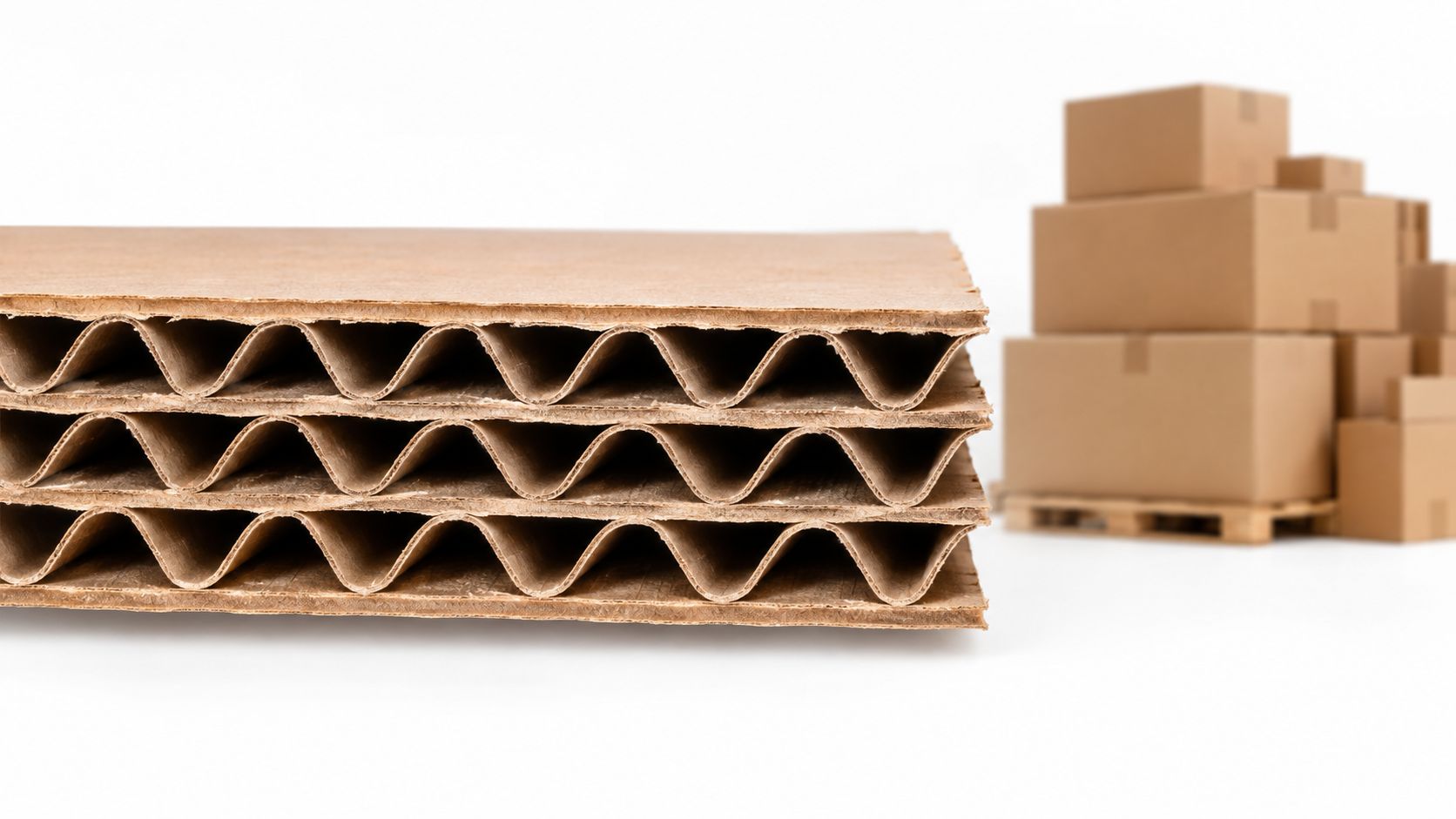
A pallet arrives with a corner crushed inward. The outer carton is split, the contents have shifted, and a customer is waiting for an explanation. For a business shipping heavy, bulky or fragile goods around the UK, the packaging failure can cost more than the box. It can mean a damaged product, a replacement shipment, a return, wasted handling time and a damaged customer relationship.
That's why triple wall cardboard boxes deserve a more careful assessment than just calling them “strong boxes”. Their three fluted layers and four liners can provide much greater resistance to compression, punctures and impact than lighter corrugated grades. But extra material isn't automatically the right answer. The practical question is whether the load, handling route and failure risk justify it.
Table of Contents
- Why Your Boxes Need to Be Stronger
- Understanding Triple Wall Construction
- Reading Strength Ratings Correctly
- Single, Double, and Triple Wall Compared
- Applications for Heavy Freight and Retail
- Sustainability and Bespoke Options
Why Your Boxes Need to Be Stronger
A light parcel moving directly from a fulfilment bench to a customer may never need the protection of triple-wall board. A palletised machine part travelling through several warehouses is a different proposition. The carton may be lifted, stacked, pushed through a parcel hub, placed in a vehicle and stored in changing conditions before it reaches its destination.
Single-wall cartons often fail when the load inside is heavy relative to the box footprint, when the contents press against weak panels or when stacked cartons transfer weight through damaged edges. Double-wall construction deals with more demanding work, but it can still be the wrong choice where the product has concentrated weight, awkward geometry or a high replacement cost.
The failure usually starts before delivery
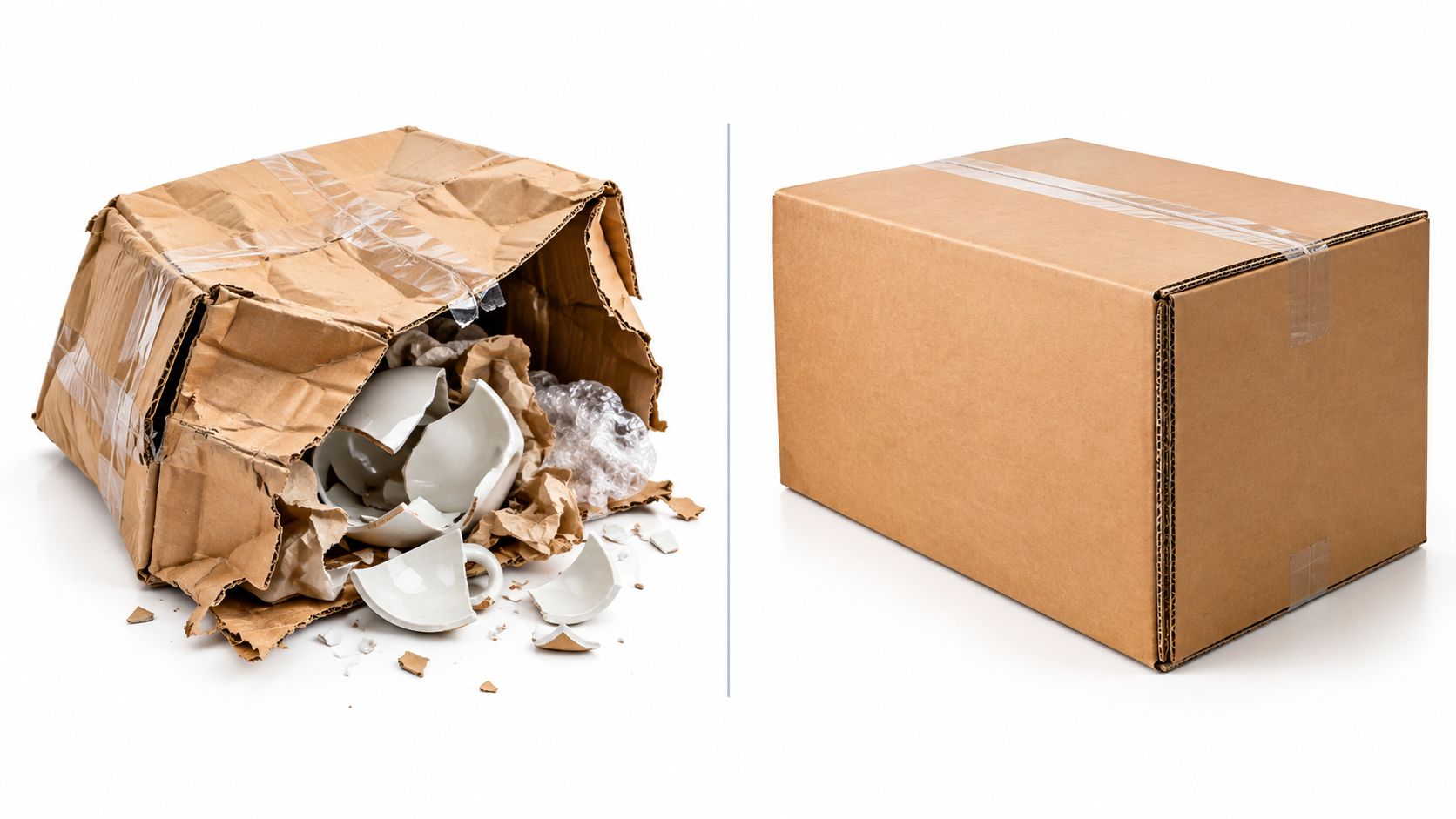
A crushed top panel is only the visible symptom. Compression may have weakened the box during pallet storage, an impact may have punctured a side wall, or moisture may have reduced the board's usable strength. Once the carton loses shape, internal protection has less room to work and the product carries more of the impact.
Triple-wall construction adds another fluted layer and liner, creating a more rigid fibreboard shell. That extra structure can help distribute pressure across the carton rather than allowing one panel or edge to take the full load. It's particularly relevant to heavy industrial components, appliances, bulky retail goods and fragile items that can't tolerate movement.
Practical rule: the heavier the product and the longer it remains stacked, the less useful a simple wall-count decision becomes.
The UK packaging stream provides important context. In 2023, paper and cardboard packaging waste amounted to 5.422 million tonnes, with 3.980 million tonnes recycled, giving a recycling rate of 73.4%, according to the UK parliamentary answer on packaging waste. Those figures cover paper and cardboard packaging overall, not triple-wall boxes alone, but they show why fibre-based heavy-duty packaging remains relevant to UK businesses.
Strength must match the distribution problem
A stronger carton can reduce the chance of product damage, but it won't correct poor palletisation, excessive empty space or inadequate internal restraint. The correct specification considers the product's weight, dimensions, centre of gravity, stacking duration, handling route and exposure to damp conditions.
The decision should therefore start with the failure being solved:
- Panel collapse: consider greater compression performance and a better pallet pattern.
- Punctured sides: assess board construction and internal clearance around the product.
- Product movement: improve fit and cushioning rather than just adding board.
- Wet or humid handling: check conditioned test results and protect the load from moisture.
- Repeated handling: specify a carton that can retain its shape after impacts and transfers.
Triple-wall is useful when those risks are persistent. It's unnecessary overpackaging when a lighter carton, a tighter fit or better internal protection would address the actual cause.
Understanding Triple Wall Construction
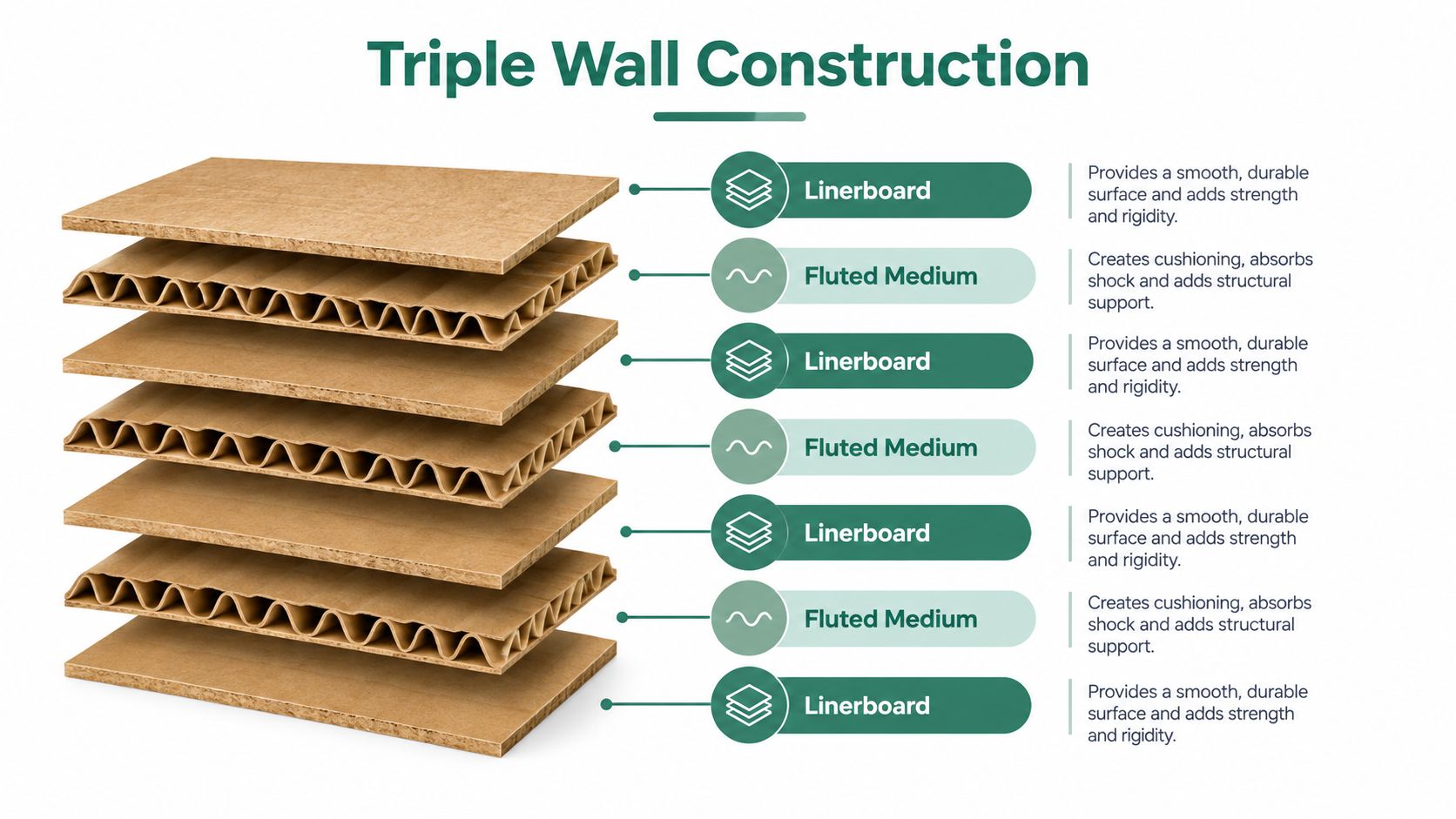
Triple-wall corrugated board is built as a seven-layer structure. It combines three fluted mediums with four flat linerboards, bonded into alternating layers. The fluted paper creates the vertical air columns and the liners hold those columns together, forming a rigid panel that can spread compression and impact.
A simple analogy is a structural sandwich. The liners act like the outer skins, while the fluted mediums act like the shaped core. One thin sheet bends easily, but a carefully bonded layered structure resists bending and crushing far more effectively.
How the layers work together
The outside liner provides the surface that receives handling, strapping and contact with other cartons. Beneath it, the first fluted layer gives the board thickness and helps absorb local impact. An inner liner separates that flute from the next one, adding another load-bearing surface.
The second and third fluted layers continue the structure through the board. The final liner closes the panel and gives the opposite face stability. The result isn't just a thicker sheet. It's a coordinated construction in which each layer supports the others.
Flute profiles can vary, and the choice affects cushioning, rigidity and resistance to crushing. That's why two triple-wall boards can behave differently even though both contain three fluted layers. Paper grammage, moisture, dimensions, joint design and pallet layout also influence the finished carton's performance.
What this means when sourcing
A buyer doesn't need to become a board engineer, but the supplier should be able to explain the construction clearly. A useful specification identifies the board grade, flute arrangement, liner composition, recycled content where relevant and test conditions.
The box format matters too. A tall carton with a small base may be more vulnerable to buckling than a shorter carton carrying the same product weight. A large unsupported panel can also behave differently from a compact carton with closely spaced load paths.
For rolled documents or artwork, a box isn't always the most suitable format. Cardboard Tubes are available in standard, heavy and extra heavy-duty wall thicknesses for posters, prints, artwork and documents, giving those products edge and crush protection in a cylindrical design.
Triple-wall board has a long UK industrial history. The Corrugated Case Company records identify its organisation as the first manufacturer to introduce triple-wall corrugated board to the UK and European market. Its history also traces a Manchester site opened in 1817, while its current UK network is described as operating from seven sites, as recorded in the company's history of the Corrugated Case Company. That history matters because triple-wall wasn't created as a recent sustainability label. It emerged as an engineered fibreboard option for loads that demanded more protection than ordinary shipping cartons could provide.
Reading Strength Ratings Correctly
A supplier's phrase such as “heavy-duty triple-wall” isn't enough to approve a carton. Wall count describes the construction, but it doesn't tell a business how the finished box will perform at its intended dimensions, humidity or pallet height.
Two measurements deserve particular attention. Edge Crush Test, or ECT, measures the edgewise compression resistance of the board per unit width. Box Compression Test, or BCT, measures the maximum compressive load the complete carton can withstand. ECT helps assess the board. BCT addresses the central question for a palletised shipment, because it evaluates the assembled box.
ECT and BCT answer different questions
ECT is useful when comparing board grades and assessing resistance to edge crushing. It doesn't account fully for the box's dimensions, joints, openings, scoring or how the product is packed.
BCT evaluates the finished carton under compression. That makes it more relevant when cartons will be stacked in a warehouse, on a vehicle or on a pallet. A box can use strong board and still produce disappointing BCT results if it is too tall, poorly designed or exposed to moisture.
The Confederation of Paper Industries guidance on corrugated packaging identifies edge-crush and box-compression testing as methods for assessing packaging reliability during stacking.
| Metric | What It Measures | Why It Matters |
|---|---|---|
| ECT | Edgewise compression resistance of the board per unit width | Helps compare the board's resistance to edge crushing |
| BCT | Maximum compressive load of the finished carton | Provides a more practical benchmark for stacked and palletised transport |
What a credible test report contains
A procurement team should request more than a single rating printed on a product listing. The report should identify the test method, conditioning environment, sample dimensions, failure load and safety factor. It should also relate to the actual carton size, because increasing box height can reduce usable stacking capacity even when the board grade remains unchanged.
Moisture deserves particular attention in UK distribution. Damp storage, condensation and wet loading areas can weaken corrugated fibreboard. A result measured in controlled conditions may not represent the box after a long period in a humid warehouse.
A test value is only useful when it describes the box that will actually carry the product.
The safety factor should reflect the distribution route and the cost of failure. A high-value product, long storage period or unpredictable courier handling may justify more protection than a short internal transfer. Conversely, specifying the thickest board without checking the actual load can add material and empty weight without solving a real problem.
For businesses handling export or containerised freight, packaging performance also sits alongside loading practice. Guidance on Canadian container loading services can provide useful context for teams reviewing how cartons are positioned, restrained and distributed during container loading.
A practical review of compression strength testing can help teams understand why finished-box testing should sit alongside board specifications. The useful outcome is a written packaging requirement, not a vague request for “the strongest box available”.
Single, Double, and Triple Wall Compared
The right board grade depends on the risk profile, not on a universal weight threshold. Product weight matters, but so do carton dimensions, stacking duration, handling frequency, moisture and the consequences of failure.
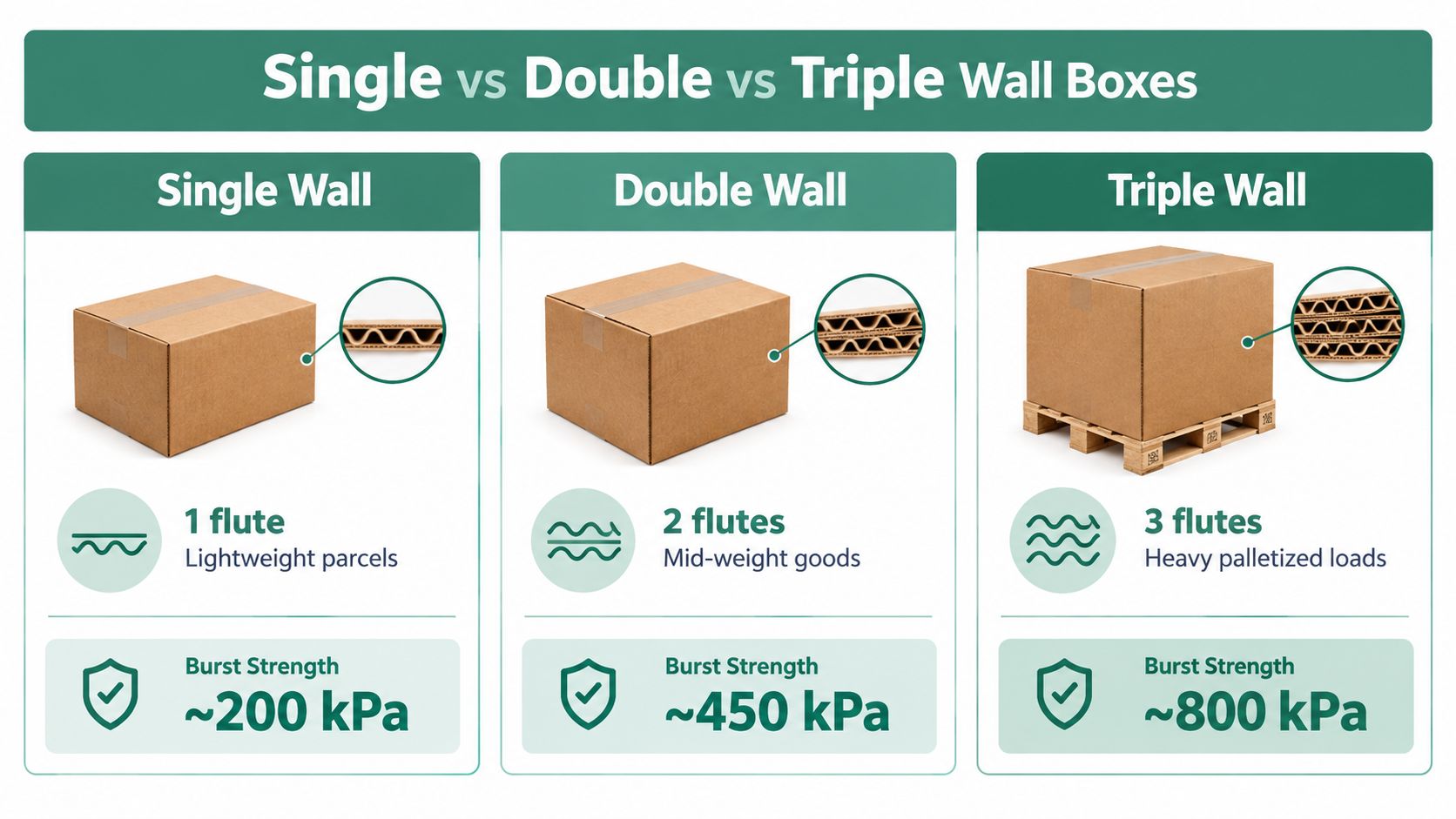
Single-wall cartons suit many lightweight parcels and routine storage tasks. They're efficient where the contents are stable, the box remains within normal parcel handling and stacking demands are modest. A carefully right-sized single-wall carton with good internal protection can outperform a larger, poorly packed box of a heavier grade.
Double-wall board adds a second fluted layer and is a practical choice for moderate to heavy goods. It often suits warehouse distribution, sturdier e-commerce products and cartons that need more stacking support than single-wall board can provide. Businesses seeking a broad range of boxes for secure packing can use the product shape and handling route as the starting point rather than selecting by appearance.
A working selection framework
Triple-wall construction is justified when the load places sustained demands on the carton. Typical triggers include a heavy product, concentrated weight, long-term pallet stacking, repeated transfers, irregular dimensions or a high cost of damage. Industrial parts, machinery components and bulky premium goods often fall into this category.
The following comparison is deliberately qualitative because published performance varies by board grade and box design:
| Box grade | Typical role | Main limitation |
|---|---|---|
| Single-wall | Lightweight parcels, small products and routine internal storage | Limited resistance to heavy compression and concentrated loads |
| Double-wall | Moderate to heavy goods and more demanding warehouse distribution | May not provide enough reserve for prolonged stacking or severe handling |
| Triple-wall | Heavy palletised loads, bulky industrial goods and high-risk shipments | Adds material, weight and cost, so it can be excessive for light or well-supported products |
The double-wall cardboard boxes category is relevant when a shipment needs more protection than single-wall board but doesn't face the sustained compression or failure cost that would support triple-wall specification.
Avoiding overpackaging
A heavier box isn't automatically more sustainable. It may prevent damage, but it also uses more fibre and adds empty weight to every movement. If the product is light and the carton isn't stacked for long, triple-wall may increase distribution impacts without delivering a useful protective benefit.
A better decision process asks four questions:
- Load: Is the product heavy, dense or concentrated against a small area?
- Stacking: Will cartons remain palletised or stacked for an extended period?
- Handling: Will the shipment pass through several manual and mechanical handling points?
- Failure: Would a damaged product create costly returns, replacement transport or reputational harm?
If most answers are no, right-sizing, dividers or cushioning may be more effective. If several answers are yes, triple-wall deserves a measured test rather than a blanket rejection.
Applications for Heavy Freight and Retail
A warehouse team usually notices the need for triple-wall board through a pattern of failures. Cartons arrive with crushed corners, pallet layers lean, internal components break or staff spend too long reboxing goods before dispatch. The packaging change should address that pattern directly.
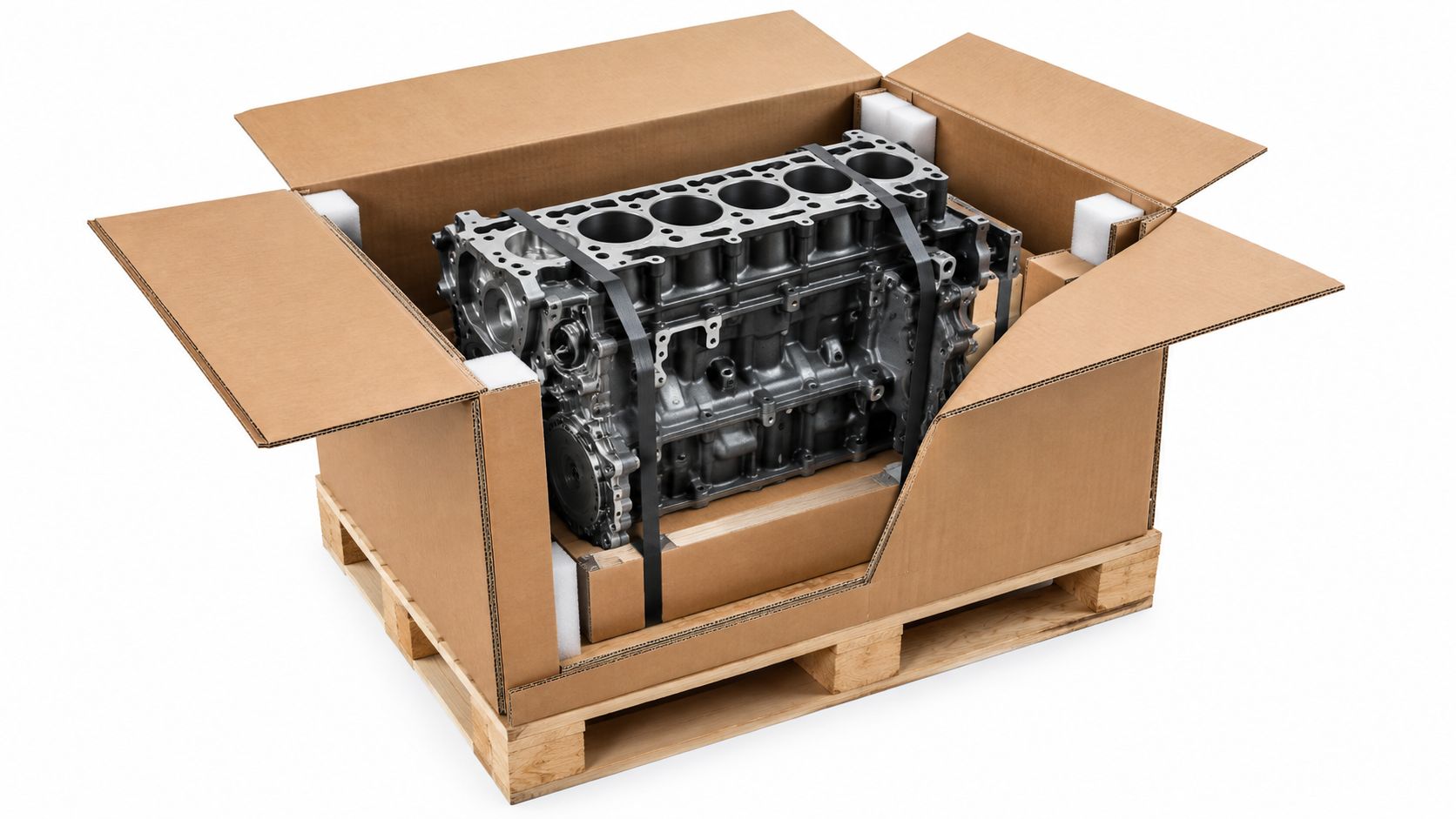
Consider a heavy automotive component. Its weight may sit unevenly across the base, while forks, pallet boards and adjacent cartons create pressure at particular points. A triple-wall carton can provide a stiffer shell, but the design still needs a suitable base, internal restraint and a pallet footprint that keeps load paths stable.
Where the extra structure earns its place
Heavy industrial goods are the obvious application, but weight is only one factor. A fragile product with a high replacement cost may need a stronger outer shell even when it isn't exceptionally dense. Long or irregular products can also put unusual strain on panels and seams.
Useful applications include:
- Automotive parts: engine components, metal assemblies and other dense items that place concentrated loads on the base.
- Large appliances: bulky goods that may experience repeated transfers and pallet movement.
- Machinery and equipment: products that need a rigid enclosure during warehouse and vehicle handling.
- Premium retail goods: valuable displays, furniture elements or electronics where presentation and replacement costs matter.
- Bulk ingredients: commercial goods that need stable palletisation and protection from carton deformation.
- Fragile heavy items: ceramics, glass assemblies or specialist equipment where internal damage can occur after a modest impact.
The box alone won't make a shipment safe. Heavy products need to sit centrally, gaps should be controlled, and the base should remain supported across the pallet. If the contents can move inside the carton, stronger walls may reduce external damage while leaving the root cause untouched.
Retail and e-commerce decisions
Retail distribution often adds handling stages. A carton may leave a supplier, pass through a fulfilment centre, move between storage locations and then enter a courier network. Each transfer presents another opportunity for compression, abrasion or impact.
For e-commerce, triple-wall can be sensible when the product is bulky, difficult to replace or likely to encounter irregular handling. It's less convincing for lightweight goods that already fit securely inside double-wall packaging. A smaller, properly fitted box with suitable paper-based cushioning may protect those items more efficiently.
Businesses should compare packaging trials using clear observations:
- Record the carton dimensions and board specification.
- Note how the product is restrained and how the pallet is configured.
- Inspect corners, seams, panels and the product after representative handling.
- Check whether damage came from compression, impact, movement or moisture.
- Change one variable at a time before moving to a heavier board.
That process separates a genuine board-strength problem from a design or loading problem. It also gives procurement evidence for selecting triple-wall only where the distribution route demands it.
Sustainability and Bespoke Options
Triple-wall board can support a responsible packaging strategy when its additional material prevents damage, replacement deliveries and returns. The material remains fibre-based, and clean, dry corrugated fibreboard can generally enter established paper-recycling channels. Adhesives, wet contamination, films and mixed materials can affect recovery, so recyclability depends on the complete pack rather than the word “cardboard” alone.
The Confederation of Paper Industries describes UK corrugated cardboard as having a recycling rate exceeding 80%, says recovered paper supplies more than 75% of the raw material used to make paper in the UK, and states that corrugated fibres can typically be recycled up to 25 times, as set out in its Beyond the Box white paper. These figures support recycled-content procurement, but they don't make unnecessary over-sizing environmentally neutral.
Specify the whole packaging system
A practical specification should record the recycled-fibre percentage, board weight, box dimensions, coatings and bonded components. It should also define how the carton will be reused, flattened and separated from non-fibre parts after delivery.
The UK's provisional 2025 paper-and-cardboard packaging recycling rate was 80.3%, while total packaging recycling was 70.5%, according to UK Statistics on Waste. Those are national packaging figures, not measurements for triple-wall boxes. They reinforce a useful distinction: a recyclable box can still be excessive if its dimensions and material use exceed the protection requirement.
Custom sizing can improve that balance. A box designed around the product may reduce empty space, limit movement and avoid the temptation to use internal materials just to fill a large carton. Branded printing can support consistent presentation, while structural testing confirms that the design still performs under its intended load.
Businesses should also review their legal records. The Producer Responsibility Obligations (Packaging and Packaging Waste) Regulations 2024 apply across England, Wales, Scotland and Northern Ireland and place duties on relevant UK-established producers, including registration, packaging data collection and reporting, recyclability assessment and contributions towards certain local-authority packaging waste costs, as set out in the 2024 packaging regulations. The duty depends on the business role and how packaging is placed on the market, so a packaging specification should retain material, weight and component information.
For wider transport planning, Peak Transport's green logistics guide offers useful context on reducing environmental impacts beyond the carton itself. Packaging decisions work best when they sit alongside right-sized loads, efficient pallet use and damage prevention.
A concise guide to recyclable cardboard boxes can help teams review fibre content, contamination risks and end-of-life handling before approving a new format.
Packaging Panda supplies UK businesses with cardboard boxes in multiple board grades, alongside protective packaging and made-to-order options such as custom sizes and branded print. Review the available packaging options at Packaging Panda, then match the box construction to the product's weight, handling route and actual failure risk.