Sustainable Packaging for Food: A UK Business Guide
The most popular advice about sustainable packaging for food is also some of the least reliable: switch to compostable packaging and the sustainability problem is solved. In the UK, that shortcut can send a pack to the wrong waste stream, increase Extended Producer Responsibility exposure and leave a brand with an environmental claim that its customers cannot act on.
A package only works sustainably when it protects food, satisfies food-contact law, fits the collection and reprocessing system, and uses no more material than necessary. UK buyers now have to assess all four factors together, especially as recyclability assessments become more technical and packaging data carries financial consequences.
Table of Contents
- Why Compostable Is Not Always the Greenest Choice
- Comparing Recyclable, Compostable and Coated Food Packaging Materials
- UK Food Contact Law and Recyclability Rules You Must Meet
- Balancing Lifecycle Emissions, Food Waste and Right-Sizing
- How to Implement Sustainable Food Packaging in Your Business
- UK Food Brands Getting Sustainable Packaging Right
- A Practical Decision Checklist for Your Next Packaging Review
Why Compostable Is Not Always the Greenest Choice
Compostable packaging can sound like the obvious answer for food, but the label alone does not decide its environmental value. A used tray, film or pouch only gains a practical end-of-life benefit when the relevant UK collection and composting route exists.
Under the current UK EPR approach, compostable packaging is treated as non-recyclable and attracts higher EPR fees, as explained in Food and Drink Federation guidance on packaging requirements. A consumer may put compostable film in a recycling bin, contaminating a fibre or plastic stream, or send it to general waste, where its compostable properties offer no practical benefit.
The commercial gap between an eco-friendly label and UK infrastructure matters. A recyclable fibre carton collected at kerbside, sorted correctly and reprocessed into new products can provide a more credible disposal route than a compostable format with no suitable facility.
Practical rule: A material earns its sustainability claim through the complete system. Collection, processing and intended reuse or recovery must all be credible.
The four-way packaging trade-off
Food brands should test each proposed format against four practical questions:
- Food safety: Does it meet applicable food-contact requirements and control migration?
- Shelf life: Does it protect the product from moisture, oxygen, grease, light, temperature changes and physical damage?
- Infrastructure fit: Can householders put it in the correct UK collection stream, and can facilities sort and reprocess it?
- Regulatory cost: How will the choice affect EPR fees, reporting and evidence requirements?
A compostable pack may suit a food-contaminated application where a justified composting system is available. It is less convincing for a clean, dry product that could use a simple, widely collected fibre format. The right choice depends on the product, pack performance and disposal route, rather than the front-of-pack claim.
The same caution applies to wider claims examined in compostable mailing bags myths. Marketing language can describe a material's theoretical properties, while the waste system determines what happens after disposal.
UK packaging decisions are also being judged through material efficiency and emissions performance. The food system is facing a 13% increase in emissions from food packaging, reported by WRAP. Practical responses include reducing raw material use, increasing recycled content and scaling reuse. Source reduction only helps when pack integrity and food safety remain intact, so shelf-life losses must be assessed alongside EPR cost and recyclability.
Comparing Recyclable, Compostable and Coated Food Packaging Materials
No single material family suits every food product. A dry bakery item, a chilled ready meal and an oily snack each place different demands on the package. The useful comparison is therefore not “which material is greenest?” but “which format provides the required protection and has a credible UK disposal route?”
Recyclable fibre and paper work well for cartons, cake boxes, sleeves, trays and dry-food packaging where the product doesn't require a strong moisture or oxygen barrier. Fibre can be right-sized and specified with only the necessary coatings or barrier layers. Its weakness is contamination. Food residue, grease and difficult laminations can reduce the usefulness of a recyclable claim.
Compostable bioplastics can provide film-like flexibility and may suit selected food-contaminated uses. Their value depends on a clearly justified industrial or home composting pathway, not merely on biodegradability. If the pack enters the UK recycling stream, it may be treated as a contaminant or rejected.
Biodegradable films need especially careful scrutiny. “Biodegradable” describes deterioration through biological activity, but it doesn't guarantee rapid breakdown in a specific UK waste process, and it doesn't mean the pack is recyclable. Buyers should request the exact disposal route and supporting technical documentation rather than treating the label as an end-of-life instruction.
Coated papers sit in the middle. A light, compatible coating may deliver the grease or moisture resistance needed for a product while preserving a viable fibre route. A heavy coating, plastic lamination or inseparable mixed structure can undermine sortation and reprocessing.
Multi-layer barrier films often provide strong shelf-life performance with low material weight. That performance can be valuable, but multiple polymers, adhesives and barrier layers make recycling assessment more difficult. A thinner pack isn't automatically a better pack if the material can't be collected, sorted or reprocessed at scale.
UK Food Packaging Materials at a Glance
| Material Type | Typical Food Uses | UK Kerbside Fit | Key Compliance Notes |
|---|---|---|---|
| Recyclable fibre and paper | Cartons, cake boxes, sleeves and dry-food formats | Often suitable where collection, sortation and reprocessing routes are confirmed | Control food contamination, coatings, inks and barrier treatments |
| Compostable bioplastics | Selected liners, films and food-contaminated applications | Not recyclable under the current UK EPR scheme | Requires a justified composting route and appropriate food-contact evidence |
| Biodegradable films | Flexible wraps and specialist food applications | Disposal route varies and shouldn't be assumed from the label | Confirm degradation conditions and avoid unsupported environmental claims |
| Coated paper | Grease-resistant wraps, trays and takeaway formats | Depends on coating, contamination and reprocessor acceptance | Assess whether layers separate and whether fibre recovery remains viable |
| Multi-layer barrier films | High-barrier pouches and shelf-life-sensitive products | Often difficult to assess and process through household systems | Match the barrier to actual shelf-life need and document composition |
A structured material review forms part of wider sustainable business strategies because packaging affects procurement, compliance, operations and customer communication together. For ecommerce food sellers, Mailers cover poly mailers, padded bags, paper mailers and book wraps, but the correct choice still depends on the product and its transit protection needs.
For a broader explanation of the terminology, brands can also review what eco-friendly packaging means. The practical outcome should be a shortlist of two or three credible formats, not a search for one universal “perfect” material.
UK Food Contact Law and Recyclability Rules You Must Meet
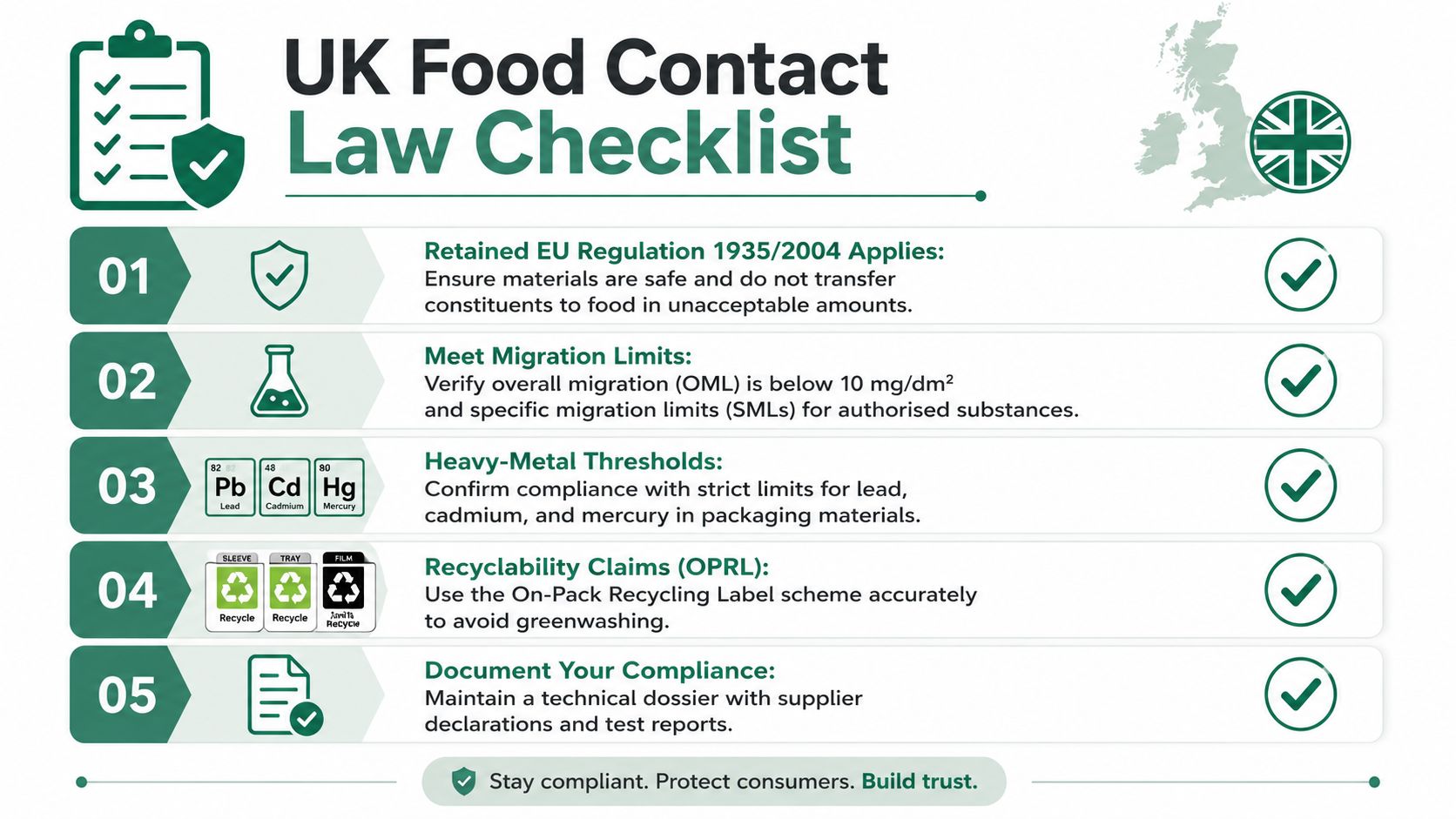
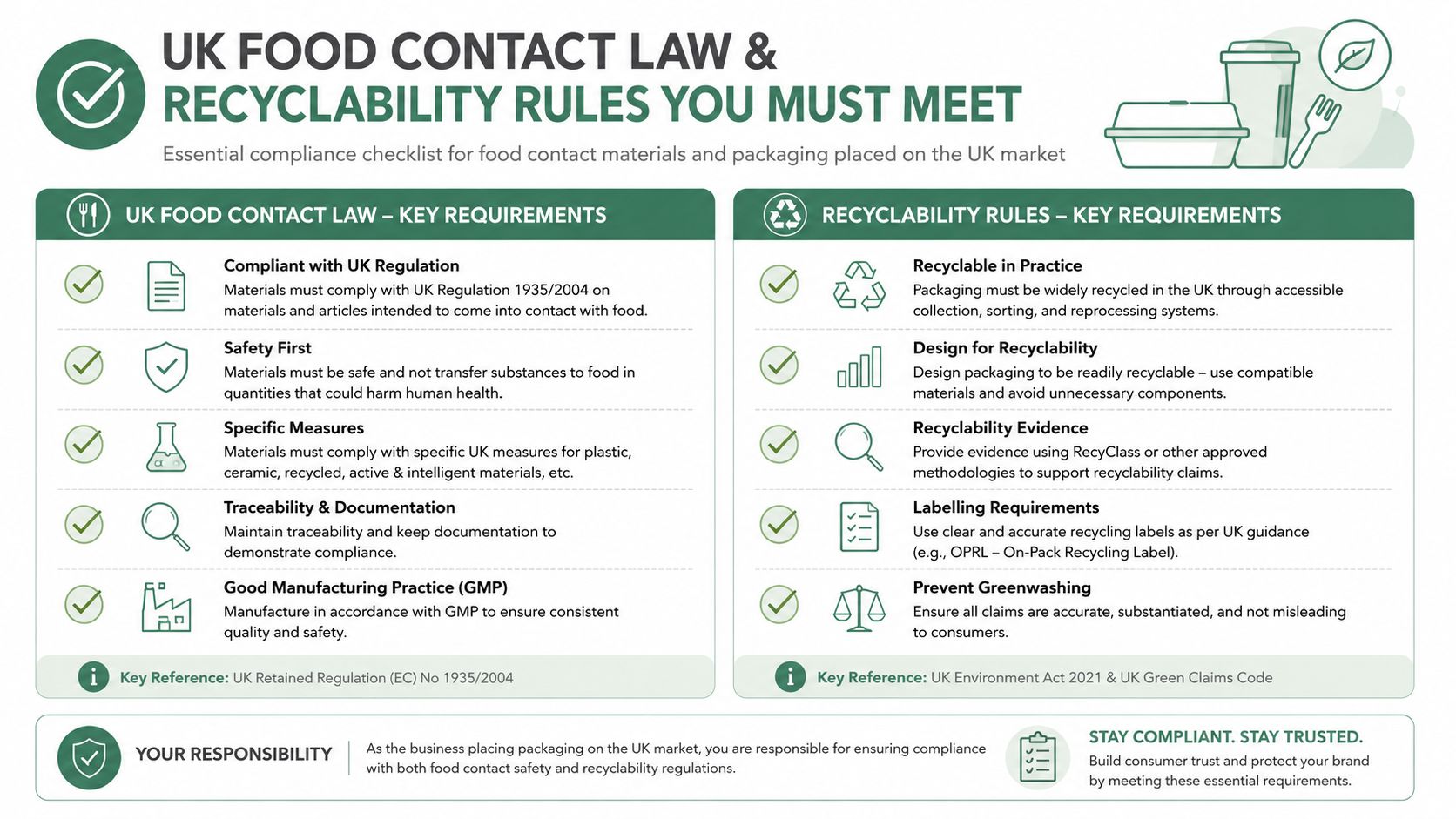
Sustainability sits below a regulatory floor. In Great Britain, food-contact packaging remains subject to the retained EU framework, including Regulation (EC) 1935/2004, GMP Regulation (EC) 2023/2006 and the Plastics Regulation (EU) 10/2011, enforced through UK domestic legislation summarised in this UK and European food packaging guidance.
The core principle is simple: packaging must be safe and must not transfer substances into food at unacceptable levels. A material that appears recyclable or low-impact cannot be approved if the supplier cannot demonstrate suitable food-contact compliance.
UK packaging law also requires packaging to use the minimum weight and volume needed to keep the product safe and hygienic, and sets a 100 ppm limit for heavy metals including cadmium, mercury, lead and hexavalent chromium under GOV.UK designer responsibilities. Recyclability claims must reflect the materials' actual capacity for recovery, while compostable packaging must be biodegradable.
Recycled plastic needs a separate check
Food-contact recycled plastic has additional constraints. Great Britain still uses Regulation (EC) 282/2008 for recycled plastics in food contact, and the cited guidance identifies post-consumer mechanical PET recycling and closed-loop recycling as suitable technologies in the British Plastics Federation food-contact position statement.
The Food and Drink Federation also notes that food-contact plastic packaging can be excluded from recycled-content requirements where recycled content would create a human-health risk or breach food-contact law. A recycled-content target therefore can't be approved in isolation. The technical team must confirm whether the proposed resin, process and application are legally suitable.
RAM 2027 changes the recyclability conversation
The UK's RAM 2027 methodology assesses household packaging across collection, sortation, reprocessing and application according to the RAM 2027 materials assessment guidance. A single red result makes the overall packaging score red.
That means a fibre tray isn't automatically compliant because it is made from paper. The tray must be collected through the relevant system, separated in material recovery facilities, accepted by reprocessors and capable of becoming a new product. Food-contact suitability also remains relevant at the application stage.
EPR transfers the financial burden of packaging waste management to producers, covering the full cost of collection, treatment and recycling. Businesses in scope must collect and report packaging data and continue using PRNs or PERNs to meet obligations as outlined in this UK EPR overview.
A supplier hand-off should therefore include material composition, food-contact declarations, migration testing where relevant, RAM evidence, collection assumptions, reprocessor information and an EPR cost model. If any item is missing, the pack isn't ready for approval.
Balancing Lifecycle Emissions, Food Waste and Right-Sizing
The lightest pack is not automatically the lowest-impact option. Thinner film or board reduces material use only if the pack still resists splitting, leaks, crushing and premature loss of shelf life. Damaged goods, rejected deliveries and spoiled food can outweigh the saving.
As noted earlier, reduced raw material use, higher recycled content and reuse can lower food-packaging emissions. Source reduction and downgauging deliver that benefit only when food safety, product protection and pack integrity remain intact.
A slightly heavier fibre pack may outperform a lighter multi-layer film if it has a clearer route through UK collection, sorting and reprocessing. Compare the full system, including manufacture, filling, transport, shelf life, disposal and food loss. A material that looks better on a marketing label can perform worse at kerbside.
Use measurable design KPIs
A practical review should track:
- Grams of packaging per unit: Confirm whether right-sizing or downgauging reduces material without weakening the pack.
- Recycled-content percentage: Record verified content, not a broad supplier description.
- Recyclability performance: Measure how many packs meet the selected recyclability or reuse target.
- Product protection: Monitor leakage, crushing, seal failure and other defects in storage and transit.
- Food quality: Test whether the revised barrier maintains the required shelf life in real conditions.
Right-sizing often gives a more dependable improvement than a dramatic material switch. Removing unnecessary void can reduce board mass and improve pallet or shelf efficiency while retaining the pack's required function. It can also lower transport impacts without changing the food-contact structure.
The right design depends on the product, disposal route and performance requirement.
The useful question is not “How little packaging can this product use?” It is “What is the minimum packaging that keeps this product safe, saleable and recoverable?”
That distinction prevents a low material weight being mistaken for low total impact. Reduce layers and dimensions only after product, quality and operations teams have agreed the protection requirement, and confirm that the resulting format fits the collection and reprocessing route.
How to Implement Sustainable Food Packaging in Your Business
A packaging change should run as a controlled project, not as a rushed substitution prompted by a new eco label. Product development, procurement, compliance, warehouse operations and marketing each hold part of the decision.
Start with the product and disposal route
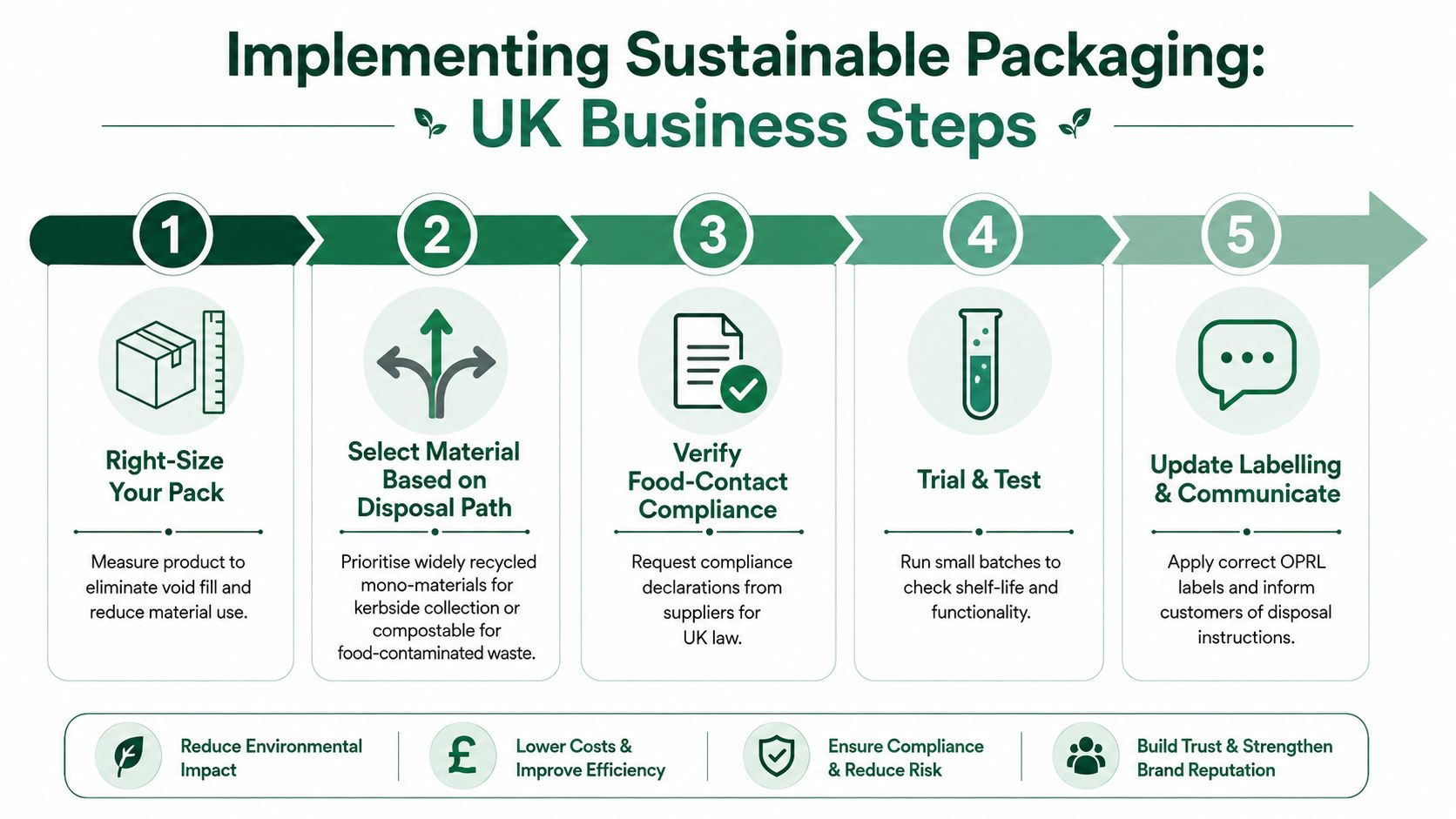
Measure the product, current pack and actual void. Record the dimensions, weight, seal requirements, expected shelf life, temperature conditions, handling points and likely household disposal route. This first audit often identifies an unnecessary layer or oversized format before any material change is considered.
Shortlist materials by end of life. Choose a widely collected recyclable structure where the product allows it, or consider compostable packaging only where the collection and composting pathway is clearly justified. A supplier should provide composition details and explain how the proposed pack performs through collection, sortation, reprocessing and application.
Test before committing to a range-wide switch
Request food-contact declarations and relevant migration evidence before ordering production stock. The Food-safe packaging guidance provides useful background, but the supplier's technical dossier must relate to the exact material, coating, adhesive, ink and intended food use.
Run small production trials. Check filling speed, sealing, stacking, cold-room behaviour, grease resistance, transit damage and shelf-life performance. A pack that performs in a sample room but jams on a packing line isn't a successful specification.
Plan supply and communication
Procurement should confirm minimum order quantities, lead times, print requirements, stockholding and replenishment arrangements before marketing approves the change. Made-to-order packaging can support bespoke sizing and print, but the business needs a realistic transition plan so old and new formats don't disrupt dispatch.
Roll out one product family first, then review the results before changing the wider range. Update recycling instructions and claims only after the route has been verified. Packaging records should be retained for 7 years, as indicated in UK guidance on recyclability evidence reported through the British Agriculture Bureau's regulatory update.
Marketing should describe what customers can do, such as placing a clean fibre carton in the relevant household recycling stream. Vague “eco” wording creates confusion when the pack's disposal route is more limited.
UK Food Brands Getting Sustainable Packaging Right
An independent bakery switching from a laminated cake box to a recyclable fibre box has a familiar trade-off. The bakery needs rigidity, grease resistance, a clean presentation and reliable stacking, but an unnecessary plastic window or coating can complicate the end-of-life assessment. The useful measures are packaging weight per cake, damaged products, packing time, customer disposal instructions and whether the selected board and coating have supporting compliance documentation.
A chilled food brand faces a different problem. An insulated liner and gel pack may protect temperature-sensitive goods during delivery, but removing material without validating the transit profile can increase spoilage or customer complaints. The team should test liner thickness, pack dimensions, gel-pack configuration, dispatch timing, carrier handling and the customer's ability to reuse or dispose of each component.
An ecommerce grocery seller can often begin with the outer parcel rather than the primary food-contact pack. Right-sized cartons reduce void fill, while paper-based mailers may suit products that don't need crush protection or a high moisture barrier. The packing line must still check seal strength, pick speed, product presentation and damage returns before a new format becomes standard.
What each business needs to measure
These examples work because each business defines sustainability through operational evidence:
- The bakery tracks material mass, grease performance, box integrity and disposal clarity.
- The chilled brand tracks temperature protection, spoilage risk, pack-out consistency and component recovery.
- The grocery seller tracks void, transit damage, dispatch time and customer-facing recycling instructions.
None of these businesses needs to claim that one material is universally superior. Each needs a documented format that protects the food, works in the operation and matches a credible disposal route.
A packaging supplier can support this process with standard formats, protective options or bespoke sizing. Packaging Panda supplies recyclable cardboard boxes, paper and poly mailing formats, protective packaging, bakery packaging and made-to-order packaging with custom sizes and branded print. The commercial decision still belongs with the buyer, who must match the specification to product performance and UK compliance requirements.
A Practical Decision Checklist for Your Next Packaging Review
Procurement and operations teams can use the following questions when reviewing their next food pack:
- Food-contact compliance: Does the supplier provide the required UK regulatory declarations, migration evidence and material composition?
- Collection and disposal: Can the end user follow a clear disposal instruction supported by UK collection infrastructure?
- RAM performance: Has the pack been checked across collection, sortation, reprocessing and application, with no unresolved red result?
- Material efficiency: Is the pack right-sized, with only the barrier layers and components needed for product protection?
- EPR exposure: Have material weights, recyclability assumptions and reporting consequences been included in the commercial model?
- Shelf-life protection: Does the revised structure preserve safety, quality and saleability under real storage and transit conditions?
- Operational fit: Can the packing line fill, seal, label and dispatch the format without creating new damage or labour problems?
- Claim accuracy: Do the label and marketing copy describe what the pack is, rather than what customers hope “eco” means?
UK producers are facing more formal scrutiny. The Environment Agency's National Packaging Waste Database publishes aggregated packaging data under the 2023 reporting rules and 2024 producer-responsibility regulations, including material, packaging type and recyclability-assessment ratings through its public summary data. That makes evidence more valuable than attractive terminology.
Start by auditing the top five food packs by volume or cost. Prioritise the one with the largest gap between its marketing claim and its real UK disposal route, then give the technical, procurement and operations teams a shared specification to approve.
Packaging Panda helps UK businesses source recyclable and compostable packaging, bakery formats, mailing supplies, protective products and made-to-order options for different dispatch requirements. Visit Packaging Panda to review suitable packaging formats and discuss a specification that balances food protection, material efficiency and practical UK disposal.