Recyclable Tissue Paper: A Practical Guide for UK Retailers

Most advice says recyclable tissue paper is simple, put it in the paper bin and move on. That's how retailers end up with angry customers, rejected waste and a neat little branding problem that started with a sheet of tissue and ended with a contaminated recycling load. In the UK, things are more exacting, because the difference between recyclable and troublesome tissue paper comes down to fibre, finish and what has touched it on the way out of the warehouse.
Table of Contents
- Why Tissue Paper Recycling Is More Complicated Than It Sounds
- What Recyclable Tissue Paper Actually Is
- The UK Paper Recycling Backbone in Numbers
- How Tissue Paper Actually Behaves in UK Recycling
- Where Recyclable Tissue Earns Its Keep in Retail
- Compliance, EPR and the Rules Closing In
- Buying Checklist for UK Retailers and a Few Honest Answers
Why Tissue Paper Recycling Is More Complicated Than It Sounds
A retailer sends out a tidy order in clean white tissue, the customer likes the presentation, then the wrap gets crumpled and tossed into household recycling. The council rejects it, the customer posts a complaint, and the brand gets blamed for a problem that started with a packaging choice that looked harmless at dispatch. That's the trap with recyclable tissue paper. The label sounds straightforward, but UK acceptance depends on what the tissue is made of, what's on it, and whether it stays clean on the journey out.
The core problem retailers keep missing
UK paper-and-card packaging is one of the country's strongest recycling streams. Government data reports 4.7 million tonnes of paper-and-cardboard packaging waste in 2024, with 84.1% recycled, while a consultation has proposed an 85% recycling target for 2030 (UK waste statistics). That headline is encouraging. It does not mean every tissue format is automatically accepted in every local collection.
The practical split is between unused packaging tissue and used hygiene tissue. England's Simpler Recycling framework requires paper and card collections from households from 31 March 2026, but tissue paper and toilet paper are explicitly excluded from the required recyclable streams (Simpler Recycling in England). Local rules can be even tighter. Richmond, for example, says used tissues, dirty paper and contaminated paper must not go in mixed recycling.
Practical rule: treat the word "paper" as a starting point, not a guarantee. For tissue, the test that matters is whether the sheet is clean, dry and free from mixed materials.
That distinction matters for UK retailers because fulfilment teams are often choosing for two different outcomes at once, presentation and disposal. A tissue that looks premium on shelf but causes confusion at end of life isn't a clean win. A better specification avoids the social-media fallout, the waste contractor's complaint and the awkward question of why a "recyclable" wrap wasn't recyclable in practice.
What Recyclable Tissue Paper Actually Is
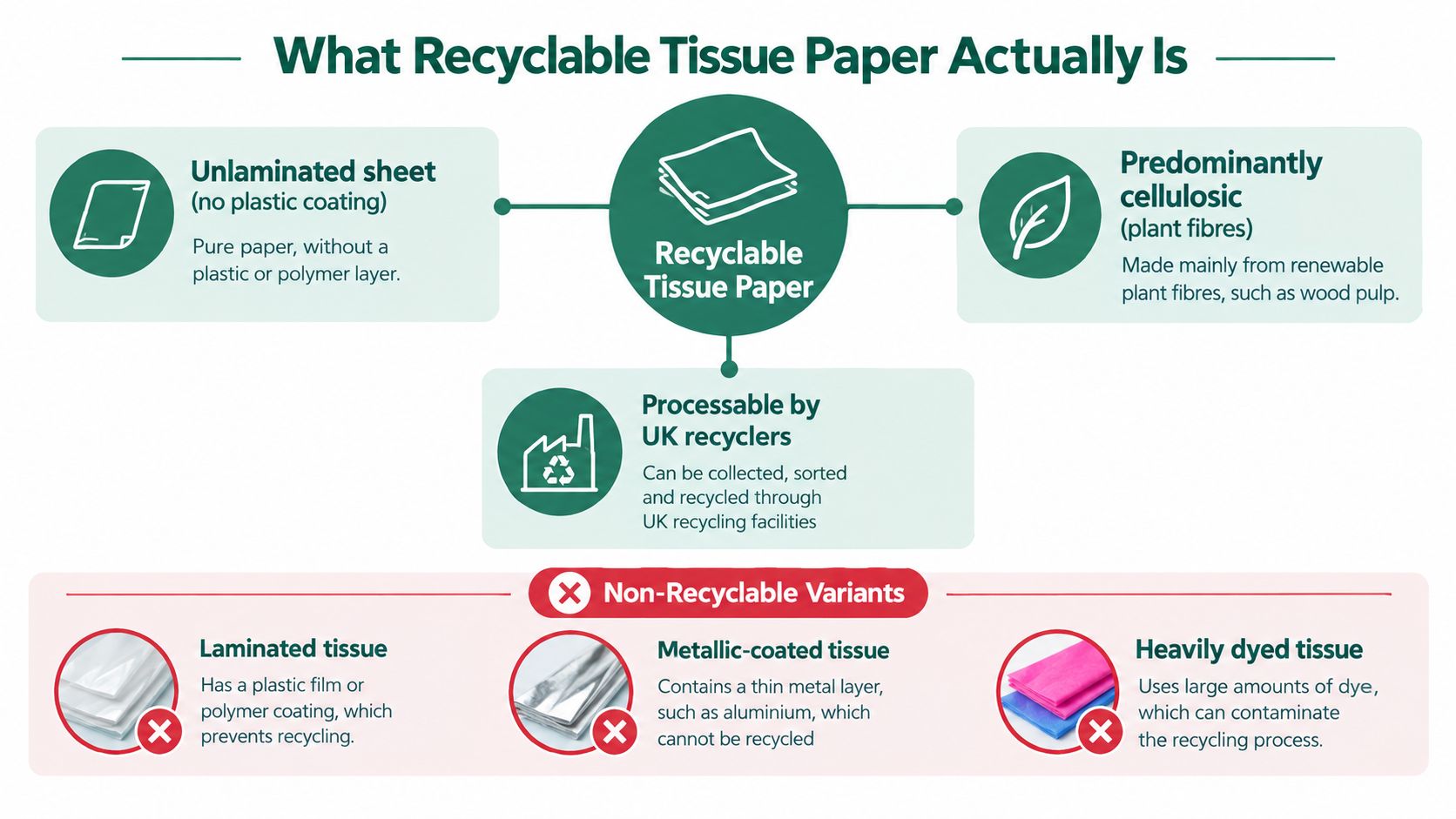
Recyclable tissue paper is defined by what remains after use, not by how attractive the sheet looks on a product or parcel. For UK packaging, the practical specification is an unlaminated, predominantly cellulosic sheet that can enter the paper stream without leaving plastic, foil or other non-paper residue. Tissue may look recyclable while its film, metallic finish, glitter or bonded decoration makes it unsuitable for ordinary paper processing.
How to spot genuinely recyclable tissue
Tissue is a light, fragile paper product intended for presentation, wrapping and interleaving. Its fibres are shorter and weaker than those in heavier board, so the sheet tears readily and cannot be recycled indefinitely. That limitation matters in use. Moisture, grease, adhesive and heavy decoration can reduce the quality of the fibre and complicate recovery.
UK recyclability methodology considers the mass of fibre, filler, water, additives and colour coating in a component against the component's total mass. The label recyclable therefore applies to the finished item, not to its paper base alone. A plastic laminate or non-separable label can shift an otherwise paper-based sheet out of the clean paper category.
Clean, dry tissue with no extra layers is the version that belongs in the paper loop.
Suppliers' descriptions need a closer check than the word “tissue”. Read the specification for film, foil, glued trims and decoration that cannot be removed by hand. Paper Packaging shows how tissue can sit alongside other paper-based formats, but a broad category name does not prove that a particular sheet is recyclable. Before comparing suppliers, review this guide to eco-friendly packaging so the tissue choice fits the wider packaging system. Then ask two direct questions: what is the sheet made from, and what has been attached to it?
The lookalikes that cause trouble
- Plastic-laminated tissue feels smooth and premium, but its plastic layer changes the material class.
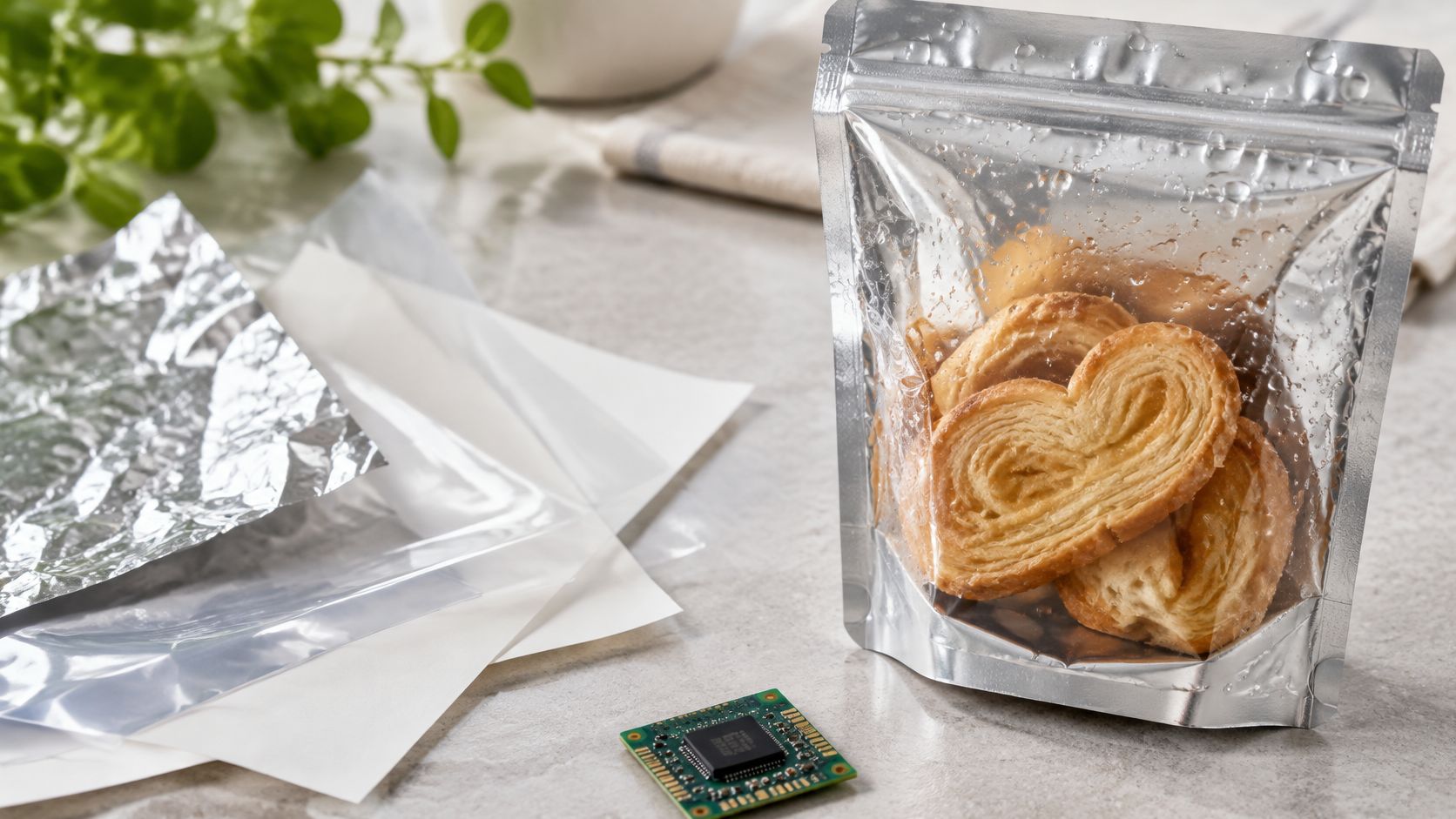
- Metallic-coated tissue may suit gift presentation while carrying a finish that disrupts paper recycling.
- Heavily dyed or decorated tissue can remain paper-based, although its colourants and coatings require checking.
- Tissue bonded to foam or bubble is a composite rather than a clean fibre sheet.
- Tissue with non-separable labels or ribbons creates a mixed-material item that is harder to sort.
The safer purchase is a simple paper sheet with declared fibre composition and no hidden extras. For retailers, that specification separates tissue that fits the UK paper stream from tissue that only sounds recyclable.
The UK Paper Recycling Backbone in Numbers
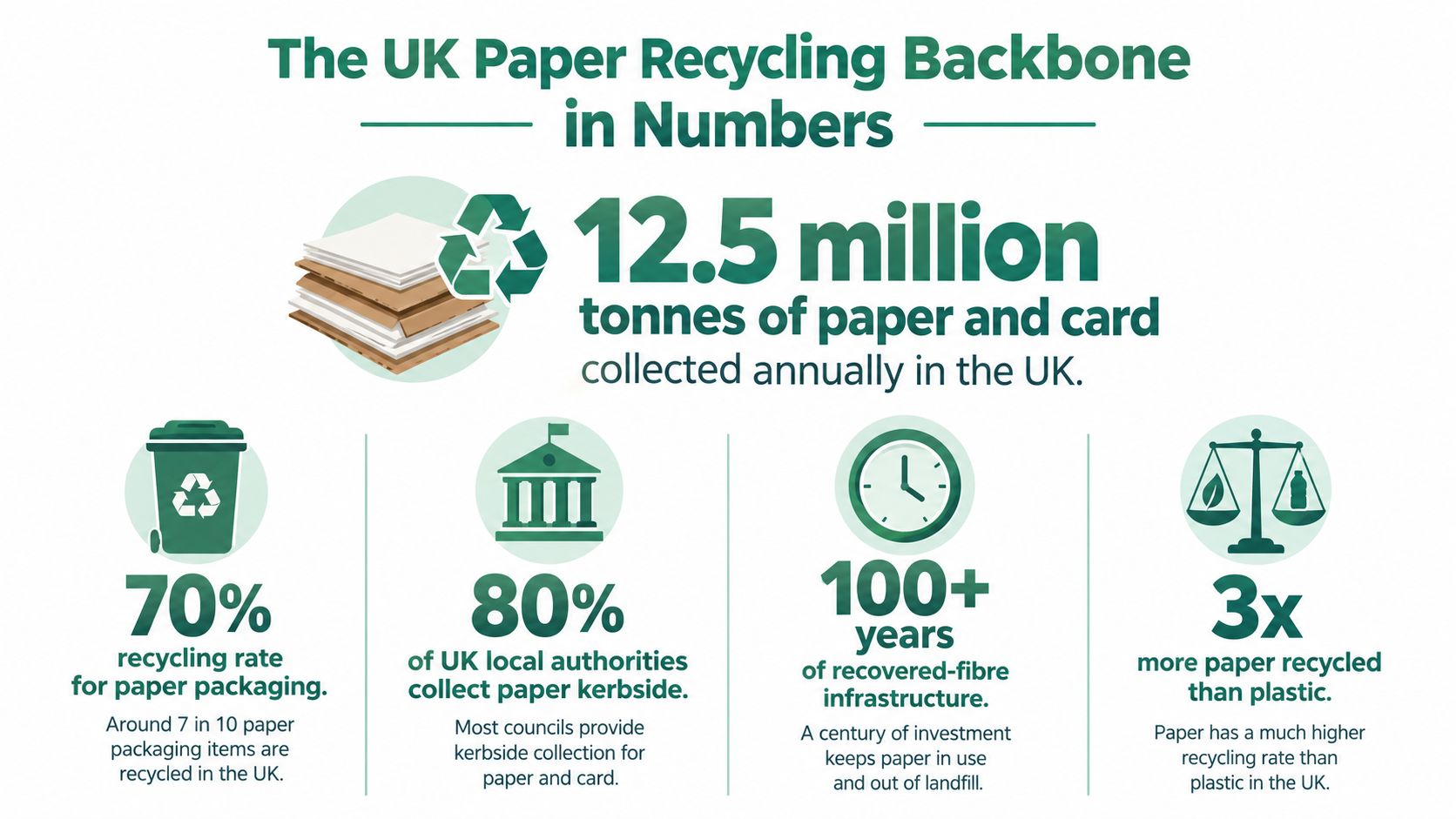
The UK's paper loop has been developing for more than 100 years, beginning with cotton rag collection. In 2020, around 6.6 million tonnes of used paper and card were recovered in the UK for recycling, according to industry data from the CPI report. That established collection network gives suitable tissue paper a route through existing British packaging recycling systems rather than requiring a separate waste stream.
The same report records around 3.8 million tonnes of recovered material exported overseas, while UK paper and board manufacturers recycled approximately 3 million tonnes of recovered paper annually. Recovered fibres made up 69% of the raw materials used in UK papermaking in 2020. Tissue represented roughly 20% of the UK's 3.6-million-tonne paper output. Recycled fibre is therefore part of normal sector operations, not a niche input.
What those numbers mean for tissue buyers
Retailers buying tissue for wrapping, interleaving or void fill are joining an established material loop. Its performance depends on the quality of what enters it. Short fibres, moisture and contamination reduce usable yield, so a clean sheet is a better feedstock than tissue saturated with grease or mixed with foil and adhesive.
The paper stream also remains under policy pressure. The 85% recycling target for paper and cardboard packaging by 2030 mentioned earlier sits close to the 84.1% rate reported for 2024. That comparison points to a practical priority for retailers: improving collection and sorting still matters, even for a material that already performs strongly.
Packaging choices also need a clear record inside procurement and sustainability reporting. Gegan's ESG reporting chart of accounts offers a reference for organising packaging, waste and purchasing categories. It does not determine whether tissue is recyclable, but it can help teams document the decision and its associated waste route.
For buyers, the rule is straightforward. Choose tissue that keeps clean fibre in the paper stream, and specify what happens to coatings, adhesives and other additions before placing the order. A recyclable claim only holds value when the sheet can move through collection, sorting and reprocessing without contaminating the material around it.
How Tissue Paper Actually Behaves in UK Recycling
Tissue paper doesn't get magically recycled because it's paper. It gets pulped, separated and reprocessed, and that's where its weaknesses show up fast. North London Waste Authority explains that paper recycling mixes paper with water and grinds it into pulp, and that oils can repel the fibres and stop them re-adhering, which leaves the new material weak or full of holes (North London Waste Authority).
What the mill sees
The paper mill does not see “gift wrap” or “premium presentation tissue.” It sees fibre quality, contamination and whether the sheet will break down cleanly. That's why paper and cardboard can't just be washed during recycling in the way some glass, metal or plastic items can. Sticky tape is also a problem because it can leave plastic in the recovered material.
For dispatch teams, the operational answer is boring but effective. Keep tissue clean, dry and separate from food residue, adhesive labels, glitter, foil and plastic film. If a sheet has wrapped a greasy product, touched medical waste, animal products or toxins, it should be treated as unsuitable for normal recycling. Printed or dyed tissue is a separate judgement, because the finish and chemistry matter as much as the fibre itself.
Tissue variants and their real-world outcome
| Tissue Variant | Typical Composition | Likely Recycling Outcome |
|---|---|---|
| Plain white wrap tissue | Predominantly cellulosic paper | Usually suitable if clean and dry |
| Printed tissue | Paper with inks | Often suitable if the print is low-impact and the sheet stays clean |
| Dyed tissue | Paper with colourants | Depends on dye stability and local acceptance |
| Laminated tissue | Paper plus plastic film | Poor fit for paper recycling |
| Glittered or foil-stamped tissue | Paper with metallic or decorative finish | Usually unsuitable |
| Tissue with tape or labels still attached | Paper plus contaminants | Poor fit until contamination is removed |
The table is the practical version of the council-side decision tree. If the tissue is clean and paper-only, it can usually stay in the fibre stream. If it carries grease, mixed materials or non-separable decoration, it risks being rejected with the rest of the load.
A useful rule for warehouse staff is to sort tissue at the point of packing, not later at the bin. Clean offcuts, unused sheets and plain paper tissue can go one way. Anything contaminated by product residue, tape or decorative finishes needs a different route.
Where Recyclable Tissue Earns Its Keep in Retail

Recyclable tissue earns its place when it does two jobs at once, protects the product and keeps the packaging story coherent. In clothing, cosmetics and gift retail, it gives a softer finish than plain kraft, and it also works as interleaving for folded apparel or delicate items inside a carton. In that role, the tissue is doing useful work long before anyone thinks about the recycling bin.
Best-fit uses and trade-offs
Presentation wrap is the most obvious use. It adds a premium feel without the weight or rigidity of boxboard, and it can help prevent scuffing on smaller items like jewellery, accessories and gift sets. Void fill is another reasonable use, especially when tissue is combined with other paper-based cushioning, but it needs to be strong enough not to collapse into dust before the parcel reaches the customer.
The trade-off is that decoration can undermine the sustainability story. Heavy print, colour transfer and composite add-ons may improve shelf impact but complicate disposal. The same applies to food retail. Tissue used as a liner or counter wrap near baked goods should be chosen with care, because once it has picked up grease or residue it stops being a clean paper item.
The lightest sheet is not always the greenest choice. Tissue that tears, fails to protect, and forces a replacement shipment usually costs more in waste and transport than a sturdier recyclable alternative.
There's also the brand question. A lot of retailers want “luxury” presentation, but the most credible version of luxury is often restraint. A clean sheet, a good fold and a proper box generally do more for the customer than a shiny wrapped mess that gets binned in doubt.
For colour-led ranges, tissue paper colours can help buyers think about presentation without losing sight of disposal, but the finish still has to remain paper-only if recyclability matters. For inspiration on gift presentation that still looks considered, retailers often also look at presents that don't look like a dog's, although the lesson is simpler, a tidy wrap is better than a fussy one if it leaves fewer disposal problems behind.
In practice, recyclable tissue works best where the parcel needs a light layer of protection, a neat reveal and a material that won't create a sorting headache later. That's a narrow brief, but it's enough for a lot of UK retail.
Compliance, EPR and the Rules Closing In
UK packaging rules increasingly tie environmental claims to the specification of the finished pack. Extended Producer Responsibility places paper, board and fibre-based composite packaging in one obligation category. The EPR rules explained in detail show how reporting and fees follow that specification. Recycling targets for businesses rise from 75% in 2025 to 77% in 2026 and 79% in 2027, according to the EPR guidance. A tissue choice can therefore affect compliance records, fees and the evidence behind a recycling claim.
Why the finished article matters
Paper fibre alone does not make a finished tissue product recyclable. Dyes, coatings, adhesives and attached materials can change how it behaves in collection and reprocessing. Dyed tissue therefore needs more than a casual “recyclable” label.
UK government paper standards state that tissue products such as kitchen tissue, toilet tissue and hand towels should contain 100% recycled content where the relevant standard applies, using recovered fibre that meets the NAPM definition (UK waste data preview). For recycled-fibre tissue, colour fastness and chemical limits also matter. Ink or dye that transfers during handling can introduce contamination into the paper stream.
UK technical references set expectations for colour fastness in dyed tissue and limit chemicals including formaldehyde, glyoxal and pentachlorophenol. These details give procurement teams something specific to check, rather than leaving recyclability as a product-page promise.
Assessment applies to the complete article. A plain recycled sheet without coatings presents a different case from the same sheet carrying ribbons, metallic ink, adhesive decoration or plastic lamination. Retailers that specify tissue early ask suppliers to explain those components before the purchase order is approved.
Practical rule: if a supplier cannot explain the fibre, finish and separable components, the “recyclable” claim is not ready for procurement.
EPR also makes tissue a shared concern for finance, operations and sustainability teams. A low unit price can become harder to defend once reporting, contamination and disposal are included in the decision.
Buying Checklist for UK Retailers and a Few Honest Answers
A good tissue specification is short enough to read, but detailed enough to defend. The buyer should ask for the fibre type, any recycled-content evidence, the basis weight that matches the use case, and a clear statement on coatings, lamination and decorative finishes. If the answer is vague, the product probably isn't specified tightly enough for a UK recycling story.
What to ask before placing the order
- Confirm the fibre: Ask whether the tissue is predominantly recycled fibre, virgin fibre or a mix, and request evidence rather than a generic “eco” label.
- Check the finish: Make sure there's no plastic lamination, foil, glitter or metallic coating hidden in the product spec.
- Review the print: Printed tissue can still be workable, but the ink chemistry and colour transfer risk need to be known.
- Inspect the attachments: Labels, ribbons and glued-on decoration should be separable if the tissue is meant to stay recyclable.
- Match the weight to the job: Thin tissue is fine for presentation, but if it tears in transit, it's costing more than it saves.
- Ask for testing or certification evidence: Mill testing, supplier declarations or third-party certification should support the recyclability claim.
- Give customers disposal guidance: The end user needs to know whether the tissue is clean, dry paper-only material or something that belongs elsewhere.
That checklist sounds dry because it is dry, and dryness matters. Clean tissue is easier to recycle than tissue that's been crushed, oiled or mixed with product residues. Cheap tissue also has a bad habit of costing more once returns, breakage and rejected waste are added back in.
Short answers to the questions retailers ask most
Is printed tissue still recyclable? Sometimes, yes, if the print is low-impact and the sheet stays paper-only and clean. Heavy ink coverage, metallic finish and colour transfer make it a different case.
Does tissue count as plastic-free packaging? Only if the finished item really is free from plastic lamination, film and mixed-material decoration. A paper base alone is not enough.
What if a local council is stricter than national guidance? Follow the local rule. Packaging decisions should be based on the waste contractor and council instructions that apply to the customer, not just the broad national trend.
For retailers that want a clean procurement route, the right tissue is the one that protects the product, survives handling and still makes sense when the box is empty.
Packaging Panda supplies paper-based packaging and tissue alongside other dispatch materials, so it can be a useful place to compare tissue against the rest of a retail wrap specification. If the goal is to buy tissue that fits UK waste streams without creating extra sorting problems, start with the product details and work outward. Visit Packaging Panda to review the available paper packaging options and match the format to the way the parcel leaves your warehouse.
Shop This Packaging Range
Wholesale prices, volume discounts and fast UK dispatch.