
Plastic Packaging Tax: Expert 2026 Compliance Guide
A lot of small businesses only realise the plastic packaging tax matters when a supplier asks about recycled content, an accountant flags a threshold issue, or HMRC registration suddenly becomes urgent. By that point, the expensive mistakes have usually already happened.
The practical problem isn't the existence of the tax. It's the number of businesses that rely on assumptions that sound sensible but are wrong. “We're too small.” “It's compostable, so it must be exempt.” “That pallet wrap doesn't count.” “Only the plastic part matters.” Those assumptions can turn a manageable compliance task into avoidable cost.
For most retailers, importers, fulfilment firms, and growing e-commerce brands, the plastic packaging tax is best treated as a packaging buying issue as much as a tax issue. Get the packaging spec right and the tax burden often drops with it. Get the spec wrong and the tax follows the business through procurement, dispatch, reporting, and audit.
Table of Contents
- Understanding the UK Plastic Packaging Tax (PPT)
- Does Your Business Need to Register and Pay?
- How to Calculate and Report Your PPT Liability
- Common PPT Mistakes and Costly Misconceptions
- Strategies to Reduce or Eliminate Your Tax Bill
- Your Plastic Packaging Tax Compliance Checklist
Understanding the UK Plastic Packaging Tax (PPT)
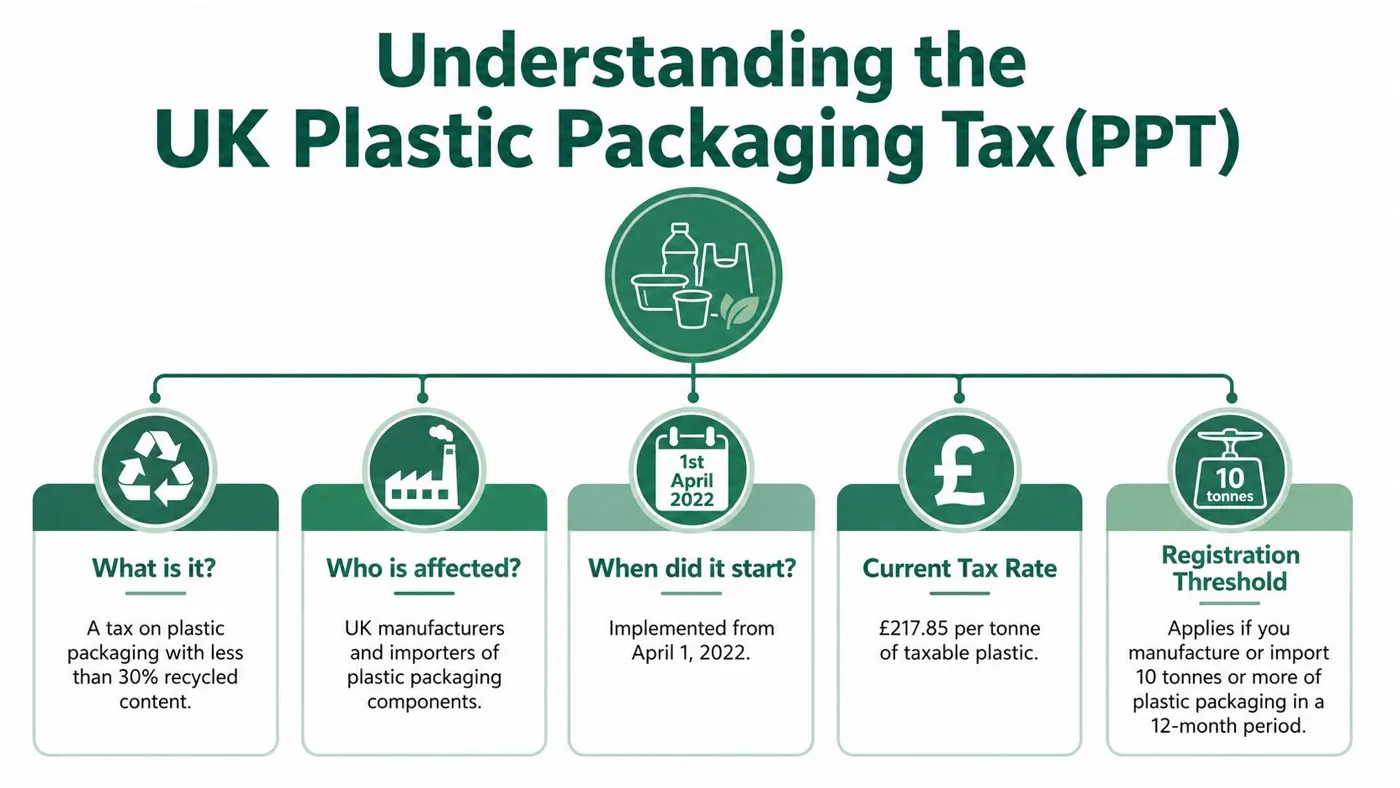
The UK plastic packaging tax applies to finished plastic packaging components that contain less than 30% recycled plastic by weight. It was introduced on 1 April 2022, after being announced at Budget 2018 and enacted through the Finance Act 2021. It applies to businesses that manufacture or import 10 tonnes or more of plastic packaging in a rolling 12-month period, and registered businesses must submit quarterly returns to HMRC. The tax started at £200 per tonne, rose to £210.82 per tonne in 2023 to 2024, then £217.85 per tonne for 2024 to 2025, and reached £223.69 per tonne from 1 April 2025, according to the HMRC Plastic Packaging Tax statistics commentary.
What the tax is really trying to do
At a practical level, the tax pushes businesses to choose plastic packaging with higher recycled content, or to reduce reliance on plastic altogether. That matters because packaging teams often treat tax compliance as an admin issue when it's really a specification issue.
A business can buy two mailers that look almost identical in use. One creates a tax exposure, the other doesn't. The difference is often buried in the material declaration, not in the product name or sales copy.
Practical rule: If a packaging decision is made without checking the recycled content evidence, it isn't a finished decision.
The tax also sits alongside wider packaging obligations. Businesses already dealing with waste reporting and packaging compliance often need to align the data they hold across both areas. Anyone reviewing broader obligations should also understand the interaction with UK packaging waste regulations.
The numbers that matter most
Two figures drive most decisions.
| Key rule | What it means in practice |
|---|---|
| 10 tonnes | This is the registration threshold over a rolling 12-month period for manufacturing or importing plastic packaging |
| 30% recycled content | Below this level, the component is taxable if it otherwise falls within scope |
Those figures sound simple, but they're where most confusion starts. Some businesses assume the threshold is an annual reset tied to the calendar. It isn't. Others assume a product marketed as sustainable automatically meets the recycled content requirement. That assumption causes trouble later.
The tax also covers more than people expect. The HMRC commentary makes clear that bioplastics and compostable packaging are still within the regime if they fall below the recycled content threshold, while certain packaging used for direct contact with human medicines is excluded in the rules already linked above.
Does Your Business Need to Register and Pay?
The fastest way to get this wrong is to ask only one question: “Did the business exceed the threshold last year?” That's too narrow.
The question is whether the business manufactures or imports enough finished plastic packaging to trigger registration, and whether the packaging in question is chargeable. Smaller firms often focus on size and miss the packaging type.
Where smaller businesses get caught out
A common SME mistake is lumping all wrap and transit materials together. That doesn't work. HMRC guidance distinguishes between transport packaging used to import goods, which is not chargeable in this context, and plastic used for transit within the UK, which must be included if it's otherwise taxable. That distinction is explained in this practical guide to plastic packaging tax and SME liability.
That means a growing e-commerce business can be wrong in both directions at once. It might overcount exempt import transport packaging, while also undercounting taxable domestic dispatch materials such as bubble mailers or poly bags.
A warehouse team using Pallet Wrap for fulfilment, for example, needs to separate operational use cases carefully. Pallet wrap and stretch film for warehouses and fulfilment may be hand or machine grade, with extended or flush cores, but the compliance question isn't the grade. It's whether that plastic packaging falls within an exempt import transport scenario or forms part of taxable UK transit and supply.
The threshold doesn't protect a business that classifies packaging incorrectly.
A simple way to assess liability
A practical self-check usually works better than trying to memorise legislation. Start with these questions:
-
Does the business manufacture plastic packaging in the UK, import it, or import goods already packed in it?
If yes, the business may be within scope. -
Is plastic the material under review?
If yes, keep checking. If not, it may fall outside PPT, though mixed materials need closer review later. -
Has the business reached the threshold in a rolling 12-month period, or is it close enough that forward planning matters?
The threshold is not a once-a-year box-tick. -
Is the packaging imported transport packaging, or domestic secondary packaging used in fulfilment and dispatch?
That distinction changes the answer. -
Does the supplier provide clear recycled content evidence?
If the business can't prove the percentage, it should not assume the packaging is outside the charge.
A simple example shows the hidden liability gap. A small online seller may import stock wrapped for international transport, then re-pack and ship each order in plastic mailers inside the UK. The import transport wrap may not drive the charge. The domestic dispatch materials may do exactly that.
Another recurring issue is timing. Businesses often leave registration until after they've already crossed the line operationally. That creates unnecessary pressure on finance and procurement at the same time.
How to Calculate and Report Your PPT Liability
Once liability is established, the work becomes more mechanical. That's good news, because mechanical processes can be made reliable.
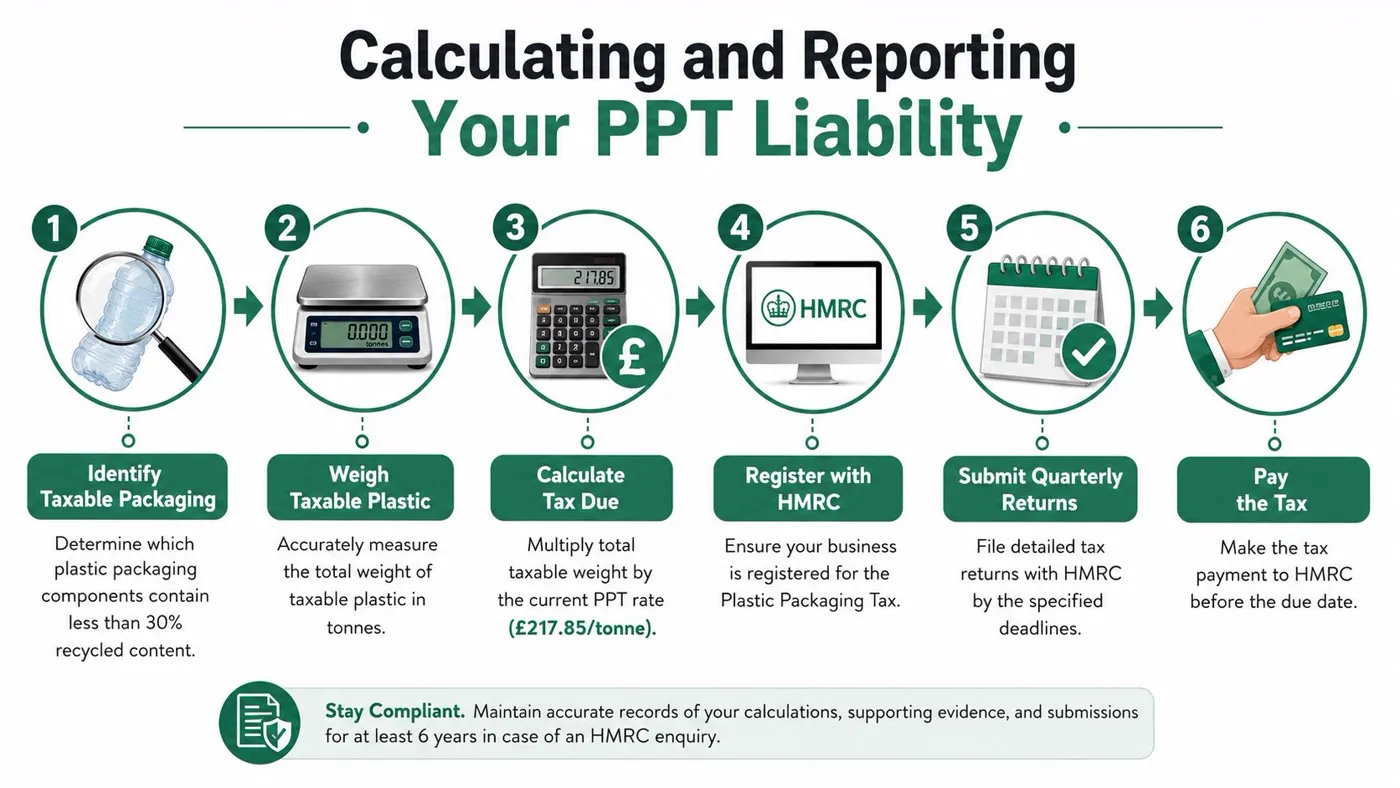
The calculation starts with the total weight of finished plastic packaging components manufactured or imported in the relevant period. The next step is to isolate the weight of components that contain less than 30% recycled plastic by weight. The methodology, including the treatment of mixed-material packaging and the six-year record retention requirement, is set out in this detailed guide to calculating Plastic Packaging Tax liability.
The practical calculation method
The mistake that causes the most under-reporting is simple. A business weighs only the plastic part of a component when plastic is the single largest material by weight. In that situation, the full component weight can matter for PPT purposes.
That catches businesses using mixed-format packaging. Think of a pouch, label, laminated mailer, or hybrid dispatch pack. If plastic is still the largest material by weight, treating the component as “part paper, part plastic” for tax calculation can produce the wrong answer.
A workable internal process looks like this:
- Build a packaging register that lists every finished component the business manufactures or imports.
- Assign a material status to each line. Plastic, mixed material with plastic dominant, or non-plastic.
- Collect recycled content evidence from suppliers before the packaging is approved for purchase.
- Record weights consistently at component level, not just order level.
- Separate taxable from non-taxable lines using the recycled content threshold.
- Prepare quarterly figures from the register rather than reconstructing them at filing time.
For e-commerce businesses using Mailers, this matters because the category can include poly mailers, padded bags, paper mailers, book wraps and more. The tax treatment depends on the actual specification of each component, not on the broad product family.
What records need to exist before HMRC asks
Most PPT problems are evidence problems disguised as tax problems. HMRC expects records to exist and to stand up to scrutiny. Those records need to be retained for six years after the accounting period, as noted in the calculation guide already linked above.
A defensible record set usually includes:
| Record type | Why it matters |
|---|---|
| Supplier declarations | Supports the recycled content position |
| Component weights | Supports the taxable tonnage calculation |
| Product specifications | Helps identify whether plastic is the main material by weight |
| Import or manufacturing records | Supports inclusion in the rolling total |
| Quarterly working papers | Shows how the return was built |
Keep the certificate, the specification, and the weight data together. If those sit in three different inboxes, errors are almost guaranteed.
Quarterly filing is much easier when purchasing, operations, and finance use the same component list. If those teams each use different names for the same item, the return will be slower to compile and harder to defend.
Common PPT Mistakes and Costly Misconceptions
The biggest misconception is also the most commercially understandable. Businesses see words like biodegradable, compostable, or eco and assume the packaging sits outside the tax. That isn't how the rules work.
Biodegradable, oxo-degradable, and compostable plastics are not exempt from PPT if they contain less than 30% recycled content, as explained in this Sedex overview of the UK plastics packaging tax. A business can therefore buy a product promoted as greener and still create a full tax liability.
Why eco language causes expensive errors
Marketing language answers a different question from tax law. “Compostable” speaks to disposal behaviour or material characteristics. PPT asks about recycled plastic content.
That difference matters at buying stage. If a supplier sells compostable mailers without clear evidence that the material contains the required recycled content, the business shouldn't assume the item is outside scope. It may still be fully chargeable.
A similar issue appears with accessories and add-on components. Document Enclosed Wallets, for example, are used for delivery notes, invoices and despatch paperwork and are available in self-adhesive plain and printed options. If a business uses plastic-based wallet components, the tax answer depends on the material composition and supporting evidence, not on the operational purpose of the item.
Eco wording is not compliance evidence.
Other mistakes that keep showing up
Some errors have nothing to do with sustainability claims. They come from process gaps.
-
Buying without specifications
Procurement teams often approve packaging from a sample or datasheet that doesn't confirm recycled content in a usable way. -
Using category labels instead of component data
Calling something a mailer, film, pouch, or wrap doesn't determine liability. The actual material make-up does. -
Leaving the tax review to finance alone
Finance can submit the return, but operations and buying usually hold the source data. -
Assuming a small overage won't matter
Crossing a threshold unexpectedly can create a bill and a registration issue at the same time.
The fix is rarely complicated. It usually means tightening approval controls so no new plastic packaging line enters the business without evidence, weight data, and a clear tax classification.
Strategies to Reduce or Eliminate Your Tax Bill
The most effective way to manage the plastic packaging tax is to stop treating it as a year-end cost. It's a live purchasing variable.
Businesses usually have three routes. They can buy plastic packaging that meets the recycled content requirement, reduce the amount of taxable plastic they use, or move selected lines to non-plastic formats where that works operationally.
Start with procurement not paperwork
Good PPT control starts before an order is placed. If a buyer only compares unit price, the business can end up choosing the “cheaper” item that later carries tax and creates extra admin.
A better buying workflow includes these checks before approval:
-
Ask for recycled content certification
The business needs evidence, not a verbal assurance. -
Confirm whether the item is a finished plastic packaging component
Tax scope starts there. -
Check whether the item is used in exempt import transport or domestic dispatch
Misclassifying transport packaging is a known technical problem, and businesses also need to register if they expect to exceed the threshold in the next 30 days, as explained in the UK explanatory memorandum for the PPT regulations. -
Model the full landed cost
Include procurement cost, likely tax treatment, storage, and operational fit.
Here, packaging review beats reactive tax reporting. A switched specification can remove a recurring liability from every order shipped afterwards.
When switching away from plastic makes commercial sense
There isn't a universal rule that paper is always the right answer. Some applications still need moisture resistance, puncture protection, or stretch performance that a plastic format handles more effectively. But many dispatch lines don't need plastic as much as teams assume.
For retailers sending soft goods, documents, books, boxed items, or low-risk products, paper-based or mixed non-plastic options can reduce exposure and simplify decision-making. That's one reason many businesses review paper alternatives alongside recycled-content plastic rather than treating it as an either-or choice.
For broader context on material selection, especially where packaging also affects customer perception and disposal behaviour, Afida's sustainable food packaging guide is a useful external reference.
One practical route is to compare each plastic line against a non-plastic substitute by asking four questions:
| Question | Why it matters |
|---|---|
| Does the product actually need plastic performance? | Prevents legacy specifications staying in place without reason |
| Is recycled-content evidence available? | Determines whether the current plastic line can be kept without tax exposure |
| Will a paper option protect the goods adequately? | Keeps damage risk in view |
| Will packing speed or storage change materially? | Avoids solving tax while creating an operations problem |
For some outbound mail applications, products such as Colour Kraft Honeycomb Eco Bags may fit because they are wholesale colour kraft honeycomb padded mailers in dark green, orange, red and black, with 100% recyclable, plastic-free protection. They won't suit every SKU, but they illustrate how tax reduction can come from material substitution rather than reporting alone.
A practical review of stretch film and warehouse wrap choices can also help teams separate operational need from habit. This guide to pallet wrap uses and selection is useful when a business is checking where plastic remains necessary and where it's inherited from old processes.
Build a packaging review routine
Most businesses don't need a complete packaging overhaul. They need a repeatable review cycle.
A sensible routine might include:
-
Quarterly line review
Check which packaging components were bought, used, or introduced since the last review. -
Supplier evidence refresh
Reconfirm recycled content documentation when specifications change. -
Exception tracking
Flag items that are exempt for transport reasons separately from taxable domestic-use items. -
Alternative testing
Trial paper or higher-recycled-content replacements on one product line at a time.
The cheapest way to lower PPT usually isn't better tax work. It's better packaging specification work.
This is also the only section where one supplier option is worth noting directly. Packaging Panda supplies UK wholesale packaging materials, including sustainable options and made-to-order formats, which makes it relevant when businesses are comparing recyclable paper lines, mailing products, and protective packaging as part of a tax reduction review.
Your Plastic Packaging Tax Compliance Checklist
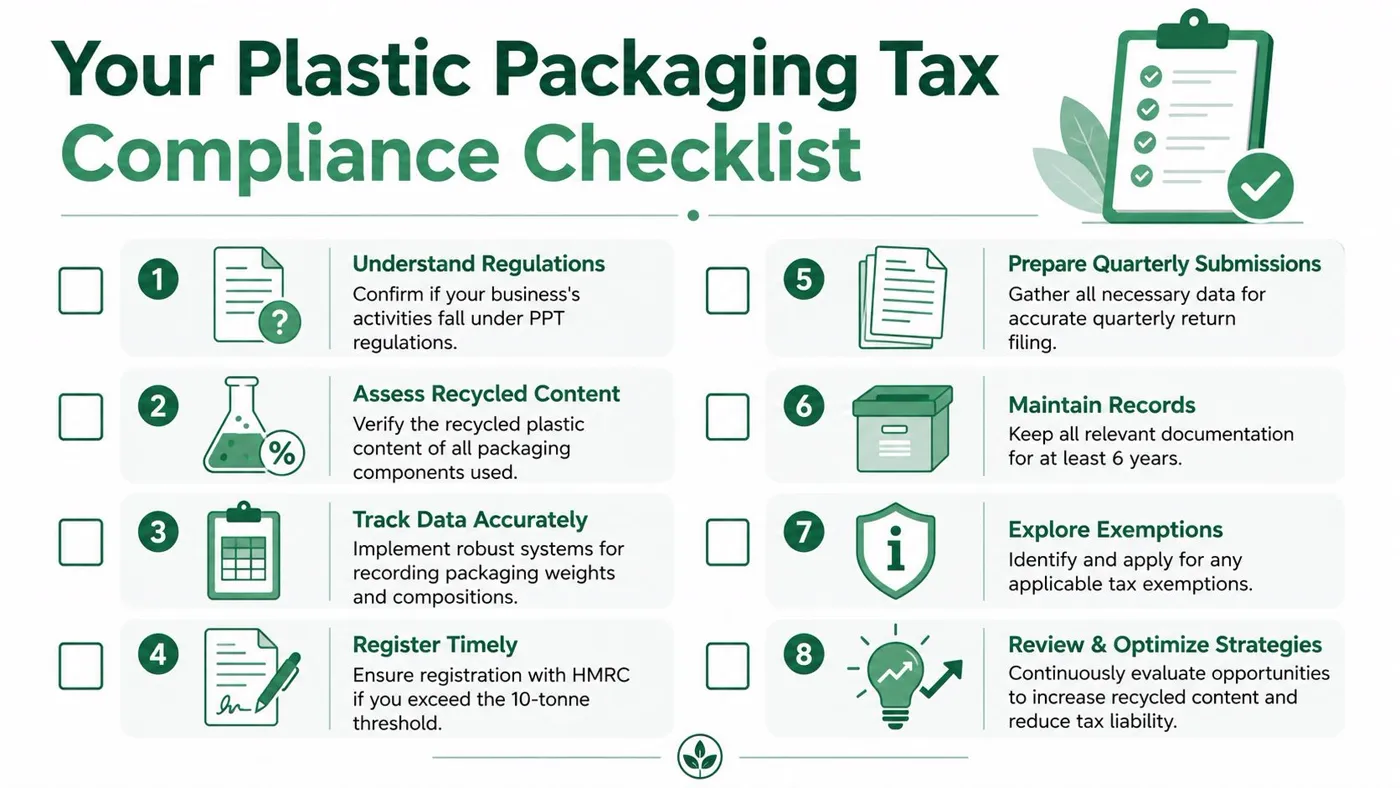
Most PPT issues come from missed basics rather than obscure legal interpretation. A short checklist keeps the business honest.
Immediate actions
- Map every packaging component used in manufacturing, import, fulfilment, and dispatch.
- Identify which components are plastic or plastic-dominant mixed materials.
- Check recycled content evidence before assuming any line falls outside the tax.
- Review the rolling threshold position and don't rely on a calendar-year estimate.
Quarterly tasks
- Update the packaging register with new SKUs, revised materials, and discontinued lines.
- Separate exempt transport packaging from taxable domestic-use packaging so the same item type isn't treated inconsistently.
- Prepare HMRC return data from recorded weights and specifications, not from memory or invoice descriptions.
- Store supporting documents in one place so finance, operations, and procurement are using the same records.
Annual strategy
- Challenge legacy plastic lines that exist only because “that's what's always been used”.
- Test alternatives with suppliers where recycled-content plastic or paper-based formats may reduce exposure.
- Review eco claims carefully. A product can sound sustainable and still create PPT liability.
- Keep the wider sustainability picture in view with practical guidance on what eco-friendly packaging means in real-world use.
A business that treats the plastic packaging tax as a live packaging management issue usually finds compliance easier and costs easier to control.
If the business needs help reviewing packaging formats, comparing plastic and paper options, or sourcing materials that fit a more compliant procurement approach, Packaging Panda is one practical place to start. Its catalogue covers mailing, protective, and sustainable packaging lines that can support a packaging review built around both compliance and cost control.