Moving Packing Papers: A UK Guide to Wrapping Anything
Packing for a house move usually starts the same way. One room looks manageable, then the cupboards come out, the glassware appears, the ornaments multiply, and suddenly there's a floor full of items that all seem breakable. Most damage doesn't happen because people forget boxes. It happens because they underestimate the wrapping.
Order kraft packing paper rolls →
That's where moving packing papers earn their keep. Used properly, they cushion, separate, fill gaps, and stop surfaces rubbing together in transit. Used badly, or replaced with the wrong “free” alternative, they can stain, collapse, or leave fragile items with the kind of avoidable damage that only shows up when the new place is half unpacked.
Table of Contents
- Beyond the Box Why Packing Paper Is Your Moving Day MVP
- Not All Paper Is Created Equal A Buyer's Guide
- Master the Wrap Protecting Plates Glasses and Valuables
- Calculating Your Paper Needs A Room-by-Room Estimator
- Packing Smart Saving Money and the Planet
- Your Room-by-Room Packing Plan
Beyond the Box Why Packing Paper Is Your Moving Day MVP
Boxes get most of the attention, but paper does most of the protection. A box only gives structure. The paper inside stops plates knocking together, glasses cracking against corners, and polished surfaces scraping during the drive.
Good moving packing papers do three jobs at once. They wrap the item, create a buffer between items, and fill the dead space that lets contents shift. That matters far more than people realise when a van hits a pothole, a box is set down too quickly, or a stack settles under its own weight.
The professional choice is usually clean, plain packing paper. Not yesterday's newspaper. Not glossy magazine pages. Not random sheets pulled from a damp garage bundle. The right paper is predictable. It folds neatly, grips well enough to stay in place, and doesn't bring ink, odour, or residue into the box.
Practical rule: If the paper can mark hands, smells musty, or feels weak when scrunched, it shouldn't go anywhere near fragile belongings.
That point matters just as much for ordinary household goods as it does for expensive pieces. Everyday mugs, cereal bowls, lamp bases, framed prints, and serving dishes all benefit from the same basic principle. Clean wrap, enough cushioning, and no empty movement inside the carton.
In UK moves, paper also fits the way most households pack. It's easy to store flat before moving day, simple to sort while packing room by room, and straightforward to recycle if it stays clean. For most homes, that makes it the material that effectively carries the job.
Not All Paper Is Created Equal A Buyer's Guide
Buying paper for a move sounds simple until the wrong type touches something delicate. Most households need one main grade for general packing and one higher-spec option for items that can't tolerate ink, dye, or chemical transfer.
Standard unprinted paper for most household items
For the bulk of a house move, standard unprinted packing paper is the practical workhorse. It suits crockery, glassware, ornaments, pans, small kitchen appliances, candle holders, and most decor. It crumples well for void fill, wraps neatly around corners, and doesn't leave printed residue behind.
A good buyer's test is straightforward:
- Surface check: Plain, uncoated sheets are easier to recycle and safer against rubbing.
- Strength in the hand: The sheet should scrunch without tearing too easily.
- Cleanliness: No moisture marks, food traces, dust build-up, or odour.
- Consistency: Mixed bundles of odd papers are harder to use because each sheet behaves differently.
For people comparing formats, a kraft paper roll guide is useful for understanding when roll-fed kraft is better for larger items and when flat sheets are easier for kitchens and boxed household goods.
If the goal is a mostly recyclable pack, sealing boxes with Paper Packing Tape keeps the outer pack aligned with paper-based materials. The product is available in gummed, self-adhesive and printed options, and is described as strong, recyclable and plastic-free.
Archival paper for items that can't risk staining
Some belongings need more than ordinary clean wrap. Photographs, artwork, antique textiles, documents, heirlooms, and delicate finishes should be treated differently. These are the items most at risk from ink transfer, dye bleed, and paper acidity.
A MoveAdvisor discussion of packing paper use cites a 2024 UK-wide survey by the National Removals Association which found that 38% of damage claims involving fragile items were due to improper wrapping materials, including ink-stained paper, while only 12% of UK moving guides explicitly address ink-free or archival paper requirements. That gap explains why so many people still think old newspaper is harmless.
Newspaper is common because it's available, not because it's safe. Ink can transfer to porous ceramics, fabric shades, matt frames, photo surfaces, and light-coloured finishes. Once that mark appears, cleaning it can do more harm than the original contact.
Use acid-free archival paper when the item has sentimental value, a vulnerable surface, or any finish that could react badly to ordinary wrap.
That's especially relevant in homes with framed art, inherited linens, albums, prints, and collectables. A broad moving guide may not mention this nuance, but specialist packers do. Similar advice appears outside the UK too, including this packaging supplies Townsville guide where material choice is treated as part of damage prevention rather than an afterthought.
Where paper alternatives fit
Paper isn't one thing. Alongside standard sheets and archival paper, there are newer options such as honeycomb paper wrap and soft tissue-style wraps. These can work well for surface protection, presentation, and lighter cushioning, especially around decor, ceramics, or polished finishes.
The trade-off is simple. Honeycomb-style wraps can be convenient for certain shapes, but standard sheets still tend to be more versatile for full-house moving because they also work as void fill and layered separation. Specialist papers are best viewed as add-ons for specific item types, not universal replacements.
Master the Wrap Protecting Plates Glasses and Valuables
Technique matters more than people think. The paper doesn't protect by magic. It protects because the wrap creates layers, absorbs movement, and stops one hard surface touching another.
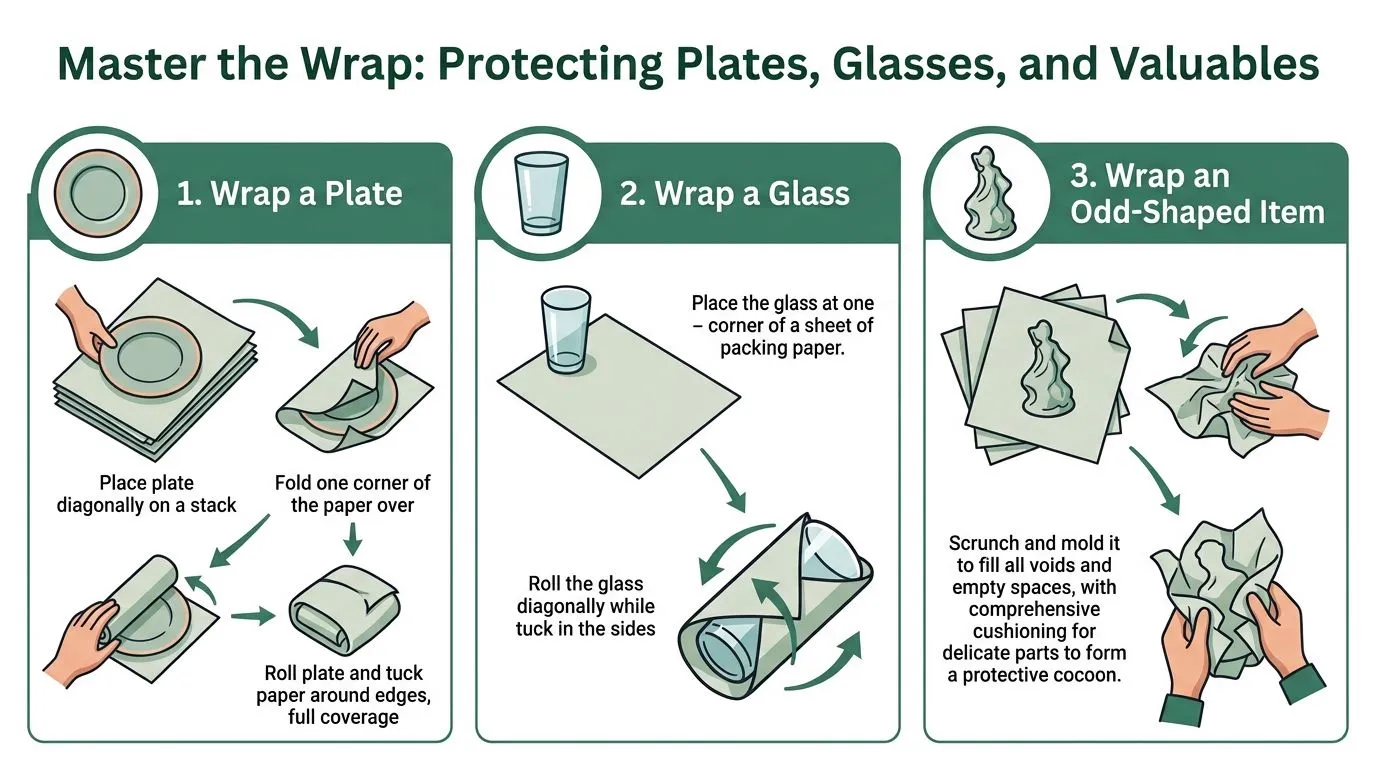
Plates and bowls
The safest method for plates is simple and repeatable.
- Lay out a small stack of sheets. One sheet is rarely enough for a ceramic dinner plate.
- Place the plate near one corner on a diagonal. That gives more paper over the edges.
- Fold and roll. Bring one corner over the plate, roll steadily, and tuck the sides as the paper closes around the rim.
- Stand plates vertically in the box. Plates packed on edge usually cope better than flat stacks because the pressure distributes more evenly.
Bowls need the same treatment, with extra paper tucked into the hollow if they're thin or easily chipped. The key isn't making a huge bundle. It's creating full edge coverage.
A chipped rim usually means the edge was underprotected, not that the whole box lacked padding.
At the bottom of the box, add a layer of crumpled paper first. Then place wrapped plates upright with more crushed paper between groups. If the box still has movement when gently shaken, it isn't ready.
Glasses and stemware
Glasses break in two common places. The rim cracks from direct contact, and the base snaps when the item shifts inside the carton. That's why the best wrap starts inside the glass, not outside it.
Use the nesting technique:
- Stuff the inside lightly: Crumpled paper supports the wall of the glass.
- Wrap the outside on a diagonal: Roll the glass while tucking paper around the base and rim.
- Separate each piece: Don't let wrapped glasses sit glass-to-glass.
- Use heavier cushioning around stems and bases: Those points take the strain.
Stemware needs more patience. Wrap the stem first with a narrow strip of paper, then wrap the whole piece. If the bowl is thin, add another outer sheet. Place these items upright where possible, with generous paper between them.
For additional examples of handling breakables, this guide to packing fragile items in Medford is useful as a general reference on separating vulnerable items and avoiding overpacked cartons.
Soft wraps can also help with highly markable surfaces. For pieces that need a gentler contact layer, plain tissue paper for packing delicate surfaces can sit beneath the outer cushioning layer.
Odd shapes and valuables
Figurines, lamp bases, candle holders, vases with handles, and anything with projections should never be wrapped like a simple plate or tumbler. These objects break at their weakest point, which is usually the part sticking out.
A better approach is to build protection in stages:
- First layer: Close, moulded wrap around the item itself.
- Second layer: Extra paper around handles, corners, lids, or protrusions.
- Third layer: Crumpled paper in the box to lock the shape in place.
For framed items or decorative pieces, avoid pressing tape directly onto the object. Wrap the paper around itself. Tape should secure the bundle, not touch the finish.
A useful test is the hand-pressure check. Hold the wrapped item and press gently around the vulnerable areas. If fingers can easily feel the hard edge beneath the paper, the wrap is still too thin.
Calculating Your Paper Needs A Room-by-Room Estimator
The most common buying mistake isn't overbuying. It's underestimating how much paper disappears into kitchens, decor boxes, and filler for half-empty spaces. A move always uses more sheets than expected because paper does double duty as wrapping and cushioning.
A practical starting table
The table below isn't a fixed rule. It's a working estimate based on typical household contents and a normal mix of crockery, glass, ornaments, and boxed miscellaneous items.
| Property Size | Estimated Boxes | Recommended Paper Bundles |
|---|---|---|
| 1-bedroom flat | 15 to 25 | 1 to 2 |
| 2-bedroom home | 25 to 40 | 2 to 3 |
| 3-bedroom home | 40 to 60 | 3 to 5 |
| 4-bedroom home | 60+ | 5+ |
A “bundle” here means the retail format many UK buyers recognise: 500 sheets. That matters for budgeting because paper is often bought in that unit rather than by loose count.
If the contents are heavy on kitchenware, framed decor, collectables, or glassware, move to the upper end of the range. If the move is mostly clothes, bedding, and flat-pack furniture, the lower end may be enough.
A quick way to sense-check your order
A practical formula is:
Number of moving boxes x 15 to 20 sheets
That won't give a perfect total, but it gives a better shopping starting point than guessing by eye. A kitchen box with plates and mugs may use more than that. A linen box may use very little. Across a whole move, the average usually balances out if the mix is ordinary household stock.
Two extra checks help avoid running short:
- Count fragile-heavy rooms first: Kitchens, living rooms with ornaments, and home offices with framed items consume paper quickly.
- Allow for void fill: Half-packed cartons and awkward appliances use a surprising amount of scrunched paper.
For anyone who wants a second reference point before ordering, this estimate your packing needs tool is a useful external calculator for comparing rough totals.
Packing Smart Saving Money and the Planet
Cost and waste usually get treated as separate decisions, but with packing paper they're tied together. The better choice is often the one that's simpler to dispose of and less likely to cause avoidable damage.
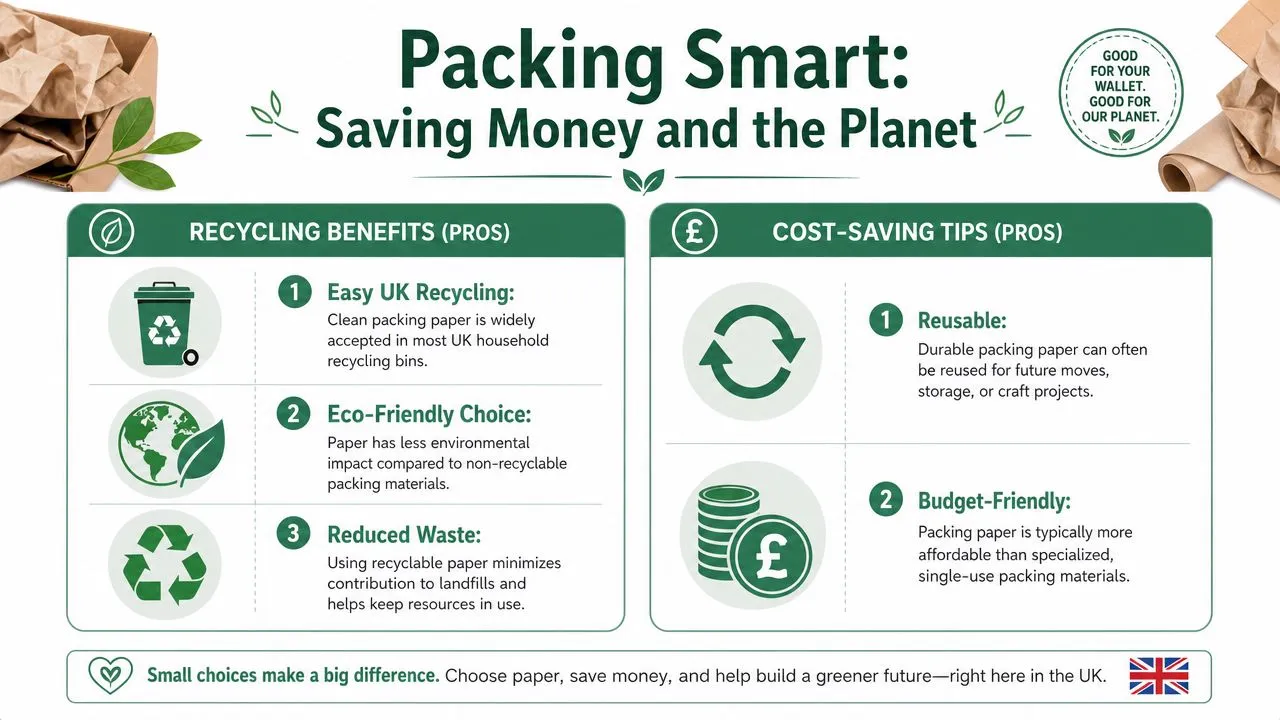
Why clean paper is easier to live with after the move
In the UK, paper makes practical sense beyond the packing stage. According to UK paper waste and recycling figures, the country uses 12.5 million tons of paper annually, with packaging accounting for nearly 60%. The same source states that packing paper can cost around £13 for 500 sheets, while bubble wrap for a typical move can be £80 to £120, and paper and cardboard achieved a 74.3% recycling rate in 2024.
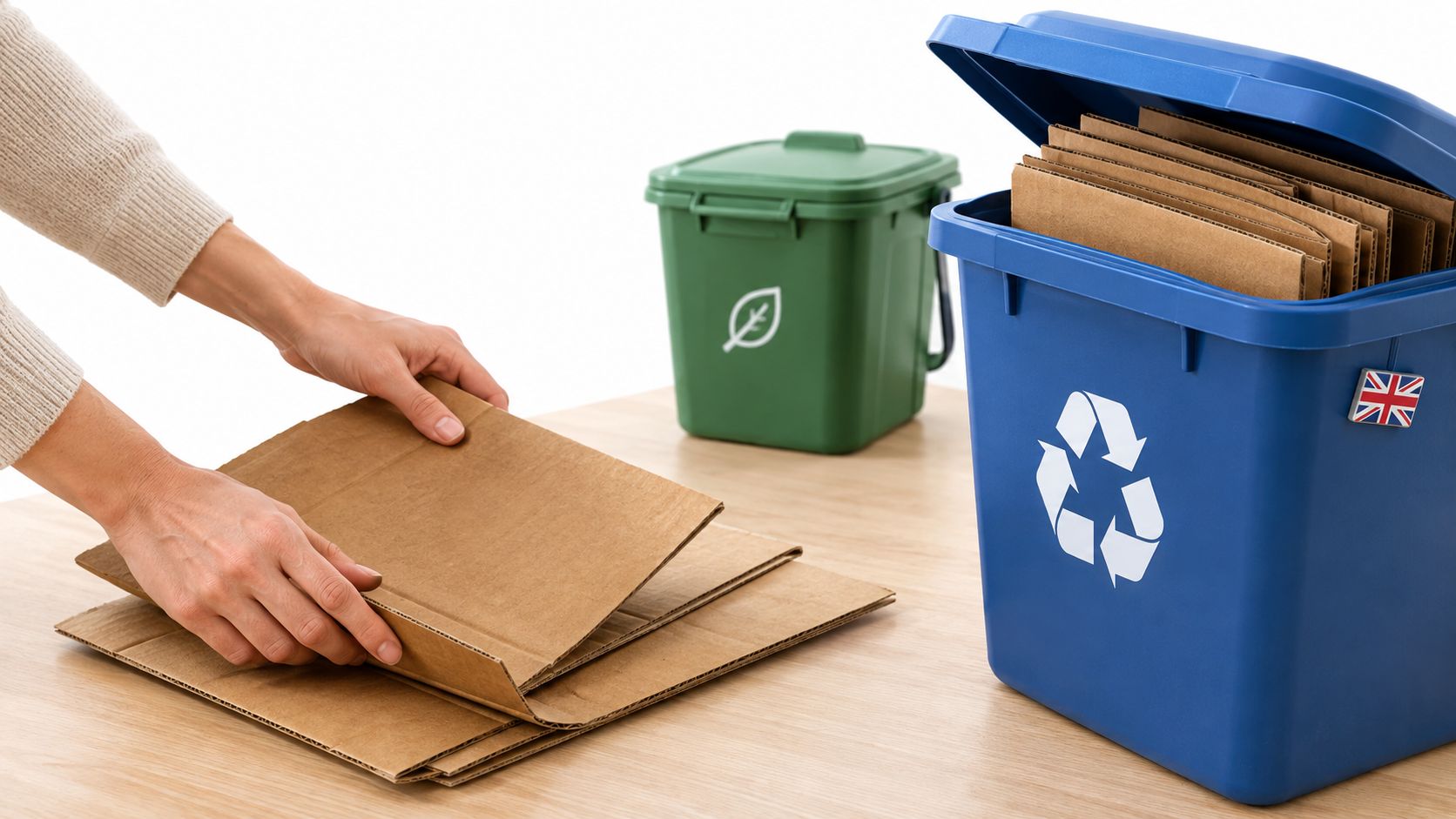
That matters on moving week because clean, uncoated paper is usually straightforward to put through household recycling, while soft plastic wraps often need separate handling. It also matters before the move because paper stores flat, tears by hand, and adapts to odd shapes without creating piles of offcuts.
For extra gap filling in cartons, paper-based options such as shredded paper void fill can work well for lighter protection and presentation where loose cushioning is needed.
Why free paper often turns into paid problems
Free materials are tempting when costs are stacking up. The problem is that “free” says nothing about condition. A stack of donated paper may be brittle. Garage-stored paper may have absorbed moisture. Random reused sheets may carry food residue, dust, mildew, or pest contamination.
The hidden cost shows up when the paper fails under compression or contaminates what it touches. A weak sheet doesn't hold a wrap. Damp paper softens box interiors. Dirty paper turns unpacking into a cleaning job. Removal crews may also object if the material looks unsanitary or unstable.
A Kerb article on packing paper is linked to an underserved angle that highlights this problem with specific UK-moving concerns. It notes a 2025 UK Citizens Advice report stating that 44% of DIY movers who sourced free packing materials experienced box failure or item damage due to weak, degraded paper, with an average £120 in unplanned replacement costs, and that 62% of UK removal companies reject boxes padded with non-vetted free paper due to contamination risks.
If a paper source is unknown, treat it as a risk, not a bargain.
There's nothing wrong with reusing clean packing paper from a recent delivery or previous move. The issue is quality control. Reuse what is dry, plain, strong, and clean. Bin what isn't.
Your Room-by-Room Packing Plan
A good move runs faster when each room has its own paper strategy. That stops over-wrapping low-risk items and under-wrapping the things that usually get damaged.
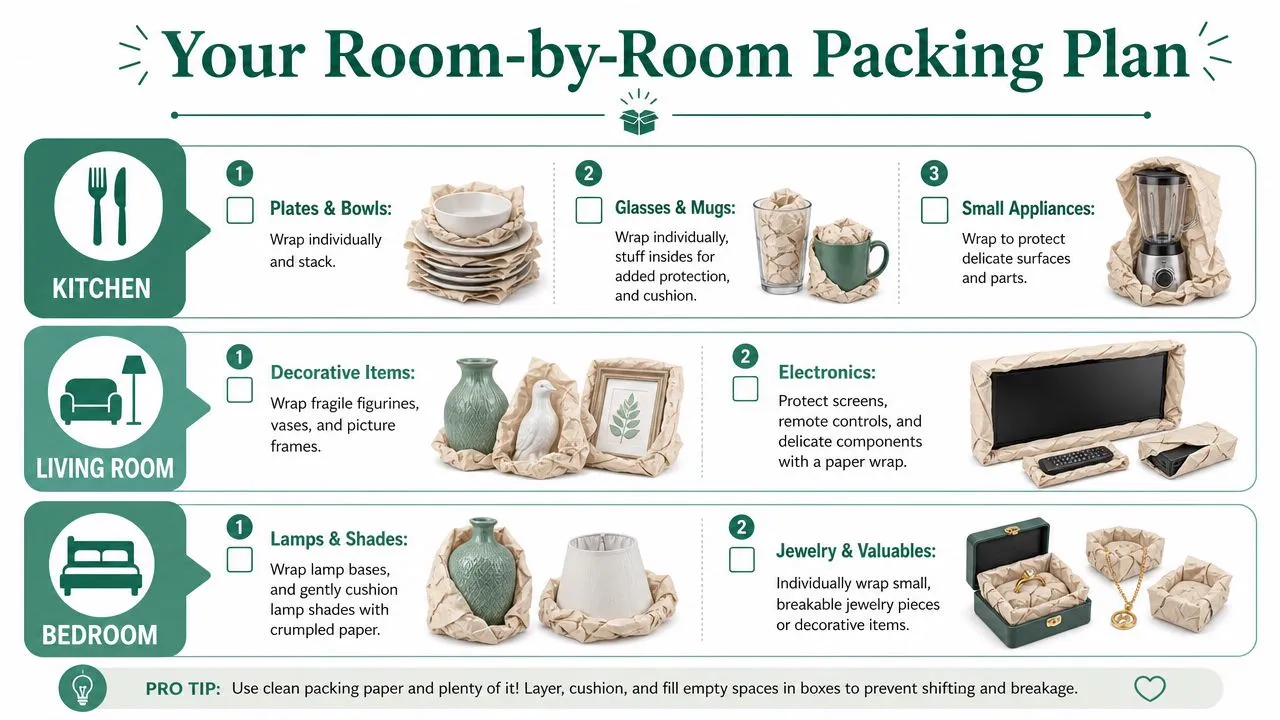
Kitchen
Most of the paper is used here.
- Plates and bowls: Wrap individually, then stand plates on edge and cushion between groups.
- Glasses and mugs: Stuff interiors lightly, wrap separately, and pad bases and rims.
- Serving dishes and ovenware: Add extra paper at handles and corners.
- Cutlery bundles: Wrap sharp or decorative pieces so they don't puncture cartons.
- Small appliances: Protect polished or glass surfaces and secure loose parts separately.
Label kitchen boxes accurately. A carton full of wrapped ceramics may look manageable but can become heavy quickly.
Living room
The living room usually contains awkward breakables rather than obvious ones.
- Picture frames: Wrap corners well and keep frames upright in the box.
- Vases and ornaments: Build up around handles, necks, and narrow points.
- Lamp bases: Wrap hard surfaces fully and keep cords separate.
- Remote controls and smaller electronics: Use paper to prevent scratching and to stop pieces shifting against each other.
If an item is decorative but not especially fragile, paper often serves best as a surface protector rather than a thick cushion.
Bedroom
Bedrooms are mixed spaces. Most soft goods need very little protection, but the small breakables are easy to overlook.
- Bedside lamps: Wrap bases and fill shades gently so they keep shape.
- Jewellery boxes and keepsakes: Wrap individual pieces that can chip or rub.
- Mirrored accessories: Cushion edges and pack upright where possible.
- Framed photos: Use cleaner, safer paper for anything with a sensitive finish.
Avoid using clothing as the only protection for hard valuables. It can supplement paper, but it doesn't replace structured wrapping.
Office and paperwork
Home office contents can be more delicate than they look.
- Document files: Keep important papers dry and flat rather than crammed into overfilled cartons.
- Printers and accessories: Wrap removable parts separately and stop cables rubbing across screens or housings.
- Desk decor: Treat ceramic pen pots, awards, and framed certificates as fragile items.
- Photos and archival material: Use the safer paper grade already discussed for anything irreplaceable.
Bathroom utility room and hallway
These rooms usually contain the awkward leftovers.
- Glass bottles and toiletries: Seal lids first, then wrap to prevent leaks spreading through the box.
- Cleaning tools with hard fittings: Pad rigid parts so they don't gouge nearby items.
- Hallway decor: Mirrors, trays, and small tables often need edge protection more than bulk padding.
- Utility odds and ends: Group by shape and weight so heavy pieces don't crush lightly wrapped items.
A final walk-through should focus on the items people skip because they don't seem “fragile”. Soap dispensers, candle jars, reed diffusers, framed prints, and lamp shades are common casualties because they were packed late with whatever paper was left.
Planning a move is easier when the materials are chosen before the boxes pile up. Packaging Panda supplies UK packaging materials with a strong focus on paper-based and recyclable options, which makes it a useful starting point for households or businesses that want practical protective packaging without relying on mixed, low-quality substitutes.