Buy Hat Boxes in Bulk: UK Business Savings Guide 2026
Packaging costs often start as a small line item and then become a margin problem. A millinery brand adds tissue, stronger transit cartons, a nicer finish on the outer box, and suddenly every order costs more to send than it did a season ago. The same happens to gifting businesses, event suppliers, and retailers selling presentation-led products where the box matters almost as much as the item inside it.
Shop wholesale hat boxes in bulk →
Hat boxes sit right in the middle of that tension. They need to look right on the shelf, survive courier handling, stack cleanly in storage, and increasingly meet UK recyclability expectations. Buying them well isn't just about finding a lower unit price. It's about ordering the right quantity, choosing the right construction, and using supplier terms in a way that protects cash flow instead of straining it.
Table of Contents
- Why Smart Bulk Buying Matters for Your Brand
- Finding Your Magic Number How to Calculate Bulk Savings
- Smart Ordering and Negotiation Tactics for UK Businesses
- Beyond the Box Using Supplier Features to Your Advantage
- The Business Case for Bespoke Hat Box Runs
- Your Strategic Packaging Plan Starts Now
Why Smart Bulk Buying Matters for Your Brand
A growing business usually notices the issue in the same way. Orders are healthy, brand presentation is getting more attention, and the packaging bill keeps climbing. The first reaction is often to push for the cheapest box possible. That usually creates a second problem: weaker presentation, more storage friction, or damage in transit.
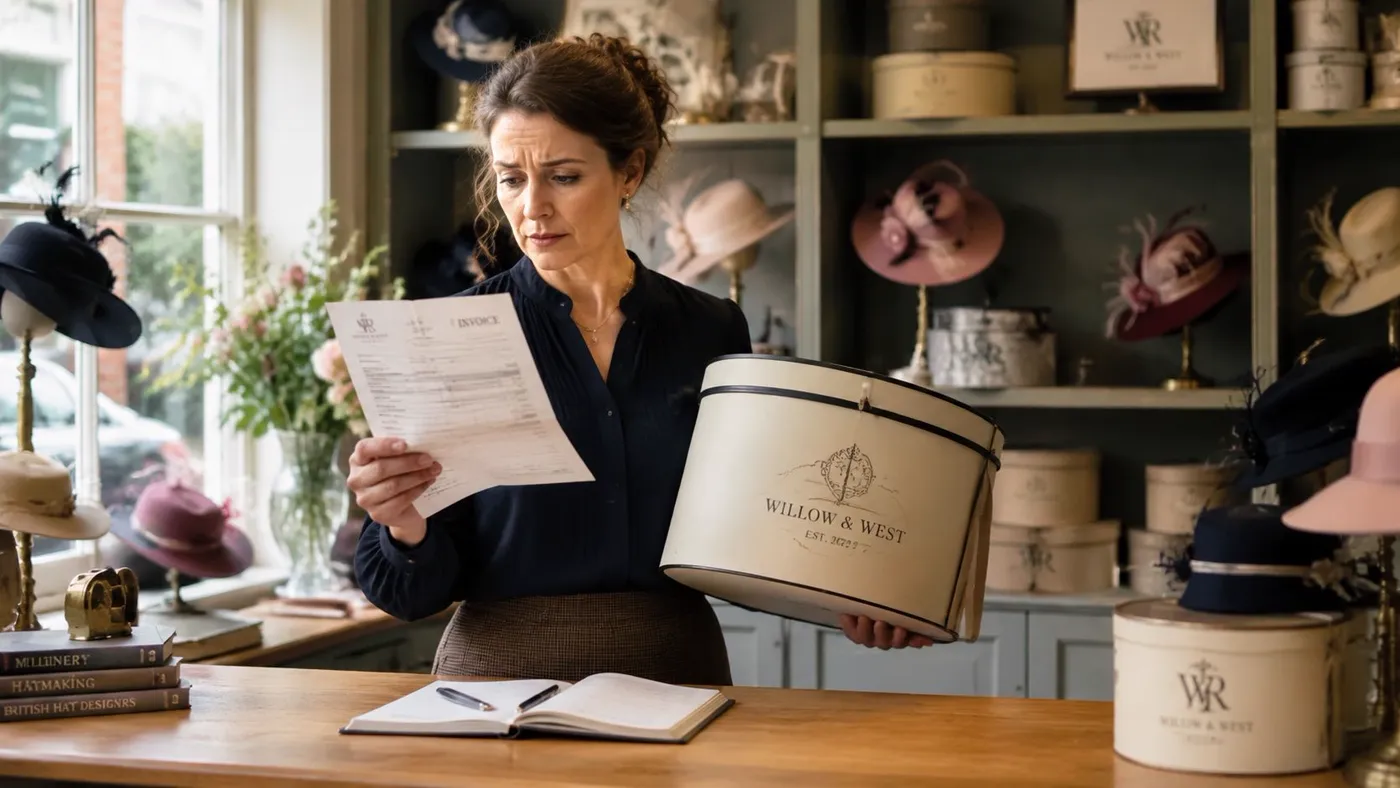
Hat boxes have always carried more meaning than plain utility packaging. Historically, they were prominent from the 18th century through the late 19th century, with their widest spread in the 19th century, when they became essential for aristocratic Grand Tours and evolved from practical storage into objects that displayed taste and refinement, according to the Loison Museum history of hat boxes. That heritage still shapes buyer expectations now. A hat box isn't judged only as protection. It's judged as part of the product.
Brand value sits in the details
For UK businesses, that means bulk buying has to serve three jobs at once:
- Protect margin by lowering repeat unit costs and avoiding expensive one-off reorders.
- Protect perception because a flimsy or poorly sized hat box undermines a premium product quickly.
- Protect operations by making storage, picking, and dispatch easier for staff.
Victorian demand for day and evening hats helped establish the hat box as a core item for storage, travel, and cleaning, and by the 19th century it had become a standard part of fashion use, as noted in the hat box background summary on Wikipedia. That practical role still matters in modern retail. If a box is awkward to stack, wastes space, or arrives scuffed, the business absorbs the cost.
A good bulk order reduces cost in more than one place. It cuts the purchase price, reduces admin time, and lowers the chance of rushed replacement orders.
Many retailers also miss a simple point. The cheapest order isn't always the most economical order. Businesses that buy too little pay more per unit and more in freight over time. Businesses that buy too much tie up cash and warehouse space in stock that may sit for months.
That's why the smartest starting point isn't “What's the lowest price?”. It's “What order structure fits the sales pattern, storage footprint, and brand standard?”. Businesses looking at wider presentation options can also compare broader retail ideas in this guide to creative retail uses for hat boxes.
Finding Your Magic Number How to Calculate Bulk Savings
Bulk savings only become real when the full cost is measured. Unit price matters, but it's only one part of the decision. Freight, storage, reorder frequency, and packaging waste all shape the true number.
The cost to track first
A practical calculation should include:
- Box purchase cost for the quantity being quoted.
- Inbound delivery cost from supplier to site.
- Storage cost if the order uses paid warehouse space or creates picking inefficiency.
- Admin cost from repeat ordering, receiving, and booking in.
- Risk cost if buying too lean causes urgent top-up orders at worse rates.
Businesses that want tighter forecasting before placing larger packaging orders should also review methods used to solve eCommerce inventory challenges, especially when seasonality affects demand.
A box also has to fit the product correctly. Ordering the wrong diameter or depth wipes out any saving because the stock becomes hard to use. Before comparing quotes, it helps to review a straightforward guide on how to measure boxes.
A simple way to compare order sizes
The quickest way to compare quotes is to turn everything into a true landed unit cost.
Working formula:
True cost per unit = (box cost + inbound delivery + storage cost + ordering/admin cost) ÷ total usable boxes
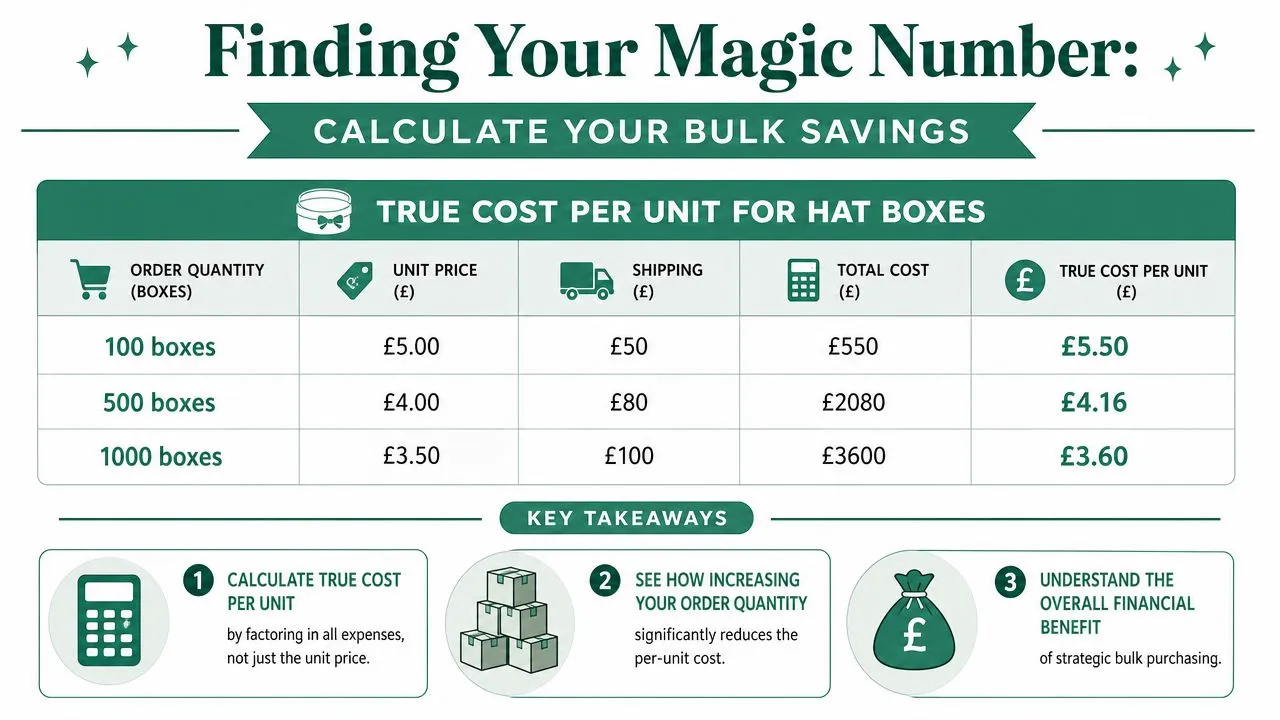
Using the figures shown in the visual above, a simple comparison looks like this:
| Order quantity | Unit price | Shipping | Total cost | True cost per unit |
|---|---|---|---|---|
| 100 boxes | £5.00 | £50 | £550 | £5.50 |
| 500 boxes | £4.00 | £80 | £2080 | £4.16 |
| 1000 boxes | £3.50 | £100 | £3600 | £3.60 |
Those figures illustrate the method rather than a market-wide benchmark. The lesson is what matters. Once shipping is spread across more units, and once the unit price drops, bulk buying usually becomes more attractive fast.
For businesses comparing standard catalogue options, Wholesale Hat Boxes are available in a wide range of colours, sizes and finishes, with round storage boxes for retail, gifting and display, plus free delivery over £150. That free-delivery threshold matters when working out the actual break-even point.
Where bulk orders go wrong
The common mistake is focusing on price breaks without checking stock velocity. A business that sells steadily year-round can usually hold more packaging with confidence. A business tied to wedding season, race season, or Christmas gifting needs more caution.
Watch for these pressure points:
- Slow-moving stock: Custom colours or niche sizes may sit too long and become dead packaging.
- Space loss: Hat boxes are bulky by nature. Excess stock can displace revenue-generating inventory.
- Design drift: Branding changes can leave old packaging behind.
- Panic reorders: Ordering too conservatively often leads to rushed buys in smaller quantities.
A sensible target sits between those extremes. The best quantity is usually the one that earns a better unit rate, clears a useful delivery threshold, and still turns over in a reasonable time without squeezing warehouse operations.
Smart Ordering and Negotiation Tactics for UK Businesses
Many UK businesses still treat packaging procurement as a simple quote comparison. That leaves money on the table. The stronger approach is to treat the supplier relationship as part of operations, not just purchasing.
A supplier that understands dispatch cycles, seasonal spikes, and storage constraints can often offer a better ordering structure than a lower headline quote from a less flexible vendor. That matters with hat boxes because they take space, often need presentation quality, and can become awkward to replenish at short notice.
Treat suppliers like operating partners
The best negotiations start before price is discussed. Buyers who share useful information usually get better options back. That includes expected annual volume, whether the box is for retail display or courier dispatch, and whether the business can accept phased deliveries.
Two commercial arrangements are often more useful than chasing another small reduction on unit price:
- Call-off ordering: Secure a larger volume price, then take delivery in smaller batches. That helps when storage is tight.
- Mixed-SKU consolidation: Group hat boxes with other regularly used packaging so the supplier sees the wider account value.
Commercial rule: Ask for terms that improve cash flow and stock control, not just a lower line on the quote.
This is particularly relevant for businesses moving from ad hoc ordering into repeat supply. A warehouse team usually benefits more from predictable replenishment and stable specifications than from switching suppliers every few months for minor savings.
What to negotiate besides price
A better buying conversation covers the full transaction. Useful asks include:
- Credit terms: Moving from pro-forma payment to a credit account can ease pressure during peak trading periods.
- Delivery pattern: Smaller scheduled drops can reduce storage strain and internal handling.
- Pack configuration: Supplier pack sizes should match realistic usage, not create awkward part-pallet leftovers.
- Board and finish choices: Some finishes add cost without adding enough perceived value for the customer.
- Damage replacement process: Clarify what happens if stock arrives marked, crushed, or inconsistent.
Another overlooked point is product compatibility. If hat boxes are being dispatched directly to customers, the outer transit packaging and void fill should be discussed at the same time. Saving money on the presentation box only to overspend on protective secondary packaging isn't smart buying.
A practical negotiation checklist looks like this:
- Lead with forecast, not haggling: Suppliers respond better when they can see likely repeat demand.
- Offer flexibility where possible: If delivery dates or exact colour shades are flexible, the supplier may have more room to help.
- Ask about standard tooling: Bespoke shapes and prints cost more. Standard dimensions with selective branding often land in a better value zone.
- Bundle requirements: If the same supplier can cover mailers, tapes, or cartons, the combined spend may secure better terms.
- Request sample approval: A sample can stop expensive mistakes on board feel, size, and finish.
- Confirm reorder consistency: Repeat runs should match the original specification closely enough for branded presentation.
Not every supplier will move on every point. Some won't offer staged delivery. Others will resist account terms for newer businesses. But a structured conversation nearly always produces a better commercial outcome than asking one question about unit price and stopping there.
For many businesses, the key advantage isn't getting the cheapest box. It's building a supply arrangement that supports margin, dispatch rhythm, and predictable quality.
Beyond the Box Using Supplier Features to Your Advantage
A lot of packaging spend is wasted in small operational leaks. Someone places two separate orders in the same week. Another buyer forgets to reorder a repeat line and pays for urgent replenishment. Finance spends time matching invoices because the ordering process isn't consistent. Supplier features can fix more of that than most businesses realise.

Use delivery thresholds deliberately
A published delivery threshold isn't just a nice extra. It can become part of the purchasing plan. If free delivery starts at £150, the business should look at what else can be sensibly consolidated into the same order rather than placing isolated top-ups below that line.
That doesn't mean adding stock nobody needs. It means grouping predictable packaging requirements so freight doesn't keep landing on smaller transactions. A retailer that regularly buys hat boxes, tissue, tape, or mailing materials should review those purchases together, not one at a time.
This also helps avoid poor buying behaviour:
- Split orders that each carry delivery cost
- Emergency purchases made without checking existing account options
- Department-level ordering where marketing, fulfilment, and retail each buy packaging separately
Turn account tools into cost controls
The best supplier portals save more than time. They reduce errors, protect reordering accuracy, and help teams buy consistently. Features such as saved addresses, repeat-order functions, live tracking, and credit-account access can make packaging purchasing much less reactive.
A practical operating routine often looks like this:
| Supplier feature | Business use | Cost-saving effect |
|---|---|---|
| Saved order history | Repeat the right specification | Fewer ordering mistakes |
| Saved delivery addresses | Route stock to shop, warehouse, or 3PL correctly | Less admin and fewer delivery errors |
| Live order tracking | Plan goods-in and replenishment | Fewer urgent backup purchases |
| Next-day cut-off awareness | Order before dispatch windows close | Better stock control |
| Credit account access | Align payment timing with sales cycle | Improved cash-flow handling |
Teams that use supplier tools properly usually run leaner stock because they trust the replenishment process.
For UK operations, a published next-day delivery cut-off like 2pm can be useful if it's tied to real internal discipline. That only works if the business checks packaging stock before it becomes critical. Waiting until the last dispatch bench is nearly empty turns next-day service into a rescue tool, and rescue tools are rarely the cheapest way to operate.
The stronger habit is simple. Review stock weekly, consolidate where possible, and use account features to reduce manual re-entry and avoid avoidable freight. That's where supplier functionality turns into margin protection.
The Business Case for Bespoke Hat Box Runs
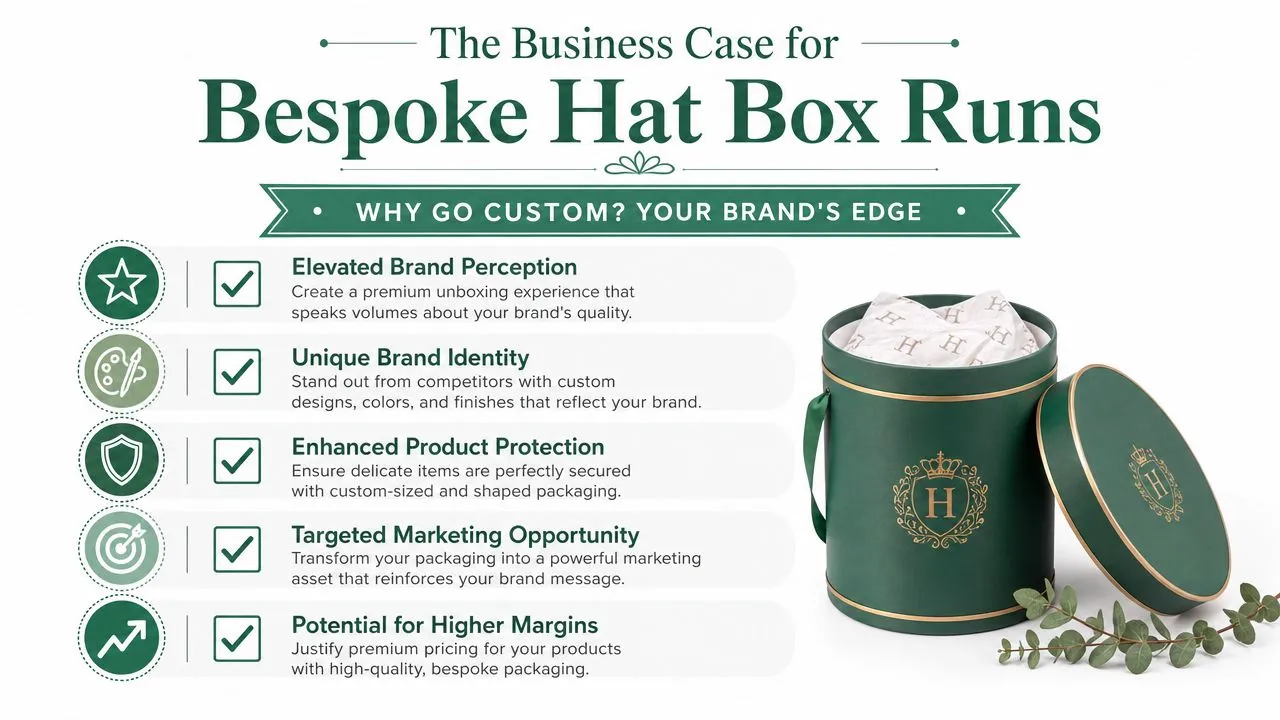
Standard stock works well for many businesses. Bespoke runs become attractive when sizing, branding, or product protection starts affecting sales and returns. The decision shouldn't be emotional. It should be commercial.
When bespoke makes commercial sense
A custom run usually earns its place when at least one of these is true:
- The product shape doesn't sit securely in standard sizes.
- The box itself plays a visible role in gifting or retail display.
- Repeated transit issues point to a structural mismatch.
- The brand needs more consistency across product lines.
For UK businesses using made-to-order packaging, minimum runs often start from 500 units according to the Packaging Panda service snapshot provided in the publisher brief. That threshold matters because bespoke only works when the order quantity matches real turnover and the business has enough confidence in design direction.
Supplier performance matters too. UK bespoke hat box manufacturers achieve a 96.4% on-time delivery success rate for custom orders of 500 units or fewer when using high-quality display flute with premium finish, but they also face a 17.8% rejection rate caused by design issues such as insufficient edge crush protection for rolled goods, according to Bespoke British Boxes guidance. The lesson is straightforward. Bespoke packaging can work very well, but weak specifications erase the value quickly.
Businesses exploring custom branding often benefit from seeing how presentation and print choices are handled in adjacent formats such as custom printed gift boxes.
The UK trade-off between luxury feel and recyclability
Many premium brands face a predicament. They want a luxury finish, but they also need to respond to recyclability expectations and paper-led packaging changes in the UK market.
That tension is becoming more important. The luxury boxes market is projected to reach USD 9.01 billion by 2034 with a 2.94% CAGR, driven by eco-friendly demand, while the UK paper packaging market is expanding at a 4.62% CAGR through 2031 and the Plastic Packaging Tax is set to rise to £223.69 per tonne in April 2025, according to Precedence Research on luxury boxes. For hat brands, the practical question is how to create a premium feel without falling back on plastic liners or difficult-to-recycle rigid formats.
That usually points to cleaner material choices:
- Mono-material design where possible
- FSC-certified paperboard where the brand specification allows
- Plant-based coatings instead of plastic-heavy finishes
- Structural upgrades that create quality through build, not through mixed materials
A premium box doesn't have to rely on excess. Good board feel, accurate sizing, neat print registration, and clean assembly often create a more convincing result than decorative add-ons that complicate recycling.
Structural details that protect margins
Presentation gets attention first, but structure decides whether the box survives the courier network. In UK corrugated manufacturing, the FEFCO GMP standard requires acid-free, high-quality display flute materials for hat boxes, and heavy-duty board grades at 1.2mm thickness or more have a documented 98.7% transit damage reduction success rate in courier networks, according to FEFCO technical standards and guidelines.
The same source identifies two design traps that come up repeatedly:
| Structural issue | Business impact | Better specification |
|---|---|---|
| Inadequate brim clearance | 23% higher deformation rates | Align brim width to 3 to 5mm clearance margins |
| Non-stackable design | Causes 31% of warehouse handling errors | Engineer for stable stacking in dispatch and storage |
Those aren't minor technicalities. A hat box that grips the brim too tightly can deform the product. A box that doesn't stack well creates handling mistakes before the parcel even leaves the building.
There's another useful data point from the UK market. According to Bespoke British Boxes, 68% of UK e-commerce retailers report reduced return rates when using acid-free, stackable hat boxes, and 42% of independent bakeries report lower product damage when using premium display flute materials in courier networks, using the same source linked earlier. That reinforces a practical truth. Better engineering doesn't only protect the product. It protects margin through fewer complaints, fewer replacements, and less repacking work.
For businesses under pressure to reduce material usage, caution is needed. Flexible packaging dominates 54.9% of the UK market, and paper substrates in flexible formats account for 54.40% with 60 to 70% material savings, but these formats offer poor edge protection for rigid goods like hats, according to Fortune Business Insights on the UK packaging market. Lightweighting can be sensible. Under-engineering usually isn't.
Your Strategic Packaging Plan Starts Now
The strongest hat box buying decisions don't start with aesthetics alone and they don't start with price alone. They start with the full commercial picture: unit economics, storage reality, dispatch conditions, and brand expectations.
A practical review of current packaging spend should check five things:
- Measure the actual cost per box: Include freight, admin, and storage, not only the quoted unit rate.
- Order to turnover, not guesswork: Bulk buying works when stock moves in a sensible timeframe.
- Negotiate the wider deal: Credit terms, delivery structure, and repeat consistency often matter as much as price.
- Use supplier systems properly: Reorder tools, account history, and delivery thresholds reduce avoidable costs.
- Go bespoke for a reason: Custom runs should improve fit, protection, or brand presentation enough to justify the extra planning.
The businesses that control packaging costs well usually make fewer emergency decisions.
There's also value in borrowing ideas from adjacent sectors. Brands reviewing presentation-led dispatch can compare notes with custom apparel packaging strategies, especially where branding and repeat customer experience carry more weight than simple transit utility.
Hat boxes have a long history as storage and presentation pieces, but for a modern UK business they're also a financial tool. Ordered well, they support margin, improve operational rhythm, and strengthen the customer's impression at the point of delivery. Ordered badly, they lock up cash, create handling issues, and turn packaging into a recurring source of friction.
A CTA for Packaging Panda.