
Desiccant Packaging: The Complete UK Buyer's Guide

If a fulfilment team has ever opened a returned carton on a damp Monday and found condensation marks, swollen inserts or a cosmetics mailer that no longer feels fit for resale, the problem usually started earlier than the parcel manifest. It started with a packaging decision that treated moisture control as an afterthought instead of a system choice.
Desiccant packaging sits at the centre of that decision. For UK shippers, wholesalers and contract packers, the key question isn't whether a sachet can absorb moisture. The question is which desiccant type fits the product, how much is needed, where it should sit in the pack, how it's handled in the warehouse, and whether the whole pack should be redesigned so less material is needed in the first place.
That matters even more in a wet market. The UK Met Office reported the UK experienced its wettest winter on record in 2023/24, and the Environment Agency said England had its third wettest February on record in 2024. Those conditions don't stay outside the building, they show up as condensation in storage, during loading, and in courier dwell time.
A useful place to start is with the wider storage picture. Businesses that need to hold seasonal stock, export cartons or overflow pallets can use low-cost storage for business goods as part of a controlled dispatch setup, but storage alone won't fix moisture-sensitive packaging. The pack itself still has to manage the air inside it.
Table of Contents
- Why Desiccant Packaging Matters for UK Shippers
- What Desiccant Packaging Does
- Common Desiccant Types and Formats Explained
- How to Size and Select the Right Desiccant
- When Desiccant Is the Wrong Answer
- UK Ambient Conditions and Humidity Risk in Transit
- Handling, Storage, Testing and Disposal
- Practical Use Cases and a UK Buying Checklist
Why Desiccant Packaging Matters for UK Shippers
A UK fulfilment manager does not need a chemistry lecture. They need a clear answer on why printed stationery, electronic accessories and bakery inserts come back looking tired after a cold, damp week, and what to change before the next dispatch cycle.
The problem usually sits in the package system, not just the packet. Moisture gets in through permeable films, imperfect seals, open headspace and repeated temperature changes. Once it is inside, a desiccant can help, but only if the rest of the pack gives it a fair chance to work.
The timing matters too. The UK saw its wettest winter on record in 2023/24, according to the UK Met Office, and England had one of its wettest Februaries on record in 2024, according to the Environment Agency and Met Office reporting. That sort of ambient load changes what happens inside cartons, film wraps and export packs the moment a pallet leaves a dry store and hits courier handling.
The five buying decisions that matter
Most buyers end up making the same five calls, whether they write them down or not. They decide which desiccant type to use, which format fits the line, how much to put in, how to handle and store it, and whether the pack should change so the desiccant load can be reduced under sustainability pressure.
Practical rule: if the outer pack leaks or breathes too freely, a better sachet will not rescue it on its own.
That matters under UK extended producer responsibility pressure too. Extra components now need a clearer justification, especially for brands trying to cut waste and simplify disposal. In many cases, the more expensive mistake is not buying a sachet, it is adding one to a pack that should have been redesigned.
The cost of getting this wrong shows up in returns, customer complaints and product rejection at pack-out. In bakery lines, inserts can pick up curl or print lift. In electronics accessories, metal parts can show early corrosion. In pharma-adjacent fulfilment, the risk is more serious because moisture can affect quality, compliance and shelf life.
The buyer's job is to treat desiccant packaging as part of a moisture-control system. That system includes the carton, the liner, the seal, the headspace and the route through the warehouse and courier network. It also includes fallback decisions for overflow stock, which is why some teams use low-cost storage for business goods when they need to keep packaged inventory dry before dispatch. Once that wider system is clear, the desiccant choice becomes easier to justify and easier to defend.
What Desiccant Packaging Does
Desiccant packaging is simple in concept. A sorbent material sits inside a sealed pack, pulls water vapour out of the air space, and holds it before that moisture can settle on the product. In practice, that helps prevent corrosion, caking, mould and print lift, the faults buyers usually spot first.
A desiccant does not dry the warehouse or fix a poor seal. It controls the air inside the closed pack, where the product is exposed to a limited moisture load. That distinction matters on UK lines, where ambient humidity, courier handling and storage delays can turn a sound pack into a weak one if the closure, liner or headspace design is off.
A long-established packaging method, not a trend
The history here is unusually clear. Walter A. Patrick patented a synthetic silica-gel process in 1919 and the material was later used in World War I gas-mask canisters and World War II to protect penicillin, military equipment and pharmaceutical supplies from moisture. A dedicated 1950 U.S. patent titled “Desiccant packaging” formalised its packaging-specific role, which is why the method is best understood as a mature protective system, not a marketing add-on. The term desiccant itself entered English in the 17th century, which shows how long moisture-control thinking has been part of technical language. The historical thread is documented in the source on desiccants from EDCO Supply and in Colorcon's overview of desiccants.
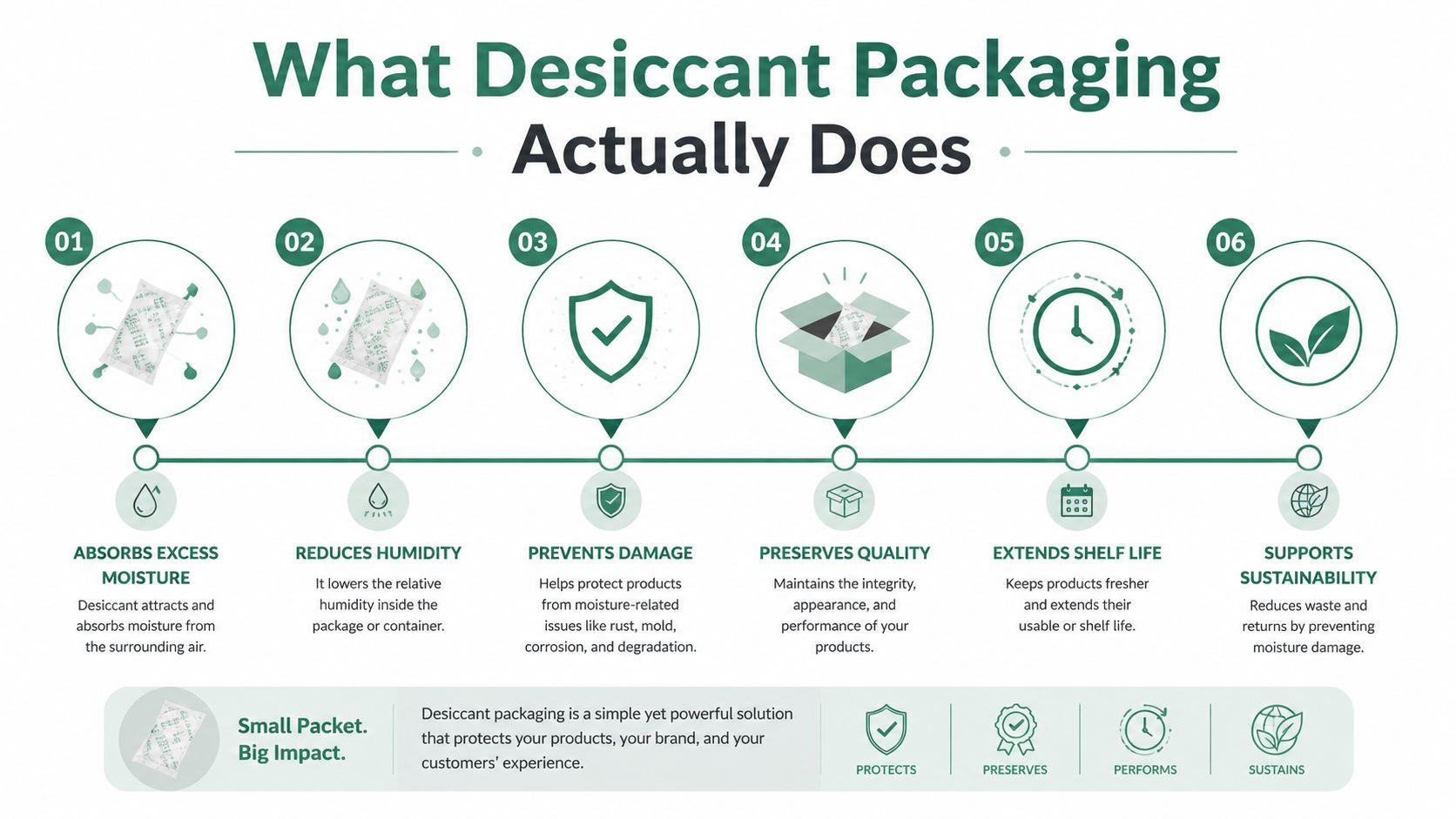
The best mental model is straightforward. The packet reduces humidity in the headspace, the sealed pack keeps outside air from rushing back in, and the product stays in a more stable microclimate. If any one of those three fails, the result is usually disappointing.
In export work, I treat the desiccant as part of the pack system, not a rescue item. A sachet can help a bakery inner, a pharma accessory tray or an electronics carton, but only if the carton, liner and sealing process are doing their share. If the route is damp or the storage window is messy, I also look at the broader moisture strategy, including whether to compare charcoal purifying bags online for adjacent storage spaces and which pack formats can be simplified. For silica gel use cases, a practical guide from Packaging Panda gives a useful reference point.
A desiccant is a control tool, not a cure-all. It works inside the enclosure it was sized for, and only while the enclosure remains sound.
That is why serious buyers do not ask whether desiccant packaging works in the abstract. They ask whether it works in their carton, on their route, with their seal quality and storage conditions.
Common Desiccant Types and Formats Explained
A desiccant choice that works in a warehouse dry run can still fail in a courier lane. The material, the format and the pack architecture have to line up, especially for UK ambient conditions, export cartons and any route that sees repeated handling before the box reaches the end user.
The word desiccant covers more than one material, and the format matters as much as the chemistry. A silica gel sachet, a molecular sieve canister and a calcium chloride strip are not interchangeable, because they are built for different moisture loads, headspace volumes and contact rules.
Materials and where they fit
Silica gel is the usual general-purpose choice for sealed cartons, consumer packs and many electronics accessories. It gives steady performance in normal ambient conditions and it is easy to place into existing pack formats. For a practical commercial reference on uses and pack fit, Packaging Panda's silica gel guidance is worth checking. Molecular sieve is the specialist option for very low humidity targets, so it appears in diagnostics and tightly controlled technical packs. Activated clay is often used where buyers want a lower-cost moisture barrier in temperate lanes. Calcium chloride suits high humidity export conditions and long-haul sea freight, where the moisture load is heavier and more continuous.
The format should match the pack architecture. Sachets suit cartons and pouches. Canisters work well when the product needs a rigid desiccant body. Strip packs fit humid export routes because they sit neatly in narrow spaces and are easy to position. Desiccant cards and bottle closures fit electronics, vitamins and diagnostics where placement and cleanliness matter. Barrier films do not absorb moisture themselves, but they can reduce how hard the desiccant has to work by lowering ingress.
The pharmaceutical sector gives a good clue to how embedded this is. Colorcon notes that desiccants are widely used in pharmaceutical packaging as part of quality and safety processes, which tells buyers these formats are engineered for different pack conditions, not chosen at random.
A scientific overview of desiccants makes one rule clear. Desiccant packs should not sit in direct contact with the product, especially where the product needs a moisture balance of its own.
For chilled and cold-chain work, Chilled Packaging is a relevant adjacent option because it covers insulated boxes, liners and gel packs for food and pharma cold chain use. That is not a substitute for desiccants, but it shows how moisture and temperature control often sit in the same buying conversation.
A few buyers also compare odour-control products when they are assessing warehouse freshness, so it can be useful to compare charcoal purifying bags online alongside desiccant options when the brief includes air quality as well as moisture.
| Format | Typical use | Best for UK buyers |
|---|---|---|
| Silica gel sachet | General carton moisture control | E-commerce, stationery, cosmetics, light electronics |
| Molecular sieve canister | Very low humidity protection | Diagnostics, precision parts, regulated packs |
| Activated clay sachet | Lower-cost general protection | High-volume temperate dispatches |
| Calcium chloride strip pack | High humidity and long transit | Export cartons, sea freight, condensation-prone lanes |
| Desiccant card | Flat packs with limited space | Electronics accessories, vitamins, retail inserts |
| Bottle closure | Moisture-sensitive sealed containers | Tablets, capsules and small technical containers |
| Barrier film | Reduces ingress rather than adsorbing moisture | Buyers trying to lower desiccant load |
The commercial packaging note from Packaging Panda is useful here because it reinforces a basic point. The format should fit the product and the pack, not the other way round.
How to Size and Select the Right Desiccant
Sizing is where many buying teams get vague, then over-order. The cleaner method is to work from DIN 55473 units, where 1 unit is the amount of desiccant that adsorbs at least 6 g of water vapour at 23°C and 40% RH. That gives the buyer a reference point instead of relying on guesswork or a competitor's sachet count.
Start with the enclosure, not the packet
The three inputs that matter are the pack's interior surface area, the expected moisture ingress from the outer packaging, and the target dwell time in storage or transit. A small mailer with tight barrier film behaves very differently from a larger carton with more headspace and a looser seal.
A simple way to think about it is this. A printed stationery mailer with low ingress may only need a modest unit count. A 12-cup cake box carrying bakery inserts needs more care because product finish and paper quality can suffer quickly if condensation builds during courier dwell. A medium carton of electronics accessories sits somewhere in between, but its risk rises if metal parts or coated surfaces are present.
Sizing rule: if the outer pack is more permeable, treat the desiccant as a support measure, not the primary barrier.
Technical datasheets also matter when the pack is going to get knocked about. High-performance silica-gel strip desiccants can be specified to absorb ≥19.0% at 25°C/40% RH and ≥27.0% at 25°C/80% RH, while surviving 15 free-fall drops from 1.2 m without rupturing or leaking adsorbent. Those figures, from WiseSorbent's technical data sheet, matter because UK courier hubs are hard on packs. A desiccant that performs in humidity but tears on the conveyor is a bad purchase.
What a sensible first trial looks like
The first trial should test the full pack, not just the sachet in isolation. That means checking whether the carton seals well, whether the desiccant stays clear of the product, and whether the result holds after real handling, not just bench storage. If the pack fails after a route through the warehouse and carrier network, the problem is probably enclosure design, not packet chemistry.
The point of sizing isn't to find the biggest packet possible. It's to match a known moisture load with the smallest reliable unit count, then prove it under the actual route the product will travel.
When Desiccant Is the Wrong Answer
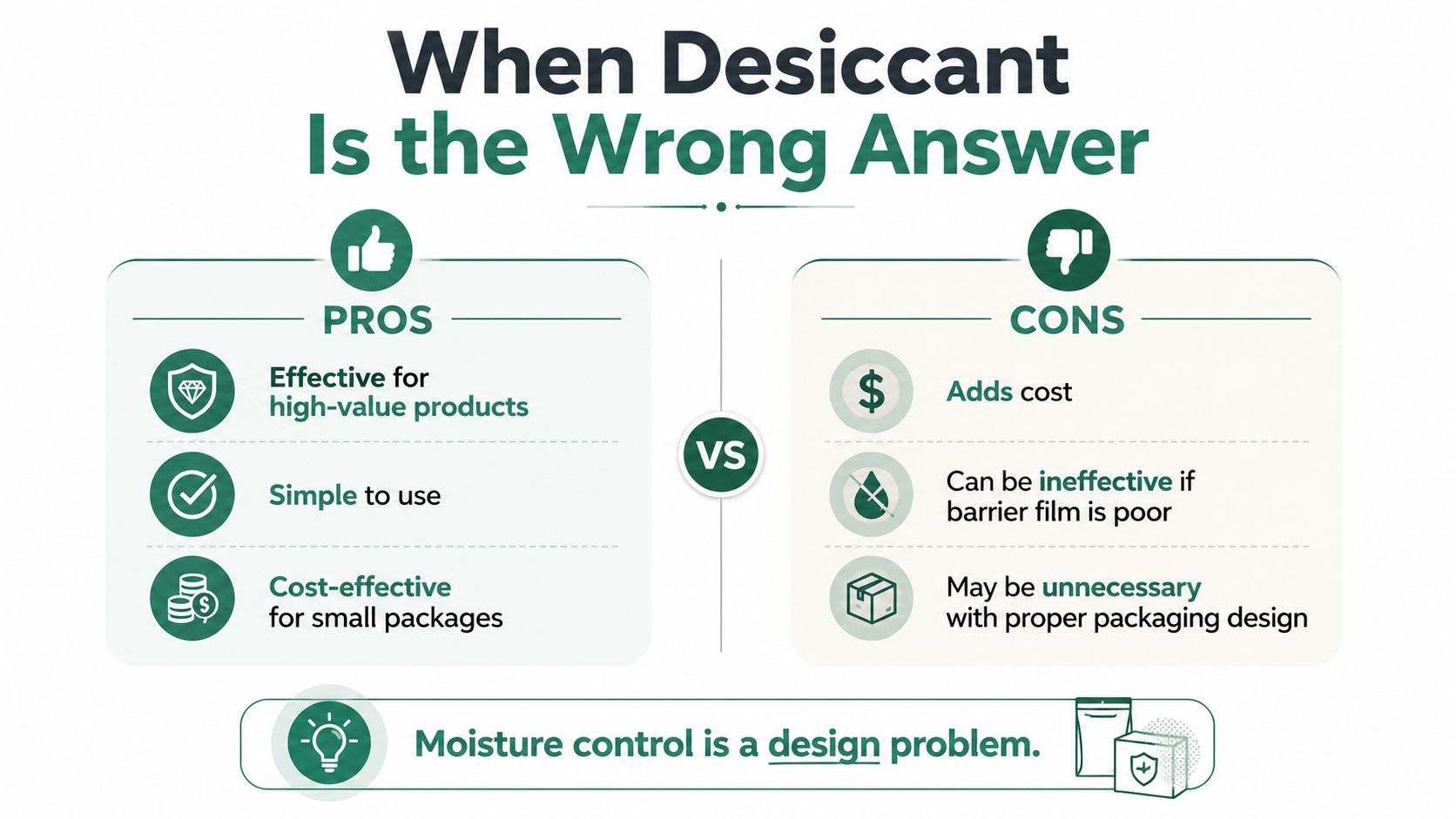
A lot of packaging teams reach for a sachet because it feels safer than changing a pack design. That instinct can be wrong. Moisture control is often a design problem, which means barrier films, permeability, seal quality and headspace geometry can matter more than adding another packet.
Where redesign beats insertion
A paper-based compostable mailer usually needs a different approach from a plastic flow-wrap. The paper system may benefit more from a stronger seal or a better liner than from a desiccant that has to fight a leaky pack. Bakery items are similar. Chocolate and inserts often respond better to faster chill-to-pack transitions and tighter thermal control than to a bigger sachet, because the moisture problem begins before the carton is even closed.
Very small headspaces and very large headspaces also expose the limits of off-the-shelf unit counts. In a tiny pack, the desiccant can be too bulky for the usable air space. In a large, loose pack, the sachet may be too small to offset ingress across the whole dwell period.
Recent packaging guidance is pushing this way for a reason. UK brands are under growing pressure from extended producer responsibility implementation to justify extra components and reduce material use where they can. That changes the buying conversation. The question becomes whether the sachet is the right control, or whether the pack should be made tighter, denser or less permeable instead.
If the pack can be redesigned to need less desiccant, that usually beats treating the sachet as a permanent fix.
The product categories that most often trigger the wrong reflex are the ones buyers know best. Paper goods, cosmetics, bakery inserts and some accessories need a careful look at the pack system before anyone orders a larger moisture absorber. If the route includes a lot of warehouse dwell, the better investment may be in a different film, a different seal or a different pack geometry.
The practical rule is blunt. Add desiccant when the enclosure is already doing its job and only needs help managing residual moisture. Redesign the enclosure when the pack itself is the reason the problem exists.
UK Ambient Conditions and Humidity Risk in Transit
A winter route in the UK can be enough to expose a weak pack spec. Damp yards, cold trailers, warm vans and short warehouse stops create a humidity cycle that a neat lab sample never sees, so the desiccant decision has to be made at system level, not as a last-minute sachet add-on.
Cold-to-warm movement is the part that catches buyers out. A carton pulled from a chilly store into a heated vehicle can sweat on the inside surface, and that moisture can sit against the wall, migrate into the headspace or settle into the product wrap before anyone notices a fault.
The point is simple. Wholesale buyers need to judge the route as carefully as the SKU. A pack that works in a dry dispatch bay may still fail once it has sat on a wet pallet, been handled by a courier and then spent time in a van with repeated temperature swings. That is why specification should follow the actual transit profile, including warehouse dwell, loading order and the handoff between storage and delivery.
Where the risk shows up first
The first problems are usually visible in the products that react quickly to damp air. Paper goods can curl or show print issues. Electronics accessories pick up corrosion risk. Cosmetics may suffer label lift or pack instability. Bakery inserts are especially sensitive because presentation matters, and any waviness or dulling is seen straight away.
Printed packaging can make that trade-off obvious. The Printano maritime print range shows how much value sits in a clean outer finish, and a moisture-control spec should protect that finish rather than fight it after the fact.
The Packaging Panda sustainable packaging guide is also a useful reminder that moisture control is part of a wider material decision. If a buyer can reduce unnecessary pack mass, improve seal quality or cut waste elsewhere, the desiccant requirement may change as well.
A generic room-temperature assumption is where a lot of buying decisions go wrong. A desiccant that looks fine on paper can be under-specified once the pack has been staged in a damp warehouse and moved through a winter route. UK ambient conditions do not just raise risk, they reduce the margin for error.
UK buyers should treat winter transit as harsher than a room-temperature label suggests. If the pack is vulnerable, the moisture-control choice should be based on the route, the dwell time and the warehouse-to-van transition, not only on the product category.
Handling, Storage, Testing and Disposal
The operational mistakes are usually boring and expensive. Someone opens a carton of desiccants too early, leaves the bag unsealed, or sends a pack line running with sachets exposed to ambient air before the shift is ready. After that, the test results are meaningless.
A desiccant safety sheet says there's no health hazard associated with packaged desiccant, but the pack still needs sensible handling. The packs should stay in their sealed polybag until required, the bag should be opened only to remove what's needed, and it should be resealed as soon as possible. That same discipline supports the pharmaceutical rule that desiccant and product shouldn't touch directly, with sealed packaging used to keep them separate, as noted in the earlier technical guidance.
Three UK use cases, three practical habits
In e-commerce, the easiest win is FIFO stock rotation and clear batch tracking at despatch. Pickers should not open desiccant cartons on the line unless the station is ready to use them immediately.
In bakery inserts, the critical habit is to keep packs away from warm prep zones and to avoid leaving open sleeves near ovens or dish areas. The product may be dry, but the ambient air around it isn't.
In pharma-adjacent fulfilment, the bar is higher. Indicator cards or humidity chamber validation may be used to verify the pack performs as expected, especially where documentation matters. The packaging copy from Packaging Panda's sustainable packaging guidance is relevant here because sustainability and control both need to be documented, not assumed.
Disposal should be matched to the pack type. Silica gel is commonly landfill-safe, while paper-based and compostable formats may fit a different waste stream if the supplier documentation supports it. Recyclable or compostable claims need checking before they're written into customer-facing instructions.
Warehouse rule: never store loose sachets in open trays. The outer bag is part of the product's performance.
For buyers, the takeaway is simple. A well-chosen desiccant can still fail if warehouse discipline is sloppy, and a modest product can perform well if the storage, opening and disposal routine is tight.
Practical Use Cases and a UK Buying Checklist
Three familiar buying scenarios cover most UK decisions. The first is an e-commerce seller shipping printed stationery and cosmetics in mailers. A sensible starting point is a silica gel sachet matched to the mailer size, then a first-run check for seal quality and any sign of print smudging or curl after courier transit.
The second is an independent bakery packing cake boxes for collection. A strip pack or compact sachet can be a starting point, but the verification step matters more than the format. The pack should be checked after a real wait in the collection area and after cold-to-warm movement, because that's when condensation risk shows up.
The third is a 3PL handling pharmaceutical-adjacent or electronics accessories that need documented moisture control. A molecular sieve canister or a better-specified silica gel solution may be appropriate, depending on the humidity target and enclosure. The first verification should be a controlled test run with humidity monitoring and batch traceability.
The buying checklist below is the one that tends to hold up in supplier quotes:
- Match the format: choose sachet, strip, card, canister or closure based on the product and the line.
- Check the DIN unit count: start from the enclosure, not from a competitor's pack count.
- Confirm seal integrity: if the outer pack leaks, the desiccant is working too hard.
- Review storage and FIFO discipline: open only what the line needs and reseal immediately.
- Verify recyclability or compostability claims: don't assume the outer pack and the desiccant share the same waste route.
- Check supplier credentials: UK stock position, next-day cut-off, free-delivery threshold and volume breaks all affect landed cost.
- Run one trial before full commitment: test the finished pack through the warehouse and courier route first.
The useful internal link here is Packaging Panda's ecommerce packaging solutions, because moisture control rarely sits alone. It usually sits next to mailer choice, box fit and dispatch speed.
A buyer who follows that checklist won't just buy a sachet. They'll buy a packaging decision that can survive UK weather, warehouse handling and customer scrutiny.
Packaging Panda supplies UK businesses with packaging that sits around moisture-sensitive products, from mailers and cartons through to protective and chilled options. If desiccant packaging is part of a wider pack review, visit Packaging Panda to compare formats, check supply options and build a moisture-control setup that fits the actual route your products travel.