
Ecommerce Packaging Solutions for UK Sellers
Getting ecommerce packaging right means turning a simple purchase into a parcel that survives the courier and delights the customer. Think of a parcel like a small moving box: the outer shell takes the knocks, the inner wrap keeps things organised, and the unboxing moment dictates whether the buyer remembers your brand for the right reasons.
Table of Contents
- What Ecommerce Packaging Solutions Include
- The Commercial Context for UK Sellers
- Sustainability and the Plastic Packaging Tax
- Core Packaging Categories at a Glance
- Main Packaging Formats And What They Do Best
- Sustainable Choices and the UK Policy Backdrop
- Right-Sizing, Branding, and Bespoke Options
- Logistics, Carrier Rules, and Cost Control
- Evaluating Suppliers and Rolling Out a New Range
- Frequently Asked Questions
What Ecommerce Packaging Solutions Include
Ecommerce packaging solutions cover every layer, from the courier-facing exterior down to the item-facing inner wrap. For UK sellers, this typically means:
- Outer cartons and shipping boxes designed in multiple board grades to match weight and handling needs.
- Mailers and padded envelopes in paper or poly for soft goods and apparel that need low weight and quick sealing.
- Void fill such as paper crinkle, honeycomb pads, or recycled bubble alternatives to stop movement and absorb knocks.
- Protective inserts and moulded supports to cradle fragile items and reduce returns.
- Tubes for posters and rolled goods engineered to resist edge crush and retain shape.
- Tamper-evident bags and security seals for high-value or regulated items.
- Labels, address sleeves, postage-friendly designs and barcode placement to speed scanning in carrier networks.
- Sealing tapes, strapping and dispatch accessories that meet courier handling requirements.
- Branded or bespoke print across boxes, mailers and tubes to create a repeatable unboxing experience.
- Right-sizing options from standard stock to on‑demand systems that reduce wasted space.
The Commercial Context for UK Sellers
For British sellers, the commercial context matters. Online retail accounts for a massive share of sales, so packaging has shifted from a back-office cost to a proper sales lever. It directly affects returns, delivery costs and brand perception. For example, moving from oversized boxes to compact mailers can reduce dimensional weight charges and lower filler spend overnight.
Sustainability and the Plastic Packaging Tax
Sustainability choices are also central to modern ecommerce packaging solutions. Recyclable corrugated board, compostable mailers and paper-based void fill are common alternatives to single‑use plastic. The UK Plastic Packaging Tax sets a clear incentive: £223.69 per tonne (2025/26 rate) is charged on plastic packaging containing less than 30% recycled plastic. Choosing recycled-content or non-plastic options can cut tax exposure and cost — Read the full guidance about the Plastic Packaging Tax.
Packaging is both protection and presentation — the right material protects profit margins and shapes customer loyalty.
Core Packaging Categories at a Glance
With so many options available, it helps to break down the core categories. Here is a quick-reference table summarising the main packaging formats UK sellers use, what each one is best for, and the typical products it suits.
| Format | Best For | Typical Products |
|---|---|---|
| Cardboard Boxes | Heavy or fragile items | Electronics, bulk orders |
| Padded Mailers | Lightweight clothing | Apparel, soft accessories |
| Cardboard Tubes | Rolled goods | Posters, prints, textiles |
While these three formats cover the basics, the right choice ultimately depends on your product mix and courier requirements.
Up next, we will explore the main formats in detail and show practical selection rules for right‑sizing, branding and supplier choice.
Main Packaging Formats And What They Do Best
Think of each packaging format as a tool in a workshop — the right one protects the product, trims costs, and makes everything look the part. Here's a practical walk through the formats UK sellers reach for most often, and when each one earns its keep.
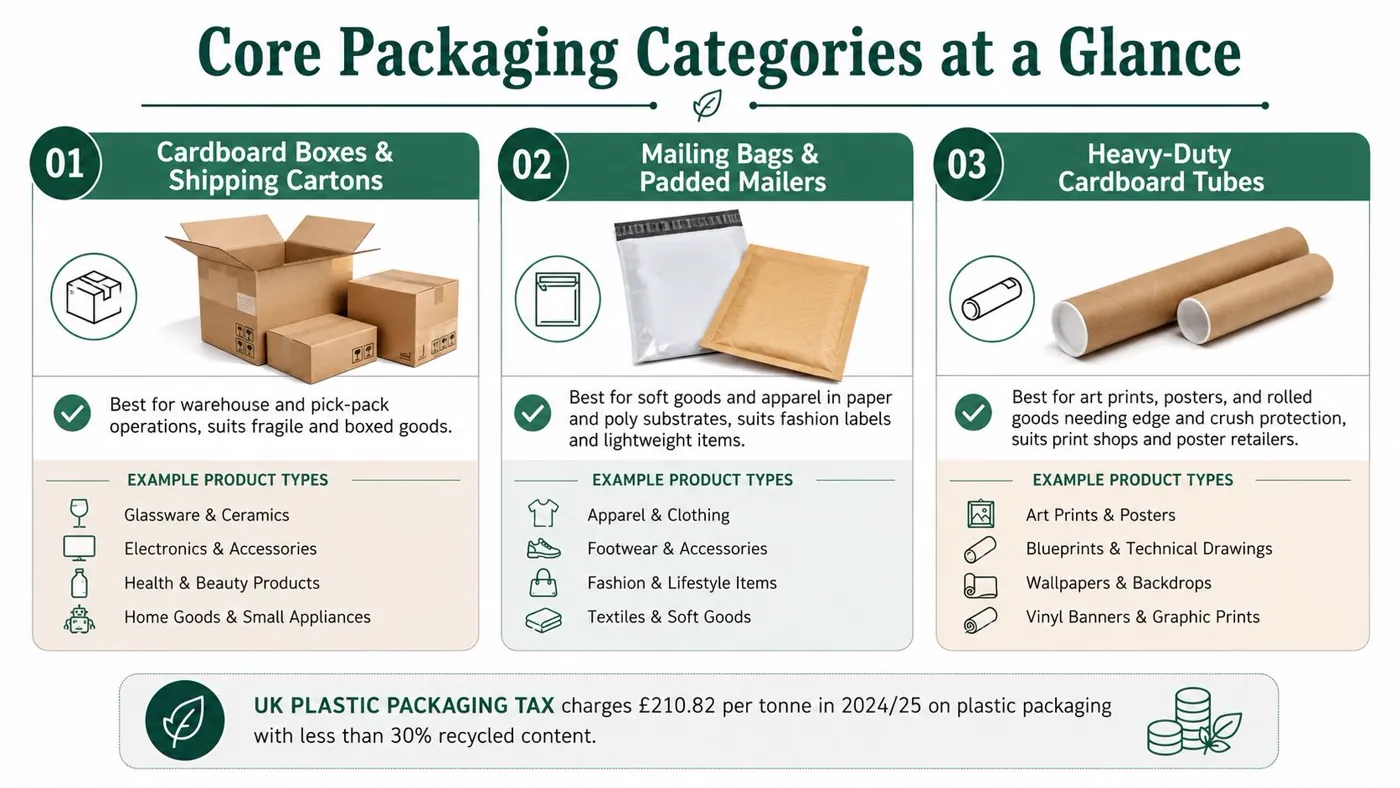
This infographic maps out the three workhorse formats and where they fit best, so you can match product to pack without second-guessing.
Cardboard Boxes And Shipping Cartons
Cardboard boxes are the default for anything heavy or breakable — and for good reason. They come in single, double and triple-wall grades, each built to handle different levels of stress. Electronics and multi-item orders, for instance, usually need double-wall corrugated to survive being stacked on a pallet and bounced around a courier network.
Practical notes worth knowing:
- Stock boxes work well for pick-and-pack operations where speed matters and keeping a handful of standard sizes simplifies inventory.
- Custom-cut boxes cut down on void fill and can reduce dimensional weight charges — but only once your volumes justify a minimum run.
- One small kitchenware brand we worked with switched from single to double-wall for fragile sets and saw breakage drop noticeably. Sometimes the fix is that straightforward.
Mailing Bags And Padded Mailers
Soft goods and lightweight items are where mailing bags come into their own. They come in paper and poly substrates, and the choice usually comes down to presentation versus cost. Fashion labels tend to lean toward paper mailers — they feel better in the hand and are easier for customers to recycle at the kerb.
- Padded mailers lined with kraft paper give you genuine shock absorption without the plastic guilt.
- Poly mailers stay lighter and cheaper, but factor in the UK Plastic Packaging Tax if recycled content falls below 30%.
- A boutique clothing brand we supply switched to paper padded mailers and ended up using less filler while customers perceived the brand as more premium. Win-win.
A few things to keep in mind:
- For apparel, lightweight padded mailers help you dodge volumetric penalties — every gram counts when carriers price by size.
- If you want to dig deeper into the options, this guide on choosing the right padded mailer covers the details.
- Tear strips and resealable closures make returns less of a headache for everyone involved.
Heavy-Duty Cardboard Tubes
Rolled goods — posters, blueprints, textiles — belong in tubes. They offer far better edge-crush resistance than flat-packed boxes for long, narrow items, which is exactly why print shops and poster retailers specify internal diameters and heavier wall grades. Get it wrong and you'll see bent corners showing up in customer photos.
- Tubes are surprisingly cost-effective for single long items and can slash return rates for prints.
- One print studio we supply ordered 50 mm wall tubes specifically to ship 24" posters across the UK without a single damage complaint.
Protective Options
No outer pack works alone. Bubble-lined envelopes, paper-padded mailers and honeycomb pads all serve the same purpose — stopping things moving around inside. They're the difference between a product arriving intact and a returns request landing in your inbox.
Protective inserts work like a bicycle helmet for products — small upfront cost, big reduction in impact damage.
Tamper-Evident Security Bags
When the goods are high-value or the chain of custody matters, tamper-evident bags are non-negotiable. Integral seals and serial numbering give you traceability where it counts — jewellery, medical samples, specialist electronics. If authentication is part of the purchase, this is the format that delivers it.
Cellophane Bags And Bakery Packaging
Retail presentation has its own rules. Cellophane gives you visibility, while bakery boxes and cake boards handle the hygiene and transport side. Independent bakeries rely on wedge boxes and windowed cake boxes to keep products looking their best on the shelf and surviving the journey to a customer's home.
Quick Selection Checklist
- Match product fragility to board grade and protective insert — don't over-pack, don't under-pack.
- Prioritise right-sizing to avoid dimensional weight surcharges that eat into margins.
- Choose substrate — paper or poly — based on presentation, cost and your exposure to packaging tax.
These formats are the core toolkit for any e-commerce packaging setup. Pick the right combination and you protect both the product and the profit margin.
Sustainable Choices and the UK Policy Backdrop
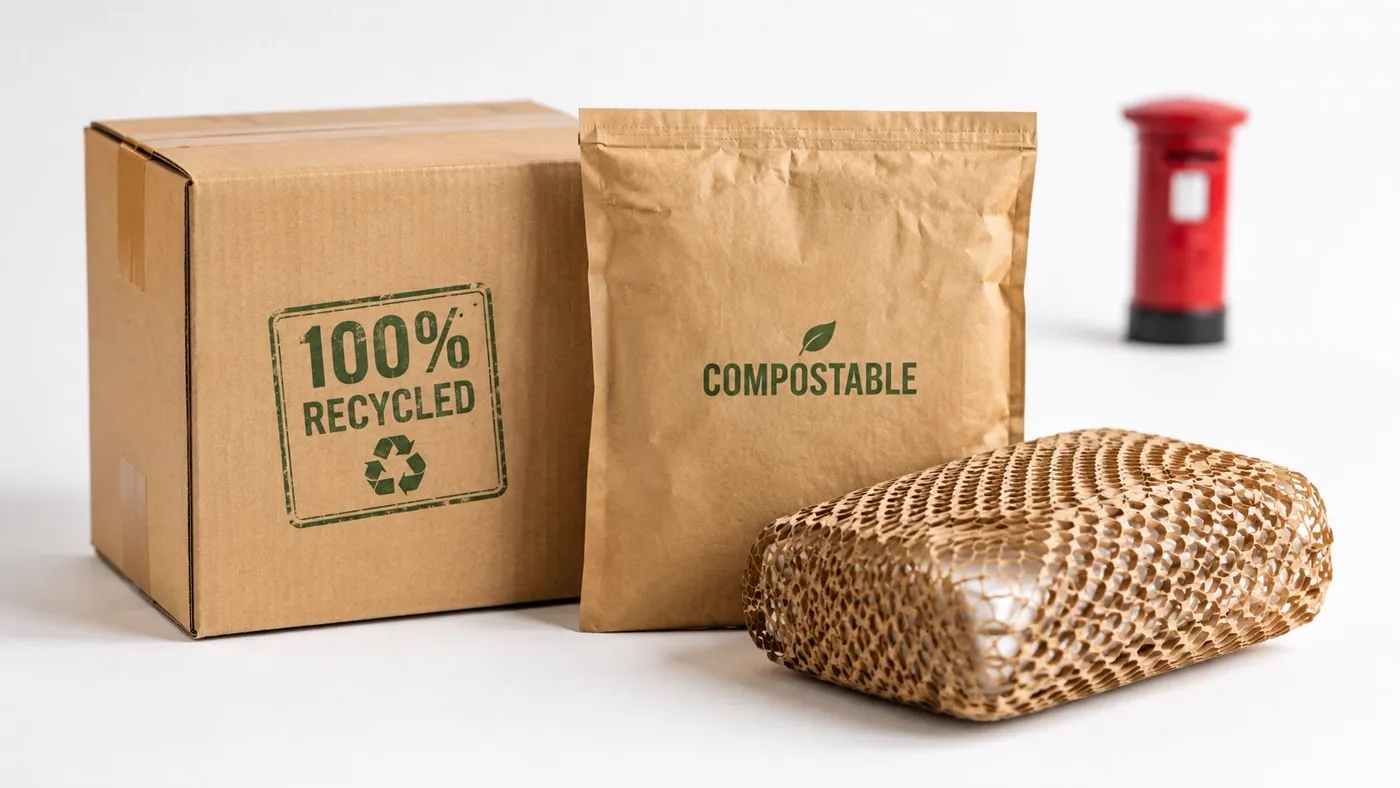
Choosing your packaging materials is a bit like picking fuel for a delivery van — tax rules, customer demand, and what infrastructure actually exists on the ground all change what makes sense for your business.
Recyclable corrugated cardboard occupies the same practical sweet spot that diesel did for decades: widely accepted, straightforward to recycle through household kerbside collections, and genuinely cost-effective across most parcel sizes.
That's why most sellers we work with default to cardboard boxes for mixed or fragile orders. The recycling infrastructure is already in place, customers know what to do with it after unboxing, and you avoid the support emails asking whether something goes in the recycling bin or the rubbish.
Compostable mailers function more like biofuel — attractive where local composting facilities exist, but largely ineffective if collection systems or customer behaviour don't support home or industrial composting. If your mailer ends up in general waste because the customer has no composting option, the environmental benefit disappears.
Paper-padded mailers sit in a useful middle ground. They offer genuine shock absorption using paper fibres that most UK councils accept through kerbside recycling. You reduce plastic exposure without raising damage rates — a swap we've seen work well for textiles, books, cosmetics, and similar products.
Sustainability is now a purchasing decision, not a marketing line. The material you choose affects your tax bill, which couriers handle your parcels smoothly, and whether customers feel good enough about your brand to return.
The Plastic Packaging Tax and What It Means in Practice
The UK Plastic Packaging Tax creates a direct financial incentive to move away from virgin plastic packaging. Here's how it plays out:
- It applies to plastic packaging containing less than 30% recycled content, which makes low-recycled poly mailers more expensive than they appear on a supplier price list.
- This alone has pushed many sellers towards paper substrates, recycled-content poly, or simply increasing the recycled percentage in their existing packaging to clear the threshold.
The alternatives that tend to work best across UK ecommerce operations:
- Recyclable cardboard boxes that reduce landfill risk and are easy to right-size to your actual product dimensions.
- Compostable mailers suitable for low-moisture, non-fragile goods — but only when composting infrastructure is genuinely accessible to your customer base.
- Paper-padded protective packaging, including honeycomb wrap and kraft padding, that absorb shock while keeping single-use plastic out of the chain.
Right-Sizing and Operational Choices
Right-sizing is where sustainability and cost savings meet on the same spreadsheet. It isn't glamorous, but it delivers measurable results.
Custom cartons and on-demand right-sized systems cut void fill significantly. That matters because carriers now charge by dimensional weight — you're paying to ship air as much as product. If your box is 40% empty space, that's money and material heading straight to waste.
For rolled goods like posters or textiles, heavy-duty cardboard tubes protect the edges while using far less material than an oversized box stuffed with bubble wrap. We've seen this single swap cut packaging waste by half for poster sellers.
Numbered steps to apply right-sizing in your operation:
- Audit your top 20 SKUs for typical dimensions and fragility. Get the tape measure out — spec sheets on supplier websites don't always reflect reality.
- Trial paper-padded mailers and one custom carton size for your highest-volume SKUs. Test with real orders, not just in the warehouse.
- Measure damage rates and courier charges over a 30-day window. If the numbers improve, scale the change. If they don't, adjust and try again.
Case Example and Practical Tip
A small UK poster retailer was shipping everything in two standard box sizes plus void fill — usually bubble wrap or foam peanuts. We switched them to a dedicated heavy-duty tube for rolled prints and a smaller flat mailer for flat-stock items.
The result was lower material use, fewer returns from damaged prints, and complete avoidance of Plastic Packaging Tax on the poly-lined mailers they'd been using. Their packaging cost per order dropped noticeably, and customers noticed the cleaner unboxing experience.
Read also: Learn more about sustainable packaging in our guide on What Is Sustainable Packaging
Practical Takeaway
- Match your material choice to what recycling and composting actually look like for your customers — not what it should look like in theory.
- Use right-sizing to reduce both your tax exposure and what carriers charge for volumetric weight.
- Prioritise paper-based protection wherever customer recycling is straightforward and well understood.
These aren't complicated changes, but they turn sustainability from a compliance cost into something that genuinely helps the bottom line for British ecommerce sellers.
Right-Sizing, Branding, and Bespoke Options

Right-sizing is a bit like having a suit made to measure. A close fit cuts out the wasted space, keeps everything tidy and reduces the bulk that carriers charge you for. Less void fill, lower dimensional weight fees and a sharper presentation when the parcel lands on the doorstep.
Custom cartons built around your product dimensions can trim volumetric weight and dodge those surcharges from couriers who bill by cubic size rather than actual weight. The maths is straightforward: smaller box means smaller bill.
When Right-Sizing Makes Commercial Sense
- High-volume SKUs where saved courier fees and reduced material use stack up quickly.
- Fragile or long items where a bespoke shape protects the edges and balances the weight.
- Products with consistent dimensions — think a poster roll, a standard book size or a folded apparel parcel.
Key insight: Right-sized packs often cut returns and materials spend at the same time, which means a better margin and a smaller environmental footprint.
Custom formats reduce damage because the internal support actually matches the product shape. Heavy-duty cardboard tubes for poster retailers are a solid example. Pick the right diameter, step up the wall grade and you get proper edge and crush protection with less cardboard than you'd use on an oversized box stuffed with void fill.
- Minimum bespoke runs usually start at 500 units, which is realistic for most small brands.
- Lead times for printed cartons or tubes are reasonable but move around — generally a few weeks depending on print complexity and the time of year.
- Weigh up print complexity against dispatch volume. Full-colour litho looks premium but costs noticeably more per unit than single-colour flexo when you're ordering in low volumes.
Practical Steps to Choose Bespoke or Standard
- Audit your top 20 SKUs for size and fragility to spot candidates for custom packs.
- Work out the courier savings from reduced dimensions using your typical carrier price bands.
- Request supplier proofs and order small pilot batches to test damage rates and gather customer feedback.
Think in modules: standard stock lines for low-volume, variable-sized items; bespoke formats for high-turnover SKUs that stay the same size.
Branding as the Unboxing Layer
Bespoke print turns a parcel into a brand moment. Branded boxes, mailers and tubes give a tactile first impression that can drive social shares and bring customers back.
- The outside panel, inner flaps and void-fill that doubles as a message card are the priority areas for branding.
- Keep it balanced. Clear identity, a single call to action and straightforward recycling instructions serve both your marketing and your sustainability goals.
"A simple printed message about recycling reduces post-purchase confusion and supports returns handling."
Cost versus Benefit Considerations
- Upfront print setup and minimum runs push up the unit cost at low quantities.
- Volume discounts and multi-pack tiers can drop the per-unit cost significantly once you hit 25+ packs or larger breaks.
- Factor in free delivery thresholds such as £150 — they cut freight overhead when you're planning reorder quantities.
Make the call on commercial grounds, not cosmetic ones. Invest in bespoke where the total landed cost — packaging plus courier and returns savings — genuinely improves the unit economics. Otherwise, standard stock sizes with sensible right-sizing and modest branding will almost always be the more pragmatic choice.
Logistics, Carrier Rules, and Cost Control
Carriers charge based on actual weight and volumetric weight, which means a lightweight but bulky parcel often costs more to send than a small, heavy box. Your packaging choices feed directly into shipping economics and your bottom line. Right-sized mailers, for instance, frequently dodge the dimensional threshold that triggers those annoying surcharges.
Heavy-duty tubes for rolled prints and compact padded mailers keep parcels within standard weight bands. This matters most when carriers apply dimensional multipliers that convert size into chargeable weight. Getting the sizing right becomes a direct way to control costs.
Courier rules also bring operational constraints that dictate how you pack. Hit the drop-off cut-off, and you secure next-day delivery windows. Miss it, and urgent replenishment suddenly becomes a costly express shipment. Aligning your dispatch slots with carrier schedules cuts down on premium fees and keeps customers happy.
Practical Controls to Reduce Freight Spend
- Audit your highest-volume SKUs to spot candidates for right-sized packs.
- Shift long, narrow items into tubes to slash void fill and bypass bulky boxes.
- Opt for compact padded mailers for soft goods to minimise volumetric penalties.
Key takeaway: Packaging becomes a measurable profit lever the moment you take control of size and timing.
- Bulk price breaks on 25+ packs drive down unit costs, particularly for stock mailers and tubes.
- Free delivery thresholds like £150 wipe out freight overheads for repeat and bulk buyers.
- Transparent volume pricing allows you to forecast per-order costs accurately at scale.
Swapping oversized stock boxes for right-sized mailers typically cuts your filler spend and eliminates the surcharge triggered by exceeding a carrier dimensional limit. It is a real-world shift that moves packaging from a back-office chore to a genuine commercial decision.
Timing, Replenishment and Warehouse Slots
- Map courier cut-offs against your peak picking windows.
- Hold safety stock for disruptive weeks like Black Friday.
- Use next-day delivery for critical replenishment, but factor those costs into your reorder calculations.
Take a small UK brand that re-specified its standard box down to a tighter mailer. They saved on material costs and dodged regular dimensional surcharges, which boosted their margin per order.
Comparisons and Cost Calculations
| Change | Typical Effect | Why It Helps |
|---|---|---|
| Oversized box → right-sized mailer | Lower volumetric charge | Less air shipped |
| Flat pack → tube for posters | Reduced material + fewer returns | Better edge protection |
| Order consolidation tool | Fewer parcels per order | Lower per-shipment handling fees |
Tracking the final leg of the journey is crucial for keeping customers satisfied without blowing the delivery budget. You can read about last mile tracking for container operators for practical ideas on aligning delivery promises with actual costs.
Implementation Steps
- Work out the volumetric weight for your top SKUs. Our guide explains the calculation mechanics in detail: How to Calculate Volumetric Weight.
- Pilot right-sized mailers and tubes over a 30-day window, recording courier charges and damage rates as you go.
- Negotiate volume tiers and free delivery thresholds with suppliers to lock in predictable unit economics.
Minor operational tweaks—smaller boxes, timed orders, and clear volume discounts—transform packaging into a routine source of savings rather than a surprise cost.
Evaluating Suppliers and Rolling Out a New Range
Choosing a UK packaging supplier should feel like hiring a dependable teammate, not buying a mystery box. Start by checking their operational transparency. Can you find a registered UK company number? Are their VAT details published? Do they have a documented environmental policy that actually backs up your sustainability claims?
Once you're past the basics, look at lead times and delivery rules. Do they offer next-day delivery for orders placed before 2pm? Is there a free delivery threshold—say, £150—that brings your freight overheads down? And if you sell cross-border, can they handle European shipping without a fuss?
Account features matter more than you might think, especially for busy fulfilment teams. Look for credit accounts, saved delivery addresses, live order tracking, and clear online order histories. These small details cut down on admin and make emergency reorders genuinely straightforward.
Quick supplier signals — look for published volume tiers, bespoke minimums, and clear returns or damage policies.
Supplier Checklist
- Registered UK company and VAT details — gives you legal certainty and makes invoicing painless.
- Published environmental policy — look for actual evidence of recycled content and proper waste handling.
- Lead times and cut‑offs — next-day dispatch before 2pm, with bespoke lead times clearly documented.
- Free delivery threshold (around £150) and European shipping options.
- Handy account features like credit terms, saved addresses, and live tracking.
Pricing and volume expectations need careful planning. Push for volume discount tiers up to 25+ packs, and get clarity on bespoke minimums—usually starting from 500 units for printed cartons or tubes. Always ask for unit pricing at multiple breaks so you can properly model your reorder economics.
First Order Planning
- Calculate your daily dispatch needs and add a bit of safety stock for peak weeks.
- Place an initial order covering typical week-on-week dispatch, plus a 2–3 week safety buffer.
- Trial one or two bespoke lines alongside standard stock sizes to compare costs and damage rates.
Test and measure rather than assume — review damage and returns data after the first month to see if the new packs reduce breakages and courier surcharges.
Rollout Steps
- Audit your current pack sizes and map your top SKUs to candidate formats.
- Run a pilot trial and gather courier and returns data for a full 30 days.
- Negotiate volume tiers and agree a reorder cadence based on actual usage.
Following these steps keeps supplier evaluation pragmatic and makes the whole rollout measurable for UK ecommerce businesses.
Frequently Asked Questions
What does ecommerce packaging actually include — and why does each bit matter for UK sellers?
Think of it as a system rather than a single product. You've got outer cartons, mailers, protective inserts, void fill, labels and sealing materials all working together. Get the combination right and you're looking at fewer damaged parcels, lower return rates and courier charges that don't quietly eat into your margins. It's the difference between a box that survives a Royal Mail sorting office and one that doesn't.
How do I balance sustainability with actually protecting what's inside?
For heavier stock, recyclable corrugated boxes do the job without the guilt. For softer items — clothing, textiles, that sort of thing — paper-padded mailers give you genuine protection while cutting out plastic entirely. The other trick most people miss is right-sizing. A box that fits properly means less void fill, less material going to waste, and lower volumetric charges from carriers. Your environmental gains and your cost savings end up pulling in the same direction.
When does bespoke packaging actually make financial sense?
Honestly? When you've got high-volume, consistent SKUs where the maths works out. Lower dimensional weight and fewer returns need to justify the minimum runs — and that tipping point usually sits around 500 units. For smaller product lines, you're often better off picking well-chosen stock sizes and adding modest branding. It performs better commercially without tying up your cash in custom tooling.
What should I check before switching suppliers?
A few things matter more than the price per unit. Check their lead times and next-day cut-offs — most reliable suppliers process orders before 2pm. Look at free delivery thresholds (around £150 is standard), whether they publish their VAT and company registration details, and whether volume pricing tiers go up to 25+ packs. And if you're making sustainability claims, ask for their documented environmental policy. You need to back up what you're telling customers.
Any quick steps to test changes without committing everything at once?
Start small. Audit your top SKUs for size and fragility first — you might be surprised how many are over-packed. Then pilot right-sized mailers or a single bespoke line for 30 days. Track courier charges, damage rates and what customers actually say. Once you've got real numbers, scale what works and ditch what doesn't.
Small packaging changes often yield measurable savings and fewer returns — treat them as experiments, not guesses.
For practical supplies and UK delivery terms, visit Packaging Panda at https://www.packagingpanda.co.uk


