
Business Address Verification: A Guide for UK Sellers

Business address verification sits at the point where margin, service quality, and fraud control all collide. When a delivery fails because the postcode is wrong, the flat number is missing, or the trading name doesn't match the building, the problem rarely stays with the courier. Loqate cites the Fixing Failed Deliveries report, which found that 19% of failed deliveries are caused by inaccurate delivery address details, and that the average annual total failed-delivery cost to businesses is $216,171 Loqate's address verification briefing.
For UK packaging, fulfilment, and wholesale teams, that cost shows up in redelivery charges, support tickets, refund handling, and stock that boomerangs back into the warehouse. The operational fix is not glamorous, but it is effective, valid addresses captured once, checked properly, and reused consistently. A useful comparison point for downstream delivery hygiene is the practical guidance in Packaging Panda's next-day delivery guidance, where dispatch speed only works when the underlying address data is clean.
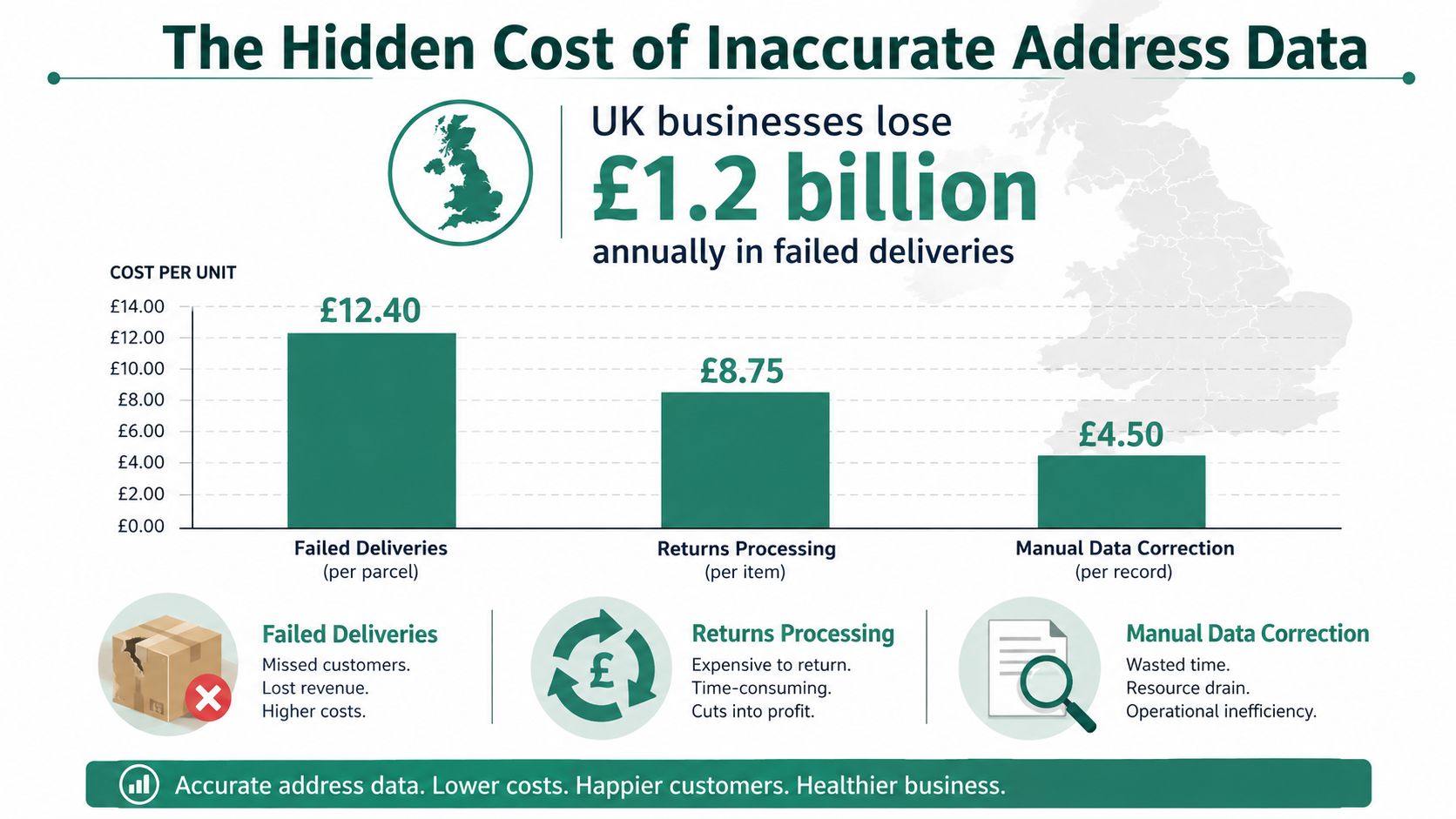
The right comparison isn't “manual checks versus automation”, it's “cheap data capture versus expensive failure”. A bad address is often created at checkout, onboarding, or account setup, then multiplied by fulfilment, customer service, and returns processing. That's why address verification belongs in the same category as stock control and pick accuracy, it protects margin before the parcel even leaves the building.
Table of Contents
- The Hidden Cost of Inaccurate Address Data
- Registered Office vs Trading Address
- Core Verification Methods for UK Businesses
- Documentary Proof and Platform Requirements
- Implementation Checklist for Fulfilment Teams
- Impact on Parcel Routing and Sustainability
- Strategic Risk Matrix and Final Takeaways
The Hidden Cost of Inaccurate Address Data
Bad address data doesn't fail politely. It produces a chain reaction, the parcel misses first-time delivery, the customer contacts support, the warehouse retries the label, and the operation pays twice for the same movement. Loqate frames address verification as validating and standardising customer addresses against authoritative postal databases, which is exactly what keeps that chain reaction from starting Loqate.
Why the cost lands on operations
For UK e-commerce retailers, wholesalers, and logistics operators, the loss is rarely one line item. It's the combined hit of rework, wasted labour, courier exceptions, and the time spent reconciling disputes over a postcode or building name. In dense UK cities and mixed-use premises, a simple typo or missing unit number can turn a good order into a failed-service case.
The reporting line also matters. Failed deliveries often get blamed on the courier, yet the root cause is usually upstream data capture. Once the address has entered the system incorrectly, every subsequent team inherits the mistake, from fulfilment to finance.
Practical rule: if the address can't be trusted at intake, it can't be trusted anywhere else in the order flow.
Address verification becomes a control rather than a clean-up task. Businesses that ship physical goods need a checked, standardised address record before packing starts, not after the parcel comes back. That same discipline is useful when onboarding suppliers or B2B buyers, because the shipping address and the legal identity of the counterparty aren't always the same thing.
Packaging and dispatch teams already understand the cost of a missorted box or a torn carton. The same logic applies to address fields. If the destination is wrong, the most carefully packed order still travels to the wrong place.
What good capture prevents
Good verification prevents the waste that follows a bad label. It also reduces the need for manual corrections, which are slow, inconsistent, and easy to overlook during peak dispatch periods. The operational outcome is simple, fewer exceptions, fewer redeliveries, and less margin leakage.
That's why the fastest gains usually come from the front end, not the back office. If checkout or onboarding can stop an incorrect record before it enters the warehouse system, the rest of the workflow stays cleaner. For businesses with recurring shipments, that discipline compounds across every order cycle.
The same mindset also helps moving-house customers, where address updates are often treated as an afterthought. A practical reference point is 2026 moving house steps, because the underlying lesson is the same, an outdated address creates avoidable friction.
Registered Office vs Trading Address
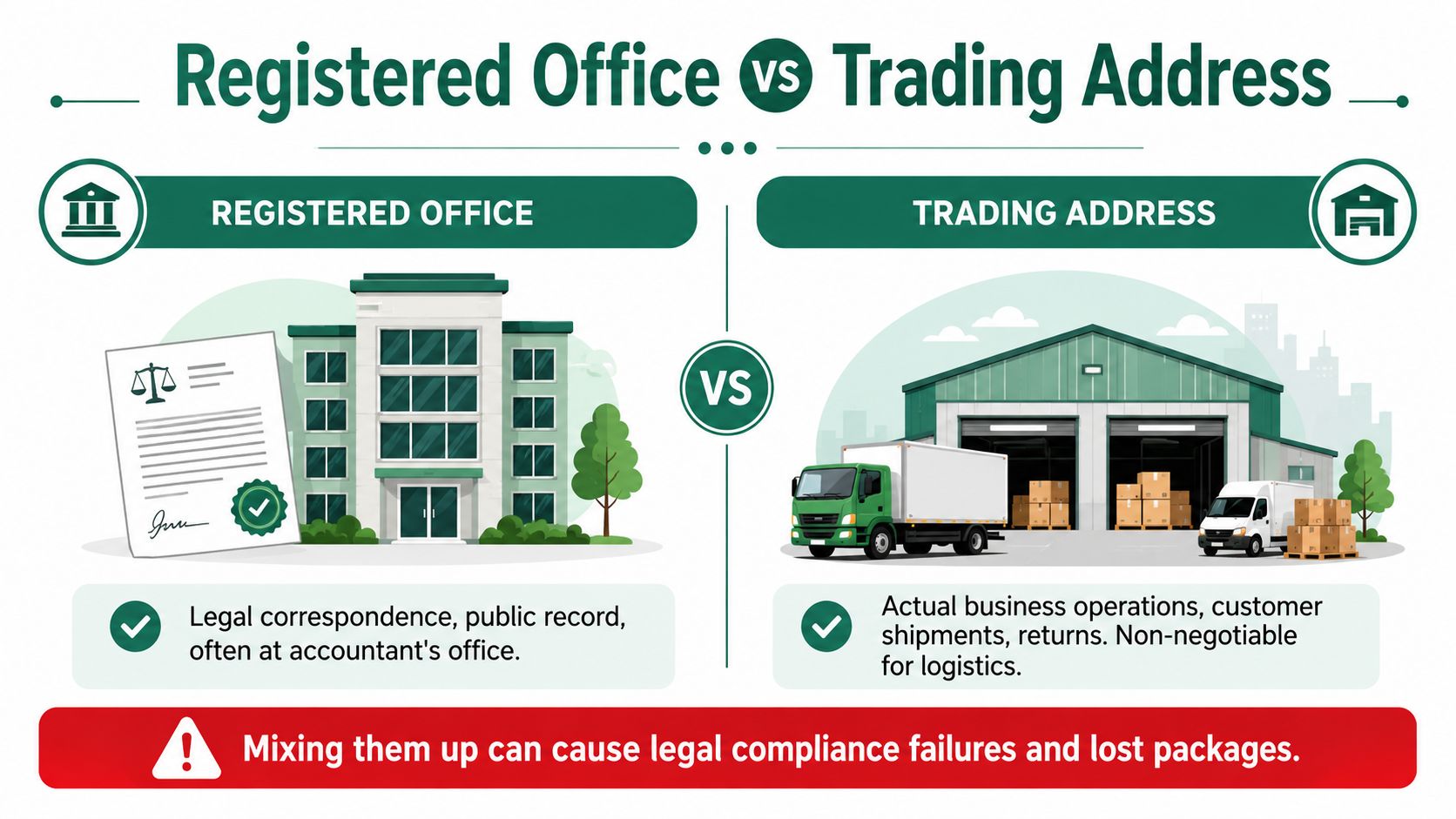
A registered office address tells the legal system where official correspondence goes. A trading address tells the business world where the operation happens. Those are not interchangeable, and treating them as the same thing creates false confidence in KYB checks.
Why the distinction matters in the UK
In the UK, a registered office can sit with an accountant, a formation agent, or a virtual office provider. That may be perfectly legitimate for statutory mail. It does not prove that a business is dispatching goods, receiving stock, or employing staff there. Enigma's guidance is clear that address verification should be type-specific and that an operating address needs independent evidence such as signage, licences, payment activity, employer records, or web presence at that location Enigma.
That matters for fulfilment risk. A shell arrangement can look tidy in a company record and still be useless as a delivery point. If a supplier's registered office is verified but the warehouse isn't, the account can pass a shallow check while the freight never lands where it should.
What to verify separately
For a UK wholesale or fulfilment workflow, the trading or dispatch address should be checked on its own. That usually means looking for two corroborating data points, not just a company filing address. The most useful evidence is practical, not decorative, something that shows the business is active at that location and can accept freight.
A registered office may satisfy the filing requirement. A trading address has to satisfy the driver, the courier, and the warehouse intake team.
A useful example is a security product line such as Tamper Evident Bags, where dispatch integrity matters and the receiving location needs to be real, reachable, and able to hold chain-of-custody records. The product category itself is straightforward, tamper evident bags, cash bags, coin bags and evidence bags, with tear-proof seals and tracking codes. That kind of shipment is exactly why a legal mailbox is not enough.
How to avoid false confidence
The safest approach is to treat the registered office as one layer and the operating site as another. A verified filing address can support compliance, but it shouldn't be used to prove fulfilment capability. When a business only has one of those two, the risk review should stay open until the second is documented.
For UK sellers dealing with mixed premises, the distinction is especially important because a warehouse, shopfront, and billing address can all be different. A clean record is only useful when each address type has been checked for the right purpose. If not, the verification result can look stronger than the actual operational reality.
Core Verification Methods for UK Businesses
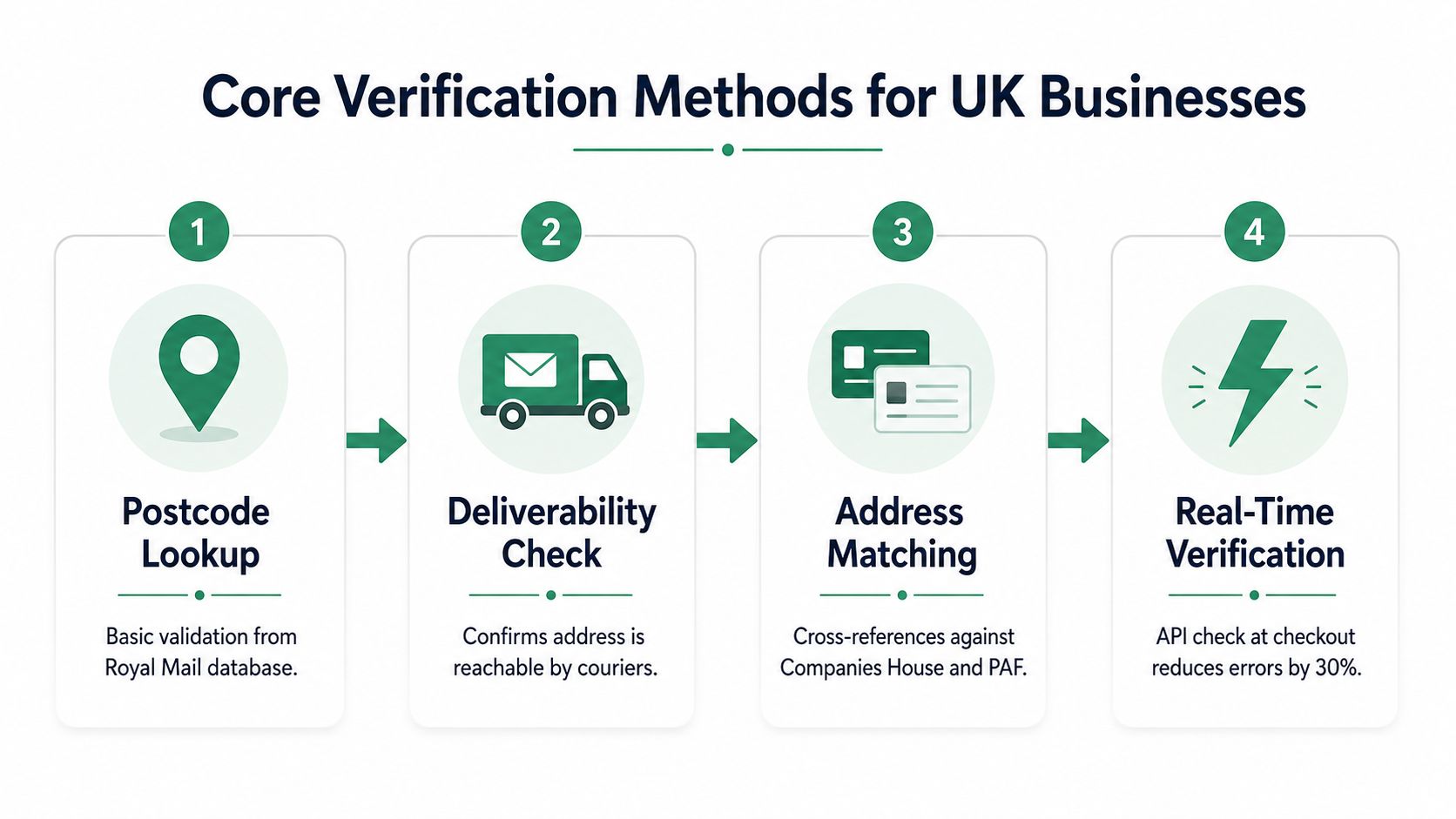
Good address verification rarely depends on a single tool. The most reliable workflows combine postal deliverability checks with registry matching, fuzzy normalisation, and ongoing monitoring, because real-world addresses are messy. Abbreviations, historic site names, and formatting differences all create false negatives if the system is too rigid.
Automated checks versus manual review
Automated verification is strongest at speed and consistency. It can standardise an address as it's entered, flag missing components, and compare the record against postal data and other sources before the order proceeds. Manual review still has a place for high-risk B2B accounts, unusual premises, or supplier onboarding where the address itself is a fraud signal.
The decision is not either-or. High-volume checkout traffic needs automation because people make typos in the moment. High-value trade accounts need extra scrutiny because a correct-looking postcode can still hide an unrelated or non-operational location.
What the more robust workflow looks like
Industry guidance for business-risk workflows recommends normalising the address, then geocoding it, then cross-referencing against corporate registry entries, property or tax records, and other timestamped sources, with fuzzy matching for abbreviations and historical addresses Loqate's address verification glossary. That combination is useful because it catches both formatting issues and suspicious drift. If an account's delivery behaviour changes, or the trading address starts moving, the record deserves another look.
Operational warning: address drift is rarely random. It often appears when a business relocates, uses a virtual office, or tries to mask where goods are really held.
Packaging and fulfilment teams should also compare the address against shipment behaviour. If parcels are consistently being rerouted, held, or returned, the issue may sit with the address record rather than the carrier network. That's why ongoing monitoring matters more than one-off validation at sign-up.
Where verification sits in the workflow
A practical setup starts with capture at entry, then validation before the order is accepted, then periodic re-checks for accounts that ship often or change status. That's especially useful for operators that handle stock movement, returns, or B2B dispatch, where one bad account can pollute multiple downstream systems.
For teams that need an internal control reference, Packaging Panda's chain-of-custody guidance aligns with the same principle, the integrity of a shipment depends on traceable, dependable records from the start. Address verification is part of that chain, even when the package itself is ordinary.
Documentary Proof and Platform Requirements
Platform rules make address verification hard to ignore. Amazon, Google Business Profile, Wise, and Paysend all expect documentary evidence, and none of them treat a typed-in address as enough on its own. For UK sellers, that means the record has to be not only valid, but also provable.
| Platform/Provider | Accepted Documents | Recency Requirement |
|---|---|---|
| Amazon | Bank statements, utility bills, rent or lease agreements, credit card statements, tax identity documents containing an address, business licences or business extracts | After updating the business address, proof must be uploaded and reviewed |
| Google Business Profile | Proof-of-address document uploaded through the account workflow | The address must be corrected or added, then saved for verification |
| Wise | Utility bills, bank statements, tax bills, insurance policies, licences | Utility bills and bank statements must be less than 3 months old. Other supporting documents must be less than 12 months old Wise |
| Paysend | Certificate of Incorporation, recent utility bill or bank statement, lease agreement, utility bill or local authority tax bill, business rates document | Recent documents must be dated within the last 3 months Paysend |
What the workflow looks like in practice
Amazon's seller verification flow is a good example because the seller must update the business address and then upload proof, the address is not verified automatically from company registration data alone Amazon seller verification. Google Business Profile uses a similar pattern. When the address is wrong, the user has to choose a different one or add a new one, upload proof, then save and continue so Google can verify it Google Business Profile help.
That means consistency matters across every document trail. If the invoice address, utility bill, and marketplace account all point to different places, the review process slows down or fails outright. The same issue appears in e-money onboarding, where current occupancy or use has to be linked back to the company name and location.
Why recency rules bite harder than people expect
The age of the document often matters as much as the document type. A business can have the right address and still fail verification if the evidence is stale. That's why teams should store a current proof pack for each trading site, not just a copy of the Companies House record.
A practical way to think about it is simple. Registered office data supports legality. Trading evidence supports live operations. When the two are mixed up, onboarding slows down and the wrong location can end up on labels, invoices, or marketplace accounts.
Implementation Checklist for Fulfilment Teams
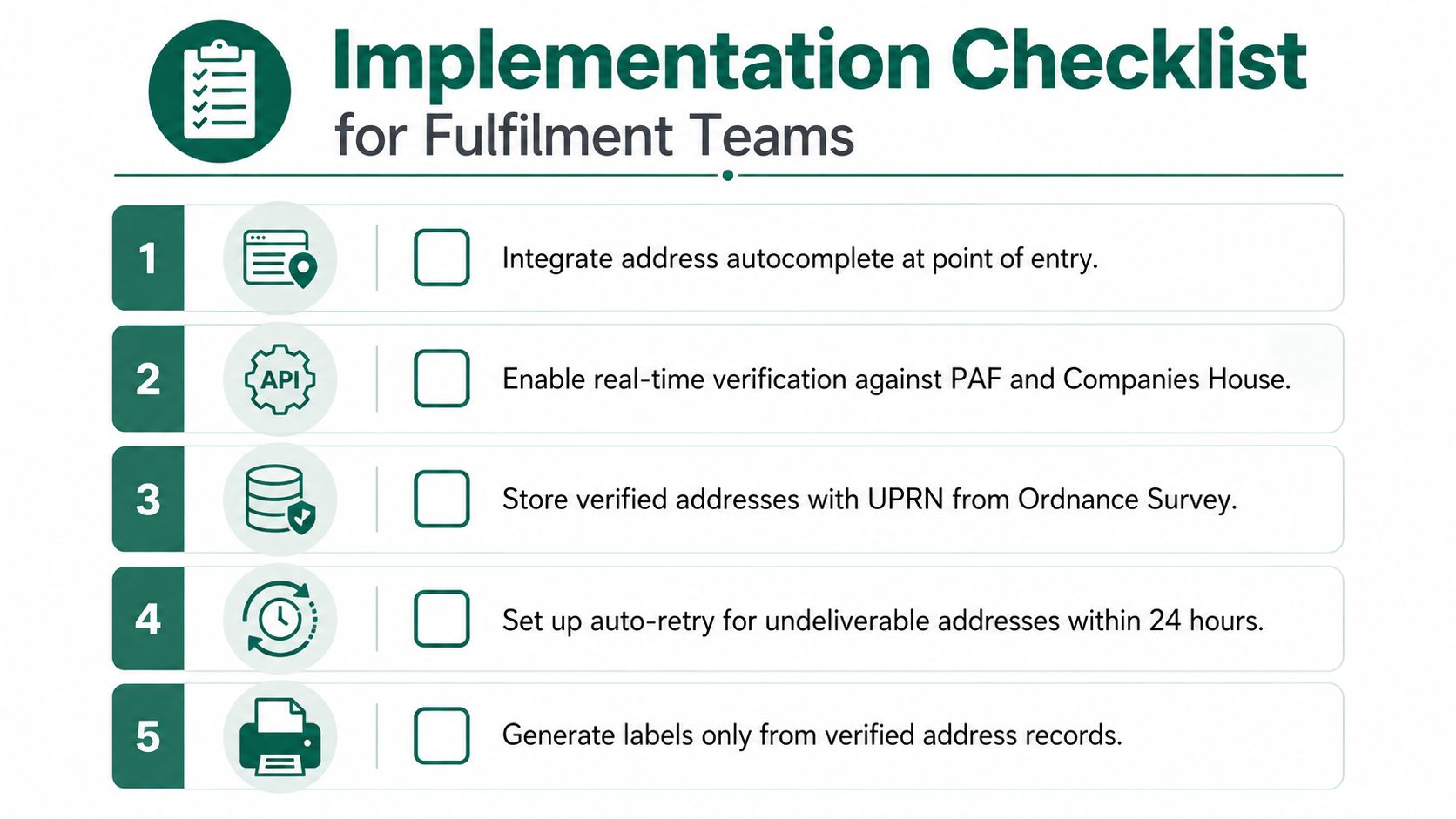
The cleanest address verification systems are built into day-to-day operations, not bolted on after complaints start coming in. The checklist below reflects what holds up in a warehouse or dispatch environment, where speed matters but exceptions are costly.
Start with capture quality
The first control is capture, not correction. Address autocomplete at checkout or account creation cuts out a lot of the messy entry problems that later need manual repair. For B2B onboarding, the intake form should ask for the dispatch site separately from the legal office, because those fields solve different problems.
Next, connect the address field to a verification layer that checks deliverability before the order enters fulfilment. That can be a postal database lookup, a registry match, or a combined API that normalises the record on the way in. For high-risk accounts, the result should be reviewed by a person before freight is booked.
Build a rules-based exception process
Not every flag means rejection. Some need a quick customer-service callback, some need a document upload, and some need a manual review by operations or compliance. The key is to define the response before the exception arrives, so staff don't improvise under pressure.
A useful internal pattern is to separate “correctable” from “suspicious”. Missing unit numbers are usually correctable. A trading address that doesn't align with evidence of occupation or shipping activity needs more scrutiny. That distinction keeps the team from wasting time on harmless formatting issues while missing the high-risk cases.
If the address changes after onboarding, treat it as a new risk event, not a housekeeping update.
Maintain the record over time
Address hygiene decays unless someone owns it. Periodic re-checks are worth the effort for accounts with frequent shipping, returned parcels, or trading changes. Storage systems should keep verified addresses in a standard format, and teams should retire stale records rather than letting them keep circulating through labels and invoices.
For businesses that want a practical starting point, one option is to review packaging workflows alongside address controls. Packaging Panda's catalogue covers dispatch-oriented products such as cartons, mailers, and protective materials, and the same operational discipline that protects a shipment also helps ensure the right parcel goes to the right place. That connection is especially useful when address verification and fulfilment sit in the same team.
Impact on Parcel Routing and Sustainability
Clean address data does more than reduce failed delivery tickets. It shortens the distance between order capture and successful receipt, which improves routing, cuts avoidable re-handling, and reduces the packaging waste attached to a second trip through the network. That matters to businesses trying to align fulfilment with sustainability goals.
When a parcel is sent to the wrong place, the box, filler, label, and transport miles all get wasted. A right-first-time address improves the odds that the parcel reaches the customer without a redelivery or return cycle. That is especially relevant for businesses with eco-friendly packaging commitments, because low-waste packaging only delivers on its promise if the shipment reaches the correct destination the first time.
The broader supply-chain view is useful here. A practical discussion of resilience and movement efficiency is set out in the Readymerce supply chain guide, and the same logic applies to address control, a fragile dispatch chain usually starts with bad data, not bad boxes. If the destination is wrong, even strong packaging can't rescue the shipment from a routing failure.
Why this matters to fulfilment planning
Routing teams need dependable destination data to keep carrier decisions sensible. A clean address record reduces ambiguity around units, building names, and collection points, which helps carriers sort parcels correctly and lowers the chance of avoidable handling. It also reduces the pressure to over-pack orders “just in case”, because parcels spend less time circulating through exceptions and return channels.
The same thinking fits into a broader sustainability programme. Fewer failed deliveries mean less wasted material, fewer repeat labels, and fewer needless trips by vehicles already under route pressure. That's not a branding exercise, it's an operational consequence of good master data.
For businesses that publish sustainability guidance, Packaging Panda's sustainable packaging notes sit naturally alongside this point. Packaging can only do so much on its own. A cleaner address record protects the whole delivery chain from avoidable waste.
Strategic Risk Matrix and Final Takeaways
The right verification strategy depends on the business model. High-volume e-commerce needs fast automated checks at the point of entry. High-value B2B wholesale needs stricter document proof and manual review. Businesses that do both need both layers, because a single control won't catch every failure mode.
| Business profile | Main risk | Best-fit control |
|---|---|---|
| High-volume checkout-led seller | Typos, missing units, malformed postcodes | Real-time postal and deliverability checks |
| B2B supplier or wholesaler | Virtual offices, mailbox arrangements, trading-site ambiguity | Trading address evidence plus document review |
| Marketplace seller | Inconsistent account, invoice, and proof-of-address data | Document consistency across platform and finance records |
| 3PL or fulfilment operator | Address drift after onboarding | Ongoing monitoring and exception handling |
The core lesson is simple. Business address verification is not a one-time clean-up task, it's an operating discipline. The businesses that treat it that way protect margin, keep parcels moving, and avoid onboarding accounts that look valid on paper but fail in the world.
Packaging Panda supplies UK packaging materials, including fulfilment-friendly cartons, mailers, and security products that support reliable dispatch. If your team wants packaging that fits a more disciplined shipping process, visit Packaging Panda and review the range alongside your address verification workflow.