
Mushroom Based Packaging: A Practical UK Guide
A UK dispatch team knows the scene. A carton goes out looking fine, then a crushed return lands on the bench and the cheap foam insert has done exactly what cheap foam always does, not enough. That is why mushroom based packaging has moved from novelty to serious buyer conversation, especially for businesses trying to cut plastic foam without making returns worse.
The problem is that most marketing copy sells the dream and skips the procurement reality. Mycelium is not a miracle substitute for every pack, and small UK shippers do not need a miracle, they need a material that survives transit, clears compliance, and does not turn into a lead-time headache. The right question is not whether mushroom packaging sounds sustainable, it is whether it earns its premium over recycled cardboard and moulded pulp in your actual dispatch conditions.
Table of Contents
- What Mushroom Based Packaging Actually Is
- How Mushroom Packaging Is Made Step by Step
- Protective Performance and Material Limits
- Mushroom Packaging vs Cardboard, Pulp and Bioplastics
- Real World UK Use Cases for E-commerce and Bakeries
- Certifications, Testing and Compliance for UK Buyers
- Cost, Lead Times and Sourcing Realities in the UK
- Next Steps for UK Buyers Considering Mushroom Packaging
What Mushroom Based Packaging Actually Is
A UK dispatch day leaves no room for loose thinking. A courier bag gets taped shut, a pallet is booked, and a return arrives with a corner crushed because the insert flexed instead of cushioning. That is the point where mycelium packaging stops being an abstract sustainability idea and starts being a material choice that either protects product or costs money.
The plain-English definition
Mycelium is the root-like vegetative network of fungi. In packaging, it is grown through agricultural waste such as corn husks, straw, or hemp hurd, then heat-treated so it stops growing and keeps its final shape. The result is a grown composite, not a foam expanded with petrochemicals and not a wet pulp that has been pressed and dried.
That distinction matters in procurement. Expanded polystyrene is made from fossil inputs and expanded into foam. Moulded pulp is pressed fibre, useful and familiar, but still a paper-based format. PLA foams are bio-based, but they remain manufactured polymer foams. Mushroom based packaging starts as biology plus a waste stream, so it brings a different buying case, a different end-of-life story, and a different set of moulding limits.
Practical rule: treat mycelium as a grown protective component, not as a universal carton substitute.
UK demand reflects that shift. In a 2026 to 2036 market snapshot, the UK is identified as the top growth market with an 11.3% growth rate, while the overall mushroom-based biodegradable packaging solutions market is forecast to rise from USD 101.0 million in 2026 to USD 257.2 million by 2036 at a 9.80% CAGR (Morningstar summary of the Accesswire market release). That does not make it mainstream. It does mean UK buyers are dealing with more than a fringe lab material.
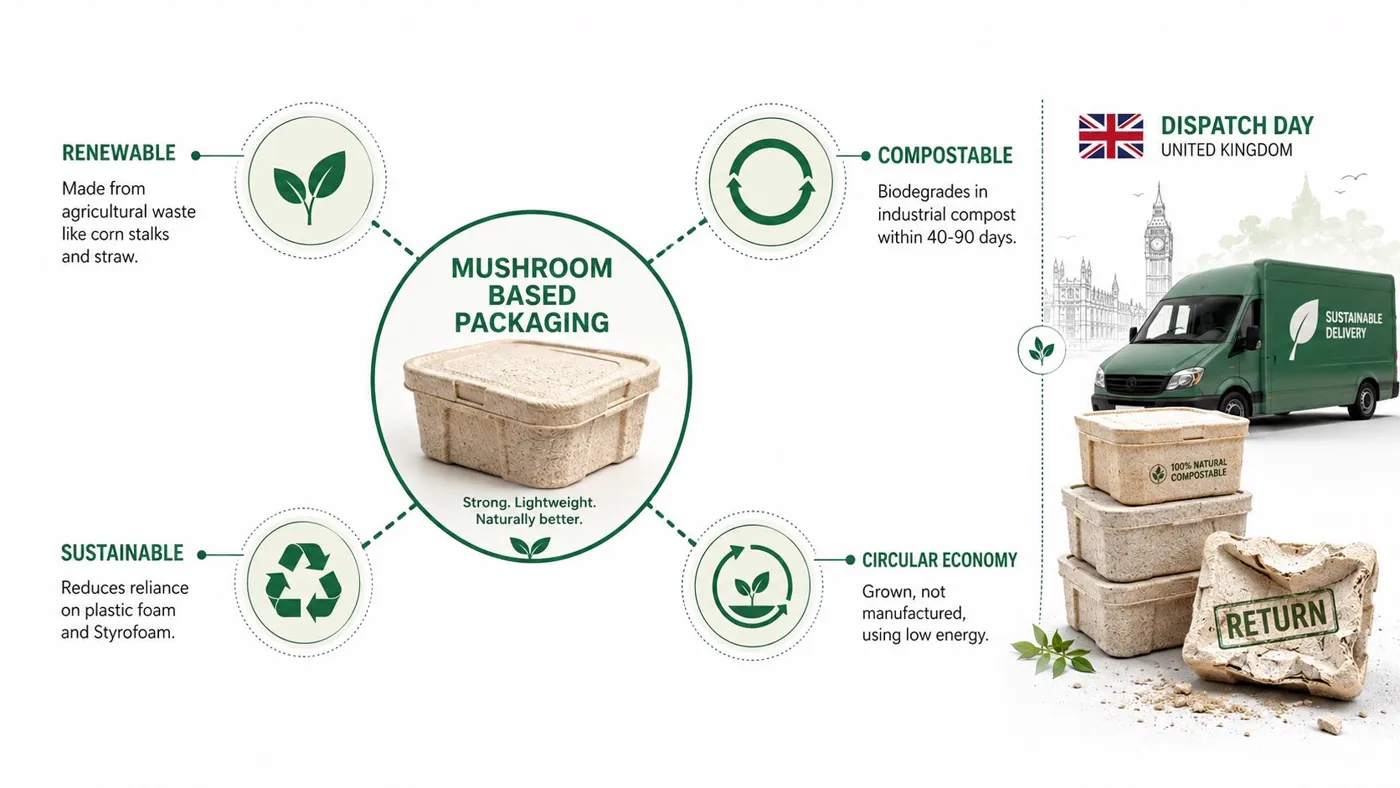
For a clean definition to give a supplier, use this: mushroom based packaging is a mycelium composite grown on agricultural waste and heat-treated into a protective shape. That wording is accurate, defensible, and far better than vague phrases like “eco foam”. For a wider packaging context, Packaging Panda's guide on eco-friendly packaging is a sensible comparison point.
How Mushroom Packaging Is Made Step by Step
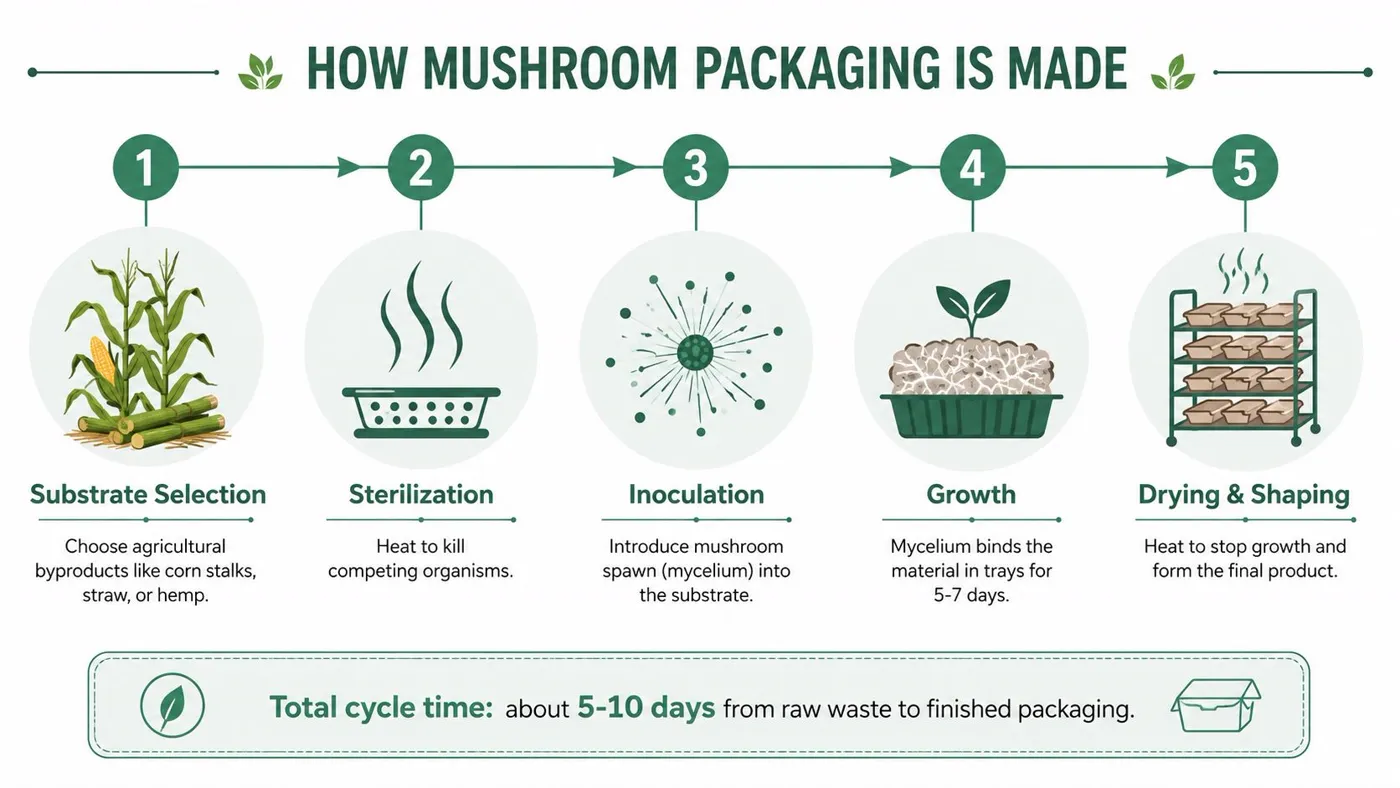
The production chain is not mysterious, but it is more hands-on than most buyers expect. It starts with the substrate, usually agricultural residue such as corn stalks, straw, or hemp material, then moves through sterilisation, inoculation, growth, drying, and final finishing. Mycelium packaging is grown in shape, which is why lead times are driven by biology and mould availability rather than by a simple press-and-cut process.
The seven-stage process buyers should expect
- Substrate selection. Suppliers choose the plant waste that will feed the fungi and determine the final surface and density.
- Sterilisation. The substrate is heat-treated to kill competing organisms.
- Inoculation. Mushroom spawn is mixed into the clean substrate.
- Growth. The mycelium binds the particles together in a controlled, humid environment.
- Shaping. The material grows inside a mould, often a negative mould.
- Drying. Heat stops further growth and locks the structure in place.
- Finishing. Trimming, inspection, and any surface clean-up happen before dispatch.
A useful working example is a corner-block insert grown in a negative mould. In that setup, the insert can take shape over five to seven days, then get dried and trimmed into a dispatch-ready part. That is a practical protective component for fragile goods, not a decorative biodegradable novelty.
Lead times are where the procurement pain starts. Standard catalogue items can move faster because the supplier already has moulds, production recipes, and stock or near-stock capacity. Bespoke shapes are different. A buyer asking for a new geometry should assume a slower cycle, more sampling, and more back-and-forth on tolerances than with recycled cardboard. For catalogue protective supplies in the meantime, Protective Packaging covers common transit formats such as foam inserts, honeycomb sleeves, and void fill, which is useful when a business wants a fast bridge rather than a full custom programme.
The key phone call to a UK supplier should not be “Can you make mushroom packaging?” It should be “What substrate, what mould, what finish, and what repeatable cycle time are you offering?” That is the difference between a viable production line and a sustainability concept deck.
Protective Performance and Material Limits
UK buyers should treat mycelium as a formed protective insert, not a universal shipping material. The engineering data is clear. Mycelium protects fragile goods well when the design brief matches the material, and it fails when the brief asks it to do the wrong job. Compressive resistance is typically 100 to 200 kPa at densities of 0.1 to 0.3 g/cm³, with tensile strength of 0.2 to 0.8 MPa and elastic modulus of 5 to 20 MPa (Naturnext). That puts it in a shock-absorbing, semi-rigid category, which is where good protective packaging belongs.
Where it fits
Mycelium works best as corner blocks, inserts, void-fill pieces, and custom protective forms for cosmetics, electronics, ceramics, and other breakable goods. It absorbs impact and holds odd shapes better than a flat sheet of cardboard. A buyer who needs a formed protective part, especially one that also supports a sustainability claim, has a real case for using it.
Useful procurement rule: if the package needs to deform in a controlled way, mycelium is worth a look. If it needs to stay flat, rigid, or load-bearing, it usually is not.
Where it fails
The same porous structure that gives cushioning also limits tensile performance. That makes mycelium a poor choice for load-bearing outer cartons, for sharp-edged or puncture-prone goods, and for products sitting unbagged in damp storage. Buyers often over-specify it because the material looks premium, then under-specify the transit environment. That order of thinking causes problems.
Moisture is the other hard limit. Uncoated material has a water vapour transmission rate of about 1,200 to 2,100 g/m²·24h, while barrier coatings can bring that down to ≤350 g/m²·24h (Packprint Matrix). The trade-off is simple. Coating improves wet performance, but it also changes the end-of-life route. Coated mycelium is no longer the same straightforward industrial-compost story as uncoated material.
For UK buyers, the practical answer is to specify mycelium where the transit route is dry, the product is fragile, and the insert shape matters more than surface hardness. If the warehouse is humid, the route is mixed-weather, or the product may sit unpacked for long periods, choose a different material or add secondary wrapping. That is not anti-mycology. It is sensible pack engineering.
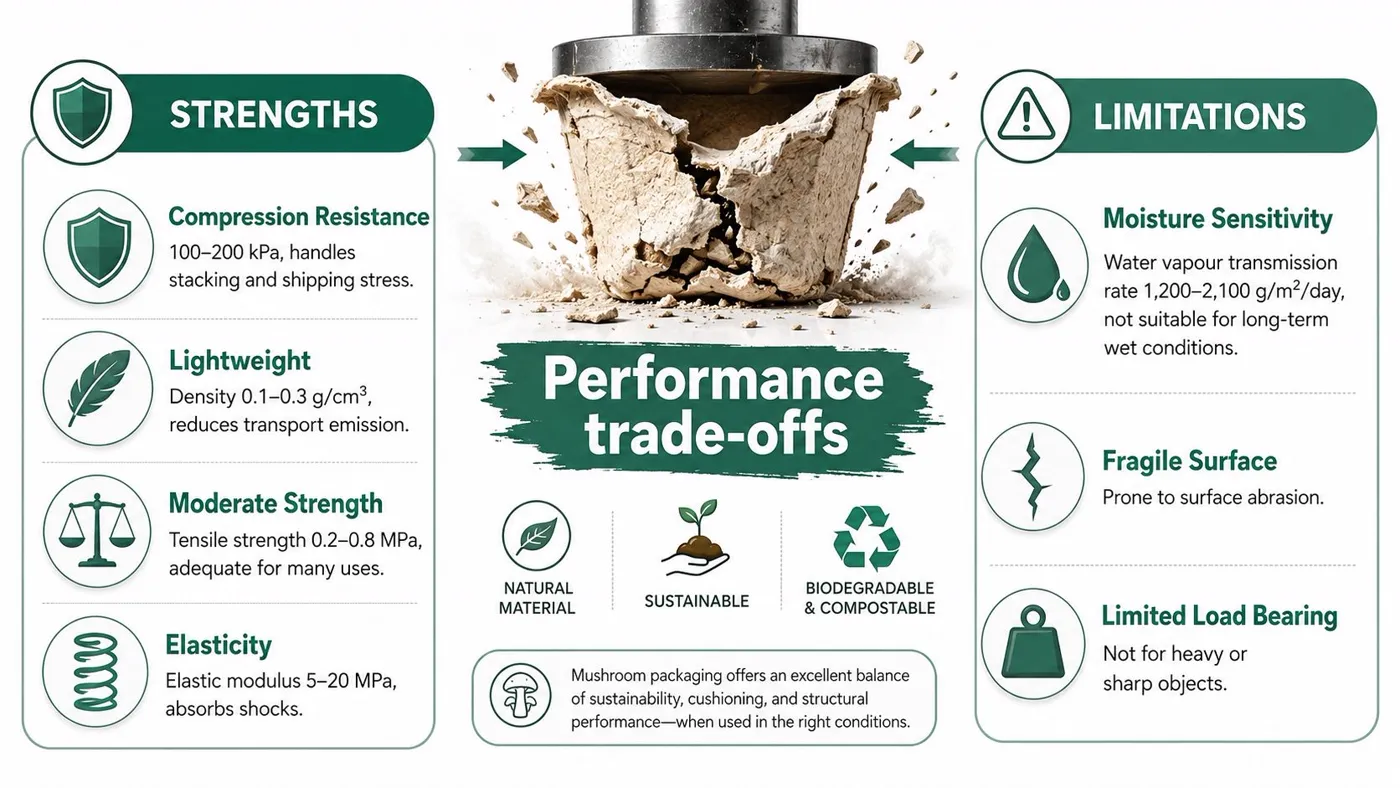
A recent review also notes that mycelium-based composite materials are suitable for low- to medium-load packaging applications and carry a lower environmental footprint than conventional plastic foams (Zenodo review). That matches procurement reality. Mycelium is a protective insert material, not a universal transit shell.
Mushroom Packaging vs Cardboard, Pulp and Bioplastics
The question most buyers ask is blunt. Do they really need mycelium, or is recycled cardboard good enough? For general shipping, recycled corrugated cardboard is still the cheapest, most available, and easiest-to-recycle option. Mycelium only starts to justify itself when the brief needs a custom protective form and the sustainability story is part of the customer-facing unboxing.
| Material | Best use case | End of life in UK | Approx. MOQ | Cost vs recycled cardboard |
|---|---|---|---|---|
| Recycled corrugated cardboard | General shipping cartons, dividers, simple protection | Widely recyclable where local collection accepts it | Low, widely stocked | Baseline, usually lowest |
| Moulded pulp | Inserts, trays, egg-style and formed protective pieces | Widely recyclable and often compostable depending on local rules | Low to moderate | Usually close to cardboard |
| Mycelium composites | Custom inserts, corner blocks, branded protective shapes | Industrial composting route when certified and collected properly | Higher for bespoke runs | Higher at small volumes |
| Bio-based or PLA foams | Lightweight protective formats and specialist applications | Composting claims depend on exact formulation and collection route | Higher than basic paper formats | Often higher |
Recycled corrugated wins where the pack is about containment, not display. Moulded pulp wins where a buyer wants formed protection without moving into a bespoke biological process. Mycelium wins when the product needs a shaped insert that looks and feels materially different from paper, and the brand wants a lower-carbon, industrially compostable narrative attached to the part.
What to pay for and what not to pay for
Pay for mycelium when the insert is visible, branded, and tied to a premium sustainable experience. Do not pay for it just to tick an eco box on a general shipping carton. For broad fulfillment, cardboard and pulp still do the job with fewer sourcing complications.
Buyer's shortcut: if a carton can be right-sized and protected with board, use board. If the product needs a custom cradling shape, mycelium starts to make sense.
Bioplastic foams sit in the awkward middle. They can be useful, but they do not automatically solve end-of-life confusion and they do not always give the same tactile sustainability story as mycelium. That is why many UK teams end up using cardboard for the shipper, pulp for the simple insert, and mycelium only for the SKUs where the premium is visible to the customer.
Real World UK Use Cases for E-commerce and Bakeries
A DTC cosmetics brand shipping glass bottles is a better test case than a lab demo. The brand wants a plastic-free packaging commitment by 2030, so it swaps polystyrene inserts for mycelium corner blocks in its outer cartons. That makes sense because the bottles are fragile, the insert is visible on unboxing, and the brand can justify a premium where sustainability is part of the product promise.
Cosmetics shipping, where mycelium earns its place
The trade-off is procurement discipline. The brand has to accept longer sampling, more care around storage humidity, and a higher unit cost than recycled board. Returns improve only if the block geometry controls movement, so the insert must be tested against the actual bottle, the actual carton, and the actual courier route. If the pack fails in a drop test, the sustainability narrative does not help.
Bakery dispatch, where the answer is narrower
An independent bakery sending celebration cakes by courier has a different problem. The priority is keeping the cake dry, level, and intact, not impressing the customer with a bio-material insert. Compostable outer cartons and paper void fill can do a lot of the work, but mycelium inserts only make sense for non-chilled, low-moisture products.
For chilled or high-moisture bakery goods, mycelium is the wrong call. Cake dispatch lives or dies on thermal control and moisture management, which is exactly where a moisture-sensitive insert becomes a distraction. That is why many bakeries are better served by right-sized cartons, paper cushioning, and a packaging spec that keeps humidity under control.
Packaging Panda's food safe packaging guidance is relevant here because bakery buyers need to separate product safety from packaging novelty.
The clearest pattern across UK e-commerce retailers, independent bakeries, 3PL operators, and bespoke brands is this. Mycelium is strong in curated, low-moisture, visible-use cases. It is weak in high-turnover, damp, or chilled dispatch environments. Buyers who ignore that split usually buy a story, not a solution.
Certifications, Testing and Compliance for UK Buyers
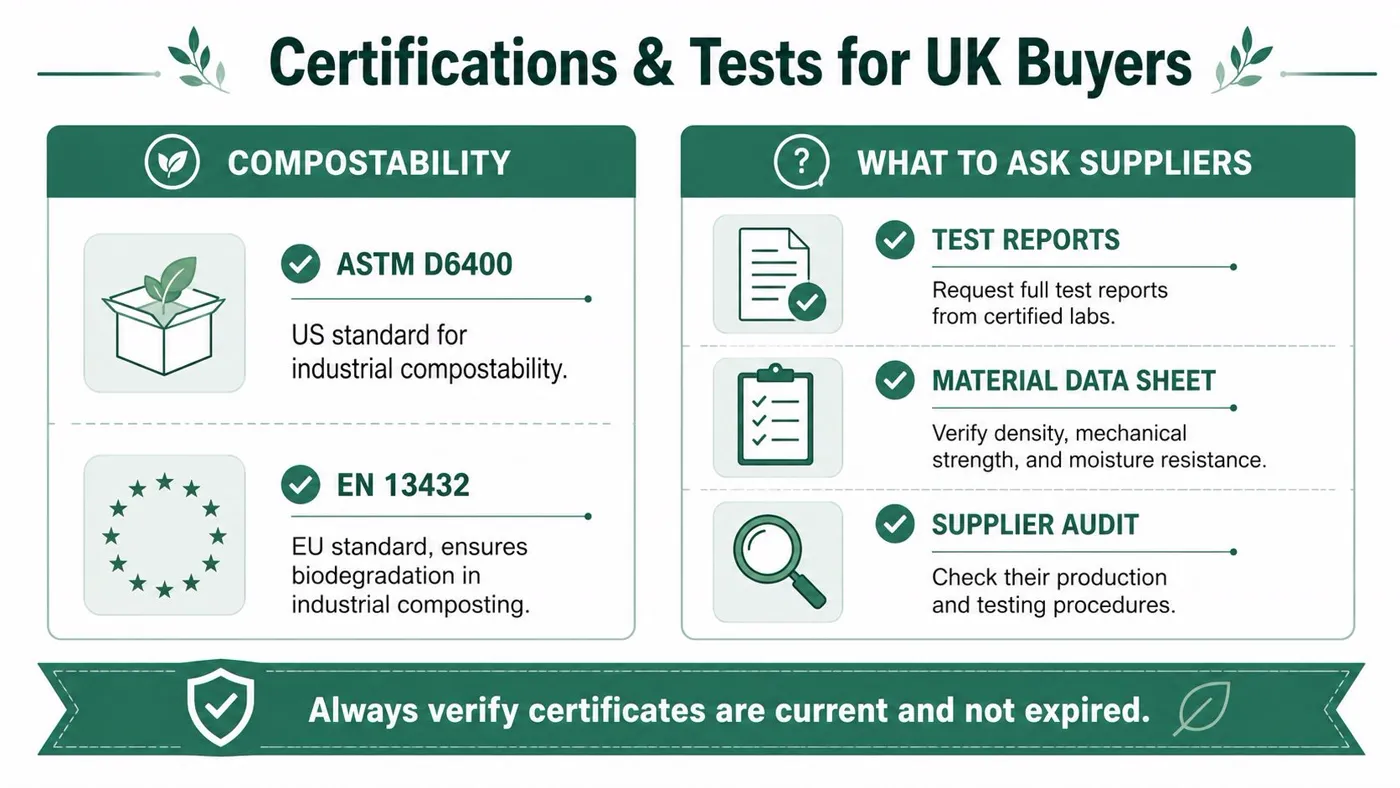
Start with proof, not packaging jargon. For Class I compostable claims, buyers should ask for evidence tied to recognised industrial-compostability standards such as ASTM D6400 and EN 13432. If a supplier cannot produce current test documentation, the claim is too vague to carry in procurement or in customer-facing copy.
The UK regulatory side also needs checking at the pack-build level, not just the substrate level. Packaging Panda's UK packaging regulations guide is useful here because food-adjacent buyers still need to verify what the law expects from the full pack, not from a single material claim.
What to ask before placing an order
- Compostability proof: ask for the full ASTM D6400 and EN 13432 reports, not just a logo on a brochure.
- Food-contact evidence: for bakery applications, ask how inks, coatings, and adhesives fit the Regulation (EC) No 1935/2004 framework in the UK.
- Export controls: if the packaging includes agricultural substrate elements and the shipper is exporting, check whether ISPM-15 issues apply to the wider pack design.
- Transit testing: run drop, vibration, and humidity tests on a real product sample before approving the design.
- Storage conditions: confirm how the material behaves in your warehouse humidity and in last-mile weather exposure.
Do not stop at the substrate. Ask for the exact coating, the adhesive spec, and the print system used on the final pack. A compostable mushroom material can still be the wrong choice if the build includes components that are not suitable for contact or migration-sensitive use.
Claims that should trigger caution
“Biodegradable in landfill” is a weak claim and usually useless for a buyer making a real disposal decision. Home compostability is also not the same as industrial compostability. Standards such as OK Compost HOME and TÜV-backed home-compost claims sit in a different category, with much harder performance expectations.
A second point matters for UK teams buying for food-adjacent or bakery use. The material may be compostable, but that does not automatically make the coating, print, or adhesive suitable for contact or migration-sensitive uses. The safer move is to insist on documentation for the entire pack build, not just the substrate.
The best supplier conversation sounds boring because it should be boring. Ask for test reports, ask for the exact substrate, ask for coating details, and ask what the pack does in wet transit. Anything less leaves too much room for a sustainability claim that fails when a delivery sits on a damp depot floor.
Cost, Lead Times and Sourcing Realities in the UK
The commercial truth is simple. At low volumes, mycelium often costs 2x to 5x more than equivalent recycled cardboard or moulded pulp, and bespoke shapes usually bring tooling or mould costs with them. Minimum-order quantities for custom work often start at 500 units, which is why small UK shippers need to be careful before committing to a full programme.
What that means for procurement
Standard catalogue items ship faster because the supplier already knows the mould, the dimensions, and the production rhythm. Bespoke runs need design approval, sampling, and lead time for growth and drying. That makes mycelium a poor fit for businesses that need a one-off emergency solve for next week's despatch.
A UK wholesaler with fast replenishment can be a sensible bridge while a team tests the case for mycelium. Packaging Panda, for example, offers Protective Packaging for safe transit, along with free delivery over £150 and next-day delivery on orders placed before 2pm. That kind of catalogue supply helps an SME stay operational while it evaluates whether a custom mycelium route is worth the premium.
Procurement reality: if the business cannot tolerate multi-week development cycles, do not start with bespoke mycelium. Start with stocked protective formats and test the economics first.
The strongest sourcing strategy is usually staged. Use stocked recyclable cartons, paper void fill, or moulded pulp where the brief is standard. Reserve mycelium for the SKUs where a shaped insert changes both protection and brand perception. That is a commercial decision, not a moral one.
Next Steps for UK Buyers Considering Mushroom Packaging
The cleanest path is a 30, 60, 90-day rollout, not a leap of faith. Days 1 to 30 should be about spend visibility, because buyers can't improve what they haven't mapped. Identify which SKUs still rely on plastic foam, ask for mycelium samples, and request one recycled-cardboard comparator so the test is honest.
Days 31 to 60
Run a real drop and vibration test on the actual product, not a dummy weight. Validate the supplier's compostability documents and check whether the disposal route fits your local UK waste infrastructure. If the material is certified but the collection route is unclear, the sustainability claim is weaker than it looks.
Days 61 to 90
Decide whether the business needs a short pilot run of moulded mycelium inserts from a specialist supplier, or whether the better move is to fix the easy wins first. For many SMEs, that means switching to recyclable cardboard cartons, paper void fill, and compostable mailers before committing to bespoke biological tooling.
- If packaging damage is the problem: test inserts first, not the outer box.
- If disposal clarity is the problem: favour board and pulp until the waste route is settled.
- If brand unboxing is the problem: mycelium is worth piloting on a small, visible SKU set.
- If cash flow is tight: use stocked UK formats and avoid custom mould investment until the unit economics are clear.
The right decision is usually narrower than the sustainability pitch suggests. Mycelium is a strong option for specific protective jobs, not a universal replacement for every parcel format. For UK buyers who want to move in stages, the practical next move is to get samples, test them properly, and compare them against stocked options before committing to tooling.
Packaging Panda supplies UK businesses with stocked protective formats, recyclable cartons, and made-to-order options that can bridge the gap while a mycelium programme is being tested. If your team is comparing foam inserts against more sustainable protective lines, visit Packaging Panda and use the catalogue as a realistic benchmark before you commit to custom moulds.


