Custom Box Printing UK: Your 2026 Packaging Guide

A lot of UK buyers land on the same problem at the same time. The boxes look easy until the quotes arrive, the artwork file needs fixing, the courier pushes back on size, and the “recyclable” finish on the sample starts to look less straightforward than the sales page suggested. For custom box printing UK, the actual cost sits in the details suppliers often leave out, not the headline unit price.
That matters because the UK custom printing market is already sizeable, with US$2,208.9 million in 2024 projected to reach US$4,243.6 million by 2030, an expected 11.5% CAGR from 2025 to 2030, and digital printing is identified as the fastest-growing technique in that market Grand View Research. The broader UK print and printed packaging base is large too, at about £23 billion, with core commercial printing at roughly £9.3 billion VC Print. That scale means custom packaging is not a side quest, it's a normal part of how UK brands sell, ship, and present products.
Table of Contents
- Navigating the UK Custom Packaging Landscape
- Printing Methods and Colour Accuracy
- Selecting the Right Board Grade and Flute
- Sustainability and Recyclability Trade-offs
- Understanding True Landed Costs and MOQs
- Artwork Preparation and Quality Control
- Choosing Between Stock and Bespoke Solutions
Navigating the UK Custom Packaging Landscape
A seller with 800 orders a month can still get tripped up by a simple quote. One supplier prices the box itself, another adds separate artwork setup, a third hides freight until checkout, and the fourth sends a sample that looks fine on screen but feels wrong in hand. The result is usually the same, a delayed launch and a packaging line that eats into margin before the first parcel leaves the warehouse.
The UK market is mature enough that buyers should speak the language properly. Kraft, white test liner, corrugated, mailer, die-cut, and MOQ all matter, because each one affects how the box prints, stacks, ships, and lands with the customer. A printer may talk about a “shipping carton” while a brand manager wants a “gift box”, and those are not interchangeable terms when board grade, finish, and assembly differ.
One practical habit saves a lot of grief, ask for the full production path, not just the unit cost. That means artwork setup, tooling, board selection, lead time, and courier terms. It also means checking packaging obligations and collection issues before committing to a finish, which is why a plain internal reference like UK packaging regulations belongs in the buying process, not after the order is placed.
Practical rule: if a quote only gives a price per box, it is incomplete.
For e-commerce sellers, bespoke packaging usually earns its keep in three places. It reduces wasted void fill when the box matches the product, it improves presentation when the parcel is opened, and it helps the brand look consistent across retail and dispatch. For retailers, the same logic applies on shelf, but only if the print method, board finish, and structural spec all support the design instead of fighting it.
Printing Methods and Colour Accuracy
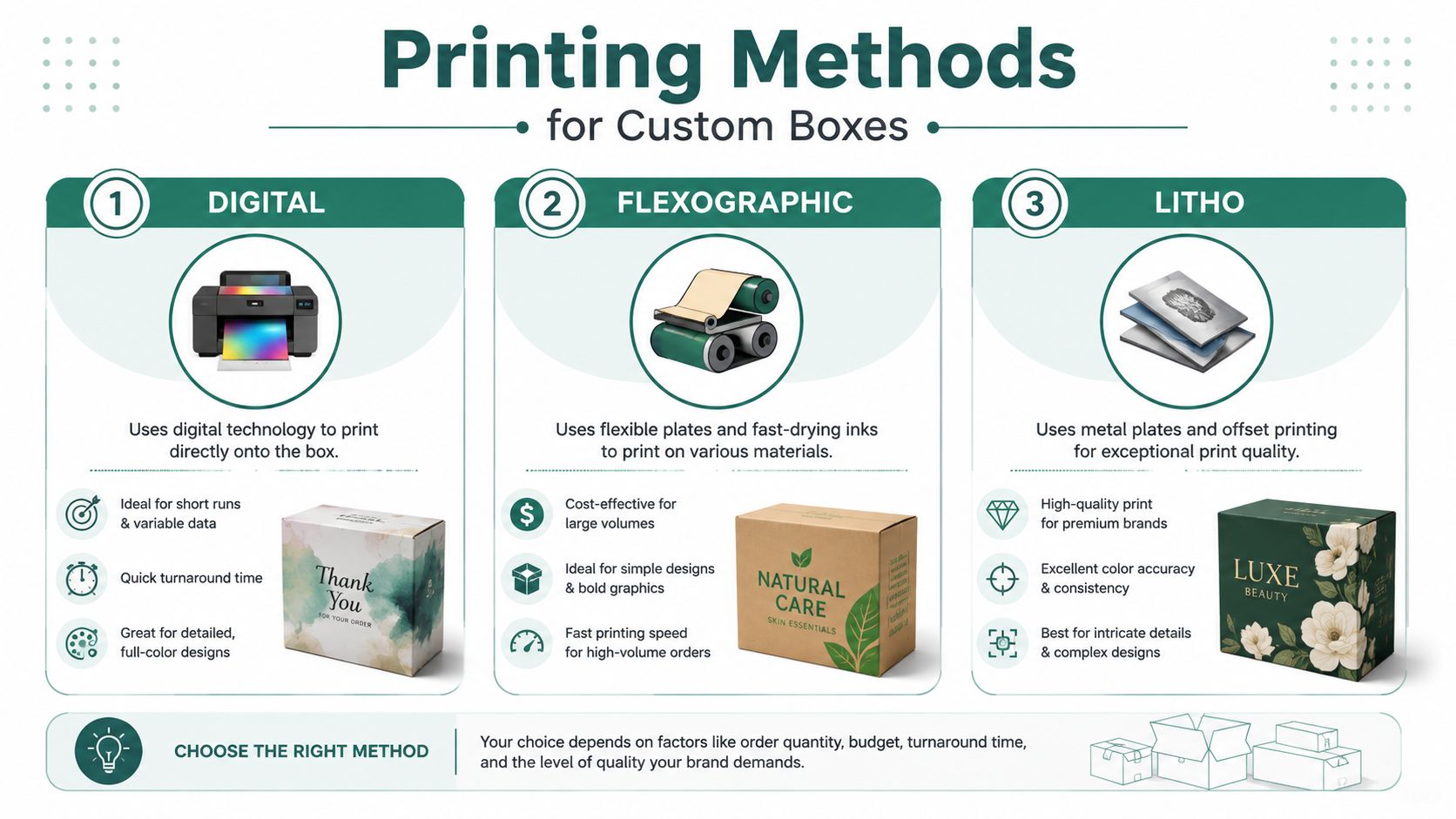
A box can look sharp on a screen and still disappoint on press if the method does not suit the board or the run length. The issue is usually not the artwork itself, it is the fit between ink, substrate, and quantity. Digital, flexographic, and lithographic printing all behave differently, and the lowest quoted price can become the expensive option once setup, finish, proofing, and order size are all counted.
A short-run buyer usually wants speed, but speed has a cost if the box spec is not matched to the print process. A longer-run buyer may accept more setup to reduce the unit price, but only if the artwork and board can hold the finish properly.
Choosing the method that fits the run
Digital printing works well for shorter runs and variable artwork because it skips the plate stage. That makes it practical for fast launches, seasonal changes, and designs that need frequent updates. If you want a plain overview of the method and where it suits packaging, the digital printing packaging guide is a useful reference, especially for short-run branded cartons where speed matters more than the lowest press setup cost.
Flexographic printing becomes more attractive as the order grows. It uses plates, so the upfront setup is less forgiving, but the unit economics can improve once volume increases. The UK mailing-box cost guide notes flexo plate costs of £30 to £100 per colour, which is why a modest order can feel expensive even when the printed box itself looks straightforward Boxtopia.
Litho suits packaging that needs a cleaner retail finish and sharper graphics. It tends to make sense for presentation-led boxes, not rough transit cartons that will take a harder journey through fulfilment and courier handling. In practice, poor method choice wastes money in two ways, the print quality misses the mark, or the setup cost is too heavy for the run.
CMYK, Pantone, and the board underneath
For photographic artwork and multi-colour images, CMYK is the standard production route, and production-ready artwork is typically supplied at 300 DPI minimum with 3 to 5 mm bleed Custom Boxes UK. Pantone or PMS is the better choice when exact brand colour matching matters more than image blending. A logo printed on kraft board will not behave the same way as the same logo on coated stock, because the fibre tone absorbs light differently and changes the final colour.
Colour on screen is backlit. Colour on board is reflected. That is why a sample or proof matters more than the digital mockup.
A buyer who wants tighter colour control should ask for the print method decision before final artwork approval. That avoids last-minute disappointment when the board, ink density, or coating changes the look of an otherwise approved file. For Gift Boxes, that matters where retail presentation and ecommerce unboxing need the same finish language across white, brown, black, and printed designs.
Selecting the Right Board Grade and Flute
A box can look right on press and still fail in the depot. The board grade and flute profile decide whether it survives stacking, courier handling, and the extra pressure that comes with a busy fulfilment line. UK custom shipping boxes commonly use E-flute and B-flute, and one UK printer specifies single-wall shippers at 1.8 mm thickness Tradeprint.
E-flute, B-flute, and why thickness changes the job
E-flute gives a tighter, flatter print surface. That makes it useful for branded packs and cleaner retail faces, especially where the product is light and the box is carrying more of the presentation work. B-flute gives more cushioning and suits shipping cartons that need better crush resistance without moving into heavy board.
The trade-off shows up in the warehouse and in freight charges. Thinner board lowers cube weight and usually keeps carriage down, but the flute profile changes how well the carton stands up to stacking and rough handling. For fragile goods, appearance is only part of the decision. The critical question is whether the board protects the item without making the parcel bulky enough to cost more to send.
The UK corrugated board packaging market forecast puts the sector at USD 12.6 billion in 2026, rising to USD 15.21 billion by 2031 at a 3.85% CAGR, and it notes single-wall board accounted for 38.88% of the market in 2025, while triple-wall is forecast to grow fastest at 4.82% CAGR Mordor Intelligence. That mix matches what buyers see in practice, most parcels do not need the heaviest board, but some need more than a decorative carton can give. If you want a closer look at how board performs under load, see compression strength testing.
White test liner or brown Kraft
White test liner prints cleaner and gives branding more contrast. Brown Kraft looks more natural and suits products that want a quieter, earthier presentation. Neither choice is automatically better. The right answer depends on whether the box is doing retail theatre or moving a product safely through a courier network.
Practical rule: choose the lightest board that still passes the real transit test, then print on that.
The wrong board choice often shows up late, after the first batch is packed. Corners crush, lids bow, or the print looks flatter than expected because the surface and the flute profile were not chosen together. Compression testing and real dispatch trials matter more than a polished render.
Sustainability and Recyclability Trade-offs
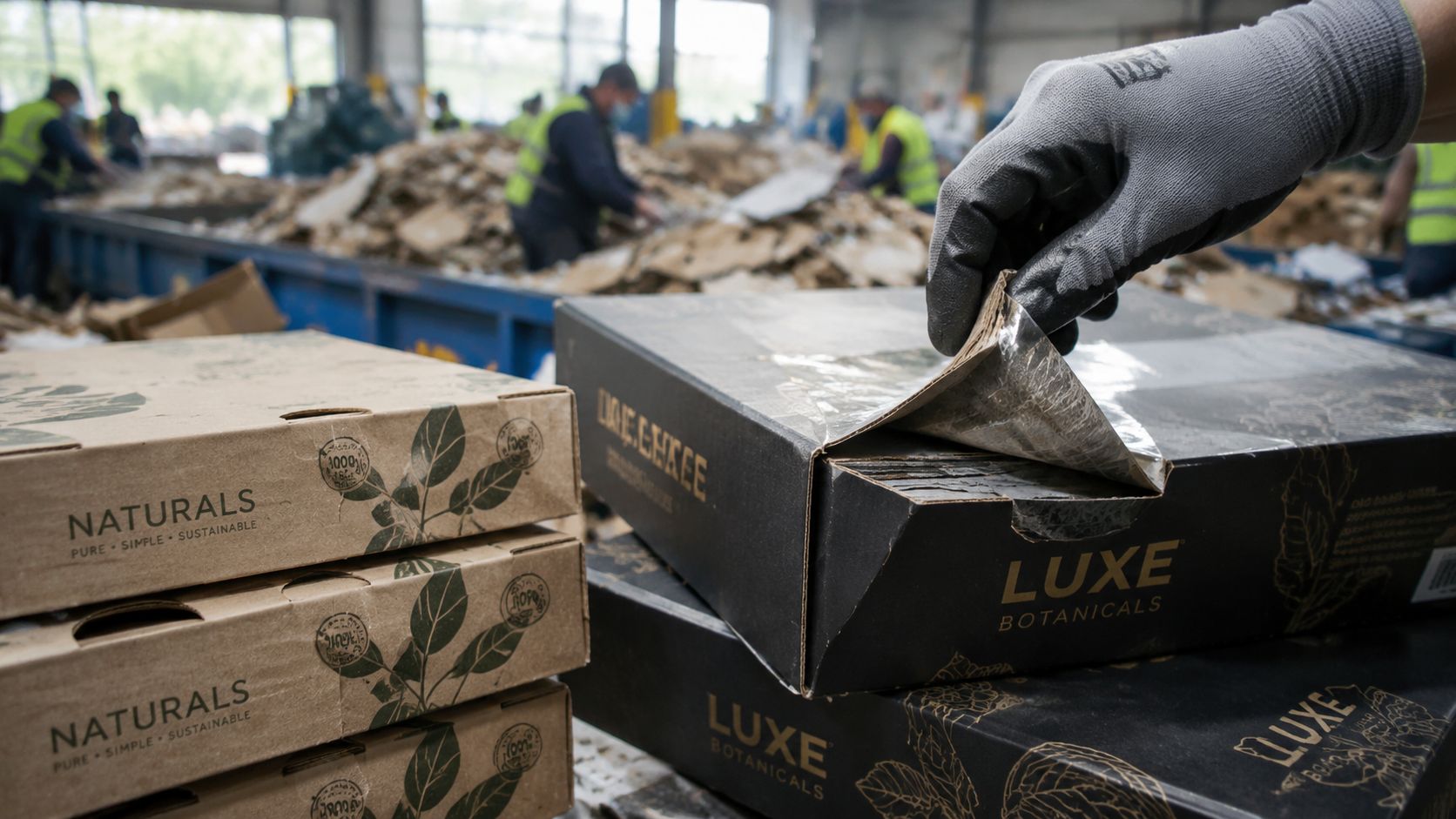
“Recyclable” on a box is not the same as “recycled in practice”. UK collection rules still vary by local authority, and premium finishes can create a gap between what a supplier promises and what households can place in the bin. That gap matters more now because packaging decisions are being pulled by environmental reporting, material efficiency, and the push for lower-impact formats.
Finishes that look premium but complicate recovery
Gloss laminations, metallic inks, heavy coatings, and plastic windows can all make a box look more premium, but they can also complicate fibre recovery. That does not mean they should never be used. It means the brand needs to decide whether shelf impact is worth the recycling trade-off in the intended UK collection context.
Aqueous and water-based approaches are often cleaner choices when the aim is to keep the pack simpler. FSC-certified board helps on the material side, but certification alone does not solve finish-related issues. The real question is whether the full pack design, board plus print plus coating, still behaves like a paper-based item when it reaches the sorting stream.
Brand impact without greenwashing
There is a useful middle ground. Matte or uncoated looks can feel quieter and more restrained, while still supporting practical recycling expectations better than film-heavy finishes. That suits brands that want a premium feel without making the pack look over-processed.
Recent UK policy and industry reporting also point to rising demand for plastic-free formats, but premium branding still matters, especially for retail and gifting. The better solution is to choose the least complicated finish that still supports the product. If a box needs a glossy face to sell the item, then that should be a deliberate choice, not a default one dressed up as sustainability.
A sustainable pack is the one that balances product protection, material efficiency, and realistic collection behaviour.
For buyers who need a clearer comparison of finish trade-offs in a UK context, the most useful checks are straightforward. Ask whether the finish stays fibre-based, whether the inks remain low-impact, and whether the construction avoids unnecessary layers. That is more honest than a generic eco badge, and it usually leads to better buying decisions.
Understanding True Landed Costs and MOQs
A unit price helps, but it never gives the full picture. The hidden cost usually sits across origination, tooling, plate changes, artwork prep, freight, and VAT, so the cheapest-looking quote can become the most expensive order once the cartons are in the warehouse. Serious buyers compare the total delivered cost, not just the sticker price.
Estimated Custom Box Pricing Scenarios
| Order Volume | Print Method | Estimated Unit Cost | Setup/Tooling Cost |
|---|---|---|---|
| 100 boxes | one-colour logo print | £60 to £80 total for 100 boxes Boxtopia | not stated |
| 500 boxes | one-colour logo print | £200 to £280 total for 500 boxes | not stated |
| 1,000 boxes | one-colour logo print | £350 to £450 total for 1,000 boxes | not stated |
| 5,000 boxes | flexo print | roughly 8 to 12 pence per box, or £400 to £600 total | £30 to £100 per colour plate |
The pattern becomes clear once the numbers sit side by side. At lower volumes, setup costs dominate. At higher volumes, unit cost matters more than pre-press overhead. That is why a 500-unit run can feel awkward, because it sits in the middle ground where the box is still bespoke, but the economies of scale have not fully kicked in.
A buyer who only compares unit cost can miss the point. A carton with a low print price may carry a higher plate charge, a tighter artwork requirement, or a freight bill that wipes out the saving. If the order is small, those fixed costs hit hard. If the order is larger, they spread out, and the economics usually improve.
Where the landed cost really moves
Freight is one of the easiest items to underestimate. A quote can look sharp until carriage is added, then the box no longer compares well against a stock alternative. Delivery thresholds change that picture. Packaging Panda states free delivery over £150 and next-day delivery on orders placed before 2pm, which can materially change how a replenishment order behaves in practice.
The UK packaging market is also under pressure from price-sensitive SMEs and e-commerce shippers, so cost transparency matters more than decorative sales copy. Recent policy pressure around waste and packaging reporting makes right-sized formats and lighter materials more attractive too, because they can reduce both material use and transport overhead.
Bottom line: the right MOQ is not the smallest one available, it is the smallest one that still keeps unit economics, lead time, and freight under control.
That means asking for quotes across at least two or three order sizes. A 500-unit estimate, a 1,000-unit estimate, and a larger production run show whether the order is economical or merely convenient. Buyers who only compare one quantity usually miss the point of bespoke packaging entirely.
Artwork Preparation and Quality Control
A box can look right on screen and still fail in production. The usual culprits are simple, a dieline that is off by a few millimetres, text sitting too close to a fold, or a logo supplied at the wrong resolution. That is why artwork control matters on custom box printing UK, especially on short runs where there is little room to absorb reprints or wasted board.
The files that avoid expensive mistakes
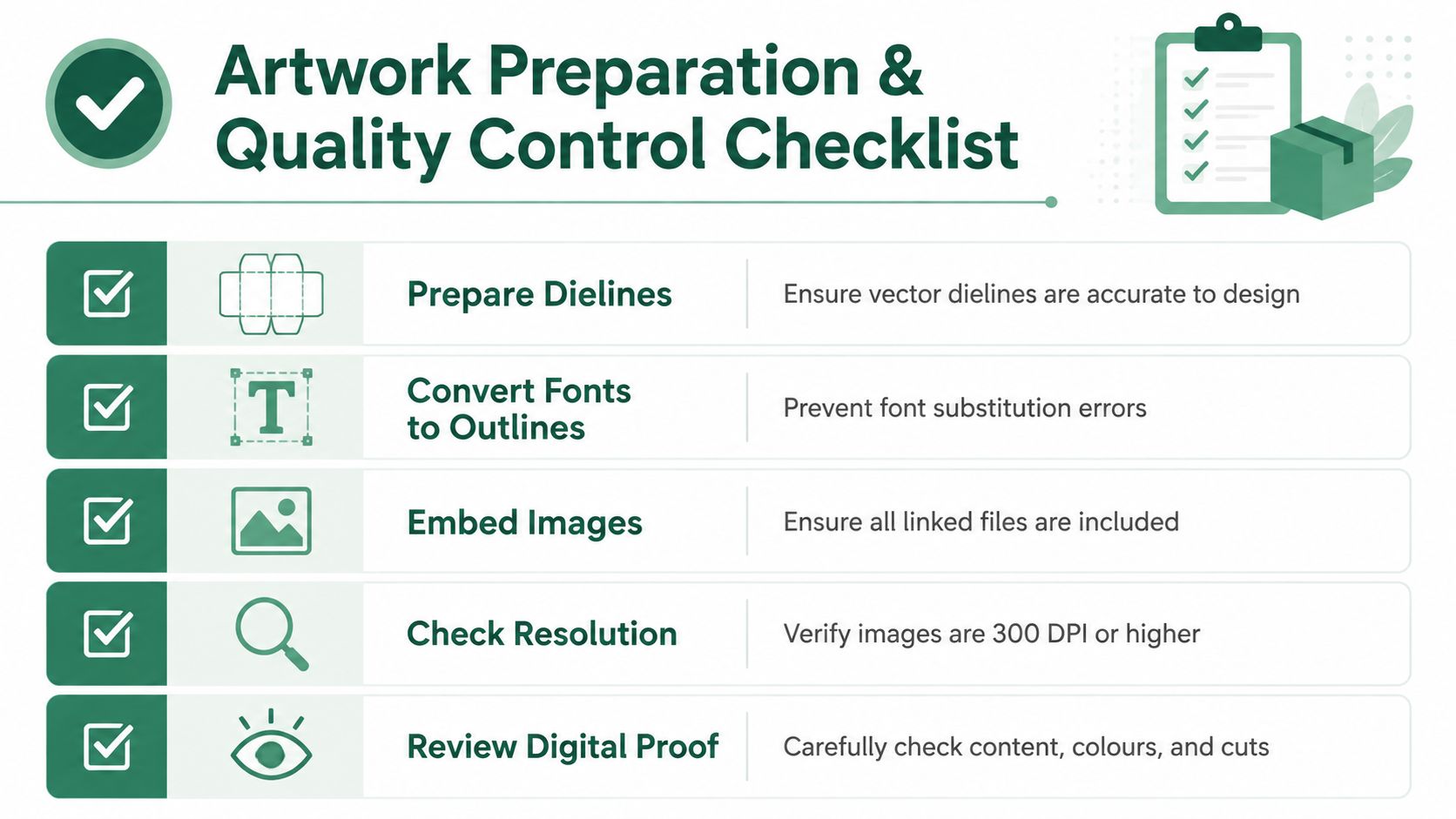
The dieline must be accurate, because cut lines and fold lines decide where artwork can safely sit. Fonts should be converted to outlines so the printer does not swap typefaces during output. Images need to be embedded in the file, not left behind in a broken link chain that fails at pre-press.
A practical pre-press check should also cover resolution, barcode placement, bleed, and safe zones. The usual production baseline of 300 DPI minimum and 3 to 5 mm bleed matters here as well Custom Boxes UK. Those settings help prevent white slivers at the trim edge and keep key text away from the fold, where it can disappear or distort.
Board choice also affects artwork tolerance. A neat design on a smooth white board can look crisp, while the same file on kraft or an uneven recycled stock may lose contrast and make fine detail harder to read. Buyers who want a cleaner result usually specify stronger line weights, simpler type, and less reliance on subtle tonal shifts.
Proofing before the press run
A digital proof is not paperwork. It is the last chance to catch colour shifts, missing marks, or layout mistakes before the order becomes physical stock. A physical sample is even better when the job matters, because board texture, coating, and box construction can change the finished look enough to alter approval.
For teams comparing ideas before they commit, an AI packaging mockup generator can help at the design stage, provided it is treated as a visual aid rather than print-ready artwork. It lets the team align on layout and shelf presence before the files are sent to production.
Check the proof like a buyer, not like a designer. Read the box as if it were already on a pallet or in a customer's hands.
That habit catches the mistakes that cost money. A barcode too close to a crease, a logo pushed across a fold, or a background colour that looks fine on a monitor but turns muddy on kraft board can ruin a run. The actual saving comes from slowing down before approval, because one clean proof is cheaper than a pallet of unusable cartons.
Choosing Between Stock and Bespoke Solutions
Not every brand needs a fully printed custom carton. A stock box with a sticker, sleeve, or insert can be the smarter move when cash is tight, products change often, or the business is still testing demand. Bespoke printing starts to make more sense when the product line is stable, the unboxing matters, or the box needs to do more than just carry goods.
The decision usually comes down to volume and consistency. Lower or unpredictable volumes favour stock formats because they are easier to reorder and less risky if the design changes. Higher repeat volumes justify bespoke print when the brand wants the box to work as part of the product experience rather than as a generic shipping shell.
A sensible buying rule is simple.
- Choose stock plus labels or sleeves when the SKU changes often, the order size is small, or the brand is still testing the market.
- Choose bespoke print when the packaging needs to carry the brand, protect the item properly, and repeat reliably across multiple shipments.
- Choose a hybrid approach when only the outer presentation needs branding and the inner pack can stay standard.
Packaging Panda's mix of stock cartons, bespoke packaging, free delivery over £150, next-day delivery before 2pm, and European shipping options gives teams a way to cover both immediate replenishment and longer-term branded growth without changing suppliers every time the requirement shifts.
The win is not choosing bespoke for everything. It is matching the pack to the job, so the box supports margin, presentation, and sustainability without wasting spend on features the product does not need.
If the next order needs a stock carton, a printed mailer, or a made-to-order box with tighter control over board and finish, Packaging Panda is a practical place to compare options and line up the spec before the run starts. The right conversation at the start usually saves the expensive one after delivery.