Custom Printed Mailer Boxes: A UK Ordering Guide
A marketplace seller finishes a Sunday pack and notices every parcel looks like the one next door. The brown box gets the product out of the building. It doesn't say who sent it, how to open it, or why the customer should order again. Custom printed mailer boxes can do that work, but only after the fulfilment constraints are settled. Size, board and print should be checked against carrier limits, damage risk and packaging records before anyone approves a logo file.
Table of Contents
- Why Custom Printed Mailer Boxes Earn Their Keep
- Specifying the Right Size Before Anything Else
- Choosing Board Grades and Print Methods
- Preparing Artwork and Finishes That Print Cleanly
- Comparing Your Options for Printed Mailer Boxes
- Understanding Minimum Runs, Lead Times and Costs
- Your Pre-Order Checklist and Next Step
Why Custom Printed Mailer Boxes Earn Their Keep
Online orders are a regular part of UK retail, so packaging often meets the customer before the product does. The Office for National Statistics reported that online sales made up 27.8% of total retail sales in Great Britain in July 2024, compared with 27.4% in June. For the full year 2024, the Office for National Statistics series recorded an online-sales share of 27.1%. For a parcel-led business, the outer pack is part of the customer experience, not just a way to move stock.
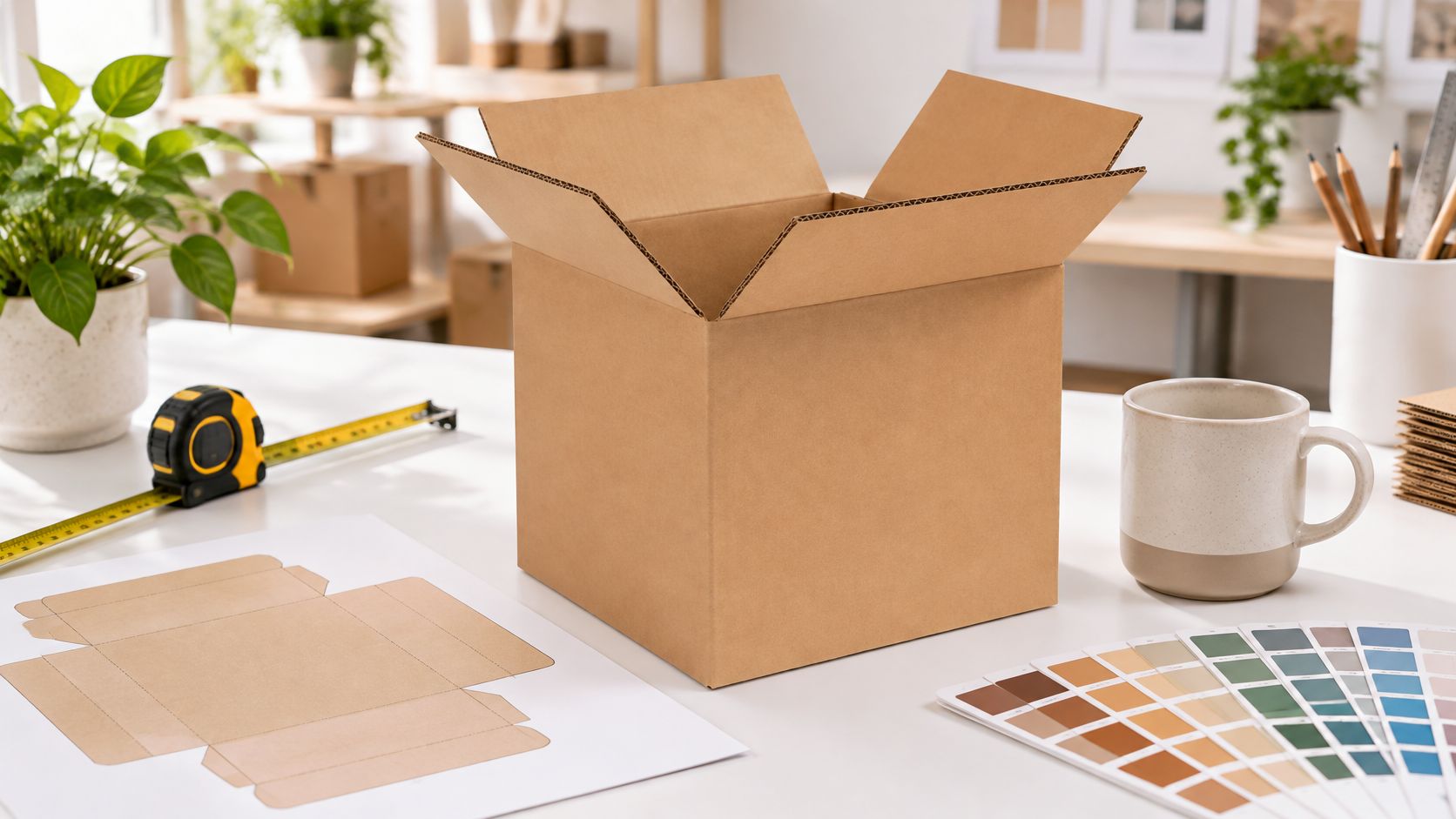
A mailer box is a pre-creased carton, usually with self-locking flaps, that ships flat and closes without a tape gun. A standard shipping carton is a slotted case, typically sealed with tape and suited to bulk freight as well as individual orders. Custom printed packaging specifies more than a logo on the lid. It combines a chosen size and board with print and finish suited to the available panels.
The commercial case varies by seller.
- Marketplace sellers can use the box to extend the listing beyond the screen, where the parcel itself becomes the first branded contact.
- Brands with repeat customers can print care instructions, a returns address or a reorder prompt where customers can refer to it.
- SMEs using plain stock can distinguish their parcels from others arriving on the same courier round.
Print adds cost and lead time, so it is not the right choice for every order. Stock packaging with a clear label often makes more sense for a short test, a one-off promotion or a product whose dimensions may change. Full print is easier to justify when one size ships regularly and the setup cost is spread across repeat orders. The printed panel also needs to carry a useful message, not just decoration.
Treat the box as a fulfilment choice first. Size, board and print affect the finished pack and its cost per successful delivery. A size change after artwork approval can mean revising the dieline, freight assumptions and weight records, so settle the specification before paying for print.
Specifying the Right Size Before Anything Else
A mailer can look right on screen and still cost more to ship, fail to close or be rejected by a carrier. Set the packed dimensions first, then approve the print specification. Start by using a guide to choose a size for your shipment for the service carrying the order, and keep the finished box within that service's limits.
The carrier-first sequence
Work through these checks before artwork approval.
- Measure the packed product. Record its length, width, depth and mass as it will ship, including any retail carton that stays inside the mailer.
- Allow only necessary clearance. Include room for a paper insert or thin wrap where needed. Empty space adds board and can increase volumetric charges.
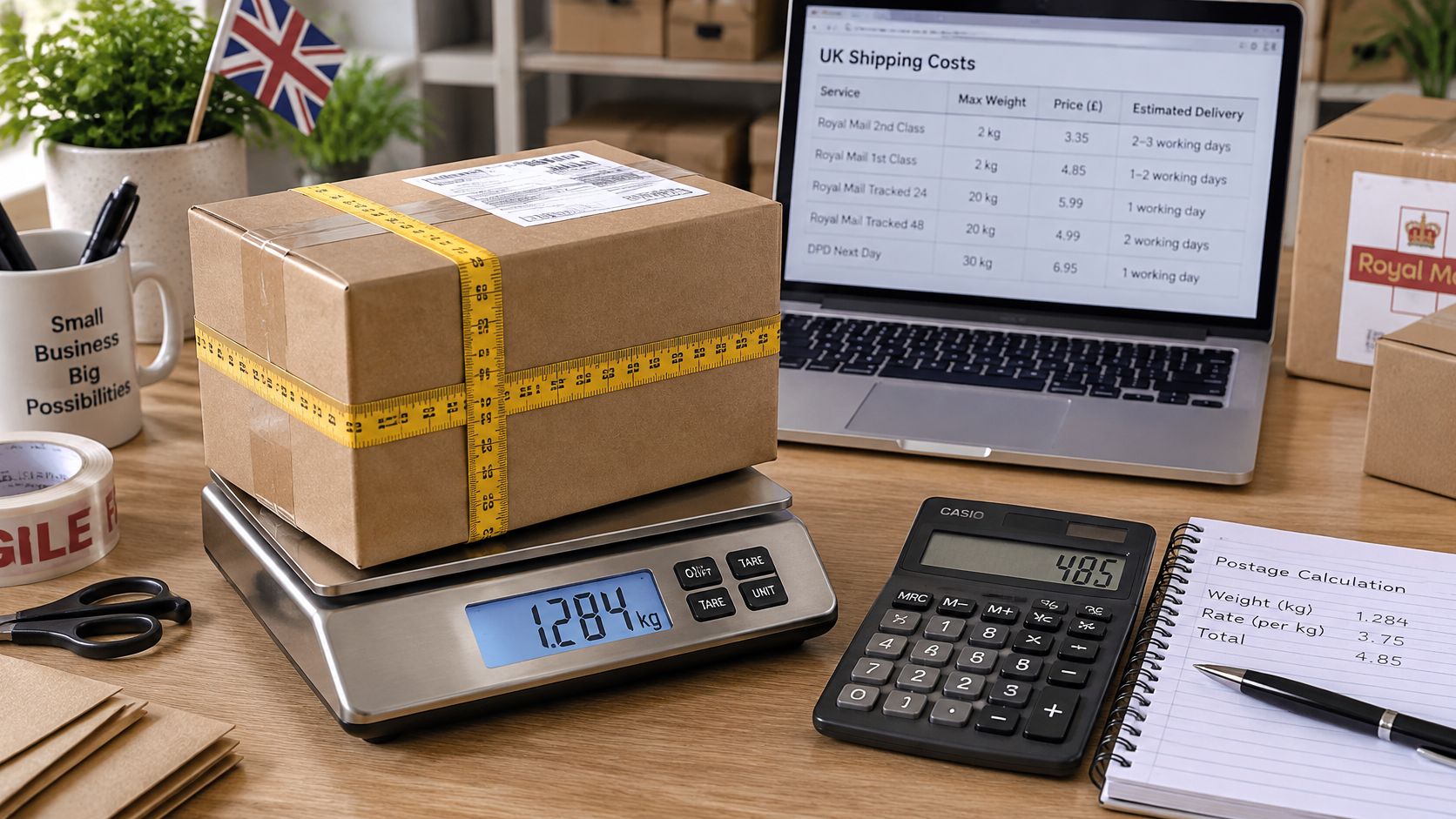
- Check the external dimensions. Royal Mail accepts parcels up to 61 × 46 × 46 cm. Leave tolerance below the limit for manufacturing variation and a closure that bulges around the product. DPD's parcel guidance sets a maximum girth of 3 m and maximum parcel weight of 31.5 kg. Service limits and tariffs vary, so confirm the specification for the service you will use before approving the box. Measure and weigh a packed sample, not an empty carton.
- Prototype the dieline. Cut a plain blank, pack the actual product and close it using the warehouse method.
- Test a realistic distribution sequence. Include handling, stacking, vibration and impacts associated with sorting and transit. A single drop onto concrete does not show how a box will perform through a hub.
A practical pass is straightforward: the packed prototype completes the sequence without a panel rupture, corner collapse, opening or product damage.
Where the reprint usually starts
A common source of rework is specifying internal dimensions when the carrier limit and dieline depend on external dimensions. Board thickness changes the finished measurements, and inserts take up space inside. Miss either detail and the box may cross a size band or fail to close. Use this guide to cardboard box dimensions to align the measurements before the dieline is made.
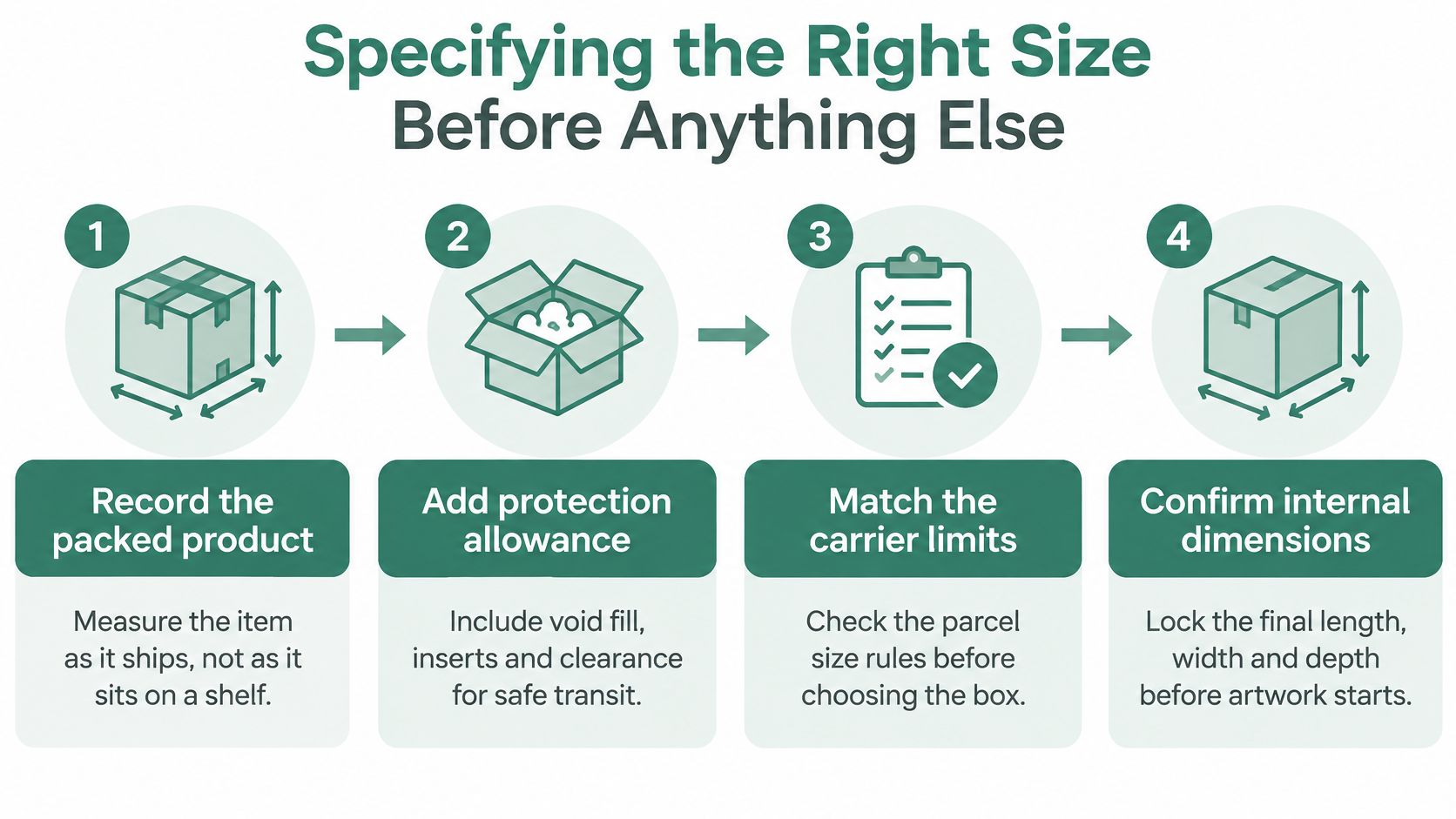
Watch for three failures: a rigid format that exceeds a girth limit, a lid that springs because the product is taller than the internal depth, and a drop test performed on an empty sample. Approve the dieline only after the packed box has passed the checks.
Choosing Board Grades and Print Methods
The cheapest quote is often the wrong board, printed beautifully. Board is what stops crush. Print is what the customer sees. They are bought together, and they should be chosen from the product, not from a supplier's default.
What the board is actually doing
Single-wall board suits apparel, flat cosmetics and other light goods that need a tidy unboxing more than a high stack strength. Double-wall earns its extra weight when the product is heavier, the route is long, or cartons will be stacked in a cage. Flute profile changes the feel as much as the strength. A finer flute, such as E, gives a smoother print face and a slimmer pack. A larger flute, such as B, resists crush better and shows more rib through the ink.
Kraft board takes ink with a warmer, slightly duller result and suits a plain brand. White-coated board makes colour cleaner and is the sensible face for photography or a pale logo. Tell the designer which face they are printing on before they pick colours. Ink that looks crisp on a coated white proof can sink on kraft.
Match grade to the product, not to habit.
- Folded apparel and soft accessories usually sit happily on single-wall with a fine flute.
- Glass, small ceramics and dense kits need double-wall or a tougher flute, plus corner protection, even if the brand wanted a slim mailer.
- Books and flat prints often do better in a shallow mailer than in a deep carton stuffed with void fill.
Print method against run length
Flexographic print suits high-volume, simple colour, often one or two inks, at a lower unit cost once plates exist. Lithographic lamination carries photographic detail and fine type, at the price of an extra material layer that must be thought through for recycling. Digital print suits short runs and versioned artwork without plates. A first order around 500 units is a natural digital job. A repeat running into several thousand units is where flexo, or litho on a stable design, usually wins. For a closer look at when short-run colour makes sense, see digital printing for packaging.
A printed label or stamp on a stock mailer still beats a printed box when the design changes every season, the volume is uneven, or the SKU range is wide. Trade printers who offer custom printing with Simply Merchandise show the same split buyers face here: method follows quantity and artwork complexity, not the other way round.
Board Grades and Print Methods Compared
| Option | Best For | Protection Level | Typical Run Length |
|---|---|---|---|
| Single-wall, fine flute, flexo | Light goods, simple branding | Adequate for soft, low-mass items | Longer repeats once plates exist |
| Single-wall, white face, digital | First orders and versioned art | Same board strength, cleaner colour | Short runs, from a few hundred |
| Litho-laminated mailer | Photo detail and premium unboxing | Depends on the corrugated base | Medium to long, stable artwork |
| Double-wall, limited print | Heavier or fragile goods | Higher crush and corner strength | Any volume where damage cost dominates |
Preparing Artwork and Finishes That Print Cleanly
A file that looks finished on screen often fails on a ribbed surface. Corrugated print hides hairlines, pinches small type, and shifts slightly at the crease. The file has to be built for that, on the approved dieline, not on a flat rectangle.
Files that survive the board
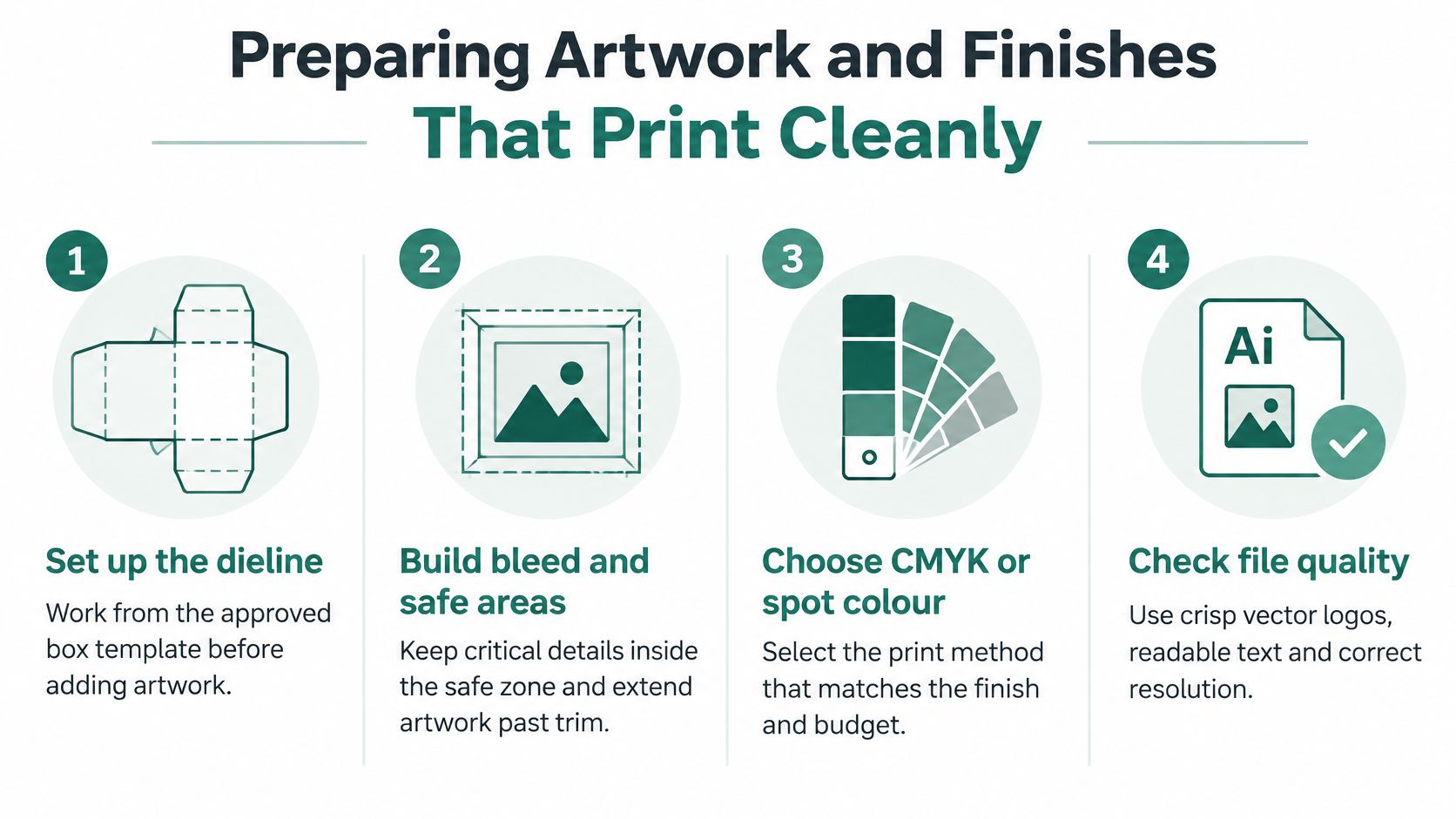
- Set the dieline first. Artwork sits on the supplier's cut and crease template. Panels, tuck flaps and glue areas are not free space.
- Bleed and safe area. Extend colour past the trim, and keep logos, barcodes and legal lines inside the safe zone, clear of creases and locks.
- Colour mode. Build for CMYK unless a specific spot colour has been agreed. Screen RGB will not match the printed board.
- Line weight, type and fonts. Keep strokes heavy enough to hold on flute, outline or embed fonts, and supply logos as vectors.
- Resolution. Photographic elements need to be sized for print, not lifted from a web page.
Ask for a printed or laminated drawdown on the board if the colour is commercially important. A glossy PDF proof will flatter the job.
Finishes and the paper stream
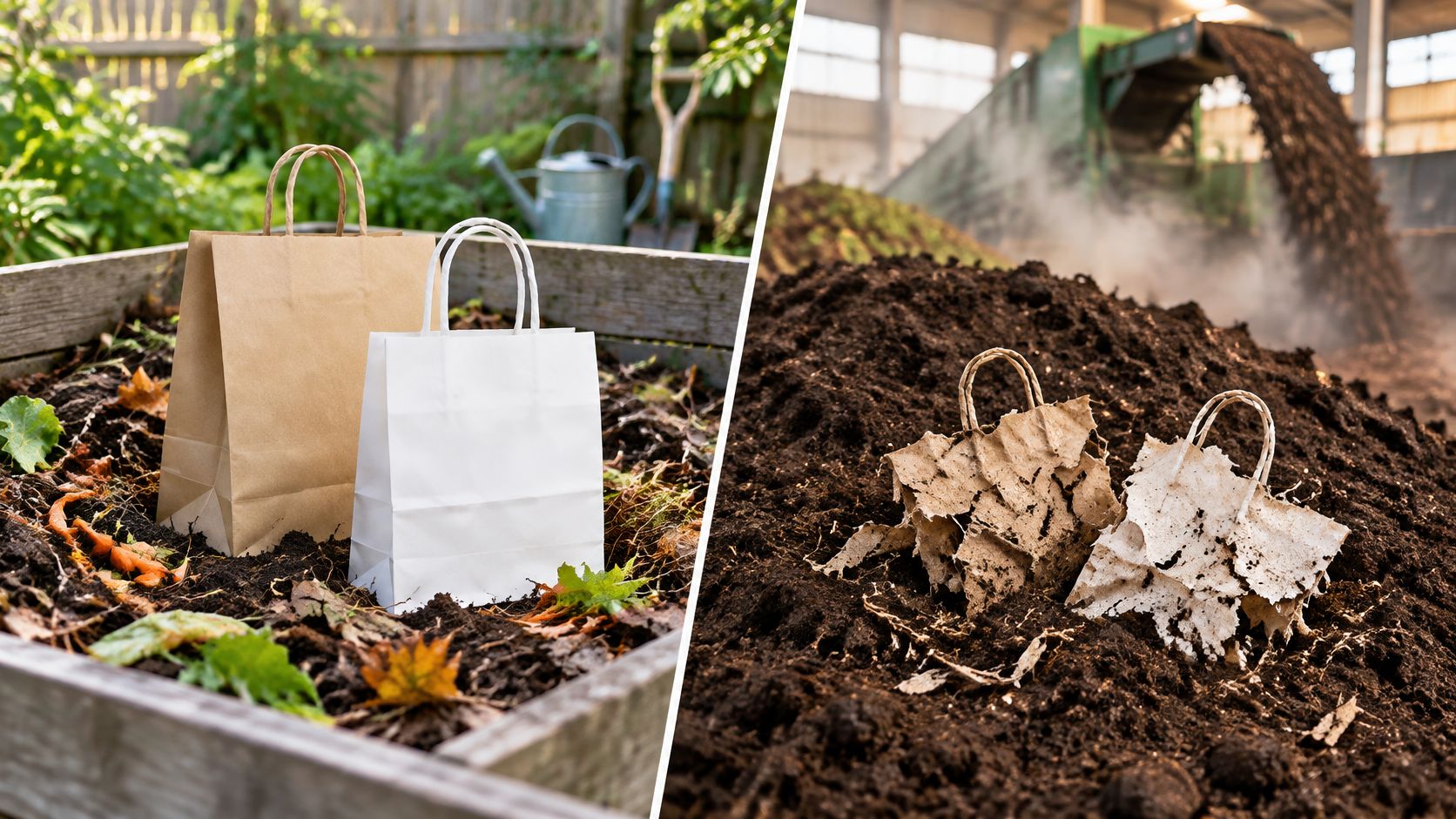
Matt and gloss varnish, water-based coatings, foil and spot UV all change how the box looks under a porch light. They also change how it is assessed at end of life. UK government statistics for 2024 recorded 4.838 million tonnes of paper-and-cardboard packaging waste arising and 4.069 million tonnes recycled, an 84.1% recycling rate, against 73.2% for packaging waste across all materials, as set out in UK statistics on waste. That record is for fibre packaging in general. It doesn't mean a heavily coated or composite mailer will be treated the same as plain board at the kerbside.
The most attractive box isn't automatically the easiest one to recycle. Cutting finishes often does more than adding a recycled-content claim.
From 31 March 2026, waste collectors in England must by default collect paper and card separately from other household waste, alongside food and garden waste, under the simpler recycling rules. That is a practical reason to keep the mailer in the paper-and-card stream. The government's recyclability assessment methodology is specific. Fibre-based composite packaging with no more than 5% plastic by mass can be assessed under the paper-and-board guidance, while more than 5% plastic is assessed as fibre-based composite. An item or component must also measure at least 40 mm in at least two dimensions to pass sortation.
A workable print spec keeps impact without building a puzzle for the sorting plant.
- Prefer uncoated or lightly coated kraft or white board, with water-based inks and coatings.
- Avoid plastic windows, full laminates and heavy foil unless the brand case is strong and the weight is recorded.
- Use removable labels and as little adhesive as the closure needs.
- Keep print coverage purposeful. Logos, instructions and one offer beat an all-over flood that adds ink and little else.
Comparing Your Options for Printed Mailer Boxes
There are three honest routes. The right one depends on volume, how often the size will change, and whether the box itself is part of the brand.
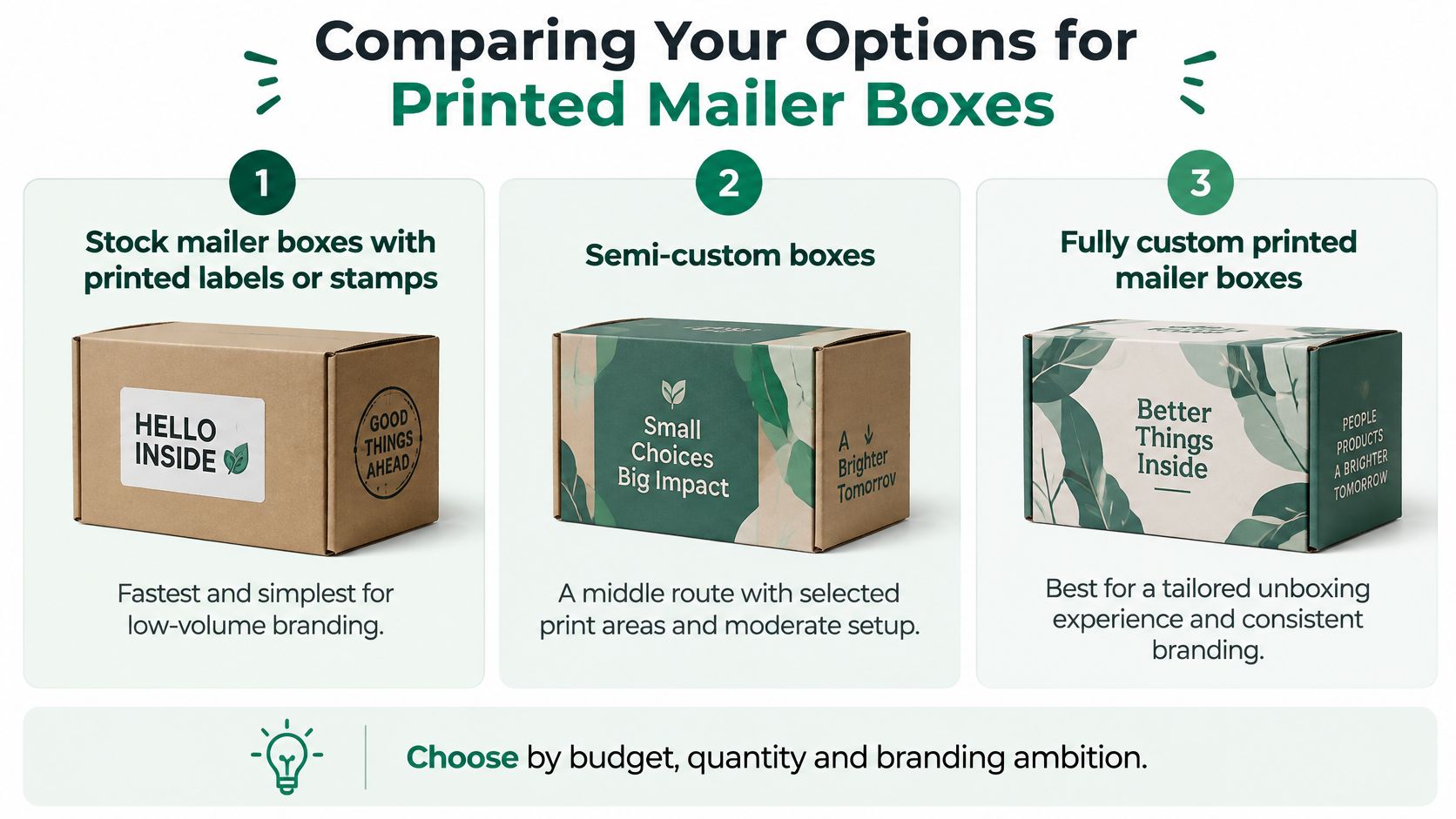
Stock mailers with a label or stamp are the fastest route. Upfront cost is low, there is no plate or custom die, and a size change next month doesn't strand a print run. Brand impact is limited to the label face. This suits a startup working through its first couple of hundred orders, or a range whose dimensions aren't stable yet. A broad wholesale range of Cardboard Boxes, covering single wall, double wall, mailing and storage, with wholesale pricing and free delivery over £150, is the practical shelf for that stage.
Semi-custom means a stock size printed in one or two colours. Tooling is lighter than a bespoke die, lead time sits between stock and fully made-to-order, and the brand is on the board rather than stuck on afterwards. Flexibility drops, because a size change means a new print setup. It fits a growing brand shipping a steady monthly volume on two or three fixed sizes.
Fully bespoke is a custom dieline and multi-colour print. Upfront cost and lead time are highest, and minimums are real, but the pack can match an awkward product and carry a consistent identity inside and out. It makes sense once volumes are predictable enough that a wrong size would be expensive. Packaging Panda's made-to-order service sits in this column: custom sizes and shapes, branded print across boxes, mailers, bags and tubes, minimum runs from 500 units, free delivery on orders over £150, and next-day delivery on orders placed before 2pm.
Which route fits this quarter
Answer these before asking for a bespoke price.
- Is the packed size stable for at least the next few months?
- Will the same artwork be used for the whole run, or does every campaign change the print?
- Is the product light enough for single-wall, or has damage already shown up on stock mailers?
- Is the monthly volume high enough that a lower unit price offsets setup, storage and a slower reorder?
If the size is still moving, stay on labels. If two sizes are locked and the art is simple, semi-custom is usually enough. Full custom printed mailer boxes are the step after that, not the first quote.
Understanding Minimum Runs, Lead Times and Costs
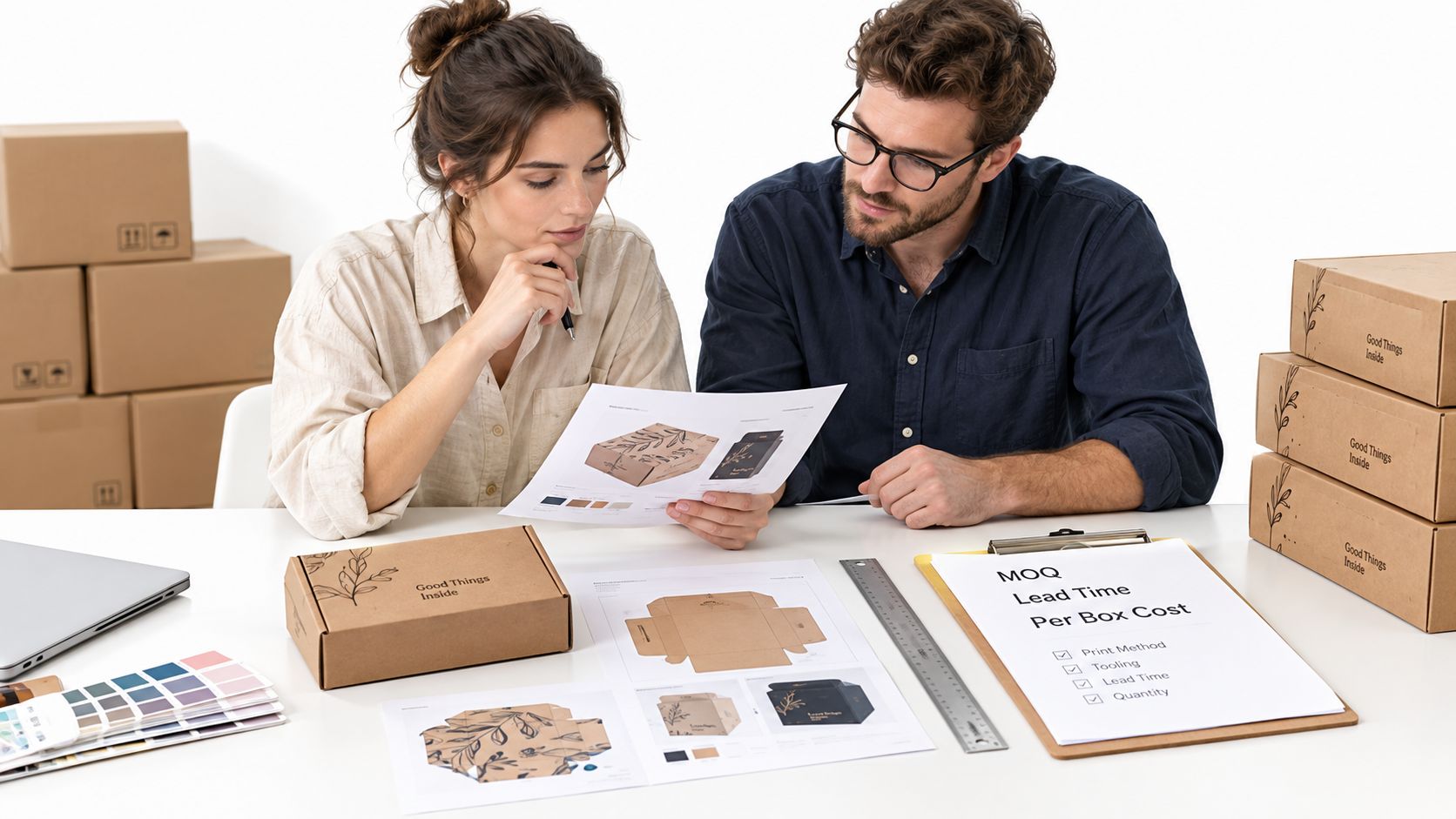
Minimums exist because plates, cutting formes and make-ready time don't shrink with the order. A 500-unit run carries almost the same setup as a much larger one, so the price per box is higher. A 5,000-unit run spreads that setup, which is why volume breaks matter more than the headline unit price on a short quote. How minimum order quantities are set is worth reading before a buyer promises a launch date the print method can't hit.
What stretches the calendar
A bespoke order is a chain, not a single print slot.
- Artwork approval is the stage buyers control. A late file costs a week that no factory can give back.
- Plates or a cutting forme come next on flexo and custom dies. Digital skips plates but not the die if the size is new.
- Printing, die-cutting and gluing follow, and each waits on the one before it.
- Delivery only starts once the glued blanks are packed. A stock box skips most of this list.
Approving artwork against a checked dieline, rather than a screen mock-up, is the reliable way to save time. Chasing the printer after the file is late is not.
Compliance weight, not just unit price
Under the Producer Responsibility Obligations (Packaging and Packaging Waste) Regulations 2024, a business is a large producer when turnover exceeds £2 million and it supplied more than 50 tonnes of packaging in the relevant preceding year. A smaller-producer threshold applies above £1 million turnover and 25 tonnes of packaging. Custom printed mailer boxes count as packaging placed on the UK market. Weights, quantities and material composition have to be recorded, not treated as a branding extra.
The UK extended producer responsibility system also sets a recycling target for paper, board and fibre-based composite packaging of 75% for 2025, rising to 77% in 2026 and 79% in 2027, under the relevant packaging regulations. Coatings, laminates, windows and adhesives can change the material category. A clean board spec makes that calculation easier. Fees are also moving toward recyclability-based modulation from 2026 to 2027, as described in the 2025 base fees publication, so a harder-to-recycle finish can cost more later, not only at the converter.
Cost per successful delivery
A lighter, cheaper box can raise the true cost if it drives refunds, reships and service time. A 2025 survey of 1,000 UK consumers found that 14% had received damaged items, 23.6% reported late deliveries and 17.9% said parcels had been left in insecure locations. Separate UK shopper research in the same source found that 69% had returned an online purchase, with damaged goods among the leading reasons.
Price the box on cost per successful delivery, not cost per empty carton.
Build that figure from unit price, fulfilment labour, damage rate, return postage and replacement value. A small rise in damage can wipe out the saving from a thinner board or a bulk print deal, especially for marketplace sellers on tight margins.
Your Pre-Order Checklist and Next Step
Before a quote goes out, these decisions should already be made.
- Packed size and weight recorded on the actual product, not the shelf item.
- Carrier limits checked for the service that will carry it.
- Board grade matched to weight and fragility.
- Print method chosen for the run length expected, not the run length hoped for.
- Artwork built to the supplier's dieline, with bleed, safe area and the right colour mode.
- Finishes chosen so the box can still sit in the paper-and-card stream.
- Weight and material data captured for packaging records.
Three mistakes sink a first order more often than a bad logo. Internal dimensions get sent instead of external ones. Artwork is signed off before a packed sample is weighed and measured. A print run is ordered before that size has been through the courier network.
The practical next step this week is plain. Order an unprinted sample in the intended size, pack it with the actual product and inserts, weigh and measure the closed box, then send those figures with the quote request. Packaging Panda's bespoke service and its UK buying guides are a sensible place to take a size that has already survived that test.
Packaging Panda supplies UK businesses with mailing, protective and made-to-order packaging, including custom printed mailer boxes from 500 units once the size and board are settled. If the packed sample is weighed and the carrier limit is already checked, that is the right moment to price the print. Visit Packaging Panda to review the range and request a quote from those figures.
Shop This Packaging Range
Wholesale prices, volume discounts and fast UK dispatch.